Life Orientation:
Life Skills
NQF 4
Downloaded from hlayiso.com
Life Orientation NQF Level 4
Skip to contentStudy guide 
View all
LO Life Skills Level 4 Module 12
Level 4 Life Orientation study guide, 45 pages. Read online or get the free PDF download.
Subject: Life OrientationMultiple grades45 pages
Life Orientation. Study guide, 45 pages. Read online or download the PDF.
- Subject
- Life Orientation
- Grade
- Multiple grades
- Document type
- Study guide
- Curriculum
- TVET
- Pages
- 45
- File size
- 2.6 MB
Loading document…
Loading document…
1 of 45
Document textSearch extracted text and jump to a page.
Explore ways to
deal with the
infringement
of workers’
rights & settle
labour disputes
Module 12
Downloaded from hlayiso.com
*see terms and conditions
Think about it…
• What is the key ingredient in a good
working relationship between employers
& employees?
• What is the difference between dismissal
& retrenchment?
• Can workers strike whenever they feel it
is justified?
Downloaded from hlayiso.com
Unit 12.1
Workers’ grievances
& the CCMA
Downloaded from hlayiso.com
Life Orientation NQF Level 4
What is a grievance?
• A legitimate reason
for laying a formal
complaint at work
• It may be an
infringement
against rights Figure 12.1: Sexual
• It is not about demands reported as a grievance
harassment needs to be
but rather about raising
awareness regarding a
serious Downloaded
issue. from hlayiso.com
Grievance & complaints procedures
• Stage 1: Direct
reporting
• Stage 2: Grievance
investigation &
meeting
• Stage 3: Grievance
hearing Figure 12.3: If necessary, witnesses may
be present at the grievance meeting
• Stage 4: External
dispute resolution.
Downloaded from hlayiso.com
Mathematics NQF Level 2
Click above to play this video.
Downloaded from hlayiso.com
Learning activity 12.1
Module 12
Test your knowledge of this section by completing Learning activity 12.1 in your
Student’s Book.
Downloaded from hlayiso.com
Life Orientation NQF Level 4
What is the CCMA?
• CCMA = Commission for Conciliation
Mediation and Arbitration
• In existence because of the Labour
Relations Act
• Not linked to trade unions, businesses
or political parties
• Assists workers only after internal
negotiations with the employer have
failed.
Downloaded from hlayiso.com
Negotiation
• Discussion between employer
& employee(s)
• Try to compromise to resolve the issue
• Formal negotiations may include
representation by skilled negotiator(s).
Downloaded from hlayiso.com
Conciliation & dispute resolution
• Conciliation = an
independent mediator
calms down people
involved in a dispute
• Dispute = disagreement
• Dispute resolution needed
if grievance isn’t resolved
• If all internal attempts fail,
you can involve the CCMA.
Downloaded from hlayiso.com
Mediation & arbitration
• Mediation = when a mediator becomes
involved in a dispute, but doesn’t take
sides or force a solution.
• Arbitration:
If mediation & conciliation fail
Third party (e.g. CCMA) makes judgement
& tells two parties what to do.
Downloaded from hlayiso.com
Litigation
• Litigation = bringing a
lawsuit against
someone or
challenging a lawsuit.
• CCMA can give legal
advice, but won’t get
involved:
In civil lawsuits
Figure 12.6: The CCMA
Where the law has won’t become involved if
been broken. the case is about someone
who broke the law
Downloaded from hlayiso.com
Bargaining councils
• One or more registered trade unions
join bargaining councils to:
Negotiate agreements for groups
of workers
Prevent & resolve labour disputes.
• May inspect the workplace
& investigate complaints.
• If they cannot resolve a dispute, they
may appoint an arbitrator or go to the
CCMA. Downloaded from hlayiso.com
Workplace forums
• Employer & employees make joint
decisions about work issues
• A trade union applies to the CCMA to
start a workplace forum
• A workplace forum:
Can’t negotiate wages or industrial action
Promotes interests of all employees.
Downloaded from hlayiso.com
The CCMA’s conciliation procedure
• Step 1: Refer the case to the CCMA.
• Step 2: Attend the conciliation hearing.
• Step 3: Participate in the hearing.
• Step 4: Reach a settlement agreement.
• Step 5: Uphold the agreement, or
proceed to a further stage.
• Step 6: Request arbitration.
Downloaded from hlayiso.com
The CCMA’s conciliation procedure
Refer to Table 12.1 in
your Student’s Book to
see criteria for referring
a case to the CCMA.
Downloaded from hlayiso.com
Learning activity 12.2
Module 12
Test your knowledge of this section by completing Learning activity 12.2 in your
Student’s Book.
Downloaded from hlayiso.com
Life Orientation NQF Level 4
Disputes handled by the
Department of Labour
• All pay-related complaints, such as:
Working overtime without pay
Being paid less than agreed
Not being paid for leave days.
Downloaded from hlayiso.com
Disputes handled by the
Department of Labour
• To lodge a labour complaint:
Complete the form at one of the
department’s offices.
An inspector visits your workplace.
A compliance order is issued if your
employer is found guilty.
If your employer won’t pay, the case will
go to the Labour Court.
Downloaded from hlayiso.com
Disputes handled by the CCMA
Issues about the employment
relationship, for instance:
• Unfair dismissal
• Working conditions
• Discrimination
• Changes in the workplace
• Retrenchment
• Sexual harassment.
Downloaded from hlayiso.com
Learning activity 12.3
Module 12
Test your knowledge of this section by completing Learning activity 12.3 in your
Student’s Book.
Downloaded from hlayiso.com
Life Orientation NQF Level 4
Unit 12.2
Unfair dismissal
& retrenchment
Downloaded from hlayiso.com
Life Orientation NQF Level 4
Fair dismissal
Dismissal is considered fair if:
• There is serious employee misconduct
(e.g. theft).
• The employee performs poorly or
isn’t able to work (e.g. prolonged illness).
• The employer’s operational requirements
change (e.g. restructuring).
Downloaded from hlayiso.com
Unfair dismissal
According to Chapter 8 of the Labour
Relations Act, unfair dismissal includes:
• Where process isn’t followed properly
• Discrimination
• Infringement of workers’ rights.
Downloaded from hlayiso.com
Procedure to follow
for unfair dismissal
• Stage 1: Referral (to relevant council
or the CCMA)
• Stage 2: Conciliation
• Stage 3: Arbitration (judgement by
third party) or adjudication
(legal decision).
Downloaded from hlayiso.com
Procedure to follow
for unfair dismissal
• Stage 4: Remedy
• If dismissal is unfair:
You may be reinstated or re-employed
by the employer.
You may be paid compensation.
Downloaded from hlayiso.com
Procedure to follow
for unfair dismissal
Refer to Table 12.2 in
your Student’s Book to
see types of unresolved
unfair dismissal disputes
that can be referred for
arbitration or adjudication.
Downloaded from hlayiso.com
Mathematics NQF Level 2
Click above to play this video.
Downloaded from hlayiso.com
Learning activity 12.4
Module 12
Test your knowledge of this section by completing Learning activity 12.4 in your
Student’s Book.
Downloaded from hlayiso.com
Life Orientation NQF Level 4
Retrenchment
• Retrenchment = cut back on staff.
• An employer may retrench legally if the
needs of the business have changed.
• Retrenchment may occur if there are
changes to the:
Economy
Technology
Structure.
Downloaded from hlayiso.com
Procedure to follow
if you are retrenched
• Ensure that your dismissal is fair.
• If you think your dismissal is unfair,
consult a workplace forum, trade union
or labour lawyer.
• If your retrenchment is unfair, you can
lodge a complaint with the CCMA.
• You must receive severance pay.
Downloaded from hlayiso.com
Coping with retrenchment
• Uphold your
self-esteem.
• Stay positive.
• Reassess your
skills base.
• Stay humble.
• Keep a check on
your finances.
Downloaded from hlayiso.com
Learning activity 12.5
Module 12
Test your knowledge of this section – and think of ways to use your skills – by
completing Learning activity 12.5 in your Student’s Book.
Downloaded from hlayiso.com
Life Orientation NQF Level 4
Unit 12.3
Strike action & unions
Downloaded from hlayiso.com
Life Orientation NQF Level 4
Strike action
• SA Constitution allows for legal strikes
& trade unions
• Strike = workers organise & refuse to
work to protest something (e.g. wages)
• Usually organised by trade unions
• In certain circumstances, employers
can lock workers out.
Downloaded from hlayiso.com
Correct procedure for strike action
• Ensure that strike or lockout is legal
• Ensure workers know what to expect
• Give notice of strike action.
Figure 12.18: The Constitution allows peaceful, non-violent protest action.
Section 17 states: “Everyone has the right, peacefully and unarmed,
to assemble, to demonstrate, to picket and to present petitions”
Downloaded from hlayiso.com
Correct procedure for strike action
• Prescribed procedures don’t apply if:
The employer locks out employees staging
an illegal strike.
Workers strike in response to an illegal
lockout.
An employer changed workers’ working
conditions without consulting them.
• Detailed records must be kept.
• Workers can strike in support of a legal
strike byDownloaded
another group of employees.
from hlayiso.com
Learning activity 12.6
Module 12
Test your knowledge of this section – and find out more about secondary strikes
– by completing Learning activity 12.6 in your Student’s Book.
Downloaded from hlayiso.com
Life Orientation NQF Level 4
Benefits of belonging to a union
• Union can raise concerns with
employers.
• Unions can represent you in grievance
meetings & disciplinary hearings.
• You have help protecting your rights.
Downloaded from hlayiso.com
Benefits of belonging to a union
• Unions can monitor whether an
employer obeys labour law.
• Unions can enter into collective
agreements.
• Unions can form a bargaining council
with the employer’s organisation.
Downloaded from hlayiso.com
Mathematics NQF Level 2
Click above to play this video.
Downloaded from hlayiso.com
Learning activity 12.7
Module 12
Test your knowledge of this unit – and find out more about the trade union for
your profession – by completing Learning activity 12.7 in your Student’s Book.
Downloaded from hlayiso.com
Life Orientation NQF Level 4
Summative assessment
Module 12
Test your knowledge of this module by completing the Summative assessment
of Module 12 in your Student’s Book.
Downloaded from hlayiso.com
Life Orientation NQF Level 4
Mathematics NQF Level 2
Downloaded from hlayiso.com
Life Orientation (Life Skills) NQF Level 4
Study this subject
Notes, quizzes and topic questions for this subject.
Recommended for this subject
More papers and memos for this grade and subject.
Study guide
L2 Life Orientation Fire Safety Measures
Study guide
L2 Life Orientation Module 11 Human Rights Responsibilities
Study guide
L2 Life Orientation Module 12 Ethical Behaviour
Study guide
L2 Life Orientation Module 3 Time Management
Study guide
L2 Life Orientation Module 4 Positive Relationships
Study guide
L2 Life Orientation Module 5 How your brain works in terms of learning
Related documents
Study guide
L2 Life Orientation Module 6 Study Groups Timetables and Plans
Study guide
L2 Life Orientation Module 7 Balanced Lifestyle
Study guide
L2 Life Orientation Module 8 Effects of substance abuse
Study guide
L2 Life Orientation Module 8 Substance Abuse
Study guide
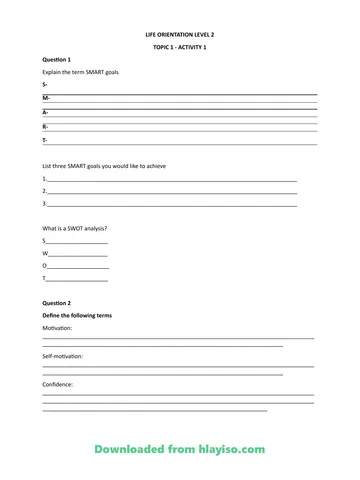
L2 Life Orientation Topic 1 Activity 1
Study guide