
Downloaded from hlayiso.com
NATIONAL
SENIOR CERTIFICATE
GRADE 12
PHYSICAL SCIENCES: CHEMISTRY (P2)
NOVEMBER 2023
MARKS: 150
TIME: 3 hours
This question paper consists of 16 pages and 4 data sheets.
Copyright reserved Please turn over
You're offline
Skip to contentQuestion paper 
View all
Physical Sciences P2 Nov 2023 Eng_hlayiso.com_.pdf
Physical Sciences · Grade 12 · NSC November Exam · 2023. Question paper, 20 pages. Read online or download the PDF.
- Subject
- Physical Sciences
- Grade
- Grade 12
- Document type
- Question paper
- Year
- 2023
- Exam period
- NSC November Exam
- Paper
- 2
- Pages
- 20
- File size
- 1.5 MB
Loading document…
Loading document…
1 of 20
Document textSearch extracted text and jump to a page.
Downloaded from hlayiso.com
Physical Sciences/P2 2 DBE/November 2023
NSC
INSTRUCTIONS AND INFORMATION
1. Write your centre number and examination number in the appropriate spaces
on the ANSWER BOOK.
2. This question paper consists of NINE questions. Answer ALL the questions in
the ANSWER BOOK.
3. Start EACH question on a NEW page in the ANSWER BOOK.
4. Number the answers correctly according to the numbering system used in this
question paper.
5. Leave ONE line between two subquestions, e.g. between QUESTION 2.1 and
QUESTION 2.2.
6. You may use a non-programmable calculator.
7. You may use appropriate mathematical instruments.
8. Show ALL formulae and substitutions in ALL calculations.
9. Round off your FINAL numerical answers to a minimum of TWO decimal
places.
10. Give brief motivations, discussions, etc. where required.
11. You are advised to use the attached DATA SHEETS.
12. Write neatly and legibly.
Copyright reserved Please turn over
Downloaded from hlayiso.com
Physical Sciences/P2 3 DBE/November 2023
NSC
QUESTION 1: MULTIPLE-CHOICE QUESTIONS
Various options are provided as possible answers to the following questions.
Each question has only ONE correct answer. Choose the answer and write only the
letter (A–D) next to the question numbers (1.1 to 1.10) in the ANSWER BOOK,
e.g. 1.11 E.
1.1 Which ONE of the following represents a straight chain SATURATED
hydrocarbon?
A C5H8
B C5H10
C C6H12
D C6H14 (2)
1.2 Which ONE of the following is a SECONDARY alcohol?
A C(CH3)3OH
B CH3(CH2)3OH
C CH3(CH2)2CHO
D CH3CH2CH(OH)CH3 (2)
1.3 Which ONE of the following is a HYDROLYSIS reaction?
A CH3CH2Br + H2O CH3CH2OH + HBr
B CH3CH2OH + HBr CH3CH2Br + H2O
C CH2CH2 + H2O CH3CH2OH
D CH2CH2 + H2 CH3CH3 (2)
Copyright reserved Please turn over
Downloaded from hlayiso.com
Physical Sciences/P2 4 DBE/November 2023
NSC
1.4 Hydrochloric acid reacts with EXCESS zinc:
Zn(s) + 2HCℓ(aq) → ZnCℓ2(aq) + H2(g)
Different reaction conditions are shown in the diagrams below. The mass of
zinc used is the same in both test tubes.
Test tube X Test tube Y
100 cm3
0,1 mol∙dm-3 HCℓ(aq) 200 cm3
0,1 mol∙dm-3 HCℓ(aq)
Zn powder Zn lumps
How will the INITIAL rate of reaction and FINAL VOLUME of H 2(g) produced
in test tube Y compare with that in test tube X?
INITIAL RATE OF FINAL VOLUME
REACTION IN Y OF H2(G) IN Y
A Higher Equal
B Lower More
C Lower Equal
D Higher More (2)
Copyright reserved Please turn over
Downloaded from hlayiso.com
Physical Sciences/P2 5 DBE/November 2023
NSC
1.5 The diagram below represents a mixture of NO2(g) and N2O4(g) molecules at
equilibrium in a 1 dm3 container at T °C.
KEY
NO2
N2O4
The balanced equation for this reaction is:
2NO2(g) ⇌ N2O4(g)
Which ONE of the following is TRUE for the value of the equilibrium constant,
Kc, for the reaction at T °C?
A Kc = 24
B Kc > 1
C Kc = 1
D 0 < Kc < 1 (2)
1.6 A reaction is at equilibrium in a closed container according to the following
balanced equation:
4CuO(s) ⇌ 2Cu2O(s) + O2(g)
The volume of the container is now increased while the temperature remains
constant. A new equilibrium is reached.
Which ONE of the following combinations is CORRECT for the new
equilibrium?
CONCENTRATION NUMBER of EQUILIBRIUM
OF O2 MOLES OF O2 CONSTANT (Kc)
A Decreases Remains the same Increases
B Remains the same Decreases Remains the same
C Remains the same Increases Remains the same
D Decreases Increases Remains the same
(2)
Copyright reserved Please turn over
Downloaded from hlayiso.com
Physical Sciences/P2 6 DBE/November 2023
NSC
1.7 Nitric acid, HNO3(aq), and ethanoic acid, CH3COOH(aq), of equal volumes
and concentrations are compared.
Consider the following statements regarding these solutions:
(i) They have different pH values.
(ii) Both have the same electrical conductivity.
(iii) Both solutions require the same number of moles of KOH(aq) for
complete neutralisation.
Which of the above statement(s) is/are TRUE?
A (i) only
B (i) and (ii) only
C (i) and (iii) only
D (ii) and (iii) only (2)
1.8 The apparatus in the diagram below is used for the titration between HCℓ(aq)
and KOH(aq).
HCℓ(aq)
Titration mixture
In a titration, the learner accidentally exceeds the endpoint. Which ONE of the
following will be TRUE for the titration mixture?
A [H+] > [OH−] and pH < 7
B [H+] < [OH−] and pH < 7
C [H+] < [OH−] and pH > 7
D [H+] > [OH−] and pH > 7 (2)
Copyright reserved Please turn over
Downloaded from hlayiso.com
Physical Sciences/P2 7 DBE/November 2023
NSC
1.9 The following hypothetical standard reduction potentials relate to a galvanic
cell:
X2+(aq) + 2e → X(s) EƟ = +0,10 V
Y+(aq) + e → Y(s) EƟ = –0,10 V
Consider the following statements for this galvanic cell:
(i) The emf of the cell is 0,20 V under standard conditions.
(ii) Electrode Y is the anode.
(iii) X is oxidised.
Which of the above statement(s) is/are TRUE for this galvanic cell?
A (i) only
B (i) and (ii) only
C (i) and (iii) only
D (ii) and (iii) only (2)
1.10 Which ONE of the half-reactions below will be the MAIN reaction at the
ANODE during the electrolysis of CONCENTRATED CuCℓ2(aq)?
A Cu2+(aq) + 2e → Cu(s)
−
B 2H2O(ℓ) + 2e → H2(g) + 2OH (aq)
C 2H2O(ℓ) → O2(g) + 4H+(aq) + 4e
−
D 2Cℓ (aq) → Cℓ2(g) + 2e (2)
[20]
Copyright reserved Please turn over
Downloaded from hlayiso.com
Physical Sciences/P2 8 DBE/November 2023
NSC
QUESTION 2 (Start on a new page.)
The letters A to H in the table below represent eight organic compounds.
A Heptanoic acid B CH3(CH2)3COOCH3
C 4-ethyl-3,3-difluorohexane D Hexanoic acid
CH2 O
E CH3 CH C CH3 F CH3 CH C CH2 CH3
CH3 CH3
CH3
H H O H
CH3 C CH2 CH3
G H H C C C C H
C O
H H H
H O
2.1 Define the term organic compound. (1)
2.2 Write down the IUPAC name of compound:
2.2.1 E (2)
2.2.2 H (2)
2.3 Write down the:
2.3.1 STRUCTURAL formula of compound B (2)
2.3.2 STRUCTURAL formula of compound C (3)
2.3.3 General formula of the homologous series to which compound E
belongs (1)
2.3.4 STRUCTURAL formula of the FUNCTIONAL group of compound F (1)
2.3.5 IUPAC name of the alcohol needed to produce compound B (2)
2.4 Write down the letter(s) of the compound(s) that:
2.4.1 Is a FUNCTIONAL isomer of compound G (1)
2.4.2 Are CHAIN isomers of each other (1)
[16]
Copyright reserved Please turn over
Downloaded from hlayiso.com
Physical Sciences/P2 9 DBE/November 2023
NSC
QUESTION 3 (Start on a new page.)
The relationship between boiling point and the molecular mass of aldehydes,
carboxylic acids and primary alcohols is investigated. Curves P, R and S are obtained.
All compounds used are straight chain molecules.
GRAPH OF BOILING POINT VERSUS MOLECULAR MASS
250
P
200
R
Boiling point (°C)
GRAPH OF BOILING POINT VERSUS MOLECULAR MASS
S
150
100
50
0
30 50 70 90 110 130
Molecular mass (g·mol-1)
3.1 Define the term boiling point. (2)
3.2 Write down the conclusion that can be made for curve P. (2)
3.3 Explain the answer to QUESTION 3.2 in terms of the structures of the
compounds. (2)
3.4 Curve R represents the alcohols.
3.4.1 Which homologous series is represented by curve S? (1)
3.4.2 Explain the answer to QUESTION 3.4.1 by referring to the strength
of intermolecular forces. (2)
Copyright reserved Please turn over
Downloaded from hlayiso.com
Physical Sciences/P2 10 DBE/November 2023
NSC
3.5 For curve R, write down the:
3.5.1 Molecular mass of the compound with a boiling point of 97 °C (1)
3.5.2 IUPAC name of the compound in QUESTION 3.5.1 (2)
3.6 Two compounds, A and B, used in this investigation have a molecular mass
of 74 g∙mol-1. A has a boiling point of 118 °C and B a boiling point of 142 °C.
Explain the difference in these boiling points by referring to the structures of
these compounds. (3)
[15]
Copyright reserved Please turn over
Downloaded from hlayiso.com
Physical Sciences/P2 11 DBE/November 2023
NSC
QUESTION 4 (Start on a new page.)
4.1 Consider the cracking reaction below.
C16H34 C6H14 + C6Hx + 2CyHz
4.1.1 Define cracking. (2)
4.1.2 Write down the values represented by x, y and z in the equation
above. (3)
Compound C6H14 undergoes complete combustion.
4.1.3 Using MOLECULAR FORMULAE, write down the balanced
equation for this reaction. (3)
4.2 Consider the equations for reactions I to III below.
A and B represent organic compounds that are POSITIONAL ISOMERS.
X is an inorganic product.
I CH3CH2CHCHCH3 + HCℓ A + B
H2O
II A CH3CH2CH2CH(OH)CH3 + X
Δ
III CH3CH2CH2CH(OH)CH3 CH3CH2CHCHCH3 + H2O
Write down the:
4.2.1 Definition of positional isomers (2)
4.2.2 Type of reaction represented by reaction I (1)
4.2.3 STRUCTURAL formula of compound B (3)
4.2.4 Formula of X (1)
4.2.5 Inorganic reagent for reaction lll (1)
Compound A can be converted directly to the organic product of reaction lll.
4.2.6 Besides heat, write down the reaction condition needed for this
conversion. (1)
4.2.7 Write down TWO terms that describe this type of reaction. (2)
[19]
Copyright reserved Please turn over
Downloaded from hlayiso.com
Physical Sciences/P2 12 DBE/November 2023
NSC
QUESTION 5 (Start on a new page.)
The reaction between EXCESS dilute hydrochloric acid and sodium thiosulphate is
used to investigate factors that influence reaction rate.
Na2S2O3(aq) + 2HCℓ(aq) → 2NaCℓ(aq) + S(s) + H2O(ℓ) + SO2(g)
The concentration of HCℓ(aq) used is 1 mol·dm-3. The same volume of HCℓ(aq) is used
in each run.
The time taken for the cross on the paper under the flask to become invisible is
measured.
Flask
Na2S2O3(aq) + HCℓ(aq)
White paper
The table below summarises the reaction conditions and results of the experiment.
VOLUME VOLUME H2O(ℓ) CONCENTRATION
TIME
RUN Na2S2O3(aq) ADDED Na2S2O3(aq)
(s)
(cm3) (cm3) (mol·dm-3)
1 50 0 0,13 20,4
2 40 10 0,10 26,7
3 30 20 P 33,3
5.1 Define reaction rate. (2)
5.2 Write down the independent variable for this investigation. (1)
5.3 Calculate the value of P in the table. (3)
5.4 When 0,21 g of sulphur has formed in Run 1, the cross becomes invisible.
Calculate the average reaction rate with respect to sodium thiosulphate,
Na2S2O3(aq), in g·s-1. (5)
Another investigation is performed at different temperatures.
5.5 Sketch the Maxwell-Boltzmann distribution curve for the reaction at 20 °C.
Label this curve as A. On the same set of axis, draw the curve that will be
obtained at 35 °C and label it as B. (4)
5.6 Explain the effect of temperature on reaction rate in terms of the collision
theory. (4)
[19]
Copyright reserved Please turn over
Downloaded from hlayiso.com
Physical Sciences/P2 13 DBE/November 2023
NSC
QUESTION 6 (Start on a new page.)
Consider the following hypothetical reaction reaching equilibrium in a 4 dm3 closed
container at 150 °C.
2AB(g) ⇌ A2(g) + B2(g)
The graph below shows the changes in the amounts of reactants and products over
time.
14
AB(g)
12
Number of moles (mol)
10
8 A2(g)
6
4
2
B2(g)
0 20 40 60 80 100 120 140 160 Time (s)
6.1 Write down the meaning of the term reversible reaction. (1)
6.2 State Le Chatelier's principle. (2)
6.3 A change was made to the equilibrium mixture at t = 80 s.
6.3.1 Write down the change made at t = 80 s. (1)
6.3.2 Use Le Chatelier's principle to explain how the system reacts to
this change. (2)
6.4 Calculate the equilibrium constant, Kc, at t = 120 s. (4)
6.5 At t = 130 s the temperature of the system is decreased to 100 °C.
6.5.1 Draw a potential energy diagram for this reaction. (3)
6.5.2 Will the equilibrium constant, Kc, at 100 °C be GREATER THAN,
LESS THAN or EQUAL TO the Kc at 150 °C? Explain the answer. (3)
6.6 The initial reaction now takes place in the presence of a catalyst at 150 °C.
Describe the changes that will be observed on the graph between t = 0 s and
t = 60 s. (3)
[19]
Copyright reserved Please turn over
Downloaded from hlayiso.com
Physical Sciences/P2 14 DBE/November 2023
NSC
QUESTION 7 (Start on a new page.)
To identify metal M in an unknown metal carbonate, MCO3, the following procedure is
carried out:
Step 1: 0,198 g of IMPURE MCO3 is reacted with 25 cm3 of 0,4 mol∙dm-3 nitric acid,
HNO3(aq).
Step 2: The EXCESS HNO3(aq) is then neutralised with 20 cm3 of 0,15 mol∙dm-3 barium
hydroxide, Ba(OH)2(aq).
Assume that the volumes are additive.
The following reactions take place:
2HNO3(aq) + MCO3(s) → M(NO3)2(aq) + CO2(g) + H2O(ℓ)
2HNO3(aq) + Ba(OH)2(aq) → Ba(NO3)2(aq) + 2H2O(ℓ)
7.1 Define the term strong base. (2)
7.2 Calculate the:
7.2.1 Number of moles of Ba(OH)2(aq) that reacted with the excess
HNO3(aq) (3)
7.2.2 pH of the solution after Step 1 (5)
7.3 The percentage purity of the MCO3(s) in the sample is 85%. Identify metal M. (8)
[18]
Copyright reserved Please turn over
Downloaded from hlayiso.com
Physical Sciences/P2 15 DBE/November 2023
NSC
QUESTION 8 (Start on a new page.)
A cleaned pure copper strip, Cu(s), is placed in a beaker containing a colourless
silver nitrate solution, AgNO3(aq), at 25 °C, as shown below.
AgNO3(aq) Copper strip
After a while, it is observed that the solution in the beaker becomes blue.
8.1 Write down:
8.1.1 ONE other OBSERVABLE change, besides the solution turning
blue (1)
8.1.2 The NAME or FORMULA of the oxidising agent (1)
8.2 Explain the answer to QUESTION 8.1.1 by referring to the relative strengths
of the oxidising agents or reducing agents. (3)
A galvanic cell is now set up using Cu and Ag strips as electrodes. A simplified
diagram of the cell is shown below.
V
A(s)
B Ag+(aq)
8.3 Write down the:
8.3.1 NAME or FORMULA of electrode A (1)
8.3.2 NAME or FORMULA of solution B (1)
8.3.3 Overall (net) balanced equation for the cell reaction (3)
8.4 The salt bridge contains potassium nitrate, KNO3(aq).
Write down the FORMULA of the ion in the salt bridge that will move
into the silver ion solution. Choose from K+(aq) or NO (aq).
Give a reason for the answer. (2)
[12]
Copyright reserved Please turn over
Downloaded from hlayiso.com
Physical Sciences/P2 16 DBE/November 2023
NSC
QUESTION 9 (Start on a new page.)
An electrolytic cell is set up to purify a piece of copper that contains silver and zinc as
impurities. A simplified diagram of the cell is shown below. Electrode R is impure
copper.
Power
source
Electrode Q Electrode R
Electrolyte Silver
9.1 Define the term electrolysis. (2)
9.2 Write down the reaction taking place at electrode Q. (2)
9.3 In which direction do the electrons flow in the external circuit? Choose from
Q to R or R to Q. (1)
9.4 Calculate the current needed to form 16 g of copper when the cell operates
for five hours. (5)
9.5 During this electrolysis, only copper and zinc are oxidised.
Give a reason why the silver is not oxidised. (2)
[12]
TOTAL: 150
Copyright reserved
Downloaded from hlayiso.com
Physical Sciences/P2 1 DBE/November 2023
NSC
DATA FOR PHYSICAL SCIENCES GRADE 12
PAPER 2 (CHEMISTRY)
GEGEWENS VIR FISIESE WETENSKAPPE GRAAD 12
VRAESTEL 2 (CHEMIE)
TABLE 1: PHYSICAL CONSTANTS/TABEL 1: FISIESE KONSTANTES
NAME/NAAM SYMBOL/SIMBOOL VALUE/WAARDE
Standard pressure
p 1,013 x 105 Pa
Standaarddruk
Molar gas volume at STP
Vm 22,4 dm3∙mol-1
Molêre gasvolume by STD
Standard temperature
Standaardtemperatuur T 273 K
Charge on electron
e -1,6 x 10⁻¹⁹ C
Lading op elektron
Avogadro's constant
NA 6,02 x 10²³ mol-1
Avogadro-konstante
TABLE 2: FORMULAE/TABEL 2: FORMULES
m N
n= n=
N
n m
c= or/of c= n=
m
a a na
pH = -log[H3O+]
n
Kw = [H3O+][OH-] = 1 x 10-14 at/by 298 K
Eθcell Eθcathode Eθanode / Eθsel Ekatode
θ
Eθanode
or/of
Eθcell Ereduction
θ
Eθoxidation / Eθsel Ereduksie
θ
Eθoksidasie
or/of
Eθcell Eθoxidisingagent Ereducing
θ
agent / E sel Eoksideermiddel Ereduseermiddel
θ θ θ
n= where n is the number of electrons/
I= qe waar n die aantal elektrone is
Copyright reserved Please turn over
Downloaded from hlayiso.com
Physical Sciences/P2 2 DBE/November 2023
NSC
TABLE 3: THE PERIODIC TABLE OF ELEMENTS
TABEL 3: DIE PERIODIEKE TABEL VAN ELEMENTE
1 2 3 4 5 6 7 8 9 10 11 12 13 14 15 16 17 18
(I) (II) (III) (IV) (V) (VI) (VII) (VIII)
Atomic number
1 KEY/SLEUTEL Atoomgetal 2
2,1 H He
1 29 4
3 4 Electronegativity Symbol 5 6 7 8 9 10
1,0 1,5 1,9 Cu 2,0 2,5 3,0 3,5 4,0
Li Be Elektronegatiwiteit
63,5
Simbool B C N O F Ne
7 9 11 12 14 16 19 20
11 12 13 14 15 16 17 18
0,9 Na 1,2 Mg Approximate relative atomic mass 1,5 Aℓ 1,8 Si 2,1 P 2,5 S 3,0 Cℓ Ar
23 24 Benaderde relatiewe atoommassa 27 28 31 32 35,5 40
19 20 21 22 23 24 25 26 27 28 29 30 31 32 33 34 35 36
0,8 K 1,0 Ca 1,3 Sc 1,5 Ti 1,6 V 1,6 Cr 1,5 Mn 1,8 Fe 1,8 Co 1,8 Ni 1,9 Cu 1,6 Zn 1,6 Ga 1,8 Ge 2,0 As 2,4 Se 2,8 Br Kr
39 40 45 48 51 52 55 56 59 59 63,5 65 70 73 75 79 80 84
37 38 39 40 41 42 43 44 45 46 47 48 49 50 51 52 53 54
0,8 Rb 1,0 Sr 1,2 Y 1,4 Zr Nb 1,8 Mo 1,9 Tc 2,2 Ru 2,2 Rh 2,2 Pd 1,9 Ag 1,7 Cd 1,7 In 1,8 Sn 1,9 Sb 2,1 Te 2,5 I Xe
86 88 89 91 92 96 101 103 106 108 112 115 119 122 128 127 131
55 56 57 72 73 74 75 76 77 78 79 80 81 82 83 84 85 86
0,7 Cs 0,9 Ba La 1,6 Hf Ta W Re Os Ir Pt Au Hg 1,8 Tℓ 1,8 Pb 1,9 Bi 2,0 Po 2,5 At Rn
133 137 139 179 181 184 186 190 192 195 197 201 204 207 209
87 88 89
0,7 Fr 0,9 Ra Ac 58 59 60 61 62 63 64 65 66 67 68 69 70 71
226
Ce Pr Nd Pm Sm Eu Gd Tb Dy Ho Er Tm Yb Lu
140 141 144 150 152 157 159 163 165 167 169 173 175
90 91 92 93 94 95 96 97 98 99 100 101 102 103
Th Pa U Np Pu Am Cm Bk Cf Es Fm Md No Lr
232 238
Copyright reserved Please turn over
Downloaded from hlayiso.com
Physical Sciences/P2 3 DBE/November 2023
NSC
TABLE 4A: STANDARD REDUCTION POTENTIALS
TABEL 4A: STANDAARD-REDUKSIEPOTENSIALE
Half-reactions/Halfreaksies E θ (V)
F2(g) + 2e ⇌ 2F + 2,87
+ e
3+ 2+
Co ⇌ Co + 1,81
+
H2O2 + 2H +2e ⇌ 2H2O +1,77
2+
⇌
+
MnO 4 + 8H + 5e Mn + 4H2O + 1,51
Cℓ2(g) + 2e ⇌ 2Cℓ + 1,36
2 3+
Cr2O 7 + 14H + 6e ⇌
+
2Cr + 7H2O + 1,33
+
O2(g) + 4H + 4e ⇌ 2H2O + 1,23
Increasing strength of reducing agents/Toenemende sterkte van reduseermiddels
+ 2+
MnO2 + 4H + 2e ⇌ Mn + 2H2O + 1,23
Increasing strength of oxidising agents/Toenemende sterkte van oksideermiddels
2+
Pt + 2e ⇌ Pt + 1,20
Br2(ℓ) + 2e ⇌ 2Br + 1,07
+ 4H + 3e
+
NO 3 ⇌ NO(g) + 2H2O + 0,96
2+
Hg + 2e ⇌ Hg(ℓ) + 0,85
Ag + e
+
⇌ Ag + 0,80
+
NO 3 + 2H + e ⇌ NO2(g) + H2O + 0,80
3+ 2+
Fe +e ⇌ Fe + 0,77
+
O2(g) + 2H + 2e ⇌ H2O2 + 0,68
I2 + 2e ⇌ 2I + 0,54
+
Cu + e ⇌ Cu + 0,52
SO2 + 4H + 4e
+
⇌ S + 2H2O + 0,45
2H2O + O2 + 4e ⇌ 4OH + 0,40
+ 2e
2+
Cu ⇌ Cu + 0,34
2
SO 4 + 4H + 2e ⇌
+
SO2(g) + 2H2O + 0,17
2+ +
Cu +e ⇌ Cu + 0,16
4+ 2+
Sn + 2e ⇌ Sn + 0,15
S + 2H + 2e
+
⇌ H2S(g) + 0,14
+
2H + 2e ⇌ H2(g) 0,00
+ 3e 0,06
3+
Fe ⇌ Fe
+ 2e 0,13
2+
Pb ⇌ Pb
+ 2e 0,14
2+
Sn ⇌ Sn
0,27
2+
Ni + 2e ⇌ Ni
+ 2e 0,28
2+
Co ⇌ Co
+ 2e 0,40
2+
Cd ⇌ Cd
2+
0,41
3+
Cr +e ⇌ Cr
+ 2e 0,44
2+
Fe ⇌ Fe
0,74
3+
Cr + 3e ⇌ Cr
+ 2e 0,76
2+
Zn ⇌ Zn
2H2O + 2e ⇌ H2(g) + 2OH 0,83
+ 2e 0,91
2+
Cr ⇌ Cr
1,18
2+
Mn + 2e ⇌ Mn
+ 3e 1,66
3+
ℓ ⇌ ℓ
2,36
2+
Mg + 2e ⇌ Mg
Na + e 2,71
+
⇌ Na
+ 2e 2,87
2+
Ca ⇌ Ca
2,89
2+
Sr + 2e ⇌ Sr
+ 2e 2,90
2+
Ba ⇌ Ba
+ -
Cs + e ⇌ Cs - 2,92
K + e 2,93
+
⇌ K
Li + e 3,05
+
⇌ Li
Copyright reserved Please turn over
Downloaded from hlayiso.com
Physical Sciences/P2 4 DBE/November 2023
NSC
TABLE 4B: STANDARD REDUCTION POTENTIALS
TABEL 4B: STANDAARD-REDUKSIEPOTENSIALE
Half-reactions/Halfreaksies E θ (V)
Li + e 3,05
+
⇌ Li
2,93
+
K +e ⇌ K
Cs + e 2,92
+
⇌ Cs
2,90
2+
Ba + 2e ⇌ Ba
Sr + 2e 2,89
2+
⇌ Sr
2,87
2+
Ca + 2e ⇌ Ca
Na + e 2,71
+
⇌ Na
Increasing strength of reducing agents/Toenemende sterkte van reduseermiddels
2,36
Increasing strength of oxidising agents/Toenemende sterkte van oksideermiddels
2+
Mg + 2e ⇌ Mg
+ 3e 1,66
3+
ℓ ⇌ ℓ
1,18
2+
Mn + 2e ⇌ Mn
+ 2e 0,91
2+
Cr ⇌ Cr
2H2O + 2e ⇌ H2(g) + 2OH 0,83
0,76
2+
Zn + 2e ⇌ Zn
+ 3e 0,74
3+
Cr ⇌ Cr
0,44
2+
Fe + 2e ⇌ Fe
+ e
2+
0,41
3+
Cr ⇌ Cr
0,40
2+
Cd + 2e ⇌ Cd
+ 2e 0,28
2+
Co ⇌ Co
0,27
2+
Ni + 2e ⇌ Ni
+ 2e 0,14
2+
Sn ⇌ Sn
0,13
2+
Pb + 2e ⇌ Pb
+ 3e 0,06
3+
Fe ⇌ Fe
2H + 2e
+
⇌ H2(g) 0,00
S + 2H + 2e
+
⇌ H2S(g) + 0,14
+ 2e
4+ 2+
Sn ⇌ Sn + 0,15
2+ +
Cu +e ⇌ Cu + 0,16
2
SO 4 + 4H + 2e ⇌
+
SO2(g) + 2H2O + 0,17
2+
Cu + 2e ⇌ Cu + 0,34
2H2O + O2 + 4e ⇌ 4OH + 0,40
+
SO2 + 4H + 4e ⇌ S + 2H2O + 0,45
Cu + e
+
⇌ Cu + 0,52
I2 + 2e ⇌ 2I + 0,54
O2(g) + 2H + 2e
+
⇌ H2O2 + 0,68
3+ 2+
Fe +e ⇌ Fe + 0,77
+
NO 3 + 2H + e ⇌ NO2(g) + H2O + 0,80
+
Ag + e ⇌ Ag + 0,80
+ 2e
2+
Hg ⇌ Hg(ℓ) + 0,85
+ 4H + 3e
+
NO 3 ⇌ NO(g) + 2H2O + 0,96
Br2(ℓ) + 2e ⇌ 2Br + 1,07
+ 2 e
2+
Pt ⇌ Pt + 1,20
+ 2+
MnO2 + 4H + 2e ⇌ Mn + 2H2O + 1,23
O2(g) + 4H + 4e
+
⇌ 2H2O + 1,23
2 3+
Cr2O 7 + 14H + 6e ⇌
+
2Cr + 7H2O + 1,33
Cℓ2(g) + 2e ⇌ 2Cℓ + 1,36
2+
+ 8H + 5e ⇌
+
MnO 4 Mn + 4H2O + 1,51
H2O2 + 2H +2 e
+
⇌ 2H2O +1,77
3+ 2+
Co +e ⇌ Co + 1,81
F2(g) + 2e ⇌ 2F + 2,87
Copyright reserved
Recommended for this subject
Published documents with matching subject and grade metadata.
Question paper
PHYSICAL SC P2 QP GR12 SEPTEMBER 2025 AFR1_watermark.pdf
Question paper
Physics-Grade-12-NSC-P2-QP-September-2025-Gauteng.pdf
Question paper
Physics-Grade-12-NSC-P1-QP-September-2025-KZN.pdf
Question paper
Physical-Sciences-Physics-Grade-12-PS01-QP-March-2025-Limpopo.pdf
Question paper
Physics-Grade-12-NSC-P1-QP-September-2025-Limpopo.pdf
Question paper
Physical-Sciences-Physics-Grade-12-NSC-QP-P1-May-June-2025-Mpumalanga.pdf
Related documents
Matched using subject, grade, language, document type and exam metadata.
Question paper
Physical Sciences P1 Nov 2023 Afr_hlayiso.com_.pdf
Question paper
PHYS SCIENCES P2 GR12 QP SEPT2023_Xhosa_hlayiso.com_.pdf
Question paper
Physical Sciences P2 Nov 2022 Afr_hlayiso.com_.pdf
Question paper
Physical Sciences P2 Nov 2020 Afr_hlayiso.com_.pdf
Question paper
Physical Sciences P2 Nov 2019 Afr_hlayiso.com_.pdf
Question paper
Physical Sciences P2 Nov 2018 Eng_hlayiso.com_.pdf
More from Grade 12 Physical Sciences
Explore more published documents in this catalogue.
Memorandum
Pysical Sciences P2 Memo AfrEng_watermark.pdf
Memorandum
Physical-Sciences-Physics-Grade-12-NSC-MEMO-P1-May-June-2025-Limpopo.pdf
Memorandum
Physical-Sciences-Physics-Grade-12-NSC-MEMO-March-2025-Mpumalanga.pdf
Question paper
Physical-Sciences-Physics-Grade-12-NSC-QP-March-2025-Mpumalanga.pdf
Question paper
Physics-Grade-12-NSC-P2-QP-September-2025-North-West.pdf
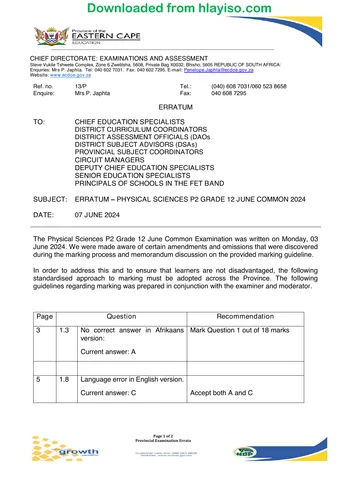
Errata