
Study & Master
Support Pack | Grade 11
CAPS
Life Sciences
Practice examination: Paper 2 memo
This support pack consists of a memorandum of answers for
Paper 2 of the Life Sciences Grade 11 CAPS curriculum so
that you or the learners can check their answers and asses
their readiness for the examinations. You have permission
to print or photocopy this document or distribute it
electronically via email or WhatsApp.
Cambridge University Press Africa
is a proudly South African publisher.
For more information on our Study & Master CAPS-approved
textbooks and valuable resource materials, visit
www.cambridge.org
Brighter thinking | Better learning
Practice Examinations Paper 1: Memo
www.cambridge.org
Skip to contentStudy guide 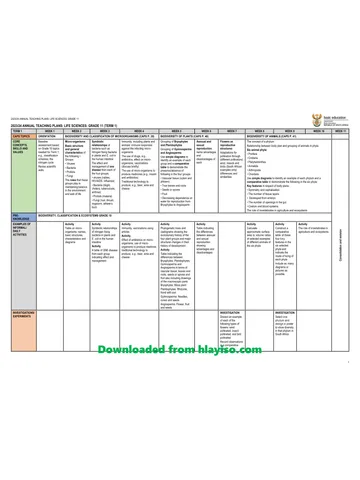
View all
11 . G11 LifeSciences DigitalSupport web Practice Examination Paper 2 Memo
Grade 11 Life Sciences study guide, 3 pages. Read online or get the free PDF download.
Publisher: Study & Master
Life Sciences · Grade 11. Study guide, 3 pages. Read online or download the PDF.
- Subject
- Life Sciences
- Grade
- Grade 11
- Document type
- Study guide
- Publisher
- Study & Master
- Curriculum
- CAPS
- Pages
- 3
- File size
- 140.9 KB
Loading document…
Loading document…
1 of 3
Document textSearch extracted text and jump to a page.
Life Sciences Examination: Exemplar Paper 2 2.1.3 a
b
A and C (2)
Both antibiotics A and C do not destroy any bacteria,
Memorandum of answers which you can see because there is no clear area
without bacterial growth. (2)
Marks: 150 2.1.4 a Fungal spores could act like an antibiotic.
Time: 2 ½ Hours (2)
b Fungal spores could cause fungal diseases. (2)
[13]
Section A 2.2
QUESTION 1 2.2.1 • Wear rubber gloves when taking the samples so as not to
1.1 get contaminated with germs
1.1.1 c • Samples should be taken by using a container/bottle
1.1.2 a attached to a string to avoid stepping too close to
1.1.3 c the river bank/prevent drowning/falling into water/
1.1.4 b contamination (4)
1.1.5 c 2.2.2 Temperature of the human body at which the bacterium
1.1.6 c normally lives/E. coli normally lives in large intestinal
1.1.7 b (7 × 2) [14] of humans/human body temperature is 37 ˚C/ to allow
bacteria to reproduce (2)
1.2 2.2.3 River Y (1)
1.2.1 cephalisation 2.2.4 The chemical indicator changed to a cloudy yellow
1.2.2 prokaryote colour, which indicates the presence of E. coli/which
1.2.3 pathogen is a positive test for E. coli (2)
1.2.4 mycelium 2.2.5 Lack/absence of proper sewage systems/poor hygiene/
1.2.5 thallus bacteria in water results in faeces getting into water (2)
1.2.6 mutualism
[11]
1.2.7 capsid
1.2.8 through gut
2.3
1.2.9 fruit
2.3.1 Hydra sp. – radial symmetry
1.2.10 spore
Planaria sp. – bilateral symmetry (2)
1.2.11 rhizome
2.3.2 • sessile organism
(11 × 1) [11] • does not go in search of food
• mouth centrally situated
1.3 • tentacles in a ring all around
1.3.1 Both a and b • sensory cells all around
1.3.2 b only • these detect and capture food from all sides (3)
1.3.3 b only 2.3.3 Hydra sp.
1.3.4 b only • diploblastic
1.3.5 a only • rapid diffusion of food
(5 × 2) [10] • many phagocytic cells all over endoderm
• distribution made easier.
1.4 Planaria sp.
1.4.1 A, B, H, I, K • diverticulated gut that branches throughout the body
1.4.2 C, E • caeca present
1.4.3 G • all cells close to food supply
1.4.4 J • flattened form makes diffusion easier
1.4.5 B, H, I, K • phagocytic cells all over gut lining. (6)
1.4.6 I, K 2.3.4 • yes – earthworm has a through gut
[10] • no mixing of food to be ingested and egested
• gut has become specialised
1.5 • parts e.g. crop, gizzard perform specific functions
1.5.1 C – Petal /corolla • systemic processing of food. (5)
D – Anther [16]
E – Stigma (3) 2.4
1.5.2 B (1) 2.4.1 Logistic growth form (1)
1.5.3 B (1) 2.4.2 A = lag/establishment phase
[5] B = exponential /geometric/accelerating/log/
logarithmic phase
Total section A: [50] C = equilibrium/stationary/stabilising/constant phase (3)
2.4.3 B (1)
QUESTION 2 2.4.4 • Environmental resistance increased
2.1 • causing the carrying capacity of the area to be reached
2.1.1 Antibiotic B is more effective in destroying bacteria than • leading to increased competition
antibiotic F or antibiotic B has a larger area without • resulting in the death rate increasing to equal the birth
bacterial growth compared to antibiotic F. (2) rate
2.1.2 a E (1) • or resulting in increased emigration that balances with
b Antibiotic E is the next most effective antibiotic after immigration (3)
antibiotic B, which you can see from the second
largest zone of no bacterial growth. (2)
Practice Examinations Paper 1: Memo
2.4.5 • Population is acclimatising/adapting to its new Drawing of the graphs 1: 1 to 8 points plotted correctly
environment 2: 9 to 15 points plotted correctly
• Few pairing partners 3: all 16 points plotted accurately
• Time required for producing offspring is relatively
long (12)
• Not all individuals are sexually mature Note:
(mark TWO only) (2) If the wrong type of graph is drawn:
[10] • marks will be lost for “correct type of graph”
• marks will be lost for joining of points
If graphs are not drawn on the same system of axes:
Total question 2: [50] • mark the first graph only using the given criteria
If axes are transposed:
QUESTION 3 • marks will be lost for labelling of x-axis and y-axis
3.1 3.2.2 Herring population shows a sharp decline from year
3.1.1 Africa (1) 1 to 2 and then a steady decline until year 7 and then
3.1.2 547 793 × 100 small increase any (4)
3 084 746 1 3.2.3 Any two of:
= 17,8 accept (17,7–17,8) (3) • Limit the size of fish caught
3.1.3 Trees used for: • Limit the number/quotas of fish caught
• fuel/fire • Limit the fishing area
• building houses • Licence to fish
• space for human settlements/farming/livelihood • Develop legislation to regulate fishing
• furniture • Heavy penalties for flouting the legislation
• medicinal purposes (any two) (2) • Scientific research to inform legislation
3.1.4 • Loss of habitat results in death of organisms/ • Minimal or no fishing during breeding season/limited
extinction of species/migration of species fishing season
• The balance of gases/carbon dioxide/oxygen • Education and awareness of endangered species
will be disturbed because of the loss of plants • Encourage mariculture/sea farming
for photosynthesis • Discouraging illegal market by government selling it
• Disturb food chains/species migrate/dying out at lower price
• Habitat degradation which will result in • Stricter monitoring (2)
increased soil erosion reduces fertility
[18]
of soil (any 2 × 2) (4)
3.3
3.1.5 • Introduce legislation to prevent the removing of trees
3.3.1 Semi-desert (1)
• Impose heavy fines/penalties to discourage repeated
3.3.2 Any two of:
acts of deforestation
• indigestion
• Educate people about the negative effects of the
• minor infections
deforestation/ about the importance of trees
• obesity (2)
• Research new technologies to find other material
3.3.3 • Indigenous people were the first to use the plant for
for building/furniture/fuel (any 3 × 2) (6)
suppressing appetite.
[16]
• Royalty must be paid for their intellectual property. (3)
3.2.1 Annual catches of herring and cod over 8 years
[6]
400 3.4
350 3.4.1 •
Obtain permission to catch fish/use dam
300 •
Conduct training to identify the Tilapia sparrmanii
Catches
Herring
250 •
Decide when to do the investigation
200 •
(thousands of tons)
Cod Decide on the tags/markers/apparatus to be used
150 •
Decide on the method of catching
100 •
Determine the sample size/number of repeat samples
50 •
Determine the period between the two successive
0 captures
1 2 3 4 5 6 7 8 9
• Decide on how to record the results
Year
(mark FOUR only) (4)
Rubric for the mark allocation of the graph
3.4.2 Number of Tilapia sparrmanii (P) = (15 × 150)
Correct type of graph 1 10
Title of graph (both variables) 1 = 225 (3)
Correct label for x-axis 1 [7]
3.5
Graphs labelled/key provided 1
3.5.1 a
Resource/spatial/niche partitioning
for 2 graphs
b
Intraspecific competition
Correct label for y-axis including 1 c
Competitive exclusion principle/interspecific
unit competition [3]
All points joined for graph A 1
All points joined for graph B 1 Total Question 3: [50]
Appropriate scale for x-axis 1 Total Section B: [100]
TOTAL: [150]
Appropriate scale for y-axis 1
Practice Examinations Paper 1: Memo
Study this subject
Notes, quizzes and topic questions for Grade 11 Life Sciences.
- Grade 11 Life Sciences notes
CAPS revision notes with worked examples.
- Life Sciences questions by topic
Past exam questions sorted by CAPS topic, with memos where available.
- Grade 11 Life Sciences quizzes
Short topic quizzes with instant feedback.
- All Grade 11 Life Sciences past papers
Past papers by year, with memos where available.
- Grade 11 Study guides
More Life Sciences and other subjects in this collection.
Recommended for this subject
More papers and memos for this grade and subject.
Annual teaching plan
Gr 11 Life Sci ATP 2023 24
Memorandum
Life Sciences Grade 11 Eastern Cape November 2025 Memo (Afr)
Memorandum
Life Sciences Grade 11 P1 Eastern Cape November 2025 Memo (Eng)
Question paper
Life Sciences Grade 11 Eastern Cape November 2025 QP (Afr)
Question paper
Life Sciences Grade 11 P2 Eastern Cape November 2025 QP
Question paper and memo
Life Sciences Grade 11 KZN June 2025 Paper & Memo
Related documents
Question paper and memo
Life Sciences Grade 11 Eastern Cape June 2024 Paper & Memo
Memorandum
Life Sciences Grade 11 P2 Eastern Cape November 2024 Memo (Afr)
Memorandum
Life Sciences Grade 11 P2 Eastern Cape November 2024 Memo (Eng)
Question paper
Life Sciences Grade 11 P2 Eastern Cape November 2024 QP (Eng)
Question paper and memo
Life Sciences Grade 11 KZN June 2024 Paper & Memo
Question paper
Life Sciences Grade 11 NW June 2024 Question Paper (Afrikaans)
More from Grade 11 Life Sciences
Question paper
Life Sciences Grade 11 NW June 2024 Question Paper (English)
Memorandum
Life Sciences Grade 11 P1 Eastern Cape November 2023 Memo (Afr)
Memorandum
Life Sciences Grade 11 P1 Eastern Cape November 2023 Memo (Eng)
Memorandum
Life Sciences Grade 11 P2 Eastern Cape November 2023 Memo (Afr)
Question paper
Life Sciences Grade 11 P1 Eastern Cape November 2023 QP (Eng)
Question paper