
Study & Master
Support Pack | Grade 11
CAPS
Life Sciences
Diversity, change and continuity
This support pack for the Diversity, change and continuity
strand of the Life Sciences Grade 11 CAPS curriculum
provides revision summaries on the topic to help prepare for
the examinations. Learners can work through these
individually at home or these could form the basis of a
catch-up class or online lesson. You have permission to print
or photocopy this document or distribute it electronically via
email or WhatsApp.
Cambridge University Press Africa
is a proudly South African publisher.
For more information on our Study & Master CAPS-approved
textbooks and valuable resource materials, visit
www.cambridge.org
Brighter thinking | Better learning
www.cambridge.org
Skip to contentStudy guide 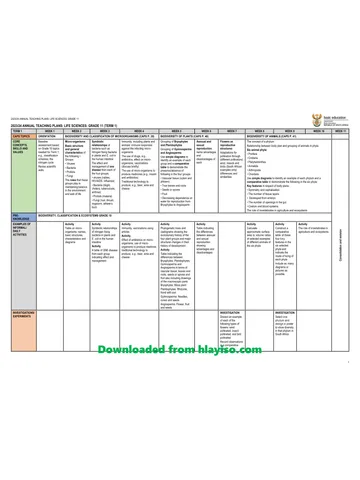
View all


2 . G11 LifeSciences DigitalSupport web Diversity Change and Continuity
Grade 11 Life Sciences study guide, 14 pages. Read online or get the free PDF download.
Publisher: Study & Master
Life Sciences · Grade 11. Study guide, 14 pages. Read online or download the PDF.
- Subject
- Life Sciences
- Grade
- Grade 11
- Document type
- Study guide
- Publisher
- Study & Master
- Curriculum
- CAPS
- Pages
- 14
- File size
- 1.8 MB
Loading document…
Loading document…
1 of 14
Document textSearch extracted text and jump to a page.
UNIT 1: Biodiversity and classification of micro-organisms
protista fungi
bacteria
immune responses of
viruses plants and animals to
Effects and management of
micro-organisms
diseases caused by micro-
organisms
vaccinations
Roles in maintaining
balance in environment
and web of life Immunity
antibiotics
E. coli in human
intestine
Biodiversity and Use of drugs
Symbiotic
relationships
micro-organisms
effect on
nitrogen-fixing micro-organisms
bacteria in plants
Biodiversity Use of micro-organisms
to produce medicines
Traditional technology
micro-organisms
antibiotics
insulin
viruses fungi producing, e.g. beer,
wine, cheese
bacteria protista
UNIT 1 Biodiversity and classification of micro-
organisms
The structure and characteristics of micro-organisms
• The basic structure and general characteristics of micro-organisms:
Viruses Bacteria Protista Fungi
General structure DNA or RNA strand Cell envelope Cell wall, vacuole, Sporangium, aerial
surrounded by protein (peptidoglycan), chloroplasts in some, hyphae, mycelium made
coat glycocalyx, cell pyrenoid, nucleus up of cells
membrane, cytosol,
ribosomes, nucleoid
Size Very small – electron Microscopic Microscopic – some Microscopic but many
microscope only macroscopic examples macroscopic examples
Prokaryote or eukaryote Not applicable Prokaryote Eukaryote Eukaryote
Unicellular or Not cells Unicellular Unicellular or Multicellular
multicellular multicellular
Specialised tissue No No No Simple tissue
present differentiation
Reproduction Only in host cell Asexually by budding Asexually by cell Asexually through
and binary fission division, sexual spores, sexually through
reproduction in poor cytoplasmic fusion
conditions
Feeding Not applicable Usually heterotrophs, Autotrophs and Autotrophs,
also saprophytic heterotrophs heterotrophs,
saprophytic
Environment All around but inactive Found everywhere, Moist environments, Moist environments
outside host cell can form endospores some can encyst to
to resist poor resist drought
environmental
conditions
A envelope B
nucleic acid capsid
nucleocapsid nucleocapsid
Figure 1 Generalised structure of viruses. A An enveloped virus B A naked virus
glycocalyx fimbriae
chromatin body cell membrane
cell wall
pilus ribosomes
mesosome
granule
flagellum
Figure 2 A rod-shaped bacterial cell
Amoeba (× 75) Chlamydomonas (× 750)
cytoplasm contractile vacuole used for osmoregulation
pseudopods used for movement
food particle
contractile vacuole flagellum used
being ingested in movement
by pseudopods
(phagocytosis) cell wall
food vacuole nucleus nucleus cell surface membrane
cytoplasm vacuoles
direction of movement
pyrenoid
cup-shaped chloroplast
Paramecium (× 150) Vorticella (× 100) Euglena (× 250)
cilia beat and cause organism anterior end
to rotate as it swims along cilia flagellum
nucleus
stigma (eye spot)
food vacuole reservoir
contractile cytoplasm
vacuole stalk chloroplasts nucleus
mouth region where contractile vacuole
food
vacuole food vacuole forms cell wall
posterior end
Figure 3 Some examples of different unicellular protista
young sporangium
containing asexual mature
spores sporangium
releasing
spores
stolon which spreads aerial
the fungus hyphae
mycelium
feeding
enzymes hyphae
released into
the bread
digesting
absorption of digested nutrients
nutrients
Figure 4 The structure of bread mould (Rhizopus stolonifer)
The role of micro-organisms
• Bacteria and fungi are major decomposers and recyclers in the environment.
They break down dead matter using enzymes, use some nutrients themselves
and recycle the rest back into the environment.
Symbiotic relationships
• Nitrogen-fixing bacteria form symbiotic relationships with plants in root
nodules and make ammonia from free nitrogen, which is broken down into
amino acids and used to synthesise proteins by the plants. There are also
free-living nitrogen-fixing bacteria, which use atmospheric nitrogen to
form nitrates.
Micro-organisms and disease
• Viruses, bacteria, protista and fungi cause diseases in plants and animals.
• Examples of these diseases are:
• viruses: rabies, HIV and influenza
• bacteria: cholera, tuberculosis and anthrax
• protista: malaria
• fungi: rusts, thrush, ringworm and athlete’s foot.
Types of defence mechanisms
• The body’s defence system is made up of the non-specific defence system
and the specific defence system.
• The non-specific defence system is made up of barriers, e.g. the skin and the
mucous membranes of the respiratory, urinary and digestive tracts. Chemical
barriers are secretions from the sebaceous glands, tears, hydrochloric acid,
perspiration, semen, lysozymes and interferon.
• The non-specific defence system includes macrophages, which use
phagocytosis, and inflammation.
• The specific defence system is the immune system.
• Specific immunity provides protection against specific pathogens and
their toxins.
• This type of immunity is provided by white blood cells called lymphocytes.
The two main types are B-lymphocytes (B-cells) and T-lymphocytes
(T-cells).
• Specific immunity is an acquired response, which allows the body to detect
and destroy particular substances.
• This type of immunity responds to chemicals called antigens. Each pathogen
stimulates the production of a specific antigen.
• Antigens activate the immune response and interact with cells of the immune
system. Once the body has responded to an antigen, it “remembers” the
pathogen.
• The next time the body encounters that pathogen or foreign substance, there
is a fast, specific secondary response to the pathogen.
• This specific defence is carried out by the lymphatic system, which involves
the production of two kinds of immunity: cell-mediated immunity and
antibody-mediated immunity.
• Cell-mediated immunity is carried out by T-cells.
• Antibody-mediated immunity is a function of B-cells. The B-cells are
responsible for the production of antibodies.
• Plants have passive immunity against invaders, provided by physical and
chemical barriers.
• A vaccine is something that is usually injected into the body to improve
immunity to a particular disease. Not all vaccines are injected.
• A vaccine usually contains a weakened or killed form of a micro-organism or
the toxins produced by a micro-organism.
• This stimulates the body’s immune system so that it produces antibodies
against a particular disease without making the person ill.
• Drugs that are used against micro-organisms are called antimicrobial drugs.
These include antiviral drugs and antibiotics, which are effective against
bacteria, protista and fungi.
Using micro-organisms to produce medicines
• Micro-organisms can be used to make antibacterial drugs and also to
synthesise insulin.
Traditional biotechnology
• Traditional technologies for making beer, wine and cheese use processes
such as fermentation and souring of milk, which requires micro-organisms.
UNIT 2: Biodiversity of plants
advantages and adaptations of flowers
sexual disadvantages of each for pollination
different pollinators
Flowers as reproductive
Reproduction in plants
structures
asexual differences and
similarities
Biodiversity
of plants
vascular tissue endemic species in
(xylem and South Africa
phloem)
Grouping of bryophytes,
pteridophytes, gymnosperms Significance of seeds
and angiosperms
seeds as
leaves and roots fruit seed banks food source
seeds and spores
UNIT 2 Biodiversity of plants
The major plant groups
• Plants are grouped into bryophytes, pteridophytes, gymnosperms and
angiosperms.
• These plant divisions are grouped according to the presence or absence of
vascular tissue (xylem and phloem), true leaves and roots, seeds and spores,
and fruit.
Bryophytes Pteridophytes Gymnosperms Angiosperms
Vascular No Yes Yes Yes
tissue
True leaves No Yes Yes Yes
and roots
Seeds and Spores Spores Seeds and Seeds and
spores spores (pollen) spores (pollen)
Fruit No No No Yes
capsule
operculum
sporophyte
seta
foot
female rosette
male rosette
gametophyte "leaf"
"stem"
rhizoid
Figure 1 The structure of a bryophyte, showing the sporophyte and the gametophyte
pinnae
frond
rachis
pinnules
petiole
young frond
leaf scales
rhizome
adventitious roots
Figure 2 The structure of a fern
A B
C
Figure 3 Examples of gymnosperms. A Podocarpus (Yellowwood); B Welwitschia mirabilis;
C Widdringtonia (Clanwilliam Cedar)
flower
terminal bud
leaf
axillary bud
internode
node
stem
root
Figure 4 An angiosperm plant showing a flower on a mature sporophyte
Decreasing dependence on water for reproduction
There is a decreasing dependence on water for reproduction from bryophytes to
angiosperms:
• Bryophytes – not yet truly suited/evolved for a terrestrial environment
because:
• no cuticle, support and strengthening tissue, neither vascular or
conducting tissue, thus dominant gametophyte essentially tiny to reduce
desiccation
• sporophyte totally dependent on gametophyte for support and food
• sperm totally dependant on a film of water (dew) to swim to egg.
• Pteridophytes – more evolved than bryophytes but still not totally terrestrial
because:
• leaves have cuticle to protect them from desiccation
• vascular tissue to conduct water and minerals (xylem) and
food (phloem), but
• still dependent on moist conditions for gamete transfer.
• Spermatophytes – evolved for a true terrestrial environment:
• have all of above terrestrial adaptations, plus
• embryo now protected from desiccation by being enclosed in a seed
• pollen grains to protect potential sperm from drying out.
Asexual and sexual reproduction
• Plants reproduce asexually and sexually. There are advantages and
disadvantages to each form of reproduction.
Flowers as reproductive structures
• Flowers are the reproductive structures of angiosperms.
• In angiosperms, pollination is required for reproduction.
• Different plants have flowers that either self-pollinate, or cross-pollinate
using wind pollination, insect pollination and bird pollination.
The significance of seeds
• Seeds are one of the reasons that the spermatophytes are the most successful
plants on Earth.
• Seeds can be used as food as well as a means to grow food crops.
• Seed banks are established by governments and other agencies to store seeds
of different crop varieties and wild plants to make sure that there is plant
biodiversity.
UNIT 3: Biodiversity of animals
Annelida Arthropoda symmetry and number of tissue
cephalisation layers developed
from embryo
Platyhelminthes Chordata
number of
Key features in respect openings in gut
Cnidaria Six major phyla
of body plans
coelom and
Porifera blood systems
body plans and
Biodiversity modes of living:
similarities and
of animals differences
Role of invertebrates in soil aeration
Phyla agriculture and ecosystems
concept of a phylum body plans and grouping decomposition
animals in phyla pollination
UNIT 3 Biodiversity of animals
The concept of a phylum
• A phylum is the taxonomic rank below kingdom and above class.
• A phylum can be defined in two ways:
• It is a group of organisms that have a similar body plan.
• It is also a group of organisms that are related through evolution.
Body plans: how these relate to modes of life
• There are five aspects of any animal body plan that are important and
common to all living animals:
• symmetry (asymmetry, radial symmetry or bilateral symmetry)
• cephalisation
• number of tissue layers developing from the embryo – two (diploblastic)
or three (triploblastic)
• presence or absence of a coelom (a cavity within the mesoderm)
• presence or absence of a through gut.
Six major phyla
• Phylum Porifera: the sponges – are asymmetrical and diploblastic, and they
do not have a coelom or a gut.
A Section through a simple sponge B Detail of body wall
osculum
amoeboid cell
collar cells spicule
outer dermal layer
water and
food enter
through pore
pore cell
central cavity spicule secreting cell
mesenchyme secretes
skeleton
Figure 1 A section through a simple sponge
Figure 2 The shape of sponges and their skeletons
• Phylum Cnidaria: jellyfish, bluebottles, corals and sea anemones – are
radially symmetrical, acoelomate and diploblastic, and have a blind-ending
gut.
Figure 3 Portuguese man-of-war
A Polyp B Medusa
mouth
ectoderm
mesogloea
jelly-like
endoderm
mouth
central cavity (coelenteron) tentacle
Figure 4 Cnidarian body plans
• Phylum Platyhelminthes: flatworms – are bilaterally symmetrical, show
cephalisation, are triploblastic, and have a coelom.
Anterior end
head
eyespot
sensory lobe
digestive cavity in cross section
mouth
mouth
pharynx
pharynx opening of
opening of pharynx
pharynx
Posterior end tail
Figure 5 A planarian
• Phylum Annelida: segmented worms – show metameric segmentation, are
bilaterally symmetrical, show cephalisation, are triploblastic, and have a
coelom.
segmented body
clitellum
mouth
anus
1 cm
Figure 6 The external features of the earthworm, a common annelid
• Phylum Arthropoda: insects, chelicerates, crustaceans, myriapods – have
many jointed legs, segmented bodies, chitinous exoskeletons and waterproof
cuticles.
• Arthropods are bilaterally symmetrical, show cephalisation, are triploblastic,
and have a coelom.
• They are the largest and most successful phylum on Earth.
E F
A C
B D
Figure 7 A range of different arthropods: A crayfish; B baboon spider; C mosquito;
D African monarch (butterfly); E locust; F centipede
• Phylum Chordata: fish, amphibians, birds, reptiles and mammals – are
bilaterally symmetrical, show cephalisation, are triploblastic, and have a
coelom.
• All chordates have a notochord, which is a long rod of supportive tissue
derived from the dorsal wall of the gut in the embryo.
• Other features that chordates share, although some may be present only in
the embryo, are:
• a dorsal nerve cord, or spinal cord
• bilateral symmetry
• gill slits
• a post-anal tail
• blood that circulates from a main ventral vessel and back through the
body in a dorsal vessel.
• Vertebrates are the only animals that have a true head that contains a true
brain, which is divided into several vesicles that control and coordinate the
nervous responses of the body.
• The bony cranium is also unique to vertebrates, as is the concentration of
sense organs – the eyes, ears and nose – on the head.
Table 1 The relationship between body plan and mode of living in six phyla
Symmetry and Tissue layers Number of Coelom and Mode of
cephalisation openings in blood systems living
the gut
Porifera Asymmetrical, Endoderm No gut Acoelomate, no Aquatic –
no and ectoderm, blood system mainly marine,
cephalisation diploblastic sessile
Cnidaria Radially Endoderm Blind-ending Acoelomate, no Aquatic
symmetrical, no and ectoderm, gut blood system (marine, few
cephalisation diploblastic freshwater),
mobile
Platyhelminthes Bilaterally Endoderm, Blind-ending Acoelomate, no Aquatic,
symmetrical, mesoderm, gut blood system free-living and
cephalisation ectoderm, parasitic
triploblastic
Annelids Bilaterally Endoderm, Through gut Coelomate with Mainly
symmetrical, mesoderm, blood vessels terrestrial, some
cephalisation ectoderm, throughout marine, highly
triploblastic length of body mobile, moist
environments
Arthropods Bilaterally Endoderm, Through gut Coelomate with Ubiquitous –
symmetrical, mesoderm, blood vessels largest phylum,
cephalisation ectoderm, terrestrial,
triploblastic marine and
freshwater,
harsh, dry
environments
Chordates Bilaterally Endoderm, Through gut Coelomate with Ubiquitous
symmetrical, mesoderm, blood vessels – terrestrial,
ectoderm, and heart, marine,
lungs and gills freshwater,
aerial, harsh,
dry, extreme
environments
(hot and cold)
Study this subject
Notes, quizzes and topic questions for Grade 11 Life Sciences.
- Grade 11 Life Sciences notes
CAPS revision notes with worked examples.
- Life Sciences questions by topic
Past exam questions sorted by CAPS topic, with memos where available.
- Grade 11 Life Sciences quizzes
Short topic quizzes with instant feedback.
- All Grade 11 Life Sciences past papers
Past papers by year, with memos where available.
- Grade 11 Study guides
More Life Sciences and other subjects in this collection.
Recommended for this subject
More papers and memos for this grade and subject.
Annual teaching plan
Gr 11 Life Sci ATP 2023 24
Memorandum
Life Sciences Grade 11 Eastern Cape November 2025 Memo (Afr)
Memorandum
Life Sciences Grade 11 P1 Eastern Cape November 2025 Memo (Eng)
Question paper
Life Sciences Grade 11 Eastern Cape November 2025 QP (Afr)
Question paper
Life Sciences Grade 11 P2 Eastern Cape November 2025 QP
Question paper and memo
Life Sciences Grade 11 KZN June 2025 Paper & Memo
Related documents
Question paper and memo
Life Sciences Grade 11 Eastern Cape June 2024 Paper & Memo
Memorandum
Life Sciences Grade 11 P2 Eastern Cape November 2024 Memo (Afr)
Memorandum
Life Sciences Grade 11 P2 Eastern Cape November 2024 Memo (Eng)
Question paper
Life Sciences Grade 11 P2 Eastern Cape November 2024 QP (Eng)
Question paper and memo
Life Sciences Grade 11 KZN June 2024 Paper & Memo
Question paper
Life Sciences Grade 11 NW June 2024 Question Paper (Afrikaans)
More from Grade 11 Life Sciences
Question paper
Life Sciences Grade 11 NW June 2024 Question Paper (English)
Memorandum
Life Sciences Grade 11 P1 Eastern Cape November 2023 Memo (Afr)
Memorandum
Life Sciences Grade 11 P1 Eastern Cape November 2023 Memo (Eng)
Memorandum
Life Sciences Grade 11 P2 Eastern Cape November 2023 Memo (Afr)
Question paper
Life Sciences Grade 11 P1 Eastern Cape November 2023 QP (Eng)
Question paper