
Downloaded from hlayiso.com
Page 1 of 7
education
Department:
Education
PROVINCE OF KWAZULU-NATAL
28 SEPTEMBER 2016
MARKS: 60 EXAMINER —— :M PADAYACHEE
TIME: 1% Hours MODERATOR :S NAIDOO
INSTRUCTIONS AND INFORMATION
1. This question paper consists of FOUR questions and 7 pages including this cover page.
2. Answer ALL the questions.
3. Read ALL the questions carefully.
4. Start EACH question on a NEW page.
5. Leave a line after each answer.
6. The mark allocation generally gives an indication of the number of facts required In your }
answer.
|
7. Number the answers correctly according to the numbering system used in this question \
paper. |
8. Write neatly and legibly.
Skip to content
View all
Information Technology Grade 11 2016 QP & Memo
Grade 11 Information Technology question paper and memo from the September Test 2016, 10 pages. Read online or get the free PDF download.
Information Technology · Grade 11 · September Test · 2016. Question paper and memorandum, 10 pages. Read online or download the PDF.
- Subject
- Information Technology
- Grade
- Grade 11
- Document type
- Question paper and memo
- Year
- 2016
- Exam period
- September Test
- Curriculum
- CAPS
- Pages
- 10
- File size
- 500.8 KB
Free to read online, no sign-up needed
Loading document…
Loading document…
1 of 10
Document textSearch extracted text and jump to a page.
Downloaded from hlayiso.com
Page 2 of 7
QUESTION ONE [MATCHING]
Match the description provided in column A with the term from column B that best suits
the description given. Write only the letter of the term next to the question number of the
description.
COLUMN A | a COLUMN B
1.4. Connects devices in a small area using Infra-Red, Bluetooth and WiFi. AEMI
1.2. Signals travelling along wires may be intercepted by outsiders. “|B Backbone
1.3.A device used to join two cables. It may also amplify or boost the signal. C WLAN
1.4. When several LAN segments hang of one fibre optic cable it is called... DWiki |
1.5. The layout of computers in a network is called a ....... E Proxy Server
1.6. Set of rules that governs the way information travels from one pointto the | F RSS Feed
next ina network e.g. Internet.
1.7. A unique website where users may contribute or edit articles. G Content Aggregator
1.8. Signals from machinery may corrupt signals travelling in wires. H WPAN
1.9. A website or software that collects specific information from other websites. | 1 Eavesdropping
1.10. A’server maintained by an ISP or business through which all web J Weblog —
content passes. :
a K Router,
L_ Web Server
M Repeater
N_ Protocol
{10] O Topology
SCENARIO
Your school is deciding to upgrade its current setup of computers to keep up with —
modern trends. At present the school has only 3 office computers for Administration
work, and 30 computers each in the IT rooms.
They have also decided that the entire school should be connected to the internet by
making it a HOT SPOT.
The school governing body approached a company to provide a quotation showing
possible costing.
Study the diagram of the Company’s recommendations and help the school to:
streamline the features so that they purchase the best setup at the most reasonable
price. -—-—-.-.-..
Le
oo
Downloaded from hlayiso.com
Page 3 of 7
a
a
« REPEATER IT ROOM LIBRARY
ud SERVER
<>
ITROOM 4 2 dg i<—>} LocaTED
30 PC's 30 PC’s e HERE
Ethernet Topology for both IT rooms Fibre opti
Will be Ring Topology with CSMA/CD Cables used to
connect 10
4S computers,
Wireless
Access
point
utd for Internet
Lib ~ uses
Token Ring
QUESTION TWO_ [NETWORK AND COMMUNICATIONS TECHNOLOGIES]
Due to the high cost of upgrading for the future, the Principal and the governing body have
many questions. Your knowledge of computers is required to assist them to make a final
decision.
2.1. Coaxial and STP cables used in the IT rooms pose three major problems due to the
copper that is used in the cabling. Name and briefly describe each problem. (6)
2.2, Explain why the cabling in the library is not the best chosen. Give 2 reasons. (2)
2.3. Give two disadvantages of using the topology suggested for the IT rooms. (2)
2.4. Explain the purpose of using a switch in the IT rooms, (2)
2.5, Discuss the difference between a Repeater and a Bridge. (2)
2.6. Why is it necessary to have a router present on the premises? (2)
2.7, Do you think that the LAN technologies chosen for the IT rooms is appropriate for the
suggested topologies included. Motivate why you think so. (2)
2.8. Describe how the two media access methods, mentioned in the quotation, works. (4)
2.9, What does it mean to say that the school is a HOT SPOT? (1)
2.10. Learners in the school will be allowed to use their tablets or smartphones to access
the Internet, with obvious restrictions. Discuss the different technologies that may be
used by the different devices under the following headings:
Page 4 of 7
Downloaded from hlayiso.com. oe
a) EDGE (a)
b) 4G LTE i (4)
c) WiMax : (1)
[26]
QUESTION THREE [INTEGRTED SCENARIO]
The principal of your school is not very keen on the whole school being on the internet.
Answer the questions below based on some of his fears.
3.1. Give two dangers of social networking in school. (2)
3.2. During transfer of files between learners and downloading from the internet, one has to
be very careful of the content received and sent. List two security measures that one
can employ to keep their computer protected from unwanted content. (2) ( )
3.3. Define the terms related to Internet usage:
3.3.1. Spam : (1)
3.3.2. Adware (1)
3.3.3, Bandwidth : (1)
3.4, What do the following acronyms stand for: ‘
3.4.1. HTTP » (2)
3.4.3. TCP/IP (2)
(44)
O)
Downloaded from hlayiso.com
Page 5 of 7
QUESITON FOUR [PROGRAMMING AND ALGORITHM DESIGN]
The school requires software to manage the different departments of the school. You, as
an IT learner, are required to assist in developing software to run the school.
4.1. The Sports department wants your assistance to develop an algorithm that uses the full
name (Surname Firstname/s) of a participating athlete, to generate a Registration
Number.
This number is used to identify the athlete by making tags with the number printed on
it. This registration number contains alphanumeric characters. Your task is to examine
the already written code and give input by answering the questions:
1. procedure TForm1.Button1Click(Sender: TObject);
2. Var fName, cde : String;
3. len, mid, f,s : integer;
4. begin
5. fName := InputBox('Enter Name','Surname then firstname’,");
6. len := Length(fName);
7. mid := len div 2;
8. if odd(len) then
9. begin
10. mid := mid + 4;
11. cde := copy(fName,1,1) + copy(fName,mid,1) + copy(fName,len-2);
12. end
13. else
14. cde := copy(fName,mid,1) + copy(fName,mid+1,1) + copy(fName,len-1);
15. f:=len div 10;
16. s:=len mod 10;
17. cde := IntToStr(f) + cde + IntToStr(s);
18, RichEdit1.Lines.Add(cde);
19. end;
4.1.1. Trace the code to determine the registration number formed when the input is:
(N.B. No trace table is required as marks will only be awarded for output)
a) Jonathan Francis (2)
b) Hlakanipho Duma (2)
c) Tony Cho (2)
4.1.2. Describe in not more than SEVEN steps exactly what is being done with the input to
obtain the desired registration code. (7)
4.1.3, You need to modify the program so that it removes spaces found in the reg no.
formed. Write the Delphi statements to solve this problem. At which line would you
insert the new statements. (6)
Downloaded from hlayiso.com:
age 6 of
4.2. The Library needs to create a database in order to store the details of all members.
Software developers have agreed on the details necessary to construct the respective
record. Your task is to continue with the completion of the a software as specified by
the questions that may follow:
THE RECORD STRUCTURE
Here is a list of fields that constitutes the record. The record represents the details of all
library members. .
1. A Boolean variable (Learner) to represent whether a member is a learner or not. If not a
learner, the member could be an educator or any other staff member in the school.
2. A string variable called RegNo that will store a code generated by the members full name.
3. A real variable called fines, that stores the total fines, if any, owed by the member.
4, A String variable, fName, that stores the full name of the member.
4.2.1, Declare the object type for the class variables above. To do this you must only write’
the segment of the code that defines the instance variables. The name of the object
type is LibMem. : : (3) ( )
4.3. Study the class diagram which represents the object class for the record structure
above and answer the questions based on it.
CLASS DIAGRAM
LibMem
- Learner : Booleanr;
~ Rego: string
fines: real;
Lname : String;
Constructor Create; Overloaded:
Constructor Create(pL: char; pName:String:); Overloaded;
getLearner : Boolean;
getLName : Real
setName(pn:String;);
calcAmtOwing(amnt : real; days: integer; charge:real):
toString : string: C
i
tee EHH Sl
4.3.1. Clearly distinguish between a class and an object. ‘ (2)
4.3.2. The class diagram has various methods. Identify the three different types of methods
from the class and give an example of each from the diagram. (6)
4.3.3, From the class diagram identify the following:
~~ =~ ay The parametrised constructor, = eg
b) A Mutator method (1)
c) An Accessor method (1)
Downloaded from hlayiso.com
Page 7 of 7
4.4, Discuss the prupose of accessors and mutators. (2)
4.5. How do procedures differ from functions? (2)
4.6, List the two auxillary methods methods from the class diagram. {2)
4.7. You need to redefine the auxillary method below :
calcAmtOwing(amnt : real; days: integer; charge:real);
So that the value of amnt changes in the calling statement of the method. (1)
e
4.7.1, What kind of parameter have you transformed amt into in 4.7.? (1)
4.7.2. What is the name given to the parameters found in the:
a) Method calling statement e.g. calcAmtOwing(a,d,c); (1)
b) Method definition e.g. calcAmtOwing(Var amnt : real; days: integer; charge:real); (1)
[43]
FINAL TOTAL : 90 +3 x 2 = 60
Downloaded from hlayiso.com
Downloaded from hlayiso.com
“Seo|nap a], gow Wosy a|qyssod UOISIAE|} CE pue BUuj2UE/9JL09 OApIA ‘AL aljqow Us
joD0}03d joqUOD JaysUeL “Eye
jooojoud sasueN apis “Zy'S
Jos0}0zd Jaysued xeyedAH ‘Ty's
“Jouueyp uoReoIUNWUIOD e Jo Aysedeo Suyjpuey exep je03 Oy 0} s1BJa2 YIPIMpUR “YEE
aremayos Suisnuenpe $i ae¢py “ECE
“OIL B42 JO Jepuas By3 02 YOeq pus pue ,sIBSN Jo sjleJep pu
sqUaA@ P10da/ 0} 2)Gz SI Jey? ‘Dy JO ysOMYaU e JO Eale a|qea}epuN Ue LI Pagpo} sj Jeu} aseMYJOS “Z"E"E
Lua YUN! paUurjosun Tes
ae auemids nuy ‘wedsnuy ‘ snuianuy ‘Z°€
~s1ayjo arepiuiul Jo yoaads azey a,owosd 02 21 asn Aew ajdoag -
om JueVOdUI pue sarINp Wey} 399/Fou pue y UO sun dow! puads 03 pual jim ajdoed — "T's
BBYHL NOSSO
“Aldi pue djo, ‘Sulpueqpeoig ajged oj aaewaye
Ssaja4IM ‘AIANIBULOD PuegpeOIg aI!Gow SapIAosd pue 141 UL? ase JOpIM & $39A03 Y
~sp}e1 Jaysuen
eep sey WO. apaoud AjUOWLUOD UD Yr14M PJEPUETS SUOEIIUNWWOD ssafaM & S!— XVIALM (2
UDP YSIy ‘soo1aras
Sues ‘AuoYdaay g] Saye YyYpimpueg paads ysiy siys “sse2se JouSqW! pueg-peosg eQIN YM Sizsn
@PIAOIE 31 “DE SMOHOS 2eYI PJepURyS SUOHeOIUNWWOD SsUOY alIqow Jo LOHeJEUaT YLNOY BUI SI OF (G
“SUdd psoueyUz se UMoUy Osly¥ “ADojouUde} oIpes N¢E-aud @ polepisuod
S| FOS "WSO 40 usIsUS}xe o1qneduloo-premnjoRg B Se Soyer UOISSIWUSUBI} EJP perosdu! sMO|TE
yeuR ABojoUYoS} suoYd Syqow jeubip e si ~ UOAN|OAT NGS 10} sexe Byeg psoueYUS (e ‘OTT
-Asng se uay03 243 SeW pue UaYO} BY} OF peppe
ue sassauppe Janlades pue JApUAs ‘elep Sppe Ud}O} Sy? S242} SIIAp oy} ‘Bduj Se PAyJeW S! UBx0] Sy)
41 Sul, 3p punore sjanesy uByoy e pajjes uresoud jjeuus e “pounaw siya ul — Buissed uayOL/3UL1 UaXOL
“Suipuas doys yim Aaty a2uay 1n200 jj uOIst|OD e AW aUeS By Ie pUas SapoU OMY
4{ Hlusuen Aew y ‘aul Jeep e $193 apou e e2u0 Os sseze jenbe aney Sapou jy “4ea)9 S} WiNipawW aya.
| ASN y “JEP WwusueJ} OF syueM apou e 1 -YOMIAU SNq JO JERS @ UL PAS — GD/VINSI'S"Z
psjozaseg
“AB010d0} 23s Ym pasn ApUOUUWIOD ysOlW S| AZOJOUYIS3 JUIEYIT “ON “LT
“POU BY O} NYT 8U0 WO a[gissod AyANIaUUOD JUL}
Supjyew snyy ssaippe gj ue asn se yam Se seop sajeades pue eSpuq e& yey} je 07 B/qe Si 1ayNO1 YET
“SSBIPPE JyYy Sy Suruswexs Aq
Bqep Jo syexoed puss 0] yred By} s}DaaS pue sjeusis suey Susys ‘suewFas Ny] sSpeuuco espug y
“saauezsip 8u0] 4800 uayeam
sjeu8|s asnecaq saauelsip uo] 39A0 SjuaWas sO MJOU SPSUUOD JeUR aa!nap e AjdwuIs st aeaday “SZ
“WAL OJ Suis seuss $1S00q Osje YIMS BYL WIOMISU e UI SADA SBLLIOD YOYMS 2 ANISH “7 T
“Bulusyzua.ys j2usis Sy} 0} snp yromsu pueIxe Ayisea ued -
-uinusjupus e re shes sso} Jeus}s yeu? Os ;eUTIs eep B47 sazessUaSas apoU YDeD -
~yusuen 0 Ayunpoddo ue sey eojnap Arana asaym roman ALapsO AaA— "ET
ujequreus pue {]e1SU1 0} asedxe sy eArey JOU saop ooyps au -
Surges aasuedxe os aaey 0} JOU SBOP eae ews — “77
“uonesianuod
SuOYTa|a2 Passo.d Ut se JaYIO YDee YAM aieparul Wed Se1iM JUAeIpe UI S]eUBIS ~ y]e3sS01
“suapisino Aq paydaosequy] 3g ued sejqeo saddos Suoje Sujane jeud}s — Suiddospsaneg
“euesIp & J8A0 YPBuia3s SaSO] [2UsIs yy — UOReNUaRy
n282 Sjeusis ydn4u09 ued AsauIyDeU Se YoNs se2unos Jay O WO4 [eUEIS — 3 “TZ
“saiqeo saddoo ui 3
OM NOLSaNO
JOLT
D'6T
vet
aLt
NOT
ost
ayt
WET
Tt
HEE
JNO NOLLS3ND
TL a0VeD OWN DNDN
910¢ ISdl GATIOUL NOD UzaINaLdas:
XSOIONHIAL NOILVIARSOING
TOOHIS ABVGNODaS AUNENATED
p40 Tageg
Downloaded from hlayiso.com
Page 3 of 4
JUIESTION FOUR
41.1. 2) inisé
b) 1HpumaS
©) Oy ho&
4.1.2. Step 1—the length of the full is found and checked if it is odd or even.
Step 2—if odd, then the first letter, middle letter and the last 3 letters are joined
Step 3 - if even, the 2 middle chars and the last 2 letters are joined
Step 4—then the digits of ‘the length of the string is separated
4.1.3. ..newCde =”,
for i:=1to length{cde) do
Begin
If not (cde[i} =‘) then newCde := newCde + cdefi]
End;
Cde := newCde;
4.2.4, Type LibMem = Class(TObject)
Private
Learner : Boolean;
RegNo : String;
ies : real;
fName : String;
Public
End;
|
if
Page 4.0f4 |
1
i
|
431 |
Aclass is subprogram that contains methods objects and variables. I conteins attributes that pertain to
a particular object.
An object is an instance of a class. It inherits class attributes and member variables.
4.3.2. Constructor : Constructor Create; Overloaded;
Constructor Create(pL: char; pName:: String; ; Overloaded;
i
Accessor : getlearner , getLName i
Mutator - setName.
Auxillary methods : calcAmtCwing , toString
4,3.3, a) Constructor Create(pL: char; pName:String;); Overloaded;
b) setName |
c) getLearner , GetLName
4.4. Accessors — gets values out of the class. |
Mutators — sets the values of the class attributes or changes the class variables.
4.5. Procedures does not return any values back to the calling statement.
Functions are of a specific type and they return values back'to the cal
g statements.
4.6. toString and calcAmtOwing
4,7, calcAmtOwing(Var amnt : real; days: integer; charge:real};
\
4.7.1. A reference parameter or a variable parameter i
4.7.2. a) Actual parameters or arguments
b) Formal Parameters. i
Study this subject
Recommended for this subject
Question paper and memo
Information Technology Grade 11 2015 QP & Memo
Memorandum
Information Technology Grade 11 P1 2016 Memo (Eng)
Memorandum
Information Technology Grade 11 P1 2016 Memo (Afr)
Memorandum
Information Technology Grade 11 P2 2016 Memo (Afr)
Memorandum
Information Technology Grade 11 P2 2016 Memo (Eng)
Question paper
Information Technology Grade 11 P1 2016 QP (Eng)
More from Grade 11 Information Technology
Memorandum
Information Technology Grade 11 P1 November Mock 2026 Memo
Annual teaching plan
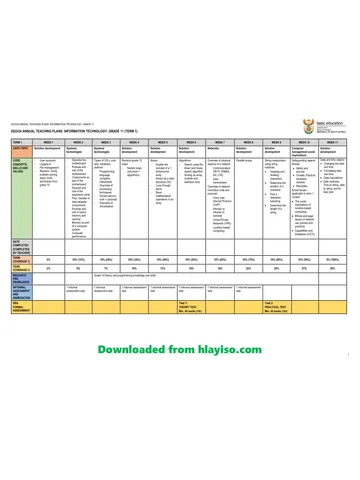
Gr 11 Info Tech ATP 2023 24
Memorandum
Information Technology Grade 11 P1 2022 Memo (Eng)
Memorandum
Information Technology Grade 11 P1 2022 Memo (Afr)
Memorandum
Information Technology Grade 11 P2 2022 Memo (Afr)
Question paper