
o4o40000
Lefapha la Thuto la Bokone Bophirima
Noordwes Departement van Onderwys
North West Depariment of Education
~” NORTH WEST PROVINGE
NATIONAL SENIOR CERTIFICATE
NASIONALE SENIOR SERTIFIKAAT
GRADE 12/GRAAD 12
>
o PHYSICAL SCIENCES: CHEMISTRY (P2) ic
- FISIESE WETENSKAPPE: CHEMIE (V2) a
fi u
: SEPTEMBER 2020 F
a a
t MARKING GUIDELINES/NASIENRIGLYNE a
Lay 7
MARKS/PUNTE: 150
These marking guidelines consist of 12 pages and 3 pages with the cognitive
grid.
Hierdie nasienriglyne bestaan uit 14 bladsye en 3 bladsye met die kognitiewe
tabel.
Copyright reserved/Kopiereg voorbehou : Please turn over/Blaai om asseblief
Skip to contentAll 2020 papers 
View all





Physical Sciences Grade 12 North West Mock 2020 Memo
Grade 12 Physical Sciences memorandum from the North West Mock Exam 2020, 12 pages. Read online or download the free PDF.
Physical Sciences · Grade 12 · North West Mock Exam · 2020. Memorandum, 12 pages. Read online or download the PDF.
- Subject
- Physical Sciences
- Grade
- Grade 12
- Document type
- Memorandum
- Year
- 2020
- Exam period
- North West Mock Exam
- Curriculum
- CAPS
- Pages
- 12
- File size
- 4.8 MB
Free to read online, no sign-up needed
Loading document…
Loading document…
1 of 12
This exam
North West Mock Exam 2020
- Other filesQuestion paperQuestion paper (2)MemoMemo (2)
Document textSearch extracted text and jump to a page.
Physical Sciences Downloaded. from hlayiso.GMPemver 2020
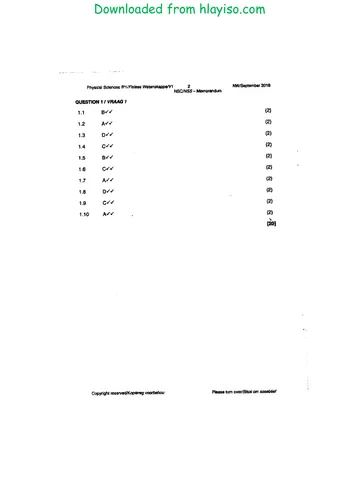
QUESTION 1/VRAAG 7
A
1.2
1.3
1.4
1.5
16
1.7
1.8
1.9
1.10
Copyright reserved/Kopiereg voorbehou
B
NSC Marking guidelines /NSS Nasienriglyne
(2)
(2)
(2)
(2)
(2)
(2)
(2)
(2)
(2)
(2)
[20]
Please turn over/Blaai om asseblief
og040000 ~
Physical Sciences Dawnleaded, f ro m h lay so . GR Baotember 2020
NSC Marking guidelines /VSS Nasienriglyne
QUESTION 2/QUESTION 2
21
2.2
2.3
24
Molecules with the same molecular formulae, but different structural
formulae. Vv ¥
Molekule met dieselfde molekulére formule, maar verskillende
struktuurformules.
2.21 AVY
222 Dv
22:3 BY
2.3.1 Esterification/Esterifikasie Vv
(2)
(1)
(2)
(1)
2.3.2 Acts as a catalyst/a substance that speeds up the rate of the
reaction/dehydrating agent. ¥
Tree op as ‘n katalisator/'n stof wat die tempo van ‘n reaksie
verhoog/dehidrateermidde!
2.3.3
H
|
O
H Cc c Cc
H
cl oH
| |
c—c
feel
H Hjn
Vv
Copyright reserved/Kopiereg voorbehou
vv
(1)
(2)
(2)
[12]
Please turn over/Blaai om asseblief
Physical Sciences Pawnloaded f ram h layiso 6 QMember 2020
NSC Marking guidelines /VSS Nasienriglyne
QUESTION 3/VRAAG 3
3.4
3.2
3.3
3.4
The temperature at which the vapour pressure of a substance equals
atmospheric/external pressure. Vv“
Die temperatuur waar die dampdruk van die stof gelyk is aan die
atmosferiese/eksterne druk (2)
AY
Lowest boiling point/Shortest chain lengthY
Laagste kookpunt/ Kortste keitinglengte (2)
3.3.1. Ethyl ethanoate. vv /Etieletanoaat (2)
3.3.2
H H
vv (2)
Marking guidelines/nasienriglyne
e BOTH have hydrogen bonding” /BEIDE het
waterstofbinding
e Compare number of sites for hydrogen bondingY /Vergelyk
aantal plekke vir waterstofbinding
Compare strength of IMFs” /Vergelyk sterkte van IMKs
© Compare energy required /Vergelyk energie benodig
Both compounds/C and D have (in addition to London forces and dipole-
dipole forces) hydrogen bonding. ¥
Beide verbindings/C en D het (in addisie tot Londonkragte en dipoo!-
dipoolkragte) waterstofbinding
Compound C/Ethanol/alcohol has one site for hydrogen bonding and
compound D/Ethanoic acid/ carboxylic acid has two/more sites for
hydrogen bonding. ”
Verbinding C/etanol! /alkoho! het een plek vir waterstofbinding en verbinding
D/etanoésuur/karboksielsuur het twee/meer plekke vir waterstofbinding.
Intermolecular forces in compound D/Ethanoic acid/ carboxylic acid are
stronger than intermolecular forces in compound C/Ethanol/alcohol. ”
Intermolekulére kragte in verbinding D/etanoésuur /karboksielsuur is sterker
as die intermolekulére kragte in verbinding C/etanol/alkohol.
Copyright reserved/Kopiereg voorbehou : Please turn over/Blaai om asseblief
UcUUUUU
Physical Sciences Dawnlaaded, f ro 4) h lay so 2 GR otember 2020
NSC Marking guidelines /NSS Nasienriglyne
OR/OF
intermolecular forces in compound C/Ethanol/alcohol are weaker than
intermolecular forces in compound D/Ethancic acid/ carboxylic acid.
Intermolekulére kragte in verbinding C/etanol/alkohol is swakker as die
intermolekulére kragte in verbinding D/etanoésuur/karboksielsuur
More energy is needed to overcome/break intermolecular forces in
compound D/Ethanoic acid/ carboxylic acid than in compound C/
Ethanol/alcohol. ¥
Meer energie word benodig om die intermolekulére kragte in verbinding D
/etanoésuur /karboksielsuur te breek/oorkom as in verbinding C/etanol
alkohol
OR/OF
Less energy is needed to overcome/break intermolecular forces in
compound C/Ethanol/alcohol than in compound D/Ethanoic acid/
carboxylic acid.
Minder energie word benodig om die intermolekulére kragte in verbinding
C/etanol /alcohol te breek/oorkom as in verbinding D/Ethanoic acid/
carboxylic acid. (4)
[12]
QUESTION 4/VRAAG 4
441
4.1.1 Addition v /Addisie (1)
4.1.2 2C2Hs +702 — 4COQ2 + 6H20
Notes/Nota’s
e Reactants /Reaktantev Products/Produkte “
Balancing/Balansering v
e Ignore/ignoreer = and phases/en fases
e Marking rule/Nasienreél 6.3.10
(3)
4.2
4.2.1 1,2-dichloroethaney Vv /1,2-dichloroetaan (2)
4.2.2 Halogenation/Chlorination Vv /Halogenering/Chlorinering (1)
4.3
4.3.1 Hydrolysis ¥ /Hidrolise (1)
4.3.2
el eer H H ¥ a
| | +NaOH/KOH A [4 + NaCt/KCe
H—C—C—H — oe ae
ce dy H OH
(4)
Copyright reserved/Kopiereg voorbehou
Please turn over/Blaai om asseblief
Physical Sciences eLaw nleaded fram h layiso RS Gbember 2020
NSC Marking guidelines /NSS Nasienriglyne
44
4.4.1. Hydration v /Hidrasie (1)
4.4.2 -ANY ONE /ENIGE EEN
- Excess water Vv /Oormaat water
- Concentrated H2SOz /Gekonsentreerde H2SO4 (1)
[14]
QUESTION 5/VRAAG 5
5.1 The influence/the effect of a catalyst V /Invoed/effek van katalisator (1)
52 LY : (1)
5.3 No-catalystv’“/Geen kaitalisator (2)
5.4 Change in concentration of products/ reactantsv’ per (unit ) time”
Verandering in konsentrasie van produkte/reaktante per tydseenheid (2)
OR/IOF
Change in amount/number of moles/volume/mass of products or reactants per
(unit) time
Verandering in die hoeveelheid/aantal molvolume/massa van
produkte/reaktante per tydseenheid
A [H20
5.5 Average rate = - AT202)
At
_ _ 0,0131-0,020 v
400-(0) v
= 1,73 x 10 > mol-dm? stv (3)
56
Copyright reserved/Kopiereg voorbehou
MARK ALLOCATION/PUNTETOEKENNING
=e =a, =e
sicre or/of ¢ = = or/of n a v
e Substitute/vervang (0,0200 — 0,0106) and/en 50 x 10° v
e n(O2) = %(H202) ¥
e Using/gebruik M = 32 in m = Mn or/of n = cMV or/of ratio
calculation/verhouding berekening “
e Answer/aniwoord: 7,52 x 10° g/ 0,008 g/ 0,01 g ¥
Please turn over/Biaai om asseblief
ve aie amt
Physical Sciences D winloa led f ro m h lay | so . oA Sela 2020
NSC Marking guidelines /NSS Nasienriglyne
OPTION 4/OPSIE 1 OPTION 2/OPSIE 2
cay Ac [H202] = 0,0200-0,0106
<Is
= 0,094
(0,0200 — 0, 0106) =
n
¥
in Ac(O2) = 1/2(H202)
=1/2(0,0094) ¥
n(Qz) = 4/2 n(H2O2) = 1/2(4,7 x 10“) ¥
= 2,35 x10 mol =0,0047 ¥
m
n=—
M Gs
MV
2,35 x 104 = m/32 Vv Am(O2) = cMV
m= 7, 52x 10%9 v = (0,0047)(32) v (50X10)
=7,52x10⁻³g
= 0,008 g
= 0.019” (5)
[14]
Copyright reserved/Kopiereg voorbehou Please turn over/Blaai om asseblief
Physical Sciences Pawnloaded fram h layiso fe AMember 2020
NSC Marking guidelines /NSS Nasienriglyne
QUESTION 6/VRAAG 6
6.1. The stage in a chemical reaction when the rate of the forward reaction is
equals to the rate of the reverse reaction. V“”
Stadium in ‘n chemiese reaksie waar die tempo van die voorwaartse reaksie
elyk is aan die tempo van die terugwaartse reaksie.
OR/OF
The stage in a chemical reaction when the concentration of reactants and
products remain constant.
Stadium in ‘n chemiese reaksie waar die konsentrasie van reaktante en
produkte konstant bly. (2)
6.2. STAY THE SAME. v¥ BLY DIESELFDE
At equilibruim there are equal number of moles of gaseous reactants and
products. vv
By ewewig is daar gelyke aanial mol gasagtige reaktante en produkte. (3)
6.3
6.3.1 A very small amount of NO(g) is formed. VW
‘n Baie klein hoeveelheid NO(g) is gevorm. (2)
6:3'2
Na(g) O2(g) | 2NO()
Initial moles/Aanvangsmol 7 2 0
Moles reacted/mol gereageer 0,2 0,2 047
Moles at equilibrium/mol by ewewig ie 0,4v
6,8
Equilibrium concentration/ 3,4 0,9 0,2
Ewewigskonsentrasie_(mol-div)
Divide by 2/deel met 2)v
__{[Noy?
~ [No] [02]
0,04
“(3.4)(0.9) v
= 0,013 ¥ (8)
c
v
Copyright reserved/Kopiereg voorbehou Please turn over/Blaai om asseblief
Physical Sciences Dawnleaded.f rom h layiso GO aptember 2020
NSC Marking guidelines /NSS Nasienriglyne
OPTION 2/OPSIE 2
Nez Oz nM 2NO
Initial concentration _ Ls 3,5 224
Aanvangskonsentrasie 2 2 0
(mol-dim)
Change/verandering 0,1v 0,1 Of ov
(mol-dm) 2°
Equilibrium concentration 3,4 0,9 02Vv
/konsentrasie by ewewig
(mol-dim)
__INO}?
*"[NallO,]
__ (02
~ 3,4)(0,9)
= 0.04 ,
3,06
= 0,013V
63.3
e When the system is heated, Ke increased’, which implies that more
NO(g) was formed.
Met toename in temperatuur het die K- verhoog, wat impliseer dat meer
NO¢qg) gevorm het.
e The forward reaction is favoured. ¥
Die voorwaartse reaksie is bevoordeel.
e Increase in temperature favours the reaction which absorbs energy” /
endothermic reaction.
Verhoging in temperatuur bevoordee! die reaksie wat energie absorbeer /
endotermiese reaksie. (4)
[19]
01040000
Copyright reserved/Kopiereg voorbehou Please turn over/Blaai om asseblief
Physical Sciences pReanleadead fram hlayiso.GQMrember 2020
NSC Marking guidelines /NSS Nasienriglyne
QUESTION 7/VRAAG 7
7.1
7.1.1 An acid that ionises completely in water. VW
‘n Suur wat volledig ioniseer in water. (2)
7.1.2
OPTION 1/OPSIE 1 OPTION 2/OPSIE 2
PH = - log [HsO*] ¥ pH+pOH =14
3 +pOH =14
3 =- log [H30*] ¥ pOH =- log [OH]
11. =-log [OH]
[H30*] =0,001 mol-dm?v (3)
[OH] =1x10⁻¹
Kw = [H30*] [OH] =14
[H3O*] = 0,001 mol-dm®?
7.1.3 No /Nee (1)
7.1.4. The concentration of the hydrogen ions in the HX solution is lower
than’ that of HC? of the same concentration . “
Die konsentrasie van die waterstofione in die HX_oplossing is laer as
die van HC? met dieselfde konsentrasie. (2)
OR/OF
The pH of HX is higher than that of HC£ of the same concentration
Die Ph van HX is hoér as die van HCt met dieselfde konsentrasie
2
7.2.1 A substance that can react as an acid or a base in a chemical
reaction. Vv Vv
‘n Stof wat beide as ‘n suur en ‘n basis kan optree in ‘n chemiese
reaksie (2)
7.2.2 HSOs ¥ (1)
7.2.3. Sulphite ion Y Sulfietioon (1)
7.3
7.3.1 ¢(H2SOx) = 2v
Vv
n
02=—v
0,1
n = 0,02 molv (3)
Copyright reserved/Kopiereg voorbehou Please turn over/Blaai om asseblief
Physical Sciences Downleaded from hlayiSo.GQptencer 2020
NSC Marking guidelines /NSS Nasienriglyne
7.3.2 n[Mg(OH)2]= cV
= (0,2) x (0,02) ¥
= 0,004 mol
n(H2SO« in excess/oormaat) = 0,004 mol v (mol ratio)
n(H2SQa4) reacts with/reageer met Na2zCOz = 0,02 -0,004”
= 0,016 mol
n(Na2CQs3) = n(H2S04) = 0,016 mol” = (mol ratio)
m(Na2zCO3) = nM
= 0,016 x 106V”
= 1,696
Mass of impurity/massa onsuiwerheid = 5 — 1,696V
= 3,304g V (7)
[22]
QUESTION 8/VRAAG 8
8.1. The substance/ species which gains electrons. vv
Stof wat elektrone bykry. (2)
82 BiAgtY
Silver ions (Ag*) has a stronger oxidising ability than cobalt (Co)v’, and
silver ions (Ag*) will be reduced to silver v.
Silwer ione (Ag*) het ‘n sterker oksideervermoé as kobalt (Co), en
silwer (Ag*) sal gereduseer word na silwer (3)
8.3 Co(s) — Co* + 2e
2Ag* +2e => 2Aq(s
Co(s) + 2Ag* == Co + 2Ag(s)V¥v (bal)” (3)
8.4 E® cei = E®cathodelkatode - E®anode ¥
Accept any other correct formula
E® sel = E®katode/katode - E®anode from the data sheet.
_ Aanvaar enige ander korrekte
= +0,80 v - (-0,28) formule vanaf gegewensblad.
= 1,08 vv
E®cetser<1,5 V, thus the bulb will not glow or light up/ gloeilamp sal nie
brand.¥ (5)
[13]
Copyright reserved/Kopiereg voorbehou Please turn over/Blaai om asseblief
Physical Sciences pRawnleadead from h layiso GOP tember 2020
NSC Marking guidelines /NSS Nasienriglyne
QUESTION 9/VRAAG 9
9.1 Electrical energy is converted to chemical energy. v~“
Elektriese energie word omgeskakel in chemiese energie. (2)
9.2 Cathode/katode V (1)
9.3.1 Cryolite/kriolietv (NasAIFe) Vv (2)
9.3.2 AlzOs(.2H20) VY (2)
9.4 Carbon in the electrodes reacts with O2 gas produced, forming CO2 ¥
carbon is used upY causing electrodes to disintegrate/corrode away.
Koolstof in die elektrodes reageer met O2 gas wat vorm en vorm CO2/
Koolstof word opgebruik wat veroorsaak dat elektrodes disintegreer/
weggevreet word (2)
[9]
QUESTION 10/VRAAG 10
10.1
10.1.1 Combustion (process) “ Verbrandings(proses) (1)
10.1.2 4NH3s +502 Y> 4NO + 6GH20V balv (3)
10.2
10.2.1 Neutralisation (Acid-Base) V /neutralisasie (Suur-basis) (1)
10.2.2 HNOs+NH3sv—> NH4NOs3 v bal v (3)
10.3
10.3.1 Haber ¥ (1)
10.3.2 Feliron/yster ¥ (1)
10.4
10.4.1 The ratio of nitrogen, phosphorus and potassium in the
fertiliser” v'IDie verhouding stikstof, suurstof fosfor en kalium in die
kunsmis. (2)
10.4.2 Pure fertiliser/Suiwer kunsmis = 10 kg x 23 V
100 ¥
=23kgv (3)
[15]
TOTAL/TOTAAL: 150
Copyright reserved/Kopiereg voorbehou
Study this subject
Recommended for this subject
Memorandum
Physical Sciences Grade 12 P2 Eastern Cape Mock 2020 Memo
Memorandum
Physical Sciences Grade 12 P1 Western Cape Mock 2020 Memo
Memorandum
Physical Sciences Grade 12 Paper 2 North West Mock 2019 Memo
Memorandum
Physical Sciences Grade 12 North West Mock 2016 Memo
Question paper
Physical Sciences Grade 12 Free State Mock 2020 QP
Question paper
Physical Sciences Grade 12 P2 NSC November 2020 QP (Afr)
More from Grade 12 Physical Sciences
Question paper
Physical Sciences Grade 12 P1 Eastern Cape June 2025 QP
Question paper
Physical Sciences Grade 12 P2 Eastern Cape Mock 2025 QP
Question paper
Physical Sciences Grade 12 P2 Gauteng Mock 2025 QP
Question paper
Physical Sciences Grade 12 P1 KZN Mock 2025 Question Paper
Question paper
Physical Sciences Grade 12 Limpopo March Test 2025 QP
Question paper