
Study & Master
Support Pack | Grade 11
CAPS
Life Sciences
Environmental studies
This support pack for the Environmental studies strand of the
Life Sciences Grade 11 CAPS curriculum provides revision
summaries on the topic to help prepare for the examinations.
Learners can work through these individually at home or these
could form the basis of a catch-up class or online lesson. You
have permission to print or photocopy this document or
distribute it electronically via email or WhatsApp.
Cambridge University Press Africa
is a proudly South African publisher.
For more information on our Study & Master CAPS-approved
textbooks and valuable resource materials, visit
www.cambridge.org
Brighter thinking | Better learning
www.cambridge.org
Skip to contentStudy guide 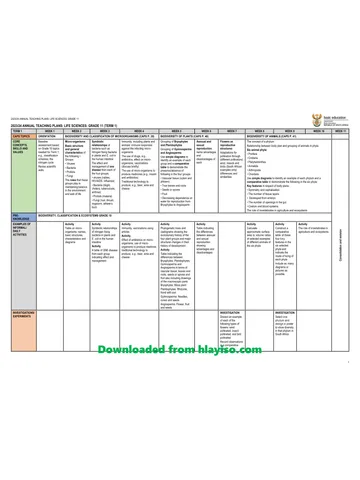
View all
4 . G11 LifeSciences DigitalSupport web Environmental Studies
Grade 11 Life Sciences study guide, 8 pages. Read online or get the free PDF download.
Publisher: Study & Master
Life Sciences · Grade 11. Study guide, 8 pages. Read online or download the PDF.
- Subject
- Life Sciences
- Grade
- Grade 11
- Document type
- Study guide
- Publisher
- Study & Master
- Curriculum
- CAPS
- Pages
- 8
- File size
- 388.0 KB
Loading document…
Loading document…
1 of 8
Document textSearch extracted text and jump to a page.
UNIT 1: Population ecology
benefits of packs
parasitism mutualism
herds/flocks (hunting)
(avoidance) dominance division of
specialisation commensalism tasks (castes)
intraspecific
primary secondary
Social organisation succession succession
Interaction in the
competition
environment
Community change
interspecific predation over time: succession
Population
logistic and ecology possible endpoints
geometric depending on
limiting factors, environmental fluctuations
carrying capacity
fluctuations Population size Human population
reasons for
births immigration exponential growth
mortality emigration forecasts of SA’s
population growth: age and gender
consequences for differences of
environment different countries
UNIT 1 Population ecology
Population size
• Population size is determined by birth, death, immigration and emigration.
• The size of a population can be counted directly or estimated indirectly using
different methods.
• There are at least six ecological factors that regulate the size of populations.
• The size of a population fluctuates around the carrying capacity of the
environment that supports the population.
• Species with a long lifespan, limited number of offspring and extensive
parental care usually follow a logistic population growth pattern (sigmoid or
S-curve).
• Species with a short lifespan, large number of offspring and no or limited
parental care usually follow a geometric growth pattern (exponential or
J-shaped curve).
Interactions in the environment
• Interactions between members of the same species, and also members of
different species, contribute towards maintaining balanced ecosystems.
• Predator-prey relationships regulate the size of both predator and prey
populations in a cyclic way.
• Two specialised forms of competition allow species to share similar
resources. These are competitive exclusion and resource partitioning.
• Parasitism, mutualism and commensalism are examples of interactions in the
environment.
Social organisation
• Individuals in a community show social organisation, e.g. herds and flocks.
Community change over time: succession
• Plant and animal communities are not static. They change by going through
developmental stages collectively known as ecological succession.
The human population
• The world’s population is growing at an exponential rate. The global human
population size reached 7.8 billion by June 2020. It took 200 000 years of
human history to reach the first billion and only 200 years to reach 7 billion.
So, strictly speaking, our population is growing faster than the normal
exponential rate.
• Scientists are of the opinion that the global population will reach
8 billion by 2023, 9 billion by 2048 and 10 billion by 2100. This is alarming
if one considers that the world’s natural carrying capacity has already been
exceeded.
• However, humans have the unique ability, unlike any other species, to
overcome density dependent limiting factors by altering the environment to
satisfy their own needs and greed.
• This humans do by using their mental ability and technical skills. Modern
agriculture, technology, sanitation and medical advances have elevated the
Earth’s artificial carrying capacity to between 9 to 10 billion.
• This comes at the expense of human wellbeing as we have already seen by
the world wide increase of economic and social refugees that have already
doubled during the last decade.
• As can be seen in Figure 2, the global population growth is optimistically
expected to show a slowdown beyond 8 billion when the environmental
resistance intensifies as the carrying capacity is reached.
• However, it is uncertain whether an equilibrium phase will be reached
(logistic S-shaped growth) or whether the population will crash (geometric
J-shaped growth).
Population of the Earth
Number of people living worldwide since 1700 2048
9 bn
9
8 2023
Human population (billions)
2012 8 bn
7 7 bn
6 1999
1987 6 bn
5 5 bn
4 1974
1960 4 bn
3 3 bn
1804
2 1 bn
1927
1 2 bn
0
1700 1800 1900 2000
Year
Figure 2 Estimated global human population growth
The population of South Africa
• The population pyramid in Figure 3 is a most recent estimate of the age and
gender distribution of South Africa.
100+
95–99 South Africa 2017
90–94
85–89 male female
80–84
75–79 Key:
70–74
65–69 postreproductive
60–64
55–59 reproductive
Age (in years)
50–54 prereproductive
45–49
40–44
35–39
30–34
25–29
20–24
15–19
10–14
5–9
0–4
3 2.5 2 2.5 1 0.5 0 0.5 1 1.5 2 2.5 3
Millions
Figure 3 Population pyramid of South Africa
• South African population is becoming rapidly urbanised and we have an age
structure that is skewed towards young people.
• South Africa is going through a demographic transition. Death rates are
dropping, birth rates are declining and there is a declining rate of natural
population increase.
• South Africa is still a very youthful nation. This can be seen in the broad
base of the population pyramid.
• The age group with the largest numbers is those that are currently bearing
children or will bear children in the future. This means that a great deal more
environmental and economic resources are going to be required in the future
to serve all citizens in the country.
• By 2020, South Africa’s human population reached 58.8 million. Ten years
ago, the figure was 50 million. With this rapid growth rate, we may be
heading for a crises in securing future resources for all.
South African population
75
70
60
55
Population in millions
55
50
45
40
35
30
25
20
15
1960 1970 1980 1990 2000 2010 2020 2030 2040
Figure 4 Population growth in South Africa from 1960–2020
UNIT 2: Human impact on the environment
effect of mining
on water quality thermal droughts and
pollution floods
diseases,
eutrophication, poor farming
algal blooms human practices
alien exponential
quality plants population
water use in homes, alien plants
growth and reduction
industry, agriculture
and mining: pollution of agricultural
land
Water
Food security loss of wild
wastage
varieties:
impact on
gene pools
boreholes and
effects on aquifers availability building
dams genetically
wastage engineered
exotic plants
foods
and depletion of destruction
water table of wetlands
droughts and poor farming Human
floods practices impact habitat
destruction
on the poaching
environment
ozone Loss of
depletion biodiversity
(the sixth alien
The extinction) plant
methane
emissions atmosphere invasion
and climate
change
greenhouse indigenous knowledge
effect and systems and sustainable
global warming use of the environment
carbon dioxide
emissions
deforestation reduction of
carbon footprint Solid waste
disposal managing
disposal of dump sites for
nuclear waste rehabilitation
methane from dump sites preventing soil and
for domestic use water pollution
UNIT 2 Human impact on the environment
The atmosphere and climate change
• Carbon dioxide emissions have risen steeply since 1950.
• Carbon dioxide is one of the greenhouse gases that contributes to climate
change.
• The other important greenhouse gases are methane, nitrogen dioxide and
water vapour.
• The carbon footprint is a unit that can be used to work out the cost, in terms
of carbon emissions, of human activities on the environment.
• Forests are the largest terrestrial carbon sinks. Deforestation and
desertification reduce Earth’s ability to soak up excess carbon dioxide and
other greenhouse gases in the atmosphere.
• The greenhouse effect is the name given to the fact that the long wavelengths
of solar energy are reflected back to Earth as they hit the atmosphere and
that carbon dioxide and other greenhouse gases trap some of this long-wave
energy. This forms a “blanket” around the Earth that keeps the planet at the
correct temperature for life.
• Global warming is caused by increasing levels of greenhouse gases, which
are causing a rise in the Earth’s temperature, which is causing climate
change.
• Methane emissions from landfill sites and animal manure are contributing to
global warming and climate change.
• Ozone depletion is caused by reactive chemicals (such as
chlorofluorocarbons, CFCs) that react with and destroy the ozone layer in the
atmosphere. This permits UV-B solar energy to reach Earth, putting all life at
risk of mutations and other forms of damage.
Water
• The availability of water decreases as the human population rises.
• Dam construction has advantages for humans but disadvantages
for ecosystems.
• Wetland destruction has a negative impact on water availability and quality.
• Many modern agricultural practices are detrimental to the water cycle. Much
water is wasted by inefficient irrigation systems used in agriculture.
• Climate change is causing more frequent extreme climatic events such as
droughts and floods.
• The quantity and quality of water stores in aquifers is threatened by
boreholes, municipal landfills, mining and lack of waterborne sewerage in
informal settlements.
• The cost of water rises as the demand increases and availability decreases.
• Industry, agriculture, mining and poor settlement infrastructure pollute and
reduce the quality of water, causing waterborne diseases and eutrophication.
• Pollutants that decrease water quality come from a wide range of human
impacts.
• Purification and recycling of water are essential to sustain this limited
resource.
• Aquatic invasive alien plants have a negative effect on water resources and
are costly to eradicate.
Food security
• Food production has increased faster than the human population has over
the past 40 years, but the availability of food per head of population has
decreased, particularly in the developing world.
• Climate change in the form of frequent floods and droughts and changes to
the timing of seasons decreases food security.
• Poor farming practices negatively affect food security.
• Alien plants affect food security by decreasing the amount of available
agricultural land.
• Genetic vigour of domestic crops requires back-crossing with wild ancestor
strains but many of these ancestral species are threatened by habitat loss.
• Genetically engineered foods may help to improve food security, but so far
they have not had much impact.
• Food waste is greatest in Westernised countries.
Loss of biodiversity
• The sixth mass extinction that is occurring now is a direct result of
human impact.
• Habitat destruction, which reduces biodiversity, is accelerated by human
activities such as overgrazing, monoculture, mining, wetland destruction,
deforestation, planting extensive exotic forests, destruction of grasslands and
other biomes, expanding cities and golf courses, illegal trading of wildlife,
over-exploitation of selected species, introducing invasive alien species and
poaching.
• Mining has serious adverse effects on land, water and air.
• Poaching is potentially causing species to become extinct and is negatively
affecting biodiversity.
• Invasive alien plants (IAPs) are rapidly replacing indigenous species of
plants, at the expense of South Africa’s biodiversity, water resources and soil
fertility.
• Indigenous knowledge systems can provide effective strategies for
conserving biodiversity but can also perpetuate destructive myths and
cultural practices that undermine biodiversity.
• South Africa’s medicinal plants are in global demand and require careful
management to avoid over-exploitation.
Solid waste disposal
• Human industry, technology, consumerism and irresponsibility result in an
ever-increasing load of waste.
• Waste and landfill sites have a serious impact on all parts of the environment
and undermine the efficiency of ecological functions and services.
• The management of most landfill sites in South Africa is very costly and
highly inefficient in terms of energy and resource recovery.
• The waste hierarchy outlines levels of efficiency in managing and saving
energy and resources.
• Landfill sites can be managed to generate biogas or electricity and in the
process also reclaim grey water.
• Methane from landfills can be used to generate electricity for households.
• Nuclear waste disposal is still the major problem associated with
nuclear power.
Study this subject
Notes, quizzes and topic questions for Grade 11 Life Sciences.
- Grade 11 Life Sciences notes
CAPS revision notes with worked examples.
- Life Sciences questions by topic
Past exam questions sorted by CAPS topic, with memos where available.
- Grade 11 Life Sciences quizzes
Short topic quizzes with instant feedback.
- All Grade 11 Life Sciences past papers
Past papers by year, with memos where available.
- Grade 11 Study guides
More Life Sciences and other subjects in this collection.
Recommended for this subject
More papers and memos for this grade and subject.
Annual teaching plan
Gr 11 Life Sci ATP 2023 24
Memorandum
Life Sciences Grade 11 Eastern Cape November 2025 Memo (Afr)
Memorandum
Life Sciences Grade 11 P1 Eastern Cape November 2025 Memo (Eng)
Question paper
Life Sciences Grade 11 Eastern Cape November 2025 QP (Afr)
Question paper
Life Sciences Grade 11 P2 Eastern Cape November 2025 QP
Question paper and memo
Life Sciences Grade 11 KZN June 2025 Paper & Memo
Related documents
Question paper and memo
Life Sciences Grade 11 Eastern Cape June 2024 Paper & Memo
Memorandum
Life Sciences Grade 11 P2 Eastern Cape November 2024 Memo (Afr)
Memorandum
Life Sciences Grade 11 P2 Eastern Cape November 2024 Memo (Eng)
Question paper
Life Sciences Grade 11 P2 Eastern Cape November 2024 QP (Eng)
Question paper and memo
Life Sciences Grade 11 KZN June 2024 Paper & Memo
Question paper
Life Sciences Grade 11 NW June 2024 Question Paper (Afrikaans)
More from Grade 11 Life Sciences
Question paper
Life Sciences Grade 11 NW June 2024 Question Paper (English)
Memorandum
Life Sciences Grade 11 P1 Eastern Cape November 2023 Memo (Afr)
Memorandum
Life Sciences Grade 11 P1 Eastern Cape November 2023 Memo (Eng)
Memorandum
Life Sciences Grade 11 P2 Eastern Cape November 2023 Memo (Afr)
Question paper
Life Sciences Grade 11 P1 Eastern Cape November 2023 QP (Eng)
Question paper