
Downloaded from hlayiso.com
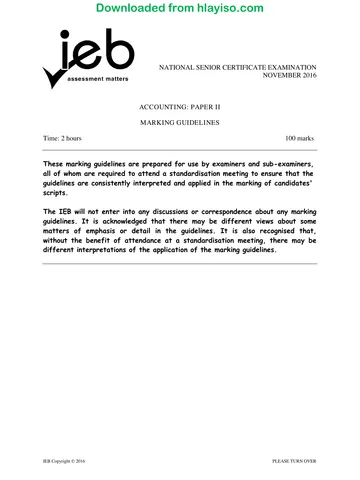
NATIONAL SENIOR CERTIFICATE EXAMINATION
NOVEMBER 2017
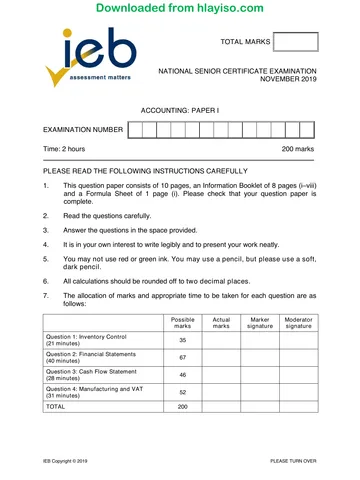
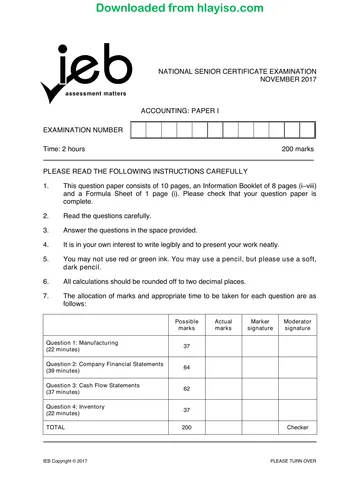
ACCOUNTING: PAPER I
MARKING GUIDELINES
Time: 2 hours 200 marks
These marking guidelines are prepared for use by examiners and sub-examiners,
all of whom are required to attend a standardisation meeting to ensure that the
guidelines are consistently interpreted and applied in the marking of candidates'
scripts.
The IEB will not enter into any discussions or correspondence about any marking
guidelines. It is acknowledged that there may be different views about some
matters of emphasis or detail in the guidelines. It is also recognised that,
without the benefit of attendance at a standardisation meeting, there may be
different interpretations of the application of the marking guidelines.
IEB Copyright © 2017 PLEASE TURN OVER
Skip to contentMemorandum 
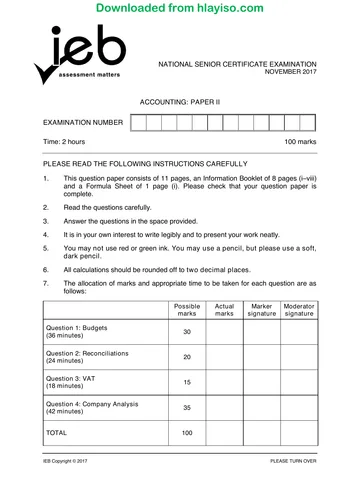
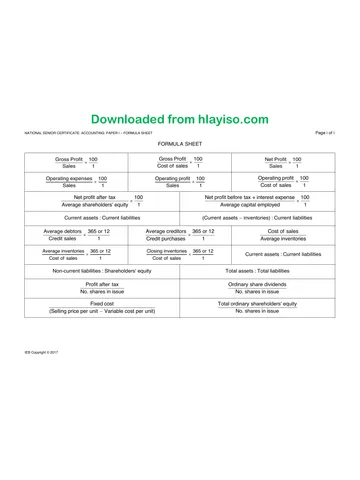
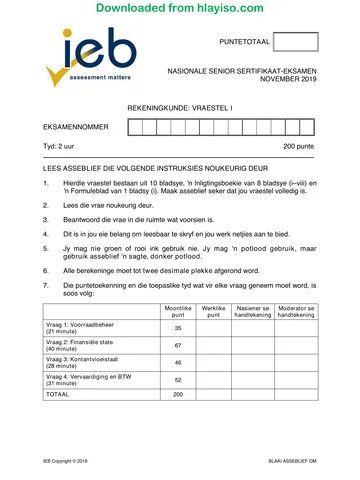
View all
Accounting Grade 12 IEB Paper 1 2017 Memo
IEB Grade 12 Accounting Paper 1 memorandum from the 2017, 12 pages. Read online or get the free PDF download, question paper linked when available.
Publisher: IEB
Accounting · Grade 12 · 2017. Memorandum, 12 pages. Read online or download the PDF.
- Subject
- Accounting
- Grade
- Grade 12
- Document type
- Memorandum
- Year
- 2017
- Paper
- 1
- Publisher
- IEB
- Curriculum
- IEB
- Pages
- 12
- File size
- 382.6 KB
Loading document…
Loading document…
1 of 12
Document textSearch extracted text and jump to a page.
Downloaded from hlayiso.com
NATIONAL SENIOR CERTIFICATE: ACCOUNTING: PAPER I – MARKING GUIDELINES Page 2 of 12
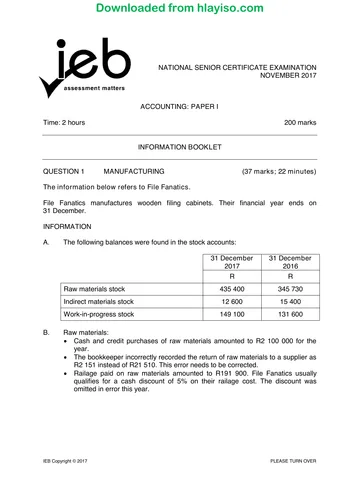
QUESTION 1 MANUFACTURING
Refer to the Information Booklet for information relating to File Fanatics.
1.1 Complete the raw materials note as it would have appeared on
31 December 2017:
Opening stock 345 730
Purchases (2 100 000 – 19 359 mark given if figure seen)
2 080 641
only if subtracted will lose method if amount is unrelated
Railage (191 900 – 9 595)
182 305
loose mark if incorrect use of brackets
Closing stock loose mark if incorrect use of brackets (435 400)
DO NOT TOTAL
1.2 Complete the direct labour note as it would have appeared on
31 December 2017:
Wages (13 × (2 920 × 115) 335 800) 4 365 400
Bonus (4 365 400 × 7%) 305 578
UIF contribution 22 464
If deduction is added they lose contribution mark
DO NOT TOTAL
Bonus and wages may have been added together
4 670 978 or 4 955 366 or 4 431 518 =
4 103 476 =
IEB Copyright © 2017 PLEASE TURN OVER
Downloaded from hlayiso.com
NATIONAL SENIOR CERTIFICATE: ACCOUNTING: PAPER I – MARKING GUIDELINES Page 3 of 12
1.3 Complete the factory overheads note as it would have appeared on
31 December 2017:
Depreciation on factory machinery 15 930
Indirect materials (15 400 + 187 200 – 12 600) 190 000
Factory foreman's salary 540 025 – 312 625) 227 400
Rent expense (409 500 × 3/6) 204 750
50 304
73 360 – 10 480 = 62 880 × 0.8 Give if related
apportionment = 50 to
Insurance (73 360/14 × 12 = 62 880 × 80%) apportionment
Water and electricity 70 000
(22 500 × 100/20 = 112 500 – (112 500 × 25%) – 14 375 Must show
both
112 500 – 28 125 = 84 375 subtractions
DO NOT TOTAL
22 500 × 25% = 5 625
22 500 – 5 625 = 16 872
16 872 -14 375 = 2 500 4 marks if working is shown
1.4 The bookkeeper has incorrectly allocated the bad debts figure of R36 750. Into
which note should bad debts have been recorded? Justify your answer by providing
a reason.
NOTE Selling and distribution note
REASON Bad debts arise specifically from credit sales and therefore
the cost of these needs to be borne by the sales
department.
If reason relates to their note will get 1 out of 2
If reason “Sales” no mark
IEB Copyright © 2017 PLEASE TURN OVER
Downloaded from hlayiso.com
NATIONAL SENIOR CERTIFICATE: ACCOUNTING: PAPER I – MARKING GUIDELINES Page 4 of 12
QUESTION 2 COMPANY FINANCIAL STATEMENTS
Refer to the Information Booklet for information relating to ITSIE LIMITED.
2.1 Complete the Statement of Comprehensive Income (Income Statement) for
the year ending 30 June 2017:
Ignore brackets in Income Statement process
ITSIE LIMITED
Statement of Comprehensive Income for the year ending 30 June 2017
30 June 2017 30 June 2016
R R
Net Sales (3 830 400 – 80 400) 3 750 000
Ignore brackets –
Less: Cost of Sales (2 343 750) less
Gross profit 1 406 250
DO NOT
Other Operating Income CALCULATE
600 000
618 000
Rent income (R50 000 × 9 = 450 000) + 708 000
(R59 000 × 3 = R177 000) 627 000 924 000
Discount received 9 600
Fee income 223 000
DO NOT
Gross income for the year CALCULATE
(1 687 500)
1 723 680
Operating expenses (45% 3 830 400)
Advertising (37 100 + [7 600/1,6 × 3 = 51 350
14 250]) OR [37 100 + (7 600 × 3) 59 900
×100/160] (3 × SP)
Audit fees 90 000
Bank charges 11 400
Debtors' allowances (80 400 – 80 400) 0
Delivery expenses 145 000
Discount allowed 29 350
Lease on vehicle 161 000
Salaries and wages 505 200
Directors' fees 682 900
9 500
Trading stock deficit (4 750 × 2) If 15 200
Check with advertising (2 × SP of 7 600)
Provision for bad debts adjustment 1 800
DO NOT
Operating profit for the year CALCULATE
Interest income 12 625
DO NOT
Profit before interest expense CALCULATE
Interest expense (33 000 + 50 375) (83 375)
Only as adjusting figure Method in adding
Profit before taxation 507 600
Taxation for the year (170 250)
IEB Copyright © 2017 PLEASE TURN OVER
Downloaded from hlayiso.com
NATIONAL SENIOR CERTIFICATE: ACCOUNTING: PAPER I – MARKING GUIDELINES Page 5 of 12
Net profit after taxation (154 000/0,22
= 700 000 + 165 000) × 39 c 337 350
315 900
165 000 × .39c = 64 350
700 000 × .39c = 273 000
Interest [600 000 × 14% × 7/12 = 49 000] + [550 000 × 15% × 5/12 = 34 375]
= 84 000 = 82 500
IEB Copyright © 2017 PLEASE TURN OVER
Downloaded from hlayiso.com
NATIONAL SENIOR CERTIFICATE: ACCOUNTING: PAPER I – MARKING GUIDELINES Page 6 of 12
2.2 Complete the Retained income note as it would have appeared in the notes
to the Financial Statements as at 30 June 2017:
ITSIE LIMITED
Notes to the Financial Statements as at 30 June 2017
30 June 2017
R
RETAINED INCOME
Balance as at 1 July 2016 302 500
Net income after tax not before tax 337 350
Repurchase of shares (55 000 × 1, 90) (104 500)
95 000
Dividends for the year (393 050)
Interim paid (400 000 – 154 000) 246 000
147 050
If 14 705 000
Final declared (700 000 + 165 000) × 17c (865 000 × R17)
Balance as at 30 June 2017 142 300
Must show brackets
2.3 Complete the Current Assets section in the Statement of Financial Position
(Balance Sheet) as at 30 June 2017:
ITSIE LIMITED
Statement of Financial Position as at 30 June 2017
30 June 2017 30 June 2016
R R
DO NOT
CURRENT ASSETS CALCULATE
Inventories 407 000 437 000
Trade and other receivables
(337 500 × 1,25 – 152 000) 269 875
Cash and cash equivalents 152 000
If 421 875 (337 500 × 1,25)
185 000 (337 500 – 153 000)
IEB Copyright © 2017 PLEASE TURN OVER
Downloaded from hlayiso.com
NATIONAL SENIOR CERTIFICATE: ACCOUNTING: PAPER I – MARKING GUIDELINES Page 7 of 12
QUESTION 3 CASH FLOW STATEMENTS
Refer to the Information Booklet for information relating to INGIVELA LIMITED.
3.1 Complete the Tangible Asset note as it would have appeared in the
Statement of Financial Position as at 31 December 2017:
NOTE 3: TANGIBLE ASSETS
Plant and
Property Vehicles Machinery
Carrying value on 1 January 2017 3 000 000 700 000 645 000 ?
Cost 3 000 000 1 750 000 1 350 000
Accumulated depreciation – (1 050 000) (705 000)
Ignore
MOVEMENTS brackets
2 850 000
Additions ? 450 000 225 000
Disposals (110 160)
180 000 – 57 600 – 12 240 – 0 ?
Depreciation (104 520 + 12 240 + (131 760)
15 000) – (220 000) ?
Carrying value on 31 December DO NOT
2017 5 850 000 930 000 CALCULATE
Cost 5 850 000 2 200 000 1 395 000
– (766 920)
Accumulated depreciation (1 270 000) ?
Accuracy Method mark = brackets
If no information in note then award marks in calculation block due to ? being in the way
Calculation for depreciation (Alternate mark allocation for workings only.)
1350 + 225 – × =1 395
(180 000 – 57 600) = 122 400 × 20% × 6/12 = 12 240 sold new old
24 480 / 36 000 / 18 000
225 000 × 20% × 4/12 = 15 000
1 350 000 – 180 000 = 1 170 000
705 000 – 57 600 = 647 400
106 968
1 170 000 – 647 400 = 522 600 × 20% = 104 520 depr cal – disposal
depreciation
Calculation for asset disposal
180 000 – (57 600 + 12 240 = 69 840) = 110 160
122 400
167 760
IEB Copyright © 2017 PLEASE TURN OVER
Downloaded from hlayiso.com
NATIONAL SENIOR CERTIFICATE: ACCOUNTING: PAPER I – MARKING GUIDELINES Page 8 of 12
3.2 Calculate the Cash generated from operations as it would appear in the
reconciliation of profit before taxation and cash generated from operations
on 31 December 2017.
= 1 962 010 – 946 050 (1 463 550 – 517 500)
+ 315 900 (944 400 – 628 500) + 414 750 ( 656 700 + 13 050 OR =
669 750 – 247 500 – 7 500 OR (255 000)
656 700 – 247 500 = 409 200
= 1 746 610 Payables +/
3.3 Complete the Cash Flow Statement of INGIVELA LIMITED for the year
ended 31 December 2017. Show all working detail in brackets.
INGIVELA LIMITED
Cash Flow Statement for the year ended 31 December 2017
No brackets no marks
DO NOT
Cash flows from operating activities CALCULATE
Cash generated from operations 1 746 610
Interest paid (63 000)
Dividends paid (412 500 + (173 250 + 157 500)) –
157 500
-412 500 – 173 250 – 157 500 + 157 500 (585 750)
Taxation paid (494 830 – 53 550 – 26 100)
-494 830 + 53 550 + 26 100
494 830 – 53 550 = 441 280
494 830 – 26 100 = 468 730
53 550 +26 100 = 79 650
53 550 – 26 100 = 27 450 (415 180)
DO NOT
Cash flows from investing activities CALCULATE
(3 900 000)
Purchase of non-current assets (3 525 000 + 375 000) (3 525 000)
Proceeds from the sale of non-current assets refer back 110 160
DO NOT
Cash flows from financing activities CALCULATE
Proceeds of share capital (475 000 × 4, 50) 2 137 500
Repurchase of shares (134 500)
Proceeds of new loans (600 000 + 63 000 = 663 000 –
123 000 – 2 692 500)
663 000 – 123 000 = 540 000
600 000 – 123 000 = 477 000
123 000 – 63 000 = 60 000
600 000 – 2 692 500 = 2 095 500
663 000 – 123 100 – 2 692 500 = 1 906 500 2 152 500
IEB Copyright © 2017 PLEASE TURN OVER
Downloaded from hlayiso.com
NATIONAL SENIOR CERTIFICATE: ACCOUNTING: PAPER I – MARKING GUIDELINES Page 9 of 12
Repayment of capital portion of loan (10 250 × 12 =
123 000) – 63 000 (60 000)
Net change in cash and cash equivalents 988 340
(138 000)
165 000 –
Cash and cash equivalents at the beginning of the year 27 000
Cash and cash equivalents at the end of the year 850 340
IEB Copyright © 2017 PLEASE TURN OVER
Downloaded from hlayiso.com
NATIONAL SENIOR CERTIFICATE: ACCOUNTING: PAPER I – MARKING GUIDELINES Page 10 of 12
QUESTION 4 INVENTORY
Refer to the Information Booklet for information relating to Rhodes Cricket
Supplies.
4.1 Provide one advantage of both the Periodic and Perpetual Inventory systems.
Advantage of the Periodic system:
Simple, cheap
It is a cost effective system as there is very little outlay for expensive
equipment. Feasible for businesses where it is difficult to determine the
cost price of a single item.
Advantage of the Perpetual system:
GP can be determined
Cost of sales is known
Stock thefts are easily and quickly identified. Better control over stock
Alternative advantages will be marked.
4.2 A number of cricket bats were stolen during the November robbery. No
entry has been made to account for this theft. Calculate the number of
cricket bats stolen.
(1 100 + 15 000 )= 16 100 – 2 650 = 13 450 – 13 430 = 20 bats stolen
4.3 Calculate the value of the closing stock of cricket bats.
2 650 × [14 409 500 (13 470 000 + 939 500)/ 16 100 (15 000 + 1 100) =
895] = 2 371 750
898 = 2 379 700
IEB Copyright © 2017 PLEASE TURN OVER
Downloaded from hlayiso.com
NATIONAL SENIOR CERTIFICATE: ACCOUNTING: PAPER I – MARKING GUIDELINES Page 11 of 12
4.4 By calculating how long the closing stock will last (stock holding period)
determine on what date the owner has to place his next order for cricket
bats so as not to run out. The supplier takes 14 days to deliver after the
order has been placed.
Calculation of stock holding period:
Cost of sales [939 500 + 13 470 000 – 2 371 750] = 12 037 750
COS: ignore use of formula.
Implied total if calculation in formula
From 4.3
2 371 750 × 365
12 037 750 1
14 409 500
14 391 600
Or (895 × 13 430)= 12 019 850 + (20 × 895) = 17 900 =12 037 750
= 71, 9 days or 72 days
The order needs to be placed:
From above
71, 9 days – 14 days = 57, 9 days
January 31 days therefore the order needs to be placed on about the
27 February date correct to answer
IEB Copyright © 2017 PLEASE TURN OVER
Downloaded from hlayiso.com
NATIONAL SENIOR CERTIFICATE: ACCOUNTING: PAPER I – MARKING GUIDELINES Page 12 of 12
4.5 Calculate the cost of sales for the cricket bags sold.
60 000 + 1 260 000 (1 000 × 1 260) + 1 417 500 (1 050 × 1 350) + 27 600
(20 × 1 380) = 2 765 100
OR
60 000 + [4 051 500 – 270 000 (200 × 1 350)] – 1 076 400 (780 × 1 380) =
2 765 100
4.6 Clive Rhodes, the owner, is concerned that the business is not achieving
their intended mark-up on the sale of cricket bags. The business aims to
achieve a mark-up of 60% at all times. Calculate the mark-up % achieved
on the sale of cricket bags.
From 4.5 from 4.5
4 112 800 – 2 765 100 = 1 347 700/ 2 765 100 × 100/1
= 48, 74%
If used mark-up formulae (GP/COS × 100 or Sales /COS × 100 – 100)
4.7 Provide (does not need to be explained) two reasons why the business has
not achieved their intended mark-up on the sale of cricket bags.
Linked to 4.6. if actual is higher accept relevant answer
Do not accept: donations, drawings, deficits
Accept: damages, debtors allowances, different valuation method, loyalty
programmes, error in processing selling price, cost price increasing but
selling price stays the same
Reason 1:
Too many cash discounts on the selling price granted to customers.
May have been holding too much stock and need cash so sold below the
intended mark-up%
Reason 2:
Seasonal sales may have seen stock being sold at a lower price. They may
be moving old stock to make room for new brands etc.
Total: 200 marks
IEB Copyright © 2017
Study this subject
Revise the topics in this paper, then practise them question by question.
- Grade 12 Accounting notes
CAPS revision notes with worked examples.
- Accounting questions by topic
Past exam questions sorted by CAPS topic, with memos where available.
- Grade 12 Accounting quizzes
Short topic quizzes with instant feedback.
- All Grade 12 Accounting past papers
Past papers by year, with memos where available.
- Grade 12 IEB past papers
More Accounting and other subjects in this collection.
Recommended for this subject
More papers and memos for this grade and subject.
MemorandumIEB
Accounting Grade 12 IEB Paper 1 2018 Memo
MemorandumIEB
Accounting Grade 12 IEB Paper 2 2018 Memo
MemorandumIEB
Accounting Grade 12 IEB Paper 2 2017 Memo
MemorandumIEB
Accounting Grade 12 IEB Paper 1 2016 Memo
MemorandumIEB
Accounting Grade 12 IEB Paper 2 2016 Memo
Question paperIEB
Accounting Grade 12 IEB Paper 1 2019 Question Paper
Related documents
Question paperIEB
Accounting Grade 12 IEB Paper 1 2017 Question Paper
Information sheetIEB
Accounting Grade 12 IEB Paper 1 2017 Information Sheet
Question paperIEB
Accounting Grade 12 IEB Paper 2 2017 Question Paper
Information sheetIEB
Accounting Grade 12 IEB 2017 Information Sheet
Information sheetIEB
Accounting Grade 12 IEB Paper 2 2017 Information Sheet
Question paperIEB
Accounting Grade 12 IEB Paper 1 2019 Question Paper (Afrikaans)
More from Grade 12 Accounting
Question paperIEB
Accounting Grade 12 IEB Paper 2 2019 Question Paper
Question paperIEB
Accounting Grade 12 IEB Paper 2 2019 Question Paper (Afrikaans)
Information sheetIEB
Accounting Grade 12 IEB 2019 Information Sheet (Afrikaans)
Information sheetIEB
Accounting Grade 12 IEB Paper 1 2019 Information Sheet
Information sheetIEB
Accounting Grade 12 IEB P1 2019 Information Sheet (Afrikaans)
Information sheetIEB