
Downloaded from hlayiso.com
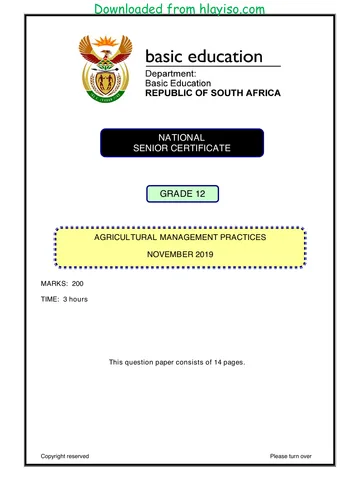
NATIONAL SENIOR CERTIFICATE EXAMINATION
NOVEMBER 2019
AGRICULTURAL MANAGEMENT PRACTICES
Time: 3 hours 200 marks
PLEASE READ THE FOLLOWING INSTRUCTIONS CAREFULLY
1. This question paper consists of 14 pages. Please check that your question paper is
complete.
2. This question paper consists of TWO sections.
3. Answer ALL the questions.
4. Read all the questions carefully and make sure that you answer only what is being
asked.
5. Start EACH question on a NEW page.
6. Number your answers exactly as the questions are numbered.
7. Non-programmable calculators may be used.
8. ALL calculations must be rounded off to TWO decimal places unless stated
otherwise.
9. It is in your best interests to write legibly and to present your work neatly.
IEB Copyright © 2019 PLEASE TURN OVER
You're offline
Skip to contentQuestion paper 



View all



Agri Management 2019 hlayiso.com
Agricultural Management Practices · Grade 12 · 2019. Question paper, 14 pages. Read online or download the PDF.
- Subject
- Agricultural Management Practices
- Grade
- Grade 12
- Document type
- Question paper
- Year
- 2019
- Publisher
- IEB
- Pages
- 14
- File size
- 342.6 KB
Loading document…
Loading document…
1 of 14
Document textSearch extracted text and jump to a page.
Downloaded from hlayiso.com
NATIONAL SENIOR CERTIFICATE: AGRICULTURAL MANAGEMENT PRACTICES Page 2 of 14
SECTION A
QUESTION 1
1.1 Various options are provided as possible answers to the following questions.
Choose the correct answer and write down the question number and the letter
that corresponds to your answer in the ANSWER BOOK, for example
1.1.11 B.
1.1.1 The fertiliser that must be applied to correct the high pH of soil with
an excess of sodium salts is ...
A lime.
B urea.
C gypsum.
D ammonium sulphate.
1.1.2 The employment of capital in an enterprise with the expectation of
making a profit is called ...
A profit.
B gross farming income.
C investment.
D input terms.
1.1.3 The addition of organic matter to soils especially improves the …
A soil structure.
B soil reaction.
C soil depth.
D soil texture.
1.1.4 A … is issued to confirm that money was received by the
enterprise.
A credit sales invoice
B receipt
C cheque
D debit note
1.1.5 The … is where money is kept for expenses such as coffee,
envelopes, etc.
A cheque
B cash book
C diary
D petty cash
IEB Copyright © 2019
Downloaded from hlayiso.com
NATIONAL SENIOR CERTIFICATE: AGRICULTURAL MANAGEMENT PRACTICES Page 3 of 14
1.1.6 The primary tilling implement that is used to deeply till soil to break
down a restrictive layer to improve water infiltration and drainage is
a ...
A rotavator.
B chisel plough.
C disc plough.
D ripper.
1.1.7 The following is NOT a technological aid used in precision farming:
A global positioning system (GPS)
B geographic information system (GIS)
C yield monitors
D cation-exchange capacity (CEC)
1.1.8 The soil characteristic determining and affecting most soil qualities
is ...
A soil structure.
B soil depth.
C soil texture.
D soil reaction.
1.1.9 The most economic source of animal feed is …
A natural veld.
B established pastures.
C grain crops.
D pastures under irrigation.
1.1.10 The term … means that not a single living organism is present in a
product.
A pasteurised
B sterilised
C heated
D preserved (20)
IEB Copyright © 2019 PLEASE TURN OVER
Downloaded from hlayiso.com
NATIONAL SENIOR CERTIFICATE: AGRICULTURAL MANAGEMENT PRACTICES Page 4 of 14
1.2 Choose a description from COLUMN B that matches a term from
COLUMN A. Write down only the question number and the letter that
corresponds to your choice in the ANSWER BOOK, for example: 1.2.11 A.
Each description in COLUMN B may be used only ONCE.
COLUMN A COLUMN B
1.2.1 production risk A the economic phenomenon where
the income from certain equipment
1.2.2 monopoly does not justify the monetary cost of
that equipment
1.2.3 global positioning
system B the rendering of services to the
farmer
1.2.4 groundwater capacity
C a resource that is used to obtain all
1.2.5 control the data and prices of equipment
1.2.6 inventory D assists a farmer in determining the
area of a field
1.2.7 depreciation
E the loss in value of a movable asset
1.2.8 information because of wear and tear
1.2.9 undercapitalisation F the ability of soil to hold water
against gravitation
1.2.10 tertiary agriculture
G a list of all the assets on the farm
H drought and unforeseen weather
phenomena in a production season
I the type of price fixing in a market
with one seller and many buyers
J the management function that
ensures that all the daily work gets
done
K when too little capital is available to
obtain maximum production
(20)
IEB Copyright © 2019
Downloaded from hlayiso.com
NATIONAL SENIOR CERTIFICATE: AGRICULTURAL MANAGEMENT PRACTICES Page 5 of 14
1.3 Give the correct agricultural term for each of the following descriptions.
Write down only the question number and the correct term in the ANSWER
BOOK, for example 1.3.11 sodium.
1.3.1 The type of vegetation that grows in alkaline soil in a low-rainfall
area.
1.3.2 The setting of a spray pump to function at the correct rate.
1.3.3 The precision farming technology that is used to assist the farmer in
technologically controlling the amount of harvesting input that is
required by a crop on a specific area.
1.3.4 The management function that is required before any task on a
farm can start or without which no activity is possible.
1.3.5 Refers to the particle size of the soil particles.
1.3.6 The process that the farmer follows to get the product from the farm
to the consumer.
1.3.7 The production of various specialised products from the basic
product.
1.3.8 The type of pest control system in which the farmer uses biological
and chemical control as well as efficient farming methods.
1.3.9 The successive cultivation of different crops on the same piece of
land.
1.3.10 The most basic natural resource in the agricultural industry. (10)
50 marks
IEB Copyright © 2019 PLEASE TURN OVER
Downloaded from hlayiso.com
NATIONAL SENIOR CERTIFICATE: AGRICULTURAL MANAGEMENT PRACTICES Page 6 of 14
SECTION B
QUESTION 2 RESOURCE UTILISATION, LAND USE AND FARMING
SYSTEMS
2.1 Study the fact box below and then answer the questions that follow:
• Together with water, soil can justly be regarded as one of the most important
natural resources.
• Soil suitability or the uses of soil are determined by soil characteristics related
to soil qualities.
• The soil structure influences the soil aeration.
• Soil texture and soil depth determine the water-holding capacity of the soil.
• The cation exchange capacity of soil determines the soil fertility.
• The soil fertility in turn determines the soil colour and soil temperature.
• Information (a human resource) on soil characteristics and soil qualities is
therefore essential for determining the suitability of soil for irrigation,
grazing, cultivation, etc.
2.1.1 In each of the cases below, explain how the relevant soil
characteristics would affect the stated soil quality.
(a) The effect of a clayey soil texture on water infiltration. (2)
(b) The effect of a single-grain soil structure on the tillability of
the soil. (2)
(c) The effect of shallow soil on the aeration of the soil. (2)
(d) The effect of low soil temperatures on plants' absorption of
water and nutrients. (2)
2.1.2 Discuss the …
(a) mineral content and drainability of soil with a red colour. (2)
(b) growth rate of plants and the microbe population of soil with
a pH of 4. (2)
IEB Copyright © 2019
Downloaded from hlayiso.com
NATIONAL SENIOR CERTIFICATE: AGRICULTURAL MANAGEMENT PRACTICES Page 7 of 14
2.2 Study the case study below and then answer the questions that follow:
A famer has a mixed farming enterprise. The farm has tillable soil for cultivating
grain, established perennial pastures and orchards under irrigation. The seeds for
planting the grain and pastures are bought from recognised seed producers to
ensure good germination. The work on the farm is done by a farm manager and
eight labourers who receive their remuneration monthly, live on the farm, share
in the profits and maintain a 45-hour work week. The labourers also get regular
training to develop their skills.
The water for irrigating the fruit and established pastures comes from a borehole
and is pumped to a reservoir. The reservoir was erected by an experienced
contractor and a team of labourers. The water also serves as drinking water for
the intensive stock farming. The farmer attempts to use only organic farming
practices and markets his fruit and meat in the local shopping centres as
"organic". The farmer uses labourers from the local community as well as
contract workers to help harvesting the fruit.
2.2.1 Give TWO examples from the case study of …
(a) fixed capital. (2)
(b) movable capital. (2)
(c) operating capital. (2)
2.2.2 List THREE problems associated with capital as a factor of
production. (3)
2.2.3 List THREE methods that the farmer could use to improve the
productivity of his farmland. (3)
2.2.4 Explain from the case study what is meant by …
(a) mixed farming. (2)
(b) organic farming. (1)
2.2.5 Discuss intensive stock farming in terms of …
(a) population density. (2)
(b) animal feed. (2)
(c) labour costs. (2)
2.2.6 Give ONE sentence from the case study that suggests that the
farmer is a commercial farmer. (1)
IEB Copyright © 2019 PLEASE TURN OVER
Downloaded from hlayiso.com
NATIONAL SENIOR CERTIFICATE: AGRICULTURAL MANAGEMENT PRACTICES Page 8 of 14
2.2.7 List THREE advantages of a camp system in animal production
should the farmer decide to divide the pastures into camps. (3)
2.2.8 Name the TWO types of temporary labour that the farmer uses and
also give an example of each. (4)
2.2.9 Give TWO pieces of evidence that the farmer attempts to increase
the productivity of his labourers. (2)
2.2.10 Name the labour law applicable to the "45-hour work week". (1)
2.3 Study the photograph below and then answer the questions that follow.
[Photo: Landbouweekblad, 14 April 2017]
2.3.1 Identify the poor farming technique that caused the conditions to
the right of the fence in the photograph above. (1)
2.3.2 Name TWO reasons why a pasture should get enough time to rest
between grazing periods. (2)
2.3.3 Define the term carrying capacity. (3)
[50]
IEB Copyright © 2019
Downloaded from hlayiso.com
NATIONAL SENIOR CERTIFICATE: AGRICULTURAL MANAGEMENT PRACTICES Page 9 of 14
QUESTION 3 AGRITOURISM AND MARKETING
Carefully study the article (Landbouweekblad, 3 February 2017) below and then
answer questions 3.1, 3.2 and 3.3.
Over the past ten years the local alpaca industry has grown from a handful of breeders
with a few animals to a fully fledged branch of farming consisting of about 50 breeders,
producers and processors of alpaca products.
Ms Alison Notley, chairperson of the alpaca society of SA, says that most alpaca farming
enterprises are in the Western Cape, but there are also big alpaca herds in the Free
State, KwaZulu-Natal and Gauteng. She says that interest in alpacas is increasing and
more and more breeders are joining the society.
Although the fibre-processing branch of alpaca production does not suit everybody,
alpacas are also used as guards for flocks of sheep and as pets. In Oudtshoorn there is
even a farmer using them to guard his springbuck.
However, Notley warns that alpacas are a niche market and the initial input cost of the
animals varies significantly. The price of the animal will largely be determined by its
gender and whether a female animal is pregnant. A young pregnant alpaca can cost up
to R22 000, whereas male alpacas cost approximately R5 500 each. A young alpaca ram
that has not yet been proven fertile, can fetch even less. The prices of alpaca fibre also
vary considerably, depending on the product that is being made from the fibre.
Notley is of the opinion that the market for alpacas has a bright future. "A number of
breeders have already exported alpacas to Namibia, to Lesotho and recently to
Botswana," she says.
3.1 3.1.1 List THREE uses of alpacas from the article above. (3)
3.1.2 In the article it is claimed that alpacas are a niche market. Give a
definition of a niche market by referring to TWO characteristics of a
niche market. (2)
3.1.3 Give THREE reasons why experts claim that niche markets will
become more common in the agricultural industry in future. (3)
3.1.4 Analyse and explain THREE possible reasons for Ms Notley's
warning to farmers and prospective buyers. (3)
IEB Copyright © 2019 PLEASE TURN OVER
Downloaded from hlayiso.com
NATIONAL SENIOR CERTIFICATE: AGRICULTURAL MANAGEMENT PRACTICES Page 10 of 14
3.2 After a young farmer has read the alpaca article, he decides to start farming
with alpacas. The farmer visits several of the alpaca farms in the Free State
and Western Cape to conduct research and gather information on alpacas.
But before he buys any animals, he first compiles a business plan.
3.2.1 Give FOUR reasons for compiling a business plan. (4)
3.2.2 In compiling the business plan he also conducts a SWOT analysis.
Explain what is meant by a SWOT analysis by referring to its
components. (4)
3.2.3 Name TWO requirements or principles with which the setting of
production objectives for the intended alpaca enterprise should
comply. (2)
3.3 The farmer in Question 3.2 may justly be regarded as an agritourist.
3.3.1 Explain what is meant by the term agritourist. (3)
3.3.2 Identify the following types of agritourism:
(a) Tourists visiting the alpaca farm to conduct research on
alpaca breeding. (1)
(b) Tourists visiting the farm to follow the route to see how
alpaca products are being processed. (1)
3.3.3 List THREE ways in which agritourism may benefit the local
community. (3)
3.4 The table below shows the number of bags of potatoes supplied and sold
per week at different prices at a local market. Each bag weighs 10 kg.
Study the table and then answer the questions that follow.
PRICE NUMBER OF NUMBER OF
(R/BAG) BAGS SUPPLIED BAGS SOLD
R60,00 100 5
R45,00 80 25
R40,00 70 30
R35,00 70 45
R30,00 60 50
R25,00 50 50
3.4.1 Draw a line graph to represent the relationship between the number
of bags of potatoes supplied and sold at a given price. (6)
3.4.2 Explain how the price of a bag of potatoes in the table above affects
its supply and demand. (3)
3.4.3 From the table above it is clear that the price of potatoes affects its
demand. List THREE other factors that would also influence the
demand for potatoes. (3)
IEB Copyright © 2019
Downloaded from hlayiso.com
NATIONAL SENIOR CERTIFICATE: AGRICULTURAL MANAGEMENT PRACTICES Page 11 of 14
3.4.4 Explain what the concept market equilibrium implies. (2)
3.4.5 Which marketing method do the farmers use in the example
(Question 3.4) above? (1)
3.4.6 List THREE marketing methods other than the method in
Question 3.4.5 that farmers could use to market their products. (3)
3.4.7 List THREE marketing costs in the production of an agricultural
product. (3)
[50]
IEB Copyright © 2019 PLEASE TURN OVER
Downloaded from hlayiso.com
NATIONAL SENIOR CERTIFICATE: AGRICULTURAL MANAGEMENT PRACTICES Page 12 of 14
QUESTION 4 FARM MANAGEMENT, FINANCIAL PLANNING AND
ADDING VALUE TO HARVESTS
4.1 Income statements, balance sheets and budgets are very important
documents in the financial management of a farming enterprise. The budget
below shows the estimated financial aspects of the sheep production
enterprise for the 2018/2019 financial book year of a vineyard, wheat and
sheep production enterprise. Study the information below and then answer
the questions that follow.
ESTIMATED EXPENSES ESTIMATED INCOME
ITEM AMOUNT ITEM AMOUNT
(R) (R)
Veterinary/Medicine 9 300,00 Sales of livestock directly 470 000,00
from the farm
Feed 33 345,00 Manure sales 7 500,00
Feed supplements 8 800,00
Labour 35 500,00
Electricity 4 308,00
Maintenance of feeding 19 500,00
pen/feed lot
Chemical pest control 8 756,00
Fuel 3 500,00
Total costs Total proceeds
4.1.1 Calculate the possible profit or loss that the farmer can generate
from this enterprise. Show all the calculations. (4)
4.1.2 Name TWO ways in which the income can be increased. (2)
4.1.3 Name TWO environmentally friendly measures that this farmer
could implement. (2)
4.1.4 Is the budget above a whole-farm, operational or partial budget? (1)
4.1.5 Give ONE reason for your answer to Question 4.1.4. (1)
4.1.6 Name the type of budget that is used to compare two branches of a
farming enterprise with each other. (1)
4.1.7 Define the following terms:
(a) budget (3)
(b) income statement (3)
(c) balance sheet (3)
IEB Copyright © 2019
Downloaded from hlayiso.com
NATIONAL SENIOR CERTIFICATE: AGRICULTURAL MANAGEMENT PRACTICES Page 13 of 14
4.2 In the decision-making process an entrepreneur uses the break-even
analysis to assist him in evaluating the dynamic ratio between cost, volume,
income and profit. Study the scenario below and then answer the questions
that follow.
An entrepreneur would like to use precision farming in his intended beef cattle
enterprise, but he first wants to determine how much it is going to cost for an
animal to gain enough weight before he will make a profit. The fixed cost
amounts to R520,00 per animal. The variable cost amounts to R0,70 per
kilogram. The price that the entrepreneur will get is R3,50 per kilogram live
weight.
4.2.1 Use an applicable formula to calculate the break-even point. Show
the formula as well as all the calculations. (4)
4.2.2 Name ONE management skill from the scenario above that this
entrepreneur should possess to possibly establish a successful
enterprise. (1)
4.2.3 Give THREE ways in which this entrepreneur can use precision
farming in his beef cattle enterprise. (3)
4.3 Study the text below and then answer the questions that follow:
Handling agricultural products is very important to ensure that the consumer
gets a product of good quality. The process already starts on the farm by applying
the correct management practices during the growth process and harvesting,
handling, storing and packaging the products.
Fruit for the fresh produce market is usually harvested manually, and for the
processing market, mainly mechanically. Transporting the product from the
orchard to the storeroom on the farm should take place as quickly as possible.
Cooling the product during transportation and in the storeroom is of the utmost
importance.
Grain products are often stored in bulk by companies investing a lot of capital in
the maintenance and technological development of their handling and storage
facilities. These companies perform several important value-adding functions
such as the grading and sorting of the product. The presence of foreign
substances, the presence of broken/damaged grains, the presence of diseases/
insects and the moisture content at storage are important factors that must be
taken into account by companies to ensure that the consumer gets a product of
good quality.
4.3.1 Give TWO reasons and substantiate each of the reasons why
products for the fresh produce market should rather be harvested
manually and not mechanically. (4)
IEB Copyright © 2019 PLEASE TURN OVER
Downloaded from hlayiso.com
NATIONAL SENIOR CERTIFICATE: AGRICULTURAL MANAGEMENT PRACTICES Page 14 of 14
4.3.2 In the text, reference is made to the grading of grain products.
(a) Define the term grading. (1)
(b) Give THREE visible criteria from the text on the previous
page for the grading of grain products. (3)
4.3.3 Explain the advantages that the packaging, storage, grading and
sorting of products as value-adding functions can possibly have for
the consumer. (3)
4.3.4 According to the text, the cooling of the products during
transportation and in the storeroom is of the utmost importance.
(a) Defend the statement above by referring to the effect of
temperature on living microorganisms and enzymes that are
present on products. (2)
(b) List THREE types of cooling methods that may be used to
protect products against spoilage. (3)
4.3.5 Storing products in small quantities on the farm have various
advantages and disadvantages for the producer. Give THREE
disadvantages of storing products in small quantities. (3)
4.3.6 For which THREE reasons are products mainly packaged? (3)
[50]
150 marks
Total: 200 marks
IEB Copyright © 2019
Recommended for this subject
Published documents with matching subject and grade metadata.
Question paper
Agricultural Management Practices Nov 2025 Afr
Question paper
Agricultural Management Practices Nov 2025 Eng
Question paper
AGRIC SCIENCES P1 QP GR12 SEPT 2024 Xhosa
Question paper
AGR SCIENCES P2 GR12 QP SEPT2024 IsiXhosa
Question paper
Agricultural Management Practices Nov 2024 Afr
Question paper
Agricultural Management Practices Nov 2024 Eng
Related documents
Matched using subject, grade, language, document type and exam metadata.
Question paper
Agri Management 2019 Afr hlayiso.com
Question paper
Agri Management Afr hlayiso.com
Question paper
Agricultural Management Practices May June 2019 Eng hlayiso.com
Question paper
Agricultural Management Practices Nov 2019 Afr hlayiso.com
Question paper
Agricultural Management Practices Nov 2019 Eng hlayiso.com
Document
Agricultural Management Practices PAT GR 12 2019 Afr hlayiso.com
More from Grade 12 Agricultural Management Practices
Explore more published documents in this catalogue.
Annual teaching plan
Gr 12 Agric Man Prac ATP 2023 24
Memorandum
Agricultural Management Practices Nov 2025 MG Eng
Memorandum
Agricultural Management Practices Nov 2025 MG Afr
Memorandum
AGRIC SCIENCES P1 QP GR12 SEPT 2024 Xhosa Memo
Memorandum
AGR SCIENCES P2 GR12 MEMO SEPT2024 English
Question paper