
Downloaded from hlayiso.com
NATIONAL SENIOR CERTIFICATE EXAMINATION
NOVEMBER 2017
AGRICULTURAL MANAGEMENT PRACTICES
Time: 3 hours 200 marks
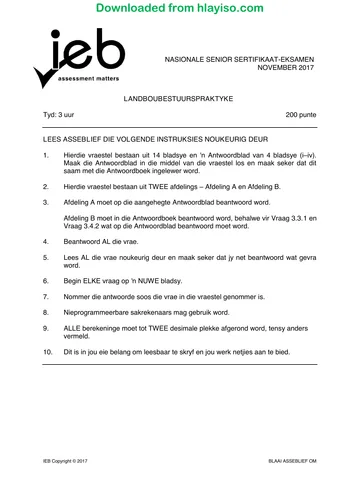
PLEASE READ THE FOLLOWING INSTRUCTIONS CAREFULLY
1. This question paper consists of 14 pages and an Answer Sheet of 4 pages (i–iv).
Detach the Answer Sheet from the centre of the question paper and ensure that it
is handed in together with the Answer Book.
2. This question paper consists of TWO sections – Sections A and B.
3. Section A must be answered on the attached Answer Sheet.
Section B must be answered in the Answer Book, except for Question 3.3.1 and
Question 3.4.2 which must be answered on the Answer Sheet.
4. Answer ALL the questions.
5. Read ALL the questions carefully and make sure that you answer only what is
asked.
6. Start EACH question on a NEW page.
7. Number the answers as the questions are numbered on the question paper.
8. Non-programmable calculators may be used.
9. ALL calculations must be rounded off to TWO decimal places unless stated
otherwise.
10. It is in your own interest to write legibly and to present your work neatly.
IEB Copyright © 2017 PLEASE TURN OVER
You're offline
Skip to contentQuestion paper 
View all
Agricultural Management 2017 hlayiso.com
Agricultural Management Practices · Grade 12 · 2017. Question paper, 14 pages. Read online or download the PDF.
- Subject
- Agricultural Management Practices
- Grade
- Grade 12
- Document type
- Question paper
- Year
- 2017
- Publisher
- IEB
- Pages
- 14
- File size
- 902.7 KB
Loading document…
Loading document…
1 of 14
Document textSearch extracted text and jump to a page.
Downloaded from hlayiso.com
NATIONAL SENIOR CERTIFICATE: AGRICULTURAL MANAGEMENT PRACTICES Page 2 of 14
SECTION A
QUESTION 1
1.1 Various options are provided as possible answers to the following
questions. Choose the answer and make a cross (X) in the block (A–D)
next to the question number (1.1.1–1.1.10) on the attached ANSWER
SHEET.
1.1.1 One of the following is a main factor used to determine the veld
type.
A Amount of grass
B Density of the grass
C Amount of Karoo bush
D Composition of grass species
1.1.2 The term used to describe the amount of moisture that soil can
retain after rainfall or irrigation.
A Soil aeration
B Water-holding capacity
C Soil water
D Soil drainage
1.1.3 The following practice will increase the carrying capacity of natural
pastures.
A An increase in stocking rate
B Rotational grazing
C Uncontrolled veld burning
D A system of kraaling the animals
1.1.4 This is a type of worker that is trained to perform specialised tasks
for a long time.
A Unskilled worker
B Skilled worker
C Casual worker
D Temporary worker
1.1.5 One of the following is an example of production capital or working
capital.
A Milking machines
B Fertilisers
C Breeding cows
D Shearing machines
IEB Copyright © 2017
Downloaded from hlayiso.com
NATIONAL SENIOR CERTIFICATE: AGRICULTURAL MANAGEMENT PRACTICES Page 3 of 14
1.1.6 The term used for the relation between profit and loss of a farming
enterprise.
A Gross profit
B Gross income
C Gross expenditure
D Gross margin
1.1.7 The type of credit normally used for purchasing land, or for
expensive fixed improvements such as buildings or boreholes.
A Intermediate credit
B Short-term credit
C Long-term credit
D Medium-term credit
1.1.8 One of the following is NOT a function of agricultural marketing.
A Processing
B Planting
C Storage
D Transport
1.1.9 The management process that is involved when making a choice
between two alternatives.
A Decision-making
B Motivation
C Control
D Leadership
1.1.10 One of the following is NOT a role of an agricultural producer
organisation.
A Conducts research
B Sets market prices
C Negotiates on behalf of the producers
D Provides training (20)
IEB Copyright © 2017 PLEASE TURN OVER
Downloaded from hlayiso.com
NATIONAL SENIOR CERTIFICATE: AGRICULTURAL MANAGEMENT PRACTICES Page 4 of 14
1.2 Choose a description from COLUMN B that matches a term in COLUMN A.
Write only the letter (A–L) next to the question number (1.2.1–1.2.10) on the
attached ANSWER SHEET, for example 1.2.11 N. Each description in
COLUMN B may be used only ONCE.
Column A Column B
1.2.1 Calibration A Using advanced and modern
technology to optimise the production
1.2.2 Commercial output of the farm.
farming
B The maximum amount of water that
1.2.3 Carrying capacity can be retained by the soil.
1.2.4 Intensive farming C Farming enterprise that produces a
high volume of products on a relatively
1.2.5 Irrigation small piece of land.
scheduling
D Sells agricultural products on the export
1.2.6 Market agent market on behalf of the farmer.
1.2.7 Organic farming E The production of agricultural products
for income generation.
1.2.8 Equilibrium
F The total number of animals on a farm
1.2.9 Mixed farming in a year.
1.2.10 Precision farming G Applying water to plants only when
necessary and using the correct
amount.
H A farm on which beef cattle and maize
are produced.
I Setting of sprayers to deliver the
correct amount of herbicide.
J The number of animals kept per
hectare without degrading the natural
grazing.
K The point in the market where the
supply of a product is the same as the
demand for that product.
L Farming that uses compost and
indigenous knowledge to control pests. (20)
IEB Copyright © 2017
Downloaded from hlayiso.com
NATIONAL SENIOR CERTIFICATE: AGRICULTURAL MANAGEMENT PRACTICES Page 5 of 14
1.3 Give the CORRECT agricultural term for each of the following descriptions.
Write only the term next to the question number (1.3.1–1.3.10) on the
attached ANSWER SHEET, for example 1.3.11 Manufacturing.
1.3.1 A veld type that contains a balance between sweet veld and sour
veld grasses.
1.3.2 A farming method where the same crop is produced on the same
piece of land year after year.
1.3.3 A farming system that produces small volumes of products on land
of a limited size.
1.3.4 The growing of crops without the use of irrigation.
1.3.5 The type of labourer who works on a farm during the same period
each year to perform tasks that occur yearly.
1.3.6 The financial statement that reflects the probable income and
expenditure for the year to come.
1.3.7 The document issued as proof of a transaction between a seller and
a buyer.
1.3.8 The marketing system in which the government fixes prices and
controls the marketing process.
1.3.9 Examination of carcasses at an abattoir to ensure they are free
from any pests or diseases.
1.3.10 Applying very high temperatures to agricultural products in order to
completely destroy all living organisms that may cause spoilage. (10)
50 marks
IEB Copyright © 2017 PLEASE TURN OVER
Downloaded from hlayiso.com
NATIONAL SENIOR CERTIFICATE: AGRICULTURAL MANAGEMENT PRACTICES Page 6 of 14
SECTION B
QUESTION 2 FARM PLANNING (PHYSICAL AND FINANCIAL)
2.1 Read the article below, which was taken from a Farmer's Weekly magazine
(22 November 2016), and answer the questions that follow.
Investing in farming technology: how much is too much?
Advanced new farming technology is changing the way farmers produce food and
manage their businesses. But how do producers know if they're spending too
much on technology and if the new equipment will ultimately yield the promised
financial returns?
[Photo: Farmer's Weekly Archive]
2.1.1 Name TWO advantages and TWO disadvantages of using high
levels of technology in today's farming operations. (4)
2.1.2 Give FOUR factors that a farmer should consider when deciding on
the level and type of technology that would best suit a particular
farming operation. (4)
2.1.3 Using advanced farming technology requires machinery operators
that are suitably trained. List THREE important aspects that should
be included in staff training. (3)
2.2 2.2.1 State the FOUR main types of resource information included on a
farm map. (4)
2.2.2 List FOUR factors used to determine whether a soil is arable, and
explain the significance of each factor. (8)
IEB Copyright © 2017
Downloaded from hlayiso.com
NATIONAL SENIOR CERTIFICATE: AGRICULTURAL MANAGEMENT PRACTICES Page 7 of 14
2.3 A farmer with 500 ha of sour veld grazing and 100 ha of arable land on the
farm is trying to determine the most suitable enterprises for a mixed farming
system.
2.3.1 Outline FOUR advantages of a mixed farming system, as opposed to
farming with a single enterprise. (4)
2.3.2 Suggest TWO enterprises that would make a suitable combination in
a mixed farming system. Support your choices. (4)
2.4 The graph below shows the influence of temperature on crop growth.
Answer the questions that follow.
[Adapted from: <www.sciencedirect.com/science/article/pii/s2272094715300116>]
2.4.1 In your own words, describe the relationship between temperature
and plant growth. (3)
2.4.2 Refer to the graph to identify the optimal temperatures for growing
broccoli and maize respectively. (2)
2.4.3 Indicate the time of the year suitable to plant broccoli and maize
respectively. Provide a reason for your answers. (4)
2.4.4 With an expected rise in global temperatures in the future, indicate
the impact on the production of these two crops. Give a reason for
your answer. (4)
2.5 2.5.1 Distinguish between a whole-farm budget and an enterprise budget. (2)
2.5.2 Define the concept cash flow budget. (2)
2.5.3 On certain occasions, a farmer might experience problems with
regard to poor cash flow in a farming business. Suggest TWO
reasons which may cause this problem. (2)
[50]
IEB Copyright © 2017 PLEASE TURN OVER
Downloaded from hlayiso.com
NATIONAL SENIOR CERTIFICATE: AGRICULTURAL MANAGEMENT PRACTICES Page 8 of 14
QUESTION 3 ENTREPRENEURSHIP, RECORDING, MARKETING,
BUSINESS PLANNING AND ORGANISED AGRICULTURE
3.1 Study the data for two livestock farmers who are involved in the same
farming industry.
FARMER A
Value Value
Income Expenditure
(R) (R)
Livestock sales 80 000 Purchase of rams 18 000
Wool sales 35 000 Feed 34 000
Sale of kraal manure 9 000 Electricity, water and wages 12 000
Veterinary care 12 000
Maintenance 8 000
Total Total
FARMER B
Value Value
Income Expenditure
(R) (R)
Livestock sales 80 000 Purchase of rams 18 000
Wool sales 42 000 Feed 26 000
Sale of kraal manure 15 000 Electricity, water and wages 12 000
Veterinary care 14 000
Maintenance 11 000
Total Total
3.1.1 Calculate the net profit for FARMER A. (3)
3.1.2 Calculate the net profit for FARMER B. (3)
3.1.3 Identify the more successful farmer between the two. Give THREE
reasons for your choice. (4)
3.2 3.2.1 Define the term "depreciation". (2)
3.2.2 A farmer purchases a new tractor for R800 000. The farmer
estimates that it will be used for 10 years and then sold for R80 000.
Calculate the average depreciation value per year for this tractor. (3)
IEB Copyright © 2017
Downloaded from hlayiso.com
NATIONAL SENIOR CERTIFICATE: AGRICULTURAL MANAGEMENT PRACTICES Page 9 of 14
3.3 A maize producer provides the following information on 12 September 2017.
Value of farm that he owns R1 300 000
Value of farm house and sheds R870 000
Cash in hand R60 000
Stock of seeds R100 000
Outstanding bank loan R450 000
Seeds loaned from neighbour R50 000
Account at local cooperative R28 000
Balance in the bank R32 000
3.3.1 Using the template provided on the ANSWER SHEET, compile a
balance sheet to determine the net worth. (11)
3.3.2 This farmer has made it a priority to pay all outstanding loans.
Explain the possible reason for this decision by the farmer. (2)
3.4 The table below represents the supply and demand schedule of a crop.
Quantity Quantity
Price demanded supplied Shortage
Surplus (kg)
(R/kg) per week per week (kg)
(kg) (kg)
5 800 200 600
10 700 300 400
15 600 400 200
20 500 500
25 400 600 200
3.4.1 Using your own words, describe the relationship between product
price, product demand and product supply. (3)
3.4.2 Draw a line graph on the attached ANSWER SHEET that represents
the supply and demand schedule for the crop. (5)
3.4.3 Determine the price of the product at the point of market equilibrium. (1)
3.4.4 At certain times there is shortage of the product. Give TWO possible
reasons for the shortage. (2)
3.4.5 Indicate whether the supply and demand relationship is a feature of a
free-market system or controlled marketing system. Explain your
answer. (2)
3.5 In order to apply for a loan, a farmer would need to compile a business
plan.
3.5.1 Name the SIX main sections or components of a business plan. (6)
3.5.2 Explain the necessity to compile a business plan when applying for a
loan. (3)
[50]
IEB Copyright © 2017 PLEASE TURN OVER
Downloaded from hlayiso.com
NATIONAL SENIOR CERTIFICATE: AGRICULTURAL MANAGEMENT PRACTICES Page 10 of 14
QUESTION 4 HARVESTING, PROCESSING, MANAGEMENT AND
AGRITOURISM
4.1 Read the article below, adapted from Farmer's Weekly (14 August 2015)
and answer the questions that follow.
From a hawker to an award-winning agro-processing farmer
By Luyolo Mkentane
Entrepreneur Gugu Mlipha went from being a hawker to an award-winning agro-
processing farmer with a turnover of R2,4 million/year. Despite her success, she
remains firmly hands-on, even driving her company's delivery truck.
Gugu and her daughter Tikholisile A hawker by profession. That's how
with some of the products they Gugu Mlipha (38) describes herself,
tongue in cheek. Her "entrepreneurial
produce on their 6 ha farm in
passion", as she describes it, started at
Walkerville.
age 12. "I sold vegetables at taxi ranks
near Newcastle in KwaZulu-Natal,
where I was raised by my
grandmother. I'd bunk school just to
do so," she recalls.
Today, she runs the R2,4 million/year
farming and agro-processing business
Gugu & Daughters Farming in
Walkerville near Vereeniging. Gugu
[Photo: Luyolo Mkentane] came to Johannesburg in the early
1990s where she completed her
schooling and later obtained a diploma in banking from Damelin.
However, her heart lay in growing and selling fresh produce. So in 2002, Gugu
and her husband Naphtali, decided to take the plunge. Using their life savings,
they bought a rundown 6 ha farm in Walkerville for about R300 000. It was a
gamble that would change their lives forever.
Fruit and veggies
Gugu sources 60% of her fruit and vegetables from fellow farmers in the Walker
Fruit Farms area. The balance she grows herself. Crops include baby corn, baby
marrow, pattypans, cauliflower, spinach, broccoli and herbs. Naphtali is
responsible for the production side of the operation, while Gugu is packhouse
manager and takes care of marketing and distribution.
She is also the farm's delivery driver. The couple has two daughters, both of
whom are involved in the business. The farm processes stir fries, soup mixes (a
variety of carrots, butternut, green beans, celery and leeks), fruit mixes and
potatoes. The raw produce is prepared and cut according to clients' specifications
at the farm's packhouse.
IEB Copyright © 2017
Downloaded from hlayiso.com
NATIONAL SENIOR CERTIFICATE: AGRICULTURAL MANAGEMENT PRACTICES Page 11 of 14
Market success
Satisfied customers include the Birchwood Hotel & Conference Centre, the
Soweto Hotel on Freedom Square and the Maslow Sun International Hotel. Gugu
& Daughters Farming supplies public hospitals in the greater Johannesburg area;
the Boksburg Prison; and Pick n Pay outlets in Heidelberg, Meyerton and
Brackenhurst.
Asked how she succeeded in gaining so many clients, Gugu explains: "I started by
farming and selling spinach and tomatoes, which were a hit with customers in
Meyerton. But when I started producing broccoli, cauliflower and lettuce, I had
no market. I had to look for it."
Gugu did this by simply going through the Yellow Pages and calling all the hotels
to see if they were interested in buying her produce. The Birchwood Hotel asked
her to bring some samples – and she has never looked back. The Department of
Agriculture, Forestry and Fisheries (DAFF) noticed Gugu in 2012.
"They approached me to supply some hospitals," she recalls. "I put in my bid and
qualified. The SA Agri Academy taught me about food safety and good
agricultural practices. We are HACCP-compliant and are audited in a process in
which the authorities check the chemicals we use to clean the packhouse, how
packaging is done, and how we manage personal hygiene.
"We're audited every month, or as per the client's request. We also compile and
keep all food safety records."
Organic principles
The farm, which has 15 full-time employees, has a cold room and processing
equipment, including a vegetable cutter, spin dryer, potato peeler and a
vegetable washing machine sponsored by DAFF. "We don't have a tractor.
Everything is done by hand," says Gugu. "We farm according to organic
principles, but we're not certified organic just yet. Applying organic principles
means we use organic fertiliser instead of chemical fertiliser.
"We label each product for traceability purposes," she explains. "In the unlikely
event of someone, say, suffering from an upset stomach after eating produce we
supplied, it's easy to check where the produce came from. In turn we can check
how and when it was produced, having all the information about the product at
our fingertips. The expiry date is also clearly visible."
The future
Her long-term goal is to expand the packhouse into a big processing plant and be
accredited to cater for the airline industry. "I want to increase my annual
turnover from R2,4 million to R5 million in the next few years," she says. Her
advice to those considering a career in farming is to the point and carries much
common sense. "Have a clear business plan. Execute it. Be passionate. Don't go
into farming for the love of money, but you must be profit-driven."
[Source: Farmer's Weekly, 14 August 2015]
IEB Copyright © 2017 PLEASE TURN OVER
Downloaded from hlayiso.com
NATIONAL SENIOR CERTIFICATE: AGRICULTURAL MANAGEMENT PRACTICES Page 12 of 14
4.1.1 Gugu Mlipha is an example of a successful entrepreneur. From the
article, identify SIX characteristics of an entrepreneur. (6)
4.1.2 Gugu describes the way she started as a hawker and later
developed a formal marketing channel. Compare these two
marketing channels in terms of the following criteria:
(a) Volume of product marketed (2)
(b) Value of product marketed (2)
(c) Profitability (2)
4.1.3 List FIVE management roles that Gugu would need to perform in her
role as packhouse manager. (5)
4.1.4 Operating a packhouse requires a variety of equipment and
infrastructure. Identify in the article FIVE pieces of equipment or
infrastructure that are used in the agro-processing business. (5)
4.1.5 Gugu mentions the importance of product labelling.
(a) Explain why it is important to label processed goods. (2)
(b) List FOUR types of information that should be included on a
product label. (4)
4.1.6 The article mentions a number of quality control measures that are
implemented in the business.
(a) Give TWO important reasons for maintaining a quality
assurance system in this type of business. (2)
(b) From the article, list FOUR types of quality assurance
measures that are mentioned in the article. (4)
4.1.7 Indicate whether this particular business can be classified as an
AgriBEE enterprise. Use information from the article to support your
answer. (2)
IEB Copyright © 2017
Downloaded from hlayiso.com
NATIONAL SENIOR CERTIFICATE: AGRICULTURAL MANAGEMENT PRACTICES Page 13 of 14
4.2 Refer to the two adverts for farm sales and answer the questions that
follow.
FARM A
Selling price R21 000 000
Location Uniondale, Western Cape
Farm size 1 155 ha
This includes 600 ha of game reserve with enclosed
2,4 m high electrified fence
Game and A herd of 40 disease-free Cape buffalo
livestock Other game: blesbok, eland, fallow deer, gemsbok,
grey rhebok, red hartebeest, springbok, ostrich, zebra
3 horses trained
Facilities Boma for handling game
3-star guest house and Cape Dutch-style lodge
Conference facility for 70 delegates
Equestrian facilities, 4 stables, store rooms and tack
room
Farm Water from perennial fountain in mountains
developments 5 Storage dams with ± 330 000 cubic meters storage
10 ha lucerne under gravity irrigation from dam
10 ha irrigable land on mainline
Additional 3 boreholes delivering 20 000 litres/hour
± 110 ha dry land
Vehicles and Toyota Hilux 4 × 4 Game View Vehicle (2006)
implements Toyota Hilux 2.5 Double Cab (2006)
FORD 85 DT Tractor (2009)
Husqvarna TLB
Bush clearing equipment
Haymaking equipment
FARM B
Selling price R2 960 000
Location Britstown, Northern Cape (Central Karoo)
Farm size 1 400 ha mixed karoo veld
Vlei-type veld mixed with karoo bushes. Grass in
places. Small section of mountain
Carrying capacity ± 6 ha per small stock unit
Farm Divided into 6 camps, all with water troughs
developments Jackal-proof fencing on 2 sides of the farm; the rest is
stock-proof
Employed a good rotational grazing plan
There are no buildings but has potential for
development
Water supply 2 windmills, 4 boreholes for potential small irrigation!
Average rainfall ± 260 mm per year
No electricity
Farming Sheep, goats, cattle, ostriches or game
potential
IEB Copyright © 2017 PLEASE TURN OVER
Downloaded from hlayiso.com
NATIONAL SENIOR CERTIFICATE: AGRICULTURAL MANAGEMENT PRACTICES Page 14 of 14
4.2.1 Calculate the land price (rand per ha) for FARM A and FARM B. (4)
4.2.2 Deduce from the information provided, the reasons for the different
land values of the two farms. (6)
4.2.3 Identify between the two farms the one developed for agritourism.
Provide THREE reasons for your answer. (4)
[50]
150 marks
Total: 200 marks
IEB Copyright © 2017
Recommended for this subject
Published documents with matching subject and grade metadata.
Question paper
Agricultural Management Practices Nov 2025 Afr
Question paper
Agricultural Management Practices Nov 2025 Eng
Question paper
AGRIC SCIENCES P1 QP GR12 SEPT 2024 Xhosa
Question paper
AGR SCIENCES P2 GR12 QP SEPT2024 IsiXhosa
Question paper
Agricultural Management Practices Nov 2024 Afr
Question paper
Agricultural Management Practices Nov 2024 Eng
Related documents
Matched using subject, grade, language, document type and exam metadata.
Question paper
Agri Man Prac Afr hlayiso.com
Question paper
Agricultural Afr hlayiso.com
Question paper
Agricultural Management Practices Nov 2017 Eng hlayiso.com
Question paper
Agricultural Management Practices Feb March 2017 Eng hlayiso.com
Memorandum
Agri Man Prac MG 2017 hlayiso.com
Document
Agricultural Management Practices PAT GR 12 2017 Afr hlayiso.com
More from Grade 12 Agricultural Management Practices
Explore more published documents in this catalogue.
Annual teaching plan
Gr 12 Agric Man Prac ATP 2023 24
Memorandum
Agricultural Management Practices Nov 2025 MG Eng
Memorandum
Agricultural Management Practices Nov 2025 MG Afr
Memorandum
AGRIC SCIENCES P1 QP GR12 SEPT 2024 Xhosa Memo
Memorandum
AGR SCIENCES P2 GR12 MEMO SEPT2024 English
Question paper