
Downloaded from hlayiso.com
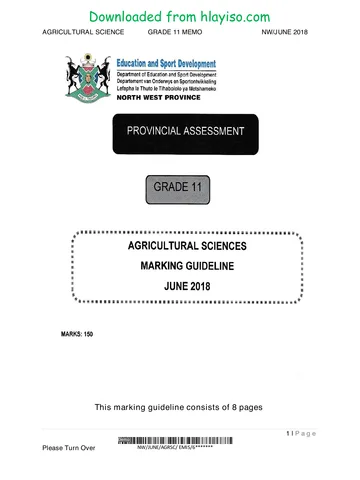
PROVINCIAL ASSESSMENT
GRADE 11
AGRICULTURAL SCIENCES
MARKING GUIDELINE
JUNE 2019
MARKS : 150
TIME : 2 ½ hours
This MARKING GUIDELINE consists of 08 pages
Demo
Copyright reserve NW/JUNE/AGRSC/ EMIS/6*******
Skip to contentAll 2019 papers 
View all
Agricultural Sciences Grade 11 North West June 2019 Memo
Grade 11 Agricultural Sciences memorandum from the North West June 2019, 8 pages. Read online or download the free PDF.
Agricultural Sciences · Grade 11 · North West June · 2019. Memorandum, 8 pages. Read online or download the PDF.
- Subject
- Agricultural Sciences
- Grade
- Grade 11
- Document type
- Memorandum
- Year
- 2019
- Exam period
- North West June
- Curriculum
- CAPS
- Pages
- 8
- File size
- 1.1 MB
Free to read online, no sign-up needed
Loading document…
Loading document…
1 of 8
This exam
North West June 2019
- Other filesQuestion paperMemo
Document textSearch extracted text and jump to a page.
Downloaded from hlayiso.com
SECTION A
QUESTION 1
1.1 MULTIPLE CHOICE:
1.1.1 C
1.1.2 B
1.1.3 A
1.1.4 D
1.1.5 D
1.1.6 B
1.1.7 C
1.1.8 A
1.1.9 D
1.1.10 B
(10 x 2) (20)
1.2 MATCHING COLUMNS:
1.2.1 A only
1.2.2 A only
1.2.3 B only
1.2.4 Both A and B
1.2.5 None
Demo
NW/JUNE/AGRSC/ EMIS/6*******
Downloaded from hlayiso.com
(5 x 2) (10)
1.3 AGRICULTURAL TERMS/ PHRASES:
1.3.1 Isomer
1.3.2 Atom
1.3.3 Adsorption/ Cation Adsorption
1.3.4 Atomic number
1.3.5 Haematite/ Iron
(5 x 2) (10)
1.4 CHANGING THE UNDERLINED WORD(S):
1.4.1 Polysaccharide
1.4.2 Electrons
1.4.3 Organic matter
1.4.4 Reserve acidity
1.4.5 Ammonification
(5 x 1) (5)
TOTAL SECTION A: [45]
SECTION B
QUESTION 2
2.1.1 Organic Compounds
A. Water Molecule (1)
B. Hydrogen Molecule (1)
2.1.2 A water molecule
Polar covalent bond (1)
Unequal sharing of valence electrons/ Sharing of pair of electrons between
atoms (1)
B hydrogen molecule
Non – polar covalent bond (1)
Equal sharing of pair of electrons between atoms (1)
Demo
NW/JUNE/AGRSC/ EMIS/6*******
Downloaded from hlayiso.com
2.1.3 Chemical formula for compound A (Water)
H2O (2)
2.1.4 Functions of Compound A (Water)
Water is a solvent/ dissolve mineral salts to be absorbed by plants
Chemical reactions take place in water eg. Photosynthesis
Transport medium/ Substances dissolved in water can be transported around the
body
Body form or shape and support/ Cytoplasm of cells consists mainly water
Regulate or control body temperature
Needed for reproduction
any 3 (3 x 2 = 6)
2.2.1 Difference between
Hydrophobic: means something that does not like water/ will not readily mix or bond with
water
Hydrophillic: means something that likes water/ will readily mix or be attracted to water
(2 x 2 = 4)
2.2.2 Types of fatty acids
Saturated
Poly – unsaturated
Mono – unsaturated (3 x 1 = 3
2.3. Table of Organic and Inorganic compounds
A NH3
B Inorganic compound
C Methane
H
D
H C H
H
E Carbon dioxide
F
G C2H5OH
Demo
NW/JUNE/AGRSC/ EMIS/6*******
Downloaded from hlayiso.com
H H
H H—C— C— OH
H H
I Ethanoic Acid
J CH3COOH (1 x 10 = 10)
2.4.1 Disaccharides
Maltose (1)
Sucrose (1)
Lactose (1)
2.4.2 Glycosidic bond (1)
[35]
QUESTION 3 ( SOIL SCIENCES)
3.1 Using texture triangle to determine soil textural class
A. Silt – Loam
B. Loam
C. Sand Clay – loam
D. Clay – Loam (8
3.2.1 Soil structure
A. Platy : Thin, flat plates of soil that lie horizontally/ and usually found in compacted
soil (2)
B. Prismatic: Columns or units which are vertically longer than they are broad/usually
found in lower horizon (2)
C. Blocky : Irregular blocks that are having sharp angles and sides/ mostly found in
the B - Horizon (2)
3.2.2 Factors influencing the development and stability of soil structure:
Soil structure and the colloidal matter of the soil
Type of clay mineral
Climate
Alternating moisture and drought
Plant roots
Any 3 (3)
3.3 Bulk Density
3.3.1 Calculation of bulk density
Bulk density = 750 g
500 cm3
Bulk density = 1, 5 g / cm3 (3)
Demo
NW/JUNE/AGRSC/ EMIS/6*******
Downloaded from hlayiso.com
3.3.2 Low bulk density because it is below 1. 6g/ cm3 the bulk density is ideal for plant growth/
or
low bulk densities are an indication of favourable soil condition for cultivation (3)
3.4. 1 Movement of water and air in sand and clay soil
Sand – water movement very rapidly downward, aeration is good (2)
Clay – water movement extremely slow, aeration very limited (2)
3.4.2 Ways to increase the percentage of pore space in the top soil
Ensure a good soil texture/ the coarser the soil texture, the more total pore space
Ensure a good soil structure
Limit the cultivation of soil Any 2 (2)
3.4.3 The type of water in point labelled A
Gravitational water (1)
3.4.4 Forms of water present in the soil
Adhesion water (1)
Cohesion water (1)
3.5. Soil colour
3.5.1 Light colour or whitish colour (1)
3.5.2 Yellow colour (1)
3.5.3 Mottled colour (1)
[35]
QUESTION 4: SOIL SCIENCES
4.1.1 Factors that influence soil temperature labelled A – D
A Slope/ topography/ orientation of the land/ aspect (1)
B Degree of cloud covers (1)
C Vegetation/ plant cover (1)
D Soil depth (1)
4.1.2 Ways in which soil temperature influence plant growth
Seed germination is affected by soil temperature
Root growth depends on soil temperature
Soil microbes are active if temperatures are favourable/ release more nutrients
for crops any two (2 x 2 = 4)
4.2.1 Soil horizon which consists of clay/ or iron, manganese and aluminium oxides
B – horizon (1)
4.2.2 Properties of G – horizon
G – horizon results from waterlogged condition
Soil which reflects permanent waterlogging
Wet or waterlogged horizon any 2 (2)
4.2.3 Reasons for the classification of soil
Optimal utilisation of land/ effective use of land
Homogeneous production units
Choice of crop
Demo
NW/JUNE/AGRSC/ EMIS/6*******
Downloaded from hlayiso.com
Planning of farming activities/ scientific farm planning
Allocation of land/ for agricultural purpose/ forestry/ game reserves
Valuation of soil/ used to value land when applying for a loan any two (2)
4.2.4 Levels of taxonomic soil classification system used in South Africa
Soil forms (1)
Soil families (1)
4.3.1 Group of micro – organisms in the soil
Bacteria
Fungi
Algae
Protozoa
Actinomycetes any 2 (2)
4.3.2 Beneficial effects of micro – organisms
Breakdown plant and animal remains to release plant nutrients
Form humus which improve soil structure and water retention
Release CO2 in the atmosphere during decay of plant materials
Help to turn milk into dairy products – sour milk, yoghurt, cheese
Help during fermentation of grape sugar to produce wine any 2 (2)
4.3.3 Micro – organism that plays a role in denitrification
Species of bacteria (Pseudomonas and achromobacter) (1)
4.4.1 Graph showing different percentages of soil components
Soil component
Demo
NW/JUNE/AGRSC/ EMIS/6*******
Downloaded from hlayiso.com
Marking of Bar graph:
Criteria Yes No
Bar graph 1 0
Heading/ Title 1 0
Correct labelling of X-axis 1 0
Correct labelling of Y-axis 1 0
Indication of unit 1 0
Accuracy 1 0
4.4.2 Component that forms the most part of the soil
Rock particles (1)
4.5.1 Identifying the acidity and alkalinity of soil colloid based on adsorbed cations:
A. Acid soil (1)
B. Brackish (1)
4.5.2 Table to compare the saline and sodic soils under:
Saline soil Sodic soil
pH condition Less than 8, 5 Between 8, 5 and 10
Dominant salts Ca++ and Mg++ Na+
Surface appearance White brack or salt Black crust
crystal crust
Corrective measures Over – irrigation to leach Over – irrigation to leach out
Out salts salts
Improve drainage Apply gypsum
Any three of the above mentioned (3 x 2 = 6)
[35]
TOTAL SECTION B [105]
GRAND TOTAL [150]
Demo
NW/JUNE/AGRSC/ EMIS/6*******
Study this subject
Recommended for this subject
Question paper
Agricultural Sciences Grade 11 North West June 2019 QP
Memorandum
Agricultural Sciences Grade 11 P1 2019 Memo (Eng)
Memorandum
Agricultural Sciences Grade 11 P1 2019 Memo (Afr)
Memorandum
Agricultural Sciences Grade 11 North West June 2018 Memo
Memorandum
Agricultural Sciences Grade 11 North West June 2017 Memo
Question paper
Agricultural Sciences Grade 11 P1 2019 QP (Eng)
More from Grade 11 Agricultural Sciences
Annual teaching plan
Gr 11 Agric Sci ATP 2023 24
Question paper
Agricultural Sciences Grade 11 P1 2025 QP (Eng)
Question paper
Agricultural Sciences Grade 11 P2 2025 QP (Eng)
Question paper
Agricultural Sciences Grade 11 P1 2024 QP (Afr)
Question paper
Agricultural Sciences Grade 11 P1 2024 QP (Eng)
Question paper