
Downloaded from hlayiso.com
SENIOR CERTIFICATE EXAMINATIONS/
NATIONAL SENIOR CERTIFICATE EXAMINATIONS
CONSUMER STUDIES
2021
MARKING GUIDELINES
MARKS: 200
These marking guidelines consist of 19 pages
Copyright reserved Please turn over
Skip to contentQuestion paper 
View all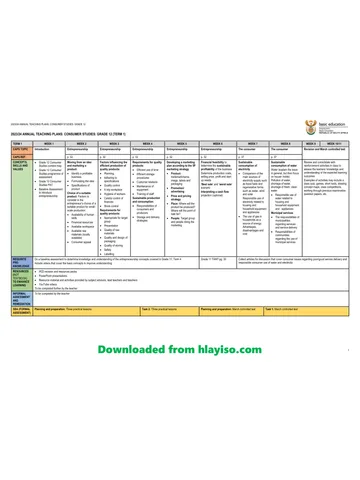
Consumer Studies Grade 12 NSC June 2019 Question Paper
Grade 12 Consumer Studies question paper from the NSC June Exam 2019, 19 pages. Read online or get the free PDF download, memo linked when available.
Consumer Studies · Grade 12 · NSC June Exam · 2019. Question paper, 19 pages. Read online or download the PDF.
- Subject
- Consumer Studies
- Grade
- Grade 12
- Document type
- Question paper
- Year
- 2019
- Exam period
- NSC June Exam
- Curriculum
- CAPS
- Pages
- 19
- File size
- 450.5 KB
Loading document…
Loading document…
1 of 19
Document textSearch extracted text and jump to a page.
Downloaded from hlayiso.com
Consumer Studies 2 DBE/2021
SC/NSC – Marking Guidelines
QUESTION 1: SHORT QUESTIONS
1.1 1.1.1 A Remembering, easy (Focus, p.157; Successful, p.173) (1)
1.1.2 D Remembering, easy (Focus, p.169; Successful, p.190) (1)
1.1.3 C Understanding, easy (Focus, p.161; Successful, p.177) (1)
1.1.4 B Remembering, easy (Focus, p.98; Successful, p.118) (1)
1.1.5 D Remembering, easy (Focus, p.93; Successful, p,113) (1)
1.1.6 D Remembering, easy (Focus, p.104; Successful, p.126) (1)
1.1.7 C Understanding, moderate (Focus, p.73; Successful, p.82) (1)
1.1.8 B Understanding, easy, (Focus, p.90; Successful, p.107) (1)
1.1.9 C Applying, easy (Focus, p.50; Successful, p.51) (1)
1.1.10 D Understanding, easy (Focus, p.47-50; Successful, p.50-51) (1)
1.1.11 C Remembering, easy (Focus, p.120; Successful, p.139) (1)
1.1.12 B Remembering, easy (Focus, p.130; Successful, p.149) (1)
1.1.13 A Remembering, easy (Focus, p.148; Successful, p.162) (1)
1.1.14 D Remembering, easy (Focus, p.128; Successful, p.146) (1)
1.1.15 A Understanding, easy (Focus, p.126; Successful, p.171) (1)
1.1.16 B Remembering, easy (Focus, p.22; Successful, p.29) (1)
1.1.17 A Remembering, easy (Focus, p.41; Successful, p.42) (1)
1.1.18 D Understanding, moderate (Focus, p.13; Successful, p.10-11) (1)
1.1.19 C Understanding, moderate (Focus, p.19; Successful, p.22-24) (1)
1.1.20 B Understanding, moderate (Focus, p.30; Successful, p.29) (1)
Copyright reserved Please turn over
Downloaded from hlayiso.com
Consumer Studies 3 DBE/2021
SC/NSC – Marking Guidelines
1.2 1.2.1 B (1)
1.2.2 G (1)
1.2.3 D (1)
1.2.4 C (1)
Understanding, moderate (Focus p.127-128; Successful p.146-147)
1.3 1.3.1 Grey goods/ parallel imports
1.3.2 Phishing/ scam
1.3.3 Pyramid scheme
1.3.4 Exemption clause
1.3.5 Guarantee (5)
Remembering, moderate (Focus, p.155-162; Successful, p.173-179)
1.4 B
D (Any order) (2)
Understanding, moderate (Focus, p; 49-51; Successful, p.50-53)
1.5 A
C
F (Any order) (3)
Understanding, moderate (Focus, p; 16 -19; Successful, p.21-25)
1.6 1.6.1 D iii
(2)
1.6.2 A v
(2)
1.6.3 E ii
(2)
Analysing, difficult (Focus p.79-80; Successful p.91-94)
[40]
Copyright reserved Please turn over
Downloaded from hlayiso.com
Consumer Studies 4 DBE/2021
SC/NSC – Marking Guidelines
QUESTION 2: THE CONSUMER
2.1 Give THREE examples of indirect taxes that consumers pay on goods
and services.
Value added tax (VAT)1
Excise duty/ sin/ liquor/ cigarette tax2
Import duty3
Licences (car/ television/ fishing/ drivers/ hunting)4
Fuel levy/ road accident fund/ emission tax5
Environmental tax/ levy6
Sugar tax7
Air passenger tax8 (Any 3) (3)
Remembering, easy (Focus, p.164-165; Successful, p.181-183)
2.2 Name TWO ways of using energy more efficiently when lighting a home.
Switch off lights when they are not used/ only light rooms that you are
in/ use lamps with timers/ automatic switch control/ movement sensors.1
Use bulbs with a lower wattage.2
Replace conventional light bulbs with energy saving/ compact fluorescent
lamps (CFL)/ LED lights.3
Install solar panels to charge batteries on which lights can work/ use solar
bulbs that can be charged and used at night to light the house.4
(Any 2) (2)
Remembering, easy (Focus, p.173; Successful, p.192)
2.3 Discuss the impact of the production of eco-bricks on:
2.3.1 Water pollution
Less water pollution1 and the plastic won't end up in rivers and
dams.2
2.3.2 Municipal service delivery
Municipalities are responsible for refuse removal.1
There will be less refuse to remove2 as plastic waste will be used
for making eco-bricks.3 (Any 2) (2)
Applying, moderate (Focus, p.182; Successful, p.203)
Copyright reserved Please turn over
Downloaded from hlayiso.com
Consumer Studies 5 DBE/2021
SC/NSC – Marking Guidelines
2.4 Explain the role that communities should play to help reduce the debt of
their municipality.
Pay for the water1 and electricity/ avoid illegal connections2 to reduce
the debt of municipalities.
Install pre-paid water/ electricity metres as it is paid for in advance.3
Pay for their rates and taxes on time4 in order for municipalities not to
get into debt.
Do not destroy the infrastructure5 in order to avoid the cost of repairs for
the municipality.
Clean up campaigns/ community clean-up projects/ recycle projects in
communities will lessen the financial burden on municipal resources/
communities should not litter.6 (Any 3) (3)
Applying, difficult (Focus, p.185; Successful, p.205)
2.5 Identify TWO unfair business practices by the shop owner.
The shop owner made a false promise/ misrepresentation
about the bed supporting one's back while sleeping.1
The bed had a two-year guarantee but the retailer refused to
repair or replace the bed.2 (2)
Understanding, easy (Focus, p.157; Successful, p.174)
2.6 2.6.1 Explain the term interest rate.
Interest is the amount/ money/ percentage1 that a financial
institution or credit provider charges for the use of money.2
OR
The rate at which borrowers pay interest for the money they
borrow3 from lenders expressed as a percentage4 of the
total sum borrowed/ the principle amount for a specific period. (2)
Remembering, easy (Focus, p.166; Successful, p.183)
Copyright reserved Please turn over
Downloaded from hlayiso.com
Consumer Studies 6 DBE/2021
SC/NSC – Marking Guidelines
2.6.2 Analyse how consumers with home loans are affected by the
change in the repo rate.
When the repo rate decreases, the bank/ financial institution
decrease the interest rate payable on home loans./ Interest
rates decreased from 10% to 9,75%/ decrease by 0,25%.1
Consumers thus pay less2 interest on their home loans.
Consumers will have more disposal income3 that will
contribute to increasing their buying power.4
Consumers may take out more loans/ second bond to buy a
second property/ to improve their properties since the interest
rate will be lower and they may be able to afford to pay back
their loans.5
If consumers do not reduce their current bond instalment/ keep
on paying the same instalment6 they will be able to pay off
their bond in a shorter period.7 (Any 4) (4)
Analysing, difficult (Focus, p.166; Successful, p.183-184)
[20]
Copyright reserved Please turn over
Downloaded from hlayiso.com
Consumer Studies 7 DBE/2021
SC/NSC – Marking Guidelines
QUESTION 3: FOOD AND NUTRITION
3.1 3.1.1 Define the term hypoglycaemia.
A condition in which the blood glucose level drops/ falls1
abnormally low.2 (2)
Remembering, easy (Focus, p.71; Successful, p.78)
3.1.2 Name TWO ways to prevent hypoglycaemia.
Eat regular meals and snacks.1
Eat low-GI foods (with every meal and snack).2
Avoid eating high-GI foods/ carbohydrates/ high energy
drinks/ high energy snacks between meals.3
Combine high-GI with low-GI/ with protein rich foods.4
(Any 2) (2)
Remembering, easy (Focus, p.71; Successful, p.79)
3.2 Suggest how a person can control his/her salt intake to manage
hypertension.
Use salt/ sodium/ sodium chloride sparingly/ do not use more than 5g of
salt per day/ avoid eating too much salt.1
Herbs and spices can be used to flavour food instead of salt.2
Reduce the intake of processed/ fast food/ take-aways/ convenience
food3 as they contain hidden salt.
Do not add extra salt to food.4 (Any 2) (2)
Remembering, easy (Focus, p.77; Successful, p.87-88)
Copyright reserved Please turn over
Downloaded from hlayiso.com
Consumer Studies 8 DBE/2021
SC/NSC – Marking Guidelines
3.3 Discuss how the nutrients lacking in a vegan diet could lead to the
following:
3.3.1 Osteoporosis
Calcium will be lacking1 because vegans do not eat dairy2
therefore the bones will be brittle/ weak/ less dense.3
Calcium builds strong bones/ increases bone density4 and
therefore helps to prevent osteoporosis.
Vegans may lack phosphorus and vitamin D5 which helps with
the absorption of calcium6 these are found in oily fish7 and dairy
products. (Any 3) (3)
3.3.2 Anaemia
Animal products are the best source of iron1 and are lacking in a
vegan diet.
Iron is necessary for the formation of haemoglobin/ red blood cells
to prevent anaemia/ lack of Iron will lead to insufficient formation of
haemoglobin/ formation of red blood cells.2 as a result a reduced
amount of oxygen is carried to the body cells.3
Vitamin B 124 is only found in animal sources5 and a lack of
Vitamin B12 may cause anaemia. (4)
Understanding, moderate (Focus, p.75-76; Successful, p.89-91)
3.4 3.4.1 Name THREE symptoms of tuberculosis.
Chest pains1
(Severe) cough2
Blood in sputum3
(Muscle) weakness4
Night sweats5
Fever6
Loss of appetite7
Weight loss8
Shortness of breath9
Tiredness/ fatigue10 (Any 3) (3)
Remembering, easy (Focus, p.89; Successful, p.104)
Copyright reserved Please turn over
Downloaded from hlayiso.com
Consumer Studies 9 DBE/2021
SC/NSC – Marking Guidelines
3.4.2 Write a paragraph to explain how so many learners could have
been infected by the disease.
Learners could have been infected with TB when an infected
person coughed/ sneezed on their hands1 without covering their
mouths.2 Tiny droplets of mucus and saliva could have spread in
the air3 and these droplets transmitted the disease to others who
inhaled them. Learners at the boarding school live close to each
other4 and they breathe the same air for prolonged periods of
time and therefore they could have infected each other, due to
little/ no ventilation.5 The learners could have eaten food on which
tiny droplets of mucus/ saliva had landed6 and the disease could
have spread.7 Staff preparing the food could have been infected
and spread the disease to the food.8 (Any 5) (5)
Applying, moderate (Focus, p.89; Successful, p.104)
NOTE: Deduct ONE mark if not written in paragraph format
3.5 Give FOUR reasons why a person suffering from anorexia nervosa ends
up losing weight to a dangerous point.
A distorted body image/ wants a perfect body image/ the person saw
themselves as being overweight1 and tried to lose weight to become
thinner and thinner.2
Irrational/ intense fears of gaining weight/ becoming fat, obsession with
kilojoule intake although the person is underweight.3
Exercise excessively.4
Purging: over use of diet pills/ laxatives/ enemas/ vomiting.5
Restricted food intake/ kilojoules much less than required6 to the point
of dangerous and excessive weight loss.
Eat very little/ starve excessively.7 (Any (4)
4)
Understanding, moderate (Focus, p.82; Successful, p.94-95)
Copyright reserved Please turn over
Downloaded from hlayiso.com
Consumer Studies 10 DBE/2021
SC/NSC – Marking Guidelines
3.6 Explain how food irradiation can help South African households to be
food secured.
Irradiation reduces/ destroys micro-organisms therefore food will last
longer,1 this reduces wastage/ disposal of food 2 and more food will
be available to South African households.
Delays the ripening of fruit/ sprouting/ greening of potatoes/ onions/
garlic3 thus the shelf-life/ eating quality/ freshness of food is
lengthened.4 It makes it easier to transport/ less damage during
transporting.5 Households can therefore have food for longer as food
spoilage is reduced.6
It destroys pathogenic bacteria7 which prevents food-borne diseases8
and the food is safe to eat 9 and available for longer.
Destroys salmonella bacteria10 so it improves the shelf life of raw meat,
fish and chicken.11 (6)
Understanding, moderate ((Focus, p.105; Successful, p.127)
3.7 3.7.1 Identify the type of fat abundant in the dishes above.
Saturated/ animal fats/ trans fatty acids (1)
Remembering, easy (Focus, p.74; Successful, p.84)
3.7.2 Evaluate the suitability of the fast foods above for the
prevention and management of coronary heart disease.
Patties/ cheese/ fries/ milk shake are all high in saturated
fats/ animal fat/ lots of fat1 and trans fat2 which causes the
cholesterol/ low-density lipoprotein (LDL) to build up in the
arteries/ increase the risk of coronary heart disease.3
This causes the gradual narrowing of the blood vessels,4
the cholesterol eventually forms plaque which causes the
arteries to narrow, thicken and harden leading to
atherosclerosis.5
The single burger is more suitable than the other burgers as it
contains less cheese and fewer patties.6
White bread rolls contain little fibre,7 fibre is necessary to
lower cholesterol levels.8
The take away dishes contain too much salt9 that increases
the blood pressure10 which is a risk factor of coronary heart
disease.
Coke/ soda/ candy/ sweets/ milks shakes increase the
kilojoule/ sugar intake11 that will contribute to obesity,12
increasing the risk of coronary heart disease.13 (Any 7) (7)
Conclusion: The foods are not suitable for the prevention and
management of coronary heart disease.14 (1)
Evaluating, difficult (Focus, p.74; Successful, p.83)
[40]
Copyright reserved Please turn over
Downloaded from hlayiso.com
Consumer Studies 11 DBE/2021
SC/NSC – Marking Guidelines
QUESTION 4: CLOTHING
4.1 Explain the term fashion.
Style/type of clothing1 worn by the majority/ most/ many people2 at a
specific time and place.3 (Any 2) (2)
Remembering, easy (Focus, p.48; Successful, p.49)
4.2 Describe the stage in the fashion cycle of the shirt when it was sold for:
4.2.1 R399.00. (Peak)
Fashion reaches the height of it's popularity/ many people wear
it.1
Fashion is produced in growing numbers.2
Advertised in stores/ magazines /social media.3
Mass production stimulate sales.4
Cheaper5 than at fashion show/ introduction as mass production
takes place.6 (Any (2)
2)
4.2.2 R259.00 (Decline)
A new fashion trend has begun1 and interest in the old trend is
waning/ people are bored with the fashion.2
The item is now “out of fashion”3 and fewer consumers want to (2)
buy it.4 (Any 2)
Understanding, easy (Focus, p.50; Successful, p.50)
NOTE: No mark to be allocated for naming the stage of fashion cycle.
4.3 The revival of vintage clothing can be considered to be an
environmentally sustainable practice.
Motivate the statement above.
Buying/ wearing old clothes from a previous era1 means that new
fabrics do not have to be produced to manufacture new garments.2
This ensures that fewer natural resources will need to be
used/depleted3 as fabrics/ garments are reused.4
Less clothes are thrown away/ less waste/ less clothing will appear on
land fill sites.5
Less water and electricity are needed/ lowers carbon footprint6 as less
clothing needs to be made because old clothing items are being reused.
Less water is wasted7 as less fabric/textiles are manufactured than
usual.
Land is preserved8 as fewer plants are planted to manufacture new
fabrics/ textiles.9 (Any 4) (4)
Understanding, difficult (Focus, p.51; Successful, p.53, 67-68)
Copyright reserved Please turn over
Downloaded from hlayiso.com
Consumer Studies 12 DBE/2021
SC/NSC – Marking Guidelines
4.4 4.4.1 Define the term dress-code.
It is a set of rules1 about the type of clothing that the company
expects2 its employees to wear to work. (2)
Remembering, easy (Focus, p.54; Successful, p.57)
4.4.2 Suggest THREE items that can be worn with the three-piece
suit to create a neutral colour combination.
Black/ white/ grey shirt/ blouse1
Black/ white/ grey tie/ scarf2
Black/ white/ grey handkerchief/ pocket square3
Black/ grey pair of socks/ shoes4
Black/ grey belt5
Black/ grey handbag/ brief case6
Black/ white/ grey (Fedora) hat7 (Any 3) (3)
Applying, moderate (Focus, p.58-59; Successful, p.61-65)
NOTE: A neutral colour must accompany the clothing item for a mark to be
awarded.
4.4.3 Evaluate the suitability of the three-piece suit for a person
who works at a law firm.
The suit is suitable.1 (Conclusion) (1)
It is formal/ professional/ neat/ presentable2 and people will
take the wearer seriously.
It will give the impression that the wearer is ready to work/ will
do a good job/ assertive/ confident.3
It is classic4 and will last for many seasons/ years/ it is
timeless/ it has simple lines/ accepted by large group of
people.5
It is versatile because of it's neutral colour and can be worn
with a variety of shirts/ accessories/ can be mixed and
matched.6
It is versatile as the pants can be worn on its own/ the suit can
also be worn without the waistcoat.7
It is not offensive/ not revealing.8 (Any 4) (4)
Evaluating, moderate (Focus, p.58-59; Successful, p.61-65)
[20]
Copyright reserved Please turn over
Downloaded from hlayiso.com
Consumer Studies 13 DBE/2021
SC/NSC – Marking Guidelines
QUESTION 5: HOUSING AND INTERIOR
5.1 Name TWO responsibilities of EACH of the following in terms of a
housing complex:
5.1.1 Tenant/Lessee
Pays/ buys electricity for their own units.1
Take care of the inside/ look after/ keep their own unit
clean.2
Pay deposit before moving in.3
Pay rent on time.4
Abide by the rules/ terms and conditions of the complex.5
(Any 2) (2)
Understanding, easy (Focus p.122; Successful p.140-141)
5.1.2 Body corporate
Responsible for the election of trustees.1
Controls/ administer/ manage the block/ conducts day to day
business of running the complex.2
Pay rates and taxes to the municipality for the complex.3
Pay insurance for the complex.4
Pay water and electricity of common areas.5
Repair and maintain the common areas/ gardens/ swimming
pool.6
Taking care of waste disposal.7
Provide security for the complex. 8 (Any 2) (2)
Remembering, easy (Focus p.122; Successful p.140-141)
5.1.3 Lessor/Landlord
Draws up a lease agreement.1
Maintenance of the interior part of the unit. 2
Pays a monthly levy to the body corporate.3
Pay rates and taxes if this is not included in the levy.4 (Any 2) (2)
Understanding, easy (Focus p.122; Successful p.140-141)
Copyright reserved Please turn over
Downloaded from hlayiso.com
Consumer Studies 14 DBE/2021
SC/NSC – Marking Guidelines
5.2 Discuss the benefits of building a new home.
It can cost less if the owner is the builder1 as the owner will not be paid.
The house can be designed to the owner's specifications/ can have
everything they want/ suit their needs.2
Latest designs and technology can be included.3
An environmentally friendly house can be created/ use and select
materials and systems that are eco-friendly.4
The house can be finished per the owner's schedule5
Building work can be halted for a while when there are no funds.6
Building a house is an investment/ the value of the house increases over
time.7
There is no inheritance of old problems/ there are no old problems to be
dealt with.8
The owner can design own garden.9
New houses are built in growing/ new developing areas which will help
with the resale value of the house.10 (Any 6) (6)
Remembering, moderate (Focus, p.121; Successful, p.138)
5.3 5.3.1 Name Naz's type of home ownership.
Freehold.1
Full-title ownership.2 (Any 1) (1)
Remembering, easy (Focus, p.121; Successful, p.139)
5.3.2 Describe the type of home ownership named in QUESTION
5.3.1.
The owner/ buyer/ Naz becomes the legal owner1 of the entire
property2 the land and all the structures/ buildings on it.3
(Any 2) (2)
Remembering, easy (Focus, p.121; Successful, p.139)
5.3.3 Explain the term deposit.
A deposit is a down payment1 made at the time of purchase.2
OR
The amount of money a buyer has available to contribute3
towards the purchase of the home.4
OR
The amount of money you are required to give in advance 5 to
show your intention to complete a purchase/ to serve as security/
partial payment of a property.6 (Any 2) (2)
Remembering, easy (Focus, p.126; Successful, p.144)
Copyright reserved Please turn over
Downloaded from hlayiso.com
Consumer Studies 15 DBE/2021
SC/NSC – Marking Guidelines
5.3.4 State the pre-cautionary measures that Naz took with regard
to safety after she bought the house.
Naz installed an alarm system 1 to make it safer.
She built a wall2 around the property. (2)
Remembering, easy (Focus, p.122; Successful, p.140)
5.3.5 In terms of Naz's house, name and explain the following:
(a) TWO types of insurances Naz should have.
Bond/ Mortgage protection insurance1
This is life assurance2 to settle the home loan if
something unexpected should happen to her.
Homeowner's (comprehensive) insurance3
This will cover any losses should the structure suffer
damage as a result of a natural disaster/ accident/ burst
geyser/ political unrest/ fire.4 (4)
(b) ONE type of insurance the tenant should have.
Household content insurance1
Which covers the contents of a home, e.g. furniture/
clothing, against loss or damage.2 (2)
Understanding, moderate (Focus, p.127-128; Successful, p.145)
5.3.6 Suggest FOUR reasons why Naz was able to rent out her
property so quickly.
3-bedrooms are suitable for a family with children.1
Renovated interiors made the house attractive/ modern.2
Has good security/ high walls/ alarm system.3
Close to a school which is convenient for a family with
children.4
Close to a shopping mall5 which is convenient.
There was a demand for rentals in the area as she rented out
quickly.6 (Any 4) (4)
Understanding, moderate (From the scenario)
5.4 5.4.1 Select the most suitable washing machine for Sam and
Cecelia's needs.
Front loader (1)
Analysing, moderate (Focus, p.137; Successful, p.156-157)
Copyright reserved Please turn over
Downloaded from hlayiso.com
Consumer Studies 16 DBE/2021
SC/NSC – Marking Guidelines
5.4.2 Support your choice in QUESTION 5.4.1.
The alarm will notify them when the load is finished/ do not
need to watch the machine.1
The machine is fully automatic2 reducing human energy
consumption.3 Easier to use for Cecelia who has arthritis.4
The size of the machine is suitable for their needs.5
The size is most suitable for a small house.6
It is affordable.7
It is (non-human) energy efficient/ saves non-human energy/
uses less electricity.8
Easy to clean because of metallic finish.9
10 Programmes will suit their needs/ allow choices.10
Uses the least water/ less water than a top loader.11
Stainless steel drum is durable/ won't chip.12 (Any 6) (6)
Analysing, difficult (Scenario)
5.4.3 Give reasons why the other TWO washing machines are not
suitable for Sam and Cecelia's needs.
Front loader is bigger/ need more space/ less suitable for a
small two-bedroom house.1
Top loader is very expensive2 to buy compared to the front
loader and twin tub.
Top loader uses more water than a front loader.3
Top loader will show dirt/ marks easily because of its white
colour.4
Twin tub is bigger/ need more space/less suitable for a small
two-bedroom house.5
The twin tub uses more human/ physical energy/ requires too
much time/ not fully automatic6 which is not suitable for
Cecelia's arthritis.
The twin tub uses more (non-human) energy/ electricity.7
The twin tub will show dirt/ marks easily because of its white
colour.8
The enamel drums can chip more easily than the stainless
steel drum.9
The twin tub has no alarm.10
The twin tub has only 3 programme cycles which limit their
choices.11 (Any 4) (4)
Analysing, difficult (Scenario)
NOTE: TWO marks must be allocated for each washing machine.
[40]
Copyright reserved Please turn over
Downloaded from hlayiso.com
Consumer Studies 17 DBE/2021
SC/NSC – Marking Guidelines
QUESTION 6: ENTREPRENEURSHIP
6.1 Define the following terms:
6.1.1 Target market
A specific group of people1 who may want to purchase your
product2/ with common needs and interest.3
(Any 2) (2)
Remembering, easy (Focus, p.20; Successful, p.11)
6.1.2 Sustainable production
Sustainable production is the production of goods to satisfy basic
needs1 of consumers and improve their quality of life2 without
harming the environment/ reducing the use of natural resources/
toxic material/ chemicals/ reducing waste and pollution.3 (3)
Remembering, easy (Focus, p.26; Successful, p.26)
6.2 State why it is important for an entrepreneur to adhere to product
specifications.
This ensures that the product is always the same1 in terms of
appearance/ quality/ size/ weight/ colour and style2 and that the quality is
consistent.3
Customers will get what they expected.4
The products will be successful and an entrepreneur will not lose profit
because of failures.5 ( Any 3) (3)
Remembering, easy (Focus, p.16; Successful, p.21)
6.3 6.3.1 State THREE human resources that Lelethu had.
Passion/ interest in fashion1
Sewing skills2
Knowledge of fashion and dressmaking3
Creativity4 (Any 3) (3)
Understanding, moderate (Focus, p.10; Successful, p.17)
6.3.2 Explain why it is important for Lelethu to do a financial
feasibility study.
It will discover the strengths1 and weaknesses2 of the
business idea.
It will help her decide whether to continue with the business or
not/ will give a clear picture of whether the business has the
potential for success.3
If the revenue will be enough to cover the costs4 and make a
reasonable profit5 the business will be viable.
To determine the start-up costs/ needs of the business.6
(Any 3) (3)
Remembering, easy (Focus, p.35; Successful, p 35)
Copyright reserved Please turn over
Downloaded from hlayiso.com
Consumer Studies 18 DBE/2021
SC/NSC – Marking Guidelines
6.3.3 Identify FOUR factors that gave Lelethu's business a
competitive edge in the market.
Her outfits are unique/ are her own designs.1
The garments are made to fit the individual customer/
personalised/ satisfy their needs/ fill the gap in the market.2
None of her customers will wear the same designs.3
Price is reasonable/ affordable.4
She covers bags and shoes to match her garments.5
She uses 100% Proudly South African produced cotton
fabric.6 (Any 4) (4)
Applying, moderate (Focus, p.8; Successful, p.11)
6.3.4 Name THREE ways in which Lelethu could advertise her
business in the community.
Electronic media/ radio/ cell phones/ internet1
Social media/ Facebook/ Instagram/ Twitter/ WhatsApp/ Tik-
Tok2
Print media/ local community newspaper/ flyers/ brochures/
posters/ pamphlets/ billboards3
Fashion shows/ display in the community4
Customers wearing her garments/ telling others/ word of mouth/
self-advertisement (she wears her own clothes)5 (Any 3) (3)
Understanding, moderate (Focus, p.30; Successful, p.29-30)
6.3.5 State TWO ways in which Lelethu managed her time
effectively.
She doesn't delay/ postpone tasks.1
Used holiday time to keep up with orders.2
She didn't take on more orders than she could manage/ she
takes a few orders.3 (Any 2) (2)
Understanding, moderate (Focus, p.24; Successful, p.25, Scenario)
6.3.6 Comment on the impact of the quality and the availability of
the fabric for Lelethu's business.
The fabric that she uses is produced in South Africa and will
therefore always be available1 at a reasonable price.2 She
will not have to wait for fabric to be imported3 and doesn't
have to pay import tax/ doesn't have to obtain an import
licence.4
The fabric is 100% cotton which will ensure a good quality end
product/.5 It is cool and comfortable to wear in summer.6
(Any 4) (4)
Understanding, moderate (Focus, p.13, 21; Successful, p.19, 24)
Copyright reserved Please turn over
Downloaded from hlayiso.com
Consumer Studies 19 DBE/2021
SC/NSC – Marking Guidelines
6.3.7 Calculate the total cost of ONE dress with a mark-up of
30%. Show ALL calculations.
3 x R70.001 = R 210.00
R210.00 + R 10.00 + R 250.00 = R 470.002
R470.00 30%3 = R 141.004 OR R470.00 5 =
R141.006
Total cost = R 470.00 + R 141.00 = R 611.007
OR
R470.00 89 = R611.0010
(R monetary value must be in the answer to receive the final
mark) (5)
Applying, moderate (Focus, p. 37-38; Successful, p. 220-221)
6.3.8 Analyse why Lelethu's business is likely to show sustainable
profitability.
She makes garments by order1 which means all the
products/ garments that she makes are already sold2 and no
middleman takes a cut/ no cost payable for a place to sell the
products.3
All the garments are unique/ personalized/ suit her
customers4 and this gives her a competitive advantage/
ensure that she meets her customers' needs.5
The garments are affordable6 and this ensure further future
orders7 which will keep the business sustainable.
The customers are happy/ satisfied8and this will ensure that
they come back/ spread the news by word-of-mouth9 and
this will sustain her business.
Low overheads/ expenses10 as she is working from
home.11
Her garments fulfil a need in the market12 as they are
popular for traditional celebrations.13
The fabric she uses is locally produced/ 100 % Proudly South
African produced cotton fabric/ quality fabric 14 and will
always be available,15 this also fulfil the need of consumers
who want to buy locally made products.16
She offers accessories/ shoes/ bags17 which is an additional
service18 that consumers are looking for and this will ensure
a sustainable business. (Any 8) (8)
Analysing, difficult (Focus, p.35; Successful, p.44)
[40]
GRAND TOTAL: 200
Copyright reserved
Study this subject
Revise the topics in this paper, then practise them question by question.
- Grade 12 Consumer Studies notes
CAPS revision notes with worked examples.
- Consumer Studies questions by topic
Past exam questions sorted by CAPS topic, with memos where available.
- All Grade 12 Consumer Studies past papers
Past papers by year, with memos where available.
- Grade 12 past papers
More Consumer Studies and other subjects in this collection.
Recommended for this subject
More papers and memos for this grade and subject.
Question paper
Consumer Studies Grade 12 Eastern Cape Mock 2025 Question Paper
Question paper
Consumer Studies Grade 12 NSC June 2025 Question Paper (Afr)
Question paper
Consumer Studies Grade 12 NSC November 2025 Question Paper
Question paper
Consumer Studies Grade 12 Eastern Cape Prelim 2024 QP (Afr)
Question paper
Consumer Studies Grade 12 Eastern Cape Prelim 2024 QP (Eng)
Question paper
Consumer Studies Grade 12 November 2024 NSC Question Paper
Related documents
Question paper
Consumer Studies Grade 12 NSC June 2019 Question Paper
Question paper
Consumer Studies Grade 12 NSC June 2019 Question Paper
Question paper
Consumer Studies Grade 12 Eastern Cape Mock 2019 QP (Eng)
Question paper
Consumer Studies Grade 12 NSC November 2019 Question Paper
Question paper
Consumer Studies Grade 12 NSC November 2019 Question Paper
Question paper
Consumer Studies Grade 12 NSC June 2024 Question Paper (Afr)
More from Grade 12 Consumer Studies
Annual teaching plan
Gr 12 Con Stu ATP 2023 24
Memorandum
Consumer Studies Grade 12 Eastern Cape Mock 2025 Memo
Memorandum
Consumer Studies Grade 12 NSC June 2025 Memo (English)
Memorandum
Consumer Studies Grade 12 NSC November 2025 Memo (Afrikaans)
Errata
Consumer Studies Grade 12 Eastern Cape Prelim 2024 Errata
Memorandum