Downloaded from hlayiso.com
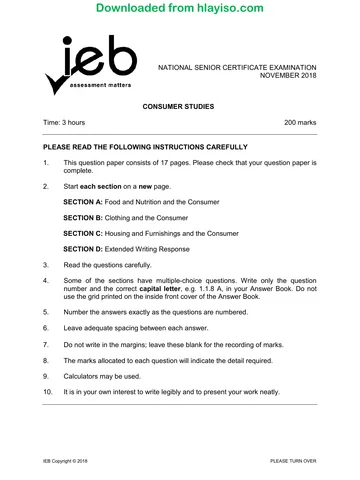
NATIONAL SENIOR CERTIFICATE EXAMINATION
NOVEMBER 2018
CONSUMER STUDIES
MARKING GUIDELINES
Time: 3 hours 200 marks
These marking guidelines are prepared for use by examiners and sub-examiners,
all of whom are required to attend a standardisation meeting to ensure that the
guidelines are consistently interpreted and applied in the marking of candidates'
scripts.
The IEB will not enter into any discussions or correspondence about any marking
guidelines. It is acknowledged that there may be different views about some
matters of emphasis or detail in the guidelines. It is also recognised that,
without the benefit of attendance at a standardisation meeting, there may be
different interpretations of the application of the marking guidelines.
IEB Copyright © 2018 PLEASE TURN OVER
Skip to contentMemorandum 
View all
Consumer Studies Grade 12 IEB 2018 Memo
IEB Grade 12 Consumer Studies memorandum from the 2018, 19 pages. Read online or get the free PDF download, question paper linked when available.
Publisher: IEB
Consumer Studies · Grade 12 · 2018. Memorandum, 19 pages. Read online or download the PDF.
- Subject
- Consumer Studies
- Grade
- Grade 12
- Document type
- Memorandum
- Year
- 2018
- Publisher
- IEB
- Curriculum
- IEB
- Pages
- 19
- File size
- 333.9 KB
Loading document…
Loading document…
1 of 19
Document textSearch extracted text and jump to a page.
Downloaded from hlayiso.com
NATIONAL SENIOR CERTIFICATE: CONSUMER STUDIES – MARKING GUIDELINES Page 2 of 19
SECTION A FOOD AND NUTRITION AND THE CONSUMER
QUESTION 1
1.1 C
1.2 B
1.3 B
1.4 D
1.5 A
QUESTION 2
Categorise the following taxes into direct or indirect taxes.
Tabulate your answer as shown below:
Direct tax Indirect tax
property tax value added tax
PAYE excise duty
provisional tax import duty
capital gains tax licences
transfer duty
estate duty
QUESTION 3
3.1 The maize starch in the Chakalaka is genetically modified and therefore has
some advantages. Identify any four advantages by writing only the letters of
your choice.
B D E G (in any order)
3.2 State one reason why the spices in the Chakalaka are irradiated.
• Spices are high in bacteria and irradiation prevents them from
contaminating the Chakalaka.
• To eliminate or reduce the number of disease causing bacteria, making
the food safer.
3.3 Elaborate on why irradiated foods may be beneficial to HIV/AIDS patients.
• Food irradiation improves the safety of food and will protect the HIV/AIDS
patient from food-borne diseases.
• Food is sterilised with the use of very short light waves, penetrating the
food to kill harmful organisms (salmonella) without making the food itself
radioactive.
• Making it suitable for HIV/AIDS patients' weakened immune system.
IEB Copyright © 2018 PLEASE TURN OVER
Downloaded from hlayiso.com
NATIONAL SENIOR CERTIFICATE: CONSUMER STUDIES – MARKING GUIDELINES Page 3 of 19
3.4 Analyse the ingredient list to show that this Chakalaka is a suitable choice
to include in the diet of an HIV/AIDS patient.
Tabulate your answer as shown below:
Ingredient Motivation for suitability
Vegetables: carrots / green peppers / Contain flavonoids and phytosterols to
tomato puree strengthen the immune system.
Vegetables: carrots / green peppers / Keep skin and mucous membranes in
tomato puree the lungs and digestive tract healthy.
Vegetables: carrots / green peppers / Contains antioxidants that prevent
tomato puree / sunflower oil / damage to cells and infections.
wheat / maize starch
Vegetables: carrots / green peppers / Aid in recovery from infections.
tomato puree
Vegetables: carrots / green peppers / Maintain healthy immune and nerve
tomato puree systems.
Water Helps with dehydration when patients
have diarrhoea.
Wheat / maize starch Selenium helps activate T-helper cells.
Energy (prevention of weight loss)
Antioxidant TBHQ (Vit C,E and A) Prevents or delays oxidation of
ingredients.
Vegetable oils Provides energy after weight loss
Candidates must indicate that it is suitable as the HIV/AIDS patient has a
weakened immune system.
3.5 Compile a suitable nutritious lunch menu that includes the Chakalaka and
could be served to manage the health of an HIV/AIDS individual. Motivate
your choices.
Mark allocation:
Menu should include dishes (including the Chakalaka) suitable for lunch and
should include different food groups.
Three different reasons for the inclusion of specific dishes (nutrients included in
the dish with motivation) must be provided.
Examples of dishes:
Protein Strengthens the immune system.
Meat, fish, chicken, milk, eggs and Body building/Repairing of cells after
legumes weight loss
Iron
Liver, red meat, chicken, fish,
wholegrain products and legumes
Phytochemicals such as flavonoid
and phytosterols naturally found in
foods
Vit B6
White beans, potatoes, meat, fish,
chicken, maize, nuts, green leafy
vegetables, broccoli and avocados
IEB Copyright © 2018 PLEASE TURN OVER
Downloaded from hlayiso.com
NATIONAL SENIOR CERTIFICATE: CONSUMER STUDIES – MARKING GUIDELINES Page 4 of 19
Vit A Needed to keep the linings of the
Dark green, yellow, orange and red lungs and intestine healthy to
fruit and vegetables make it difficult for germs to enter
the body and cause infection.
Antioxidants that prevent
infections and damage to cells.
Vit C Help with recovery from infections.
Citrus fruits, guavas, mangoes, Antioxidants that prevent
marulas, tomatoes, potatoes and infections and damage to cells.
strawberries
Vit E Antioxidants that prevent
Plant oils, margarine and nuts infections and damage to cells.
Needed to maintain a healthy
immune and nervous system.
Selenium and zinc Important protectors of the
immune system.
Fructose Energy after weight loss
Fruit
Starches Energy – sustained energy-fuller
for longer
Low GI
Fibre content
4.1 Clarify Beth's blog question by identifying two causes below for the
development of type 2 diabetes. Write only the correct capital letters of your
choices.
A C (Any order)
4.2 Provide Beth with five diet-related guidelines that she would need to
implement if diagnosed with type 2 diabetes. Justify these guidelines.
• Follow a healthy diet by eating small, regular meals as this will prevent
extreme fluctuations in the blood glucose level.
• Do not skip meals – it helps to keep the blood glucose levels constant.
• Choose foods that are low in saturated fat and kilojoules, in order to lose
weight if overweight or to maintain a healthy body weight.
• Choose high-fibre foods, e.g. legumes, apples, rolled oats – they have a
stabilising effect on the blood sugar level.
• Eat more low-GI foods – they release energy more gradually and keep
the body satisfied / sated for longer.
• Eat foods containing lean protein to prevent the development of
cardiovascular disease.
• Avoid refined sugars and be aware of hidden sugars to reduce the risk
of high blood-sugar level.
• Maintain a healthy body weight to ensure optimal use of insulin and thus
control blood glucose levels.
• Use salt sparingly and avoid saturated fats – to control blood pressure
and cholesterol.
IEB Copyright © 2018 PLEASE TURN OVER
Downloaded from hlayiso.com
NATIONAL SENIOR CERTIFICATE: CONSUMER STUDIES – MARKING GUIDELINES Page 5 of 19
QUESTION 5
5.1 Identify, from the extract, three reasons why Tebogo was diagnosed with
bulimia nervosa.
Reasons Example from extract
She eats more than most individuals "a variety of fast foods"
would eat under similar circumstances
The excessive eating occurs in a "she tries to finish the food before her
limited period of time brother returns from soccer pratice"
Spends a lot of time in the bathroom "she usually spends a lot of time in the
bathroom"
Purging/Vomiting "purging"
Depression "making her feel depressed"
Ashamed "ashamed"
Vicious cycle "vicious cycle"
Binge eating "binge eating"
Have little or no control over eating "urge to binge eat overcomes her"
Poor self-image "hates the way she looks"
Feelings of guilt "guilt"
Compensatory behaviour "she tries to limit her food intake during
the day"
Secretive behaviour "she tries to finish the food before her
brother returns from soccer practice"
Lack of control "lots"
Not know how to stop "she does not know how to stop"
Eating lots of sugary treats "followed by lots of sugary treats"
5.2 Name two digestive system side effects of Tebogo's eating disorder not
mentioned in the extract.
• Sore throat.
• Stomach pain/Damage to stomach lining.
• Damage to villi in colon
• Damage to oesophagus
• Tooth decay due to vomiting / Erosion of teeth / Acid dissolves the tooth
enamel.
• Heartburn.
• Acid reflux.
• Bloating.
• Diarrhea.
• Constipation.
• Swollen salivary glands.
• Dehydration.
• Oedema.
IEB Copyright © 2018 PLEASE TURN OVER
Downloaded from hlayiso.com
NATIONAL SENIOR CERTIFICATE: CONSUMER STUDIES – MARKING GUIDELINES Page 6 of 19
5.3 Suggest a management strategy for bulimia nervosa to Tebogo.
Management should include:
• Maintaining a healthy body weight and obtaining information about
healthy nutrition by consulting a dietician who will create a healthy
eating plan with enough low-GI carbohydrates (to prevent food
cravings), as well as enough fats (to make sufferer feel full for longer).
• This eating plan should also include the necessary mineral and vitamin
supplementation. This way a healthy body weight, normal eating habits
and good nutrition can be achieved.
• Psychotherapy that will help to replace unhealthy, negative beliefs and
behaviour with healthy, positive ones.
• Will be taught behavioural skills to deal with stress, to control emotions
and to develop good relationships.
• Medication, such as antidepressants, together with psychotherapy may
help to reduce the symptoms of bulimia.
5.4 Define the term "body mass index" and explain to Tebogo how to calculate
her BMI.
BMI can be defined as the relationship between weight and height. A high
BMI is associated with body fat and health risks. It is the preferred method
to assess weight in adults.
BMI is calculated by dividing a person's weight in kilograms (kg) by his or
her height in meters squared.
5.5 Calculate Tebogo's BMI. Use the table below to explain to her which
category of classification she falls into and then determine her ideal body
weight. (Show all calculations).
Tebogo's BMI = 85 ÷ (1,63)²
= 32 (Obesity class I)
Normal weight = (1,63)² × 18,5 = 49 kg
(1,63)² × 24,9 = 66 kg
Between 49 kg–66 kg
IEB Copyright © 2018 PLEASE TURN OVER
Downloaded from hlayiso.com
NATIONAL SENIOR CERTIFICATE: CONSUMER STUDIES – MARKING GUIDELINES Page 7 of 19
QUESTION 6
6.1 The above-mentioned graph refers to the Consumer Price Index (CPI).
Define the term.
• The instrument that is used to determine the increase in prices and the
inflation rate.
• The CPI reflects the change in the cost of an imaginary basket of goods
and services bought by a typical household. This is done monthly and is
also known as the cost of living.
6.2 According to the monthly basis inflation rates, between which months of
2017 did South African consumers experience the highest level of inflation,
and what was the percentage?
• February–January 2017
• 1,09%–1,1%
• Slightly higher than 1% but not exceeding 1,1%
6.3 Predict what the consequences would be for South African households if
the inflation rate keeps escalating at the above-mentioned rate.
• Consumers will be able to buy less for the same amount of money.
• Wages and salaries may not keep up with the inflation rate.
• Less money will be available if the inflation rate is higher than the
interest rate earned on savings.
• Increase in petrol prices.
• Increase in food prices.
• Leading to malnutrition
• Higher unemployment.
• High food prices will result in consumers having less choice / variety of
foods to purchase.
• Families will take on more work to increase monetary income that will
lead to less family time
6.4 Give two possible reasons for the increased inflation rate.
• Increase in food prices worldwide/Increase VAT.
• A sudden rise in fuel due to high oil prices.
• Recession.
• Repo rate/Bank lending money
• Import taxes/goods
• Demand/Environmental factors/Supply
• Policital climate of the country
IEB Copyright © 2018 PLEASE TURN OVER
Downloaded from hlayiso.com
NATIONAL SENIOR CERTIFICATE: CONSUMER STUDIES – MARKING GUIDELINES Page 8 of 19
6.5 Discuss the measure the government has taken to assist low-income
households with food purchases.
The government of South Africa has zero rated (no VAT) basic foodstuffs
(which means that Value Added Tax (VAT) is levied at 0%) such as brown
bread, brown wheat flour, raw eggs, dried beans, maize meal, canned
sardines, fresh fruit and vegetables, fresh and powdered milk and dairy
powder blend, dried maize, mealie rice, samp, lentils, white rice, sunflower
oil and legumes (peas and beans).
6.6 Predict the outcome if children suffer from a severe protein deficiency?
Name four symptoms of this disease.
Outcome:
• Children will develop kwashiorkor, as protein foods are very expensive.
Symptoms:
• poor digestion
• chronic diarrhoea
• infections (middle ear)
• deterioration of hair (rusty colour/hair loss), skin (rash or flaky skin) and
nails (soft, thin and rigid)
• oedema (retention of body fluids)
• swelling of the abdomen (potbelly) and extremities
• skinny limbs
• fatty liver
• failure to thrive
• unintentional weight loss
• apathy/fatigue
• stunted growth
• decrease in muscle mass
• anaemia
• weak and brittle bones
6.7 Suggest two protein-rich foods that are VAT exempt and therefore more
affordable.
• hens' eggs
• pilchards (canned)
• fresh milk / milk powder / dairy powder blend
• cultured milk
• samp
• legumes and pulses / lentils / dried beans
IEB Copyright © 2018 PLEASE TURN OVER
Downloaded from hlayiso.com
NATIONAL SENIOR CERTIFICATE: CONSUMER STUDIES – MARKING GUIDELINES Page 9 of 19
SECTION B CLOTHING AND THE CONSUMER
QUESTION 7
7.1 C v
7.2 F i
7.3 A ii
7.4 E iv
7.5 B vi
QUESTION 8
8.1 Suggest five classic items that Shirley can incorporate into her existing
wardrobe to make it appropriate for her new job at the law firm.
• Trousers / slacks/ skirt
• Plain white shirt
• Jacket to match slacks / skirt/ trousers
• Neat pair of shoes to wear with trousers and skirts / plain court shoes
• Good-quality black handbag/laptop bag/briefcase (neutral colour)
• Stockings
Any other classic items that she will be able to pair with her existing
wardrobe.
8.2 Evaluate Shirley's existing wardrobe for her new career environment.
She will be able to use some of the current items as casual wear, according
to her lifestyle and personality, however, she will need clothing for formal /
smart functions at the law firm.
Her clothing should reflect the image of the law firm.
She will need a core of basic, classic styles in neutral colours. Classic items
that she will be able to mix and match.
Conclusion: Most clothing in her current wardrobe is not appropriate for her
new career / work environment, but she might be able to use certain pieces,
matching them with classic items to make her clothing appropriate OR any
other appropriate answer that evaluates the suitability of her current
wardrobe.
IEB Copyright © 2018 PLEASE TURN OVER
Downloaded from hlayiso.com
NATIONAL SENIOR CERTIFICATE: CONSUMER STUDIES – MARKING GUIDELINES Page 10 of 19
8.3 Create a complete and appropriate outfit for Shirley to appear in court,
using items from her current wardrobe and some of the classic styles
suggested in Question 8.1.
• Example given:
− Plain white shirt (classic item) (any classic item may be used)
− Black pencil skirt (existing wardrobe) (any suitable item from existing
wardrobe)
− Black jacket
− Black pumps
• Appropriateness for law firm.
QUESTION 9
Fashion choice and change are influenced by various factors.
In each of the following instances select the factor that has nothing in common
with the other two and provide a reason for your selection.
9.1 Recession
Others are social factors influencing fashion change.
Recession forms part of economic factors that influence fashion change.
9.2 The picture a person has of themselves or physical self
The picture a person has of themselves form part of self-image.
The physical and psychological self is part of self-concept.
OR
This refers to the physical characteristics of an individual's body type.
Psychological self and picture of oneself, refers to the ideological
perception an individual has of themselves and their body image.
9.3 No individuality
Disadvantage of corporate clothing.
To be identifiable and to ensure a standard of appearance is some of the
advantages of wearing corporate clothing.
9.4 Minimal make-up
When dressing for an interview your make-up should be minimal.
Extreme high heels and lots of perfume should be avoided when dressing
for an interview.
IEB Copyright © 2018 PLEASE TURN OVER
Downloaded from hlayiso.com
NATIONAL SENIOR CERTIFICATE: CONSUMER STUDIES – MARKING GUIDELINES Page 11 of 19
QUESTION 10
10.1 Name the four main factors that influence fashion change.
• Economic factors
• Social factors
• Political factors
• Technological factors
10.2 "… fashion has become so much part of the Olympic Games …" Identify
the factor mentioned in Question 10.1 this statement will form part of.
Social factors
10.3 Brand names like Ralph Lauren and Nike were mentioned in the extract.
Discuss how the use of these names could influence the buying behaviour
of consumers for this current Olympic Games fashion trend.
• Brand labels will be must-haves for teenagers and young adults whether
they can afford them or not. This might lead to some consumers
accumulating debt.
• During the Olympic Games, they will want to be part of the trend and not
feel left out. Peer pressure.
• Expensive brand names are often associated with good quality,
encouraging buying.
• Advertising campaigns associate brand names with success, fashion,
wealth and status that consumers want to be part of.
• Peer acceptance and social status are important to consumers therefore
they will buy these brands.
• It being sportswear will make consumers feel good about themselves
and boost self-confidence and self-esteem.
• Counterfeit clothing will enter the market making it more affordable for
some consumers. Will not be the same quality.
(The answers must relate to the Olympic Games.)
IEB Copyright © 2018 PLEASE TURN OVER
Downloaded from hlayiso.com
NATIONAL SENIOR CERTIFICATE: CONSUMER STUDIES – MARKING GUIDELINES Page 12 of 19
QUESTION 11
Explain how consumers can manage their use and choice of clothing to support
sustainability and thus leave a smaller carbon footprint.
• Buy clothes that are made from sustainable textiles such as organic cotton and
silk.
• A lot of fuel is used to import goods, and this increases the carbon footprint as
carbon dioxide is emitted into the atmosphere during combustion – avoid
buying imported clothing.
• Buy clothes made from textiles that have been manufactured locally, as this
promotes sustainability and the South African economy.
• Do not throw unused clothes away. Sell them to second-hand clothes shops or
donate them to a children's home, hospice or welfare organisation. Recycle.
• Convert old clothes or fabric into new clothes or cut them up to make rags /
cleaning cloths. Re-use.
• Production of new clothes is reduced by recycling clothing, thus lowering the
carbon footprint.
• Buy from climate- / ethics-conscious brands that are taking steps to reduce
their carbon footprint.
• Buy less, but buy better quality as this is the best way to reduce carbon
footprint as clothing will last longer.
• Air-dry clothing, instead of using tumble dryer.
• Choose the cold cycle of the washing machine.
• Upcycling/revamping into new items
• Repairing clothing when damaged and not just throwing it out
• Read labels to maximise product life
• Sustainable brands/designers
IEB Copyright © 2018 PLEASE TURN OVER
Downloaded from hlayiso.com
NATIONAL SENIOR CERTIFICATE: CONSUMER STUDIES – MARKING GUIDELINES Page 13 of 19
SECTION C HOUSING AND FURNISHINGS AND THE CONSUMER
QUESTION 12
12.1 B ii
12.2 D i
12.3 A iv
12.4 F v
12.5 C vi
QUESTION 13
Compare buying, building and renting a house with regard to:
13.1 Lifestyle
13.2 Cost
13.3 Investment
13.4 Maintenance
Tabulate your answer as shown below:
BUYING BUILDING RENTING
LIFESTYLE Flexibility – the Can be designed for Restricted – no
property can be own needs. flexibility to improve
altered. property.
Suit your lifestyle Suit your lifestyle Lifestyle can be
limited by the
contract – not having
pets
COST Fluctuates Fluctuates Rental increases
depending on depending on with inflation.
interest rates. interest rates.
Costs more than May cost more than
renting initially. buying.
INVESTMENT Increasing value. Increasing value. No investment
Generates wealth. Generates wealth. benefit to yourself.
May also borrow May be able to
against its value. borrow against its
value.
MAINTENANCE Maintenance of Low maintenance Maintenance is
house and garden. initially because owner's
house is new. responsibility.
High cost to
establish new
garden.
IEB Copyright © 2018 PLEASE TURN OVER
Downloaded from hlayiso.com
NATIONAL SENIOR CERTIFICATE: CONSUMER STUDIES – MARKING GUIDELINES Page 14 of 19
QUESTION 14
14.1 Name five factors to take into consideration when building your own home.
Site/Location • Select location to meet own needs
• Advisable to use estate agent to ensure legality of
purchase
Plan • Choose house plan according to personal needs / finances
available / suitability of the site
• Draughtsman or architect will ensure house plans are legal
and meet requirements of local authority
Builder • Use NHBRC to select registered builder / contractor to
construct the house
• Ensure that a quotation is received, stating all
requirements, before making a final selection
Finance/financial • Organise finance before building commences
circumstances • Bank loan or government housing subsidy
Family's lifestyle •
Stage of family •
in life cycle
Size of family •
14.2 Finding the right builder is very important when building your own home.
State two disadvantages when an unreliable builder is chosen.
• There will be the risk of faulty construction and design
• It can cost more than the original quote due to poor workmanship
• It can create a lot of problems and stress for the owner if the building
work is delayed due to an unreliable builder
• An unreliable builder might not manage subcontractors during the
building process and it will become the landowners' responsibility
• Penalties might be applicable if the building progress is delayed
14.3 State five criteria to be included in the building contract in order to protect
Kevin and Jo-Anne.
Costs • A detailed breakdown of all costs including building and legal
costs
General • Specific dates for commencement and completion of building
information process
• Method and terms of payment
Guarantees • To ensure that there are no structural defects, roof leaks,
incorrect building practices or incomplete work
Cancellation • The consequences if either the landowner or the builder does
clause not fulfil their part of the agreement
Specification • That describes all the materials, finishes and fittings to be used
list in the construction of the house
IEB Copyright © 2018 PLEASE TURN OVER
Downloaded from hlayiso.com
NATIONAL SENIOR CERTIFICATE: CONSUMER STUDIES – MARKING GUIDELINES Page 15 of 19
QUESTION 15
15.1 Identify the type of home ownership in the advertisement.
Sectional title
15.2 Define the term "sole mandate".
A seller gives only one estate agent authority to sell his property.
15.3 Discuss the role the estate agent plays when selling this property.
• They see that the buying and selling of the property goes smoothly.
• Protect the interest of the client (usually the seller).
• Give information about schools, medical facilities, shops, amenities,
crime levels.
• Advise on the fair market value of the property.
• Assist the buyer with his/her application for a home loan.
• May apply for a bond on behalf of the buyer.
• Disclosure of all facts relating to the property.
• Seeing that any money paid by the buyer is properly receipted and paid
into an appropriate account.
• Giving advice, co-ordinating and managing the entire buying process
until the property is registered in the buyer's name.
• The agent can mediate and resolve queries, disputes and problems that
might occur during the buying process.
• Advertise the property
15.4 The advertisement states "No transfer duty". Clarify what is meant by this
term.
• Transfer duty is a government tax that needs to be paid when the
ownership of a property is transferred from the seller to the buyer.
• Transferring the property into the new owners' name.
15.5 Explain why it is not necessary to pay transfer duty when buying one of
these town houses.
• The property is newly built / a new development / bought from the
developer.
• It has not belonged to someone else before / the buyer will be the first
owner.
• No transfer duty for up to R900 000.
15.6 Even though no transfer duty is necessary for this property, there are other
costs involved when buying a property. List two additional transfer costs
that need to be paid.
• Conveyance fee / Attorney fees
• Deeds office fee
IEB Copyright © 2018 PLEASE TURN OVER
Downloaded from hlayiso.com
NATIONAL SENIOR CERTIFICATE: CONSUMER STUDIES – MARKING GUIDELINES Page 16 of 19
15.7 State to whom the costs mentioned in Question 15.6 are payable and for
what reason.
• Conveyance fee: payment for the conveyancer (attorney)
for overseeing the transfer process
• Deeds office fee: payable to the Deeds Office
to register the property into the buyer's name
15.8 A monthly levy is payable every month. What is the levy for this advertised
property?
R1 861,00
15.9 Suggest four specific uses for this levy.
• Insurance on the buildings.
• Payment of rates and taxes/waste removal.
• Water consumption of the complex.
• Electricity consumption of all the services except the owner's own
electricity consumption.
• Maintenance of the buildings (on the outside of the units) and common
areas (garden and swimming pool).
• Complex security arrangements.
• Covering of any extraordinary expenses, for example damage caused
by flooding.
• Free internet for a year
(Ensure that learners' answers are not general and does not include
homeowner costs.)
QUESTION 16
Advise the consumers in Cape Town on buying a washing machine in order to
reduce their water consumption and have less impact on the environment.
• Frontloading washing machines use the least water.
• Study the water and energy consumption ratings on the label.
• Consider buying the washing machine that uses the least water per kilogram of
laundry.
• An automatic setting to adjust water levels ensures that only the required
amount of water is used.
• Manufacturers may indicate how to dispose of environmentally friendly
packaging. Dispose of packaging appropriately by recycling it.
• Buy locally manufactured washing machines to reduce the carbon footprint of
shipping and transport emissions.
• Purchase a washing machine with a filter which catches shed fibres and thus
does not pass through waste water, causing possible damage to the
environment.
• Purchase a washing machine with a cold water option, which is environmentally
friendly as it does not use electricity to heat the water.
IEB Copyright © 2018 PLEASE TURN OVER
Downloaded from hlayiso.com
NATIONAL SENIOR CERTIFICATE: CONSUMER STUDIES – MARKING GUIDELINES Page 17 of 19
SECTION D EXTENDED WRITING RESPONSE
QUESTION 17
There is a very real threat to household food security in poor communities in South
Africa. Write an article as a response to this news24 extract discussing the
reasons for this threat and for problems associated with food production. Suggest
solutions to help consumers in poorer communities.
The article must:
• have an applicable heading and introduction.
• contain about 500 words (1½–2 pages) and appropriate paragraphs.
• come to a clear conclusion and give a valid reason for your answer.
Marks will be allocated according to the rubric.
Category 4 marks 3 marks 2 marks 1 mark
Focuses on The entire response Most of the Some of the No attempt has
and uses is accurately related response is related response is related been made to relate
article. to the topic and to the topic. to the topic. Not a the response to the
allows the reader to Wanders off at one strong link to the topic.
understand clearly. point, but the topic.
reader can still
learn something
about the topic.
Content: All facts presented in Almost all facts Some facts Facts irrelevant or
Thoroughness the response are presented in the presented in the incorrect.
accurate. response are response are No mention of
Definite link to poor accurate. Some accurate. Very little South Africa or the
communities in South reference to South reference to South article.
Africa and the article. Africa and the Africa and the
article. article.
Content: Response relevant Response relevant Discusses only the Response not
Relevance and many reasons and mentions a few reasons for food relevant to either
and solutions are reasons and security crisis. food security
mentioned. solutions. reasons or solutions.
Conclusion Clearly understands Understands the Somewhat No understanding of
the topic in depth and topic. Conclusion understands the the topic. No clear
presents a clear and relevant. topic. No clear conclusion.
concise conclusion. conclusion.
Presentation Tone of article is Tone is consistent Tone, language Writing is almost
mature. Suited, and suited to and terminology is unintelligible.
appropriate and professional weak. Tone, language and
professional argument. Heading does not terminology
argument. Good and relate to article. exceptionally weak.
Excellent and appropriate use of Attempts at correct Introduction and
appropriate use of language and introduction and paragraphing not
language and terminology. paragraphing. present.
terminology. Heading given for
Appropriate heading article.
for article. Mostly appropriate
Interesting introduction and
introduction. paragraphing.
Correct paragraphing
with good transitions.
IEB Copyright © 2018 PLEASE TURN OVER
Downloaded from hlayiso.com
NATIONAL SENIOR CERTIFICATE: CONSUMER STUDIES – MARKING GUIDELINES Page 18 of 19
The article is marked holistically using the IEB source-based essay rubric with the
following guidelines.
Introduction:
• Food security means that all people have daily access to enough safe and
nutritious food to lead an active and healthy life.
• Three main principles:
− food availability
− food accessibility
− food utilisation
Discuss reasons for this threat:
• Access to nutritious, safe food and water is often a problem in poorer
communities as it can be very expensive, and these communities might not
have clean, safe running water.
• Poorer communities are often not close to cities / towns and expensive transport
costs to these centres might have an impact on their access to food.
• Even though a government might assure food availability and accessibility, it is
the consumers' responsibility to use their basic knowledge of nutrition to make
safe use of food and water resources to maintain a healthy life – this is often
not possible in poorer communities as they might not have access to the
relevant knowledge.
• Unemployment and low wages make it impossible for these communities to
afford healthy foods.
• Insufficient information, education (poorer communities often struggle to make
wise purchasing choices), knowledge about nutrition and hygiene.
• Limited social media services due to location makes it impossible for these
communities to take advantage of specials in shops.
• Poorer communities prioritise their income and spend most of their money on
education, debt, electricity and transport, rather than food.
• Child support grants often do not even cover a child's basic food needs.
• Food prices have increased at such a rate and they are paying the same price
for less food, which makes it impossible to feed a family.
• Prices of foods used by poorer communities (examples from extract) increase
significantly due to inflation.
Problems associated with local food production:
• Strikes
− Food industry – decrease in food production.
− Truck driver strikes – food not delivered to communities on time and can
spoil or go to waste.
− Farm worker strikes – some aspects of the farming process cannot go
ahead such as cultivation, harvesting and the packaging of food, which
decrease the availability of food.
• Land reform
− Viable farms are given to inexperienced farmers thus reducing the
availability of food.
− Inexperienced farmers do not have any support or guidance to farm
successfully and produce enough food.
IEB Copyright © 2018 PLEASE TURN OVER
Downloaded from hlayiso.com
NATIONAL SENIOR CERTIFICATE: CONSUMER STUDIES – MARKING GUIDELINES Page 19 of 19
• Droughts and unavailability of water
− Lead to decrease in food production – threat to food security as food prices
increase.
− No water – production is restricted / crops die / poor production yield.
− Less food is produced which results in food price increases.
− Contamination, through poor sanitation; available water cannot be used,
leads to decreased food production.
• Suggestions to help poorer communities
− Wage disputes during strikes should be settled as soon as possible to
prevent a decrease in food production.
− Own vegetable gardens – encouraging and educating poorer communities
to start their own vegetable gardens.
− They can use the produce of these gardens to supplement their income.
− Poorer communities should be educated with regard to VAT-exempted
foods, cheaper options (especially other protein sources), wise food
choices, including the preparation of nutritional meals.
Conclusion
Marked according to rubric requirements.
Total: 200 marks
IEB Copyright © 2018
Study this subject
Revise the topics in this paper, then practise them question by question.
- Grade 12 Consumer Studies notes
CAPS revision notes with worked examples.
- Consumer Studies questions by topic
Past exam questions sorted by CAPS topic, with memos where available.
- All Grade 12 Consumer Studies past papers
Past papers by year, with memos where available.
- Grade 12 IEB past papers
More Consumer Studies and other subjects in this collection.
Recommended for this subject
More papers and memos for this grade and subject.
MemorandumIEB
Consumer Studies Grade 12 IEB 2019 Memo
MemorandumIEB
Consumer Studies Grade 12 IEB 2019 Memo (Afrikaans)
MemorandumIEB
Consumer Studies Grade 12 IEB 2018 Memo (Afrikaans)
MemorandumIEB
Consumer Studies Grade 12 IEB 2017 Memo
MemorandumIEB
Consumer Studies Grade 12 IEB 2017 Memo (Afrikaans)
Question paperIEB
Consumer Studies Grade 12 IEB 2019 Question Paper
Related documents
Question paperIEB
Consumer Studies Grade 12 IEB 2018 Question Paper
Question paperIEB
Consumer Studies Grade 12 IEB 2018 Question Paper (Afrikaans)
Question paperIEB
Consumer Studies Grade 12 IEB 2019 Question Paper (Afrikaans)
AddendumIEB
Consumer Studies Grade 12 IEB 2019 Addendum
AddendumIEB
Consumer Studies Grade 12 IEB 2019 Addendum (Afrikaans)
Question paperIEB