Downloaded from hlayiso.com
NATIONAL SENIOR CERTIFICATE EXAMINATION
NOVEMBER 2017
CONSUMER STUDIES
MARKING GUIDELINES
Time: 3 hours 200 marks
These marking guidelines are prepared for use by examiners and sub-examiners,
all of whom are required to attend a standardisation meeting to ensure that the
guidelines are consistently interpreted and applied in the marking of candidates'
scripts.
The IEB will not enter into any discussions or correspondence about any marking
guidelines. It is acknowledged that there may be different views about some
matters of emphasis or detail in the guidelines. It is also recognised that,
without the benefit of attendance at a standardisation meeting, there may be
different interpretations of the application of the marking guidelines.
IEB Copyright © 2017 PLEASE TURN OVER
Skip to contentMemorandum 

View all
Consumer Studies Grade 12 IEB 2017 Memo
IEB Grade 12 Consumer Studies memorandum from the 2017, 20 pages. Read online or get the free PDF download, question paper linked when available.
Publisher: IEB
Consumer Studies · Grade 12 · 2017. Memorandum, 20 pages. Read online or download the PDF.
- Subject
- Consumer Studies
- Grade
- Grade 12
- Document type
- Memorandum
- Year
- 2017
- Publisher
- IEB
- Curriculum
- IEB
- Pages
- 20
- File size
- 1.1 MB
Loading document…
Loading document…
1 of 20
Document textSearch extracted text and jump to a page.
Downloaded from hlayiso.com
NATIONAL SENIOR CERTIFICATE: CONSUMER STUDIES – MARKING GUIDELINES Page 2 of 20
SECTION A FOOD AND NUTRITION AND THE CONSUMER
QUESTION 1
1.1 A (1) K
1.2 B (1) comp
1.3 D (1) K
1.4 C (1) comp
1.5 B (1) K
QUESTION 2
2.1 C ii (2) app
2.2 A iv (2) app
2.3 E i (2) app
2.4 B iii (2) app
2.5 D v (2) app
QUESTION 3
3.1 3.1.1 Constipation
Bread A – has the highest amount of dietary fibre to stimulate
peristalsis thus helping to alleviate constipation.
3.1.2 High blood pressure
Bread B – has the least sodium – sodium/salt needs to be limited in
the diet of a hypertensive person as it retains water and increases
blood pressure. Also contains the least amount of fat – a
hypertensive person must watch their weight.
3.1.3 Anaemia
Bread B – has the highest amount of iron – needed for production of
haemoglobin to transport oxygen in the blood to the cells.
No mark for incorrect choice.
IEB Copyright © 2017 PLEASE TURN OVER
Downloaded from hlayiso.com
NATIONAL SENIOR CERTIFICATE: CONSUMER STUDIES – MARKING GUIDELINES Page 3 of 20
3.2 Examine the nutritional information of bread C. Assess the effect of the
nutrients/factors listed below on the health of a diabetic patient. Conclude
as to whether or not this product would be suitable for a diabetic person to
consume.
Tabulate your answer as follows:
Dietary fibre
(3,3 g/100 g.
Energy Carbohydrate Glycaemic Total fat A high-fibre
(944 kJ/100 g) (43 g/100 g) index (70) (1,7 g/100 g) product has
4,8–6 g
fibre/100 g)
Managing White bread = GI rating of 70 Relatively low Low fibre
diabetes refined/simple or more = high fat content – content 3,3 g.
involves a CHO. High GI. They this is good Satiety value
reduction in CHO content provide quick for a diabetic is low
total kilojoule 43 g per 100 g or even as they need therefore one
intake – therefore not instant energy to guard may feel
944 kJ per recommended because they against weight hungry soon
100 g is quite for diabetics as break down gain and heart after
high – energy this will be quickly during disease. consuming
dense rather composed of digestion and Fat inhibits this product.
than nutrient both starch and release the action of Diabetics
dense. Energy sugar which glucose insulin need high
intake must may lead to a quickly into (natural or satiety value
balance with spike in blood the blood injected) to help control
energy sugar and the stream. Not leading to appetite and
expenditure in diabetic has good for poor control of prevent weight
order to insufficient/ no diabetes as a diabetes. Low gain.
prevent weight insulin to lower spike in the fat foods Fibre
gain – this energy glucose levels prevent (especially
important for a spike. cannot be plaque build- soluble) slows
diabetic. controlled. up in blood down
vessels – emptying of
good as stomach,
circulatory thereby
problems are helping to
present in control blood
many sugar level.
diabetics.
Conclusion
Not suitable – this product has low nutritional value (consists of CHO, fat,
very small amount of protein and sodium)/empty kilojoules therefore is not
satisfying, not nutritious and will not be helpful for control of blood sugar
levels. All sugars and starches will increase blood glucose levels. Low
glycaemic index
Assess 2 suitable points to motivate why not suitable. Other valid
motivation can be accepted. Mark allocated to NOT SUITABLE.
IEB Copyright © 2017 PLEASE TURN OVER
Downloaded from hlayiso.com
NATIONAL SENIOR CERTIFICATE: CONSUMER STUDIES – MARKING GUIDELINES Page 4 of 20
QUESTION 4
4.1 Menu B is the best option for a person suffering from Celiac disease. Justify
this statement.
Menu B is best as it does not have any wheat, rye, barley or oat products
that are sources of gluten.
Potato starch is gluten-free therefore suitable for a celiac sufferer.
(Peas, carrots and orange juice are suitable choices).
No sauces in Menu B – no hidden gluten – making it more suitable.
Menu A is not suitable as it has a whole-wheat wrap = wheat flour
contains gluten.
The chicken is crumbed – crumbs may contain gluten.
Commercial sauces such as sweet chilli and soya often contain (wheat)
starch which would contain gluten and worsen the condition.
Any four valid points to justify the statement. Answers should relate to
the avoidance of gluten for a Celiac sufferer.
4.2 Name two gastro-intestinal symptoms of Celiac disease.
Bloating, diarrhoea, stomach pain, constipation, flatulence, fatty stool,
heartburn, nausea/vomiting, blood in stool.
4.3 Explain the purpose of the following additives in the menu items listed
below:
4.3.1 Vitamin C is easily lost during processing. Fortification means more
than the original quantity is added to boost the nutritional value. It
also acts as an anti-oxidant – prevents oxidation/discolouration in the
juice. (2)k
4.3.2 Lecithin is an emulsifying agent – prevents oil and water (vinegar/
lemon juice) from separating/gives a smooth thickened consistency.
4.3.3 Sodium benzoate is a preservative – prevents growth of bacteria
and mould in foods such as jams, juices and condiments. Also as a
flavour enhancer in acidic foods, e.g. salad dressings.
IEB Copyright © 2017 PLEASE TURN OVER
Downloaded from hlayiso.com
NATIONAL SENIOR CERTIFICATE: CONSUMER STUDIES – MARKING GUIDELINES Page 5 of 20
QUESTION 5
5.1 Which of the following symbols signifies to a consumer that a product has
been irradiated?
B
5.2 Give the name of the consumer organisation to which one could complain if
one discovered false advertising of irradiated foodstuffs.
Advertising Standards Authority (of South Africa).
Name is asked for, not abbreviation.
5.3 Define the following terms:
5.3.1 Food irradiation – treatment of food with short-wave ionising
radiation/gamma rays that has the effect of pasteurising or sterilising
the food. The rays penetrate into the food and kill undesirable
bacteria, parasites and insects because biological cells are sensitive
to irradiation. Extends the shelf life of food.
5.3.2 Food security – availability/continuous supply of food (i.e. farms and
shops). It should be affordable and what people want
(appropriate/adequate culturally, etc.).
It needs to be safe and nutritious (fresh, no harmful substances).
It should be distributed to where it is needed (right time and place).
It should be sustainable for now and the future.
5.4 Irradiation of foodstuffs is a step towards food security in S.A.
To what extent do you agree or disagree with the statement? Justify your
point of view and come to a conclusion.
AGREE:
Shelf-life is extended (ripening and sprouting are delayed) which will
assist in providing a supply of food – food will remain available for
longer. It allows food to be transported to outlying areas while still being
fresh enough – therefore can be distributed to where it is needed, when
it is needed. It reduces food wastage therefore can feed more people.
Because micro-organisms are inactivated and insects/eggs are killed –
food is made safer by irradiation, it will fulfil the requirement to be safe
and reliable. Freshness is extended and the food does not contain
harmful substances/provides an alternative to hazardous chemicals. It is
a safe and approved method.
Irradiation causes minimal loss of nutritional value so it is a means of
providing nutritious food. Nutrient losses are comparable to other
processing methods.
Irradiation is a new and modern method of food preservation so should
provide a viable means of helping the food supply for the future –
sustainable.
IEB Copyright © 2017 PLEASE TURN OVER
Downloaded from hlayiso.com
NATIONAL SENIOR CERTIFICATE: CONSUMER STUDIES – MARKING GUIDELINES Page 6 of 20
DISAGREE:
Irradiation is an expensive process and would push the price of food up
therefore might not meet the requirement for affordable food. A large
proportion of the SA population is very poor. Transportation to and from
the irradiation facilities will add to the cost – this will be passed on to the
consumer.
Some people might not want to buy irradiated food – not suitable
culturally/health reasons.
Some nutrients are affected so it may not meet the requirement for
nutritious food/slight nutrient loss may be unacceptable to some.
Not all foods are suitable for irradiation (e.g. eggs, fatty foods).
Formaldehyde (very harmful) is produced during irradiation of
carbohydrates – safety requirements are not entirely met. Not all
harmful micro-organisms are destroyed.
There is potential for abuse – contaminated foods may be sterilised to
make them edible.
The process of irradiating foods produces radio-active waste material
that is very difficult to get rid of and dangerous to the environment
therefore is not really sustainable in the long term.
CONCLUSION: For example – irradiation of foods is a step towards food
security in SA as it will prevent a lot of food from going to waste/will enable
more food to be available for the people who need it/will be able to be taken
to outlying areas while fresh and edible … or other suitable comment.
OR: Food irradiation will not help food security as it is too expensive/the
foods that are irradiated are limited so won't be available to the masses/it is
not sustainable in a poor country/it may be abused for profit or poor
countries may abuse it … or other suitable comment.
Candidates may partially agree/disagree – must discuss five valid
points relating to irradiation and food security (5) plus a conclusion (1).
No mark for agree/disagree.
5.5 Discuss the possible economic consequences that food irradiation may
have on international trade (importation and exportation) of fresh produce,
for countries such as South Africa and Mauritius.
Longer shelf-life of food allows for transportation to other countries;
without irradiation this would not be possible.
Irradiation enables produce such as fresh fruit and vegetables to meet
quarantine requirements therefore allows for/no restrictions/increase in
trade with other countries.
Quality of produce is increased – South Africa/Mauritius earn a
reputation for good quality therefore leading to increased trade.
An increase in international trade means economic growth for the
exporting country – more foreign investment therefore an increase in
international flow of capital – provides a good balance in the local
economy.
Without methods of preserving the quality of foods, such as irradiation,
food spoilage could lead to insufficient food for their population. They
would have to import. This would mean more imports, less exports
which become expensive for the country. Job loss – negative impact.
Job creation.
IEB Copyright © 2017 PLEASE TURN OVER
Downloaded from hlayiso.com
NATIONAL SENIOR CERTIFICATE: CONSUMER STUDIES – MARKING GUIDELINES Page 7 of 20
QUESTION 6
6.1 6.1.1 From the extract, identify two risk factors for heart disease.
6.1.2 For each risk factor give advice, with a reason, on how to implement
a heart healthy practice.
Tabulate your answer as follows:
6.1.1 Risk
6.1.2 Advice (explained)
factors
Lifestyle Cut down/give up smoking.
factors: REASON:
Blood vessels contract with smoking – causes the heart to
work harder to pump the blood. Smokers also have a lower
blood oxygen content causing the heart to pump faster to
provide sufficient oxygen.
Limit alcohol intake/stop drinking alcohol/use moderately.
REASON:
Excessive alcohol/binge drinking/long term alcohol abuse
contributes to high blood pressure – a serious risk factor
for heart attack. Alcohol intake also contributes to weight
gain – also increases blood pressure.
Control stress levels.
REASON:
Stress hormones cause the heart rate to speed up and
blood pressure to rise. Stress may also affect behaviours
such as drinking or smoking therefore can have an indirect
impact on heart disease.
Any one valid recommendation with
motivation/explanation
Diet: Decrease intake of saturated and trans fats/hidden fats/
too much fat in general.
REASON:
They can raise LDL (bad) cholesterol and put one at higher
risk for coronary heart disease (CHD).
Include unsaturated fats and omega-3 essential fatty
acids (EFAs) in oily fish.
REASON:
Unsaturated fats have a (LDL) cholesterol-lowering effect
which reduces the risk of developing CHD due to plaque
build-up.
Omega-3 EFAs have cardiovascular benefits by helping to
reduce LDL cholesterol levels, triglycerides, blood pressure
and inflammation.
Limit intake of foods high in dietary cholesterol (organ
meats, red meat, shellfish).
REASON:
High blood cholesterol levels are linked to heart
disease/atherosclerosis due to build-up of fatty plaque
deposits on walls of blood vessels.
IEB Copyright © 2017 PLEASE TURN OVER
Downloaded from hlayiso.com
NATIONAL SENIOR CERTIFICATE: CONSUMER STUDIES – MARKING GUIDELINES Page 8 of 20
Eat plant foods to increase fibre intake.
REASON:
The satiety value helps to control weight gain –
overweight people are at a much higher risk for heart
disease.
Soluble fibre lowers blood cholesterol levels – reduces
chance of plaque built-up leading to blocked or hardened
coronary arteries/CHB.
Control KJ/energy intake.
REASON:
Overweight people are at a much higher risk for heart
disease as their hearts have to work much harder.
Reduce sodium intake.
REASON:
To help control blood pressure, a major risk factor for
heart disease/heart attack. High BP makes the heart work
harder.
Any one valid recommendation with
motivation/explanation
Physical Be more active/include moderate (enough to raise pulse
activity: rate slightly) exercise in the daily routine/ regular (several
times per week).
REASON:
This will burn extra KJ and help to maintain ideal body
mass/control weight.
To strengthen heart muscle.
Any one valid recommendation with
motivation/explanation
Any 2 factors (2) A recommendation for each factor with a reason
(2 × 2 = 4)
6.2 Judge the impact on the family budget when the breadwinner suffers from
heart disease.
Increased medical costs will be incurred – doctor's visits and
medications, so less disposable income for other goods/services. Medical
aid might run out and the family will have to pay medical bills. Medical
aid premiums may be increased and cost the family more.
Heart healthy food products are more expensive therefore will increase
the food bill.
There is a risk of possible job loss – an unwell person is not as
productive so may be laid off/put on short time or may be unable to
continue working. The family will then have less or no income.
Working days lost due to ill health may exceed paid sick leave so will
result in loss of earnings due to unpaid days.
The cost of a life or disability policy will be more expensive for a person
with CHD as they are high risk.
The breadwinner may die causing loss of income and financial hardship.
Assess suitable answers related to impact on family budget.
IEB Copyright © 2017 PLEASE TURN OVER
Downloaded from hlayiso.com
NATIONAL SENIOR CERTIFICATE: CONSUMER STUDIES – MARKING GUIDELINES Page 9 of 20
SECTION B CLOTHING AND THE CONSUMER
QUESTION 7
7.1 D (1) k
7.2 B (1) comp
7.3 A (1) app
7.4 C (1) comp
7.5 D (1) k
QUESTION 8
8.1 E (1) K
8.2 D (1) K
8.3 B (1) K
8.4 F (1) K
8.5 A (1) K
QUESTION 9
9.1 FALSE – technological factors.
9.2 TRUE
9.3 TRUE
9.4 FALSE – conformity/peer pressure.
9.5 FALSE – inferior/poor/worse/lower standards.
IEB Copyright © 2017 PLEASE TURN OVER
Downloaded from hlayiso.com
NATIONAL SENIOR CERTIFICATE: CONSUMER STUDIES – MARKING GUIDELINES Page 10 of 20
QUESTION 10
Read the consumer complaint below.
"I tried to return some items of clothing to ABC Stores. I had my receipt and the items
were still tagged. I admit the items were 6½ months old but I didn't want my money back,
I only wanted store credit. The store manager said that as they don't have those items in
stock any more, she cannot accept the items. I know their returns policy is 30 days, but
surely they should give their customers better service?"
Devise a response to the above consumer, explaining what the Consumer
Protection Act says about a consumer's rights and responsibilities concerning the
return of unwanted goods.
A consumer is entitled to return goods if they are defective/faulty within
6 months of purchase. This does not apply to items that are unsuitable or if
one changes their mind, or if the consumer caused the damage.
Some stores will accept returns if the goods are unwanted, e.g. a gift – in the
above scenario, the store's returns policy is 30 days. This policy can vary
according to the store. This consumer has no right to return the clothes after
6 months.
This store will probably not be able to sell old stock and is not legally expected
to give a full refund or credit after such a long time.
Consumer rights – right to redress and right to return goods. If the goods are
returned, the consumer can choose the form of redress – refund, repair or
replacement according to the store policy.
Consumer responsibility – to be fair, follow rules and regulations, fair/just,
reasonable terms and conditions – answer must be substantiated.
QUESTION 11
11.1 Discuss how celebrities "can work wonders in gaining the attention and trust
of consumers" and how this leads to fashion change.
Celebrities are seen as role models/symbols of success – they are idols
that people want to copy; consumers trust their favourite celebrity's
example.
Celebrities have a lot of media coverage so what they wear is well-
known and publicised in magazines, television, movies, online, red
carpet events, etc. = this "gains the attention of consumers".
Because of this great awareness created among ordinary people of the
fashions worn by celebrities, these styles become more popular.
Fashion designers therefore use celebrities to introduce new fashions
by giving them haute couture/high fashion clothing to wear and be seen
and photographed in.
IEB Copyright © 2017 PLEASE TURN OVER
Downloaded from hlayiso.com
NATIONAL SENIOR CERTIFICATE: CONSUMER STUDIES – MARKING GUIDELINES Page 11 of 20
Celebrities are seen in new outfits on a regular basis – as soon as their
latest fashion item is seen, it is copied. This boosts frequent changes of
fashion. Trickle-across-theory.
It is a boost to a consumer's self-esteem to wear styles that their
celebrity icon wears – therefore these styles become popular and cause
fashion change.
Consumer demand is thus created and the products become more
widely available. Styles become more affordable as they are mass
produced.
Answers should relate to fashion change.
11.2 Name four requirements that would need to be met for a textile to be
considered sustainable.
Grown and processed with minimal impact on the natural environment.
Ethical methods should be used, e.g. human and animal rights should be
respected.
Renewable resources would be used (not necessarily organic).
Resources should not be depleted or permanently damaged by
production of the textile.
Crops should need minimal water.
Yield should be good.
Few or no chemicals should be used/needed to grow crops or
manufacture the textiles.
Recycled materials could be used (e.g. plastic PET bottles) – less new
materials required.
Fibres should be durable so they will last longer before being discarded.
Eco-friendly
QUESTION 12
12.1 12.1.1 The most appropriate outfit for an interview for a position in the
Public Relations department at Edgars head office.
Outfit C
A good first impression – her outfit is formal and conservative.
A skirt and jacket looks professional, smart and suitable for
this working environment.
She is neat, is appropriately covered (no cleavage visible,
skirt is not too short). Accessories are appropriate – heels not
too high, not too much jewellery, etc.
She is wearing classic styles rather than trying to look trendy
and fashionable – she would fit into an office environment.
Her body language reflects confidence therefore she would
come across as capable in a first impression.
Red is one of Edgars' corporate colours which could have a
positive influence in the interview.
IEB Copyright © 2017 PLEASE TURN OVER
Downloaded from hlayiso.com
NATIONAL SENIOR CERTIFICATE: CONSUMER STUDIES – MARKING GUIDELINES Page 12 of 20
Neutral colours with a splash of red (a "power" colour that
implies assertiveness) give a positive first impression.
However, a well-groomed appearance contributes to a good
first impression, so her hairstyle could be neater/tied back.
Outfit C is best Outfit A may be chosen but no mark for the
choice. Marks will only be awarded for valid motivation of
points.
4 valid reasons to motivate choice.
Should relate to first impression.
12.1.2 An interview for a position as a sports coach at a high school.
Outfit A
He is dressed fairly smartly but does not need to wear a suit or
tie for this job interview therefore he is appropriate and
gives a positive first impression.
He has dressed simply – he is not trying to be formal or
fashionable so he gives the impression that he would be
prepared to be outdoors and hands-on on the sports field.
He would need to be a good role model for teenagers in this
job – sensible, neutral coloured classic clothing is therefore
good.
He is neat and plainly dressed, therefore he looks
approachable and not intimidating to high school learners.
First impressions include body language – he looks fit and
confident, able to control a sports team of high school
pupils.
Formal outfit, but not corporative
Outfit A is best.
4 valid reasons to motivate choice.
Should relate to first impressions.
12.2 Using your knowledge of wardrobe planning, assess the versatility/flexibility
of outfit B for a young adult who is a first year university student.
This is very versatile as it is easy to mix and match – basic/neutral
colours and classic styles are used so garments can each be worn
with something else, e.g. different colour pants or shirt. Jeans and
white tee-shirt will go with many other colours.
The student could add interest and express individuality by adding up-
to-date fashion accessories thus creating versatility and a flexible
outfit.
The shoes and belt could be changed for other colours and styles –
this would make the basic garments look different.
This outfit can look smarter or more casual, by adding suitable
accessories, therefore is versatile and suitable for a variety of functions.
A jacket or a jersey could be added for colder weather – versatile for
different seasons or to make it smarter.
4 points discussed – must relate to versatility/flexibility, not just
general suitability.
IEB Copyright © 2017 PLEASE TURN OVER
Downloaded from hlayiso.com
NATIONAL SENIOR CERTIFICATE: CONSUMER STUDIES – MARKING GUIDELINES Page 13 of 20
12.3 Discuss why conforming to a company dress code would be necessary for
the personal growth of a young adult entering the professional world of
work.
Dressing the same as/similar to everyone else creates a sense of
belonging and security – the new young professional would fit in with
the staff and group as a whole.
The clothes we wear have a psychological effect on us, e.g. we either
feel good or uncomfortable wearing certain things. Conforming means
that what they wear is acceptable to the others in the work place –
therefore the young adult will feel comfortable and develop a positive
self-image due to feeling secure in their work environment.
Dressing according to the dress code also means that the young
professional is accepted by the company's clients – this would boost
their confidence when dealing with clients.
Conforming to the company dress code shows that they identify with
the company image, values, ethics, etc. – proud of where they work
and could indicate to the company that they are willing to be a "team-
player".
Makes them less conspicuous, able to cope with the uncertainties of
young adulthood and a new job.
Conforming to the company dress code will enable them to feel
professional and competent, thereby contributing to their personal
growth and confidence.
IEB Copyright © 2017 PLEASE TURN OVER
Downloaded from hlayiso.com
NATIONAL SENIOR CERTIFICATE: CONSUMER STUDIES – MARKING GUIDELINES Page 14 of 20
SECTION C HOUSING AND FURNISHINGS AND THE CONSUMER
QUESTION 13
13.1 D (1) k
13.2 F (1) k
13.3 A (1) k
13.4 E (1) k
13.5 B (1) k
QUESTION 14
Term
(do not re- Explanation Payment by
write this Buyer/Seller
column)
14.1 A deposit. A sum payable as a pledge/ guarantee for a Buyer
contract, the balance being payable later. It is
usually between 5–20% of the cost and may be
payable in cash or another form of collateral
security, e.g. an insurance policy or other asset. It
forms part of the total price.
14.2 Electrical A certificate issued by a qualified electrician which Seller
compliance certifies that the electrical installation in the home
certificate. is safe according to minimum legal standards. It is
a legal requirement for transfer of ownership.
14.3 Estate An agent is paid a commission as payment for the Seller
agent's work they do in selling the house for the owner. It (although it is
commission. is a percentage (usually 5–8%) of the property's built into the
sale price. The more the house sells for, the higher selling price,
the commission. It is paid after the sale is so in reality
concluded. the buyer
pays)
14.4 Transfer duty. Transfer duty is a tax levied in terms of the Buyer
Transfer Duty Act on any immovable property
which changes ownership. It is payable to SARS.
It is a percentage based on the value of the
property, but only if it is worth more than
R600 000. It is not payable when new property is
bought from a developer.
IEB Copyright © 2017 PLEASE TURN OVER
Downloaded from hlayiso.com
NATIONAL SENIOR CERTIFICATE: CONSUMER STUDIES – MARKING GUIDELINES Page 15 of 20
QUESTION 15
15.1 Outline three factors that Steve should consider when selecting a
refrigerator.
Functions e.g. ice maker/water dispenser/self-defrosting function for
convenience; adjustable shelves to fit items of various sizes; universal
design.
Energy usage – human: user-friendly, easy to clean/self-defrosting
models save time and human energy.
Energy usage – non human: look for energy efficiency for lower running
costs and less environmental impact. It should also be free of CFCs
(chlorofluorocarbons) that damage the ozone layer and contribute to
global warming.
The size required to suit Steve's needs and to fit available space in his
kitchen.
Steve's lifestyle – does he entertain, bulk buy meat …?
Check for quality e.g. SABS and duration of warranties and guarantees.
Price should relate to quality. Can he afford the monthly payments in his
budget?
Accept 3 valid factors – must relate to choice of refrigerator.
15.2 Steve needs to enter into a contract with the retailer.
15.2.1 Name the type of credit agreement that Steve will enter into.
Instalment sales transaction/hire purchase.
15.2.2 State the likely percentage that Steve will be expected to pay to the
retailer as a deposit.
10%.
15.2.3 The retailer would use a Credit Bureau to check on Steve's credit
worthiness before entering into a contract with him. Explain in detail
what this means.
The Credit Bureau would have a record of Steve's credit history,
i.e. his payment record with all other credit providers where he
has had accounts.
The credit history includes the number and types of accounts he
has, and how much of his available credit he is currently using
as well as if he has ever defaulted or been insolvent.
This will determine whether or not he gets further credit.
This check is required in order to prevent over-indebtedness of
consumers and the granting of reckless credit by businesses.
IEB Copyright © 2017 PLEASE TURN OVER
Downloaded from hlayiso.com
NATIONAL SENIOR CERTIFICATE: CONSUMER STUDIES – MARKING GUIDELINES Page 16 of 20
15.2.4 Stipulate two advantages for Steve of purchasing the refrigerator on
credit.
Steve can get a new fridge even if he cannot afford the full
amount to pay cash.
He has immediate use of the fridge while it is not fully paid for.
It is easier for him to manage smaller monthly payments – this
has less of an impact on his monthly budget.
If he saves up in order to pay cash, that particular model may
not be available any longer.
Build up a good credit history.
Accept two valid advantages for a credit purchase.
15.3 Steve noted that the refrigerator has an A+ energy ranking/rating. Explain
the significance of this.
It means that the appliance is energy efficient so uses less electricity. The
energy ratings go from A (most efficient) to G (least efficient) in South
Africa. This means that it will cost less to run as well as be more
environmentally friendly / sustainable, although it may cost more initially.
QUESTION 16
16.1.1 A (1) k
16.1.2 D (1) comp
16.1.3 C (1) k
16.1.4 B (1) k
16.1.5 C (1) k
16.1.6 D (1) k
16.1.7 C (1) app
16.1.8 A (1) k
16.2 Examine the advertisement below for Villa Pierro Estate in the Cape Town
area and answer Question 16.2.1 to 16.2.3.
16.2.1 Consider the housing needs of Family 1 (Nazreen and Devan).
Judge how a townhouse in this estate might suit their needs in
terms of the following:
(a) Location – this estate is out of the city centre in the suburbs,
therefore would be:
Quieter than living in the city centre – they do not want the
hustle and bustle of city living.
Being further out of town, properties are more affordable
than in the city and municipal rates are lower.
IEB Copyright © 2017 PLEASE TURN OVER
Downloaded from hlayiso.com
NATIONAL SENIOR CERTIFICATE: CONSUMER STUDIES – MARKING GUIDELINES Page 17 of 20
Further from work – they must consider travelling (time,
cost, inconvenience) although 25 minutes is not too much
for people living near large cities.
Close to the main highway – as they have cars, it would be
convenient, easy access to main routes. However, it also
would be a main traffic route (less convenient/time
consuming due to traffic congestion).
Between Cape Town and Stellenbosch therefore is
convenient for both centres for shopping, dining,
entertainment.
Suburb close to Stellenbosch university and schools for
teenage children.
4 points discussed with regard to how the location would
suit/not suit them.
(b) Sectional title ownership – would suit their needs:
Shared amenities = shared costs, so saves the family
money.
Common areas are administered by the body corporate –
they have the benefit of gardens, exterior maintenance of
buildings, driveways, etc. without having the responsibility
or work.
Security is "state-of-the-art" – is a safe place to live.
Levy includes municipal rates.
They have the benefit of being part of a community – not
isolated in a single home, especially for teenagers.
It is an asset that will increase in value and can be
passed on to their children.
Living in a complex might not suit their needs:
Monthly levy to pay is an extra expense in their budget;
will also increase annually.
People all around – could be noisy, lack privacy.
Common areas and facilities are shared, not their own
therefore not private.
Permission from the body corporate is needed before
changes may be made to their buildings.
There would be rules to be followed.
4 points discussed as to how sectional title ownership
would suit them or not.
(c) Amenities:
They are an active family, so would use the pool and gym,
which would be only for the residents and are on site so
very convenient.
The amenities are maintained and cleaned so is not their
responsibility or expense.
The children can walk safely to the various amenities –
pool, shops, gym, sports fields.
There are the shops within the complex/estate –
convenient
IEB Copyright © 2017 PLEASE TURN OVER
Downloaded from hlayiso.com
NATIONAL SENIOR CERTIFICATE: CONSUMER STUDIES – MARKING GUIDELINES Page 18 of 20
but choice might be limited/might be expensive.
Petrol station is very convenient – can fill up any time
without
having to go out of the estate.
Sports field is nice for teens to use after school and on
weekends, can socialise in a healthy way with other young
people in the estate – but it might not always be available
when they want to use it.
4 points discussed – how the amenities would benefit them or not.
16.2.2 A good infrastructure is the responsibility of the municipality. List
four basic services that local government should provide for the
residents of the Northern suburbs.
Clean water supply
Electricity and/or gas supply
Sewage system / sanitation
Refuse disposal and landfill sites
Roads and pavements
Gutters and storm water drains
Street lights
Libraries
Parks and recreational facilities
Municipal services in terms of infra-structure for the community (not traffic
police, fire department, etc.)
Not the pool, sports fields that the estate offers.
16.2.3 Suggest three initiatives that the Villa Pierro Estate's Body
Corporate could implement in the communal areas in order to
demonstrate the responsible use of water Tabulate your answer:
Suggestions (x 3): Reasons/explanations (x 3):
Install rain water tanks in the garden. Have a supply of free water to top
up the pool/water gardens.
Plant an indigenous garden. Water-wise Does not require as much water.
plants/succulent.
Use a pool cover on the swimming pool. Reduce evaporation.
Avoid any decorative water features or
fountains
Don't backwash excessively. Wastes water.
Collect and re-use grey water from residents Recycles the water – avoids the
(showers, baths, washing machines) for use need to use fresh clean water on the
in the gardens. gardens.
Water gardens early in the morning or late in To reduce evaporation.
the evening./Avoid watering when windy.
Signage in communal areas – "save water". (Informal) Educate and inform.
Appoint a person in complex to track leaks Eliminate problem areas and make
and water usage. sure maintenance is carried out, i.e.
dripping taps. Lessen water use.
Accept other suitable answers – must relate to water-saving initiatives that
the estate can implement (3 × 2 = 6)
IEB Copyright © 2017 PLEASE TURN OVER
Downloaded from hlayiso.com
NATIONAL SENIOR CERTIFICATE: CONSUMER STUDIES – MARKING GUIDELINES Page 19 of 20
SECTION D INTEGRATED EXTENDED WRITING RESPONSE
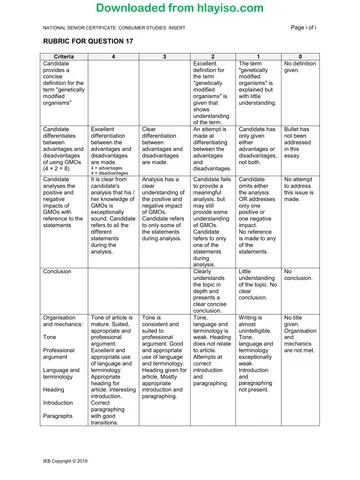
QUESTION 17
The economic impact of cheap clothing imports on South Africa.
The first resource shows that there are vast quantities of cheap imports
coming into South Africa, many of which are illegal. Being illegal means that
they have not followed the right procedures for imports, such as paying import
duties/taxes. This means that their selling prices can be lower.
Counterfeit products – illegal
China is also able to produce goods very cheaply due mainly to their cheap
labour. South African manufacturers have to pay minimum wages or more to
their workers. SA labour laws protect workers from exploitation – they therefore
have specified working hours and working conditions (including health and
safety procedures) so SA production costs more and SA workers produce
less than their Chinese counterparts.
Because local producers have a lot of competition (unfair as much of it is
illegal) they often cannot compete financially. Local producers therefore end
up closing down resulting in thousands of job losses and an increase in
unemployment which has a direct impact on families.
Local manufacturers and retailers have to charge VAT on goods sold – this
increases the selling price for consumers. Many of the Chinese retail centres
'do not comply with legal requirements such as being registered with SARS'
and they are illegally avoiding paying SA VAT which reduces their operating
costs even more therefore less money for the South African government.
Many of the cheap imports are designed to be "fast fashion", i.e. intended to
be worn for only one season or part of a season. They are cheap so people are
happy to discard and replace them on a regular basis. People are therefore
buying new clothes often but their money is not going to local producers and
is not benefitting the SA economy through taxes and job creation. Instead even
more money is leaving SA and going to Chinese producers.
7 points discussed that relate to economic impact on local production and
S.A. as a whole.
The benefits of buying "proudly South African" clothing and supporting
local fashion designers and producers.
When you buy SA produced goods, you are contributing to the SA economy:
South African companies and workers will be earning money. For example,
manufacturers like Tsonga use local people to hand-stitch the leather shoes –
thereby creating jobs and boosting local GDP.
Local skills will thus be developed and local workers will benefit.
Unemployment will decrease – more families earning their own income means
less people dependent on government grants to survive. It also creates pride
and increases self-esteem of people who are able to use their skills to
produce goods.
SA fashion designers are entrepreneurs who are contributing their skills to
our country. If we support them, we are supporting local talent. Their
businesses and reputations will grow and they will earn more – so will
contribute more taxes and as their businesses expand, will create even more
local jobs. This in turn will increase the skills base in local industry.
IEB Copyright © 2017 PLEASE TURN OVER
Downloaded from hlayiso.com
NATIONAL SENIOR CERTIFICATE: CONSUMER STUDIES – MARKING GUIDELINES Page 20 of 20
Consumer behaviour creates demand and affects the market place. In SA
there is a large market for the cheap imports and the volume of these goods
available has grown which is very damaging to the local designers and
producers. If people buy locally made clothes, local designers will need to
design and produce more to meet the demand.
SA fashion designers showcase their creations at fashion shows (e.g. Cape
Town Fashion Week) – this attracts many visitors from all over the world and
brings in tourism money to SA and is a boost for the economy.
Sense of patriotism
Environmental aspects/benefits
8 points discussed that relate to buying "PSA" and its effect on local
designers and producers.
The advantages of buying classic fashions such as practical leather shoes
and bags for one's working wardrobe.
These styles do not go out of fashion – are timeless/remain popular and can
be worn for many years. This saves money (good value for money) as they
do not need to be replaced often.
Classic styles are simple/not extreme therefore are always in good taste. It is
important to be tastefully presented at work.
Classic shoes are comfortable. This is important at work as you spend all day
wearing the shoes.
They suit most people so you will look good at work.
Classic styles go with many types of clothing and are usually neutral or
basic colours. This is practical for a working wardrobe as you do not have to
have a specific pair of shoes/bag that only goes with/matches a particular
outfit/do not have to change bags for different outfits.
Classic leather shoes and bags will be good quality (will last/durable) which
means they will look classy, fit well and will be durable for a long lasting
working wardrobe. Money can then be spent on fun fashion items for after
working hours.
5 points discussed that relate to advantages of classic shoes and bags in a
working wardrobe.
Total: 200 marks
IEB Copyright © 2017
Study this subject
Revise the topics in this paper, then practise them question by question.
- Grade 12 Consumer Studies notes
CAPS revision notes with worked examples.
- Consumer Studies questions by topic
Past exam questions sorted by CAPS topic, with memos where available.
- All Grade 12 Consumer Studies past papers
Past papers by year, with memos where available.
- Grade 12 IEB past papers
More Consumer Studies and other subjects in this collection.
Recommended for this subject
More papers and memos for this grade and subject.
MemorandumIEB
Consumer Studies Grade 12 IEB 2019 Memo
MemorandumIEB
Consumer Studies Grade 12 IEB 2019 Memo (Afrikaans)
MemorandumIEB
Consumer Studies Grade 12 IEB 2018 Memo
MemorandumIEB
Consumer Studies Grade 12 IEB 2018 Memo (Afrikaans)
MemorandumIEB
Consumer Studies Grade 12 IEB 2017 Memo (Afrikaans)
Question paperIEB
Consumer Studies Grade 12 IEB 2019 Question Paper
Related documents
Question paperIEB
Consumer Studies Grade 12 IEB 2017 Question Paper
Question paperIEB
Consumer Studies Grade 12 IEB 2017 Question Paper (Afrikaans)
Question paperIEB
Consumer Studies Grade 12 IEB 2019 Question Paper (Afrikaans)
AddendumIEB
Consumer Studies Grade 12 IEB 2019 Addendum
AddendumIEB
Consumer Studies Grade 12 IEB 2019 Addendum (Afrikaans)
Question paperIEB