Downloaded from hlayiso.com
NATIONAL SENIOR CERTIFICATE EXAMINATION
NOVEMBER 2019
CONSUMER STUDIES
MARKING GUIDELINES
Time: 3 hours 200 marks
These marking guidelines are prepared for use by examiners and sub-examiners,
all of whom are required to attend a standardisation meeting to ensure that the
guidelines are consistently interpreted and applied in the marking of candidates'
scripts.
The IEB will not enter into any discussions or correspondence about any marking
guidelines. It is acknowledged that there may be different views about some
matters of emphasis or detail in the guidelines. It is also recognised that,
without the benefit of attendance at a standardisation meeting, there may be
different interpretations of the application of the marking guidelines.
IEB Copyright © 2019 PLEASE TURN OVER
Skip to contentMemorandum 
View all
Consumer Studies Grade 12 IEB 2019 Memo
IEB Grade 12 Consumer Studies memorandum from the 2019, 24 pages. Read online or get the free PDF download, question paper linked when available.
Publisher: IEB
Consumer Studies · Grade 12 · 2019. Memorandum, 24 pages. Read online or download the PDF.
- Subject
- Consumer Studies
- Grade
- Grade 12
- Document type
- Memorandum
- Year
- 2019
- Publisher
- IEB
- Curriculum
- IEB
- Pages
- 24
- File size
- 403.6 KB
Loading document…
Loading document…
1 of 24
Document textSearch extracted text and jump to a page.
Downloaded from hlayiso.com
NATIONAL SENIOR CERTIFICATE: CONSUMER STUDIES – MARKING GUIDELINES Page 2 of 24
SECTION A FOOD AND NUTRITION AND THE CONSUMER
QUESTION 1
Write only the correct capital letter (A–D) next to the question number.
1.1 B
1.2 D
1.3 A
1.4 C
1.5 D
QUESTION 2
Match a function in Column B to a food additive in Column A.
Write only the capital letter (A–J) next to the question number.
2.1 E
2.2 H
2.3 A
2.4 I
2.5 C
2.6 J
2.7 B
QUESTION 3
3.1 Name an ingredient from the food label that should be avoided by a person
who is gluten intolerant.
Wheat
IEB Copyright © 2019 PLEASE TURN OVER
Downloaded from hlayiso.com
NATIONAL SENIOR CERTIFICATE: CONSUMER STUDIES – MARKING GUIDELINES Page 3 of 24
3.2 Complete the table below with regard to gluten allergy and gluten
intolerance.
3.2.1 definition
3.2.2 visible symptoms
3.2.3 management
Gluten allergy Gluten intolerance
Definition Gluten allergy refers specifically to: Gluten intolerance is:
Adverse reaction involving antibodies' A hereditary disorder in which eating
response to one or more proteins in gluten leads to damage of the lining in
wheat. the small intestine resulting in mal-
The immune system overreacts with absorption of minerals, vitamins and
strong and unusual antibodies causing other nutrients.
an inflammatory interaction. Seldom life threatening
Can be life threatening
Symptoms Hives Skin lesions
Eczema Swelling of the ankles
Itchiness/Rash Skin problems psoriasis
Swelling of lips Skin rash
Swelling of mouth
Swelling of tongue
Swelling of face
Swelling of throat
Asthma
Runny nose and nasal congestion
Sneezing
Coughing
Wheezing
Breathing difficulties
Management Read labels carefully.
Be aware of hidden wheat protein in food.
Enquire about the menu when you eat out.
Remove all gluten from your diet.
Exclude all foods that contain wheat, barley, rye or oats from the diet.
Be on the lookout for wheat in packets of soup, sausages, processed meats, frozen
meat and fish products that contain wheat flour as a binder or coating.
Vitamin and mineral supplementation must be taken to correct any deficiency
Substitute wheat-containing products with appropriate alternatives
IEB Copyright © 2019 PLEASE TURN OVER
Downloaded from hlayiso.com
NATIONAL SENIOR CERTIFICATE: CONSUMER STUDIES – MARKING GUIDELINES Page 4 of 24
QUESTION 4
4.1 Define osteoporosis.
• A condition characterised by a decrease in the density of bone mass.
This decreases bone strength and results in fragile/weak/brittle bones.
• Leads to abnormally porous bones that are compressible like a sponge.
• This health condition of the skeleton weakens the bone, resulting in
frequent fractures due to the loss of calcium, phosphorous, Vit D and
other minerals in the body over a long period of time.
4.2 State four biological factors that increase the risk of osteoporosis.
• Genetic factors / family history
• Gender – female low oestrogen levels
• Age
• Body weight
• Body shape / form (small, short people have less bone to lose than
taller, large-boned people)
• Low oestrogen levels (menopause) results in loss of bone mass
• Hyperactive thyroid excess of the hormone extracts calcium from bone
4.3 Name three calcium substitutes for individuals with lactose intolerance to
prevent osteoporosis.
• Milk substitutes (soya / coconut / quinoa / almonds / rice / cheese /
yoghurt / lactose free milk)
• Tofu
• Fortified fruit juices/cereals/breads
• Green vegetables (any example)
• Fish with soft, edible bones such as salmon / sardines
• Soybeans/Soy products
• Nuts
IEB Copyright © 2019 PLEASE TURN OVER
Downloaded from hlayiso.com
NATIONAL SENIOR CERTIFICATE: CONSUMER STUDIES – MARKING GUIDELINES Page 5 of 24
QUESTION 5
5.1 Identify the diet-related health condition evident in the above-mentioned
patient profile.
Anaemia or
Iron deficiency anaemia
5.2 Compile a list of food to be included or excluded from this patient's diet to
manage this health condition. Motivate your choices.
Include: Motivation:
Red and organ meats. Contain high amounts of haem iron,
which is easily absorbed.
Vit C sources such as dark leafy Promotes the absorption of iron.
vegetables and citrus fruits.
Folic acid, citrus fruit, bananas, Cannot be produced by the body,
broccoli, legumes and enriched bread, which will lead to enlarged red blood
cereal and pasta. cells, thus is necessary for red blood
cell formation.
Vit B12 in meat, dairy products and Cannot be produced by the body,
soya milk or food products enriched which will lead to enlarged red blood
with B vitamins Foods fortified/ cells, thus is necessary for red blood
enriched with B-vitamins cell formation.
Exclude:
Avoid large amounts of tea and coffee. Reduce the absorption of iron.
Oxalates, carbonates, phosphates and Tannins form an insoluble compound
phytates. that causes less iron to be available for
absorption.
QUESTION 6
6.1 Select from the tuckshop the food items that should be avoided by a
diabetic individual and give a reason for your answer.
Brownies
High sugar level (54 g) that will cause a rapid/quick increase/spike in blood
glucose levels.
IEB Copyright © 2019 PLEASE TURN OVER
Downloaded from hlayiso.com
NATIONAL SENIOR CERTIFICATE: CONSUMER STUDIES – MARKING GUIDELINES Page 6 of 24
6.2 Evaluate the food items sold at the school tuckshop with regard to their
suitability for children.
High kilojoule content that might lead to childhood Brownies
obesity Sausage roll
Cheese burger
Toasted chicken mayo
Macaroni & cheese
Foods are loaded with fat and sugar All the foods
High sodium content, risk of high blood pressure Most food, but especially
sausage roll
Very little to no fibre, risk of constipation Very little fibre in all the foods
Low iron levels, risk of developing anaemia Chicken mayo 0% Iron
Iron strengthens the immune system
Low Vit C levels, necessary for the absorption of iron Most food contain 0% Vit C,
to prevent risk of developing anaemia except Greek salad
Antioxidant that prevents damage to cells and
decreases the risk of infections
Calcium levels very low – children need calcium to Only macaroni and cheese
develop strong bones and teeth and prevent rickets contain 80% of RDA
and osteoporosis
Conclusion:
Thus none of the food items sold at this tuckshop are suitable for children as they
will increase their risk for developing anaemia, obesity, coronary heart disease as
well as high blood pressure (hypertension). The lack of vital micro nutrients will
influence the children's growth and development.
Or
The following foods are good because, … (reason)
The following foods are not suitable, … (reason)
IEB Copyright © 2019 PLEASE TURN OVER
Downloaded from hlayiso.com
NATIONAL SENIOR CERTIFICATE: CONSUMER STUDIES – MARKING GUIDELINES Page 7 of 24
6.3 Parents and caregivers of children should be educated with regard to
healthy eating habits. Formulate reasons for healthy eating habits of school-
going children.
• Healthy eating aids in growth and development.
• Ensures stable energy levels throughout the day.
• Aids in the ability to learn, concentrate and perform.
• Prevents childhood obesity and other diet-related health conditions.
• Decreases hyperactive behaviour.
• Enables children to make healthier food choices as adults.
• Prevents malnutrition.
• Children should include more fruit and vegetables in their diet to supply
the necessary fibre and prevent constipation.
• Healthy eating habits will build a strong and healthy immune system that
will prevent infections, thus preventing the overuse of antibiotics that
lead to poor gut health and ultimately cancer.
6.4 Eating foods high in fat and sodium, like the food items on this tuckshop
menu, might lead to coronary heart disease and high blood pressure
(hypertension).
State four dietary guidelines for each of the above-mentioned health
conditions.
Coronary heart disease High blood pressure
• Decrease the intake of saturated • Eat less sodium.
(animal) fats and trans-fatty acids • Limit sodium intake to 1,5–2,3 g per
and replace them with mono- day.
unsaturated and poly-unsaturated • Avoid processed foods such as
fats. biltong, potato crisps and
• Be aware of hidden fats. flavourings.
• Limit the intake of high cholesterol • Eat less saturated fats.
foods and replace them with foods • Eat low-fat dairy products.
of plant origin. • Eat foods that are rich in potassium,
• Limit the intake of red meats. calcium and magnesium – lowers
• Eat oily fish rich in unsaturated blood pressure.
fats. (Omega-3 & Vit D) • Eat wholegrain products high in
• Eat foods rich in soluble fibre. fibre.
• Use healthy cooking methods. • Do not add extra salt during the
• Always read food labels. cooking process or substitute salt
• Include at least 5 portions of fruit with other herbs
and vegetables per day – contains • Maintain a healthy body weight.
no cholesterol. • Increase water consumption
IEB Copyright © 2019 PLEASE TURN OVER
Downloaded from hlayiso.com
NATIONAL SENIOR CERTIFICATE: CONSUMER STUDIES – MARKING GUIDELINES Page 8 of 24
QUESTION 7
7.1 Briefly explain what is meant by the term organic food.
Organic food is the product of a farming system that avoids the use of
man-made fertilisers; pesticides; growth regulators and livestock feed
additives OR a system that uses natural pesticides.
Irradiation and the use of Genetically Modified Organisms (GMOs) or
products produced from or by GMOs are generally prohibited by organic
legislation.
7.2 To what extent do you agree or disagree with this statement? Justify your
point of view and come to a clear conclusion.
Agree – worth the money
Safer, as:
• These products are cultivated and reared without the use of chemical
pesticides, herbicides, fertilisers and GMOs, thus the food is natural,
reducing health risks.
• Foods do not contain chemical preservatives or artificial additives, such
as colouring or waxy substances, e.g. to repel insects.
• No antibiotics or growth hormones are used and animals are fed organic
products.
• Toxic metal. Cadmium is a toxic chemical naturally found in soils and
absorbed by plants. Studies have shown significantly lower cadmium
levels in organic grains, but not fruits and vegetables, when compared to
conventionally grown crops. The lower cadmium levels in organic grains
may be related to the ban on synthetic fertilizers in organic farming.
• Pesticide residue. Compared with conventionally grown produce,
organically grown produce has lower detectable levels of pesticide
residue. Organic produce may have residue because of pesticides
approved for organic farming or because of airborne pesticides from
conventional farms. The difference in health outcomes is unclear
because of safety regulations for maximum levels of residue allowed on
conventional produce.
• Bacteria. Meats produced conventionally may have a higher occurrence
of bacteria resistant to antibiotic treatment. The overall risk of bacterial
contamination of organic foods is the same as conventional foods.
• Food is natural, which will reduce health risks such as cancer and
infertility that are linked to chemicals.
IEB Copyright © 2019 PLEASE TURN OVER
Downloaded from hlayiso.com
NATIONAL SENIOR CERTIFICATE: CONSUMER STUDIES – MARKING GUIDELINES Page 9 of 24
More nutritious / healthier as:
• The vitamin and mineral content are probably higher as the chemical
used to ripen crops more quickly remove nutrients that would normally
be synthesised in food products during the natural ripening process.
• Nutrients. Studies have shown small to moderate increases in some
nutrients in organic produce. The best evidence of a significant increase
is in certain types of flavonoids, which have antioxidant properties.
• Omega-3 fatty acids. The feeding requirements for organic livestock
farming, such as the primary use of grass and alfalfa for cattle, result in
generally higher levels of omega-3 fatty acids, a kind of fat that is more
heart healthy than other fats. These higher omega-3 fatty acids are
found in organic meats, dairy and eggs.
Clear conclusion
Even though there is only a minimal increase in the nutritional value of
organic food, it is important to note that organic food is definitely safer for
human consumption due to the fact that the food does not contain
herbicides, pesticides and genetically modified organisms.
Disagree – not worth the money,
Not safer, as:
• Moulds are more likely to grow on organic fruits and vegetables as a
result of insect damage, which can lead to food poisoning as toxins are
produced.
• There is a shortage of locally produced organic food products that leads
to more imports and contributes to pollution and global warming.
• Negative influence on ecosystem as some organic pesticides are toxic
to earthworms and fish.
Not more nutritious / healthier as:
• Labels should be read very carefully as organic does not always mean
that it is healthy. Excessive amounts of salt and sugar can still be
added. 95% of the ingredients must be organic before it can be labelled
as organic.
Clear conclusion
According to the Food Advisory Consumers Service there is no credible
evidence to show that organic food is safer or more nutritious than
conventionally grown products. The only difference is the way it is grown
and processed.
IEB Copyright © 2019 PLEASE TURN OVER
Downloaded from hlayiso.com
NATIONAL SENIOR CERTIFICATE: CONSUMER STUDIES – MARKING GUIDELINES Page 10 of 24
SECTION B CLOTHING
QUESTION 8
Write only the correct capital letter(s) next to the question number.
8.1 B
8.2 A, C, D, E (any order, but only the first four)
8.3 B, C (any order)
8.4 D
QUESTION 9
9.1 Identify the different types of fashion in Outfit A and C.
A = Average / Contemporary / Standard fashion / Trend
C = Fad fashion / Retro
9.2 Outfit B can be identified as classic fashion. Why is it important to include
classic styles in the wardrobe of a young adult entering the world of work?
• Classic styles tend to be timeless.
• Simplistic has possibilities of dressing up or dressing down, mix and
match with other items.
• Remain popular thus can be worn for more than one season by just
changing accessories.
• Are considered good taste as it is simplistic and timeless.
• Are worn over a long period of time which means you don't have to
replace clothing often.
• Are suitable for most people and therefore will flatter most figure types.
• Are good quality and therefore a good investment.
• Suitable for most occasions and company dress codes
IEB Copyright © 2019 PLEASE TURN OVER
Downloaded from hlayiso.com
NATIONAL SENIOR CERTIFICATE: CONSUMER STUDIES – MARKING GUIDELINES Page 11 of 24
9.3 Draw a graph of the fashion cycles represented by Outfit A, B and C. Label
the graphs and the various stages of the fashion cycle.
Classic graph drawing
Fad graph drawing
Average / Contemporary / Standard
Sales / Popularity /
graph drawing
Quantity
Time / Duration
1 2 3 4 5
Different stages:
1. Introduction / launch / beginning / new
2. Rise / growth / increase / incline
3. Peak / maturity / culmination
4. Decline
5. Obsolete / end / rejection / outdated
QUESTION 10
Explain the effect of textile research and new technology on clothing production,
resulting in fashion change.
• Development of synthetic micro fibres and new finishing processes resulted in
the improvement of fabric properties and new production methods and thus
ongoing change in the fashion industry.
• Clothing production industry is mostly mechanised and to a certain extent
computerised which results in more clothes being produced and thus making
fashion change easier.
• With improved sewing and knitting machines, more clothes are produced, thus,
cost of fashion items decreases lower prices help to stimulate production and
further sales, promoting frequent change in fashion.
• Wider/More variety of clothing styles
• Improved communication via social media platforms
• Faster and easier payment methods
• Technology lead to more sustainable material and styles that promotes fashion
change
IEB Copyright © 2019 PLEASE TURN OVER
Downloaded from hlayiso.com
NATIONAL SENIOR CERTIFICATE: CONSUMER STUDIES – MARKING GUIDELINES Page 12 of 24
QUESTION 11
11.1 Explain why the appropriate choice of clothing for a work interview is
important.
• You need to convey your talents, skills and personality as positively as
possible in a very short time.
• Ensure that you find out what the dress code of the company is before
you go for an interview. You will then be able to select the most
appropriate clothing for the interview.
• It is always better to overdress than underdress for an interview, as you
will be under scrutiny of senior personnel present at the interview.
• For a professional job the most appropriate dress code would be
business professional.
• Your clothing is a vital form of communication and will tell your
interviewer how serious and professional you are. You will be judged
during the interview.
• You only have that one chance to create a positive first impression and
nothing makes a greater impact than the way we present ourselves.
• Clothing, personal hygiene, body language and facial expression all
contribute towards a first impression.
• A person that is dressed appropriately and smartly for an interview will
give the impression that he or she is confident, competent, serious and
ready to learn and should be considered seriously.
• Colours – explain why certain colours are more appropriate/suitable for
the work environment
11.2 Provide reasons why neither of these outfits would be appropriate for an
interview as a receptionist of a hotel.
• Hotel receptionist – first contact the visitors have with the hotel.
Dressing for the interview would need to reflect the general dress code
of the hotel, thus look professional as it will be the first contact visitors
have with the hotel and impressions will be formed about the hotel.
• Ripped jeans and miniskirts are not appropriate for a professional job as
it shows too much flesh / skin (revealing) and to create a professional
look, one should avoid overly sexy clothing such as the ripped jeans and
miniskirt.
• High heels will not be appropriate as the receptionist is on her / his feet
all day and for an interview the individual wants to convey the message
that he / she is aware of what the job entails.
• Outfits are too informal, which makes it difficult to create a professional
look for the interview. It is always better to rather be overdressed that
underdressed for an interview.
• Yellow frayed jersey shows too much flesh / skin which is not appropriate
for someone interacting with guests from different countries and
cultures. Good to be sensitive towards the beliefs of others.
(Answer should relate back to dressing for an interview)
IEB Copyright © 2019 PLEASE TURN OVER
Downloaded from hlayiso.com
NATIONAL SENIOR CERTIFICATE: CONSUMER STUDIES – MARKING GUIDELINES Page 13 of 24
11.3 Suggest four guidelines regarding suitable clothing choices for a work
interview.
• Ensure clothes are neat and well laundered / Dress neatly
• Wear a smart and comfortable pair of shoes
• Keep accessories minimal and professional
• Dress to suit the working environment or dress code of the company (no
T-shirts with slogans)
• Classic styles are a good choice as they are timeless / not too
fashionable
• Do not wear clothes that may seem provocative / revealing
• Clothing must fit well
• No underwear should be visible
QUESTION 12
12.1 Predict the outcome on the South African clothing industry if consumers
keep supporting illegal clothing imports.
• Less and less clothing will be manufactured in South Africa
• Local clothing and textile industry will suffer
• Leading to job losses and no income
• Poorer communities
• Would be detrimental to the country's economy
• Farmers producing raw fibres for clothing production such as cotton,
bamboo, hemp and wool will lose income due to less clothing being
produced
• Local designers will leave the country
12.2 Formulate a strategy to promote local or "Proudly South African" clothing
products.
• Advertising campaigns on TV and social media to make a wide
audience of the general public aware of the availability of locally
produced clothing.
• Registering as "Proudly South African" will give access to local tenders
and marketing platforms.
• Promoting the quality of locally produced items by educating consumers
with regard to the criteria necessary to become part of the "Proudly
South African" campaign and the use of locally sourced products. Proof
of quality by way of certification from an accredited verification body or
industry association.
• Promoting fair trade practices as the "Proudly South African" trademark
specifies labour and environmental practices to participants, where
workers are not exploited which is part of the campaign.
• Promoting the adherence to specific environmental standards.
• Get more local manufacturers involved in the campaign by means of
incentives to be part of the campaign, such as tender processes.
IEB Copyright © 2019 PLEASE TURN OVER
Downloaded from hlayiso.com
NATIONAL SENIOR CERTIFICATE: CONSUMER STUDIES – MARKING GUIDELINES Page 14 of 24
• Promote a campaign at craft markets where local manufacturers sell
their clothing.
• Promote the advantages of buying local such as job creation.
• Get fashion influencers / famous personalities to wear and promote
locally produced clothing via social media.
• Promote the usage of these clothing items by linking it to charity
organisations or events
IEB Copyright © 2019 PLEASE TURN OVER
Downloaded from hlayiso.com
NATIONAL SENIOR CERTIFICATE: CONSUMER STUDIES – MARKING GUIDELINES Page 15 of 24
SECTION C HOUSING AND FURNISHINGS AND THE CONSUMER
QUESTION 13
13.1 Choose the correct term in brackets. Write only the term next to the
question number in your Answer Book.
13.1.1 Monthly insurance
13.1.2 Inspection fee
13.1.3 Occupational rent
13.2 Give the term for each of the descriptions below. Write only the term next to
the question number in your Answer Book.
13.2.1 Simple interest
13.2.2 Transfer fees (costs) / Conveyancing fees
QUESTION 14
14.1 Give reasons why the above-mentioned townhouse would be suitable for
Khumo's lifestyle.
• She is single and the townhouse provides good security as it has a
secured perimeter and controlled access.
• Save money on the cost of having to maintain a larger property and
garden.
• As she will travel a lot and is frequently away from home, Khumo can
just lock up and go.
• Close to airport where she works.
• She can enjoy the common facilities such as the library, landscaped
gardens and shuttle service to shopping centre.
• Close enough to business centre and shopping shuttle available.
• From the picture it can be assumed that it is a sectional title home where
the body corporate will oversee management of complex.
14.2 Khumo is a first-time buyer and does not know whether she should buy or
rather rent a property. Suggest, with supporting reasons, the best choice for
Khumo.
Buying
• Khumo becomes the legal owner of the property
• Sense of pride, security and independence
• Can be used as security for a bank loan
• Investment as family can inherit
• She can make a profit when selling as the value of property generally
increases over time
• Owning a first home often leads to the purchase of a better home later
IEB Copyright © 2019 PLEASE TURN OVER
Downloaded from hlayiso.com
NATIONAL SENIOR CERTIFICATE: CONSUMER STUDIES – MARKING GUIDELINES Page 16 of 24
OR:
Renting
• May be a more affordable option in the beginning
• Monthly expenses may be lower – no levies
• Rental is a fixed amount per month
• Khumo does not pay for insurance of the property
• She does not pay property rates or taxes
• She will not be responsible for any maintenance
• Easy to move (usually after notice period)
(Come to a clear conclusion with reasons – 1 mark)
QUESTION 15
15.1 Select a builder and give a reason for your choice.
Advert B / Joel Human – builder is registered to the NHBRC
15.2 State the advantages and disadvantages of building your own home.
Tabulate your answer.
Advantages Disadvantages
• It can cost less than buying a house • It can cost more than buying a
(provided you know what you do) house as there is always the risk of
• Can be designed to suit owner's faulty construction and design
needs and taste • Risk of faulty design and floor plan
• The latest designs and technology cost escalation during building
can be included process
• The house can be completed • Quality control is very important
according to the owner's own • The process can be time-consuming
schedule and complicated (delays)
• The owner can choose fixtures, • Managing and supervising
paint and flooring to suit their taste sub-contractors is a tricky, complex
• If there are not enough funds, the and risk-laden task
building work can be halted for a • Starting a new garden is expensive
while
• It is an investment/asset
• It is a way of saving
• No transfer duty
• The owner will not inherit previous
faults and poor workmanship
• New houses are often in developing
areas, which have an increased
property value
IEB Copyright © 2019 PLEASE TURN OVER
Downloaded from hlayiso.com
NATIONAL SENIOR CERTIFICATE: CONSUMER STUDIES – MARKING GUIDELINES Page 17 of 24
15.3 List the documentation needed by the bank before approving a building
loan.
• Fully completed home loan application
• Proof of income and expenditure and assets and liabilities / proof of
stable income
• Title deeds of land
• A detailed quotation from the builder (registered at the NHBRC)
• Proof of enrolment of home with NHBRC
• Contract between builder and yourself
• A schedule of fittings and finishes
• A building plan (Municipal Approved/Provisional building plans)
• Copy of Identity Document/s or smart card ID
• Copy of Offer to Purchase, except where no sale is taking place
• Latest 3 month's bank statements original and stamped
• Building contracts/ quotes signed by you and the builder
• Builders All Risk Insurance Policy
• Income Tax number
• FICA (proof of residency)
QUESTION 16
16.1 Draw a flow diagram / chart of the correct channels (ports of call) for
consumers to follow when they have a complaint.
DEALER / CUSTOMER SERVICE / SALESPERSON
STORE MANAGER
MANUFACTURER / WISHY WASHY
SA NATIONAL CONSUMER NATIONAL CONSUMER
UNION (SANCU) FORUM (NCF)
SMALL CLAIMS COURT / CONSUMER
TRIBUNAL / OMBUDSMAN
MEDIA
Dealer-Manufacturer-Consumer Organisation-Legal Action (Courts)-Media
(-1 mark if not flow diagram / chart)
IEB Copyright © 2019 PLEASE TURN OVER
Downloaded from hlayiso.com
NATIONAL SENIOR CERTIFICATE: CONSUMER STUDIES – MARKING GUIDELINES Page 18 of 24
16.2 The complaint received by Hellopeter.com lacked important information.
Write an e-mail to the manufacturer, including all the relevant information, to
achieve the best possible outcome. (This e-mail should be no longer than
one page). Fictional information must be used.
Learners must write an e-mail to the manufacturer that include the following
information.
• Name / initials or surname
• Telephone number for home / business / cell
• Account number (if applicable)
• Nature of the complaint and why he / she is dissatisfied
• Details of the store where the purchase was made
• Date and place of the transaction
• The cost of the product or expenses due to broken washing machine
• Method of payment
• Invoice number or any information that can identify the product
• What was wrong
• Clear on what is expected of the outcome
• How long he / she is willing to wait
• Attach all documents (please see attached documents)
Example:
Date (usually automatic)
To: wishywashy@hotmail.co.za
Cc: the store / manager
From: Florence Nightingale
Subject: Repairs of washing machine
Dear (manager name) / To whom it may concern
Introduction:
Explain who you are and why you are writing
Faulty washing machine
Body:
First paragraph – state what you bought, when and where, including serial
numbers where appropriate.
Second paragraph – state the problem you have with the product. Give as
many details as possible.
Attach copies of any relevant documentation (receipts, warranties, letters,
etc.).
IEB Copyright © 2019 PLEASE TURN OVER
Downloaded from hlayiso.com
NATIONAL SENIOR CERTIFICATE: CONSUMER STUDIES – MARKING GUIDELINES Page 19 of 24
Conclusion:
In the final paragraph – state what action you want taken to resolve your
complaint. Give precise but reasonable timeframes for actions. State that if
you do not hear from them you will take further action.
Yours sincerely
Signature
Printed name
• Be formal and to the point / neat and easy to read / short and to the point
16.3 The outcome of the complaint was that the consumer received a refund and
must now buy a new washing machine.
Explain to the consumer the financial responsibility before buying new
appliances.
Before:
• Compare different brands / energy levels and shop around / Some
suppliers give the option of comparing different appliances on their
websites / Product comparison reports are a useful tool
• Compare different stores
• Make sure the store that you finally buy from is reputable / reliable dealer
• Ask about extra costs such as service charges, installation charges,
delivery cost and administration costs
• Read the store's return or exchange policy
• Make sure the item comes with a guarantee / warranty
• Read the guarantee / warranty and contract very carefully
• Compare the financial implication of buying cash or on credit
• Ensure that purchase is within your budget/financial means
16.4 The consumer needs to choose between the following three washing
machines. Study the labels below and then answer the questions that follow:
16.4.1 Rank the three washing machines with regard to their energy
consumption from the best to the worst.
1. Machine B
2. Machine A
3. Machine C
16.4.2 Rank the three washing machines with regard to their water
consumption from the best to the worst.
1. Machine B
2. Machine A & C
16.4.3 Choose the machine that is the most sustainable with regard to
energy and water consumption.
Machine B
IEB Copyright © 2019 PLEASE TURN OVER
Downloaded from hlayiso.com
NATIONAL SENIOR CERTIFICATE: CONSUMER STUDIES – MARKING GUIDELINES Page 20 of 24
16.4.4 Evaluate the impact on the environment when a family uses a
tumble dryer every day.
• If the family uses lower temperatures, electricity and money
would be saved and their carbon footprint will be reduced. The
anti-crease cycle will help that the clothing does not need any
ironing which will reduce electricity usage and save money.
• Except for gas dryers, dryers are not energy efficient (B- to D-)
• However, a family will have larger loads of washing and this
family is using the dryer every day, which increases their
electricity usage increasing their carbon footprint. Fossil fuels are
necessary to generate electricity and harmful gases are released
into the atmosphere.
• Every day usage might result in the dryer being replaced often,
and some parts can't be recycled
• Lint of machine may cause pollution
• Old machines are noisy and add to sound pollution
• Clothes may not last long, need to be replace and old clothes
may end up on landfills, harming the environment
Conclusion
The family should rather hang their clothes outside if the weather
permits it. If they use the dryer with discretion, their financial cost
and environmental impact will be reduced.
By using the dryer daily, they are increasing their electricity usage
and it will have a negative impact on the environment as well as the
family's finances.
(4 marks evaluation + 1 mark conclusion)
IEB Copyright © 2019 PLEASE TURN OVER
Downloaded from hlayiso.com
NATIONAL SENIOR CERTIFICATE: CONSUMER STUDIES – MARKING GUIDELINES Page 21 of 24
SECTION D EXTENDED WRITING RESPONSE
QUESTION 17
Study the extracts below. Using the information, write an essay, debating whether the use
of Genetically Modified (GM) food should be allowed. You must form a clear opinion on
the issue and substantiate your position.
Use the following points in your preparation:
• Provide a title for your essay.
• Organise your essay by using paragraphs.
• Provide a definition for the term Genetically Modified Organisms (GMOs).
• Come to a clear conclusion.
Marks will be allocated according to the rubric.
Statement 1
South Africa's unique position on GM
While many countries allow GM production, South Africa's Genetically Modified Organisms Act
of 1997 is more or less unique. It allows maize modified to contain soil protein fatal to insects to
enter the human food chain – most countries that allow GM staples to be grown do so only for
use in animal food. According to one study, GM planting in South Africa increased production by
1,1%, although attempts to evaluate the benefits are strangely few and far between.
[Adapted from: Sunday Times, Food Basket, April 2017]
Statement 2
All over Europe and the USA, anti-GM activists tore up crops and dug for legislation to close
down trials. In the years since, several studies suggest that public opinions have calmed down.
Consumers had two primary concerns: that GM foods pose an inherent health risk, and that the
corporations who create GM seeds would dominate chains and penalise smaller, poorer growers
with high prices.
[Adapted from: Sunday Times, Food Basket, April 2017]
Statement 3
Most South Africans, without their knowledge or consent, are unknowingly consuming
genetically modified food products every single day.
"Local farmers are continuing to use toxic glyphosate-based products and are farming crops that
have been genetically modified and are therefore Genetically Modified Organisms. Even if these
products were correctly labelled, the majority of South Africans would have little choice but to
consume them," said Haidee Swanby from the African Centre for Biosafety (ACB).
[Source: <https://www.health-e.org.za/>]
Statement 4
Significant developments in GM crops have been made in South Africa's agricultural sector,
including increased crop yield, which has a direct impact on food production and food security,
as well as a decreased use of pesticides and herbicides in GM crop fields. "This has a
considerable impact on the environment, biodiversity and health of farm workers who could be
exposed to chemicals while applying them to the fields," says the Council for Scientific and
Industrial Research biosciences principal researcher, Dr Eugenia Barros.
[Source: <http://www.engineeringnews.co.za>]
IEB Copyright © 2019 PLEASE TURN OVER
Downloaded from hlayiso.com
NATIONAL SENIOR CERTIFICATE: CONSUMER STUDIES – MARKING GUIDELINES Page 22 of 24
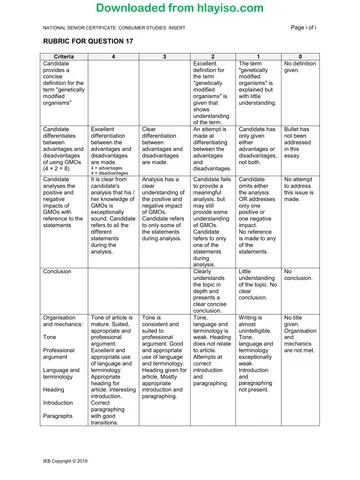
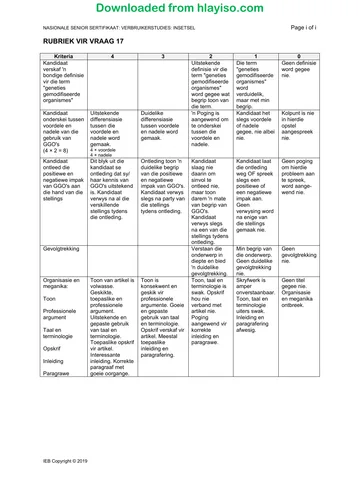
Rubric:
Criteria 4 3 2 1 0
Candidate . Excellent The term No definition
provides a definition for "genetically given.
concise the term modified
definition for the "genetically organisms" is
term "genetically modified explained but
modified organisms" is with little
organisms" given that understanding.
shows
understanding
of the term.
Candidate Excellent Clear An attempt is Candidate has Bullet has
differentiates differentiation differentiation made at only given not been
between between the between differentiating either addressed
advantages and advantages and advantages and between the advantages or in this
disadvantages disadvantages disadvantages advantages disadvantages, essay.
of using GMOs are made. are made. and not both.
(4 × 2 = 8) 4 × advantages disadvantages.
4 × disadvantages
Candidate It is clear from Analysis has a Candidate fails Candidate No attempt
analyses the candidate's clear to provide a omits either to address
positive and analysis that his / understanding of meaningful the analysis this issue is
negative her knowledge of the positive and analysis, but OR addresses made.
impacts of GMOs is negative impact may still only one
GMOs with exceptionally of GMOs. provide some positive or
reference to the sound. Candidate Candidate refers understanding one negative
statements refers to all the to only some of of GMOs. impact.
different the statements Candidate No reference
statements during analysis. refers to only is made to any
during the one of the of the
analysis. statements statements.
during
analysis.
Conclusion Clearly Little No
understands understanding conclusion.
the topic in of the topic. No
depth and clear
presents a conclusion.
clear concise
conclusion.
Organisation Tone of article is Tone is Tone, Writing is No title
and mechanics: mature. Suited, consistent and language and almost given.
appropriate and suited to terminology is unintelligible. Organisation
Tone professional professional weak. Heading Tone, and
argument. argument. Good does not relate language and mechanics
Professional Excellent and and appropriate to article. terminology are not met.
argument appropriate use use of language Attempts at exceptionally
of language and and terminology. correct weak.
Language and terminology. Heading given for introduction Introduction
terminology Appropriate article. Mostly and and
heading for appropriate paragraphing. paragraphing
Heading article. Interesting introduction and not present.
introduction. paragraphing.
Introduction Correct
paragraphing
Paragraphs with good
transitions.
IEB Copyright © 2019 PLEASE TURN OVER
Downloaded from hlayiso.com
NATIONAL SENIOR CERTIFICATE: CONSUMER STUDIES – MARKING GUIDELINES Page 23 of 24
The essay is marked holistically using the IEB source-based essay rubric with the
following guidelines.
Definition:
Genetic modification is the result of genetic engineering. The genetic code inside living
cells is made of DNA. The long, chain-like molecules of DNA are divided into
chromosomes and the chromosomes are divided into units called genes. Genes control
the characteristics of living things, such as the colour of a flower petal or a child's eyes.
Scientists can now identify the individual gene responsible for a desired characteristic,
extract it, copy it and insert the copy into another organism. That organism will then also
possess that property.
Genetic engineering thus allows genetic material from one organism to be implanted into
another organism in order to introduce characteristics from one species into another.
Advantages:
• Crops can be modified so they are resistant to pests.
• Fewer pesticides need to be sprayed on crops, which is better for the environment.
• Some crops are modified so that they are resistant to weed-killing chemicals.
• Chemicals can then be used to wipe out weeds without killing the crop.
• Crops may have an increased resistance to disease, drought and fluctuations in
temperature, which makes it possible for crops to be grown in regions with low
agricultural productivity.
• The crop yields are greater.
• More people can be fed.
• Production costs may be lower.
• Food products made from genetically modified crops have a longer shelf life, with
better processing and manufacturing properties.
• Genetically modified food is cheaper and more plentiful.
• Crops may have an improved flavour, appearance and texture.
• Food can be used as an edible vaccine.
• Food may have more nutritional value than conventionally grown crops.
Disadvantages:
• It is unclear what happens to genes that are inserted into other products.
• It is not known how these crops influence the direct environment, such as the soil in
which they are grown.
• No one knows what will happen if genetically modified plants pollinate conventionally
grown plants.
• It is possible that genetic modification may be used to cause animals to grow bigger
and faster than usual so they can be slaughtered for consumption at a younger age.
This is unethical.
• There is no specific data that proves that genetically modified foods are harmless.
• The practice of genetic modification is vague and the scientific developments that
make it possible have occurred so recently that there is no guarantee that we will not
experience problems in the future.
IEB Copyright © 2019 PLEASE TURN OVER
Downloaded from hlayiso.com
NATIONAL SENIOR CERTIFICATE: CONSUMER STUDIES – MARKING GUIDELINES Page 24 of 24
Positives:
• Insect resistant, increased production, increased yield, better food security, longer
shelf life, export of food to poorer countries, access to more nutrition-rich foods.
• Decreased use of pesticides and herbicides in GM crop fields. This has a considerable
impact on the environment, biodiversity and health of farm workers who could be
exposed to chemicals while applying them to the fields.
• Less greenhouse gas emissions.
Negatives:
• Soil protein fatal to insects may enter the human food chain – most countries that allow
GM staples to be grown do so only for use in animal food – risk of gene migration.
• GM foods pose an inherent health risk – humans might become antibiotic resistant,
unknown allergic reactions.
• Corporations who create GM seeds would dominate chains and penalise smaller,
poorer growers with high prices.
• Even if these products were correctly labelled, the majority of South Africans would
have little choice but to consume them.
Total: 200 marks
IEB Copyright © 2019
Study this subject
Revise the topics in this paper, then practise them question by question.
- Grade 12 Consumer Studies notes
CAPS revision notes with worked examples.
- Consumer Studies questions by topic
Past exam questions sorted by CAPS topic, with memos where available.
- All Grade 12 Consumer Studies past papers
Past papers by year, with memos where available.
- Grade 12 IEB past papers
More Consumer Studies and other subjects in this collection.
Recommended for this subject
More papers and memos for this grade and subject.
MemorandumIEB
Consumer Studies Grade 12 IEB 2019 Memo (Afrikaans)
MemorandumIEB
Consumer Studies Grade 12 IEB 2018 Memo
MemorandumIEB
Consumer Studies Grade 12 IEB 2018 Memo (Afrikaans)
MemorandumIEB
Consumer Studies Grade 12 IEB 2017 Memo
MemorandumIEB
Consumer Studies Grade 12 IEB 2017 Memo (Afrikaans)
Question paperIEB
Consumer Studies Grade 12 IEB 2019 Question Paper
Related documents
Question paperIEB
Consumer Studies Grade 12 IEB 2019 Question Paper (Afrikaans)
AddendumIEB
Consumer Studies Grade 12 IEB 2019 Addendum
AddendumIEB
Consumer Studies Grade 12 IEB 2019 Addendum (Afrikaans)
Question paperIEB
Consumer Studies Grade 12 IEB 2018 Question Paper
Question paperIEB
Consumer Studies Grade 12 IEB 2018 Question Paper (Afrikaans)
Question paperIEB