
Downloaded from hlayiso.com
education
Department:
Education
PROVINCE OF KWAZULU-NATAL
NATIONAL
SENIOR CERTIFICATE
�------------------ • • • •ra • • • • • • • • �
",,
,,
.,
�--------------- ---------------� �
\I
�
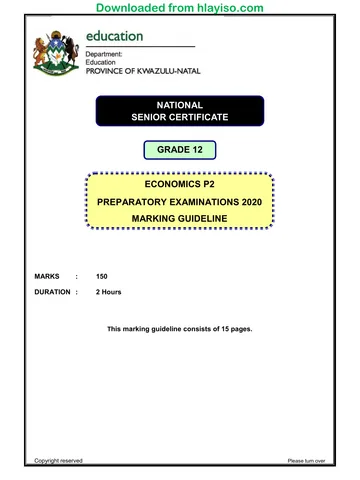
MARKS: 150
TIME: 2 Hours
This question paper consists of 13 pages.
Copyright reserved Please turn over
You're offline
Skip to contentQuestion paper 
%202020%20Preparatory%20Question%20Paper_hlayiso.com_--468fe2d7-94f8-43ec-88c6-86cf12e31969/v1-b9f94b025e76d883b8ba/card.webp)
View all%20June%202025%20Possible%20Answers--3df8bb66-2d0a-4b1b-89bf-509b303bfa3e/v1-45abc04fbe038cfc315d/card.webp)
Economics 2020 KZN P2 QP_hlayiso.com_.pdf
Economics · Grade 12 · KZN June · 2020. Question paper, 13 pages. Read online or download the PDF.
- Subject
- Economics
- Grade
- Grade 12
- Document type
- Question paper
- Year
- 2020
- Exam period
- KZN June
- Paper
- 2
- Pages
- 13
- File size
- 3.2 MB
Loading document…
Loading document…
1 of 13
Document textSearch extracted text and jump to a page.
Downloaded from hlayiso.com
June 2020 Common Test
NSc'
INSTRUCTIONS AND INFORMATION
1. Answer FOUR questions as follows in the ANSWER BOOK.
• SECTION A : COMPULSORY
2. Write the question number above each answer.
3. Answer only the required numbers of questions. Answers in excess of the required
number will not be marked.
4. Answer the questions in full sentences and ensure that the format, content and context
of your responses comply with the cognitive requirements of the questions.
5. Number the answers correctly according to the numbering system used in this question
paper.
6. Read the questions carefully.
7. Start each question on a new page.
8. Leave 2-3 lines between sub sections of questions.
9. Use only black or blue ink.
10. You may use a non- programmable pocket calculator.
11. Write legible and present your work neatly.
Copyright reserved Please turn over
Downloaded from hlayiso.com
Econofitsmanloaded from Stanmorephysics.com June 2020 Common Test
SECTION A: COMPULSORY
QUESTION 1 30 MARKS - 20 MINUTES
slare provided as possible answers to the following questions.
ect answer and write only the letter (A-D) next to the question
-1.8) in the ANSWER BOOK, for example 1.1.9. D.
1.1 Various opti 3A
1.1.1 An example of a variable cost in a bakery is ...
A electricity.
B rent.
Cc insurance
D interest
1.1.2 The business in a perfect competition makes ...profit in the long run.
A abnormal
B economic
Cc perfect
D normal
1.1.3 The perfect market will shut down when price is ...
A equal to AR.
B equal to MC.
Cc equal to demand.
D below AVC
1.1.4 The market produces merit goods in ... quantities
A enough
B insufficient
Cc large
D sufficient
1.1.5 A key feature of public goods is their ...
A limited consumption.
B non excludability
Cc rivaly
D rejectabiity
Copyright reserved Please turn over
Downloaded from hlayiso.com
Econofitsmanloaded from Stanmorephysics.com June 2020 Common Test
1.1.6 Price set by the government below market price is called ...
A equilibrium
B ice floor
Cc inimum price
D rice ceiling
1.1.7. The cost and benefits for third parties that are not included in the
price are called ...
A externalities.
B private cost.
Cc social cost.
D social benefits.
1.1.8 The value of the alternative that is sacrificed when a choice is made
when producing two products is called ...
A profit
B opportunity cost
Cc savings
D economies of scale (8 x 2) (16)
Copyright reserved Please turn over
Downloaded from hlayiso.com
Econofrsmnloaded from Stanmorephysics -COM June 2020 Common Test
1.2 | Choose a description from COLUMN B that matches the item in COLUMN A.
Write only the letter (A-I) next to the question numbers (1.2.1. to 1.2.8) in the
ANSWER BOOK.
COLUMN._A COLUMN B
1.2.1 Marginal,cost A Actual expenditure of business e.g. insurance.
1.2.2 Competition B Occurs when the gap between TR and TC is the
tribunal— greatest.
1.2.3 Break-even point | C A mechanism that bring together buyers and
sellers.
1.2.4 Industry D_ Adjudicate in the case of misconduct and issue
orders on matters presented by competition
1.2.5 Explicit cost commission.
E Agroup of businesses which produce similar and
1.2.6 Black market related products.
1.2.7 Renewable F Costs incurred for producing an additional unit of
resources a product.
1.2.8 Profit oo G Asituation where a business does not make profit
maximization or loss.
point
H_ Asituation in which illegal goods are bought and
sold.
| That which can be returned to its natural habitant
(8 x1) (8)
1.3. Give ONE term for EACH of the following descriptions.
Write only the term next to the question numbers (1.3.1 to 1.3.6)
in the ANSWER BOOK. Abbreviations, acronyms and examples WILL
NOT be accepted.
1.3.1. A period of production where all costs of production are variable.
1.3.2 A group of producers forming a collective monopoly.
1.3.3. When buyers are charged differently for the same product: 1a
1.3.4 A point where MC equals MR yet the business is makingfameconomic loss.
1.3.5 An instrument used to determine the feasibility of the project,
1.3.6 Asituation where businesses fail to meet the needs of consumers.
(6 x 1) (6)
TOTAL SECTION A: [30]
Copyright reserved Please turn over
Downloaded from hlayiso.com
Econofitsmanloaded from Stanmorephysics.com June 2020 Common Test
SECTION B
Answer any TWO of the three questions in this section in the ANSWER BOOK.
QUESTION 2: MACROECONOMICS 40 MARKS - 30 MINUTES
2.1 Answer the following questions.
2.1.1 Give TWO types of monopolies. (2x1) (2)
2.1.2 Why are businesses in a monopoly market regarded as
price setters? (1x2) (2)
2.2 Study the graph below and answer the questions that follow
Remove the graph
MC
w AC
=)
Zz
wi
a 10 AR =MR=P
5
fe) 8 c
fe) I
mi
8
fe I
° 100
QUANTITY
2.2.1 What does point A in the graph above represent? (1)
2.2.2 Why would the above graph be regarded as that of a perfect (1)
competitor? Tal
2.2.3 Describe the term /ong-run. lone (2)
2.2.4 Briefly explain how an individual business can increase its profit. (2)
2.2.5 Calculate the total profit made by the above firm.
Show all calculations. (4)
Copyright reserved Please turn over
Downloaded from hlayiso.com
Econotemmloaded from Stanmorephysics.com June 2020 Common Test
2.3. Study the graph below and answer the questions that follow.
[Source: www.google.com]
2.3.1. In which industry do these firms operate? (1)
2.3.2 Give the type of product sold in the oligopoly market. (1)
2.3.3 Describe the term price leadership. (2)
2.3.4 Briefly explain the barriers to enter into an oligopoly market. (2)
2.3.5 How does the oligopolist increase its market share without
causing price wars? (2 x 2) (4)
2.4 With an aid of a well labeled graph discuss negative externality. (8)
2.5 How does a monopolist negatively impact consumers? (8)
[40]
Copyright reserved Please turn over
Downloaded from hlayiso.com
Econofitsmanloaded from Stanmorephysics.com June 2020 Common Test
QUESTION 3: MICROECONOMICS 40 MARKS — 30 MINUTES
3.1. Answer the following questions.
TWO variables that determine profit. (2 x 1) (2)
3.1.2 Whyare markets not willing to supply merit goods? (1 x 2) (2)
lt
ps
3.2. Study the cartoon below and answer the questions that follow..
MONOPOLY
PRICE
AC
| \MR D/AR
" 100 QUANTITY.
3.2.1. Give the name of the shaded area in the graph above. (1)
3.2.2 Which curve is the same as the demand curve in the gra ‘Bbove? (1)
3.2.3 Describe the term monopoly. (2)
3.2.4 Briefly explain why is the above equilibrium position typical of the (2)
short-run?
3.2.5 Calculate the loss made by the firm in the graph above. (4)
Copyright reserved Please turn over
Downloaded from hlayiso.com
Econofrsmnloaded from Stanmorephysics .com June 2020 Common Test
3.3. Read the extract below and answer the questions that follow.
SA GOVERNMENT MINIMUM WAGE
PICIR, .
Ss
R15 Minimum wage
R10
D
5 10 20 Q
3.3.1 Identify the minimum wage rate in the above graph. (1)
3.3.2 Which sector benefit from the imposing minimum wage? (1)
3.3.3 Describe the term minimum wage. (2)
3.3.4 Briefly explain the reason for the government to provide public goods? = (2)
3.3.5 What negative impact does the minimum wage have on the
economy? (2x2) (4)
3.4. Briefly discuss the objectives of the Competition Act. (8)
3.5 How do firms in the oligopoly industry use collusion maximize their
profits? (8)
[40]
Copyright reserved Please turn over
Downloaded from hlayiso.com
Econoftemmloaded from Stanmonephysics.com June 2020 Common Test
QUESTION4 MACROECONOMICS AND ECONOMIC PURSUITS
40 MARKS -— 30 MINUTES
4.1. Answer the following questions.
4.1.1 Give-the TWO market forces. (2 x1) (2)
4.1.2 Whyisrsocially optimum output beneficial to society? (1x2) (2)
4.2 Read the extract below and answer the questions that follow.
A MONOPOLY AS AN IMPERFECT MARKET
A monopoly is a good example of a market where profit is maximized to the detriment
of the consumers. This type of market is often unregulated which causes failure to
produce an ideal state of affairs. Lack of direct competition, due to the nature of their
products, causes pure monopolies not to exist, resulting in inefficiencies and
customer exploitation.
A monopoly contrasts with a monoposony. It is characterized by profit maximization,
high barriers to entry and price discrimination. It is a business entity that has a
significant market power.
www.economicsonline.co.com
4.2.1 How many businesses are found in a monopoly? (1)
4.2.2 Give an example of a monopoly in South Africa. (1)
4.2.3 Describe the term artificial monopoly. (2)
4.2.4 Briefly explain the shape of the demand curve of a monopoly market. (2)
4.2.5 How can legal requirements cause monopolies in the market? (2x2) (4)
Copyright reserved Please turn over
Econofitsmanloaded from Stanmonephysics.com
4.3. Study the graph below and answer the questions that follow.
Downloaded from hlayiso.com
June 2020 Common Test
OLIGOPOLY DEMAND CURVE
4
Oo
R12 en
R10 —— bal
2 a oe Pe ee ee
= H
'
i
H
aa Quantity 910
[Source: google.com]
4.3.1. Which market structure is depicted on the graph above? (1)
4.3.2 Identify the shape of the demand curve. (1)
4.3.3 Describe the term duopoly. (2)
4.3.4 Briefly explain the interdependence of decision making in the above
market structure. (2)
4.3.5 Why is it preferable for the firm in this market structure to sell at the
market price? (2x2) (4)
4.4 Briefly discuss the rationale behind cost benefit analysis without using a graph. (8)
4.5 Howcan the government discourage the production of demerit goods (8)
[40]
TOTAL SECTION B: [80]
Copyright reserved
Please turn over
Downloaded from hlayiso.co
m
Econoftemmloaded from Stanmonephysics.com June 2020 Common Test
SECTION C
Answer any ONE of the two questions in this section in the ANSWER BOOK.
Ensure that your answer follows the structure indicated below in order to obtain
maximum marks:
STRUCTUTURE OF ESSAY
MARK
ALLOCATION
Introduction
The introduction is a lower order-response
e A good starting point would be to define the main concept related to
the question topic.
e Do not include any part of the question in your introduction.
¢ Do not include any part of the introduction in your body.
e Avoid saying in the introduction what you are going to discuss in the
body.
Max. 2
Body
Main part: Discuss in detail/ In depth discussion/ Examine/ Critically
discuss/ Analyse/ Compare/ Evaluate/ Distinguish/Differentiate/
Explain.
Additional part: Give own opinion/ Critically discuss/ Evaluate/
Critically evaluate/ Draw a graph and explain/ Use the graph given and
explain/ Complete the given graph/ Calculate/ Deduce/ Compare/
Explain/ Distinguish/ Interpret/ Briefly debate/ How/ Suggest
Max. 26
Max. 10
Conclusion
Any high-order conclusion should include:
e A brief summary of what has been discussed without repeating
facts already mentioned.
e Any opinion or value judgment on the facts discussed.
e Additional support information to strengthen the discussion/
analysis.
e Acontradictory viewpoint with motivation, if required.
e¢ Recommendations.
Max. 2
TOTAL
40
QUESTION 5: MICROECONOMICS 40 MARKS -
40 MINUTES
Compare the characteristics of the perfect market and the monopolistic competition.
(26 marks)
How has the Competition Act of South Africa succeeded in promoting faitccompetition?
(10 marks)
[40]
Copyright reserved Please turn over
Downloaded from hlayiso.com
Econoftemmloaded from Stanmonephysics.com June 2020 Common Test
QUESTION 6: 40 MARKS - 40 MINUTES
e Examine in detail the causes of market failure. (26 marks)
has outh African government intervene in the economy to
e How does
limit market failure? (10 marks)
ay [40]
TOTAL SECTION C: [40]
GRAND TOTAL: [150]
Copyright reserved
Recommended for this subject
Published documents with matching subject and grade metadata.
Question paper
ECONOMICS P2 GR12 QP JCT 2025 AFR D_watermark.pdf
Question paper
Economics-Grade-12-NSC-P1-QP-September-2025-Free-State.pdf
Question paper
Economics P1 May-June 2025 Afr.pdf
Question paper
Economics P2 May-June 2025 Afr.pdf
Question paper
ECONOMICS QP.P1 GR 12 JUNE 2024 (Backup papers)_hlayiso.com_.pdf
Question paper
ECONOMICS P1 GR12 QP JUNE 2024_Afrikaans_hlayiso.com_.pdf
Related documents
Matched using subject, grade, language, document type and exam metadata.
Question paper
Grade 12 NSC Economics P2 (Afrikaans) 2020 Preparatory Question Paper_hlayiso.com_.pdf
Question paper
Economics 2022 KZN June P2 QP_hlayiso.com_.pdf
Memorandum
Economics 2020 KZN Prelim P2 Memo_hlayiso.com_.pdf
Question paper
Grade 12 NSC Economics P1 (Afrikaans) 2020 Preparatory Question Paper_hlayiso.com_.pdf
Question paper
Grade 12 NSC Economics P1 (English) 2020 Preparatory Question Paper_hlayiso.com_.pdf
Question paper
Economics P2 Nov 2024 Eng.pdf
More from Grade 12 Economics
Explore more published documents in this catalogue.
Memorandum
Economics P2 Memo Afr_watermark.pdf
Memorandum
Economics P2 (English) June 2025 Possible Answers.pdf
Memorandum
Economics-Grade-12-NSC-P2-MEMO-September-2025-KZN.pdf
Memorandum
Economics-Grade-12-NSC-P1-MEMO-Pre-June-2025-Limpopo.pdf
Memorandum
Economics P2 May-June 2025 MG Afr.pdf
Memorandum