
Downloaded from hlayiso.com
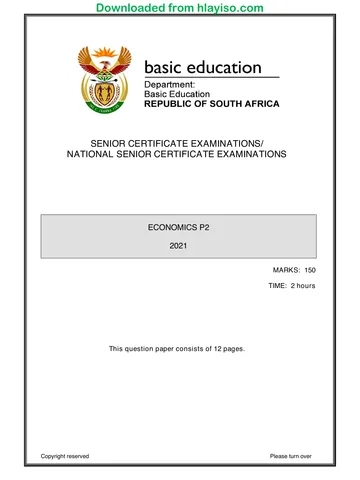
SENIOR CERTIFICATE EXAMINATIONS/
NATIONAL SENIOR CERTIFICATE EXAMINATIONS
ECONOMICS P1
2021
MARKS: 150
TIME: 2 hours
This question paper consists of 13 pages.
Copyright reserved Please turn over
You're offline
Skip to contentQuestion paper 
View all
Economics P1 May June 2021 Eng hlayiso.com
Economics · Grade 12 · NSC June · 2021. Question paper, 13 pages. Read online or download the PDF.
- Subject
- Economics
- Grade
- Grade 12
- Document type
- Question paper
- Year
- 2021
- Exam period
- NSC June
- Paper
- 1
- Pages
- 13
- File size
- 553.9 KB
Loading document…
Loading document…
1 of 13
Document textSearch extracted text and jump to a page.
Downloaded from hlayiso.com
Economics/P1 2 DBE/2021
SC/NSC
INSTRUCTIONS AND INFORMATION
1. Answer FOUR questions as follows in the ANSWER BOOK:
SECTION A: COMPULSORY
SECTION B: Answer TWO of the three questions.
SECTION C: Answer ONE of the two questions.
2. Answer only the required number of questions. Answers in excess of the
required number will NOT be marked.
3. Number the answers correctly according to the numbering system used in this
question paper.
4. Read the questions carefully.
5. Start EACH question on a NEW page.
6. Leave 2–3 lines between subsections of questions.
7. Answer the questions in full sentences and ensure that the format, content
and context of your responses comply with the cognitive requirements of
the questions.
8. Use only black or blue ink.
9. You may use a non-programmable pocket calculator.
10. Write neatly and legibly.
Copyright reserved Please turn over
Downloaded from hlayiso.com
Economics/P1 3 DBE/2021
SC/NSC
SECTION A (COMPULSORY)
QUESTION 1 30 MARKS – 20 MINUTES
1.1 Various options are provided as possible answers to the following questions.
Choose the answer and write only the letter (A–D) next to the question
numbers (1.1.1 to 1.1.8) in the ANSWER BOOK, e.g. 1.1.9 D.
1.1.1 Cycles that last 3–5 years and are caused by businesses adapting
their inventory levels:
A Jugler
B Kitchin
C Kuznets
D Kondratieff
1.1.2 A decrease in the value of the currency due to market forces is
known as …
A revaluation.
B devaluation.
C appreciation.
D depreciation.
1.1.3 Newly established firms that still need protection are called …
industries.
A competitive
B strategic
C declining
D infant
1.1.4 The continuous movement of factors of production, goods and
services among the participants in the economy is called …
A leakages.
B injections.
C real flows.
D money flows.
1.1.5 Service delivery to ensure the daily management of cities and
towns is the responsibility of the ... government.
A local
B national
C provincial
D central
Copyright reserved Please turn over
Downloaded from hlayiso.com
Economics/P1 4 DBE/2021
SC/NSC
1.1.6 A nationwide government intervention to create employment using
labour-intensive methods is known as the …
A Black Economic Empowerment Programme.
B National Skills Development Strategy.
C Expanded Public Works Programme.
D Joint Initiative on Priority Skills Acquisition.
1.1.7 Issues related to human well-being over a period of time are
monitored by using … indicators.
A growth
B social
C economic
D communication
1.1.8 A track of land that forms a passageway allowing access from one
area to another is called a/an …
A corridor.
B special economic zone.
C spatial development initiative.
D industrial development zone. (8 x 2) (16)
Copyright reserved Please turn over
Downloaded from hlayiso.com
Economics/P1 5 DBE/2021
SC/NSC
1.2 Choose a description from COLUMN B that matches the item in COLUMN A.
Write only the letter (A–I) next to the question number (1.2.1 to 1.2.8) in the
ANSWER BOOK.
COLUMN A COLUMN B
1.2.1 Embargo A when a country engages in foreign trade
and produces a given good at a lower
1.2.2 Length of the input cost than other countries
business cycle
B a complete ban imposed on the
1.2.3 Comparative importing of goods from a particular
advantage country
1.2.4 Marginal propensity C measured from peak to peak or trough
to save to trough
1.2.5 Non-rivalry D the proportion of income that households
do not consume
1.2.6 Wealth tax
E consumption by one person does not
1.2.7 Industrial reduce consumption by another person
development
F economic goods which do not take a
1.2.8 Services tangible and storable form
G measured in terms of per capita real
gross domestic product
H levied on properties according to their
market value
I extensive increase in organised
economic activity to manufacture, mine,
farm and deliver services
(8 x 1) (8)
Copyright reserved Please turn over
Downloaded from hlayiso.com
Economics/P1 6 DBE/2021
SC/NSC
1.3 Give ONE term for each of the following descriptions. Write only the term next
to the question numbers (1.3.1 to 1.3.6) in the ANSWER BOOK.
Abbreviations, acronyms and examples will NOT be accepted.
1.3.1 The curve that indicates the relationship between the unemployment
rate and inflation rate
1.3.2 An economy that excludes the foreign sector
1.3.3 A strategy to strengthen the institutional capacity to deliver services
that facilitate economic and social development
1.3.4 A regional development initiative that attracts infrastructure and
business investments to neglected areas
1.3.5 A tariff based on a fixed amount per unit, weight or size that is levied
on imported goods
1.3.6 A business cycle approach based on forces inside the market
system (6 x 1) (6)
TOTAL SECTION A: 30
Copyright reserved Please turn over
Downloaded from hlayiso.com
Economics/P1 7 DBE/2021
SC/NSC
SECTION B
Answer any TWO of the three questions in this section in the ANSWER BOOK.
QUESTION 2: MACROECONOMICS 40 MARKS – 30 MINUTES
2.1 Answer the following questions.
2.1.1 Name any TWO examples of a strategic industry. (2 x 1) (2)
2.1.2 How does a progressive income tax system influence income
redistribution? (1 x 2) (2)
2.2 Study the table below and answer the questions that follow.
South Africa's National Accounts Aggregates
Expenditure on Gross Domestic Product
R millions 2019
At constant 2010 prices
Final consumption expenditure by households 3 058 619
Final consumption expenditure by general government 1 081 318
Gross capital formation 893 104
Gross Domestic Expenditure 5 033 041
Residual item 19 097
Gross Domestic Expenditure (including residual) 5 052 077
Exports of goods and services 1 515 966
Imports of goods and services 1 490 318
GDP at market prices 5 077 625
[Adapted from wwwrs.resbank.co.za/webindicators, June 2020]
2.2.1 Which year does the South African Reserve Bank currently use as
the base year? (1)
2.2.2 Identify the figure used to cater for errors and omissions when
calculating the gross domestic product at market prices. (1)
2.2.3 Briefly describe the term gross domestic expenditure. (2)
2.2.4 What effect would an increase in imported clothing have on
domestic textile manufacturers? (2)
2.2.5 How does gross capital formation impact the economy positively?
(2 x 2) (4)
Copyright reserved Please turn over
Downloaded from hlayiso.com
Economics/P1 8 DBE/2021
SC/NSC
2.3 Study the extract below and answer the questions that follow.
ECONOMIC INTEGRATION – NEW FREE TRADE AREA IN AFRICA
The United Nations Conference on Trade and Development and the World
Trade Organisation play a role in international trade.
In May 2019 the African Continental Free Trade Area (AfCFTA) was launched
to grow countries economically through regional cooperation and integration.
AfCFTA aims to unlock manufacturing potential and facilitate industrialisation
in Africa. The continent currently accounts for only 1,4% of global
manufacturing output and is plagued by infrastructural challenges and
corruption.
[Adapted from Mail & Guardian, 23 July 2020]
2.3.1 Name the institution that promotes trade liberalisation. (1)
2.3.2 Give ONE form of economic integration. (1)
2.3.3 Briefly describe the term free trade. (2)
2.3.4 Why will import substitution have a negative effect on consumers in
the long run? (2)
2.3.5 How could African countries benefit from a new free trade
agreement? (2 x 2) (4)
2.4 With the aid of a correctly labelled graph, explain the effects of demand-side
policies in stimulating economic activity during a recession. (2 x 4) (8)
2.5 How could an increase in investments contribute towards a higher national
income in the economy? (8)
[40]
Copyright reserved Please turn over
Downloaded from hlayiso.com
Economics/P1 9 DBE/2021
SC/NSC
QUESTION 3: ECONOMIC PURSUITS 40 MARKS – 30 MINUTES
3.1 Answer the following questions.
3.1.1 Name any TWO examples of industrial development zones in South
Africa. (2 x 1) (2)
3.1.2 How can public-private sector partnerships contribute more to
regional development? (1 x 2) (2)
3.2 Study the extract below and answer the questions that follow.
SUSTAINABLE LIVELIHOODS OF TOWNSHIP SMMEs TOWARDS
GROWTH AND DEVELOPMENT
In South Africa, small, medium and micro-enterprises (SMMEs) have been
recognised as the critical driving force to alleviate some economic challenges
that the country faces. SMMEs in South Africa play a critical role in the
country's economy and contribute between 40% and 41% of the country's
GDP and up to 61% of the overall employment.
In this regard, the Small Enterprise Development Agency (SEDA) and the
Small Enterprise Finance Agency (SEFA) plan on implementing programmes
to improve the livelihood of township SMMEs.
[Adapted from www.mdpi.com, 14 April 2020]
3.2.1 Identify the institution that promotes small businesses. (1)
3.2.2 Which economic challenge is addressed by small, medium and
micro-enterprises in the economy? (1)
3.2.3 Briefly describe the term employment. (2)
3.2.4 How do small, medium and micro-enterprises benefit from the Small
Business Support Programme? (2)
3.2.5 What are the challenges in implementing broad-based black
economic empowerment? (2 x 2) (4)
Copyright reserved Please turn over
Downloaded from hlayiso.com
Economics/P1 10 DBE/2021
SC/NSC
3.3 Study the diagram below and answer the questions that follow.
FOCUS AREAS OF THE
INDUSTRIAL POLICY ACTION PLAN (IPAP)
Public
procurement
Spatial
Special development
economic initiatives
zones IPAP
2018/2019
Innovation Developmental
and trade
technology policy
[Adapted from dti/IPAP, 2018/19–2020/21]
3.3.1 Which focus area provides economic infrastructure for industrial
development? (1)
3.3.2 Name the industrial development policy that sets out the
government's broad approach to industrial development. (1)
3.3.3 Briefly describe the term innovation. (2)
3.3.4 How does industrial development promote entrepreneurship in the
economy? (2)
3.3.5 What are the challenges faced by the Industrial Policy Action Plan?
(2 x 2) (4)
3.4 Discuss the general benchmark criteria for regional development. (4 x 2) (8)
3.5 Evaluate the use of supply-side measures in solving the persistent low
economic growth in South Africa. (8)
[40]
Copyright reserved Please turn over
Downloaded from hlayiso.com
Economics/P1 11 DBE/2021
SC/NSC
QUESTION 4: MACROECONOMICS AND ECONOMIC PURSUITS
40 MARKS – 30 MINUTES
4.1 Answer the following questions.
4.1.1 Name any TWO effects of international trade. (2 x 1) (2)
4.1.2 How do consumers in the importing country benefit from dumping?
(1 x 2) (2)
4.2 Study the extract below and answer the questions that follow.
SOUTH AFRICA'S BALANCE OF PAYMENTS – SECOND QUARTER 2019
The balance of payments consists of a current account, capital transfer and
financial account.
South Africa's trade balance switched from a surplus of R41,9 billion in the
first quarter of 2019 to a deficit of R27,2 billion in the second quarter. The
deterioration in the trade balance came about as the value of merchandise
imports increased substantially. This has impacted the terms of trade.
[Adjusted from SARB, Statistical Press Release, September 2019]
4.2.1 Identify the account in the balance of payments that records exports
and imports of goods and services. (1)
4.2.2 Which commodity is recorded as a separate export item in the South
African balance of payments? (1)
4.2.3 Briefly describe the term terms of trade. (2)
4.2.4 Explain the impact of an increase in export prices on South Africa's
trade balance. (2)
4.2.5 How can import control be used to correct the balance of payments
deficit? (2 x 2) (4)
Copyright reserved Please turn over
Downloaded from hlayiso.com
Economics/P1 12 DBE/2021
SC/NSC
4.3 Study the cartoon below and answer the questions that follow.
I need a
sharp pencil
for this task.
[Adapted from Google images, 2020]
4.3.1 Which government department is responsible for budgeting? (1)
4.3.2 Name ONE factor that contributed to the downgrading of the South
African economy. (1)
4.3.3 Briefly describe the term affirmative action. (2)
4.3.4 What impact will South Africa's credit rating to junk status have on
the economy? (2)
4.3.5 How could state-owned enterprises contribute towards expanding
the economy? (2 x 2) (4)
4.4 Briefly discuss extrapolation and amplitude as features in the forecasting of
business cycles. (2 x 4) (8)
4.5 Evaluate the impact of the depreciating rand on the South African economy. (8)
[40]
TOTAL SECTION B: 80
Copyright reserved Please turn over
Downloaded from hlayiso.com
Economics/P1 13 DBE/2021
SC/NSC
SECTION C
Answer any ONE of the two questions in this section in the ANSWER BOOK.
Your answer will be assessed as follows:
MARK
STRUCTURE OF ESSAY
ALLOCATION
Introduction
The introduction is a lower-order response. Max. 2
A good starting point would be to define the main concept related to the
question topic.
Do NOT include any part of the question in your introduction.
Do NOT repeat any part of the introduction in the body.
Avoid mentioning in the introduction what will be discussed in the body.
Body
Main part: Discuss in detail/In-depth discussion/Examine/Critically discuss/ Max. 26
Compare/Evaluate/Distinguish/Differentiate/Explain/Assess/Debate/Draw a
graph and explain/Use the graph given and explain/Complete the given
graph
Additional part: Give own opinion/Critically discuss/Evaluate/Critically Max. 10
evaluate/Deduce/Compare/Distinguish/Interpret/Briefly debate/How/
Suggest/Analyse
Conclusion
Any higher-order conclusion should include: Max. 2
A brief summary of what has been discussed without repeating facts
already mentioned
Any opinion or value judgement on the facts discussed
Additional support information to strengthen the discussion/analysis
A contradictory viewpoint with motivation, if required
Recommendations
TOTAL 40
QUESTION 5: MACROECONOMICS 40 MARKS – 40 MINUTES
Discuss, in detail, the objectives of the public sector. (26 marks)
How will public sector failure negatively influence economic stability in South
Africa? (10 marks) [40]
QUESTION 6: ECONOMIC PURSUITS 40 MARKS – 40 MINUTES
Discuss the various economic indicators in detail. (26 marks)
How did the Covid-19 pandemic negatively influence the South African economy?
(10 marks) [40]
TOTAL SECTION C: 40
GRAND TOTAL: 150
Copyright reserved
Recommended for this subject
Published documents with matching subject and grade metadata.
Question paper
ECONOMICS P2 GR12 QP JCT 2025 AFR D
Question paper
Economics Grade 12 NSC P1 QP September 2025 Free State
Question paper
Economics Grade 12 NSC P1 QP September 2025 Mpumalanga
Question paper
Economics Grade 12 NSC P2 QP September 2025 Mpumalanga
Question paper
Economics P1 May June 2025 Afr
Question paper
Economics P2 May June 2025 Afr
Related documents
Matched using subject, grade, language, document type and exam metadata.
Question paper
Economics P2 May June 2021 Eng hlayiso.com
Question paper
Economics P1 QP June 2021 English hlayiso.com
Question paper
Economics P1 Nov 2021 Afr hlayiso.com
Memorandum
ECONOMICS P1 GR12 MEMO SEPT2021 Afrikaans hlayiso.com
Memorandum
ECONOMICS P1 GR12 MEMO SEPT2021 English hlayiso.com
Memorandum
Economics Grade 12 Trial 2021 P1 and Memo hlayiso.com
More from Grade 12 Economics
Explore more published documents in this catalogue.
%20June%202025%20Possible%20Answers--3df8bb66-2d0a-4b1b-89bf-509b303bfa3e/v1-45abc04fbe038cfc315d/card.webp)
_hlayiso.com_--cb8af277-aab9-4fba-8e76-5924dcaf1941/v1-2f8e9b7acbc676448fd6/card.webp)