
oo Downloaded from hlayiso.com
KWAZULU DEPT, OF EDUCATION
GREENBURY SECONDARY
FINAL EXAM
ENGLISH-P2: GRADE 10
DATE: 14 -06-2017
|
DATE:
ME: 2 HRS
MARKS: 80
EXAMINERS & MODERATORS: J.V. SINGH; V. SINGH, J. BHIKRAJ;
: R. NUNDKUMAR
NAME: GRADE: 10
INSTRUCTION D INFORMA TO CANDIDATES:
This question paper consists of 13 Pages and THREE sections:
1. Read these instructions carefully before you begin to answer the
questions.
2. This question paper consists of THREE sections:
SECTION A: Poetry — Prescribed and Unseen (30)
SECTION B: Novel -- ‘Mother to Mother’ (25)
SECTION C: Drama — ‘Romeo and Juliet’ (25)
3. Follow the instructions at the beginning of each section carefully.
4. Answer FIVE QUESTIONS in all: THREE in SECTION A, ONE in SECTION B
and ONE in SECTION C as follows:
SECTION A: POETRY
PRESCRIBED POETRY — Answer TWO questions.
UNSEEN POETRY — The question is compulsory.
P1
p.to. p. 2... SECTION B: NOVEL
You're offline
Skip to contentQuestion paper and memo 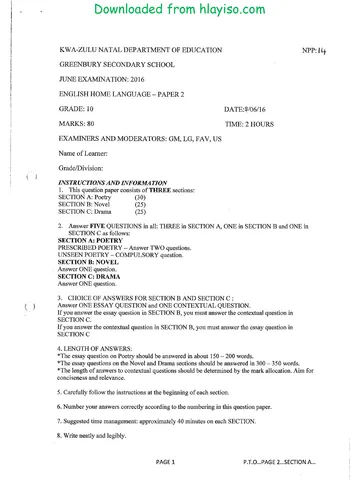
%20Controlled%20Test%20March%202023%20Question%20Paper_hlayiso.com_--28313d3a-6b96-42ec-8a4a-8cb0674cc44e/v1-3ca3d267c9b18ad2edfb/card.webp)
View all%20Controlled%20Test%20March%202023%20Question%20Paper--839d0b8e-e808-4d6b-9018-cffe2494c1e6/v1-ff32bea960d01727367b/card.webp)

ENG 2017-JUNE P2-QP-and MEMO_hlayiso.com_.pdf
English Fal · Grade 10 · KwaZulu Natal June · 2017. Question paper and memorandum, 22 pages. Read online or download the PDF.
- Subject
- English Fal
- Grade
- Grade 10
- Document type
- Question paper and memo
- Year
- 2017
- Exam period
- KwaZulu Natal June
- Paper
- 2
- Pages
- 22
- File size
- 967.6 KB
Loading document…
Loading document…
1 of 22
Document textSearch extracted text and jump to a page.
Downloaded from hlayiso.com
SECTION B: NOVEL — MOTHER TO MOTHER
Answer ONE question.
SECTION C: DRAMA — ROMEO AND JULIET
Answer ONE question.
5. Number your answers correctly according to the numbering system used in
this question paper.
6. Start EACH section on a NEW page.
7. Suggested time management:
SECTION A: approximately 40 minutes
SECTION B: approximately 40 minutes
SECTION C: approximately 40 minutes
8. LENGTH OF ANSWERS:
® Essay questions on Poetry should be answered in about 200 — 250
words,
@ Essay questions on the Novel and Drama sections should be answered
in 300 ~ 350 words (Approximately 1 %4- 1/2 pages),
@ The tength of answers to contextual questions should be determined
by the mark allocation. Candidates should aim for conciseness and
relevance.
9. CHOICE OF ANSWERS FOR SECTIONS B (NOVEL) AND C (DRAMA):
e Answer ONE ESSAY QUESTION and ONE CONTEXTUAL QUESTION. If
you answer the essay question in SECTION B, you must answer _only the
contextual question in SECTION C. If you answer the contextual
question in SECTION B, you must answer _only the essay question in
SECTION C.
10. Write neatly and legibly.
P2
P.t.0. wo Pp. 3
Downloaded from hlayiso.com
SECTION A: POETRY
PRESCRIBED POETRY
Answer any two of the following questions.
QUESTION 1: POETRY — ESSAY QUESTION
ALWAYS A SUSPECT - Oswald M Mtshali
I get up in the morning
and dress up like a gentleman —
A white shirt, a tie and a suit.
I walk into the street
to be met by a man
who tells me “to produce.”
I show him
the document of my existence
to be scrutinised and given the nod.
Then I enter the foyer of the building
to have my way barred by a commissionaire
“What do you want?”
I trudge the city pavements
side by side with “madam”
who shifts her handbag
from my side to the other,
and looks at me with eyes that say
“Ha! Ha! I know who you are;
beneath those fine clothes
10
15
20
P3
In this poem, the poet describes the life of the black person who was constantly under
suspicion in his everyday life under apartheid laws in South Africa.
By close reference to the diction (choice of words), imagery, feelings and tone used in the
poem, discuss the above statement in an essay of 200-250 words (about % page). [10]
p.to. ... p4
|
|
Downloaded from hlayiso.com
OR
QUESTION 2: POETRY — CONTEXTUAL QUESTION
THE ANIMALS - WALT WHITMAN
I think T could turn and live with animals, they are 1
so placid and self-contained:
I stand and look at them long and long.
They do not sweat and whine about their condition:
They do not lie awake in the dark and weep for their 5
sins;
They do not make me sick discussing their
duty to God:
Not one is dissatisfied - not one is demented with the
mania of owning things; 10
Not one kneels to another, nor to his kind that
lived thousands of years ago,
Not one is respectable or unhappy over the whole
earth. 14
21
2.2
2,3
Explain why the speaker admires animals.
Refer to line 1 and comment on the importance of the word ‘turn’.
Critically discuss the theme of the poem.
P4
p.to. .. pS
(3)
(3)
(4)
[10]
Downloaded from hlayiso.com
OR
QUESTION 3: POETRY — CONTEXTUAL QUESTION
The Gamblers
The Coloured long-shore fishermen unfurl
their nets beside the chilly and unrested sea,
and in their heads the little dawn-winds whirl
some scraps of gambling, drink and lechery.
Barefoot on withered kelp and broken shell,
they toss big baskets on the brittle turf,
then with a gambler’s bitter patience still
slap down their wagering boat upon the surf.
Day flips a golden coin ~ but they mock it.
With calloused, careless hands they reach
deep down into the sea’s capacious pocket
and pile their silver chips upon the beach.
Anthony Delius
10
3.1, Comment on the appropriateness of the title ‘The Gamblers’.
3.2. In line 2, explain why the sea is described as ‘chilly and unrested’.
3.3. Critically discuss the effectiveness of the imagery in ‘Day flips a golden coin but they
mock it.’ ( line 9).
PS
p.t.o. .. p6
Downloaded from hlayiso.com
OR
QUESTION 4: POETRY — CONTEXTUAL QUESTION
Shall I compare thee to a summer's day? (Sonnet 18)
William Shakespeare
Shall I compare thee to a summer's day? 1
Thou art more lovely and more temperate.
Rough winds do shake the darling buds of May,
And summer's lease hath all too short a date.
Sometime too hot the eye of heaven shines, 5
And often is his gold complexion dimmed;
And every fair from fair sometime declines,
By chance, or nature's changing course, untrimmed;
But thy eternal summer shall not fade,
Nor lose possession of that fair thou ow’st, 10
Nor shall Death brag thou wand’rest in his shade,
When in eternal lines to Time thou grow’st.
So long as men can breathe, or eyes can see,
So long lives this, and this gives life to thee. 14
4.1.
4.2.
4.3.
According to the poet, why is his beloved ‘more lovely and more temperate’ (L-2)
than a summer's day?
‘Sometime too hot the eye of heaven shines,
And often is his gold complexion dimmed’ (L5-6)
Explain the effectiveness of the imagery above.
(3)
(3)
Critically comment on the message the rhyming couplet, ‘So long as men ... life to
thee.’ (L 13-14) conveys about the poet's love ?
P6
p-t.o, ... p7
(4)
[10]
Downloaded from hlayiso.com
Unseen Poetry (compulsory)
QUESTION 5: CONTEXTUAL QUESTION
Read the poem below and answer the questions that follow.
[Brother Africa - Colin Ian Jeffery
He lies near to death
Dying in the dust
Broken and forgot. 3
Now his children
Once mighty tribes
Fall like flies before the setting sun. 6
His women - young and old
Dead and dying
Host the killer AIDS. 4
He calls for help
To rich brothers in the West
But his cries fall upon stone-deaf ears. 12
For they can find no profit In
supplying HIV drugs
To those who cannot pay. is |.
Questions:
5.1. Show how the diction in stanza 1 effectively conveys Africa’s devastation. (3)
5.2. Refer to lines 5-6: “Once mighty tribes...the setting sun.”
Discuss the appropriateness of the above image in context. (3)
5.3. The speaker’s attitude is that the “rich brothers in the West” do not care about
their African brothers who are dying of AIDS.
Do you agree with this statement? Justify you response by referring to the
imagery and/or diction in stanzas 4 and 5. (4)
TOTAL: 10 MARKS
P.T.O page 8 to Question 6
EXTRACT A
Downloaded from hlayiso.com _
SECTION B : NOVEL
MOTHER TO MOTHER : SINDIWE MAGONA
Answer EITHER Question 6 (Essay Question) OR Question 7 (Contextual Question).
QUESTION 6 : ESSAY QUESTION
Mxolisi is a victim of circumstance in an apartheid-ridden South Africa.
Based on your reading of the first three chapters of the novel, critically discuss
the extent to which you agree with this statement. [25]
QUESTION 7 : CONTEXTUAL QUESTION
Read the extracts below and answer the questions that follow.
Mandisa’s Lament .
My son killed your daughter. 1
People look at me as though I did it, The generous ones, as
though I made him do it. As though I could make this child do
anything. Starting from when he was less than six years old,
even before he lost his first tooth or went to school. Starting, if 3
truth be known, from before he was conceived; when he, with ©
total lack of consideration, if not downright malice, seeded
himself inside my womb.
But now, people look at me as if I’m the one who woke
up one hot ["shushu] day and said, Boyboy, run out and see [0
whether, somewhere out there, you can find a white girl with ,
nothing better to do than run around Gugulethu, where she
does not belong.
And hey, while you're at it, Sonnyboy, hey, if she’s Ameri-
can, all the better! As though that were something - a badge (le
or label ~ she would have worn on her face. As though he
would go out there, weigh the pros and cons and carefully
choose her for her sake, for being who she truly was.
My revilers seem to think that, with such perfect under-
standing between mather and son, I wouldn’t have had tosay 90
one word more. Naturally, he‘d’ve just known what it was | «
wanted done ...what I wanted him to.do.
I should have such an obedient son! Why do they think he :
did what he did if he were such a lamb, a model child? :
Let me say out plain, ! was not surprised that my son killed 128
your daughter. That is not to say I was pleased. It is not right i
to kill. .
But, let me ask you something: what was she doing, |
vagabonding all over Gugulethu, of all places, taking her
foot where she had no business? Where did she think she was 20
going? Was she blind not to see there were no white people in
_ this place? g P.T.O page 9 to Question 7, |
Lee Connnued
Downloaded from hlayiso.com
QUESTIONS :
7.1 Briefly explain what you understand by the title, “Mandisa’s lament’. [3]
7.2 “My son killed your daughter” (line 1).
Comment on the significance of the above statement. [3]
| 7.3. The writer's tone in lines 9 — 13 : “But now, people look at me ... where
she does not belong” is :
: A-sad
| B - fearful
| C - sarcastic
D — anxious [2]
7.4 Refer to lines 28 — 2M: “Why do they ... a model child?”
Discuss the effectiveness of the imagery in the above lines. [3]
7.5 Refer to lines 25 — 26: “Let me say ... killed your daughter.” oe
What do these lines reveal about Mandisa’s attitude towards Mxolisi? [4]
7.6 Examine lines 29 — 33 : “But, let me ... in this place.”
In your view, is Mandisa justified in asking these questions?
Motivate your response. [4]
[19]
>
Zz
oO
|
P.T.O page 10 to Question 7
g re» Continued °
EXTRACT B
Downloaded from hlayiso.com
QUESTIONS :
7.7 Refer to lines 17 — 18 : “I insist !_ You cannot refuse me this last wish,”
She hears herself blurt: t
‘Tl take you home’ She cannot believe she has said that.
‘You will?’ asks one of her friends, in disbelief,
‘Sure!’ answers your daughter, convinced now this is
something she should do. ‘But I can’t stay. I'll just drop you -&
guys off
‘I don’t think so; says Lumka, another of the Gugulethu
trio. ‘You said you have lots to do still’
‘But taking you to Gugs will only take a few minutes, it’s |
justadetour’ ~ : lo
‘No! No! We can take a taxi/ Lumka is adamant. She is:
uneasy about your daughter, a white person after all, going |
to the townships at this time of day - late afternoon, when
people return from work and wherever else their day had
taken them. Earlier, perhaps. But not this late. No, not this tS
late,
“Tjnisist] You"tainot refuse me this last wish, your
daughter jokes. ;
‘Okay, then’ Lumka acquiesces..She doesn’t want to bea
spoilsport. Since the other two girls from Gugulethu do not 20
help her in declining the offer, she understands that they |
want to be driven home. They want to be with this friend, |
‘who is leaving them, just a little longer.
Your daughter's generosity has endeared her to many.
She knows she should not be doing this ... not with all the 28
packing she still has to do. Packing, oy
your daughter jokes.
Explain the irony of Amy’s “last wish”.
7.8 Refer to line 24 : “Your daughter's generosity has endeared her to many.”
[3]
Explain how this line contributes to your understanding of Amy’s character. [3]
TOTAL : [25]
[6]
P.T.O page 11 to Question
10
Downloaded from hlayiso.com
SECTION C : DRAMA [25]
“Romeo and Juliet” — William Shakespeare
Answer either Question 8 (Essay question) or Question 9 (Contextual question).
QUESTION 8 : ESSAY
“The love between Romeo and Juliet is doomed from the beginning.”
Critically discuss the extent to which you agree with the above statement in a well- constructed
essay of 300 — 350 words (1 % pages)
QUESTION 9 : CONTEXTUAL
Read the extracts below and then answer the questions that follow.
EXTRACT A
LADY CAPULET: Nurse, where's my daughter? Call her forth to me.
NURSE: Now by my maidenhead at twelve year old,
| bade her come. What, lamb! What, ladybird!
God forbid, where's this girl? What Juliet!.
Enter JULIET
JULIET: How now, who calls? 5
NURSE: Your mother
JULIET: Madam, | am here, what is your will?
LADY CAPULET: This is the matter. Nurse, give leave a while,
We must talk in secret. Nurse, come back again,
| have remembered me, thou s’ hear our counsel. 10
Thou knowest my daughter's of a pretty age.
NURSE: Faith, | can tell her age unto an hour.
LADY CAPULET: She’s not fourteen.
NURSE: Peace, | have done. God mark thee to his grace!
Thou wast the prettiest babe that e’er | nursed. 15
And | might live to see thee married once,
| have my wish.
(Act1, Sc3)
P.T.O page 12 to Question 4
tee Continued
VI
Downloaded from hlayiso.com
9.1. Refer to Line 1 : “ Nurse, where’s my... forth to me.”
The word that best describes the tone in the above lines is:
A. anger
B, frustration
C. authoritative (2)
9.2. Examine line 3: “What lamb! What ladybird!”
Comment on the nurse’s description of Juliet in the above line. (2)
9.3. Refer to line 7 : “Madam, | am here, what is your will?”
Discuss how Juliet goes against Lady Capulet’s ‘will’ (3)
9.4. With reference to lines 16 and 17:
“And | might live to see thee married once, | have my wish.”
Show how Nurse assists Juliet to marry Romeo. (3)
EXTRACT B
FRIAR LAWRENCE: Romeo, come forth, come forth, thou fearful man:
Affliction is enamoured of thy parts,
And thou art wedded to calamity.
[Enter] Romeo
ROMEO: Father, what news? What is the Prince’s doom?
What sorrows craves acquaintance at my hand, 5
That | yet know not?
FRIAR LAWRENCE: Too familiar
Is my dear son with such sour company!
| bring thee tidings of the prince’s doom.
ROMEO: What less than doomsday is the Prince's doom?
FRIAR LAWRENCE: A gentler judgement vanished from his lips: 10
Not body’s death, but body's banishment.
ROMEO: Ha, banishment? be merciful, say ‘death’:
For exile hath more terror in his look,
Much more than death. Do not say ‘banishment’!
FRIAR LAWRENCE: Here from Verona art thou banished, 15
Be patient, for the world is broad and wide.
ROMEO: There is no world without Verona walls,
But purgatory, torture, hell itself:
Hence ‘banished’ is banished from the world,
And world’s exile is death; then ‘banished’ RO
Is death mistermed. Calling death ‘banished’,
Thou cut'st my head off with a golden axe,
And smilest upon the stroke that murders me.
(Act 3,Sc3)
"++ Continued
12
P.T.O page 13 to Question qQ
Downloaded from hlayiso.com
9.6. Refer to lines 2 — 3 : “ Affliction is ... wedded to calamity.”
Briefly explain what Friar Lawrence implies about Romeo's and Juliet’s relationship
in the lines above
9.7. ‘What sorrow craves acquaintance at my hand,” (line5)
9.7.1. State the figure of speech in the above line.
9.7.2, Explain how ‘sorrow’ follows Romeo later in the play
9.8. Refer to lines 19 — 21 : “ Hence ‘banished’ is ... Calling death banished.”
Critically account for Romeo’s repetition of the word “banished” in the above lines.
GRAND TOTAL=80
CREENBURY SECONDARY SCHOOL
(4)
(2)
(3)
(3)
[25]
13
Downloaded from hlayiso.com
Downloaded from hlayiso.com
MEMO — SUGGESTED ANSWERS
QUESTION 1 — ALWAYS A SUSPECT - ESSAY
MESSAGE
In his poem ‘Always a Suspect’ Mtshali highlights that for a black person in South Africa
during Apartheid, daily life was a contest for survival both physically and mentally.
The purpose is to provide insight into racial alienation and its effect on an individual. It also
gives a voice for the people who suffered under the Apartheid. And by alluding to the poet's
intelligence and educated manner, he disrupts society’ s rules and prejudices based on
outward appearances.
The subject is contained within the title ‘Always A Suspect’, and is evidently the distrust and
discrimination between races.
DICTION
- Formal and proper language such as ‘scrutinized’ and ‘commissionaire’ implies Mtshali
possesses an educational background. This informs the reader that despite society's
stereotypical nature, he is not ‘a thief’ because of his skin colour, rather an educated and
respectable man.
~ Language such as ‘scrutinized’, ‘barred’ and ‘looks at” suggest persecution and probing
interrogation by the world around him because of his outward appearance.
- Each stanza begins with a verb such as ‘I get up’, ‘I show’ etc, displaying his journey
throughout the day. It symbolizes the hope he feels in the beginning of the day which slowly
transforms into disparity as he unceasingly experiences discrimination. Evidence of this is
the juxtaposition of ‘I get up’ at the beginning of the first stanza and ‘I trudge’ at beginning
of the last.
MOOD/ TONE/ FEELINGS
The mood and tone of the poem is relentless despondency. There is seemingly no relief for
the poet and he slowly grows more disheartened as the day continues. The atmosphere
created is sombre, bitter and tormented.
IMAGERY
- Incorporated by Mtshali is an extended metaphor for his daily journey through reference to
paths and endless movement, ‘I walk onto the street’ and ‘I trudge the city pavements’.
- Another instance of imagery is the line ‘ticks the heart of a thief’, suggesting that 'madam'
presumes the man is not fully a human being but rather a calculating robot or machine.
- Onomatopoeia is incorporated through 'ticks', and adds auditory imagery.
- The full stop at the end of every stanza symbolizes that one ordeal has ceased and
signalling the commencement of another tribulation.
~‘Always A Suspect’ is written in first person which incorporates first hand experiences but
additionally an element of bias. This is because the accounts of his daily life predominately
depend on perspective. Perhaps the woman was simply shifting her bag to the other
shoulder because her arm was sore, but the poet interpreted the movement as a sign of
Downloaded from hlayiso.com
racism, This scene is also an example of insinuated hyperbole, because the poet has
previously experienced injustice, every encounter becomes hyperbolic.
[10]
QUESTION 2 — THE ANIMALS
2.1
2.2
2.3
The speaker finds that animals have many virtues which are facking in men. They
do not hanker after things that have no value for them. They always remain calm
and self-satisfied. [3]
‘Turn’ suggests that the poet wishes to tune his back on human beings. He
wishes to reject them and turn away from the lives humans lead. He turns
towards animals as a source of inspiration about how human should live. [3]
The speaker wants to tell us that humans have become complicated and false.
They have forgotten their true nature. They want to earn more and more, so that
they can own more and more luxurious commodities. They commit sins in order
to earn then they repent. Their sins have made them restless. Humans trouble
their companions discussing their duties to God. On the other hand, animals are
free from all types of trivial anxieties, so they are still living their natural life. [4]
[40]
QUESTION 3 — THE GAMBLERS .
3.1.
3.2,
3.3.
The fishermen play games of high stakes with the sea — they play against the dangers
posed by nature/ weather/ elements especially the sea as the sea is the hub of their
livelihood. They could die at any time therefore they are gambling with their lives. [3]
The sea is personified. The water is quite cold and continuously moves, therefore, it
never rests. Furthermore, this is a pointer to the men’s physical condition — like the
sea, they are always on the move, not resting. [3]
Use of personification - day is personified. It is as if day is turning over (‘flipping’) —
turning night to day with the appearance of the ‘golden coin’ — the sun- use of
metaphor. This is another image based on gambling. The fishermen lead hard lives,
therefore, they ‘mock’ at the warmth the sun brings them — there is no warmth or
comfort in their lives. [4]
[10]
Downloaded from hlayiso.com
Question 3 — SHALL I COMPARE THEE ...
4.1.
4.2.
4.3.
His beloved has a mild/ moderate temperament while summer has extreme changes
in weather. ‘rough winds do shake the darling buds of May’. Summer has a short
time framework. Summer has a short time framework — sun- very hot ~ sometimes
covered by storm or cloud. Everything that is beautiful loses its beauty ‘Fair from fair
declines’, Her beauty lasts forever — it is ‘eternal’. [3]
The poet effectively personifies the sun as ‘the eye of heaven’. The sun observes
the entire world perched high up in the sky (heaven’). It is unbearably hot. Often,
its surface {‘golden complexion’) is covered by clouds or storms. [3]
He is able to express his love and admiration for his beloved through this poem. He
immortalises her youth and beauty — this gives her eternal life. His love for her and
her beauty will live as long as people read this poem. [4]
[10]
Downloaded from hlayiso.com
he bpoe+ pecs bBorikes Adres -' he |ves
neac ceod" sages he ee weal: ) feeble.
_Contbnentk - Al\i Faken = deadw Ay tng Ww
ane Cw st ‘ s ey eckve. we compe Pun (Me,
hateh reality Ss Asrican = Oncace ~f Cy
Stace neuel _ heale: A\ec) , Let co a e* Re okev
oat Geet" coweys Whe clevashabion porought
on hee Seu tael es cbeptien {P reluce SP
— he once. been \rome_ fo Keres
~ Shen COOL TF (eo _Acibes - Bet we. “nest fallen
Wel Jo dhe levees anc de dot
beset dhe. consneat: An ds —Ve we out «f
_comval “= ae An iN We. Gon Ninerct os XO ica:
atk
Diwle q MW es! _<feckvs yes
aah
Pals it dung around Whe. dame dwet, 'fertlona
lice Ay es" (Aer Aw Me shot \fesen (2
ata :
Yes - the cheater Cen mnewks or Ane Wess
iad Aelerent sens! drive. anck OAS yoptets
ax ent Kae crocs Akio: Anes
: shone ses " -Siess-a 4 . <| Vs ;
ny Sbexkers ert hiceet a geod
leas f- help are Conrh\
he. dese nel ae eet
Downloaded from hlayiso.com
GRADE 10
LITERARY ESSAY - MEMO
- Grows up in a Black township — Gugulethu — poverty and unemployment is rifle -
crime is a way of life.
- Education was hampered by political interference ~ boycotts, teacher strikes,
violence and unrest. :
- Police presence not adequate to curb violence.
Indifference and apathy to violence — a disease.
Mxolisi — hated school — 20 years old and in Std 6 only.
- In Std 5 — he was beaten for not paying school fees.
- Léaves school.
- Education in the township — sub-standard.
- Mandisa, Mxolisi’s mum — a domestic assistant in the home of Mrs Nelson (a White
woman).
- Works long hours and 6 days a week — at the expense of her own children being
neglected.
- Loses control over Mxolisi becoming a “street child”, indoctrinated by ruthless
politicians — “Operation Barcelona’.
- Also treats him very partially and spoils him.
- Heis lazy and a bully and spends time doing nothing mostly.
- Township reality — black-on-black violence and barbaric acts of burning and
“necklacing” -- Mxolisi’s reality.
- Life-changing experiences for Mxolisi :
e His father’s disappearance,
e His innocent denouncement of his friends who are subsequently killed by police
forces him into a prolonged period of silence, stemming from guilt.
e Blacks are indoctrinated to hate Whites — viewed as Dogs who must be killed.
- Saves a girl from rape — inherently good.
- Amy Biehl — a symbol of the White oppressor in the wrong place at the wrong time.
- Mxolisi “Burning and hatred for the oppressor possessed his being” — a victim of
mob mentality.
- From a victim of violence, he becomes a perpetrator.
- The novel is “the enactment of a deep, dark, private yearnings of a subjugated race”
—atool of his race.
- Amy Biehl “died when the time and place and hands were all in perfect congruence,
cruel congruence of time, place and agent.”
Downloaded from hlayiso.com
SUGGESTED ANSWERS — CONTEXTUAL
7.41
7.2
7.3
74
7.5
7.6
7.7
7.8
It effectively portrays a mother’s (Mandisa’s) expression of grief at her son’s
(Mxolisi’s) murder of Amy Biehl. Her grief also makes her question her role
as a parent. Mandisa’s lament takes the form of a letter written by her to the
mother of Amy Biehl. [3]
It is a cold, harsh, unemotional statement that lays bare the facts. Significant
because it is a stand-alone statement that highlights Mandisa’s acceptance
of her son’s role in Amy's murder. [3]
Sarcastic [2]
Metaphor highlights the irony of Mxolisi being thought of as a lamb / model
child — pure / innocent / harmless / meek; he was, in fact, far from an
obedient, gently child. [3]
She reveals a realistic attitude about her son; acknowledges that her son
is not a man of solid character -- he was sullen, disobedient, violent.
Therefore, his role in Amy's murder is not all that surprising to her. His
conception had been a shock to her (unplanned) and this prepared her,
in a way, fir his violence. She admits that she expected him to kill
someone. [4]
Subjective response.
No — Mandisa is trying to exonerate her son — tries to place blame elsewhere
by suggesting that Amy is responsible for her own death. Illogical and unfair.
Amy was doing a good deed and paid for it with her life. Cruelty of the
murder. [4]
lrony is that this does, indeed, prove to be Amy’s last wish, which led to
her untimely, cruel death. She was punished for doing a good deed.
Perhaps Lumka had tried to dissuade her, but Amy’s kindness sadly
worked against her. [3]
It attests to the fact that Amy was a generous, kind, sociable, friendly person.
She was considerate of others — giving a lift to her friends despite the danger.
She had also promised to secure bursaries for her friends when she returned
to the US. She was loved by those whose lives she’d touched. {3]
TOTAL : [25]
Downloaded from hlayiso.com
SUGGESTED ANSWERS: “ROMEO AND JULIET”
QUESTION 8: ESSAY
As per DOE
Points to consider:
-Fate of the stars-Romeo and Juliet are described as “star-crossed” because things
happen beyond their control.
-Imagery of stars are reinforced, “Then | defy you stars” shows his deep despair for
he is ready to defy fate and rushes to buy poison.
-Juliet is also aware of the fate in stars, “Alack, alack that heaven a subject as
myself.”
- Conflict between passion and reason- the quarrel betwéen the two houses are
based on age-old feud with no reason given.
- Romeo and Juliet fall in love too quickly because they feel the powerful emotion
and Juliet realises the danger of quick love, “Although, | joy..."Act 28c116-120.
-Also Friar Lawrence also warns them, “These violent delights have violent ends.”
-Generational gap- The relationship with Juliet with her father and her mother not
understanding her daughter's refusal to marry Paris.
- The nurse loves Juliet and aids in her marriage to Romeo. However, she then
encourages her to marry Paris. She is unable to support her making Juliet to fell
alone with her dilemma and leading to her thoughts of suicide.
-The family feud also contributes to the complication of Romeo and Juliet’s love.
They are unable to disclose their marriage which leads to the untimely death of
Tybalt and Mercutio.
- This leads to Romeo’s banishment and Juliet’s proposed marriage to Paris that
eventually leads to an elaborate risky plan for them to be together.
Downloaded from hlayiso.com —
SUGGESTED ANSWERS
QUESTION 9: CONTEXTUAL
EXTRACT A
9.1.C (2)
9.2. The Nurse’s description shows that she loves Juliet/ affectionate/cares deeply.
The word ‘lamb’ creates a gentle and meek image of Juliet’s character/ ‘lamb’ is
significant of sacrifice which Juliet becomes to bring about restoration of peace
between the Montague’s and Capulet. ‘ladybird’ is dainty and well-loved insect
emphasising her affection for Juliet. (2)
9.3. Lady Capulet wants Juliet to consider Paris's proposal for marriage- a man who
is older than her and with whom she is not in love. Juliet goes against her mother’s
will by disobeying her and marrying her enemy’s son, Romeo in secret. Thus, Juliet’s
will prevails. (3)
9.4, Nurse helps Juliet to carry messages between Juliet and Romeo. She brings
news to Juliet of Romeo’s pian to marry Juliet in secret. She assists Romeo’s man
Balthasar to bring the rope ladder so that Romeo can go into Juliet’s room. Nurse
ensures that Friar Lawrence is able to marry Romeo and Juliet. (3)
EXTRACT B
9.5. Romeo had killed Tybalt and is hiding in Friar Lawrence’s cell fearing he would
be executed by the Prince of Verona. He is awaiting his punishment when Friar
Lawrence informs him of his banishment than death. (3)
9.6. Friar Lawrence reiterates the misfortune that plagues Romeo’s and Juliet’s love.
‘Affliction’ emphasize that there is danger in their relationship. ‘wedded to calamity’
implies that misfortune follows Romeo/ implies that he is married to Juliet, the
daughter of a hated family. (4)
9.7.1 Personification (2)
9.7.2. Romeo has to flee Verona and live in Mantua- away from the women he so
desperately loves. She is betrothed to another man- Paris. He hears of Juliet’s
‘death’. In a fit of despair, he kills himself not knowing that his Juliet is really alive. (3)
9.8. The repetition of ‘banished’ shows Romeo's anguish and inner turmoil for trying
to live a life without Juliet. His reaction shows his depth of his love for Juliet. For
Romeo, the term ‘banished ' does not merely mean exile of the body to another
place-his love for Juliet is so great that his separation from her is liken to physical
death. (3)
Recommended for this subject
Published documents with matching subject and grade metadata.
Question paper and memo
ENG 2017-JUNE-P1-QP-and MEMO_hlayiso.com_.pdf
Question paper and memo
ENG 2016-P1-JUNE-QP and MEMO-1_hlayiso.com_.pdf
Question paper and memo
ENG 2016-P2-JUNE-QP and MEMO-1_hlayiso.com_.pdf
Question paper and memo
ENG JUNE-2015-P1-QP-and MEMO-1_hlayiso.com_.pdf
Question paper and memo
ENG JUNE-2015-P2-QP-and MEMO-1_hlayiso.com_.pdf
Annual teaching plan
Gr 10 English FAL ATP 2023-24.pdf
Related documents
Matched using subject, grade, language, document type and exam metadata.
Question paper
ENG JUNE-P2-QP-ONLY-2_hlayiso.com_.pdf
Memorandum
English FAL Gr 10 P3 Memo_hlayiso.com_.pdf
Question paper
English FAL P3 Grade 10 Nov 2017_hlayiso.com_.pdf
Question paper
ENG JUNE-QP-ONLY-1_hlayiso.com_.pdf
Question paper
ENGLISH-FAL-P1-QP-ENG-JUNE-24.pdf
Question paper
Gr 10 English (FAL) Controlled Test March 2023 Question Paper_hlayiso.com_.pdf
More from Grade 10 English Fal
Explore more published documents in this catalogue.
Question paper
Gr 10 English (FAL) Controlled Test March 2023 Question Paper.pdf
Question paper
English FAL P3 Grade 10 Nov 2019 D_hlayiso.com_.pdf
Memorandum
English-GR-10-MEMO-FAL-Paper-1__hlayiso.com_.pdf
Question paper
English-GR-10-FAL-Paper-1__hlayiso.com_.pdf
Memorandum
NW-GR-10-ENG-FAL-P1-MEMO-NOV-2019-1_hlayiso.com_.pdf
Memorandum