
hlayiso mock exams
Practice Series:
Grade 10 Exam Preparation
WWW.HLAYISO.COM
NATIONAL
SENIOR CERTIFICATE
GRADE 10
ENGLISH FIRST ADDITIONAL LANGUAGE P2
NOVEMBER EXAMINATION 2026 (MOCK)
MARKING GUIDELINES
MARKS: 70
These marking guidelines consist of 10 pages.
Copyright reserved Please turn over
Skip to contentAll 2026 papers 
View all
English FAL Grade 10 Paper 2 November Mock 2026 Memo
Grade 10 English FAL Paper 2 memorandum from the November Mock Exam 2026, 10 pages. Read online or download the free PDF.
English Fal · Grade 10 · November Mock Exam · 2026 · English. Memorandum, 10 pages. Read online or download the PDF.
- Subject
- English FAL
- Grade
- Grade 10
- Language
- English
- Document type
- Memorandum
- Year
- 2026
- Exam period
- November Mock Exam
- Paper
- 2
- Publisher
- Hlayiso
- Curriculum
- CAPS
- Pages
- 10
- File size
- 150.6 KB
Free to read online, no sign-up needed
Loading document…
Loading document…
1 of 10
This exam
November Mock Exam 2026
- Paper 1Question paperMemo
- Paper 2Question paperMemo
- Paper 3Question paperMemo
Document textSearch extracted text and jump to a page.
English First Additional Language/P2 2 Hlayiso/Mock 2026
NSC – Marking Guidelines
INSTRUCTIONS TO MARKERS
1. Candidates answer TWO questions, ONE question each from ANY TWO sections. If a
candidate answers more than two sections, mark only the first two sections answered.
2. These marking guidelines are a guide. Many questions are open-ended; credit any
relevant, well-substantiated response, even if it is not listed here.
3. Because the focus is on understanding, spelling and language errors should not be
penalised unless they change the meaning of the answer.
4. For open-ended questions, no marks are awarded for YES/NO or AGREE/DISAGREE
alone. The substantiation is what is credited.
5. When TWO/THREE facts/points are required and more are given, mark only the first
TWO/THREE.
6. For multiple-choice and matching questions, accept the letter AND/OR the answer
written out in full.
7. For ‘Change ONE word’ questions, accept only the corrected word (or the corrected
statement with that word changed).
8. For figure-of-speech questions, the figure of speech must be correctly identified; the
explanation must refer to BOTH the comparison/device AND its relevance in the
extract/poem.
Copyright reserved Please turn over
English First Additional Language/P2 3 Hlayiso/Mock 2026
NSC – Marking Guidelines
SECTION A: NOVEL
QUESTION 1: TREASURE ISLAND
1.1 1.1.1 (a) E✓ (4)
(b) B✓
(c) D✓
(d) A✓
(4 x 1)
1.1.2 At the Admiral Benbow inn, which is run by Jim’s parents✓, beside
a cove on the coast of England/on the coast road to Bristol, in the
1700s (eighteenth century).✓ (2)
1.1.3 (a) Simile✓ (1)
(b) The captain’s snort is compared to the loud, harsh sound of
a ship’s fog-horn✓. It shows that he is rough/rude/unfriendly and
frightening; he uses this noise instead of words to keep people away
from him.✓ (2)
1.1.4 He is afraid of/hiding from his old shipmates (Flint’s pirates).✓
He wants to avoid them because they are looking for him/for what he
has in his sea-chest (Flint’s map).✓ (2)
1.1.5 Long John Silver✓ (1)
1.1.6 Jim is terrified/anxious/haunted by fear.✓
He has nightmares in which he sees the one-legged man as a
monster in a thousand evil forms, chasing him over hedges and
ditches.✓
NOTE: Award 1 mark for an answer that is not well-substantiated. (2)
1.1.7 B/a map of Treasure Island.✓ (1)
1.1.8 Open-ended. Accept a suitable answer, e.g.
Yes. Although he is only a boy, Jim faces danger many times. He
returns to the inn with his mother to open the captain’s chest while
the pirates are on their way; he listens to Silver’s plans from inside
the apple barrel and warns the captain; he sets the Hispaniola adrift
on his own and shoots Israel Hands in self-defence.
OR
No. Jim is often reckless rather than brave: he leaves the group
without permission (e.g. going ashore with the pirates and leaving
the stockade), and he survives mainly because of luck.
NOTE: Do not award a mark for YES/NO or AGREE/DISAGREE
alone. Award 3 marks for a well-substantiated discussion that refers
to the text as a whole; award 1–2 marks for a partially substantiated
answer. Accept a mixed response. (3)
Copyright reserved Please turn over
English First Additional Language/P2 4 Hlayiso/Mock 2026
NSC – Marking Guidelines
1.2 1.2.1 He slipped into one of the boats taking the pirates ashore and ran off
into the woods as soon as they landed.✓
He saw Silver murder Tom, an honest sailor, and he is afraid that the
pirates will kill him too.✓ (2)
1.2.2 (a) Simile✓ (1)
(b) Ben Gunn’s voice is compared to the creaking/grating sound of
a lock that has not been used for a long time✓. It shows that he has
not spoken to anyone for three years, so his voice sounds rough and
strange.✓ (2)
1.2.3 To be left alone on a deserted island as a punishment.✓ (1)
1.2.4 He is afraid/uncertain/nervous✓; he hesitates and moves backwards
and forwards because he does not know whether Jim is a friend or
an enemy.✓
He is desperate/lonely✓; he kneels and begs Jim for mercy/help.✓
NOTE: Accept any TWO relevant points. (2)
1.2.5 (a) Longing/wistful/pleading/sad✓ (1)
(b) He has eaten only goats, berries and oysters for three years and
badly misses ordinary food such as cheese.✓ (1)
1.2.6 B/Captain Flint.✓ (1)
1.2.7 escapes✓ (1)
1.2.8 Ben Gunn begs for a small piece of cheese like a poor beggar✓, but
he is actually a very rich man: he has already found Flint’s treasure
and moved it to his cave.✓ (2)
1.2.9 The pirates’ greed for Flint’s treasure leads to mutiny, lies and murder
(e.g. Silver kills Tom). Most of the greedy pirates die on the island or
are left behind. Silver changes sides whenever it suits him so that
he can save his own life and get some of the gold. Even the honest
characters, such as the Squire, are attracted by the treasure. The
novel shows that greed destroys people.
NOTE: Award 3 marks for a discussion that clearly links the theme
to events/characters in the text; award 1–2 marks for a partial
discussion. Accept other relevant, well-substantiated responses. (3)
[35]
Copyright reserved Please turn over
English First Additional Language/P2 5 Hlayiso/Mock 2026
NSC – Marking Guidelines
SECTION B: DRAMA
QUESTION 2: JULIUS CAESAR
2.1 2.1.1 (a) C✓ (4)
(b) B✓
(c) E✓
(d) A✓
(4 x 1)
2.1.2 The crowd is cheering because Caesar is being given new
honours/offered a crown (by Antony at the Feast of Lupercal).✓
Brutus fears that the people want to make Caesar king, which would
end the Roman Republic/make Caesar too powerful.✓ (2)
2.1.3 (a) Simile✓ (Accept: hyperbole) (1)
(b) Caesar is compared to the Colossus, a giant statue, while
the other Romans are tiny men walking under its legs✓. Cassius
suggests that Caesar has become far too powerful and that men
like Brutus and Cassius have become small/unimportant; he wants
Brutus to feel that this is unacceptable.✓ (2)
2.1.4 People control their own lives/fate✓; it is not fate (the stars) but their
own weakness/failure to act that makes them inferior to Caesar, so
they can change the situation by acting against him.✓ (2)
2.1.5 Brutus is equal to Caesar in every way/there is nothing special about
Caesar’s name.✓
Brutus therefore deserves the same honour and power, and he
should not accept Caesar’s rule.✓ (2)
2.1.6 B/drove a king out of Rome.✓ (1)
2.1.7 Brutus’s✓ (1)
2.1.8 Open-ended. Accept a suitable answer, e.g.
Yes. Cassius flatters Brutus and plays on his love for Rome and his
pride in his ancestor. He has forged letters, supposedly from Roman
citizens, thrown through Brutus’s window to convince him that Rome
wants him to act. He knows that Brutus’s good name will make the
murder look honourable.
OR
No. Cassius cannot control Brutus once he has joined the conspiracy:
Brutus overrules him, e.g. by sparing Antony and allowing him to
speak at the funeral, which leads to the conspirators’ downfall.
NOTE: Do not award a mark for YES/NO or AGREE/DISAGREE
alone. Award 3 marks for a well-substantiated discussion that refers
to the text as a whole; award 1–2 marks for a partially substantiated
answer. Accept a mixed response. (3)
Copyright reserved Please turn over
English First Additional Language/P2 6 Hlayiso/Mock 2026
NSC – Marking Guidelines
2.2 2.2.1 Brutus gave him permission (against Cassius’s advice), believing
that it would show that the conspirators respected Caesar.✓
Antony promised not to blame the conspirators in his speech, and
Brutus would speak to the people first.✓ (2)
2.2.2 He wants to get the attention of the crowd, which is hostile towards
Caesar✓; by calling them ‘friends’ and ‘countrymen’ he flatters
them/makes them feel that he is one of them, so that they will listen
to him.✓ (2)
2.2.3 (a) Repetition✓ (Accept: irony/sarcasm) (1)
(b) At first Antony seems to praise Brutus, but each time he repeats
the words after giving proof of Caesar’s goodness✓, the words
become sarcastic: he suggests that Brutus is NOT honourable and
turns the crowd against him.✓ (2)
2.2.4 Caesar brought many captives to Rome, and their ransoms filled the
public treasury.✓
Caesar wept when the poor cried.✓
Caesar refused the crown three times at the Feast of Lupercal.✓
NOTE: Accept any TWO of the above. (2)
2.2.5 (a) Sad/sorrowful/grieving/emotional✓ (1)
(b) He is mourning the death of his friend/he wants to stir the crowd’s
sympathy and pauses to let his words take effect.✓ (1)
2.2.6 At first the citizens think that Caesar was a tyrant and are glad that
he is dead.✓
By the end of the extract they begin to feel that Caesar has been
wronged and they start to doubt the conspirators.✓ (2)
2.2.7 C/Cinna the poet.✓ (1)
2.2.8 Cassius uses flattery and forged letters to persuade Brutus to join the
conspiracy. Decius persuades Caesar to go to the Senate by giving
Calpurnia’s dream a flattering meaning. At the funeral, Brutus calms
the crowd with reason, but Antony’s emotional speech, his repetition
and the reading of Caesar’s will turn the citizens into an angry mob
that drives the conspirators out of Rome. Words are shown to be as
powerful as swords.
NOTE: Award 3 marks for a discussion that clearly links the theme
to events/characters in the text; award 1–2 marks for a partial
discussion. Accept other relevant, well-substantiated responses. (3)
[35]
Copyright reserved Please turn over
English First Additional Language/P2 7 Hlayiso/Mock 2026
NSC – Marking Guidelines
SECTION C: SHORT STORIES
QUESTION 3
‘THE OPEN WINDOW’
3.1 3.1.1 (a) C✓ (4)
(b) E✓
(c) D✓
(d) A✓
(4 x 1)
3.1.2 In Mrs Sappleton’s house in the countryside, in a room with a large
French window that opens on to a lawn✓; on an October afternoon
(as evening approaches).✓ (2)
3.1.3 He suffers from (bad) nerves/a nervous illness.✓ (1)
3.1.4 (a) Sad/sympathetic/pitying✓ (1)
(b) She wants to make her made-up story believable/to make
Framton feel sorry for her aunt.✓ (1)
3.1.5 B/calm and in control of oneself.✓ (1)
3.1.6 Framton believes that Mrs Sappleton has lost her mind because
she expects dead men to return✓; in fact she is perfectly sane, her
husband and brothers are alive, and it is Vera, who seems so calm
and sensible, who has invented the whole story.✓ (2)
3.1.7 dogs✓ (1)
3.1.8 Vera is very good at making up exciting/imaginative stories
(‘romance’)✓ quickly/on the spot, without any time to prepare.✓ (2)
3.1.9 Open-ended. Accept a suitable answer, e.g.
Yes. Framton is a nervous, sick man who has come to the country
to rest. Vera deliberately frightens him so badly that he runs away
in terror and almost causes an accident. She shows no regret and
immediately tells another lie about him.
OR
No. It is a harmless/clever prank that nobody is physically hurt by.
Framton is boring and self-centred, talking only about his illnesses,
and the trick is meant to be humorous.
NOTE: Do not award a mark for YES/NO or AGREE/DISAGREE
alone. Award 3 marks for a well-substantiated discussion that refers
to the text as a whole; award 1–2 marks for a partially substantiated
answer. Accept a mixed response. (3)
Copyright reserved Please turn over
English First Additional Language/P2 8 Hlayiso/Mock 2026
NSC – Marking Guidelines
‘THE MONKEY’S PAW’
3.2 3.2.1 He got it in India, where he served as a soldier/an old fakir had put a
spell on it there.✓
He got it after the first owner, who had used his third wish to wish for
death, died.✓ (2)
3.2.2 He has had his own three wishes and knows that the paw brings
misery/‘It has caused enough mischief already’.✓
He wants to destroy it so that nobody else is harmed by it.✓ (2)
3.2.3 He is curious/greedy/foolish/reckless.✓
He snatches the paw out of the fire and asks Morris to give it to him,
even though Morris has warned him about it.✓
NOTE: Award 1 mark for an answer that is not well-substantiated. (2)
3.2.4 (a) Mocking/joking/light-hearted/sceptical✓ (1)
(b) She does not believe in the magic; she thinks it is just a fairy
tale.✓ (1)
3.2.5 They foreshadow that the wishes will bring terrible results✓: the wish
for two hundred pounds is granted when Herbert is killed and the
family receives the money as compensation.✓ (2)
3.2.6 B/two hundred pounds.✓ (1)
3.2.7 factory/works/machinery✓ (1)
3.2.8 Morris advises Mr White to wish for something ‘sensible’✓, but the
sensible wish for two hundred pounds (to pay off the house) leads to
the death of his son; even a sensible wish brings disaster.✓ (2)
3.2.9 Open-ended. Accept a suitable answer, e.g.
Yes. Mr White ignores Morris’s warnings, takes the paw out of the
fire, pays Morris for it and makes the wish. His curiosity and desire
for money cause his son’s death.
OR
No. Herbert encourages his father to make the wish, and Mr White did
not wish for anyone to be harmed. The cursed paw/fate is to blame.
NOTE: Do not award a mark for YES/NO or AGREE/DISAGREE
alone. Award 3 marks for a well-substantiated discussion that refers
to the text as a whole; award 1–2 marks for a partially substantiated
answer. Accept a mixed response. (3)
[35]
Copyright reserved Please turn over
English First Additional Language/P2 9 Hlayiso/Mock 2026
NSC – Marking Guidelines
SECTION D: POETRY
QUESTION 4
‘OZYMANDIAS’
4.1 4.1.1 (a) traveller✓ (4)
(b) statue✓
(c) desert✓
(d) sculptor✓
(4 x 1)
4.1.2 He was a proud/cruel/arrogant/harsh ruler (tyrant).✓
The frown and the ‘sneer of cold command’ show that he gave orders
without feeling and looked down on his people.✓
NOTE: Award 1 mark for an answer that is not well-substantiated. (2)
4.1.3 It is broken/ruined: only the legs are still standing and the shattered
face lies half buried in the sand.✓ (1)
4.1.4 (a) Arrogant/boastful/proud/commanding✓ (1)
(b) He believed that his works/empire were so great that other
mighty rulers would despair of ever equalling them.✓ (1)
4.1.5 Ozymandias boasts that his works will make other mighty rulers
despair✓, but nothing of his works remains except a broken statue
in an empty desert; the mighty should rather ‘despair’ because all
power ends in ruin.✓ (2)
4.1.6 (a) Alliteration✓ (1)
(b) The repeated ‘b’ and ‘l’ sounds slow down the pace of the lines✓
and emphasise how empty and endless the desert is; nothing is left
of the king’s great empire.✓ (2)
4.1.7 B/sonnet.✓ (1)
4.1.8 Ozymandias was once a powerful and proud king who believed that
his works would last forever. All that remains is a broken statue
surrounded by endless sand. Time destroys even the greatest rulers
and their empires, so human power and pride are temporary. Only
the sculptor’s art and the words on the pedestal survive.
NOTE: Award 3 marks for a discussion that clearly links the theme
to events/characters in the text; award 1–2 marks for a partial
discussion. Accept other relevant, well-substantiated responses. (3)
Copyright reserved Please turn over
English First Additional Language/P2 10 Hlayiso/Mock 2026
NSC – Marking Guidelines
‘I WANDERED LONELY AS A CLOUD’
4.2 4.2.1 Beside a lake, beneath the trees (in the countryside).✓ (1)
4.2.2 (a) Simile✓ (1)
(b) The speaker compares himself to a single cloud floating
high above the valleys and hills✓. It shows that he feels
lonely/alone/without purpose before he sees the daffodils; this
contrasts with the ‘crowd’ of daffodils.✓ (2)
4.2.3 The daffodils seem even more joyful/lively than the dancing,
sparkling waves✓; anyone, especially a sensitive poet, would feel
happy in such cheerful company.✓ (2)
4.2.4 It is not money✓; it is the happy memory of the daffodils, which
comforts him/brings him joy whenever he is lonely or sad.✓ (2)
4.2.5 The ‘inward eye’ is his memory/imagination✓: he is able to see the
daffodils again in his mind when he is alone.✓ (2)
4.2.6 (a) Happy/joyful/content✓ (1)
(b) The memory of the daffodils fills his heart with pleasure, even
when he is alone.✓ (1)
4.2.7 B/thoughtful.✓ (1)
4.2.8 lake✓ (1)
4.2.9 Open-ended. Accept a suitable answer, e.g.
Yes. At the beginning the speaker is lonely, but the sight of the
dancing daffodils makes him happy. Even years later, when he lies
on his couch in an empty or sad mood, the memory of the flowers fills
his heart with pleasure. Nature has a lasting power to comfort him.
OR
No. The poem only describes one happy moment; the speaker is not
really ill or in pain, so it does not show that nature can heal serious
problems.
NOTE: Do not award a mark for YES/NO or AGREE/DISAGREE
alone. Award 3 marks for a well-substantiated discussion that refers
to the text as a whole; award 1–2 marks for a partially substantiated
answer. Accept a mixed response. (3)
[35]
GRAND TOTAL: 70
Copyright reserved
Study this subject
Recommended for this subject
Question paper
English FAL Grade 10 P1 November Mock 2026 Question Paper
Question paper
English FAL Grade 10 P3 November Mock 2026 Question Paper
Question paper
English FAL Grade 10 P2 November Mock Exam 2 2026 QP
Question paper
English FAL Grade 10 P1 November Mock Exam 2 2026 QP
Question paper
English FAL Grade 10 P3 November Mock Exam 2 2026 QP
Memorandum
English FAL Grade 10 Paper 3 National November 2018 Memo
More from Grade 10 English FAL
Study guide
Gr10 ENG FAL studyguide LR
Annual teaching plan
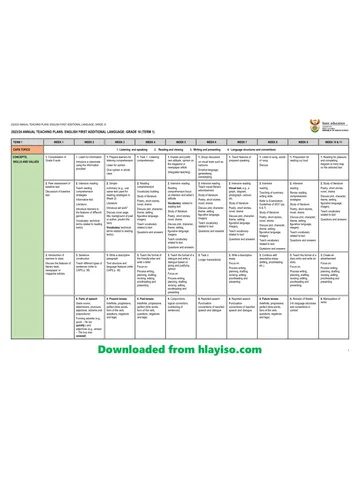
Gr 10 English FAL ATP 2023 24
Question paper
English FAL Grade 10 P1 North West June 2024 Question Paper
Question paper
English FAL Grade 10 NSC Term 1 Controlled Test 2023 QP
Question paper
English FAL Grade 10 P3 National November 2019 QP
Question paper