
Downloaded from hlayiso.com
Pagel
KWA-ZULU NATAL DEPARTMENT OF EDUCATION
GREENBURY SECONDARY SCHOOL
JUNE EXAMINATION — 2018
ENGLISH — GRADE 10 ~ PAPER 2
DATE: ©¢- 06-2018 MARKS: 80
TIME: 2 HOURS
EXAMINERS AND MODERATORS: F.A.VANMALI, L. GOPALAN, G. MUNISAMY, L. MOODLEY
INSTRUCTIONS :
1. Ensure that your paper comprises of 13 pages.
three sections :
Marks: (Answer TWO questions)
2. This paper includes the fol
Section A: Prescribed Poetry:
AND
Unseen Poetry: 10 Marks : (Compulsory)
Section B: Novel : 25 Marks: (Answer ONE question only : Essay or Contextual)
Section C: Drama: 25 marks: (Answer ONE question only : Essay or Contextual)
contextual question from section C. If you answer the contextual question
from section B, you must answer the essay question from Section C.
Write neatly and legibly, using dark blue or black ink.
we
4. Leave a line after each answer.
a
Start each section on a NEW page.
6. Number your answers correctly.
7. Be guided by the mark allocation regarding the length and depth of your answers.
8. Use the following guide to manage your time :
POETRY: 40 MINUTES
NOVEL : 40 MINUTES
DRAMA : 40 MINUTES
You're offline
Skip to contentQuestion paper 
%20Controlled%20Test%20March%202023%20Question%20Paper_hlayiso.com_--28313d3a-6b96-42ec-8a4a-8cb0674cc44e/v1-3ca3d267c9b18ad2edfb/card.webp)
%20Controlled%20Test%20March%202023%20Question%20Paper--839d0b8e-e808-4d6b-9018-cffe2494c1e6/v1-ff32bea960d01727367b/card.webp)
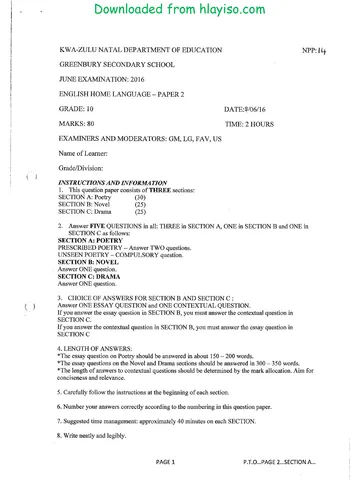
View all
ENG JUNE-P2-QP-ONLY-2_hlayiso.com_.pdf
English Fal · Grade 10 · KwaZulu Natal June · 2018. Question paper, 14 pages. Read online or download the PDF.
- Subject
- English Fal
- Grade
- Grade 10
- Document type
- Question paper
- Year
- 2018
- Exam period
- KwaZulu Natal June
- Paper
- 2
- Pages
- 14
- File size
- 3.0 MB
Loading document…
Loading document…
1 of 14
Document textSearch extracted text and jump to a page.
Downloaded from hlayiso.com
SECTION A: POETRY
PRESCRIBED POETRY
Answer any TWO of the following questions.
Question 1: Poetry ~ Essay
|
i
|
|
ee eesti —
Sonnet 18
Shall I compare thee to a summer’s day?
Thou art more lovely and more temperate:
Rough winds do shake the darling buds of May,
And summer’s lease hath all too short a date:
Sometime too hot the eye of heaven shines, 2
And often is his gold complexion dimm’d;
And every fair from fair sometime declines,
By chance or nature’s changing course untrimrn’d;:
But thy eternal summer shall not fade
Nox jose possession of that fair thou owest; io
Nor shall Death brag thou wander’st in his shade,
When in eternal lines to time thou growest:
So long as men can breathe or eyes can see,
So long lives this, and this gives life tothee. lu
William Shakespeare
In this poem, the poet describes his beloved’s beauty as everlasting and timeless.
Page 2
By making close reference to diction (choice of words), imagery and tone used in the poem,
discuss the above statement in an essay of 150 — 200 words. (3/4 page)
[10]
OR
Downloaded from hlayiso.com
Question 2: Poetry — Contextual question
2.1.
2.2.
2.3:
2.4,
Earth has not anything to show more fair:
Dull would he be of soul* who could pass by
A sight so touching in its majesty:
This City now doth, like a garment, wear F
The beauty of the morning; silent, bare, 5
Ships, towers, domes, theatres, and temples lie
Open unto the fields, and to the sky;
All bright and glittering in the smokeless air.
Never did sun more beautifully steep*
In his first splendour, valley, rock, or hill; 1
Ne’er saw I, never felt, a calm so deep!
The river glideth at his own sweet will:
op Dear God! the very houses seem asleep;
y And all that mighty heart is lying still!
Y William Wordsworth
oul — the spiritual part of a person that outlives the body
_ steep — soak: bathe
The poet has included a date in the title because:
A-he wants to show the reader how old the poem is.
B —the poem is taken from a historical journal / diary.
C- heimplies that the bridge was built on that date.
Write the correct letter only.
Discuss the tone used in L 1-2: “Earth has not .... in its majesty.”
Account for the poet’s reference to ‘ships, towers, domes, theatres’ in line 6.
Comment on the message conveyed in “Dear God!” (line 13)
(10)
Page 3
Downloaded from hlayiso.com
Question 3: Poetry — Contextual Question
Page 4
The gamblers
The Coloured long-shore fishermen unfurl
their nets beside the chilly and unrested sea,
and in their heads the little dawn-winds whirl
some scraps of gambling, drink and lechery.
i
Barefoot on withered kelp and broken shell,
they toss big baskets on the bitter turf,
then with a gambler’s bitter patience still
slap down their wagering boats upon the surf.
oot
Day flips a golden coin — but they mock it
With calioused, careless hands they reach -;
deep down into the sea’s capacious pocket
12 and pile their silver chips upon the beach.
Anthony Delius
3.1. “Coloured ‘in line 1 is in capital fetters because:
A-itis a name of a town.
B-—the fishermen are colourful in appearance.
C— it refers to the race-group of the fishermen
Write the correct letter only.
3.2. Refer to lines 1-4:’The coloured...tur?’
What insight are we given about the fishermen?
3.3. Refer to lines 5 — 6: ‘Barefoot ...turf”
Show how the diction captures the feelings of the fishermen.
3.4. Discuss the appropriateness of the last line, ‘and pile...the beach’.
(10)
(2)
(3)
(3)
Downloaded from hlayiso.com eaves
Question 4 — Poetry ~ Contextual Question
I get up in the mor ng
and dress up like a gentleman —
A white shirt a Ge and a suit,
{ walk into the street
to be met by a man 5
who tells me to ‘produce’.
I show him
the document of my existence
to be scrutinized* and given the nod,
Then J enter the foyer of a building 10
to have my way batred by a commissionaire*
“What do you want?’
| trudge the city pavenients
side by side with ‘madam’
who shifts her handbag 13
from my side to the other,
and looks at me with eyes that say
“Ha! Ha! [ know who you are;
beneath those fine clothes
ticks the heart of a thief’ 2»
Mbuyiseni Oswald Mtshali
|serutinized — examined
/commissionaire ~ aman in uniform who stands at the entrance to a building
| canes = a
—_ ——
4.1, ‘Suspect’ in the title means:
A—one whom you are.
B- one who has ulterior or bad motives.
C- one who is superior |
(2
Write the correct letter only.
4.2. Refer to stanzas 1 and 2:1 get up... produce.
3)
Account for the change in the mood from one stanza to the next. (
MA -, er r ? the
“ want?” highlight the main concern oO}
4.3. How does L 10-12, “Then | enter ... do you
poem?
4.4. Whyis ‘madam’ (line 14) written within inverted commas PTO.....Page 6
(10)
Downloaded from hlayiso.com
Page 6
UNSEEN POEM (COMPULSORY)
QUESTION 5: CONTEXTUAL QUESTION
Read the poem below and then answer the questions that follow.
Crying ‘Africa’ - Konye Ori
Once the color of the night,
graced in starry skies
The full moon left little to wonder
of the morning sunrise
Then we were singing “Africa.”
Ui
But lightning flashes struck our clouds
and raging thunders burst open
the sky and let the rains pour.
Now, we are flooded in austerity: we flow
scrambling for support, ‘a
tramping over one another for a gasp.
The current of diseases and hunger
washes us away. We slop in the
tides of corruption and as we are washed,
we flounder and we cry “Africa.” is
Shivering like sparrows in winter
we are thrown from side to side
like trees, dancing unwillingly to
the music of the wind
Bruised on rocks and stunted tree roots Re
As we drift helplessly in the flood;
Choking, wailing, crying “Africa.”
PTO.....Page 7
epee
5.2.
5.3
5.4
Downloaded from hlayiso.com
Refer to lines 1-4: ‘Once the color .... morning sunrise’.
What impression do the descriptions in these lines create about Africa?
Account for the speaker's tone in line 15: ‘we cry Africa’
Refer to lines 16-17: ‘Shivering like ..... side to side’.
Discuss the effectiveness of the figure of speech in the context of the poem.
In the final stanza the speaker attempts to draw the reader's sympathy.
Do you agree with this statement? Justify your answer by referring to diction.
Page 7
[10]
Downloaded from hlayiso.com Page 8
SECTION B : NOVEL
MOTHER TO MOTHER ~ Sindiwe Magona
Answer EITHER Question 6 (essay question) OR Question 7 (contextual question).
QUESTION 6 : ESSAY QUESTION
Police brutality gives rise to the violence in Gugulethu.
Critically discuss this view by referring to relevant issues from the text.
Your response should take the form of a well-constructed essay of 300-350 words(1.5 pages).
25)
OR
QUESTION 7: CONTEXTUAL QUESTION
Read the extracts below and then answer the questions that follow
That is the one thing he is never lazy
to do: going from the home of this friend or acquaintance to
the home of that one ... on and cn and on... the whoie blessed
day. Seeing him do his daily rounds, one would be excused in
thinking he delivers milk to these houses and gets paid for it.
This day, Mxolisi leaves the house. He stands at the gate ¢
and takes a long look at the street. Like a general surveying
his armies, up and down the street he looks.
A whistle.
That jerks his head up.
From the corner, a wave of arm. He waves back and
slowly saunters out the gate. ‘Yes, brothers ["Majita!]; he 12
hails his friends.
‘Ja, brother [“Mjita‘]’ the others reply in chorus. The
group opens up and swallows him. In their midst, he is lost.
You couldn’t tell him from the others now. Although they
are not wearing their school uniform, the clothes they have
on are so similar in colour, cut, and the way they hang on 1¢
their long, lithe and careless frames, that the boys appear as
though they are wearing a uniform of sorts.
Like a gigantic, many-limbed millipede, the group swells
as it moves up NY 1, There is neither haste nor dawdling in
the manner in which its numerous feet eat up the distance.
PTO.,...Page 9
Downloaded from hlayiso.com
Page 9
7.1 Mxolisi “leaves the house” (line 6) to :
A: go to school
B: meet his mother
C.: visit the police station
D: none of the above.
Choose the correct answer from above. (2)
7.2. Mandisa’s relationship with Mxolisi can best be described as :
: a love-hate relationship
: aromantic relationship
QO we >
- a short-lived relationship.
i]
: none of the above.
Choose the correct answer from above. (2)
7.3 “Like a general surveying his armies, up and down the street he looks” (lines7-8) .
Discuss the effectiveness of the above image. @G)
7.4 Refer to lines 9-10: “A whistle. That jerks his head up.”
Account for the use of the short lines at this stage of the extract. (2)
7.5. Refer to lines 12 - 16 : “Yes, brothers ...... from the others now .”
By referring to the diction, show how the theme of unity is emphasised. (3)
7.6 Discuss the reason why the boys “are not wearing their school uniform”(line i7). (3)
PTO.....Page 10
Downloaded from hlayiso.com
Page 10
Mandy!’ Mrs Nelson screams.
That is what the white woman [ work for calls me:
Mandy. She says she can’t say my name. Says she can’t say
any of our native names because of the clicks. My name is
Mandisa. Ma-Ndi-Sa. Do you see any click in that? s
Anyway, this day, here she comes, her eyes on stalks.
‘Grab your bag, I'm taking you to the station,’ she says. Now
it is my turn lo be astonished. What has come into her head?
‘But, Madam, | say, ‘I’m still cooking. | am not a little
surprised, | can tell you. After all, this is Wednesday, a day se
on which [ do not get to leave this place till as late as eight
o'clock most times. | cannot imagine what has come over her,
for her to tell me | should Jeave work early. On Wednesday,
too. Usually, on this day she makes sure | not only cook and
serve dinner but wash the last dessert spoon before | can 1S
leave. Be that as it may, | am not complaining, though. In
some ways, this is also the best day of my work week.
7.7 “That is what the white woman 1 work for calls me : Mandy” (lines 2-3).
Mandisa’s tone in the above lines can best be described as :
A. acceptance
B : nostalgia
C : annoyance
D: amusement
Choose the correct answer from above. (2)
78 State a reason why the writer uses the first person narrative style. (2)
7.9 Refer to line 7: “ Grab your bag, I’m taking you to the station”
Discuss whether the above line is consistent with Mrs Nelson’s actions. (3)
7.10 Is the writer justified in providing details about Mandisa’s job ? Motivate
G)
(25)
your answer.
Downloaded from hlayiso.com
Page il
SECTION C: DRAMA
ROMEO AND JULIET — WILLIAM SHAKESPEARE
Answer EITHER Question 8 (essay question) OR Question 9 (contextual question).
QUESTION 8: ESSAY QUESTION
Romeo and Juliet are responsible for their own tragic end.
Discuss the extent to which you agree with the above statement.
Your response should take the form of a well-constructed essay of 300 — 350 words (1.5
pages).
[25]
OR
QUESTION 9: CONTEXTUAL QUESTION
Read the extracts below and then answer the questions that follow.
EXTRACT A: (Act 1 Scene 2)
Capulet’s mansion
Enter CAPULET, COUNTY PARTS, and the CLOWN [SERVANT to
CAPULET |
cAPULEY But Montague is bound as well as I,
In penalty alike, and ‘us not hard, | think,
For men so old as we to keep the peace.
paris Of honourable reckoning are you both,
And pity “tis, you lived at odds so long. 5
But now, my lord, what say you to my suit?
CAPULET But saying o’er what I have said betore:
My child is yet a stranger in the world,
She hath not seen the change of fourteen years;
Let two more summers wither in their pride, 10
Ere we may think her ripe to be a bride
PARIS Younger than she are happy mothers made |
CAPULET And too soon marred are those so early made
Farth hath swallowed all my hopes but she;
She’s the hopeful lady of my earth 15
\ But woo her, gentle Paris, get her heart,
My will to her consent is but a part:
| And she agreed, within her scope of choice
| Lies my consent and fair according voice.
| This night I hold an old accustomed feast, Fs 20
Whereto I have invited many a guest,
Such as | love, and you among the store, }
One more, most welcome, makes my number more i PTO... Page 12
Downloaded from hlayiso.com
9.1. Refer to line 2: “In penalty alike”
Account for the “penalty” mentioned in the above line.
9.2. Refer to line 6: “what say you to my suit?”
Why, according to Lord and Lady Capulet, is Paris a good “suit” for Juliet?
9.3. Give a synonym of your own for “ripe” (line 11).
9.4. Refer to lines 17-19: “My will to her... fair according voice.”
Page 12
Using your knowledge of the play as a whole, show how Lord Capulet proves to be insincere
(false).
(G3)
9.5. How does this “old accustomed feast” (line 20) become a significant event for Romeo
and Juliet?
EXTRACT B: (Act 5 Scene 3)
PRINCE This letter doth make good the Friar’s words,
Their course of love, the tidings of her death;
And here he writes that he did buy a poison
Of a poor pothecary, and therewrthal
Came to this vault to die, and lie with Juliet r-4
Where be these enemies? Capuler, Montague?
See what a scourge is laid upon your hate,
‘That heaven finds means to kill your joys with love!
And I for winking at your discords too
Have lost a brace of kinsmen. All are punished, 10
capucrd © brother Montague, give me thy hand.
This is my daughter's jointure, for no more
Can I demand.
MONTAGUE But [can give thee more,
For | will raise ber statue in pure gold, IS
That whiles Verona by that name is known,
al
There shall no figure at such rate be set
As that of true and faithful Juliet
CAPULET As rich shall Romeo's by his lady's lic,
Poor sacrifices of our enmity! Zo
PRINCE A glooming peace this morning with it brings,
The sun for sorrow will not show his head
Go hence to have more talk of these sad things;
Some shall be pardoned, and some punished:
For never was a story of more woe 238
Than this of Juliet and her Romeo.
| Exeunt omnes|
Dyer creme yrenarmrnnnte
(3)
Downloaded from hlayiso.com
Page 13
9.6. Refer to line 1: “the Friar’s words”
Briefly explain how the Friar used words throughout the play to try and influence Romeo. (3)
9.7. Refer to line 11: “O brother Montague”
Explain the irony of Lord Capulet’s words at this point in the play. (3)
9.8. Refer to line 18: “true and faithful Juliet”
In your view, is this an accurate description of Juliet? Justify your answer. (3)
9.9. Refer to line 20: “Poor sacrifices of our enmity”
The word which best describes the tone in the above line is:
A — Regret
B — Praise
C— Hope
D — All of the above
Choose the correct letter only. (1)
9.10. “a glooming peace” (line 21) is an example of:
A- Pun
B- Oxymoron
C — Malapropism
D — None of the above
Choose the correct letter only. qd)
[25]
Downloaded from hlayiso.com
Recommended for this subject
Published documents with matching subject and grade metadata.
Question paper
ENGLISH-FAL-P1-QP-ENG-JUNE-24.pdf
Question paper
Gr 10 English (FAL) Controlled Test March 2023 Question Paper_hlayiso.com_.pdf
Question paper
Gr 10 English (FAL) Controlled Test March 2023 Question Paper.pdf
Question paper
English FAL P3 Grade 10 Nov 2019 D_hlayiso.com_.pdf
Question paper
English-GR-10-FAL-Paper-1__hlayiso.com_.pdf
Question paper
ENG JUNE-QP-ONLY-1_hlayiso.com_.pdf
Related documents
Matched using subject, grade, language, document type and exam metadata.
Question paper and memo
ENG 2017-JUNE P2-QP-and MEMO_hlayiso.com_.pdf
Question paper and memo
ENG 2016-P2-JUNE-QP and MEMO-1_hlayiso.com_.pdf
Question paper
English FAL P3 Grade 10 Nov 2018_hlayiso.com_.pdf
Question paper
English-GR-10-FAL-Paper-1_-1_hlayiso.com_.pdf
Memorandum
English FAL P3 Grade 10 Nov 2018 Memo_hlayiso.com_.pdf
Memorandum
English-GR-10-MEMO-FAL-Paper-1_-1_hlayiso.com_.pdf
More from Grade 10 English Fal
Explore more published documents in this catalogue.
Annual teaching plan
Gr 10 English FAL ATP 2023-24.pdf
Memorandum
English-GR-10-MEMO-FAL-Paper-1__hlayiso.com_.pdf
Memorandum
NW-GR-10-ENG-FAL-P1-MEMO-NOV-2019-1_hlayiso.com_.pdf
Question paper and memo
ENG 2017-JUNE-P1-QP-and MEMO_hlayiso.com_.pdf
Memorandum
English FAL Gr 10 P3 Memo_hlayiso.com_.pdf
Question paper