
PROVINCIAL ASSESSMENT
GRADE 10
HISTORY
NOVEMBER 2024
MARKS: 150
TIME: 3 hours
This question paper consists of 9 pages.
Copyright reserved Please turn over
Skip to contentAll 2024 papers 
View all
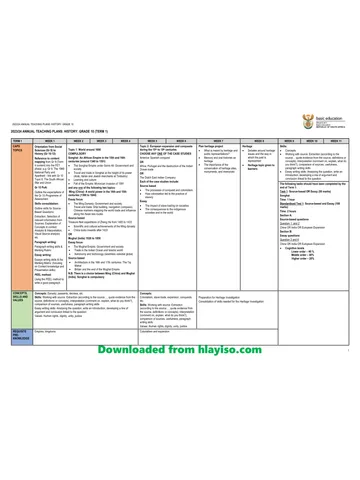
History Grade 10 North West November 2024 QP (Eng)
Grade 10 History question paper from the North West November Exam 2024 (English), 9 pages. Read online or get the free PDF download, memo linked when available.
History · Grade 10 · North West November Exam · 2024 · English. Question paper, 9 pages. Read online or download the PDF.
- Subject
- History
- Grade
- Grade 10
- Language
- English
- Document type
- Question paper
- Year
- 2024
- Exam period
- North West November Exam
- Curriculum
- CAPS
- Pages
- 9
- File size
- 573.7 KB
Free to read online, no sign-up needed
Loading document…
Loading document…
1 of 9
This exam
North West November Exam 2024
Document textSearch extracted text and jump to a page.
History 2 NW/November 2024
Grade 10
INSTRUCTIONS AND INFORMATION
1. This question paper consists of SECTION A and SECTION B based on the
prescribed content framework in the CAPS document.
SECTION A: SOURCE-BASED QUESTIONS
QUESTION 1: COLONIAL EXPANSION AFTER 1750
QUESTION 2: SOUTH AFRICAN WAR AND UNION FROM 1899 TO 1902
QUESTION 3: THE NATIVE LAND ACT OF 1913
SECTION B: ESSAY QUESTIONS
QUESTION 4: COLONIAL EXPANSION AFTER 1750
QUESTION 5: THE SOUTH AFRICAN WAR FROM 1899 TO 1902
QUESTION 6: SOUTH AFRICAN WAR AND UNION FROM 1899 TO 1913
2. SECTION A consists of THREE source-based questions. Source material that is
required to answer these questions can be found in the ADDENDUM.
3. SECTION B consists of THREE essay questions.
4. Answer THREE questions as follows:
4.1 At least ONE must be a source-based question and at least ONE must be an
essay question.
4.2 The THIRD question can either be a source-based question or an essay
question.
5. You are advised to spend ONE hour per question.
6. When answering questions, learners should apply their knowledge, skills and
insight.
7. You will be disadvantaged by merely rewriting the sources as answers.
8. Number the answers correctly according to the numbering system used in this
question paper.
9. Write neatly and legibly.
Copyright reserved Please turn over
History 3 NW/November 2024
Grade 10
SECTION A: SOURCE-BASED QUESTIONS
Answer at least ONE question, but not more than TWO questions in this section.
Source material to be used to answer these questions is contained in the ADDENDUM
QUESTION 1: DID THE BRITISH COLONIAL CONTROL OF SOUTH AFRICA
LEAD TO INDIGENOUS POPULATIONS BEING COERCED
INTO LABOUR FORCE?
Study Sources 1A, 1B, 1C and 1D and answer the questions that follow.
1.1 Refer to Source 1A.
1.1.1 Since when, according to the source, had the Dutch been at the Cape?
(1 x 1) (1)
1.1.2 Define the historical term colonialism in your own words. (1 x 2) (2)
1.1.3 Quote a reason from the source why the VOC could no longer afford to
administer its colony. (1 x 1) (1)
1.1.4 Comment on the statement, “When the British took control of the Cape
for the second time in 1806, they brought with them new ideas of
governance”. (1 x 2) (2)
1.1.5 Using the information in the source and your own knowledge, comment
on what do you think are the reasons that the British took control of the
Cape for the second time? (2 x 2) (4)
1.2 Read Source 1B.
1.2.1 When according to the source, was slave trade abolished in Britain?
(1 x 1) (1)
1.2.2 State TWO groups of people from the source, who could still be sold.
(2 x 1) (2)
1.2.3 What were the TWO implications, according to the source, of abolition of
slave trade in the Cape colony? (2 x 1) (2)
1.2.4 Mention FOUR ways on how the lives of slaves were improved by
passing new laws. (4 x 1) (4)
1.2.5 Comment on the implication of the statement “The freed slaves at the
Cape were given nothing to help them start a new life. They did not
receive money, land or training.” (1 x 2) (2)
1.2.6 Why do you think many slaves moved to the cities to find work? (2 x 2) (4)
Copyright reserved Please turn over
History 4 NW/November 2024
Grade 10
1.3 Use Source 1C.
1.3.1 Why do you think this photograph was taken? (1 x 2) (2)
1.3.2 Explain why black migrant labourers were made to stay in the mine
compounds in South African mines. (1 x 2) (2)
1.4 Consult Source 1D.
1.4.1 What was the reason, according to the source, many black people
were forced to become migrant workers? (1 x 1) (1)
1.4.2 Explain the term migrant worker in your own words. (1 x 2) (2)
1.4.3 Comment on the statement “This was the only way to earn money but
still kept ties with their old way of life in their farms (home).” (2 x 2) (4)
1.4.4 Which companies, according to the source, had to find ways to force
rural Africans into migrant labour? (1 x 1) (1)
1.4.5 Name THREE results according to the source, that happened when
the British and the Boer governments in South Africa introduced taxes
to force Black South African workers in to migrant labour. (3 x 1) (3)
1.5 Refer to Sources 1C and 1D. Explain how the evidence in Source 1D supports
the information in Source 1C regarding the migrant labour system in South
Africa. (1 x 2) (2)
1.6 Using the information in the relevant sources and your own knowledge, write
a paragraph of about EIGHT lines (about 80 words) explain how British
colonial control of South Africa led to indigenous populations being coerced
into labour force? (8)
[50]
Copyright reserved Please turn over
History 5 NW/November 2024
Grade 10
QUESTION 2: WHY DID DIFFERENT SOCIAL CLASSES EMERGE IN SOUTH AFRICA
AFTER THE DISCOVERY OF MINERALS?
Study Sources 2A, 2B, 2C and 2D to answer the questions that follow.
2.1 Refer to Source 2A.
2.1.1 Identify the FOUR states, that existed in what was to become South
Africa. (4 x 1) (4)
2.1.2 Whom, according to the source controlled:
(a) The Cape Colony and Natal. (1 x 1) (1)
(b) The Transvaal and the Orange Free State. (1 x 1) (1)
2.1.3 Comment on the statement: “Most African Kingdoms had been
defeated, but some had managed to retain control over limited
amounts of land.” (1 x 2) (2)
2.1.4 Which mineral, according to the source ran for many kilometres
underground? (1 x 1) (1)
2.1.5 Explain the implications of the statement “People from overseas in
ships, and travelled from all over southern Africa in ox-wagons or on
foot, walking long distances.” (1 x 2) (2)
2.2 Read Source 2B.
2.2.1 What, according to the Source, are TWO reasons that made it
expensive for individuals to operate a gold mine? (2 x 1) (2)
2.2.2 Name TWO, now famous men according to the source, who provided
leadership in the early gold-mining days. (2 x 1) (2)
2.2.3 Comment on the implication of the words “These men soon began to
work in partnership and created mining companies.” (1 x 2) (2)
2.2.4 What, according to the source was the Chamber of Mines? (1 x 2) (2)
2.2.5 What do the words in the source “It became a very powerful
association that used its power to benefit the mine owners” mean?
(1 x 2) (2)
2.2.6 Define the historical term capitalist in your own words. (1 x 2) (2)
2.2.7 Using the information in the source and your own knowledge, what
were objectives of this association that benefitted the mine owners?
(1 x 2) (2)
Copyright reserved Please turn over
History 6 NW/November 2024
Grade 10
2.3 Use Source 2C.
2.3.1 What, according to the source, was the TWO chief consideration of
the authorities? (2 x 1) (2)
2.3.2 Explain the implications of the statement “the chief consideration was
ensuring a labour supply and undermining black competition on the
land.” (1 x 2) (2)
2.3.3 List THREE, according to the source, the designs that forced black
people into labour markets. (3 x 1) (3)
2.3.4 Explain, what made the employers and authorities to entrench the
labour migrancy? (1 x 2) (2)
2.3.5 What are the implications of the statement “The preservation of
communal areas from which migrants could be drawn had the effect
of lowering wages, by denying Africans rights within the urban areas”
on black society? (1 x 2) (2)
2.4 Consult Sources 2A and 2C. Explain how evidence in Source 2C contrast with
information in Source 2A on how people in general, migrated into urban areas
of South Africa. (1 x 2) (2)
2.5 Consult Source 2D.
2.5.1 Why do you think this photograph was taken? (1 x 2) (2)
2.5.2 Explain what this picture means about the emergence of a capitalist
class called Randlords and their lifestyle. (1 x 2) (2)
2.6 Using the information in the relevant sources and your own knowledge, write
a paragraph of about EIGHT lines (about 80 words) explaining why did
different social classes emerge in South Africa after the discovery of minerals. (8)
[50]
Copyright reserved Please turn over
History 7 NW/November 2024
Grade 10
QUESTION 3: WHAT WAS THE NEGATIVE IMPACT OF THE NATIVES LAND ACT OF
1913 ON THE SOUTH AFRICAN SOCIETIES?
Study Sources 3A, 3B, 3C and 3D to answer the questions that follow.
3.1 Refer to Source 3A.
3.1.1 Which people, according to the source, lived and worked on white
owned land outside of the reserves? (1 x 1) (1)
3.1.2 Why, according to the source, were they allowed to stay on these
white owned lands? (1 x 1) (1)
3.1.3 List THREE types of tenants that are mentioned in the source. (3 x 1) (3)
3.1.4 Comment on what is implied by the statement ‘The wealthier white
landowners were opposed to sharecropping as they complained that
it took away their cheap labour, as Africans preferred to be
sharecroppers rather than low paid farm workers. (2 x 2) (4)
3.1.5 What, according to the source, were white land owners unhappy
about? (1 x 2) (2)
3.1.6 State THREE reasons, in the source, why the Native Land Act of 1913
was passed by the government. (3 x 1) (3)
3.2 Use source 3B.
3.2.1 What, according to the source happened to the thousands of black
people who could not obtain such employment, or perhaps did not
want it? (1 x 2) (2)
3.2.2 Define the concept Black reserves/Homelands in the context of the
Native Land Act of 1913. (1 x 2) (2)
3.2.3 What does the statement ‘The law also stated that to provide landless
black person with a place to live was forbidden under the penalty of
100 pounds (a great deal of money at the time) or six months’
imprisonment? (1 x 2) (2)
3.2.4 What type of conditions, according to the source, existed in the
reserves? (1 x 2) (2)
Copyright reserved Please turn over
History 8 NW/November 2024
Grade 10
3.3 Consult Source 3C.
3.3.1 Name, the person, in the source who travelled about South Africa to
record the effects of the passing of the Land Act of 1913. (1 x 2) (2)
3.3.2 Which book, according to the source, was published in 1916? (1 x 2) (2)
3.3.3 Explain, the implication of the statement “Awaking on Friday morning,
June 20, 1913 [The day the Natives’ Land Act had been passed], the
South African Native found himself, not actually a slave, but a pariah
[outcast] in the land of his birth.” (2 x 2) (4)
3.3.4 Define the concept Forced removals in the context of Native Land Act of
1913. (1 x 2) (2)
3.3.5 Comment on the meaning of the statement “They wandered about the
countryside in search for shelter and a place to stay. It looked, he wrote,
as if these people were so many fugitives escaping from war, with the
enemy pressing hard on their heels.” (2 x 2) (4)
3.4 Study Source 3D.
3.4.1 Explain why the photographer took this picture of Sol Plaatje. (1 x 2) (2)
3.4.2 Why, according to your interpretation, did Sol Plaatje take a journey to
record the effects of the Native Land Act of 1913. (1 x 2) (2)
3.5 Refer to Sources 3C and 3D, explain how the visual source supports the written
source regarding the recording of the effects of the Native Land Act of 1913.
(1 x 2) (2)
3.6 Using the information in the relevant sources and your own knowledge, write a
paragraph of about EIGHT lines (80 words) and explain to what extent was the
impact of the Natives Land Act of 1913 negative on the South African societies? (8)
[50]
Copyright reserved Please turn over
History 9 NW/November 2024
Grade 10
SECTION B: ESSAY QUESTIONS
Answer at least ONE question, but not more than TWO questions in this section.
Your essay should be about THREE pages long
QUESTION 4: COLONIAL EXPANSION IN THE INTERIOR OF SOUTHERN
AFRICA AFTER 1750
“The Voortrekkers of the Cape found life under British control intolerable due to
Anglicization, Ordinance 50 and lack of freedom to govern themselves.”
Do you agree with the statement? Use relevant evidence to support your line of
argument. [50]
QUESTION 5: THE SOUTH AFRICAN WAR FROM 1899 TO 1902
“The South African War was called The Anglo-Boer War because it was seen
as a white man’s war, but Africans, Coloureds and Indians played a role in this
war.”
Critically discuss this statement and use relevant historical evidence to support
your line of argument. [50]
QUESTION 6: THE SOUTH AFRICAN WAR AND UNION FROM 1899 TO
1910
Explain to what extent did the segregationist government succeed in creating
the Union of South Africa with its discriminatory policies which won the support
of black people in the early 1900s.
Use relevant evidence to support your line of argument. [50]
GRAND TOTAL: 150
Copyright reserved
Study this subject
Recommended for this subject
Addendum
History Grade 10 North West November 2024 Addendum (English)
Question paper
History Grade 10 NSC Term 1 Controlled Test 2023 QP (Eng)
Question paper
History Grade 10 P1 Eastern Cape November 2020 QP (Eng)
Question paper
History Grade 10 P2 2020 QP (Eng)
Question paper
History Grade 10 National November 2018 Question Paper (Eng)
Question paper
History Grade 10 Eastern Cape November 2017 QP (Eng)
More from Grade 10 History
Addendum
History Grade 10 P1 November Mock 2026 Addendum (English)
Memorandum
History Grade 10 Paper 1 November Mock 2026 Memo (English)
Addendum
History Grade 10 P1 November Mock Exam 2 2026 Addendum (Eng)
Memorandum
History Grade 10 P1 November Mock Exam 2 2026 Memo (English)
Annual teaching plan
Gr 10 His ATP 2023 24
Question paper and memo