
NATIONAL
SENIOR CERTIFICATE
GRADE 10
NOVEMBER 2018
HISTORY
MARKS: 150
TIME: 3 hours
This question paper consists of 9 pages and an addendum of 11 pages.
You're offline
Skip to contentQuestion paper 
%20Term%201%20Controlled%20Test%201%20Question%20Paper_hlayiso.com_--2e075895-ae15-4478-b0ac-8807d3d13ca1/v1-803a66c22dd2f107ea24/card.webp)
View all
%20Term%201%20Controlled%20Test%201%202023%20Addendum_hlayiso.com_--48741a44-1ab1-444b-86d4-58897c42c11d/v1-335be09d3493899c7cdb/card.webp)
HISTORY QP GR10 NOV2018 Eng D
History · Grade 10 · National November Exam · 2018 · English. Question paper, 16 pages. Read online or download the PDF.
- Subject
- History
- Grade
- Grade 10
- Language
- English
- Document type
- Question paper
- Year
- 2018
- Exam period
- National November Exam
- Pages
- 16
- File size
- 179.8 KB
Loading document…
Loading document…
1 of 16
Document textSearch extracted text and jump to a page.
2 HISTORY (EC/NOVEMBER 2018)
INSTRUCTIONS AND INFORMATION
1. This question paper consists of SECTION A and SECTION B based on the
prescribed content framework in the CAPS document.: THREE source-based
questions under SECTION A and THREE essay questions under SECTION B.
SECTION A: SOURCE-BASED QUESTIONS
QUESTION 1: TRANSFORMATION IN SOUTHERN AFRICA AFTER 1750
QUESTION 2: COLONIAL EXPANSION AFTER 1750
QUESTION 3: SOUTH AFRICAN WAR AND UNION
SECTION B: ESSAY QUESTIONS
QUESTION 4: TRANSFORMATION IN SOUTHERN AFRICA AFTER 1750:
THE EMERGENCE OF THE SOTHO KINGDOM UNDER
KING MOSHOESHOE
QUESTION 5: COLONIAL EXPANSION AFTER 1750: CO-OPERATION
AND CONFLICT IN THE HIGHVELD
QUESTION 6: SOUTH AFRICAN WAR AND THE UNION: THE NATIVE
LAND ACT OF 1913
2. SECTION A consists of THREE source-based questions. Source materials that
are required to answer these questions will be found in the ADDENDUM.
3. SECTION B consists of THREE essay questions.
4. Answer THREE questions as follows:
4.1 At least ONE source-based question must be answered and at least
ONE essay must be answered.
4.2 The THIRD question can be either a source-based question or an essay.
5. When answering the questions, you should apply your knowledge, skills and
insight.
6. You will be disadvantaged by merely rewriting the sources as answers.
7. Number the answers correctly according to the numbering system used in this
question paper.
8. Write neatly and legibly.
Copyright reserved Please turn over
(EC/NOVEMBER 2018) HISTORY 3
SECTION A: SOURCE-BASED QUESTIONS
Answer at least ONE question, but not more than TWO questions, in this section.
Source material to be used to answer these questions is contained in the
ADDENDUM.
QUESTION 1: HOW DID SHAKA’S CHILDHOOD INFLUENCE HIS LEADERSHIP
OF THE ZULU NATION?
Study Sources 1A, 1B and 1C and answer the questions below.
1.1 Refer to Source 1A.
1.1.1 Who, according to the source, was Shaka’s father? (1 x 1) (1)
1.1.2 How, according to the source, did the Zulus respond to Nandi’s
pregnancy? (1 x 2) (2)
1.1.3 Provide evidence from the source that suggests that Shaka will not be
the hereditary successor. (1 x 2) (2)
1.1.4 Using the information in the source and your own knowledge, explain
how Nandi’s statement that Shaka was her little blazing fire was
vindicated. (2 x 2) (4)
1.1.5 Comment on how Nandi contributed towards Shaka becoming a great
leader. (1 x 2) (2)
1.1.6 Quote evidence from the source that proves that Shaka had a difficult
childhood. (3 x 1) (3)
1.1.7 Use the source and your own knowledge, to identify the best mentor
that would ultimately prepare Shaka for his leadership role. (1 x 2) (2)
1.2 Consult Source 1B.
1.2.1 What, according to the source, was the first thing Shaka did when he
became leader of the Zulus? (1 x 2) (2)
1.2.2 Identify the name that is given to a regiment of Zulu warriors. (1 x 2) (2)
1.2.3 Why, according to the source, did Shaka kill people (his opponents)?
(2 x 1) (2)
1.2.4 Using the information in the source and your knowledge, explain why
the region became a depopulated ruin of burning kraals. (1 x 2) (2)
1.2.5 Define the term myth in your own words. (1 x 2) (2)
1.2.6 According to the source, what was the duty of the ‘loins’? (1 x 2) (2)
1.2.7 Comment on why Shaka succeeded in defeating other tribes. (2 x 2) (4)
Copyright reserved Please turn over
4 HISTORY (EC/NOVEMBER 2018)
1.3 Study Source 1C.
1.3.1 Identify any TWO military weapons used by Shaka during his
battles. Use the visual clues. (2 x 1) (2)
1.3.2 Use your own knowledge to explain why he introduced the short
stabbing assegai. (1 x 2) (2)
1.3.3 Using the information in the source and your own knowledge,
explain why he started killing the eLangeni tribe first. (2 x 2) (4)
1.4 Compare Source 1B with Source 1C. Explain how the information in
Source 1B supports the evidence in Source1C regarding the military tactics
used by Shaka in building the Zulu nation. (2 x 2) (4)
1.5 Using the information in the sources and your own knowledge, write a
paragraph of about SIX lines (about 60 words) explaining how Shaka’s
childhood influenced his leadership of the Zulu nation. (6)
[50]
Copyright reserved Please turn over
(EC/NOVEMBER 2018) HISTORY 5
QUESTION 2: WHAT WAS THE IMPACT OF BRITISH COLONIALISM ON
THE POPULATION OF THE CAPE COLONY?
Study Sources 2A, 2B and 2C and answer the questions that follow.
2.1 Read Source 2A.
2.1.1 Why, according to the source, did the British decide to take control
of the Cape? (1 x 2) (2)
2.1.2 Define the term colonialism in your own words. (1 x 2) (2)
2.1.3 Which nation, according to the source, colonised the Cape in
1652? (1 x 2) (2)
2.1.4 Use your own knowledge to explain why the Khoikhoi community
disintegrated. (1 x 2) (2)
2.1.5 Comment on the impact that colonisation had on the indigenous
people of the Cape. (2 x 2) (4)
2.1.6 Name the European technology introduced to the indigenous
rulers. (1 x 1) (1)
2.2 Consult Source 2B.
2.2.1 Define the term apprenticeship in your own words. (1 x 2) (2)
2.2.2 Use your own knowledge to explain why Manisa is referred to as
an ex-slave. (1 x 2) (2)
2.2.3 Quote evidence from the source that proves that female slaves
were also mistreated. (2 x 1) (2)
2.2.4 Explain the usefulness of this source to a historian studying the
emancipation of slaves at the Cape Colony. (2 x 2) (4)
2.2.5 Use your own knowledge to explain why the British decided to
emancipate slaves. (1 x 2) (2)
2.2.6 Using the information in the source and your own knowledge,
explain the positive effects that emancipation had on the lives of
slaves. (2 x 2) (4)
2.2.7 Who, according to the source, was Manisa’s master? (1 x 1) (1)
Copyright reserved Please turn over
6 HISTORY (EC/NOVEMBER 2018)
2.3 Use Source 2C.
2.3.1 Which colony is Piet Retief referring to in the source? (1 x 2) (2)
2.3.2 List TWO (2) complaints made by Retief as the reasons for them
leaving the Cape Colony. (2 x 1) (2)
2.3.3 Use the information in the source and your own knowledge, explain
why the Boers decided to leave the Cape, besides the
emancipation of the slaves. (2 x 2) (4)
2.3.4 Who are the ‘vagrants’ that Retief is referring to in paragraph 1 of
the manifesto? (1 x 2) (2)
2.3.5 Comment on the attitude of the Voortrekkers regarding their future
in South Africa. (1 x 2) (2)
2.3.6 Quote a phrase from the source that indicates that the Boers
wanted to be independent from the British. (1 x 2) (2)
2.4 Using the information in the sources and your own knowledge, write a
paragraph of about SIX lines (about 60 words) explaining the impact that
British colonialism had on the population at the Cape. (6)
[50]
Copyright reserved Please turn over
(EC/NOVEMBER 2018) HISTORY 7
QUESTION 3: WHAT WERE THE ROLES AND EXPERIENCES OF BLACK
SOUTH AFRICANS IN THE SOUTH AFRICAN WAR (1899–
1902)?
Study Sources 3A, 3B and 3C and answer the questions that follow.
3.1 Use Source 3A.
3.1.1 Identify the primary population groups that were originally involved
in the South African War. (2 x 1) (2)
3.1.2 Which other population groups, according to the source, also
played a role in this war? (4 x 1) (4)
3.1.3 Name any THREE (3) roles that black South Africans played in the
war. (3 x 1) (3)
3.1.4 Using the information in the source and your own knowledge,
explain why this war was originally referred to as the ‘white man’s
war.’ (2 x 2) (4)
3.1.5 Comment on why the Boer commandos originally did not want to
arm black South Africans. (1 x 2) (2)
3.1.6 What, according to the source, were the duties of agterryers?
(3 x 1) (3)
3.1.7 Explain why a historian would consider the information in this
source useful when researching the role black South Africans
played in the South African War. (1 x 2) (2)
3.2 Read Source 3B.
3.2.1 Define the concept martial law in the context of the South African
War. (1 x 2) (2)
3.2.2 Name the magistrate that Abraham Esau asked for help. (1 x 1) (1)
3.2.3 Using the information in the source and your own knowledge,
explain why Abraham Esau established a spy network. (2 x 2) (4)
3.2.4 Quote evidence from the source that proves that Abraham Esau
was being spied on. (1 x 2) (2)
3.2.5 How, according to the source, was Abraham Esau tortured? (3 x 1) (3)
3.2.6 Use the source and your own knowledge to explain why the British
army honoured Abraham Esau. (1 x 2) (2)
Copyright reserved Please turn over
8 HISTORY (EC/NOVEMBER 2018)
3.2.7 Explain how the following people would have reacted to the death of
Abraham Esau:
(a) Pro-British sympathisers (1 x 2) (2)
(b) Boer-sympathisers (1 x 2) (2)
3.3 Refer to Source 3C.
3.3.1 Explain the message that is conveyed by the photo. Use the visual
clues in the photo to support your answer. (1 x 2) (2)
3.3.2 Explain why you think blacks were willing to fight on the side of the
British. (1 x 2) (2)
3.4 Compare Sources 3A and 3C. Explain how the information in Source 3A
supports the evidence in Source 3C regarding the participation of black
South Africans during the South African War. (1 x 2) (2)
3.5 Using the information in the sources and your own knowledge, write a
paragraph of about SIX lines (about 60 words) explaining the role and
experiences of black South Africans in the South African War. (6)
[50]
Copyright reserved Please turn over
(EC/NOVEMBER 2018) HISTORY 9
SECTION B: ESSAY QUESTIONS
Answer at least ONE question, but not more than two questions from this section.
QUESTION 4: TRANSFORMATION IN SOUTHERN AFRICA AFTER 1750 –
THE EMERGENCE OF THE SOTHO KINGDOM UNDER
KING MOSHOESHOE
‘Moshoeshoe was described as a sly but wise statesman and a clever planner.’
Do you agree with the statement? Substantiate your answer with relevant
examples. [50]
QUESTION 5: COLONIAL EXPANSION AFTER 1750 – CO-OPERATION
AND CONFLICT ON THE HIGHVELD
‘The Highveld after 1750 was characterised by conflict between the Boers, British
and the Basotho.’
Critically discuss the statement. Substantiate your answer with relevant
examples. [50]
QUESTION 6: SOUTH AFRICAN WAR AND THE UNION – THE NATIVE
LAND ACT OF 1913
‘The Land Act was passed within three years of the Union government coming to
power. That had far-reaching effects on black South Africans.’
Discuss this statement and support your answer with relevant evidence. [50]
TOTAL: 150
Copyright reserved Please turn over
Recommended for this subject
Published documents with matching subject and grade metadata.
Question paper
HISTORY ADD ENG JUNE 2024
Question paper
HISTORY QP ENG JUNE 2024
Question paper
GR10 HISTORY QP ENG
Question paper
Gr 10 History Term 1 Controlled Test Question Paper hlayiso.com
Question paper
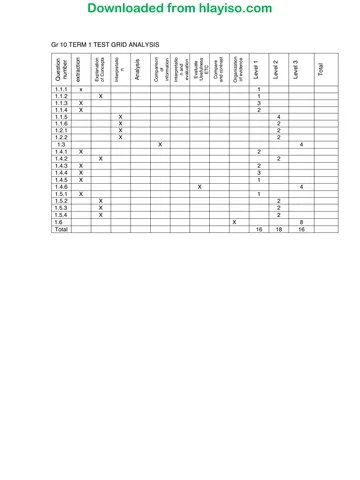
Gr 10 History Term 1 Test 2023 Grid Analysis hlayiso.com
Question paper
Gr 10 History (English) Term 1 Controlled Test 1 Question Paper hlayiso.com
Related documents
Matched using subject, grade, language, document type and exam metadata.
More from Grade 10 History
Explore more published documents in this catalogue.
Annual teaching plan
Gr 10 His ATP 2023 24
Question paper and memo
EC History Grade 10 March 2025 QP and Memo
Question paper and memo
LP MW History Grade 10 March 2025 QP and Memo
Addendum
GR10 HISTORY ADDENDUM ENG
Addendum
Gr 10 History Term 1 Controlled Test 2023 Addendum hlayiso.com
Addendum