
Grade 11 Life Sciences: Exam Preparation Paper 2
Topics:
1) Biodiversity and classification of microorganisms
2) Biodiversity of Plants
3) Biodiversity of Animals
Revision of Key Concepts:
Biodiversity of Animals
Key Concepts:
1. Invertebrates are animals without a backbone
2. According to backbone and some other features animals are classified accordingly
3. There are five features to track the increasing complexity among different animals. These
are as follows:
Body of symmetry
Type of gut
Type of body cavity
Segmentation
Cephalisation
4. Each phylum has its own
body plan. A body plan
refers to the way the
body is structured.
Skip to contentStudy guide 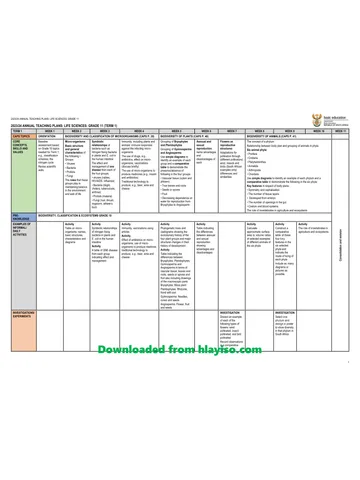

View all
Gr11 LS 15 Exam Preparation Paper 2
Grade 11 Life Sciences study guide, 6 pages. Read online or get the free PDF download.
Publisher: Exam Preparation
Life Sciences · Grade 11. Study guide, 6 pages. Read online or download the PDF.
- Subject
- Life Sciences
- Grade
- Grade 11
- Document type
- Study guide
- Publisher
- Exam Preparation
- Curriculum
- CAPS
- Pages
- 6
- File size
- 719.7 KB
Loading document…
Loading document…
1 of 6
Document textSearch extracted text and jump to a page.
Question 1:
Match each description in Column A with the correct term from Column B. Write the answer (letter
only) from column B in the space provided. (7)
Column A Answer Column B
1.1. Long strands of a fungus that can A fungi
extend over a substrate.
1.2 An opportunistic infection of an B saprotrophs
HIV-positive person
1.3 Together with bacteria, fungi of this C archae
type break down dead organic
matter
1.4 An organism that causes malaria D hyphae
1.5 The kingdom of microbes which E pneumonia
produce antibiotics
1.6 Cells that have a membrane bound F phytoplankton
nucleus and cell organelles
1.7 Animal-like protista G AIDS
H vector
I Eukaryote
J Plasmodia
K Protozoa
Question 1.2:
Differentiate between the following terms:
1.2.1 Diploblastic and triploblastic. (2)
1.2.2 Blind gut and through-gut. (2)
1.2.3 Explain the advantages of cephalisation and why is essential in bilateral animals
(4)
Question 1.3:
1.3 Indicate whether each of the statements in COLUMN Ι, applies to A ONLY,
B ONLY, BOTH A and B, or NONE of the items in COLUMN ΙΙ. Write A
ONLY, B ONLY, BOTH A and B, or NONE next to the question number in
the ANSWER BOOK.
Question 1.4:
1.4 Study the graph below and answer the questions that follow.
1.4.1 In which year was the highest number of TB cases reported? (1)
1.4.2 Calculate the total number of TB cases in 2003 and 2004. (1)
1.4.3 What trend is shown by the data on the graph? (2)
1.4.4 Suggest ONE reason why this trend is taking place. (1)
Question 3:
Learners wanted to investigate the effect of different antibiotics on the
growth of a certain bacterial species. They set up nutrient agar plates and
placed sterile discs containing three different antibiotics on each of the
plates. Study the diagram and answer the following questions.
3.1 What is an antibiotic? (2)
3.2 What is the function of the agar plates? (1)
3.3 Mention ONE precaution that the learners would have taken toensure that their results were
valid. (1)
3.4 Which factors would the learners have kept constant during theinvestigation? (2)
3.5 Use the information in the diagram to describe the results of the investigation. (3)
Lesson 15: Exam Preparation paper 2
Question 1:
Question 1.1. 1.2 1.3 1.4 1.5 1.6 1.7
Answer D E B J A I K
Question 1.2:
1.2.1 Diploblastic: animals that have two layers in their embryo are calleddiploblastic animals
Triploblastic: If there are three layers in the embryo like humans or other animals, then they
are referred to as being triploblastic.
1.2.2 A gut with a separate mouth and anus is called a through-gut.
A gut with a single opening through which food enters and waste leaves is called a blind gut
1.2.3 It is the concentration of organs, especially sensory organs, feeding appendages and nervous
tissue near the anterior end of the animal. It is common among animals that are bilaterally
symmetrical. This allows for the concentration of nerves at the anterior end; thus allowing
bilaterally symmetrical organism a developed nervous system.
Question 1.3
Question 1.4:
1.4.1. Answer: 2003
1.4.2 88 559
1.4.3 The number of TB cases increased from 1997 to 2003 and decrease slightly in 2004.
1.4.4 Probably due to an increase in the population. /More people living in poor conditions
Question 3:
3.1 It is a chemical substance that reduces the growth of bacteria by killing them/preventing
them from reproducing
3.2 They provide the bacteria with nutrients for growth.
3.3 To make sure that the agar plates are set up in sterile conditions.
To make sure that the agar plates are not contaminated with other bacteria and fungi.
3.4 Kept all plates at the same temperature.
Ensured that the plates had the same amount of nutrients in the same concentration
3.5 Antibiotic 3 was the most effective in destroying the bacteria.
Antibiotic 2 was ineffective against the bacteria.
Antibiotic 1 was fairly effective
Study this subject
Notes, quizzes and topic questions for Grade 11 Life Sciences.
- Grade 11 Life Sciences notes
CAPS revision notes with worked examples.
- Life Sciences questions by topic
Past exam questions sorted by CAPS topic, with memos where available.
- Grade 11 Life Sciences quizzes
Short topic quizzes with instant feedback.
- All Grade 11 Life Sciences past papers
Past papers by year, with memos where available.
- Grade 11 Study guides
More Life Sciences and other subjects in this collection.
Recommended for this subject
More papers and memos for this grade and subject.
Annual teaching plan
Gr 11 Life Sci ATP 2023 24
Memorandum
Life Sciences Grade 11 Eastern Cape November 2025 Memo (Afr)
Memorandum
Life Sciences Grade 11 P1 Eastern Cape November 2025 Memo (Eng)
Question paper
Life Sciences Grade 11 Eastern Cape November 2025 QP (Afr)
Question paper
Life Sciences Grade 11 P2 Eastern Cape November 2025 QP
Question paper and memo
Life Sciences Grade 11 KZN June 2025 Paper & Memo
Related documents
Question paper and memo
Life Sciences Grade 11 Eastern Cape June 2024 Paper & Memo
Memorandum
Life Sciences Grade 11 P2 Eastern Cape November 2024 Memo (Afr)
Memorandum
Life Sciences Grade 11 P2 Eastern Cape November 2024 Memo (Eng)
Question paper
Life Sciences Grade 11 P2 Eastern Cape November 2024 QP (Eng)
Question paper and memo
Life Sciences Grade 11 KZN June 2024 Paper & Memo
Question paper
Life Sciences Grade 11 NW June 2024 Question Paper (Afrikaans)
More from Grade 11 Life Sciences
Question paper
Life Sciences Grade 11 NW June 2024 Question Paper (English)
Memorandum
Life Sciences Grade 11 P1 Eastern Cape November 2023 Memo (Afr)
Memorandum
Life Sciences Grade 11 P1 Eastern Cape November 2023 Memo (Eng)
Memorandum
Life Sciences Grade 11 P2 Eastern Cape November 2023 Memo (Afr)
Question paper
Life Sciences Grade 11 P1 Eastern Cape November 2023 QP (Eng)
Question paper