
Copyright reserved
Please turn over
Mock
hlayiso mock exams
Practice Series:
Grade 11 Exam Preparation
WWW.HLAYISO.COM
NATIONAL
SENIOR CERTIFICATE
GRADE 11
ENGLISH FIRST ADDITIONAL LANGUAGE P2
NOVEMBER EXAMINATION 2026 (MOCK)
MARKING GUIDELINES
MARKS: 70
These marking guidelines consist of 12 pages.
Skip to contentMemorandum 
View all
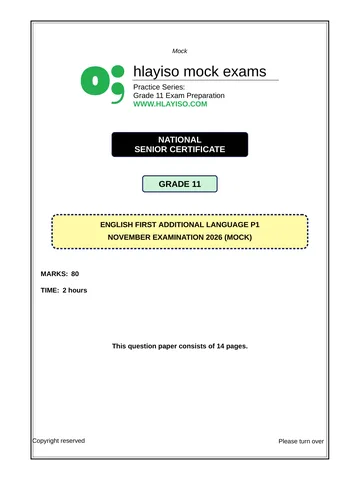
English FAL Grade 11 P2 November Mock Exam 2 2026 Memo (English)
Grade 11 English FAL Paper 2 memorandum from the November Mock Exam 2 2026 (English), 12 pages. Read online or get the free PDF download, question paper linked when available.
Publisher: Hlayiso
English FAL · Grade 11 · November Mock Exam 2 · 2026. Memorandum, 12 pages. Read online or download the PDF.
- Subject
- English FAL
- Grade
- Grade 11
- Language
- English
- Document type
- Memorandum
- Year
- 2026
- Exam period
- November Mock Exam 2
- Paper
- 2
- Publisher
- Hlayiso
- Curriculum
- CAPS
- Pages
- 12
- File size
- 155.1 KB
Loading document…
Loading document…
1 of 12
Document textSearch extracted text and jump to a page.
English First Additional Language/P2
2
NSC – Marking Guidelines
Hlayiso/Mock 2026
INSTRUCTIONS TO MARKERS
1.
Candidates answer TWO questions, ONE question each from ANY TWO sections. If a
candidate answers more than two sections, mark only the first two sections answered.
2.
These marking guidelines are a guide. Many questions are open-ended; credit any
relevant, well-substantiated response, even if it is not listed here.
3.
Because the focus is on understanding, spelling and language errors should not be
penalised unless they change the meaning of the answer.
4.
For open-ended questions, no marks are awarded for YES/NO or AGREE/DISAGREE
alone. The substantiation is what is credited.
5.
When TWO/THREE facts/points are required and more are given, mark only the first
TWO/THREE.
6.
For multiple-choice and matching questions, accept the letter AND/OR the answer
written out in full.
7.
For ‘Explain why the following statement is FALSE’ questions, the candidate must give
the correct fact from the text. Do not award a mark for ‘It is false’ alone or for simply
repeating the statement in the negative.
8.
For ‘Quote’ questions, the exact consecutive words must be given. Spelling errors in
the quotation are acceptable; if more words than required are quoted, award the mark
only if the required words are included and the meaning is not changed.
9.
For figure-of-speech questions, the figure of speech must be correctly identified; the
explanation must refer to BOTH the comparison/device AND its relevance in the
extract/poem.
Copyright reserved
Please turn over
English First Additional Language/P2
3
NSC – Marking Guidelines
Hlayiso/Mock 2026
SECTION A: NOVEL
QUESTION 1: FAR FROM THE MADDING CROWD
1.1
1.1.1
(a)
uncle’s✓
(b)
Oak✓
(c)
Fanny✓
(d)
Troy✓
(4)
(4 x 1)
1.1.2
(a) Metaphor✓(accept: allusion/biblical allusion)
(1)
(b) Boldwood is compared to Daniel in the Bible, who refused
to obey the king’s order and kept kneeling/praying towards
Jerusalem✓. Like Daniel, Boldwood is the only man who refuses to
‘bow’ to Bathsheba/give her the admiring glance that everyone else
gives her, which is why he troubles her.✓
(2)
1.1.3
Any TWO of the following:
•
He does not look at her/admire her, although everyone else
notices her.✓
•
He is the most dignified/important/wealthy man in the parish, so
his lack of interest hurts her pride/vanity.✓
•
Even a servant like Liddy has noticed and talks about it, which
embarrasses her.✓
(2)
1.1.4
‘with off-hand serenity directed’✓
NOTE: Also accept ‘with off-hand serenity’ and ‘off-hand serenity
directed the’ (hyphenated word counted as two words).
(1)
1.1.5
B/playfully.✓
(1)
1.1.6
Bathsheba knows about love only as something she watches in
others/as a game of admiration and attention✓; she has never felt
deep love herself and does not understand how powerful/painful
it can be, so she does not realise what the valentine will do to
Boldwood.✓
(2)
1.1.7
She sends it as a joke/on a whim (the hymn-book decides it), and
because she is annoyed that he ignores her; she does not love him.✓
(1)
Copyright reserved
Please turn over
English First Additional Language/P2
4
NSC – Marking Guidelines
Hlayiso/Mock 2026
1.1.8
Open-ended. Accept a suitable answer, e.g.
Yes. Her careless valentine with the seal ‘MARRY ME’ awakens
Boldwood’s
intense
passion.
She
later
leads
him
on
by
half-promising to marry him after Troy disappears. His hopes
are destroyed when Troy returns, and in desperation he shoots Troy
and is declared insane.
OR
No. Bathsheba apologises and tells Boldwood honestly that she does
not love him. Boldwood is a man of extreme feelings who chooses
to become obsessed. Troy’s cruel behaviour and Boldwood’s own
jealousy lead to the shooting.
NOTE: Do not award a mark for YES/NO or AGREE/DISAGREE
alone. Award 3 marks for a well-substantiated discussion that refers
to the text as a whole; award 1–2 marks for a partially substantiated
answer. Accept a mixed response.
(3)
1.2
1.2.1
Troy has performed the (cavalry) sword exercise around her/swung
the sword all around her body without touching her✓. He has cut off
a lock of her hair and spiked a caterpillar on her bodice/dress.✓
(2)
1.2.2
He is dishonest/deceitful/manipulative/reckless/a show-off.✓
He lied to Bathsheba that the sword was blunt so that she would
stand still, and he put her life at risk just to impress her.✓
NOTE: Award 1 mark for an answer that is not well-substantiated.
(2)
1.2.3
(a) Shocked/reproachful/accusing/upset/frightened.✓
(1)
(b) She has just realised that Troy lied to her and that she was in
great danger.✓
(1)
1.2.4
B/is lost in her thoughts.✓
(1)
1.2.5
‘powerless to withstand or deny’✓
NOTE: Also accept: ‘She felt powerless to withstand’ / ‘felt powerless
to withstand or’ / ‘altogether too much for her’.
(1)
1.2.6
(a) Simile✓
(1)
(b) Bathsheba is compared to a person facing a wind so strong that
it takes away her breath✓. Troy’s charm/passion overwhelms her so
completely that she cannot think clearly or resist him.✓
(2)
1.2.7
It is Fanny Robin’s hair.✓
It shows that Troy loved/still loves another woman; Bathsheba is
jealous/hurt and begins to realise that Troy does not truly love her/has
kept secrets from her.✓
(2)
Copyright reserved
Please turn over
English First Additional Language/P2
5
NSC – Marking Guidelines
Hlayiso/Mock 2026
1.2.8
Troy assures Bathsheba that she is ‘perfectly safe’ with him✓, but
after their marriage he gambles away her money, gets the farm
workers drunk and nearly ruins her harvest, shows that he loves
Fanny more, and then deserts her; she is far from safe with him.✓
(2)
1.2.9
Troy appears to be a handsome, charming and dashing soldier
in a bright scarlet uniform, and he flatters Bathsheba with sweet
words and his impressive skill with the sword. In reality he is selfish,
dishonest and irresponsible: he abandoned Fanny, gambles, drinks
and makes Bathsheba miserable. Bathsheba is deceived by his
appearance, while plain, quiet Gabriel turns out to be the man of
true worth.
NOTE: Award 3 marks for a discussion that clearly links the theme
to events/characters in the text; award 1–2 marks for a partial
discussion. Accept other relevant, well-substantiated responses.
(3)
[35]
Copyright reserved
Please turn over
English First Additional Language/P2
6
NSC – Marking Guidelines
Hlayiso/Mock 2026
SECTION B: DRAMA
QUESTION 2: ROMEO AND JULIET
2.1
2.1.1
(a)
C✓
(b)
D✓
(c)
E✓
(d)
A✓
(4)
(4 x 1)
2.1.2
He came (uninvited and masked) to see Rosaline, the woman he
loved at the time/because Benvolio persuaded him to compare
Rosaline with other beautiful women.✓
(1)
2.1.3
He is hot-tempered/aggressive/violent/hateful/proud.✓
He wants to kill Romeo just because he is a Montague who came to
the feast, and he believes that killing him would not be a sin because
it defends the family’s honour.✓
NOTE: Award 1 mark for an answer that is not well-substantiated.
(2)
2.1.4
Any TWO of the following:
•
Romeo is behaving like a gentleman/is not causing any
trouble.✓
•
Verona regards Romeo as a virtuous, well-behaved young
man.✓
•
Capulet will not dishonour his own house/insult a guest/spoil his
feast in front of his guests.✓
(2)
2.1.5
(a) Angry/commanding/authoritative/impatient.✓
(1)
(b) Tybalt is challenging his authority in his own house/refuses to
obey him.✓
(1)
2.1.6
He should turn to the guests and smile/speak cheerfully and loudly
(‘Well said, my hearts!’; ‘More light’), and then turn back to Tybalt,
frown and speak in a low, angry voice/point at him.✓
This shows that he is hiding the quarrel from his guests while he
scolds Tybalt.✓
NOTE: Award 1 mark for the action(s) and 1 mark for the reason.
(2)
2.1.7
Tybalt does not forget the ‘insult’: he later challenges Romeo to a
duel; Romeo refuses, Mercutio fights Tybalt instead and is killed✓.
Romeo then kills Tybalt and is banished, which leads to the deaths of
Romeo and Juliet; the ‘sweet’ feast where they met turns into ‘bitter’
tragedy.✓
(2)
Copyright reserved
Please turn over
English First Additional Language/P2
7
NSC – Marking Guidelines
Hlayiso/Mock 2026
2.1.8
Open-ended. Accept a suitable answer, e.g.
Yes. At the feast he welcomes his guests, keeps the peace and
protects Romeo, even though Romeo is a Montague. However, as a
father he later forces Juliet to marry Paris, insults and threatens her,
and refuses to listen to her feelings.
OR
No. He is a caring father who wants Juliet to have a rich, noble
husband; at first he even tells Paris to wait and win her heart. He
acts harshly later because he is grieving for Tybalt and thinks the
marriage will cheer her.
NOTE: Do not award a mark for YES/NO or AGREE/DISAGREE
alone. Award 3 marks for a well-substantiated discussion that refers
to the text as a whole; award 1–2 marks for a partially substantiated
answer. Accept a mixed response.
(3)
2.2
2.2.1
Paris✓(County Paris)
(1)
2.2.2
She is already (secretly) married to Romeo✓; marrying Paris would
be a sin/bigamy, and she loves Romeo.✓
(2)
2.2.3
She is desperate/humble/afraid/pleading.✓
By kneeling she begs her father to show mercy/listen to her, showing
that she still respects his authority.✓
(2)
2.2.4
B/worthless, good-for-nothing girl.✓
(1)
2.2.5
Capulet says that one child is ‘one too much’ and that Juliet is a
curse✓. The audience knows/suspects that he will soon lose his only
child (she will appear to die and then really die), and that he will be
heartbroken.✓
OR: The audience knows that Juliet is already secretly married to
Romeo, which Capulet does not know.✓
(2)
2.2.6
She is brave/loyal/protective/outspoken.✓
She dares to criticise Lord Capulet (‘You are to blame, my lord’) to
defend Juliet, even though he insults her and tells her to be quiet.✓
NOTE: Award 1 mark for an answer that is not well-substantiated.
(2)
2.2.7
He threatens to throw her out of his house/disown her, so that she
can ‘hang, beg, starve, die in the streets’.✓
(1)
2.2.8
(a) Metaphor✓
(1)
(b) Juliet is called a whining, crying fool and a ‘mammet’ (a
doll/puppet)✓. This shows Capulet’s contempt for her: he regards
her as weak and foolish, and expects her to be controlled like a doll
rather than treated as a person with feelings.✓
(2)
Copyright reserved
Please turn over
English First Additional Language/P2
8
NSC – Marking Guidelines
Hlayiso/Mock 2026
2.2.9
Because of their parents’ feud, Romeo and Juliet must hide their
love and their marriage. Capulet demands complete obedience and
arranges Juliet’s marriage to Paris without considering her feelings;
when she refuses, he threatens to disown her and her mother rejects
her. Juliet cannot turn to her parents, so she relies on the Nurse and
the Friar, and her desperate plan with the potion leads to tragedy.
Only after the children’s deaths do the parents understand what they
have lost.
NOTE: Award 3 marks for a discussion that clearly links the theme
to events/characters in the text; award 1–2 marks for a partial
discussion. Accept other relevant, well-substantiated responses.
(3)
[35]
Copyright reserved
Please turn over
English First Additional Language/P2
9
NSC – Marking Guidelines
Hlayiso/Mock 2026
SECTION C: SHORT STORIES
QUESTION 3
‘THE GIFT OF THE MAGI’
3.1
3.1.1
Any TWO of the following:
•
They are poor; Della has only one dollar and eighty-seven cents
to buy Jim’s Christmas present.✓
•
They live in a cheap/shabby furnished flat at eight dollars a
week.✓
•
Jim’s income has dropped from thirty to twenty dollars a week.✓
•
Della wears an old jacket and hat; the carpet is worn.✓
(2)
3.1.2
(a) Hyperbole✓/exaggeration (accept: allusion)
(1)
(b) The narrator exaggerates: Della’s hair is so beautiful that it would
make the Queen of Sheba’s jewels look worthless, and Jim’s watch
so fine that King Solomon would be jealous of it✓. This shows how
proud the couple are of their two treasures and how much they are
worth to them, which makes their sacrifice even greater.✓
(2)
3.1.3
She is nervous/sad/hesitant and regrets losing her beautiful hair (she
cries)✓, but she is determined to sell it; she puts it up quickly so that
she does not change her mind.✓
(2)
3.1.4
She is cold/unfriendly/businesslike/unsentimental.✓
She is described as ‘chilly’, speaks bluntly (‘Take yer hat off and let’s
have a sight’) and handles the hair with a practised hand, naming a
price at once.✓
NOTE: Award 1 mark for an answer that is not well-substantiated.
(2)
3.1.5
(a) Eager/urgent/impatient/determined.✓
(1)
(b) She wants the money quickly so that she can buy Jim’s present
on Christmas Eve/before she changes her mind.✓
(1)
3.1.6
B/speaks directly to the reader in a light, humorous way.✓
(1)
3.1.7
Jim is quiet/modest/humble/not showy✓, but he is a person of real
worth/good and reliable, just like the plain but valuable chain.✓
(2)
3.1.8
She pays twenty-one dollars (and is left with 87 cents).✓
(1)
3.1.9
Della is very proud of her hair, one of the couple’s two treasures, yet
after a moment’s tears she sells it because $1.87 cannot buy Jim a
worthy present. She spends $21 of her $21.87 on the watch chain
and only worries that Jim will no longer find her pretty. She puts Jim’s
happiness before her own beauty and pride; ironically, Jim has sold
his watch to buy her combs.
NOTE: Award 3 marks for a discussion that clearly links the theme
to events/characters in the text; award 1–2 marks for a partial
discussion. Accept other relevant, well-substantiated responses.
(3)
Copyright reserved
Please turn over
English First Additional Language/P2
10
NSC – Marking Guidelines
Hlayiso/Mock 2026
‘THE LAST LEAF’
3.2
3.2.1
She is drawing a picture/illustration for a magazine story and needs
someone to pose as the old hermit miner.✓
(1)
3.2.2
He has painted for forty years but has never painted the masterpiece
he always talks about✓; he paints only cheap advertising pictures
and earns a little money by working as a model.✓
(2)
3.2.3
(a) Metaphor✓
(1)
(b) Behrman is compared to a mastiff, a large guard dog✓. Like a
guard dog he is fierce and gruff, but he is loyal and protective towards
Sue and Johnsy (this prepares the reader for his sacrifice to save
Johnsy).✓
(2)
3.2.4
It
symbolises
his
unfulfilled
dream/ambition
of
painting
a
masterpiece✓; his life and talent have been wasted while he
waited, but the hope is still there.✓
(2)
3.2.5
He
pretends
to
be
hard/rough/scornful✓,
but
he
is
really
soft-hearted/caring and is deeply moved by/worried about Johnsy’s
illness.✓
NOTE: Accept that his eyes may be red from drinking, provided the
candidate shows that his rough words hide a soft heart/concern for
Johnsy.
(2)
3.2.6
B/an immigrant whose home language is German.✓
(1)
3.2.7
He agrees to pose; he says he has been trying for half an hour to say
that he is ready to pose (lines 27–28).✓
(1)
3.2.8
At first Johnsy has given up hope and believes that she will die when
the last leaf falls✓. When she sees that the last leaf has survived the
storm, she realises it was wrong/wicked to want to die; she regains
the will to live, asks for soup and a mirror and hopes to paint the Bay
of Naples one day.✓
(2)
3.2.9
Open-ended. Accept a suitable answer, e.g.
Yes. Sue nurses Johnsy every day, works hard to pay for food and
medicine, hides her own fear and refuses to let her give up; she also
fetches Behrman’s help.
OR
No. Behrman, only a neighbour, paints the last leaf on the wall on a
freezing, stormy night. It gives Johnsy the will to live, but he dies of
pneumonia: he gives his life for her.
NOTE: Do not award a mark for YES/NO or AGREE/DISAGREE
alone. Award 3 marks for a well-substantiated discussion that refers
to the text as a whole; award 1–2 marks for a partially substantiated
answer. Accept a mixed response.
(3)
[35]
Copyright reserved
Please turn over
English First Additional Language/P2
11
NSC – Marking Guidelines
Hlayiso/Mock 2026
SECTION D: POETRY
QUESTION 4
‘HOPE IS THE THING WITH FEATHERS’ – EMILY DICKINSON
4.1
4.1.1
(a)
bird✓
(b)
soul✓
(c)
storm✓
(d)
crumb✓
(4)
(4 x 1)
4.1.2
(a) Metaphor✓(accept: extended metaphor)
(1)
(b) Hope is compared to a small bird with feathers✓. Like a bird,
hope is light and gentle; it lives inside a person and ‘sings’, lifting the
person’s spirits and giving comfort and warmth.✓
(2)
4.1.3
Hope does not need words/reasons/explanations✓; it is a feeling
deep inside a person that comforts him/her constantly, even when
nothing can be said.✓
(2)
4.1.4
Hope
is
strongest/‘sweetest’
when
life
is
hardest
(in
the
gale/storm)✓;
only
a
terrible
storm
could
silence
it,
and
it
comforts/keeps many people ‘warm’ in their troubles.✓
(2)
4.1.5
‘chillest land’✓/‘strangest Sea’
(1)
4.1.6
B/shame and silence.✓
(1)
4.1.7
The dashes create pauses✓which emphasise the word ‘never’: even
in the worst situations, hope has never asked for anything.✓
(2)
4.1.8
Open-ended. Accept a suitable answer, e.g.
Yes. Hope sings all the time, comforts many people in the worst
storms and in the coldest and strangest places, yet it has never asked
the speaker for even a crumb. It is a free gift that keeps people going.
OR
No. Hope can disappoint people/can be lost in extreme situations; to
keep hope alive a person must make an effort and have faith.
NOTE: Do not award a mark for YES/NO or AGREE/DISAGREE
alone. Award 3 marks for a well-substantiated discussion that refers
to the text as a whole; award 1–2 marks for a partially substantiated
answer. Accept a mixed response.
(3)
Copyright reserved
Please turn over
English First Additional Language/P2
12
NSC – Marking Guidelines
Hlayiso/Mock 2026
‘WE WEAR THE MASK’ – PAUL LAURENCE DUNBAR
4.2
4.2.1
People who are oppressed/suffer in silence, e.g. Black Americans of
the poet’s time.✓
NOTE: Accept any group of people who hide their suffering behind
a smile.
(1)
4.2.2
The mask represents the false, cheerful face/smile that people show
to the world✓in order to hide their true pain and suffering.✓
(2)
4.2.3
(a) Metaphor✓(accept: hyperbole)
(1)
(b) Their feelings are described as torn and bleeding hearts, i.e. they
are deeply wounded/in great emotional pain✓. This contrasts sharply
with their smiles and shows how great the hidden pain is.✓
(2)
4.2.4
(a) Rhetorical question✓
(1)
(b) The world does not care/would not understand, and they do not
want to look weak/give their oppressors the satisfaction of seeing
their pain.✓
(1)
4.2.5
The repetition/refrain emphasises that hiding their suffering is a
constant, unavoidable part of their lives/the central idea of the
poem.✓
The
exclamation
mark
shows
strong
emotion,
e.g.
defiance/determination/bitterness/frustration.✓
(2)
4.2.6
Their life is hard and painful/unpleasant (‘the clay is vile’)✓, and their
struggle is long and seems endless (‘long the mile’).✓
(2)
4.2.7
(a) Anguished/desperate/pleading/sorrowful.✓
(1)
(b) They are crying out to God from ‘tortured souls’ while they must
smile in public.✓
(1)
4.2.8
Open-ended. Accept a suitable answer, e.g.
Yes. Many South Africans hide pain such as poverty, unemployment,
abuse, depression or the hurt of the past behind a smile, and on
social media people often show only happy faces. The poem reminds
us that a smile can hide suffering.
OR
No. Today people are free to speak openly about their struggles;
there is more support (e.g. counselling and helplines) and our
Constitution protects freedom of expression, so people need not hide
their pain.
NOTE: Do not award a mark for YES/NO or AGREE/DISAGREE
alone. Award 3 marks for a well-substantiated discussion that refers
to the text as a whole; award 1–2 marks for a partially substantiated
answer. Accept a mixed response.
(3)
[35]
GRAND TOTAL:
70
Copyright reserved
Matching paper and memo
The question paper, memo or addendum that belongs with this document.
Study this subject
Revise the topics in this paper, then practise them question by question.
Recommended for this subject
More papers and memos for this grade and subject.
Memorandum
English FAL Grade 11 Paper 1 November Mock 2026 Memo (English)
Memorandum
English FAL Grade 11 Paper 2 November Mock 2026 Memo (English)
Memorandum
English FAL Grade 11 Paper 3 November Mock 2026 Memo (English)
Memorandum
English FAL Grade 11 P1 November Mock Exam 2 2026 Memo (English)
Memorandum
English FAL Grade 11 P3 November Mock Exam 2 2026 Memo (English)
Memorandum
English Fal Grade 11 P1 Eastern Cape November 2022 Memo (English)
Related documents
Question paper
English FAL Grade 11 P1 November Mock Exam 2 2026 QP (Eng)
Question paper
English FAL Grade 11 P3 November Mock Exam 2 2026 QP (Eng)
Question paper
English FAL Grade 11 P2 November Mock 2026 Question Paper (Eng)
Memorandum
English Fal Grade 11 P2 National Exemplar November 2020 Memo
Memorandum
English Fal Grade 11 P2 National Exemplar November 2020 Memo
Memorandum
English Fal Grade 11 P2 Eastern Cape November 2018 Memo (English)
More from Grade 11 English FAL
Study guide
CREATIVE WRITING ENGLISH FINAL1
Study guide
Gr 11 Eng(FAL) 11 Preparing for Paper 1
Study guide
Gr11 Eng FAL Study guide LR
Question paper
English FAL Grade 11 P1 November Mock 2026 Question Paper (Eng)
Question paper
English FAL Grade 11 P3 November Mock 2026 Question Paper (Eng)
Annual teaching plan