
Copyright reserved
Please turn over
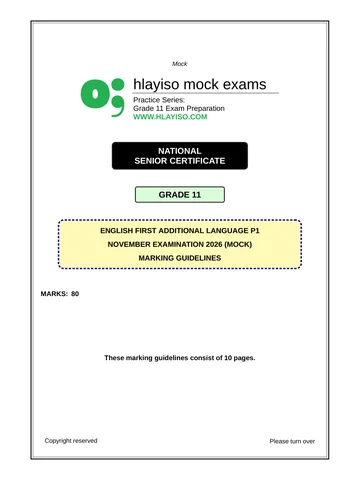
Mock
hlayiso mock exams
Practice Series:
Grade 11 Exam Preparation
WWW.HLAYISO.COM
NATIONAL
SENIOR CERTIFICATE
GRADE 11
ENGLISH FIRST ADDITIONAL LANGUAGE P2
NOVEMBER EXAMINATION 2026 (MOCK)
MARKS: 70
TIME: 2½ hours
This question paper consists of 19 pages.
Skip to contentQuestion paper 
View all
English FAL Grade 11 P2 November Mock 2026 Question Paper (Eng)
Grade 11 English FAL Paper 2 question paper from the November Mock Exam 2026 (English), 19 pages. Read online or get the free PDF download, memo linked when available.
Publisher: Hlayiso
English FAL · Grade 11 · November Mock Exam · 2026. Question paper, 19 pages. Read online or download the PDF.
- Subject
- English FAL
- Grade
- Grade 11
- Language
- English
- Document type
- Question paper
- Year
- 2026
- Exam period
- November Mock Exam
- Paper
- 2
- Publisher
- Hlayiso
- Curriculum
- CAPS
- Pages
- 19
- File size
- 171.9 KB
Loading document…
Loading document…
1 of 19
Document textSearch extracted text and jump to a page.
English First Additional Language/P2
2
NSC Mock
Hlayiso/Mock 2026
INSTRUCTIONS AND INFORMATION
Read these instructions carefully before you begin to answer the questions.
1.
Do NOT attempt to read the entire question paper. Consult the TABLE OF CONTENTS
on the next page and mark the numbers of the questions set on the texts you have
studied this year. Read these questions carefully and answer as per the instructions.
2.
This question paper consists of FOUR sections:
SECTION A:
Novel
(35)
SECTION B:
Drama
(35)
SECTION C:
Short stories
(35)
SECTION D:
Poetry
(35)
3.
Answer TWO QUESTIONS in total, ONE question each from ANY TWO sections.
SECTION A: NOVEL
Answer the questions set on BOTH extracts.
SECTION B: DRAMA
Answer the questions set on BOTH extracts.
SECTION C: SHORT STORIES
Answer the questions set on BOTH short stories.
SECTION D: POETRY
Answer the questions set on BOTH poems.
4.
Use the checklist to assist you.
5.
Follow the instructions at the beginning of each section carefully.
6.
Number the answers correctly according to the numbering system used in this question
paper.
7.
Start EACH section on a NEW page.
8.
Spend approximately 75 minutes on each section.
9.
Write neatly and legibly.
Copyright reserved
Please turn over
English First Additional Language/P2
3
NSC Mock
Hlayiso/Mock 2026
TABLE OF CONTENTS
SECTION A: NOVEL
QUESTION NO.
MARKS
PAGE NO.
1.
Far from the Madding Crowd
35
4
SECTION B: DRAMA
2.
Romeo and Juliet
35
8
SECTION C: SHORT STORIES
Answer the questions set on BOTH short stories.
3.1
‘The gift of the magi’
18
12
AND
3.2
‘The last leaf’
17
14
SECTION D: POETRY
Answer the questions set on BOTH poems.
4.1
‘Invictus’
18
16
AND
4.2
‘The road not taken’
17
18
CHECKLIST
• Answer questions from ANY TWO sections.
• Tick (✓) the sections you have answered.
SECTIONS
QUESTION
NUMBERS
NO. OF
QUESTIONS TO
ANSWER
TICK (✓)
A: Novel
1
1
B: Drama
2
1
C: Short stories
3
1
D: Poetry
4
1
NOTE: Ensure that you have answered questions on TWO sections only.
TEXTS USED IN THIS MOCK PAPER
All extracts in this paper are taken from texts that are in the public domain. Far from
the Madding Crowd is one of the novels prescribed for Grade 11 English First Additional
Language. The other texts were chosen by the examiner to practise the same skills that are
tested on drama, short stories and poetry; if your class studied different texts, use these
questions as unseen practice.
Copyright reserved
Please turn over
English First Additional Language/P2
4
NSC Mock
Hlayiso/Mock 2026
SECTION A: NOVEL
In this section, questions are set on the following novel:
• FAR FROM THE MADDING CROWD by Thomas Hardy
Answer ALL the questions on the novel.
QUESTION 1: FAR FROM THE MADDING CROWD
Read the extracts below and answer the questions set on each. The number of marks
allocated to each question serves as a guide to the expected length of your answer.
NOTE: Answer the questions set on BOTH extracts, i.e. QUESTION 1.1 AND QUESTION
1.2.
1.1
EXTRACT A
[Gabriel Oak proposes to Bathsheba.]
“No; ’tis no use,” she said. “I don’t want to marry you.”
“Try.”
“I have tried hard all the time I’ve been thinking; for a marriage would be very
nice in one sense. People would talk about me, and think I had won my battle,
and I should feel triumphant, and all that. But a husband—”
5
“Well!”
“Why, he’d always be there, as you say; whenever I looked up, there he’d be.”
“Of course he would—I, that is.”
“Well, what I mean is that I shouldn’t mind being a bride at a wedding, if I
could be one without having a husband. But since a woman can’t show off in that
10
way by herself, I shan’t marry—at least yet.”
“That’s a terrible wooden story!”
At this criticism of her statement Bathsheba made an addition to her dignity by
a slight sweep away from him.
“Upon my heart and soul, I don’t know what a maid can say stupider than
15
that,” said Oak. “But dearest,” he continued in a palliative voice, “don’t be like it!”
Oak sighed a deep honest sigh—none the less so in that, being like the sigh of a
pine plantation, it was rather noticeable as a disturbance of the atmosphere.
“Why won’t you have me?” he appealed, creeping round the holly to reach her
side.
20
“I cannot,” she said, retreating.
“But why?” he persisted, standing still at last in despair of ever reaching her,
and facing over the bush.
“Because I don’t love you.”
“Yes, but—”
25
She contracted a yawn to an inoffensive smallness, so that it was hardly
ill-mannered at all. “I don’t love you,” she said.
“But I love you—and, as for myself, I am content to be liked.”
[Chapter 4]
Copyright reserved
Please turn over
English First Additional Language/P2
5
NSC Mock
Hlayiso/Mock 2026
1.1.1
Choose a description from COLUMN B that matches the name in
COLUMN A. Write only the letter (A–E) next to the question numbers
(1.1.1(a) to 1.1.1(d)) in the ANSWER BOOK.
COLUMN A
COLUMN B
(a) Boldwood
(b) Troy
(c) Fanny Robin
(d) Liddy
A
is
Bathsheba’s
maid
and
companion
B
dies
in
the
workhouse
at
Casterbridge
C
is Bathsheba’s aunt at Norcombe
D
is a wealthy farmer who receives a
valentine
E
is a soldier who wins Bathsheba
with flattery
(4 x 1)
(4)
1.1.2
Describe the setting of this extract.
(2)
1.1.3
Refer to lines 9–11 (‘Well, what I … at least yet’).
What do these lines reveal about Bathsheba’s character?
Substantiate your answer.
(2)
1.1.4
Refer to lines 17–18 (‘Oak sighed a … of the atmosphere’).
(a)
Identify the figure of speech used in these lines.
(1)
(b)
Explain why the figure of speech is relevant in this extract.
(2)
1.1.5
Refer to lines 26–27 (‘She contracted a … she said’).
What does Bathsheba’s behaviour suggest about her feelings
towards Gabriel’s proposal?
(2)
1.1.6
Choose the correct answer to complete the following sentence. Write
only the letter (A–D) next to the question number (1.1.6) in the
ANSWER BOOK.
Soon after this proposal, Gabriel loses all his sheep when …
A
thieves steal them during the night.
B
his young dog drives them over a cliff into a chalk pit.
C
they die of a disease.
D
a fire destroys his farm.
(1)
1.1.7
Change ONE word to make the following statement TRUE:
Bathsheba’s aunt, Mrs Hurst, lives at Weatherbury.
(1)
1.1.8
Refer to the novel as a whole.
Gabriel Oak is the right husband for Bathsheba.
Discuss your view.
(3)
Copyright reserved
Please turn over
English First Additional Language/P2
6
NSC Mock
Hlayiso/Mock 2026
AND
1.2
EXTRACT B
[Gabriel tries to save the ricks from the storm.]
Before Oak had laid his hands upon his tools again out leapt the fifth flash,
with the spring of a serpent and the shout of a fiend. It was green as an emerald,
and the reverberation was stunning. What was this the light revealed to him? In
the open ground before him, as he looked over the ridge of the rick, was a dark
and apparently female form. Could it be that of the only venturesome woman in
5
the parish—Bathsheba? The form moved on a step: then he could see no more.
“Is that you, ma’am?” said Gabriel to the darkness.
“Who is there?” said the voice of Bathsheba.
“Gabriel. I am on the rick, thatching.”
“Oh, Gabriel!—and are you? I have come about them. The weather awoke
10
me, and I thought of the corn. I am so distressed about it—can we save it
anyhow? I cannot find my husband. Is he with you?”
“He is not here.”
“Do you know where he is?”
“Asleep in the barn.”
15
“He promised that the stacks should be seen to, and now they are all
neglected! Can I do anything to help? Liddy is afraid to come out. Fancy finding
you here at such an hour! Surely I can do something?”
“You can bring up some reed-sheaves to me, one by one, ma’am; if you are
not afraid to come up the ladder in the dark,” said Gabriel. “Every moment is
20
precious now, and that would save a good deal of time. It is not very dark when
the lightning has been gone a bit.”
“I’ll do anything!” she said, resolutely. She instantly took a sheaf upon her
shoulder, clambered up close to his heels, placed it behind the rod, and
descended for another.
25
[Chapter 37]
1.2.1
Why is Gabriel thatching the ricks on his own in the middle of the
night? State TWO points.
(2)
1.2.2
Refer to lines 1–2 (‘out leapt the … of a fiend’).
What do these words suggest about the storm?
(2)
1.2.3
Identify the figure of speech in ‘It was green as an emerald’ (line 2).
(1)
1.2.4
Refer to line 7 (‘Is that you, ma’am?’).
Why does Gabriel address Bathsheba as ‘ma’am’?
(1)
1.2.5
Refer to line 12 (‘I cannot find … he with you?’).
What does Troy’s absence reveal about his character?
Substantiate your answer.
(2)
1.2.6
Refer to line 23 (‘I’ll do anything!’ she said, resolutely).
What does this line reveal about Bathsheba’s character?
Substantiate your answer.
(2)
Copyright reserved
Please turn over
English First Additional Language/P2
7
NSC Mock
Hlayiso/Mock 2026
1.2.7
Choose the correct answer to complete the following sentence. Write
only the letter (A–D) next to the question number (1.2.7) in the
ANSWER BOOK.
Bathsheba and Troy were married in …
A
Casterbridge.
B
Bath.
C
Weatherbury.
D
London.
(1)
1.2.8
Explain the irony of the situation in this extract.
(2)
1.2.9
Change ONE word to make the following statement TRUE:
Troy is shot dead by Gabriel Oak at a Christmas party.
(1)
1.2.10
One of the themes in Far from the Madding Crowd is loyalty.
Discuss this theme.
(3)
[35]
TOTAL SECTION A:
35
Copyright reserved
Please turn over
English First Additional Language/P2
8
NSC Mock
Hlayiso/Mock 2026
SECTION B: DRAMA
In this section, questions are set on the following drama:
• ROMEO AND JULIET by William Shakespeare
Answer ALL the questions on the drama.
QUESTION 2: ROMEO AND JULIET
Read the extracts below and answer the questions set on each. The number of marks
allocated to each question serves as a guide to the expected length of your answer.
NOTE: Answer the questions set on BOTH extracts, i.e. QUESTION 2.1 AND QUESTION
2.2.
2.1
EXTRACT C
[Juliet speaks at her window, not knowing that Romeo is listening below.]
JULIET
O Romeo, Romeo, wherefore art thou Romeo?
Deny thy father and refuse thy name.
Or if thou wilt not, be but sworn my love,
And I’ll no longer be a Capulet.
ROMEO
[Aside.] Shall I hear more, or shall I speak at this?
5
JULIET
’Tis but thy name that is my enemy;
Thou art thyself, though not a Montague.
What’s Montague? It is nor hand nor foot,
Nor arm, nor face, nor any other part
Belonging to a man. O be some other name.
10
What’s in a name? That which we call a rose
By any other name would smell as sweet;
So Romeo would, were he not Romeo call’d,
Retain that dear perfection which he owes
Without that title. Romeo, doff thy name,
15
And for thy name, which is no part of thee,
Take all myself.
ROMEO
I take thee at thy word.
Call me but love, and I’ll be new baptis’d;
Henceforth I never will be Romeo.
20
JULIET
What man art thou that, thus bescreen’d in night
So stumblest on my counsel?
ROMEO
By a name
I know not how to tell thee who I am:
My name, dear saint, is hateful to myself,
25
Because it is an enemy to thee.
Had I it written, I would tear the word.
JULIET
My ears have yet not drunk a hundred words
Of thy tongue’s utterance, yet I know the sound.
Art thou not Romeo, and a Montague?
30
ROMEO
Neither, fair maid, if either thee dislike.
JULIET
How cam’st thou hither, tell me, and wherefore?
The orchard walls are high and hard to climb,
And the place death, considering who thou art,
If any of my kinsmen find thee here.
35
ROMEO
With love’s light wings did I o’erperch these walls,
Copyright reserved
Please turn over
English First Additional Language/P2
9
NSC Mock
Hlayiso/Mock 2026
For stony limits cannot hold love out,
And what love can do, that dares love attempt:
Therefore thy kinsmen are no stop to me.
[Act 2, Scene 2]
2.1.1
Choose a description from COLUMN B that matches the name in
COLUMN A. Write only the letter (A–E) next to the question numbers
(2.1.1(a) to 2.1.1(d)) in the ANSWER BOOK.
COLUMN A
COLUMN B
(a) Tybalt
(b) Mercutio
(c) Friar Laurence
(d) The Nurse
A
is a young count who wishes to
marry Juliet
B
marries Romeo and Juliet in secret
C
is Juliet’s hot-tempered cousin
D
carries messages between Juliet
and Romeo
E
is
Romeo’s
witty
friend
and
a
relative of the Prince
(4 x 1)
(4)
2.1.2
Describe the time and place where this extract is set.
(2)
2.1.3
Refer to line 1 (‘O Romeo, Romeo, wherefore art thou Romeo?’).
Explain what Juliet means by this question.
(2)
2.1.4
Choose the correct answer to complete the following sentence. Write
only the letter (A–D) next to the question number (2.1.4) in the
ANSWER BOOK.
The stage direction [Aside.] in line 5 shows that Romeo …
A
speaks directly to Juliet.
B
speaks so that only the audience hears him.
C
leaves the stage.
D
calls for his friends.
(1)
2.1.5
Refer to lines 11–12 (‘What’s in a … smell as sweet’).
What point is Juliet making in these lines?
(2)
2.1.6
Refer to lines 33–35 (‘The orchard walls … find thee here’).
Why would Juliet’s kinsmen kill Romeo if they found him in the
orchard?
(1)
2.1.7
Refer to line 36 (‘With love’s light wings did I o’erperch these walls’).
(a)
Identify the figure of speech used in this line.
(1)
(b)
Explain why the figure of speech is relevant in this extract.
(2)
Copyright reserved
Please turn over
English First Additional Language/P2
10
NSC Mock
Hlayiso/Mock 2026
2.1.8
Refer to the play as a whole.
Romeo and Juliet are themselves to blame for their deaths.
Discuss your view.
(3)
AND
2.2
EXTRACT D
[Mercutio has been wounded by Tybalt.]
MERCUTIO
I am hurt.
A plague o’ both your houses. I am sped.
Is he gone, and hath nothing?
BENVOLIO
What, art thou hurt?
MERCUTIO
Ay, ay, a scratch, a scratch. Marry, ’tis enough.
5
Where is my page? Go villain, fetch a surgeon.
[Exit Page.]
ROMEO
Courage, man; the hurt cannot be much.
MERCUTIO
No, ’tis not so deep as a well, nor so wide as a church door,
but ’tis enough, ’twill serve. Ask for me tomorrow, and you
10
shall find me a grave man. I am peppered, I warrant, for this
world. A plague o’ both your houses. Zounds, a dog, a rat, a
mouse, a cat, to scratch a man to death. A braggart, a rogue,
a villain, that fights by the book of arithmetic!—Why the devil
came you between us? I was hurt under your arm.
15
ROMEO
I thought all for the best.
MERCUTIO
Help me into some house, Benvolio,
Or I shall faint. A plague o’ both your houses.
They have made worms’ meat of me.
I have it, and soundly too. Your houses!
20
[Exeunt Mercutio and Benvolio.]
ROMEO
This gentleman, the Prince’s near ally,
My very friend, hath got his mortal hurt
In my behalf; my reputation stain’d
With Tybalt’s slander,—Tybalt, that an hour
25
Hath been my cousin. O sweet Juliet,
Thy beauty hath made me effeminate
And in my temper soften’d valour’s steel.
[Act 3, Scene 1]
2.2.1
Explain why Mercutio fights Tybalt in this scene. State TWO points.
(2)
2.2.2
Refer to line 2 (‘A plague o’ both your houses’).
(a)
To which two families is Mercutio referring?
(1)
(b)
Why does Mercutio curse these families?
(2)
2.2.3
Refer to lines 10–11 (‘Ask for me … a grave man’).
(a)
Identify the figure of speech in ‘a grave man’.
(1)
(b)
Explain why the figure of speech is effective in this extract.
(2)
Copyright reserved
Please turn over
English First Additional Language/P2
11
NSC Mock
Hlayiso/Mock 2026
2.2.4
Refer to lines 26–28 (‘O sweet Juliet, … soften’d valour’s steel’).
Explain what Romeo means in these lines.
(2)
2.2.5
Refer to line 16 (‘I thought all for the best’).
(a)
What tone would Romeo use in this line?
(1)
(b)
Why would Romeo use this tone?
(1)
2.2.6
Choose the correct answer to complete the following sentence. Write
only the letter (A–D) next to the question number (2.2.6) in the
ANSWER BOOK.
After Romeo kills Tybalt, the Prince punishes Romeo by …
A
sentencing him to death.
B
banishing him from Verona.
C
sending him to prison.
D
taking away his family’s land.
(1)
2.2.7
Change ONE word to make the following statement TRUE:
Juliet drinks a sleeping potion that the Nurse gives her.
(1)
2.2.8
One of the themes in Romeo and Juliet is the destructive power of
hatred.
Discuss this theme.
(3)
[35]
TOTAL SECTION B:
35
Copyright reserved
Please turn over
English First Additional Language/P2
12
NSC Mock
Hlayiso/Mock 2026
SECTION C: SHORT STORIES
In this section, questions are set on the following short stories:
• ‘THE GIFT OF THE MAGI’ by O. Henry
• ‘THE LAST LEAF’ by O. Henry
QUESTION 3
Read the extracts below and answer the questions set on each. The number of marks
allocated to each question serves as a guide to the expected length of your answer.
NOTE: Answer the questions set on BOTH short stories, i.e. QUESTION 3.1 AND QUESTION
3.2.
3.1
‘THE GIFT OF THE MAGI’
EXTRACT E
[Jim comes home on Christmas Eve.]
Jim drew a package from his overcoat pocket and threw it upon the table.
“Don’t make any mistake, Dell,” he said, “about me. I don’t think there’s
anything in the way of a haircut or a shave or a shampoo that could make me
like my girl any less. But if you’ll unwrap that package you may see why you had
me going a while at first.”
5
White fingers and nimble tore at the string and paper. And then an ecstatic
scream of joy; and then, alas! a quick feminine change to hysterical tears and
wails, necessitating the immediate employment of all the comforting powers of
the lord of the flat.
For there lay The Combs—the set of combs, side and back, that Della had
10
worshipped long in a Broadway window. Beautiful combs, pure tortoise shell,
with jewelled rims—just the shade to wear in the beautiful vanished hair. They
were expensive combs, she knew, and her heart had simply craved and yearned
over them without the least hope of possession. And now, they were hers, but
the tresses that should have adorned the coveted adornments were gone.
15
But she hugged them to her bosom, and at length she was able to look up with
dim eyes and a smile and say: “My hair grows so fast, Jim!”
And then Della leaped up like a little singed cat and cried, “Oh, oh!”
Jim had not yet seen his beautiful present. She held it out to him eagerly upon
her open palm. The dull precious metal seemed to flash with a reflection of her
20
bright and ardent spirit.
“Isn’t it a dandy, Jim? I hunted all over town to find it. You’ll have to look at the
time a hundred times a day now. Give me your watch. I want to see how it looks
on it.”
Instead of obeying, Jim tumbled down on the couch and put his hands under
25
the back of his head and smiled.
“Dell,” said he, “let’s put our Christmas presents away and keep ’em a while.
They’re too nice to use just at present. I sold the watch to get the money to buy
your combs. And now suppose you put the chops on.”
Copyright reserved
Please turn over
English First Additional Language/P2
13
NSC Mock
Hlayiso/Mock 2026
3.1.1
Choose a description from COLUMN B that matches the name in
COLUMN A. Write only the letter (A–E) next to the question numbers
(3.1.1(a) to 3.1.1(d)) in the ANSWER BOOK.
COLUMN A
COLUMN B
(a) Della
(b) Jim
(c) Sofronie
(d) The magi
A
were wise men who brought gifts to
the baby Jesus
B
buys Della’s hair for twenty dollars
C
has
only
one
dollar
and
eighty-seven
cents
to
buy
a
present
D
owns the shop that sells the combs
E
owns a gold watch that belonged to
his father and grandfather
(4 x 1)
(4)
3.1.2
Describe the time and place in which this extract is set.
(2)
3.1.3
Refer to lines 6–9 (‘White fingers and … of the flat’).
Why does Della’s scream of joy change into tears?
(1)
3.1.4
Refer to line 18 (‘And then Della … singed cat’).
(a)
Identify the figure of speech used in this line.
(1)
(b)
Explain why the figure of speech is relevant in this extract.
(2)
3.1.5
Refer to lines 27–29 (‘I sold the … buy your combs’).
Explain the irony in these lines.
(2)
3.1.6
Choose the correct answer to complete the following sentence. Write
only the letter (A–D) next to the question number (3.1.6) in the
ANSWER BOOK.
Della’s Christmas present for Jim is a …
A
gold watch.
B
platinum fob chain.
C
new overcoat.
D
pair of gloves.
(1)
3.1.7
Refer to lines 25–26 (‘Instead of obeying, … and smiled’).
What does Jim’s reaction reveal about his character?
Substantiate your answer.
(2)
3.1.8
Refer to the short story as a whole.
The narrator says that Della and Jim are ‘the wisest’ of all who give
gifts.
Do you agree? Discuss your view.
(3)
Copyright reserved
Please turn over
English First Additional Language/P2
14
NSC Mock
Hlayiso/Mock 2026
AND
3.2
‘THE LAST LEAF’
EXTRACT F
[Johnsy lies ill in bed.]
Johnsy’s eyes were open wide. She was looking out the window and
counting—counting backward.
“Twelve,” she said, and a little later “eleven;” and then “ten,” and “nine;” and
then “eight” and “seven,” almost together.
Sue looked solicitously out the window. What was there to count? There was
5
only a bare, dreary yard to be seen, and the blank side of the brick house twenty
feet away. An old, old ivy vine, gnarled and decayed at the roots, climbed half
way up the brick wall. The cold breath of autumn had stricken its leaves from the
vine until its skeleton branches clung, almost bare, to the crumbling bricks.
“What is it, dear?” asked Sue.
10
“Six,” said Johnsy, in almost a whisper. “They’re falling faster now. Three days
ago there were almost a hundred. It made my head ache to count them. But now
it’s easy. There goes another one. There are only five left now.”
“Five what, dear. Tell your Sudie.”
“Leaves. On the ivy vine. When the last one falls I must go, too. I’ve known
15
that for three days. Didn’t the doctor tell you?”
“Oh, I never heard of such nonsense,” complained Sue, with magnificent
scorn. “What have old ivy leaves to do with your getting well? And you used to
love that vine so, you naughty girl. Don’t be a goosey. Why, the doctor told me
this morning that your chances for getting well real soon were—let’s see exactly
20
what he said—he said the chances were ten to one! Why, that’s almost as good
a chance as we have in New York when we ride on the street cars or walk past a
new building. Try to take some broth now, and let Sudie go back to her drawing,
so she can sell the editor man with it, and buy port wine for her sick child, and
pork chops for her greedy self.”
25
3.2.1
Name the illness from which Johnsy is suffering.
(1)
3.2.2
Refer to line 15 (‘When the last … must go, too’).
What does Johnsy believe, and what does this belief reveal about
her state of mind?
(2)
3.2.3
Refer to lines 8–9 (‘The cold breath … the crumbling bricks’).
(a)
Identify the figure of speech in ‘The cold breath of autumn’.
(1)
(b)
Explain why the figure of speech is relevant in this extract.
(2)
3.2.4
Refer to line 17 (‘Oh, I never heard of such nonsense’).
(a)
What tone would Sue use in this line?
(1)
(b)
Why would Sue use this tone?
(1)
3.2.5
Refer to lines 20–21 (‘he said the chances were ten to one’).
Explain why Sue’s words are not true, and why she says them.
(2)
Copyright reserved
Please turn over
English First Additional Language/P2
15
NSC Mock
Hlayiso/Mock 2026
3.2.6
What does Sue’s behaviour in this extract reveal about her
character?
Substantiate your answer.
(2)
3.2.7
Choose the correct answer to complete the following sentence. Write
only the letter (A–D) next to the question number (3.2.7) in the
ANSWER BOOK.
Behrman paints the leaf on the wall …
A
on a warm, sunny afternoon.
B
during a night of cold rain and wind.
C
while Johnsy watches him from her window.
D
before Johnsy becomes ill.
(1)
3.2.8
Change ONE word to make the following statement TRUE:
Behrman dies of a heart attack.
(1)
3.2.9
Refer to the short story as a whole.
The painted leaf is Behrman’s masterpiece.
Discuss your view.
(3)
[35]
TOTAL SECTION C:
35
Copyright reserved
Please turn over
English First Additional Language/P2
16
NSC Mock
Hlayiso/Mock 2026
SECTION D: POETRY
In this section, there are questions set on the following poems:
• ‘Invictus’ by William Ernest Henley
• ‘The road not taken’ by Robert Frost
NOTE: Answer the questions set on BOTH poems, i.e. QUESTION 4.1 AND QUESTION 4.2.
QUESTION 4
4.1
Read the poem carefully and then answer the questions which follow. The
number of marks allocated to each question serves as a guide to the expected
length of your answer.
Invictus – William Ernest Henley
1
Out of the night that covers me,
2
Black as the Pit from pole to pole,
3
I thank whatever gods may be
4
For my unconquerable soul.
5
In the fell clutch of circumstance
6
I have not winced nor cried aloud.
7
Under the bludgeonings of chance
8
My head is bloody, but unbowed.
9
Beyond this place of wrath and tears
10
Looms but the Horror of the shade,
11
And yet the menace of the years
12
Finds, and shall find, me unafraid.
13
It matters not how strait the gate,
14
How charged with punishments the scroll,
15
I am the master of my fate:
16
I am the captain of my soul.
fell (line 5):
cruel, fierce
bludgeonings (line 7):
heavy blows, as if with a club
strait (line 13):
narrow
4.1.1
Complete the following sentences by using the words in the list
below. Write only the word next to the question numbers (4.1.1(a)
to 4.1.1(d)) in the ANSWER BOOK.
gods; family; soul; body; circumstance; friends; master;
servant
The speaker thanks (a) … for giving him strength. Although he has
suffered, he believes that his (b) … cannot be defeated. He has not
cried aloud in the ‘fell clutch’ of (c) …. In the last stanza, he declares
that he is the (d) … of his fate.
(4)
4.1.2
Refer to line 2 (‘Black as the Pit from pole to pole’).
(a)
Identify the figure of speech used in this line.
(1)
Copyright reserved
Please turn over
English First Additional Language/P2
17
NSC Mock
Hlayiso/Mock 2026
(b)
Explain why the figure of speech is relevant in this poem.
(2)
4.1.3
Refer to line 8 (‘My head is bloody, but unbowed’).
What does this line reveal about the speaker’s character?
Substantiate your answer.
(2)
4.1.4
Refer to lines 9–12.
What does ‘the Horror of the shade’ (line 10) refer to, and how does
the speaker feel about it?
(2)
4.1.5
Refer to lines 15–16 (‘I am the … my soul’).
(a)
What tone would the speaker use in these lines?
(1)
(b)
Why would the speaker use this tone?
(1)
4.1.6
Choose the correct answer to complete the following sentence. Write
only the letter (A–D) next to the question number (4.1.6) in the
ANSWER BOOK.
The word ‘unconquerable’ (line 4) means …
A
unable to be defeated.
B
easily beaten.
C
unhappy and lost.
D
not yet tested.
(1)
4.1.7
Identify the rhyme scheme of stanza 1.
(1)
4.1.8
One of the themes in ‘Invictus’ is courage in the face of suffering.
Discuss this theme.
(3)
Copyright reserved
Please turn over
English First Additional Language/P2
18
NSC Mock
Hlayiso/Mock 2026
AND
4.2
Read the poem carefully and then answer the questions which follow. The
number of marks allocated to each question serves as a guide to the expected
length of your answer.
The road not taken – Robert Frost
1
Two roads diverged in a yellow wood,
2
And sorry I could not travel both
3
And be one traveler, long I stood
4
And looked down one as far as I could
5
To where it bent in the undergrowth;
6
Then took the other, as just as fair,
7
And having perhaps the better claim,
8
Because it was grassy and wanted wear;
9
Though as for that the passing there
10
Had worn them really about the same,
11
And both that morning equally lay
12
In leaves no step had trodden black.
13
Oh, I kept the first for another day!
14
Yet knowing how way leads on to way,
15
I doubted if I should ever come back.
16
I shall be telling this with a sigh
17
Somewhere ages and ages hence:
18
Two roads diverged in a wood, and I—
19
I took the one less traveled by,
20
And that has made all the difference.
4.2.1
Refer to stanza 1.
(a)
Where is the speaker?
(1)
(b)
What decision does the speaker have to make?
(1)
4.2.2
Refer to line 1 (‘Two roads diverged in a yellow wood’).
What does the word ‘yellow’ suggest about the time of year, and what
could it suggest about the speaker’s life?
(2)
4.2.3
Refer to lines 2–4 (‘And sorry I … as I could’).
What do these lines reveal about the speaker’s state of mind?
Substantiate your answer.
(2)
4.2.4
Refer to lines 13–15 (‘Oh, I kept … ever come back’).
Explain what the speaker realises in these lines.
(2)
4.2.5
Refer to line 16 (‘I shall be telling this with a sigh’).
(a)
What tone could the speaker use in this line?
(1)
(b)
Why would the speaker use this tone?
(1)
4.2.6
What do the two roads represent in this poem?
(2)
Copyright reserved
Please turn over
English First Additional Language/P2
19
NSC Mock
Hlayiso/Mock 2026
4.2.7
Choose the correct answer to complete the following sentence. Write
only the letter (A–D) next to the question number (4.2.7) in the
ANSWER BOOK.
The dash at the end of line 18 (‘and I—’) …
A
shows that the poem has ended.
B
creates a pause before the speaker reveals his choice.
C
shows that the speaker is angry.
D
introduces a list of reasons.
(1)
4.2.8
Change ONE word to make the following statement TRUE:
The speaker says that he took the road that was more traveled by.
(1)
4.2.9
The speaker is happy with the choice he made.
Discuss your view.
(3)
[35]
TOTAL SECTION D:
35
GRAND TOTAL:
70
Copyright reserved
Matching paper and memo
The question paper, memo or addendum that belongs with this document.
Study this subject
Revise the topics in this paper, then practise them question by question.
Recommended for this subject
More papers and memos for this grade and subject.
Question paper
English FAL Grade 11 P1 November Mock 2026 Question Paper (Eng)
Question paper
English FAL Grade 11 P3 November Mock 2026 Question Paper (Eng)
Question paper
English FAL Grade 11 P1 November Mock Exam 2 2026 QP (Eng)
Question paper
English FAL Grade 11 P2 November Mock Exam 2 2026 QP (Eng)
Question paper
English FAL Grade 11 P3 November Mock Exam 2 2026 QP (Eng)
Question paper
English Fal Grade 11 P1 Eastern Cape November 2022 QP (Eng)
Related documents
Memorandum
English FAL Grade 11 Paper 1 November Mock 2026 Memo (English)
Memorandum
English FAL Grade 11 Paper 3 November Mock 2026 Memo (English)
Memorandum
English FAL Grade 11 P2 November Mock Exam 2 2026 Memo (English)
Question paper
English Fal Grade 11 P2 Eastern Cape November 2022 QP (Eng)
Question paper
English Fal Grade 11 P2 National Exemplar November 2020 QP (Eng)
Question paper
English Fal Grade 11 P2 Eastern Cape November 2018 QP (Eng)
More from Grade 11 English FAL
Study guide
CREATIVE WRITING ENGLISH FINAL1
Study guide
Gr 11 Eng(FAL) 11 Preparing for Paper 1
Study guide
Gr11 Eng FAL Study guide LR
Memorandum
English FAL Grade 11 P1 November Mock Exam 2 2026 Memo (English)
Memorandum
English FAL Grade 11 P3 November Mock Exam 2 2026 Memo (English)
Annual teaching plan