
Copyright reserved
Please turn over
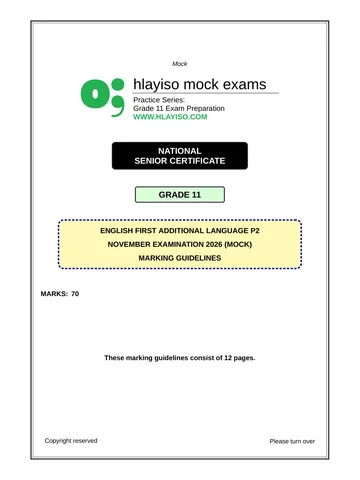
hlayiso mock exams
Practice Series:
Grade 11 Exam Preparation
WWW.HLAYISO.COM
NATIONAL
SENIOR CERTIFICATE
GRADE 11
ENGLISH FIRST ADDITIONAL LANGUAGE P2
NOVEMBER EXAMINATION 2026 (MOCK)
MARKING GUIDELINES
MARKS: 70
These marking guidelines consist of 11 pages.
Skip to contentMemorandum 
View all
English FAL Grade 11 Paper 2 November Mock 2026 Memo (English)
Grade 11 English FAL Paper 2 memorandum from the November Mock Exam 2026 (English), 11 pages. Read online or get the free PDF download, question paper linked when available.
Publisher: Hlayiso
English FAL · Grade 11 · November Mock Exam · 2026. Memorandum, 11 pages. Read online or download the PDF.
- Subject
- English FAL
- Grade
- Grade 11
- Language
- English
- Document type
- Memorandum
- Year
- 2026
- Exam period
- November Mock Exam
- Paper
- 2
- Publisher
- Hlayiso
- Curriculum
- CAPS
- Pages
- 11
- File size
- 144.6 KB
Loading document…
Loading document…
1 of 11
Document textSearch extracted text and jump to a page.
English First Additional Language/P2
2
NSC – Marking Guidelines
Hlayiso/Mock 2026
INSTRUCTIONS TO MARKERS
1.
Candidates answer TWO questions, ONE question each from ANY TWO sections. If a
candidate answers more than two sections, mark only the first two sections answered.
2.
These marking guidelines are a guide. Many questions are open-ended; credit any
relevant, well-substantiated response, even if it is not listed here.
3.
Because the focus is on understanding, spelling and language errors should not be
penalised unless they change the meaning of the answer.
4.
For open-ended questions, no marks are awarded for YES/NO or AGREE/DISAGREE
alone. The substantiation is what is credited.
5.
When TWO/THREE facts/points are required and more are given, mark only the first
TWO/THREE.
6.
For multiple-choice and matching questions, accept the letter AND/OR the answer
written out in full.
7.
For ‘Change ONE word’ questions, accept only the corrected word (or the corrected
statement with that word changed).
8.
For figure-of-speech questions, the figure of speech must be correctly identified; the
explanation must refer to BOTH the comparison/device AND its relevance in the
extract/poem.
Copyright reserved
Please turn over
English First Additional Language/P2
3
NSC – Marking Guidelines
Hlayiso/Mock 2026
SECTION A: NOVEL
QUESTION 1: FAR FROM THE MADDING CROWD
1.1
1.1.1
(a)
D✓
(b)
E✓
(c)
B✓
(d)
A✓
(4)
(4 x 1)
1.1.2
At Norcombe✓, outdoors in a field near the cottage of Bathsheba’s
aunt, Mrs Hurst; Gabriel and Bathsheba stand on either side of a
holly bush✓(in winter).
(2)
1.1.3
She is vain/proud/self-centred/independent.✓
She likes the idea of being admired as a bride at a wedding, but she
does not want a husband who would always be with her/limit her
freedom.✓
NOTE: Award 1 mark for an answer that is not well-substantiated.
(2)
1.1.4
(a) Simile✓
(1)
(b) Gabriel’s sigh is compared to the sound of wind passing through
a whole plantation of pine trees✓. It shows how deep/heavy and
sincere his disappointment is; his love for Bathsheba is honest and
strong.✓
(2)
1.1.5
She is not interested in the proposal/she is bored by it/she does not
take Gabriel’s feelings seriously.✓
However, she tries to hide her yawn so that she does not seem
rude/hurt him.✓
(2)
1.1.6
B/his young dog drives them over a cliff into a chalk pit.✓
(1)
1.1.7
Norcombe✓
(1)
Copyright reserved
Please turn over
English First Additional Language/P2
4
NSC – Marking Guidelines
Hlayiso/Mock 2026
1.1.8
Open-ended. Accept a suitable answer, e.g.
Yes. Gabriel loves Bathsheba patiently and unselfishly throughout
the novel. He is honest with her even when she does not want to
hear the truth (e.g. about the valentine to Boldwood), saves her ricks
from fire and from the storm, cures her sheep and stays loyal when
Troy and Boldwood bring her misery. Their marriage at the end is
based on friendship and respect.
OR
No. Gabriel is very different from Bathsheba: he is quiet and cautious
while she is lively and independent. She marries him only after her
other relationships have ended in tragedy, so the marriage may be
more about security than passion.
NOTE: Do not award a mark for YES/NO or AGREE/DISAGREE
alone. Award 3 marks for a well-substantiated discussion that refers
to the text as a whole; award 1–2 marks for a partially substantiated
answer. Accept a mixed response.
(3)
1.2
1.2.1
Troy
has
made
the
farm
workers
drunk
at
the
harvest
supper/celebration in the barn, so they are all asleep.✓
Troy ignored Gabriel’s warning that a storm was coming, and the
ricks of corn have been left uncovered/unprotected.✓
(2)
1.2.2
The storm is sudden/fast and dangerous, like a serpent that strikes.✓
The thunder is loud and terrifying; the storm seems evil/destructive,
like a fiend/devil.✓
(2)
1.2.3
Simile✓
(1)
1.2.4
Bathsheba is his employer/mistress and a married woman; he shows
her respect.✓
(1)
1.2.5
Troy is irresponsible/careless/selfish/a heavy drinker.✓
He promised that the stacks would be seen to, but he got drunk and
neglected the farm and his wife.✓
NOTE: Award 1 mark for an answer that is not well-substantiated.
(2)
1.2.6
She is brave/determined/hard-working/responsible.✓
She is willing to climb a ladder in a dangerous storm at night to help
save her corn.✓
NOTE: Award 1 mark for an answer that is not well-substantiated.
(2)
1.2.7
B/Bath.✓
(1)
1.2.8
Troy, Bathsheba’s husband and the master of the farm, should be
protecting her property, but he is asleep in a drunken sleep.✓
Gabriel, the man whom Bathsheba rejected and who is only her
employee, risks his life to save her corn.✓
(2)
Copyright reserved
Please turn over
English First Additional Language/P2
5
NSC – Marking Guidelines
Hlayiso/Mock 2026
1.2.9
Boldwood✓
(1)
1.2.10
Gabriel remains loyal to Bathsheba throughout the novel, even after
she rejects him and marries Troy. He saves her ricks from the fire and
the storm, cures her sheep and helps to run her farm. In contrast,
Troy is disloyal to both Fanny and Bathsheba. Loyalty is finally
rewarded when Bathsheba marries Gabriel.
NOTE: Award 3 marks for a discussion that clearly links the theme
to events/characters in the text; award 1–2 marks for a partial
discussion. Accept other relevant, well-substantiated responses.
(3)
[35]
Copyright reserved
Please turn over
English First Additional Language/P2
6
NSC – Marking Guidelines
Hlayiso/Mock 2026
SECTION B: DRAMA
QUESTION 2: ROMEO AND JULIET
2.1
2.1.1
(a)
C✓
(b)
E✓
(c)
B✓
(d)
D✓
(4)
(4 x 1)
2.1.2
At
night✓,
in
the
Capulets’
orchard/garden,
below
Juliet’s
window/balcony (after the Capulet feast).✓
(2)
2.1.3
‘Wherefore’ means ‘why’. Juliet is asking why Romeo has to be
Romeo✓, i.e. a Montague/the son of her family’s enemy, which
makes their love dangerous/impossible.✓
NOTE: Do not accept ‘Where are you, Romeo?’
(2)
2.1.4
B/speaks so that only the audience hears him.✓
(1)
2.1.5
A name is not important✓; a rose would still smell sweet if it had a
different name, in the same way that Romeo would still be the perfect
man she loves even if he were not called Montague.✓
(2)
2.1.6
He is a Montague/a member of the family that the Capulets hate.✓
(1)
2.1.7
(a) Metaphor✓/Personification
(1)
(b) Love is described as having wings that carried Romeo over the
high walls✓. Romeo’s love for Juliet is so strong that nothing, not
even danger or high walls, can keep him away from her.✓
(2)
2.1.8
Open-ended. Accept a suitable answer, e.g.
Yes. They act hastily: they marry in secret after knowing each other
for only a day. Romeo kills Tybalt in anger and is banished. Juliet
takes the Friar’s dangerous potion, and Romeo buys poison without
waiting to find out the truth. Their impulsive decisions lead to their
deaths.
OR
No. They are victims of the feud between their families, of fate
(‘star-cross’d lovers’) and of bad luck, e.g. the Friar’s letter does not
reach Romeo. Adults such as Lord Capulet, the Nurse and the Friar
also make poor decisions.
NOTE: Do not award a mark for YES/NO or AGREE/DISAGREE
alone. Award 3 marks for a well-substantiated discussion that refers
to the text as a whole; award 1–2 marks for a partially substantiated
answer. Accept a mixed response.
(3)
Copyright reserved
Please turn over
English First Additional Language/P2
7
NSC – Marking Guidelines
Hlayiso/Mock 2026
2.2
2.2.1
Tybalt challenges Romeo to a fight (because Romeo went to the
Capulet feast), but Romeo refuses because he has secretly married
Juliet and Tybalt is now his kinsman.✓
Mercutio is angered/ashamed by Romeo’s ‘submission’ and fights
Tybalt himself to defend Romeo’s honour.✓
(2)
2.2.2
(a) The Montagues and the Capulets.✓
(1)
(b) He is dying because of their feud/quarrel, in which he had no
part✓; he blames both families for his death.✓
(2)
2.2.3
(a) Pun✓/play on words
(1)
(b) ‘Grave’ means ‘serious’, but it also refers to a grave in which
a dead person is buried✓. Even as he is dying, Mercutio jokes; the
pun shows his wit and also tells the audience that he will be dead by
tomorrow.✓
(2)
2.2.4
Romeo believes that his love for Juliet has made him weak/soft✓;
it has stopped him from fighting Tybalt like a brave man, and as a
result Mercutio has been killed.✓
(2)
2.2.5
(a) Apologetic/regretful/sad/guilty.✓
(1)
(b) He was trying to stop the fight but caused Mercutio to be
wounded.✓
(1)
2.2.6
B/banishing him from Verona.✓
(1)
2.2.7
Friar✓(Laurence)
(1)
2.2.8
The long feud between the Montagues and the Capulets causes
street fights and the deaths of Mercutio, Tybalt, Paris and finally
Romeo and Juliet. Because of the hatred, the lovers must marry in
secret and act in desperate ways. Only after their children die do
the two families end their feud, which shows how destructive and
pointless their hatred was.
NOTE: Award 3 marks for a discussion that clearly links the theme
to events/characters in the text; award 1–2 marks for a partial
discussion. Accept other relevant, well-substantiated responses.
(3)
[35]
Copyright reserved
Please turn over
English First Additional Language/P2
8
NSC – Marking Guidelines
Hlayiso/Mock 2026
SECTION C: SHORT STORIES
QUESTION 3
‘THE GIFT OF THE MAGI’
3.1
3.1.1
(a)
C✓
(b)
E✓
(c)
B✓
(d)
A✓
(4)
(4 x 1)
3.1.2
On Christmas Eve✓, in Jim and Della’s small/shabby (furnished) flat
in New York.✓
(2)
3.1.3
The combs are perfect, but she can no longer wear them because
she has sold her long hair.✓
(1)
3.1.4
(a) Simile✓
(1)
(b) Della jumps up suddenly and excitedly, like a cat that has been
burnt✓. She suddenly remembers the present she bought for Jim
and is eager/excited to give it to him.✓
(2)
3.1.5
Jim sold his watch to buy combs for Della’s hair, while Della sold her
hair to buy a chain for Jim’s watch.✓
Each sacrificed his/her greatest treasure for the other, so neither gift
can now be used.✓
(2)
3.1.6
B/platinum fob chain.✓
(1)
3.1.7
He is calm/loving/good-humoured/unselfish.✓
Instead of being upset that his gift is now useless, he relaxes, smiles
and suggests that they keep the presents and have supper.✓
NOTE: Award 1 mark for an answer that is not well-substantiated.
(2)
3.1.8
Open-ended. Accept a suitable answer, e.g.
Yes. Della and Jim each gave up the thing they valued most out
of love. The gifts themselves are useless now, but the love and
unselfishness behind them are worth far more than any present. That
is why the narrator calls them wise, like the magi.
OR
No. They acted foolishly/without planning: they are poor and sold
their most valuable possessions for gifts that they cannot use.
NOTE: Do not award a mark for YES/NO or AGREE/DISAGREE
alone. Award 3 marks for a well-substantiated discussion that refers
to the text as a whole; award 1–2 marks for a partially substantiated
answer. Accept a mixed response.
(3)
Copyright reserved
Please turn over
English First Additional Language/P2
9
NSC – Marking Guidelines
Hlayiso/Mock 2026
‘THE LAST LEAF’
3.2
3.2.1
Pneumonia✓
(1)
3.2.2
She believes that she will die when the last leaf falls from the ivy
vine.✓
She has given up hope/has lost the will to live/is depressed and
morbid.✓
(2)
3.2.3
(a) Personification✓/Metaphor
(1)
(b) Autumn is described as a living thing whose cold breath kills the
leaves✓. Just as the cold has stripped the vine of its leaves, Johnsy’s
illness is taking her life; the dying vine reflects her weakening state.✓
(2)
3.2.4
(a) Scornful/dismissive/impatient/firm.✓
(1)
(b) She wants Johnsy to stop believing such a foolish idea/she
wants to encourage Johnsy to fight to live.✓
(1)
3.2.5
The doctor actually said that Johnsy had only one chance in ten of
living.✓
Sue lies/turns the figure around to give Johnsy hope and to make her
want to live.✓
(2)
3.2.6
She is caring/loving/loyal/devoted.✓
She tries to cheer Johnsy up, offers her broth and works hard at her
drawings to earn money for Johnsy’s food and wine.✓
NOTE: Award 1 mark for an answer that is not well-substantiated.
(2)
3.2.7
B/during a night of cold rain and wind.✓
(1)
3.2.8
pneumonia✓
(1)
3.2.9
Open-ended. Accept a suitable answer, e.g.
Yes. Behrman always talked about painting a masterpiece but never
did. The painted leaf looks so real that Johnsy believes it is real. It
gives her the will to live and saves her life. He paid for it with his own
life, so it is his greatest work.
OR
No. A masterpiece is a great work of art admired by many. The leaf
is a small painting on a brick wall that only a few people see.
NOTE: Do not award a mark for YES/NO or AGREE/DISAGREE
alone. Award 3 marks for a well-substantiated discussion that refers
to the text as a whole; award 1–2 marks for a partially substantiated
answer. Accept a mixed response.
(3)
[35]
Copyright reserved
Please turn over
English First Additional Language/P2
10
NSC – Marking Guidelines
Hlayiso/Mock 2026
SECTION D: POETRY
QUESTION 4
‘INVICTUS’ – WILLIAM ERNEST HENLEY
4.1
4.1.1
(a)
gods✓
(b)
soul✓
(c)
circumstance✓
(d)
master✓
(4)
(4 x 1)
4.1.2
(a) Simile✓
(1)
(b) The speaker’s suffering/difficulties are compared to a deep,
completely dark pit✓; the darkness covers everything (‘from pole to
pole’), which shows how severe and hopeless his situation seems.✓
(2)
4.1.3
He is courageous/strong/proud/defiant.✓
Although life has hurt him badly (‘bloody’), he refuses to give up or
be defeated (‘unbowed’).✓
NOTE: Award 1 mark for an answer that is not well-substantiated.
(2)
4.1.4
It refers to death✓; the speaker is not afraid of it/faces it bravely
(‘unafraid’).✓
(2)
4.1.5
(a) Confident/determined/defiant/triumphant.✓
(1)
(b) He believes that he alone controls his life and spirit, no matter
what punishments he faces.✓
(1)
4.1.6
A/unable to be defeated.✓
(1)
4.1.7
abab✓
(1)
4.1.8
The speaker faces great suffering (darkness, cruel circumstances,
the blows of chance) but he does not complain or give up. He is not
afraid of death or of the hardships still to come. He believes that his
spirit cannot be conquered and that he is in control of his own life.
The poem encourages readers to stay strong in difficult times.
NOTE: Award 3 marks for a discussion that clearly links the theme
to events/characters in the text; award 1–2 marks for a partial
discussion. Accept other relevant, well-substantiated responses.
(3)
Copyright reserved
Please turn over
English First Additional Language/P2
11
NSC – Marking Guidelines
Hlayiso/Mock 2026
‘THE ROAD NOT TAKEN’ – ROBERT FROST
4.2
4.2.1
(a) In a (yellow) wood/forest.✓
(1)
(b) He must choose which of two roads/paths to take.✓
(1)
4.2.2
It is autumn (the leaves are turning yellow).✓
It may suggest that the speaker is at a turning point/a mature stage
of life, where choices have lasting effects.✓
(2)
4.2.3
He is uncertain/hesitant/regretful.✓
He is sorry that he cannot take both roads and stands for a long time,
trying to see where one of them leads before he decides.✓
NOTE: Award 1 mark for an answer that is not well-substantiated.
(2)
4.2.4
He tells himself that he will come back one day to take the first road✓,
but he realises that one choice leads to another, so he will probably
never return/never get the chance to take the other road.✓
(2)
4.2.5
(a) Reflective/thoughtful/nostalgic/regretful/wistful.✓
(1)
(b) In the future he will look back on his choice and think about how
it changed his life/wonder what might have been.✓
(1)
4.2.6
The roads represent the choices/decisions that a person makes in
life✓; each choice leads to a different future/path in life.✓
(2)
4.2.7
B/creates a pause before the speaker reveals his choice.✓
(1)
4.2.8
less✓
(1)
4.2.9
Open-ended. Accept a suitable answer, e.g.
Yes. He says that taking the less-travelled road ‘has made all the
difference’, which suggests that his choice gave him a unique and
satisfying life.
OR
No. He will tell the story ‘with a sigh’, which suggests regret. He
also admits that the two roads were really about the same, so the
difference he claims may be what he tells himself later.
NOTE: Do not award a mark for YES/NO or AGREE/DISAGREE
alone. Award 3 marks for a well-substantiated discussion that refers
to the text as a whole; award 1–2 marks for a partially substantiated
answer. Accept a mixed response.
(3)
[35]
GRAND TOTAL:
70
Copyright reserved
Matching paper and memo
The question paper, memo or addendum that belongs with this document.
Study this subject
Revise the topics in this paper, then practise them question by question.
Recommended for this subject
More papers and memos for this grade and subject.
Memorandum
English FAL Grade 11 Paper 1 November Mock 2026 Memo (English)
Memorandum
English FAL Grade 11 Paper 3 November Mock 2026 Memo (English)
Memorandum
English FAL Grade 11 P1 November Mock Exam 2 2026 Memo (English)
Memorandum
English FAL Grade 11 P2 November Mock Exam 2 2026 Memo (English)
Memorandum
English FAL Grade 11 P3 November Mock Exam 2 2026 Memo (English)
Memorandum
English Fal Grade 11 P1 Eastern Cape November 2022 Memo (English)
Related documents
Question paper
English FAL Grade 11 P1 November Mock 2026 Question Paper (Eng)
Question paper
English FAL Grade 11 P3 November Mock 2026 Question Paper (Eng)
Question paper
English FAL Grade 11 P2 November Mock Exam 2 2026 QP (Eng)
Memorandum
English Fal Grade 11 P2 National Exemplar November 2020 Memo
Memorandum
English Fal Grade 11 P2 National Exemplar November 2020 Memo
Memorandum
English Fal Grade 11 P2 Eastern Cape November 2018 Memo (English)
More from Grade 11 English FAL
Study guide
CREATIVE WRITING ENGLISH FINAL1
Study guide
Gr 11 Eng(FAL) 11 Preparing for Paper 1
Study guide
Gr11 Eng FAL Study guide LR
Question paper
English FAL Grade 11 P1 November Mock Exam 2 2026 QP (Eng)
Question paper
English FAL Grade 11 P3 November Mock Exam 2 2026 QP (Eng)
Annual teaching plan