
Copyright reserved
Please turn over
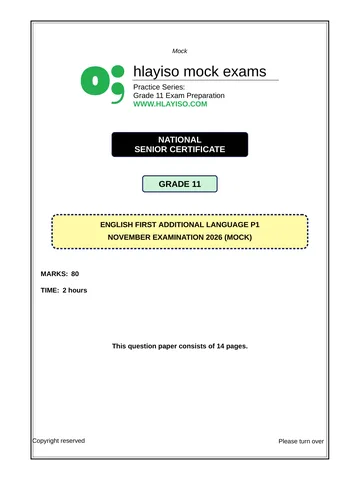
Mock
hlayiso mock exams
Practice Series:
Grade 11 Exam Preparation
WWW.HLAYISO.COM
NATIONAL
SENIOR CERTIFICATE
GRADE 11
ENGLISH FIRST ADDITIONAL LANGUAGE P3
NOVEMBER EXAMINATION 2026 (MOCK)
MARKING GUIDELINES
MARKS: 100
These marking guidelines consist of 12 pages.
Skip to contentMemorandum 
View all
English FAL Grade 11 P3 November Mock Exam 2 2026 Memo (English)
Grade 11 English FAL Paper 3 memorandum from the November Mock Exam 2 2026 (English), 12 pages. Read online or get the free PDF download, question paper linked when available.
Publisher: Hlayiso
English FAL · Grade 11 · November Mock Exam 2 · 2026. Memorandum, 12 pages. Read online or download the PDF.
- Subject
- English FAL
- Grade
- Grade 11
- Language
- English
- Document type
- Memorandum
- Year
- 2026
- Exam period
- November Mock Exam 2
- Paper
- 3
- Publisher
- Hlayiso
- Curriculum
- CAPS
- Pages
- 12
- File size
- 158.5 KB
Loading document…
Loading document…
1 of 12
Document textSearch extracted text and jump to a page.
English First Additional Language/P3
2
NSC – Marking Guidelines
Hlayiso/Mock 2026
INSTRUCTIONS AND INFORMATION
This marking guideline must be used together with the assessment rubrics for SECTIONS A,
B and C at the end of this document.
NOTE: All pieces of writing should be read at least TWICE during assessment: once for
content and once for language. Errors must be indicated during the second reading.
SECTION A: ESSAY
QUESTION 1
INSTRUCTIONS TO MARKERS:
•
Candidates are required to write on ONE topic only.
•
The ideas listed below the topics are only some of the ways in which the topics can be
interpreted. Full credit must be given for the candidate’s own interpretation.
•
Marking must be objective. Give credit for relevant ideas.
•
Use the 50-mark rubric to mark the essays. The essays must be assessed according to
the following criteria:
– Content and planning (30 marks)
– Language, style and editing (15 marks)
– Structure (5 marks)
NOTE: Adhere to the length of 200–250 words as prescribed by CAPS. Should the maximum
word count be exceeded, read up to the end of the sentence in which the limit is reached. No
additional penalties may be imposed, as the rubric itself imposes penalties.
1.1
The moment I realised I had been wrong
Narrative/Reflective/Descriptive essay
•
If narrative, a clear storyline must be evident: the candidate tells of a
situation (e.g. judging someone unfairly, blaming a friend, ignoring a
parent’s advice, a decision that went badly) and builds up to the moment of
realisation. There must be a logical sequence of events and tenses and a
clear outcome.
•
If reflective, the candidate must explore his/her thoughts and feelings at the
moment of realisation (e.g. shame, guilt, relief) and what he/she learnt or
changed afterwards (e.g. apologising, making amends).
•
If descriptive, the candidate must describe the moment vividly, using the
senses and figurative language.
NOTE: A candidate may write an essay which contains elements of more than
one type of essay.
[50]
Copyright reserved
Please turn over
English First Additional Language/P3
3
NSC – Marking Guidelines
Hlayiso/Mock 2026
1.2
Just when I thought it was all over …
Narrative/Descriptive/Reflective essay
•
The topic is open-ended. The candidate must complete the idea, e.g.
a crisis that suddenly took a turn for the better or the worse, a
match/competition that was won or lost at the last minute, an illness, a
storm, an exam, a relationship.
•
If narrative, there must be a clear storyline with suspense and a twist or
climax linked to the words of the topic.
•
If descriptive, the candidate must create a vivid picture of the moment and
the feelings involved.
•
If reflective, the candidate may reflect on hope, endurance or second
chances.
NOTE: A candidate may write an essay which contains elements of more than
one type of essay.
[50]
1.3
Honesty is always the best policy.
Argumentative/Discursive essay
•
If argumentative, the candidate must take a clear stand FOR or AGAINST
the statement and support it with convincing arguments and examples
(e.g. honesty builds trust and a good name; lies are eventually discovered;
honesty in exams, relationships, business and politics VERSUS situations
where the truth may hurt someone, white lies, keeping someone safe).
•
If discursive, the candidate must present a balanced view of both sides and
may reach a conclusion at the end.
•
A narrative essay that clearly illustrates the statement may also be
accepted.
NOTE: A candidate may write an essay which contains elements of more than
one type of essay.
[50]
1.4
‘Where there is a will, there is a way.’ (English proverb)
Reflective/Narrative/Discursive/Argumentative essay
•
The candidate should show an understanding of the proverb: if a person
is determined enough, he/she will find a way to succeed, even when there
are obstacles.
•
If reflective, the candidate may reflect on his/her own goals, obstacles and
determination, or on people who inspire him/her.
•
If narrative, the story must illustrate the proverb, e.g. a learner who
succeeds despite poverty, a disability or a lack of resources.
•
If discursive or argumentative, the candidate may discuss whether
determination alone is enough to succeed (e.g. the role of opportunity,
support and resources).
NOTE: A candidate may write an essay which contains elements of more than
one type of essay.
[50]
Copyright reserved
Please turn over
English First Additional Language/P3
4
NSC – Marking Guidelines
Hlayiso/Mock 2026
1.5
Courage
Narrative/Reflective/Descriptive/Argumentative essay
•
The topic is abstract and open to many interpretations: physical courage
(e.g. saving someone in danger), moral courage (e.g. standing up to a bully,
speaking the truth, refusing to give in to peer pressure), everyday courage
(e.g. facing an illness, starting at a new school, speaking in public).
•
If narrative, the candidate must tell a story in which someone shows
courage; the act of courage must be central to the storyline.
•
If reflective, the candidate must explore what courage means to him/her,
e.g. everyday courage versus heroic courage, and people who have shown
courage in his/her life.
•
If argumentative, the candidate may argue, for example, that true courage
is acting in spite of fear.
NOTE: A candidate may write an essay which contains elements of more than
one type of essay.
[50]
1.6
My grandmother’s kitchen
Descriptive/Reflective/Narrative essay
•
If descriptive, the candidate must create a vivid picture of the kitchen using
the senses (e.g. the smell of fresh bread or umngqusho, the sound of a
kettle, the warmth of the stove) and figurative language. The description
must have a clear focus and should not become a list.
•
If reflective, the candidate may reflect on memories, family traditions,
culture, love and the role of the grandmother (or any elder) in his/her life.
•
If narrative, the story must be set mainly in the kitchen, e.g. a family
gathering, a lesson learnt or a special event.
NOTE: A candidate may write an essay which contains elements of more than
one type of essay.
[50]
INTERPRETATION OF PICTURES
•
The candidate may interpret the picture in any way and write any type of essay.
•
The interpretation must be clearly linked to the picture.
•
The candidate should give the essay a suitable title.
1.7
Picture: A young person with a backpack standing where a road divides
into two; a signpost with question marks points one way towards dark
trees and a storm cloud and the other way towards hills and the sun
•
Literal interpretations: a journey, being lost, choosing a route, travelling to
a new place.
•
Figurative interpretations: making choices and decisions, the future after
school, choosing a career or subjects, choosing between right and wrong,
peer pressure, uncertainty, consequences of choices, good versus bad
paths in life, hope.
[50]
Copyright reserved
Please turn over
English First Additional Language/P3
5
NSC – Marking Guidelines
Hlayiso/Mock 2026
1.8
Picture: A small seedling growing out of a crack in a concrete pavement
in front of a brick wall, with a large boot stepping down right beside it
•
Literal interpretations: nature, plants growing in a city, a garden, the
environment, pollution.
•
Figurative interpretations: hope, resilience, growing up in difficult
circumstances, overcoming obstacles, beauty in unexpected places,
vulnerability and danger, being overlooked or ignored by passers-by,
being ‘stepped on’, standing out, new beginnings, never giving up.
[50]
TOTAL SECTION A:
50
Copyright reserved
Please turn over
English First Additional Language/P3
6
NSC – Marking Guidelines
Hlayiso/Mock 2026
SECTION B: LONGER TRANSACTIONAL TEXT
QUESTION 2
INSTRUCTIONS TO MARKERS:
•
Candidates are required to answer ONE question.
•
Marking must be objective. Give credit for relevant ideas.
•
Use the 30-mark rubric to mark the responses. The texts must be assessed according to
the following criteria:
– Content, planning and format (18 marks)
– Language, style and editing (12 marks)
NOTE: Adhere to the length of 120–150 words as prescribed by CAPS. Should the maximum
word count be reached in the middle of a sentence, read to the end of that sentence. No
additional penalties may be imposed, as the rubric itself imposes penalties.
2.1
FORMAL LETTER
A letter of request to the Manager of a supermarket
•
The following aspects of format must be included:
– Sender’s address (the school’s OR the candidate’s home address)
and date
– Recipient’s designation and address
– Formal salutation (e.g. Dear Sir/Madam)
– Subject line (e.g. REQUEST FOR A DONATION FOR OUR FAMILY
FUN DAY)
– Formal ending (e.g. Yours faithfully), signature, name and, if used,
designation (e.g. Secretary, Organising Committee)
•
The tone must be formal, polite and persuasive.
•
The body must: introduce the writer and the event (what, when, where,
purpose: library books); state clearly what is requested (e.g. prizes,
vouchers, refreshments); explain the benefits (e.g. a better library and
improved reading for learners, a community event, advertising/recognition
for the supermarket at the event); and thank the manager in advance and
give contact details.
[30]
Copyright reserved
Please turn over
English First Additional Language/P3
7
NSC – Marking Guidelines
Hlayiso/Mock 2026
2.2
OBITUARY
A tribute to a community soccer coach
•
The following must be included: the full name of the deceased, date and
place of birth and death (the cause of death may be mentioned), and the
surviving family members.
•
The obituary should give a brief account of the person’s life and
achievements, focusing on his/her free coaching of young people for more
than twenty years and how he/she kept them off the streets (e.g. teams
formed, players who succeeded, values taught).
•
It must pay tribute to the person and may include details of the
funeral/memorial service.
•
The tone must be formal, respectful and sincere; the obituary is written
mostly in the third person and the past tense.
[30]
2.3
REVIEW
A review of a book OR a film for the school newsletter
•
The review must have a heading and give the title, the author (book) or
director/main actors (film) and the genre. The candidate may use a real
or an imaginary book or film.
•
It must give a brief outline of the plot/setting/characters WITHOUT giving
away the ending.
•
It must give the writer’s opinion of the strengths and weaknesses (e.g.
characters, storyline, message, acting, special effects) with reasons, and
end with a recommendation (e.g. a rating, the target audience).
•
The register may be semi-formal and must suit a teenage audience. The
review is written mainly in the present tense.
[30]
2.4
DIALOGUE
A conversation between the candidate and his/her older sister/brother about
the damaged laptop
•
A brief context/scene must be given at the beginning.
•
The following aspects of dialogue format must be used: names of
speakers on the left followed by a colon; a new line for each new speaker;
stage directions/actions in brackets (if used).
•
The register may be informal, but it must suit the relationship and the
situation (e.g. nervousness, anger, apology).
•
The candidate must confess what happened, apologise and try to put
things right (e.g. offering to pay for the repair from pocket money or a
part-time job, helping to rescue the assignment, asking a parent for help).
The conversation must reach a conclusion.
[30]
TOTAL SECTION B:
30
Copyright reserved
Please turn over
English First Additional Language/P3
8
NSC – Marking Guidelines
Hlayiso/Mock 2026
SECTION C: SHORTER TRANSACTIONAL TEXT
QUESTION 3
INSTRUCTIONS TO MARKERS:
•
Candidates are required to answer ONE question.
•
Marking must be objective. Give credit for relevant ideas.
•
Use the 20-mark rubric to mark the responses. The texts must be assessed according to
the following criteria:
– Content, planning and format (12 marks)
– Language, style and editing (8 marks)
NOTE: Adhere to the length of 80–100 words as prescribed by CAPS. Should the maximum
word count be reached in the middle of a sentence, read to the end of that sentence. No
additional penalties may be imposed, as the rubric itself imposes penalties.
3.1
INVITATION CARD
An invitation to the Grade 12 farewell function
•
The invitation must include: the name(s) of the person(s) invited (the
Grade 12 learners and their teachers), the host(s) (e.g. the Grade 11
learners/class representatives), the occasion (farewell function), the date,
time and venue, and RSVP details (date and contact person/number).
•
Other details may be included, e.g. the dress code, the programme,
entertainment, whether partners are allowed.
•
The language must be polite, warm and suited to the occasion. Full
sentences are not necessary.
•
No marks are awarded for drawings or illustrations.
[20]
3.2
DIARY ENTRIES
The candidate’s feelings after failing the learner’s licence test and a week later
after rebooking it
•
There must be TWO entries, each with a date (and time, if used). The
dates must be about one week apart.
•
The first entry (the evening of the failed test) must express feelings
such as disappointment, embarrassment, anger or frustration, and may
mention what went wrong (e.g. road signs, rules of the road, nerves).
•
The second entry (a week later, after rebooking) must show a change in
feelings, e.g. renewed hope, determination, a study plan, help from family
or friends, nervousness about the new date.
•
The entries must be written in the first person. The language may be
informal and should reflect emotions.
[20]
Copyright reserved
Please turn over
English First Additional Language/P3
9
NSC – Marking Guidelines
Hlayiso/Mock 2026
3.3
INSTRUCTIONS
How to start and look after a small vegetable garden
•
The instructions must have a heading and may list what is needed (e.g. a
spade, seeds/seedlings, compost, water).
•
The steps must be clear, logical and in the correct sequence (e.g. choose
a sunny spot; clear and dig the soil; add compost; plant seeds/seedlings;
water regularly; remove weeds; protect plants from pests and animals;
harvest).
•
The imperative mood must be used (e.g. Dig, Water, Remove). The
instructions may be numbered or in point form; full sentences are
expected.
[20]
TOTAL SECTION C:
20
GRAND TOTAL:
100
Copyright reserved
Please turn over
English First Additional Language/P3
10
NSC – Marking Guidelines
Hlayiso/Mock 2026
SECTION A: ASSESSMENT RUBRIC FOR ESSAY – FIRST ADDITIONAL LANGUAGE [50
MARKS]
•
Use this rubric to mark the essay (SECTION A).
•
The marks from 0–50 are divided into five major level descriptors.
•
For Content and planning and for Language, style and editing, each level is divided into an upper and a
lower sub-level, each with its own mark range. Structure is not divided into sub-levels.
Criteria
Exceptional
Skilful
Moderate
Elementary
Inadequate
CONTENT AND
PLANNING
28–30
22–24
16–18
10–12
4–6
(Response and
ideas; organisation of
ideas for planning;
awareness of
purpose, audience
and context)
30 MARKS
Upper level
– Outstanding
response beyond
normal expectations
– Intelligent,
thought-provoking
and mature ideas
– Exceptionally well
organised and
coherent, including
introduction, body
and conclusion
– Very well-crafted
response
– Fully relevant and
interesting ideas with
evidence of maturity
– Very well organised
and coherent,
including
introduction, body
and conclusion
– Satisfactory
response
– Ideas are
reasonably coherent
and convincing
– Reasonably
organised and
coherent, including
introduction, body
and conclusion
– Inconsistently
coherent response
– Unclear ideas and
unoriginal
– Little evidence of
organisation and
coherence
– Totally irrelevant
response
– Confused and
unfocused ideas
– Vague and
repetitive
– Unorganised and
incoherent
25–27
19–21
13–15
7–9
0–3
Lower level
– Excellent response
but lacks the
exceptionally striking
qualities of the
outstanding essay
– Mature and
intelligent ideas
– Skilfully organised
and coherent
– Well-crafted
response
– Relevant and
interesting ideas
– Well organised and
coherent, including
introduction, body
and conclusion
– Satisfactory
response but some
lapses in clarity
– Ideas are fairly
coherent and
convincing
– Some degree of
organisation and
coherence
– Largely irrelevant
response
– Ideas tend to be
disconnected and
confusing
– Hardly any
evidence of
organisation and
coherence
– No attempt to
respond to the topic
– Completely
irrelevant and
inappropriate
– Unfocused and
muddled
LANGUAGE, STYLE
AND EDITING
14–15
11–12
8–9
5–6
0–3
(Tone, register, style
and vocabulary
appropriate to
purpose and context;
word choice;
language use and
conventions:
punctuation,
grammar, spelling)
15 MARKS
Upper level
– Tone, register, style
and vocabulary
highly appropriate to
purpose, audience
and context
– Language
confident and
exceptionally
impressive
– Virtually error-free
in grammar and
spelling
– Tone, register, style
and vocabulary very
appropriate
– Language
effective; consistently
appropriate tone
– Largely error-free
in grammar and
spelling
– Tone, register, style
and vocabulary
appropriate
– Appropriate use of
language to convey
meaning
– Some use of
rhetorical devices
– Tone, register, style
and vocabulary not
appropriate
– Very basic use of
language
– Very limited
vocabulary
– Language
incomprehensible
– Tone, register, style
and vocabulary less
appropriate
– Vocabulary
limitations so
extreme that
comprehension is
impossible
13
10
7
4
Lower level
– Language excellent
and rhetorically
effective in tone
– Virtually error-free
– Skilfully crafted
– Language
engaging and
generally effective
– Appropriate and
effective tone
– Few errors in
grammar and
spelling
– Adequate use of
language with some
inconsistencies
– Tone generally
appropriate; limited
use of rhetorical
devices
– Inadequate use of
language
– Little or no variety
in sentences
– Exceptionally
limited vocabulary
STRUCTURE
5
4
3
2
0–1
(Features of text;
paragraph
development and
sentence
construction)
5 MARKS
– Excellent
development of topic
– Exceptional detail
– Sentences and
paragraphs
exceptionally well
constructed
– Logical
development of
details
– Coherent
– Sentences and
paragraphs logical
and varied
– Relevant details
developed
– Sentences and
paragraphs well
constructed
– Essay still makes
some sense
– Some valid points
– Sentences and
paragraphs faulty
– Essay still makes
sense despite flaws
– Necessary points
lacking
– Sentences and
paragraphs faulty
MARK RANGE
40–50
30–39
20–29
10–19
0–9
Copyright reserved
Please turn over
English First Additional Language/P3
11
NSC – Marking Guidelines
Hlayiso/Mock 2026
SECTION B: ASSESSMENT RUBRIC FOR LONGER TRANSACTIONAL TEXT – FIRST
ADDITIONAL LANGUAGE [30 MARKS]
Criteria
Exceptional
Skilful
Moderate
Elementary
Inadequate
CONTENT,
PLANNING AND
FORMAT
15–18
11–14
8–10
5–7
0–4
(Response and
ideas; organisation of
ideas for planning;
purpose, audience,
features/conventions
and context)
18 MARKS
– Outstanding
response beyond
normal expectations
– Intelligent and
mature ideas
– Extensive
knowledge of
features of the type
of text
– Writing maintains
focus; coherent in
content and ideas
– Highly elaborated;
all details support the
topic
– Appropriate and
accurate format
– Very good
response
demonstrating good
knowledge of
features of the type
of text
– Maintains focus; no
digressions
– Coherent in content
and ideas; very well
elaborated; details
support the topic
– Appropriate format
with minor
inaccuracies
– Adequate response
demonstrating
knowledge of
features of the type
of text
– Not completely
focused; some
digressions
– Reasonably
coherent in content
and ideas
– Some details
support the topic
– Generally
appropriate format
but with some
inaccuracies
– Basic response
demonstrating some
knowledge of
features of the type
of text
– Some focus but
writing digresses
– Not always
coherent in content
and ideas
– Few details support
the topic
– Has vaguely
applied necessary
rules of format; some
critical oversights
– Response reveals
no knowledge of
features of the type
of text
– Meaning is obscure
with major
digressions
– Not coherent in
content and ideas
– Very few details
support the topic
– Has not applied
necessary rules of
format
LANGUAGE, STYLE
AND EDITING
10–12
8–9
6–7
4–5
0–3
(Tone, register, style,
purpose/effect,
audience and
context; language
use and conventions;
word choice;
punctuation and
spelling)
12 MARKS
– Tone, register, style
and vocabulary
highly appropriate to
purpose, audience
and context
– Grammatically
accurate and well
constructed
– Virtually error-free
– Tone, register, style
and vocabulary very
appropriate
– Generally
grammatically
accurate and well
constructed
– Very good
vocabulary
– Mostly free of
errors
– Tone, register, style
and vocabulary
appropriate
– Some grammatical
errors
– Adequate
vocabulary
– Errors do not
impede meaning
– Tone, register, style
and vocabulary less
appropriate
– Inaccurate
grammar with
numerous errors
– Limited vocabulary
– Meaning is
obscured
– Tone, register, style
and vocabulary do
not correspond to
purpose, audience
and context
– Error-ridden and
confused
– Vocabulary not
suitable for purpose
– Meaning seriously
impaired
MARK RANGE
25–30
19–23
14–17
9–12
0–7
Copyright reserved
Please turn over
English First Additional Language/P3
12
NSC – Marking Guidelines
Hlayiso/Mock 2026
SECTION C: ASSESSMENT RUBRIC FOR SHORTER TRANSACTIONAL TEXT – FIRST
ADDITIONAL LANGUAGE [20 MARKS]
Criteria
Exceptional
Skilful
Moderate
Elementary
Inadequate
CONTENT,
PLANNING AND
FORMAT
10–12
8–9
6–7
4–5
0–3
(Response and
ideas; organisation of
ideas for planning;
purpose, audience,
features/conventions
and context)
12 MARKS
– Outstanding
response beyond
normal expectations
– Intelligent and
mature ideas
– Extensive
knowledge of
features of the type
of text
– Writing maintains
focus; coherent
– Appropriate and
accurate format
– Very good
response
demonstrating good
knowledge of
features of the type
of text
– Maintains focus; no
digressions
– Details support the
topic
– Appropriate format
with minor
inaccuracies
– Adequate response
demonstrating
knowledge of
features of the type
of text
– Some digressions
– Some details
support the topic
– Generally
appropriate format
with some
inaccuracies
– Basic response;
some knowledge of
features of the type
of text
– Writing digresses
– Few details support
the topic
– Some critical
oversights in format
– No knowledge of
features of the type
of text
– Meaning obscure;
major digressions
– Has not applied
necessary rules of
format
LANGUAGE, STYLE
AND EDITING
7–8
5–6
4
3
0–2
(Tone, register, style,
purpose/effect,
audience and
context; language
use and conventions;
word choice;
punctuation and
spelling)
8 MARKS
– Tone, register, style
and vocabulary
highly appropriate
– Grammatically
accurate and well
constructed
– Virtually error-free
– Tone, register, style
and vocabulary very
appropriate
– Generally
grammatically
accurate
– Very good
vocabulary; mostly
free of errors
– Tone, register, style
and vocabulary
appropriate
– Some grammatical
errors
– Errors do not
impede meaning
– Tone, register, style
and vocabulary less
appropriate
– Numerous errors;
limited vocabulary
– Meaning is
obscured
– Tone, register, style
and vocabulary do
not correspond to
purpose
– Error-ridden and
confused
– Meaning seriously
impaired
MARK RANGE
17–20
13–15
10–11
7–8
0–5
Copyright reserved
Matching paper and memo
The question paper, memo or addendum that belongs with this document.
Study this subject
Revise the topics in this paper, then practise them question by question.
Recommended for this subject
More papers and memos for this grade and subject.
Memorandum
English FAL Grade 11 Paper 1 November Mock 2026 Memo (English)
Memorandum
English FAL Grade 11 Paper 2 November Mock 2026 Memo (English)
Memorandum
English FAL Grade 11 Paper 3 November Mock 2026 Memo (English)
Memorandum
English FAL Grade 11 P1 November Mock Exam 2 2026 Memo (English)
Memorandum
English FAL Grade 11 P2 November Mock Exam 2 2026 Memo (English)
Memorandum
English Fal Grade 11 P1 Eastern Cape November 2022 Memo (English)
Related documents
Question paper
English FAL Grade 11 P1 November Mock Exam 2 2026 QP (Eng)
Question paper
English FAL Grade 11 P2 November Mock Exam 2 2026 QP (Eng)
Question paper
English FAL Grade 11 P3 November Mock 2026 Question Paper (Eng)
Memorandum
English Fal Grade 11 P3 Eastern Cape November 2018 Memo (English)
Memorandum
English Fal Grade 11 Paper 3 Gauteng November 2018 Memo (English)
Memorandum
English Fal Grade 11 P3 National Exemplar November 2018 Memo
More from Grade 11 English FAL
Study guide
CREATIVE WRITING ENGLISH FINAL1
Study guide
Gr 11 Eng(FAL) 11 Preparing for Paper 1
Study guide
Gr11 Eng FAL Study guide LR
Question paper
English FAL Grade 11 P1 November Mock 2026 Question Paper (Eng)
Question paper
English FAL Grade 11 P2 November Mock 2026 Question Paper (Eng)
Annual teaching plan