MEMORANDUM
Jeppe High School for Boys
Grade: 11
Examination: Life Orientation
November Exam
Duration: 2 Hours
2023
Total Marks: 100
Examiner: D vd Merwe
QC Moderator: R. Riskowitz
Number of Pages: 9
Instructions
:
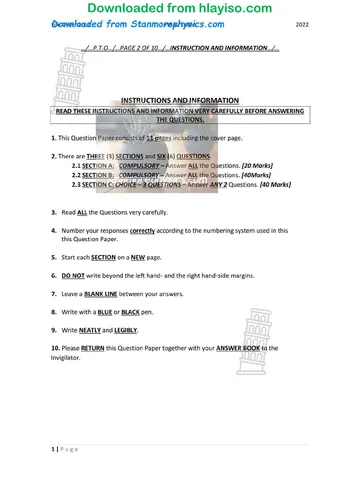
▪ Complete the front cover of your answer booklet.
▪ Answer all questions in the answer booklet provided.
▪ Number in the middle of the page.
▪ Rule off after each section.
▪ The following are not allowed in the examination room: school bags, cell phones,
smart watches, tablets, books, dictionaries, notes, sketches or paper.
Only the official examination material distributed by the invigilator is allowed.
Skip to contentAll 2023 papers 



View all
Life Orientation Grade 11 November 2023 Memo
Grade 11 Life Orientation memorandum from the November Exam 2023, 18 pages. Read online or get the free PDF download, question paper linked when available.
Life Orientation · Grade 11 · November Exam · 2023. Memorandum, 18 pages. Read online or download the PDF.
- Subject
- Life Orientation
- Grade
- Grade 11
- Document type
- Memorandum
- Year
- 2023
- Exam period
- November Exam
- Curriculum
- CAPS
- Pages
- 18
- File size
- 392.6 KB
Free to read online, no sign-up needed
Loading document…
Loading document…
1 of 18
This exam
November Exam 2023
- Other filesQuestion paperMemo
Document textSearch extracted text and jump to a page.
Life Orientation Jeppe Boys Midyear Exam 2021 Grade 11
SECTION A (COMPULSORY)
QUESTION 1
1.1 Various options are provided as possible answers to the following questions.
Choose the most correct answer and write only the letter (A-D) next to the
question numbers (1.1.1 to 1.1.5) in the ANSWER BOOK, e.g. 1.1.6 B.
1.1.1 A
1.1.2 A
1.1.3 C
1.1.4 B
1.1.5 C
1.2 Give ONE word/term for each of the following descriptions. Write only the
word/term next to the question numbers (1.2.1 to 1.2.5) in the ANSWER
BOOK.
1.2.1 Interpersonal Relationship (1)
1.2.2 Gender Norms
1.2.3 Well-being
1.2.4 Conformity
1.2.5 Ethics
1.3 Answer the following questions by writing the answer next to the question numbers
(1.3.1 to 1.3.4) in the ANSWER BOOK. Write your answers in full sentences.
1.3.1 Provide TWO ways to research higher education options. (2X1) (2)
Any TWO of the below or any relevant answers for ONE mark each.
● Attend open days.
● Visit the websites of multiple institutions.
● Conduct a web search on the pros and cons of each option. ● Speak
to people about their study experience to get first-hand ●
knowledge.
● Contact institutions directly and ask questions.
1.3.2 Critically discuss TWO important functions of Technical and
Vocational Education and Training (TVET) colleges in South
Page 2 of 18
Life Orientation Jeppe Boys Midyear Exam 2021 Grade 11
Africa. (1X2) (2)
Any TWO of the below or any relevant answers for TWO marks each.
South Africa has a large shortage of skilled artisans and trades people
so TVET colleges help to decrease this shortage and increase national
development in this sector.
Graduates from TVET colleges are able to provide key skills in South
Africa’s business sector which will boost the companies that employ
them and contribute towards South Africa’s economy.
They help to create more employment opportunities/ allow more South
Africans get jobs because they are preparing their graduates for roles/
jobs that are not already over saturated/ need more qualified workers.
1.4 Read the extract below and answer the questions that follow:
1.4.1 Discuss a negative consequence of teenagers being exposed to
untrustworthy adults on apps like Tinder. (1X2) (2)
Teenagers who encounter untrustworthy adults on platforms like Tinder may face
a heightened risk of encountering individuals with harmful intentions. These adults
may misrepresent themselves, leading teenagers to believe they are someone they
are not. This deception can result in various negative outcomes:
1. Online Predation: Untrustworthy adults may exploit the vulnerability and naivety of
teenagers, engaging in predatory behavior. They might try to manipulate or coerce
teenagers into sharing personal information, explicit content, or meeting in person
for harmful purposes.
2. Emotional Distress: Interactions with untrustworthy adults can lead to emotional
distress for teenagers. They may experience feelings of betrayal, confusion, or
humiliation when they discover they've been deceived.
3. Inappropriate Content: Exposure to explicit or inappropriate content, messages,
or images from untrustworthy adults can have a detrimental impact on teenagers'
mental and emotional well-being. It can also lead to a premature and unhealthy
understanding of relationships and intimacy.
4. Identity Theft and Privacy Concerns: Untrustworthy individuals may attempt to
steal personal information or engage in identity theft, putting teenagers at risk of
fraud or other cybercrimes.
5. Cyberbullying: Negative interactions on dating apps can also lead to
cyberbullying. Untrustworthy adults may engage in harassment or spread rumors
about teenagers, causing significant harm to their self-esteem and mental health.
1.4.2 Explain why using online dating apps could be considered risky behaviour.
(1X2) (2)
1. Potential for Deception: Online dating apps can be a breeding ground for
dishonesty. Teens may encounter individuals who misrepresent themselves,
Page 3 of 18
Life Orientation Jeppe Boys Midyear Exam 2021 Grade 11
including their age, interests, or intentions. This deception can lead to
disappointment, trust issues, and even dangerous situations.
2. Privacy Concerns: Teens may not fully grasp the importance of safeguarding their
personal information. Sharing too much personal data on dating apps can make
them vulnerable to cyberbullying, identity theft, or harassment. It's crucial for teens
to understand the significance of protecting their privacy online.
3. Inappropriate Content: Dating apps may expose teens to explicit or inappropriate
content, conversations, or images. This exposure can have a negative impact on
their emotional well-being and may lead to unhealthy perceptions of relationships
and intimacy.
1.4.3 Suggest ONE way in which teenagers can keep themselves safe when they decide
to meet someone new in person. (1X2) (2)
1. Choose a Public Meeting Place:
Opt for meeting in a well-populated, public location such as a coffee shop,
mall, or park.
Public places provide safety through visibility and access to assistance if
necessary.
2. Share Plans with a Trusted Person:
Inform a trusted friend or family member about the meeting details, including
the location, date, and time.
Share the person's contact information and a photo if possible.
3. Meet During Daylight Hours:
Whenever possible, schedule meetings during daylight hours.
Daylight offers better visibility and a generally safer atmosphere compared to
night-time meetings.
TOTAL SECTION A: 20
QUESTION 2
2.1 Define the term gender-based violence. (1X2) (2)
Gender-based violence refers to any harmful physical, emotional, or psychological
actions or threats directed at an individual or group of people based on their
gender or perceived gender roles. This type of violence is rooted in unequal power
dynamics between genders and often disproportionately affects women and girls.
Gender-based violence can take various forms, including physical abuse, sexual
harassment, domestic violence, emotional or psychological abuse, and more. It is a
pervasive and serious violation of human rights, aiming to control, harm, or
intimidate individuals solely because of their gender identity or sex. Efforts to
combat gender-based violence involve raising awareness, providing support for
survivors, and promoting gender equality and respect for all individuals, regardless
of their gender.
2.2 State TWO key reasons why gender-based violence continues to be a
significant issue in South Africa. (2X1) (2)
1. Patriarchal Culture: South Africa, like many societies, has a deeply
entrenched patriarchal culture where traditional gender roles and norms
Page 4 of 18
Life Orientation Jeppe Boys Midyear Exam 2021 Grade 11
often perpetuate unequal power dynamics between men and women. These
norms may tolerate or even condone violence against women and girls,
making it challenging to break the cycle of gender-based violence.
2. High Levels of Inequality and Poverty: South Africa faces significant socio-
economic challenges, including high levels of inequality and poverty. These
conditions can exacerbate gender-based violence, as individuals in
vulnerable situations may lack the resources and support needed to escape
abusive relationships. Economic dependence on abusive partners can trap
victims in violent situations.
2.3 Explain a strategy that the South African government could implement to
address and prevent gender-based violence effectively. (1X2) (2)
Comprehensive Education Programs:
Develop and implement age-appropriate, gender-sensitive education
programs in schools that promote healthy relationships, consent, and gender
equality.
These programs should focus on teaching students about respect, empathy,
and communication, emphasizing the importance of gender equality from a
young age.
Community Engagement and Awareness Campaigns:
Launch nationwide awareness campaigns to change social norms and
attitudes regarding gender-based violence.
Engage communities, religious leaders, and influential figures in promoting
respect for women's rights and condemning violence.
Enhanced Legal Framework:
Strengthen and enforce existing laws related to gender-based violence,
ensuring that perpetrators face appropriate consequences for their actions.
Establish specialized courts and support services for survivors to expedite
legal proceedings and provide necessary assistance.
Accessible Support Services:
Increase the availability of shelters, crisis hotlines, and counseling services
for survivors of gender-based violence.
Ensure that these services are easily accessible and adequately funded to
provide immediate help to those in need.
Data Collection and Research:
Invest in data collection and research efforts to better understand the scope
and nature of gender-based violence in different communities.
Use data to inform policies and initiatives, allowing for targeted interventions
where the problem is most prevalent.
Engage Men and Boys:
Develop programs that engage men and boys as allies in the fight against
gender-based violence.
Promote positive masculinity and encourage men and boys to challenge
harmful stereotypes and behaviors.
Collaboration with NGOs and Civil Society:
Page 5 of 18
Life Orientation Jeppe Boys Midyear Exam 2021 Grade 11
Partner with non-governmental organizations (NGOs) and civil society
groups with expertise in gender-based violence prevention and survivor
support.
These organizations can provide valuable insights, resources, and services.
Economic Empowerment:
Promote economic empowerment opportunities for women, enabling them to
gain financial independence and reduce their vulnerability to abusive
partners.
Monitoring and Evaluation:
Establish a rigorous system for monitoring and evaluating the effectiveness
of gender-based violence prevention programs and policies.
Adjust strategies based on data and outcomes to ensure continuous
improvement.
2.4 Discuss TWO potential physical and emotional consequences that victims
of gender-based violence might experience. (2X2) (4)
Physical Consequences:
1. Physical Injuries: Victims of gender-based violence, especially physical abuse
and domestic violence, often sustain a range of physical injuries. These can include
bruises, cuts, fractures, and more severe injuries such as broken bones or internal
injuries. In extreme cases, physical violence can lead to permanent disabilities or
even death.
2. Sexual Health Issues: Sexual violence can result in physical consequences such
as sexually transmitted infections (STIs) or unwanted pregnancies. Victims may
also experience pelvic pain, genital injuries, or long-term sexual dysfunction as a
result of the violence.
Emotional Consequences:
1. Post-Traumatic Stress Disorder (PTSD): Many survivors of gender-based
violence develop PTSD, a severe emotional response to trauma. Symptoms may
include flashbacks, nightmares, severe anxiety, and hypervigilance. PTSD can
significantly impact a person's daily life and mental well-being.
2. Depression and Anxiety: Victims often experience profound emotional distress,
leading to conditions such as depression and anxiety. The constant fear,
humiliation, and trauma can erode a person's self-esteem and overall mental
health. They may struggle with feelings of hopelessness and helplessness.
2.5 Assess TWO ways that gender-based violence presents itself in South Africa.
(2X2) (4)
1. Intimate Partner Violence (IPV):
Intimate partner violence, including physical, emotional, and sexual abuse, is
prevalent in South Africa. Many women suffer at the hands of their current or
former partners, enduring physical injuries, emotional trauma, and sexual
coercion.
2. Sexual Violence and Rape:
South Africa has one of the highest rates of sexual violence in the world.
Rape and sexual assault are pervasive issues, affecting women and men
Page 6 of 18
Life Orientation Jeppe Boys Midyear Exam 2021 Grade 11
alike. These crimes often go unreported due to stigma and fear, leaving
survivors with physical and emotional scars.
3. Harmful Cultural Practices:
Harmful cultural practices, such as forced marriages, female genital
mutilation, and "corrective" rape targeting LGBTQ+ individuals, persist in
some communities. These practices perpetuate gender-based violence and
violate the human rights of women and marginalized groups.
4. Violence Against LGBTQ+ Communities:
Gender-based violence extends to violence against LGBTQ+ individuals,
including physical assaults, verbal abuse, and discrimination. Hate crimes
and "corrective" rape are significant concerns, particularly for transgender
and gender-nonconforming people.
5. Human Trafficking and Sex Work Exploitation:
Gender-based violence also manifests in the form of human trafficking and
the exploitation of sex workers. Vulnerable individuals, often women and
girls, are forced into prostitution and subjected to physical and sexual
violence by traffickers and clients.
6. Cyberbullying and Online Harassment:
With the growth of the internet and social media, cyberbullying and online
harassment have become prevalent forms of gender-based violence.
Women and girls are often targeted with threats, revenge porn, and
cyberstalking
2.6 Suggest strategies the community could implement to combat gender-
based violence. In EACH answer, also indicate how government could
support these communities in their endeavours. (2X3) (6)
Strategy 1: Establish Community Education Programs
a) Make a Point: Communities can implement community education programs to raise
awareness about gender-based violence, promote gender equality, and teach conflict
resolution skills.
b) Explain the Point: These programs would involve workshops, seminars, and
awareness campaigns aimed at educating community members about the consequences
of gender-based violence and the importance of respectful relationships. They can also
provide resources for reporting and seeking help.
c) Answer the Second Part of the Question: The government can support these
community education programs by allocating funding for their development and
implementation. Additionally, government agencies can collaborate with local NGOs to
provide expert trainers and resources. This partnership ensures that the programs are
effective and reach a wider audience.
Strategy 2: Establish Safe Spaces and Support Services
a) Make a Point: Communities can create safe spaces for survivors of gender-based
violence and provide access to support services.
b) Explain the Point: Safe spaces can be physical locations or virtual platforms where
survivors can seek refuge, counseling, and legal assistance. These spaces should be
Page 7 of 18
Life Orientation Jeppe Boys Midyear Exam 2021 Grade 11
confidential and non-judgmental, offering emotional support and resources to help
survivors rebuild their lives.
c) Answer the Second Part of the Question: The government can support these
initiatives by allocating funding to establish and maintain safe spaces. Government
agencies can also collaborate with local organizations to provide trained counselors, legal
aid, and medical services within these spaces. Furthermore, legal reforms can be enacted
to protect the confidentiality and rights of survivors.
Strategy 3: Engage Men and Boys in Gender Equality
a) Make a Point: Communities can engage men and boys as allies in the fight against
gender-based violence.
b) Explain the Point: Educational programs and community events can be designed to
challenge harmful stereotypes of masculinity and promote positive, respectful attitudes
towards women and gender equality. Engaging men and boys in these conversations is
crucial for changing social norms.
c) Answer the Second Part of the Question: The government can support these efforts
by funding initiatives that focus on engaging men and boys in gender equality discussions.
This can include public awareness campaigns, school programs, and partnerships with
local organizations that work on these issues. Additionally, government policies can
encourage male involvement in gender-based violence prevention.
Strategy 4: Strengthen Community Policing and Legal Support
a) Make a Point: Communities can work to strengthen community policing and legal
support for survivors of gender-based violence.
b) Explain the Point: This involves training law enforcement officers to handle gender-
based violence cases sensitively and effectively. Additionally, communities can establish
legal clinics or hotlines where survivors can seek legal advice and support in pursuing
justice.
c) Answer the Second Part of the Question: The government can support these efforts
by investing in training programs for law enforcement personnel to handle gender-based
violence cases. Government agencies can also allocate resources to establish and
maintain legal support services, ensuring that survivors have access to justice. Legal
reforms can be implemented to prioritize the prosecution of gender-based violence
offenders
[20]
QUESTION 3
3.1 Define the term election. (1X2) (2)
An election is a formal process in which individuals or groups of people, typically
citizens of a country or members of an organization, choose or select one or more
individuals or options from a list of candidates or alternatives to hold a specific
Page 8 of 18
Life Orientation Jeppe Boys Midyear Exam 2021 Grade 11
position or make a decision. Elections are a fundamental component of democratic
systems, allowing people to participate in the selection of leaders, representatives,
or policy choices, thereby influencing the governance and direction of a country or
institution. Elections can take various forms, including presidential elections,
parliamentary elections, local elections, and referendums, depending on the context
and the level of government or organization involved.
3.2 State TWO reasons why South African citizens might decide not to vote
in an election. (2X1) (2)
1. Dissatisfaction with Political Parties:
Many citizens may feel disillusioned or dissatisfied with the available political
parties and candidates. They might perceive these options as corrupt,
ineffective, or not aligned with their values, leading them to abstain from
voting.
2. Lack of Trust in the Electoral Process:
Some South Africans may lack trust in the integrity of the electoral process,
believing that it is susceptible to fraud, manipulation, or bias. This mistrust
can discourage them from participating in elections.
3. Voter Apathy and Disengagement:
Voter apathy is a common reason for non-participation. Some citizens may
feel disconnected from the political system and believe that their vote won't
make a difference. They may choose not to engage in the political process.
4. Logistical Barriers:
Challenges related to the logistics of voting, such as long distances to
polling stations, lack of access to transportation, or difficulties with voter
registration, can deter citizens from participating in elections.
ANY SIMILAR ANSWERS
3.3 Explain reasons why voting electronically could encourage more South
Africans to vote. (1X2) (2)
1. Convenience and Accessibility:
Electronic voting allows citizens to vote from the comfort of their homes or
from convenient locations. This eliminates the need to travel long distances
to physical polling stations, making voting more accessible, especially for
those in remote areas.
2. Reduced Waiting Times:
Electronic voting can significantly reduce waiting times at polling stations.
Traditional voting methods often involve long queues, discouraging some
voters. Electronic voting streamlines the process, potentially encouraging
more people to participate.
3. Increased Voter Engagement:
Electronic voting can incorporate multimedia elements, such as candidate
profiles and explanations of ballot measures. This can enhance voter
education and engagement, helping voters make more informed decisions.
4. Enhanced Accessibility for Disabled Individuals:
Electronic voting systems can be designed to accommodate individuals with
disabilities, providing features such as screen readers, voice-activated
Page 9 of 18
Life Orientation Jeppe Boys Midyear Exam 2021 Grade 11
interfaces, or tactile interfaces. This inclusivity can encourage disabled
citizens to vote.
5. Faster and More Accurate Results:
Electronic voting systems can tabulate votes quickly and accurately, leading
to faster announcement of election results. This timely feedback can boost
voter confidence in the electoral process and increase overall trust in
democracy.
ANY RELEVANT ANSWER
3.4 Discuss TWO precautions put in place to ensure that South African
citizens can only vote once. (2X2) (4)
1. Voter Registration:
Before an election, citizens are required to register to vote. This registration
process typically involves providing personal information and proof of
identity. Electoral authorities verify this information to create a voter roll.
2. Use of Identification:
When citizens arrive at polling stations to vote, they are required to present
a valid form of identification, such as an identity card, passport, or voter
registration card. This ensures that only eligible voters are allowed to cast
their ballots.
3. Ink Marking and Biometrics:
After voting, a special ink is often applied to the voter's finger to prevent
them from voting again at the same polling station. In some cases, biometric
technology like fingerprint scanning may be used to verify a voter's identity
and prevent multiple voting.
4. Voter Lists and Cross-Checking:
Electoral authorities maintain detailed voter lists that specify which citizens
are eligible to vote in each polling station. These lists are often used to
cross-check the identity of voters and ensure that they have not already
voted at another location.
3.5 Assess TWO reasons why it is important for South African citizens to
vote in the national elections. (2X2) (4)
1. Representation and Accountability:
Voting allows citizens to choose their representatives in the government. By
participating in elections, South Africans have a say in who will make
decisions on their behalf and represent their interests at the national level.
This helps ensure that elected officials are accountable to the people they
serve.
2. Influence on Policies and Governance:
The outcome of elections determines the direction and policies of the
country. By voting, citizens can influence the political landscape and shape
the government's priorities. It allows them to have a direct impact on issues
such as healthcare, education, the economy, and social welfare.
3. Protection of Rights and Freedoms:
Voting is a means through which citizens safeguard their rights and
freedoms. It is a way to protect democracy itself, ensuring that constitutional
Page 10 of 18
Life Orientation Jeppe Boys Midyear Exam 2021 Grade 11
principles and human rights are upheld. By participating in elections, citizens
contribute to the preservation of a just and equitable society.
4. Voice for Marginalized Communities:
Voting is especially important for marginalized and underrepresented
communities. It provides an opportunity for these groups to have their voices
heard and their concerns addressed by electing representatives who
understand their unique challenges and advocate for their needs.
5. Legitimacy of Government:
A high voter turnout enhances the legitimacy of the government. When a
significant portion of the population participates in elections, it reinforces the
authority and credibility of the elected officials and the democratic process
itself. This, in turn, contributes to political stability
ANY RELEVANT ANSWER
3.6 Suggest ways that the Independent Electoral Commission of South Africa
could ensure that digital voting can take place in a way that does not
damage the integrity of the elections. In EACH answer, also indicate how
schools could use these ways for prefect voting. (2X3) (6)
Use the following as a guide as answers may vary
Ways to Ensure the Integrity of Digital Voting in South Africa:
a) Make a Point: Implement Robust Cybersecurity Measures
b) Explain the Point: The Independent Electoral Commission of South Africa should
invest in state-of-the-art cybersecurity measures to protect digital voting systems from
hacking and tampering. This includes encryption, firewalls, regular security audits, and
continuous monitoring of the voting platform for vulnerabilities.
c) Answer the Second Part of the Question: Schools can use similar robust
cybersecurity measures when conducting prefect voting. They should ensure that the
digital voting platform used within the school is secure, protected from unauthorized
access, and regularly updated to patch any security vulnerabilities.
a) Make a Point: Develop a Secure Authentication System
b) Explain the Point: The electoral commission should establish a secure authentication
system to verify the identity of voters participating in digital elections. This could involve
using biometric authentication, two-factor authentication (2FA), or secure identity
verification methods to ensure that only eligible voters can cast their ballots.
c) Answer the Second Part of the Question: Schools can adopt a secure authentication
system for prefect voting by verifying the identities of students before allowing them to
vote. This may include using student IDs or other secure methods to confirm the eligibility
of voters.
a) Make a Point: Provide Voter Education and Training
b) Explain the Point: The electoral commission should offer comprehensive voter
education and training programs to inform citizens about the digital voting process,
including how to use the technology, verify their choices, and troubleshoot any issues.
This ensures that voters are confident and informed when using digital voting systems.
c) Answer the Second Part of the Question: Schools can adapt this approach by
providing education and training to students before conducting prefect voting. This could
Page 11 of 18
Life Orientation Jeppe Boys Midyear Exam 2021 Grade 11
involve explaining the voting process, demonstrating the use of the digital platform, and
addressing any questions or concerns students may have.
a) Make a Point: Ensure Transparency and Oversight
b) Explain the Point: The electoral commission should maintain transparency throughout
the digital voting process. This includes allowing independent observers and auditors to
scrutinize the system, ensuring that the code used in the digital platform is open-source
and can be reviewed for vulnerabilities, and providing a clear and transparent audit trail for
every vote cast.
c) Answer the Second Part of the Question: Schools can adopt a similar approach by
ensuring transparency and oversight in prefect voting. This may involve having impartial
staff or students oversee the voting process to ensure its fairness and integrity.
Additionally, schools can make the voting results publicly accessible for review.
[20]
TOTAL SECTION B: 40
SECTION C
Answer any TWO questions in this section.
QUESTION 4
Construct an essay on Abortion.
Use the following as a guideline:
State FOUR reasons why a woman may feel the need to have an
abortion.
Health Risks: Concerns about the woman's physical health due to pregnancy
complications or pre-existing medical conditions.
Financial Constraints: Inability to afford the costs of prenatal care, childbirth, and
raising a child.
Educational/Career Goals: Desire to continue education or maintain a career
without the burden of motherhood.
Unintended Pregnancy: Conceiving due to failed contraception, lack of access to
contraception, or sexual assault.
(4X1) (4)
Analyse the negative effects of abortions on babies that survive abortions.
Physical Health Complications: Surviving babies may experience physical health
issues due to the abortion procedure, such as premature birth, respiratory problems, or
developmental delays.
Page 12 of 18
Life Orientation Jeppe Boys Midyear Exam 2021 Grade 11
Emotional and Psychological Impact: Babies who survive abortions might face
emotional and psychological challenges, including potential trauma and feelings of
abandonment.
Medical Treatment: They might require medical interventions and specialized care,
resulting in a lifelong need for medical attention and support.
Stigma and Identity Issues: Survivors of abortions may later encounter challenges
related to their unique identity and feelings of being unwanted or different from their
peers.
(2X4) (8)
Critically discuss the impact/importance of the psychological
consequences for a teenager who chooses to have an abortion.
Emotional Distress: The teenager might experience guilt, shame, and anxiety due
to the decision, impacting their mental well-being.
Identity and Self-Worth: The abortion decision could lead to questioning of self-
identity and feelings of low self-worth, affecting their self-esteem.
Relationships: The psychological aftermath may strain relationships with partners,
family, and friends due to differing views on the decision.
Long-Term Effects: Psychological consequences might extend into adulthood,
influencing future decisions, relationships, and mental health.
Support Systems: Access to counselling and support groups becomes crucial to
help the teenager navigate and process their emotions.
Educational Impact: Emotional distress may interfere with the teenager's
academic performance and aspirations, affecting their future opportunities.(2X4) (8)
[20]
QUESTION 5
Construct paragraphs on Social Media Wellness.
Use the following as a guideline:
● State FOUR negative effects of spending too much time on social media
platforms. (4X1) (4)
1. Reduced Productivity:
Excessive social media use can lead to distractions and reduced
productivity, as it diverts time and attention away from tasks, assignments, or
work.
2. Negative Mental Health Impact:
Prolonged use of social media has been linked to increased feelings of
anxiety, depression, and loneliness, as it can foster unrealistic comparisons,
cyberbullying, and social isolation.
3. Impaired Sleep Patterns:
Engaging with social media late at night can disrupt sleep patterns, leading
to insomnia or poor-quality sleep. The blue light emitted by screens can
interfere with the body's natural sleep-wake cycle.
4. Privacy Concerns and Cybersecurity Risks:
Sharing personal information on social media platforms can expose
individuals to privacy breaches, identity theft, and cyberbullying. Oversharing
can also compromise personal security.
Page 13 of 18
Life Orientation Jeppe Boys Midyear Exam 2021 Grade 11
It's important for individuals to strike a balance between social media use and other
aspects of life to mitigate these negative effects and maintain overall well-being.
● Analyse how social media can raise awareness of social issues. (2X4) (8)
1. Amplification of Voices:
Social media platforms provide a space for individuals and organizations to
amplify their voices and share information about social issues. This enables
grassroots movements and marginalized communities to reach a broader
audience and garner support.
2. Rapid Dissemination of Information:
Social media allows for the rapid dissemination of news and information.
When social issues emerge, they can be shared and discussed in real-time,
facilitating swift responses and mobilization for action.
3. Visual and Emotional Impact:
Visual content such as photos and videos can convey the emotional impact
of social issues. This engages users on a visceral level, evoking empathy
and prompting them to take notice and act.
4. Global Reach:
Social media transcends geographic boundaries, enabling awareness
campaigns to reach a global audience. This global reach is particularly useful
for issues that require international attention, such as climate change or
human rights abuses.
5. User-Generated Content:
Social media encourages user-generated content, empowering individuals to
share their personal experiences and stories related to social issues. These
personal narratives can humanize complex problems and foster empathy.
6. Hashtags and Viral Campaigns:
Hashtags and viral campaigns can turn social issues into trending topics,
drawing widespread attention and encouraging conversations. They serve as
digital rallying points for advocacy and activism.
7. Community Building:
Social media platforms facilitate the formation of online communities
dedicated to specific social causes. These communities provide a space for
like-minded individuals to connect, collaborate, and organize.
8. Accountability and Transparency:
Social media can hold individuals, organizations, and governments
accountable for their actions or lack of action on social issues. Public
scrutiny on these platforms can lead to increased transparency and
accountability.
9. Fundraising and Support:
Social media platforms often include features for crowdfunding and
donations, making it easier for social causes to raise funds and receive
support from a global network of donors.
10. Political Activism:
Social media has been a catalyst for political activism, allowing citizens to
organize protests, advocate for policy changes, and challenge oppressive
regimes.
In conclusion, social media serves as a powerful tool for raising awareness of social
issues by amplifying voices, disseminating information rapidly, and engaging a global
audience. It has revolutionized advocacy and activism, making it easier for individuals
Page 14 of 18
Life Orientation Jeppe Boys Midyear Exam 2021 Grade 11
and organizations to draw attention to important social challenges and drive positive
change.
● Critically discuss principles of online etiquette that students should
practice when engaging on social media platforms. (2X4) (8)
1. Respect and Civility:
Treat others with respect and civility, just as you would in face-to-face
interactions. Avoid using offensive language, derogatory comments, or
personal attacks.
2. Think Before You Post:
Before posting, consider the potential impact of your words and content.
Avoid sharing misleading information, rumors, or unverified news.
3. Privacy and Consent:
Respect the privacy of others by not sharing their personal information,
photos, or videos without their consent. Be mindful of the content you post
about yourself as well.
4. Constructive Criticism:
If you disagree with someone's views or opinions, engage in constructive
and respectful discussions. Avoid hostile arguments or "trolling."
5. Cyberbullying Prevention:
Never engage in cyberbullying, which includes harassment, threats, or any
form of intimidation online. Report and block individuals who engage in such
behavior.
6. Fact-Checking:
Verify the accuracy of information before sharing it. Misinformation and fake
news can spread rapidly and harm individuals and society.
7. Diverse Perspectives:
Encourage and respect diverse perspectives and opinions. Engage in open-
minded conversations that foster understanding and empathy.
8. Online Safety:
Be cautious about sharing personal information, such as your address,
phone number, or financial details, online. Protect your online accounts with
strong passwords and enable two-factor authentication.
9. Content Moderation:
Monitor the content you post and engage with. Avoid sharing explicit or
harmful content, and report inappropriate content when you encounter it.
10. Consent for Tagging and Mentioning:
Seek permission before tagging or mentioning someone in a post or
comment. Not everyone may want to be associated with certain content.
11. Online Etiquette in Academics:
When discussing academic matters or assignments, maintain academic
integrity by not plagiarizing or sharing answers. Respect copyright laws when
sharing academic materials.
12. Digital Footprint Awareness:
Remember that your online actions leave a digital footprint. Employers and
colleges may review your online presence, so consider how your online
activity reflects on your character and professionalism.
In conclusion, practicing online etiquette is essential for maintaining positive and
respectful online interactions. Students should be mindful of their online conduct to
create a safer, more inclusive, and productive online environment.
Page 15 of 18
Life Orientation Jeppe Boys Midyear Exam 2021 Grade 11
[20]
QUESTION 6
Construct an essay on the impact of the Corona virus pandemic.
Use the following as a guideline:
● State 4 ways in which the coronavirus pandemic has affected
interpersonal relationships among friends and family.
Responses should consider:
Examples of how social distancing measures have affected
in-person interactions
Changes in communication patterns (e.g., increased use of
video calls, decreased face-to-face meetings)
Emotional impact on relationships due to prolonged
separation
(1x4) (4)
● Analyse the impact of the coronavirus on the economy and business
1. Economic Contraction:
The pandemic led to a significant economic downturn in
South Africa, with GDP contracting as lockdowns and
restrictions disrupted economic activities.
2. Unemployment and Job Losses:
Many businesses, especially small enterprises, faced
financial strain and had to lay off employees. This resulted
in a rise in unemployment rates, particularly affecting
vulnerable populations.
3. Supply Chain Disruptions:
Supply chains were disrupted due to global travel
restrictions and reduced production capacity, leading to
shortages of essential goods and increased costs for
businesses.
4. Business Closures:
Some businesses, especially in sectors heavily impacted by
lockdowns (e.g., hospitality, tourism), had to close
permanently due to financial losses, leading to reduced
competition and market concentration.
5. Digital Transformation Acceleration:
The pandemic accelerated the adoption of digital
technologies as businesses shifted towards remote work, e-
commerce, and digital marketing to adapt to changing
Page 16 of 18
Life Orientation Jeppe Boys Midyear Exam 2021 Grade 11
consumer behaviour.
6. Government Support Measures:
The South African government implemented various relief
measures, such as loan guarantees and grants, to support
struggling businesses and individuals during the crisis.
7. Impact on Informal Sector:
The informal sector, which plays a significant role in the
South African economy, faced hardships as informal
workers often lacked safety nets and faced reduced income
opportunities.
8. Changes in Consumer Behavior:
Consumer spending patterns changed, with increased
demand for certain products (e.g., healthcare, home office
equipment) and reduced spending on non-essential items.
9. Long-Term Effects on Business Models:
The pandemic forced many businesses to reevaluate their
business models, with a focus on resilience and adaptability
to future crises.
10. Vaccine Rollout and Recovery:
The success of the vaccine rollout and the pace of
economic recovery were closely tied, with expectations of
improved economic conditions as vaccination rates
increased.
In summary, the COVID-19 pandemic had a profound impact on South
Africa's economy and businesses, causing economic contraction, job
losses, supply chain disruptions, and accelerating digital transformation.
Government support measures played a crucial role in mitigating some of
these challenges, but the long-term effects of the pandemic continue to
shape business strategies and economic outlooks in the country.
Critically discuss the broader societal consequences of the (4X2) (8)
coronavirus pandemic
1. Healthcare System Strain:
The pandemic placed immense pressure on the healthcare system,
highlighting existing weaknesses and resource shortages.
Overburdened hospitals struggled to provide adequate care for both
COVID-19 patients and those with other medical conditions.
2. Loss of Lives and Grief:
The loss of lives due to COVID-19 had a profound emotional and
psychological impact on individuals and communities. Many families
experienced grief and loss, affecting mental health and well-being.
3. Education Disruption:
School closures disrupted education, exacerbating inequalities in
access to learning resources and online education. Many students fell
behind academically, especially those from disadvantaged
backgrounds.
Page 17 of 18
Life Orientation Jeppe Boys Midyear Exam 2021 Grade 11
4. Economic Inequality:
The pandemic widened economic disparities, as vulnerable populations
faced job losses, reduced income, and limited access to government
support. The divide between the rich and poor became more
pronounced.
5. Food Insecurity:
Economic hardships and disruptions in food supply chains led to
increased food insecurity. Many South Africans struggled to access
nutritious meals, particularly in low-income communities.
6. Mental Health Challenges:
Social isolation, fear, and uncertainty associated with the pandemic led
to a rise in mental health issues, including anxiety, depression, and
stress-related disorders.
7. Digital Divide:
The shift to remote work and online education exposed the digital divide,
with many lacking access to the internet and necessary technology for
remote participation in various aspects of life.
8. Vaccine Hesitancy and Misinformation:
Vaccine hesitancy and the spread of misinformation hindered efforts to
achieve widespread vaccination, prolonging the pandemic's impact and
risks.
9. Community Resilience and Solidarity:
Communities demonstrated resilience and solidarity by supporting one
another during difficult times, organizing mutual aid initiatives, and
advocating for vulnerable populations.
10. Remote Work and Lifestyle Changes:
The pandemic prompted a shift towards remote work and changes in
lifestyle preferences, with more people valuing flexibility and considering
alternative living arrangements.
11. Healthcare Innovation and Preparedness:
The pandemic encouraged innovation in healthcare, including vaccine
development and telemedicine. It also emphasized the importance of
pandemic preparedness and strengthening healthcare infrastructure.
12. Impact on Social Norms and Customs:
Social distancing measures and restrictions on gatherings altered
traditional customs and celebrations, impacting cultural and social
norms.
In conclusion, the coronavirus pandemic had far-reaching societal consequences in
South Africa, affecting healthcare, education, economic disparities, mental health, and
more. It also revealed both vulnerabilities and strengths within society, highlighting the
need for resilience, equitable access to resources, and improved healthcare and
education systems.
[20]
TOTAL SECTION C: 40
GRAND TOTAL: 100
Page 18 of 18
Study this subject
Recommended for this subject
Question paper
Life Orientation Grade 11 November 2023 Question Paper
Memorandum
Life Orientation Grade 11 November 2018 Memo
Question paper and memo
Life Orientation Grade 11 November 2022 Paper & Memo
Question paper
Life Orientation Grade 11 November 2019 Question Paper
Question paper
Life Orientation Grade 11 November 2019 Question Paper
Question paper