
Mock
hlayiso mock exams
Practice Series:
Grade 11 Exam Preparation
WWW.HLAYISO.COM
NATIONAL
SENIOR CERTIFICATE
GRADE 11
LIFE SCIENCES P2
NOVEMBER EXAMINATION 2026 (MOCK)
MARKS: 150
TIME: 2½ hours
This question paper consists of 13 pages.
Copyright reserved Please turn over
Skip to contentAll 2026 papers 
View all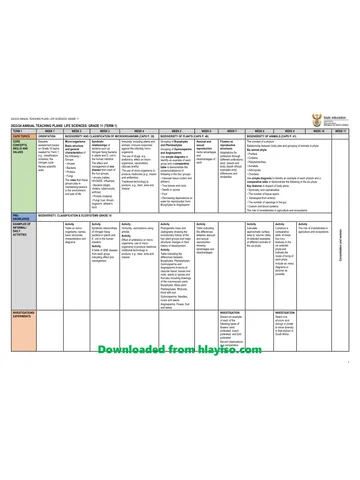


Life Sciences Grade 11 P2 November Mock Exam 2 2026 QP (Eng)
Grade 11 Life Sciences Paper 2 question paper from the November Mock Exam 2 2026 (English), 13 pages. Read online or download the free PDF.
Life Sciences · Grade 11 · November Mock Exam 2 · 2026 · English. Question paper, 13 pages. Read online or download the PDF.
- Subject
- Life Sciences
- Grade
- Grade 11
- Language
- English
- Document type
- Question paper
- Year
- 2026
- Exam period
- November Mock Exam 2
- Paper
- 2
- Publisher
- Hlayiso
- Curriculum
- CAPS
- Pages
- 13
- File size
- 166.7 KB
Free to read online, no sign-up needed
Loading document…
Loading document…
1 of 13
This exam
November Mock Exam 2 2026
- Paper 1Question paperMemo
- Paper 2Question paperMemo
Document textSearch extracted text and jump to a page.
Life Sciences/P2 2 Hlayiso/Mock 2026
NSC Mock
INSTRUCTIONS AND INFORMATION
Read the following instructions carefully before answering the questions.
1. Answer ALL the questions.
2. Write ALL the answers in the ANSWER BOOK.
3. Start the answers to EACH question at the top of a NEW page.
4. Number the answers correctly according to the numbering system used in this question
paper.
5. Present your answers according to the instructions of each question.
6. Do ALL drawings in pencil and label them in blue or black ink.
7. Draw diagrams, tables or flow charts only when asked to do so.
8. The diagrams in this question paper are NOT necessarily drawn to scale.
9. Do NOT use graph paper.
10. You may use a non-programmable calculator, protractor and a compass, where
necessary.
11. Round off ALL calculations to TWO decimal places, where necessary.
12. Write neatly and legibly.
Copyright reserved Please turn over
Life Sciences/P2 3 Hlayiso/Mock 2026
NSC Mock
SECTION A
QUESTION 1
1.1 Various options are provided as possible answers to the following questions.
Choose the answer and write only the letter (A to D) next to the question
numbers (1.1.1 to 1.1.10) in the ANSWER BOOK, e.g. 1.1.11 D.
1.1.1 Rod-shaped bacteria are called …
A cocci.
B bacilli.
C spirilla.
D vibrios.
1.1.2 Which ONE of the following diseases is caused by a virus?
A Thrush
B Cholera
C Influenza
D Ringworm
1.1.3 In the life cycle of a fern, the zygote develops into the …
A sporophyte.
B prothallus.
C spore.
D gametophyte.
1.1.4 Which ONE of the following is an advantage of seeds over spores?
A Seeds are haploid.
B Seeds are produced in much larger numbers than spores.
C Seeds need water for fertilisation to take place.
D Seeds contain stored food and are protected by a seed coat.
1.1.5 An animal is triploblastic and bilaterally symmetrical. It has a
segmented body, jointed legs and an exoskeleton. To which phylum
does it belong?
A Annelida
B Arthropoda
C Platyhelminthes
D Cnidaria
1.1.6 The concentration of nerve tissue and sense organs at the front
(anterior) end of the body of an animal is called …
A cephalisation.
B segmentation.
C triploblasty.
D radial symmetry.
Copyright reserved Please turn over
Life Sciences/P2 4 Hlayiso/Mock 2026
NSC Mock
1.1.7 Owls and hawks both feed on mice in the same grassland. Hawks
hunt during the day and owls hunt at night. This is an example of …
A competitive exclusion.
B mutualism.
C resource partitioning.
D intraspecific competition.
1.1.8 At the start of a year there were 500 impala in a game reserve.
During the year 120 impala were born, 40 died, 15 moved into the
reserve and 25 moved out of the reserve. What was the size of the
impala population at the end of the year?
A 430
B 610
C 650
D 570
1.1.9 Consider the following:
(i) Overgrazing by cattle and goats
(ii) Contour ploughing on slopes
(iii) Removal of the natural vegetation
(iv) Planting of cover crops after the harvest
Which of the above will INCREASE soil erosion?
A (i) and (ii) only
B (i) and (iii) only
C (ii) and (iv) only
D (i), (iii) and (iv) only
1.1.10 Which ONE of the following types of household waste is
biodegradable?
A Glass bottles
B Aluminium cans
C Plastic shopping bags
D Vegetable peels
(10 x 2) (20)
1.2 Give the correct biological term for each of the following descriptions. Write
only the term next to the question numbers (1.2.1 to 1.2.8) in the ANSWER
BOOK.
1.2.1 The type of immunity that develops when the body makes its own
antibodies after an infection or a vaccination
1.2.2 The thread-like filaments that make up the body of a fungus
1.2.3 The small, heart-shaped gametophyte of a fern
1.2.4 The jelly-like layer between the ectoderm and the endoderm of
cnidarians
Copyright reserved Please turn over
Life Sciences/P2 5 Hlayiso/Mock 2026
NSC Mock
1.2.5 A relationship between two species in which one species benefits
and the other is neither harmed nor benefits
1.2.6 Factors that affect a population in the same way regardless of the
size of the population
1.2.7 The removal of trees from a large area without replanting
1.2.8 The total amount of greenhouse gases (carbon dioxide) released
into the atmosphere as a result of the activities of a person,
organisation or country (8 x 1) (8)
1.3 Indicate whether each of the descriptions in COLUMN I applies to A ONLY,
B ONLY, BOTH A AND B or NONE of the items in COLUMN II. Write A only,
B only, both A and B or none next to the question numbers (1.3.1 to 1.3.3) in
the ANSWER BOOK.
COLUMN I COLUMN II
1.3.1 Reproduce by binary fission A: Bacteria
B: Viruses
1.3.2 Produce flowers and fruit A: Pteridophytes
B: Gymnosperms
1.3.3 Lead(s) to a loss of biodiversity A: Poaching
B: Monoculture
(3 x 2) (6)
1.4 The diagram below shows a possible phylogenetic tree for five animal phyla
(A to E). Phylum E is the Chordata. Each number shows where a new
characteristic first appeared.
A B C D E
4 KEY
1 = true tissues
3 2 = bilateral symmetry and
three germ layers
2
3=?
1 4 = notochord
common ancestor
1.4.1 Name the characteristic represented by 3. (1)
1.4.2 State ONE advantage of characteristic 2 for animals that move
actively. (1)
1.4.3 Identify phylum:
(a) A (1)
(b) D (1)
1.4.4 Give the LETTER(S) of the phylum/phyla that is/are:
Copyright reserved Please turn over
Life Sciences/P2 6 Hlayiso/Mock 2026
NSC Mock
(a) Diploblastic (1)
(b) Triploblastic and acoelomate (1)
(c) Animals with a blind gut (TWO phyla) (2)
(8)
1.5 An investigation was done with two species of duckweed (P and Q), small
floating water plants. The species were first grown in separate tanks and then
together in the same tank. All tanks were the same size and were kept under
the same conditions. The number of plants was counted every second day.
Growth of two duckweed species grown separately and together
450
400
350
Number of plants
300
250
200 P grown alone
Q grown alone
150 P grown with Q
100 Q grown with P
50
0
0 2 4 6 8 10 12 14 16 18 20
Time (days)
[Data: examiner’s own]
1.5.1 Name the type of competition that takes place when P and Q are
grown together. (1)
1.5.2 What is the carrying capacity of the tank for species P when it is
grown alone? (1)
1.5.3 How many plants of species P were present on day 10 when it was
grown together with species Q? (1)
1.5.4 Describe what happened to the population of species Q when it was
grown together with species P. (2)
1.5.5 Name the principle that is illustrated by your answer to QUESTION
1.5.4. (1)
1.5.6 State TWO resources for which the two duckweed species compete. (2)
(8)
TOTAL SECTION A: 50
Copyright reserved Please turn over
Life Sciences/P2 7 Hlayiso/Mock 2026
NSC Mock
SECTION B
QUESTION 2
2.1 Yeast is a fungus that is used in baking and brewing because it releases
carbon dioxide when it breaks down sugar. Grade 11 learners investigated
the effect of temperature on the production of carbon dioxide by yeast.
The procedure was as follows:
• Six flasks were each filled with 100 cm3 of a 10% sugar solution.
• 5 g of dry yeast was added to each of flasks 1 to 5. No yeast was added
to flask 6.
• Flasks 1 to 5 were placed in water baths at 15 °C, 25 °C, 35 °C, 45 °C
and 55 °C respectively. Flask 6 was placed in the water bath at 35 °C.
• The carbon dioxide released from each flask was collected in an
upside-down measuring cylinder filled with water.
• The volume of carbon dioxide collected after 30 minutes was recorded.
The results are shown in the table below.
FLASK TEMPERATURE VOLUME OF CARBON
(°C) DIOXIDE (cm3 )
1 15 4
2 25 12
3 35 26
4 45 18
5 55 2
6 (no 35 0
yeast)
[Data: examiner’s own]
2.1.1 For this investigation, identify the:
(a) Independent variable (1)
(b) Dependent variable (1)
2.1.2 State TWO variables that were kept constant. (2)
2.1.3 Explain the purpose of flask 6. (2)
2.1.4 Draw a line graph to show the volume of carbon dioxide produced
at the different temperatures in flasks 1 to 5. (6)
2.1.5 Explain why very little carbon dioxide was produced in flask 5. (2)
(14)
Copyright reserved Please turn over
Life Sciences/P2 8 Hlayiso/Mock 2026
NSC Mock
2.2 Read the extract below.
FIGHTING TB IN A RURAL DISTRICT
Tuberculosis (TB) is one of the leading causes of death in South Africa. In
one rural district, 1 250 new cases of TB were reported in 2021.
Health workers then visited homes to test everyone who had a cough that
lasted longer than two weeks, made sure that patients took their medicine
every day for six months and checked that all babies had been vaccinated.
By 2023, the number of new cases reported in the district had dropped to
400.
[Summary compiled by the examiner (fictional district; data: examiner’s own)]
2.2.1 Name the group of micro-organisms to which the organism that
causes TB belongs. (1)
2.2.2 Describe how TB is spread from an infected person to a healthy
person. (2)
2.2.3 Calculate the percentage decrease in the number of new TB cases
in the district from 2021 to 2023. Show ALL your working. (3)
2.2.4 Babies in South Africa receive the BCG vaccine against TB soon
after birth. Explain how a vaccine protects a person against a
disease. (3)
(9)
2.3 The table below shows some characteristics of four plant groups (P, Q, R and
S).
CHARACTERISTIC P Q R S
Vascular tissue Absent Present Present Present
Reproductive Spores Spores Seeds in Seeds in fruit
structures cones
Flowers Absent Absent Absent Present
Dominant generation Gametophyte Sporophyte Sporophyte Sporophyte
2.3.1 Identify plant group:
(a) P (1)
(b) R (1)
2.3.2 Give the LETTER of the group whose seeds are NOT enclosed in a
fruit. (1)
2.3.3 Tabulate TWO differences between the plants in group P and the
plants in group S. (5)
2.3.4 Name the clusters of sporangia found on the underside of the leaves
of the plants in group Q. (1)
(9)
Copyright reserved Please turn over
Life Sciences/P2 9 Hlayiso/Mock 2026
NSC Mock
2.4 A farmer investigated the importance of bees for the pollination of pumpkin
flowers.
Pumpkin plants have separate male and female flowers. Three groups of 50
FEMALE pumpkin flowers each were treated as follows:
• Group A: flowers were left open so that bees could visit them.
• Group B: flowers were covered with fine mesh bags so that bees could
not reach them.
• Group C: flowers were covered with fine mesh bags, but pollen from the
male flowers of another pumpkin plant was placed on each stigma by
hand.
The percentage of flowers that developed into fruit (fruit set) is shown in the
table below.
GROUP FRUIT SET (%)
A 76
B 4
C 72
[Data: examiner’s own]
2.4.1 Explain the result for group B. (2)
2.4.2 Explain what the result for group C shows when it is compared with
the result for group B. (2)
2.4.3 Describe how a bee carries out cross-pollination as it visits pumpkin
flowers. (3)
2.4.4 Explain how a decrease in the number of bees could threaten food
security. (2)
(9)
2.5 Animals can be classified according to the type of blood system that they
have.
2.5.1 Describe TWO differences between an open blood system and a
closed blood system. (4)
2.5.2 Name ONE phylum of animals that has a closed blood system. (1)
2.5.3 Earthworms and dung beetles are common on farms. Explain how
EACH of these invertebrates benefits farmers. (4)
(9)
[50]
Copyright reserved Please turn over
Life Sciences/P2 10 Hlayiso/Mock 2026
NSC Mock
QUESTION 3
3.1 The population pyramids below show the percentage of the total population
in each age group for two countries, X and Y.
COUNTRY X
70+
60–69
50–59
40–49
30–39
20–29
10–19
0–9
14 12 10 8 6 4 2 0 0 2 4 6 8 10 12 14
Males (%) Females (%)
COUNTRY Y
70+
60–69
50–59
40–49
30–39
20–29
10–19
0–9
14 12 10 8 6 4 2 0 0 2 4 6 8 10 12 14
Males (%) Females (%)
[Data: examiner’s own (fictional countries)]
3.1.1 Which country (X or Y) is a developing country? (1)
3.1.2 Give TWO reasons, visible in the pyramids, for your answer to
QUESTION 3.1.1. (2)
3.1.3 What percentage of the population of country X is made up of males
aged 0 to 9 years? (1)
3.1.4 Country Y has a total population of 12 000 000. Calculate the number
of females aged 70 years and older in country Y. Show ALL your
working. (2)
3.1.5 Which sex in country Y has the longer life expectancy? (1)
3.1.6 Explain why the government of country Y will need to spend more
money on health care and pensions in the next 20 years. (2)
3.1.7 Suggest TWO reasons for the high birth rate in country X. (2)
(11)
Copyright reserved Please turn over
Life Sciences/P2 11 Hlayiso/Mock 2026
NSC Mock
3.2 Learners wanted to estimate the size of the population of a protected aloe
species on a hillside with an area of 4 500 m2 . They placed 10 quadrats,
each measuring 3 m × 3 m, randomly on the hillside and counted the number
of aloes in each quadrat.
The results are shown in the table below.
Quadrat 1 2 3 4 5 6 7 8 9 10
Number of aloes 2 0 3 1 4 0 2 3 1 2
[Data: examiner’s own]
3.2.1 Name the method that the learners used to estimate the population
size. (1)
3.2.2 Calculate the estimated size of the aloe population on the hillside.
Show ALL your working. (4)
3.2.3 Explain why the quadrats were placed randomly. (2)
3.2.4 Give ONE reason why this method is NOT suitable for estimating
the size of a population of springhares. (1)
(8)
3.3 Read the extract below.
RELATIONSHIPS ON A NORTHERN CAPE FARM
Meerkats live in groups. While the group searches for insects and
scorpions, one meerkat stands on a high point and watches out for eagles
and jackals. If it sees a predator, it gives a loud alarm call and all the
meerkats run into their burrows. Ticks attach themselves to the skin of the
meerkats and suck their blood.
Legume plants on the farm have swellings on their roots that contain
bacteria. The bacteria change nitrogen from the air into compounds that
the plants can use, and the plants supply the bacteria with sugars.
[Summary compiled by the examiner]
3.3.1 Name the type of relationship between the:
(a) Ticks and the meerkats (1)
(b) Meerkats and the scorpions (1)
(c) Bacteria and the legume plants (1)
3.3.2 Explain how the behaviour of the guard meerkat benefits the group. (2)
3.3.3 Farmers in the area killed many jackals. Explain how this may affect
the size of the meerkat population. (2)
(7)
Copyright reserved Please turn over
Life Sciences/P2 12 Hlayiso/Mock 2026
NSC Mock
3.4 The table below shows the average maximum summer temperature, the
rainfall and the maize yield in a maize-farming region over five seasons.
SEASON AVERAGE RAINFALL MAIZE YIELD
MAXIMUM SUMMER (mm) (tonnes per
TEMPERATURE (°C) hectare)
2019/20 28,4 610 5,2
2020/21 28,9 580 4,9
2021/22 29,6 520 4,1
2022/23 30,8 430 3,0
2023/24 31,5 360 2,4
[Data: examiner’s own (fictional region)]
3.4.1 Explain the difference between the natural greenhouse effect and
the enhanced greenhouse effect. (2)
3.4.2 Name TWO human activities that release large amounts of carbon
dioxide into the atmosphere. (2)
3.4.3 Describe the relationship between the average maximum summer
temperature and the maize yield. (2)
3.4.4 Explain how rising temperatures may cause a decrease in the maize
yield. (4)
3.4.5 Suggest TWO ways in which farmers in this region could reduce the
effect of hotter and drier seasons on their crops. (2)
(12)
3.5 A power station releases warm cooling water into a river and a town’s sewage
works lies 4 km downstream. The water temperature and dissolved oxygen
were measured at four points along the river.
SAMPLING POSITION WATER DISSOLVED
POINT TEMPERATURE OXYGEN
(°C) (mg/ℓ)
P 1 km upstream of power station 22 8,6
Q Outlet of the cooling water 31 6,1
R 2 km downstream of power 27 7,0
station
S Just below the sewage works 26 3,2
[Data: examiner’s own]
3.5.1 Name the type of water pollution caused by the power station. (1)
3.5.2 Explain why the amount of dissolved oxygen at point Q is lower than
at point P. (2)
3.5.3 Explain why the amount of dissolved oxygen is lowest at point S. (3)
Copyright reserved Please turn over
Life Sciences/P2 13 Hlayiso/Mock 2026
NSC Mock
3.5.4 A species of fish needs at least 6,5 mg/ℓ of dissolved oxygen to
survive. Give the LETTERS of the TWO sampling points where this
fish species could survive. (2)
3.5.5 Invasive alien trees grow in the catchment area of this river. Explain
how removing these trees will increase the amount of water in the
river. (2)
3.5.6 Name ONE mechanical method and ONE chemical method that
could be used to control the invasive alien trees. (2)
(12)
[50]
TOTAL SECTION B: 100
GRAND TOTAL: 150
Copyright reserved
Study this subject
Recommended for this subject
Question paper
Life Sciences Grade 11 P2 Eastern Cape November 2020 QP
Question paper
Life Sciences Grade 11 P2 Eastern Cape November 2017 QP
Memorandum
Life Sciences Grade 11 P2 Eastern Cape November 2024 Memo
Memorandum
Life Sciences Grade 11 P2 Eastern Cape November 2022 Memo
Memorandum
Life Sciences Grade 11 P2 Eastern Cape November 2020 Memo
Memorandum
Life Sciences Grade 11 P2 Eastern Cape November 2018 Memo
More from Grade 11 Life Sciences
Annual teaching plan
Gr 11 Life Sci ATP 2023 24
Memorandum
Life Sciences Grade 11 P1 Eastern Cape November 2025 Memo
Question paper and memo
Life Sciences Grade 11 KZN June 2025 Paper & Memo
Question paper and memo
Life Sciences Grade 11 Eastern Cape June 2024 Paper & Memo
Question paper and memo
Life Sciences Grade 11 KZN June 2024 Paper & Memo
Memorandum