
hlayiso mock exams
Practice Series:
Grade 12 NSC Preparation
WWW.HLAYISO.COM
NATIONAL
SENIOR CERTIFICATE
GRADE 12
TECHNICAL SCIENCES P1
PREDICTION EXAMINATION 2026
MARKING GUIDELINES
MARKS: 150
These marking guidelines consist of 12 pages.
Copyright reserved Please turn over
Skip to contentAll 2026 papers 
View all
Technical Sciences Grade 12 P1 2026 Memo (Eng)
Grade 12 Technical Sciences Paper 1 memorandum from the NSC November Prediction Exam 2026 (English), 12 pages. Read online or download the free PDF.
Technical Sciences · Grade 12 · NSC November Prediction Exam · 2026 · English. Memorandum, 12 pages. Read online or download the PDF.
- Subject
- Technical Sciences
- Grade
- Grade 12
- Language
- English
- Document type
- Memorandum
- Year
- 2026
- Exam period
- NSC November Prediction Exam
- Paper
- 1
- Publisher
- Hlayiso
- Curriculum
- CAPS
- Pages
- 12
- File size
- 162.2 KB
Free to read online, no sign-up needed
Loading document…
Loading document…
1 of 12
This exam
NSC November Prediction Exam 2026
- Paper 1Question paperMemo
- Paper 2Question paperMemo
Document textSearch extracted text and jump to a page.
Technical Sciences/P1 2 Hlayiso/Prediction 2026
NSC – Marking Guidelines
GENERAL MARKING GUIDELINES
1. Calculations: Marks are awarded for the correct formula, correct substitution and the
correct final answer WITH the correct unit, as indicated by the ticks (✓). No mark is
awarded for a formula that is not followed by a substitution. If an incorrect formula is
used, no further marks are awarded for that calculation.
2. Units: The final-answer mark is only awarded if the correct unit is given. Penalise an
omitted or incorrect unit only ONCE per question.
3. Rounding: Accept final answers rounded to a minimum of TWO decimal places. Small
differences caused by rounding of intermediate values are accepted.
4. Positive marking: Where an incorrect answer from a previous question is used correctly
in a later calculation, full marks are awarded for the later calculation.
5. Negative marking: If a candidate must explain or motivate a choice (e.g. INCREASES
or DECREASES) and the choice is incorrect, no marks are awarded for the explanation.
6. Definitions/laws: Where key words are underlined, deduct 1 mark for EACH key word
or phrase that is omitted. Accept equivalent wording that conveys the same meaning.
7. Free-body diagrams: ONE mark for each force represented by an arrow with a correct
label. Penalise ONCE for: no arrows, no dot, gaps between the arrows and the dot,
dotted lines, or additional (non-applicable) forces.
8. Sign convention: Candidates may choose either direction as positive, provided it is
applied consistently.
Copyright reserved Please turn over
Technical Sciences/P1 3 Hlayiso/Prediction 2026
NSC – Marking Guidelines
QUESTION 1
1.1 A ✓✓ (2)
1.2 B ✓✓ (2)
1.3 C ✓✓ (2)
1.4 D ✓✓ (2)
1.5 B ✓✓ (2)
1.6 C ✓✓ (2)
1.7 D ✓✓ (2)
1.8 A ✓✓ (2)
1.9 D ✓✓ (2)
1.10 C ✓✓ (2)
[20]
Copyright reserved Please turn over
Technical Sciences/P1 4 Hlayiso/Prediction 2026
NSC – Marking Guidelines
QUESTION 2
2.1 An object continues in a state of rest or uniform (constant) velocity unless it is
acted upon by a net (resultant) force. ✓✓ (2)
2.2
N / FN / normal force ✓
fk / friction ✓ T / FT / tension ✓
Fg / w / weight ✓
Accept: Fg = 588 N; N = 588 N; fk = 147 N. Do not penalise for relative lengths of
arrows.
Mark awarded for label and arrow. Deduct 1 mark if an applied force F is drawn on
crate A. (4)
2.3 OPTION 1 (system)
fk = µk N ✓
fk = (0,25)(60 + 40)(9,8) ✓ = 245 N
Fnet = 0 (constant velocity) ∴ F – fk = 0 ✓
F = 245 N ✓
OPTION 2 (each crate)
fA = (0,25)(60)(9,8) = 147 N and fB = (0,25)(40)(9,8) = 98 N ✓✓
F = fA + fB ✓ = 245 N ✓ (4)
2.4 When a net (resultant) force acts on an object, the object will accelerate in the
direction of the net force. The acceleration is directly proportional to the net
force and inversely proportional to the mass of the object. ✓✓
Mark 2 or 0: if any key phrase is omitted, 0 marks. OR: 1 mark for ‘accelerates in
the direction of the net force’; 1 mark for ‘directly proportional to Fnet and inversely
proportional to mass’. (2)
2.5 POSITIVE MARKING FROM QUESTION 2.3
Fnet = ma ✓
375 – 245 = (60 + 40)a ✓
a = 1,30 m·s–2 ✓
OR: crate A: T – 147 = 60a; crate B: 375 – T – 98 = 40a; add the equations: 130 = 100a. (3)
Copyright reserved Please turn over
Technical Sciences/P1 5 Hlayiso/Prediction 2026
NSC – Marking Guidelines
2.6 POSITIVE MARKING FROM QUESTION 2.5
Crate A: Fnet = ma
T – fA = mA a ✓
T – 147 = (60)(1,30) ✓
T = 225 N ✓
OR Crate B: F – T – fB = mB a ✓
375 – T – 98 = (40)(1,30) ✓
T = 225 N ✓ (3)
2.7 INCREASES ✓ (1)
2.8 NEGATIVE MARKING FROM QUESTION 2.7
The tension (opposing force) on crate B falls away, so the net force on crate B
increases. ✓
The mass that is accelerated decreases (40 kg instead of 100 kg) / acceleration
is directly proportional to the net force and inversely proportional to the mass.
✓
(Calculation: aB = 375–98
40 = 6,93 m·s–2 > 1,30 m·s–2 , accept as explanation.) (2)
[21]
Copyright reserved Please turn over
Technical Sciences/P1 6 Hlayiso/Prediction 2026
NSC – Marking Guidelines
QUESTION 3
3.1 The total linear momentum of an isolated system remains constant (is
conserved) (in magnitude and direction). ✓✓ (2)
3.2 Take east as positive:
Σpi = Σpf OR mP vPi + mQ vQi = mP vPf + mQ vQf ✓
(180)(4) + (220)(–1,5) ✓ = (180)(–1) ✓ +(220)vQf
390 = –180 + 220 vQf
vQf = 2,59 m·s–1 ✓ east ✓
If west is taken as positive: vQf = –2,59 m·s–1 , i.e. 2,59 m·s–1 east. (5)
3.3 POSITIVE MARKING FROM QUESTION 3.2
Ek before = 21 mP v2P + 12 mQ v2Q
= 12 (180)(4)2 + 21 (220)(1,5)2 ✓
= 1 440 + 247,5 = 1 687,5 J ✓
Ek after = 21 (180)(1)2 + 12 (220)(2,59)2 ✓
= 90 + 737,89 = 827,89 J ✓ (Range: 827,89 – 828,41 J)
Ek before ̸= Ek after / kinetic energy is not conserved, therefore the collision is
INELASTIC. ✓ (5)
3.4.1 Impulse is the product of the net force acting on an object and the time the net
force acts on the object. ✓✓ (2)
3.4.2 Take east as positive:
Fnet ∆t = ∆p = mvf – mvi ✓
Fnet (0,25) ✓ = (180)(–1,2) – (180)(3) ✓
Fnet = –3 024 N
Magnitude: 3 024 N ✓
OR: ∆p = –756 kg·m·s–1 ; Fnet = ∆p 756
∆t = 0,25 = 3 024 N (4)
[18]
Copyright reserved Please turn over
Technical Sciences/P1 7 Hlayiso/Prediction 2026
NSC – Marking Guidelines
QUESTION 4
4.1.1 W = F∆x cos θ ✓
W = (320)(15) cos 30◦ ✓
W = 4 156,92 J ✓ (3)
4.1.2 POSITIVE MARKING FROM QUESTION 4.1.1
Wf = f∆x cos 180◦ = (210)(15)(–1) = –3 150 J ✓
Wnet = WF + Wf (WN = Wg = 0) ✓
Wnet = 4 156,92 – 3 150 = 1 006,92 J ✓
OR: Fnet = 320 cos 30◦ – 210 ✓ = 67,13 N; Wnet = Fnet ∆x = (67,13)(15) ✓ = 1 006,92 J
✓ (3)
4.1.3 The normal force is perpendicular (at 90◦ ) to the displacement / there is no
displacement in the direction of the normal force. ✓
W = F∆x cos 90◦ and cos 90◦ = 0, so W = 0. ✓ (2)
4.2.1 The total mechanical energy (sum of gravitational potential energy and kinetic
energy) in an isolated system remains constant. ✓✓ (2)
4.2.2 Ep = mgh ✓
Ep = (450)(9,8)(2,8) ✓
Ep = 12 348 J ✓ (3)
4.2.3 POSITIVE MARKING FROM QUESTION 4.2.2
(Ep + Ek )A = (Ep + Ek )B OR MEA = MEB ✓
12 348 + 0 ✓ = 0 + 12 (450)v2 ✓
v = 7,41 m·s–1 ✓
OR: Ep at A = Ek at B ✓; 12 348 ✓ = 12 (450)v2 ✓; v = 7,41 m·s–1 ✓ (4)
4.3 OPTION 1
W mgh
P= = ✓
∆t ∆t
(450)(9,8)(9)
P= ✓ = 2 646 W
15
2 646
P= = 3,55 hp ✓
746
OPTION 2
9 = 0,6 m·s–1 ; P
v = 15 ave = Fvave ✓
P = (450)(9,8)(0,6) ✓ = 2 646 W = 3,55 hp ✓ (3)
[20]
Copyright reserved Please turn over
Technical Sciences/P1 8 Hlayiso/Prediction 2026
NSC – Marking Guidelines
QUESTION 5
5.1 A body which regains its original shape and size completely when the
deforming force is removed. ✓✓ (2)
5.2.1 A = π r2 = π (8 × 10⁻³ )2 = 2,01 × 10⁻⁴ m2 ✓
F
σ= ✓
A
24 × 103
σ= ✓
2,01 × 10⁻⁴
σ = 1,19 × 10⁸ Pa ✓ (Range: 1,19 – 1,20× 10⁸ Pa) (4)
∆L
5.2.2 ε= ✓
L
1,8 × 10⁻³
ε= ✓
3,0
ε = 6,0 × 10⁻⁴ (no unit) ✓ (3)
5.2.3 POSITIVE MARKING FROM QUESTIONS 5.2.1 AND 5.2.2
σ
K= ✓
ε
1,19 × 10⁸
K= = 1,98 × 10¹¹ Pa ✓ (Range: 1,98 – 1,99× 10¹¹ Pa)
6,0 × 10⁻⁴
The rod is made of STEEL. ✓
(Award the last mark only if it is consistent with the calculated value of K.) (3)
[12]
Copyright reserved Please turn over
Technical Sciences/P1 9 Hlayiso/Prediction 2026
NSC – Marking Guidelines
QUESTION 6
6.1 In a continuous liquid at equilibrium, the pressure applied at a point is
transmitted equally to all other parts of the liquid. ✓✓
Accept: The pressure applied to an enclosed liquid is transmitted undiminished/equally
to every part of the liquid (and the walls of the container). (2)
6.2 A1 = π r21 = π (0,015)2 = 7,07 × 10⁻⁴ m2
A2 = π r22 = π (0,105)2 = 3,46 × 10⁻² m2 ✓ (both areas)
F1 F2
= ✓
A1 A2
180 F2
= ✓
7,07 × 10 –4 3,46 × 10⁻²
F2 = 8 820 N ✓ (Range: 8 800 – 8 820 N)
( )2 ( )2
OR: F2 = F1 dd2 ✓✓ = 180 21
3 ✓ = 8 820 N ✓ (4)
1
6.3 DECREASES ✓ (1)
6.4 Any ONE: hydraulic brakes of a car; hydraulic car jack/car lift; dentist’s or
barber’s chair; bulldozer/excavator arm; power steering; metal press. (Not the
plywood press given in the question.) ✓ (1)
[8]
Copyright reserved Please turn over
Technical Sciences/P1 10 Hlayiso/Prediction 2026
NSC – Marking Guidelines
QUESTION 7
7.1.1 Refraction is the bending of light when it passes from one medium to another
(of different optical density). ✓✓ (2)
7.1.2 Normal ✓ (1)
7.1.3 Angle of refraction ✓ (1)
7.1.4 Any TWO:
The speed of light decreases. ✓
The ray bends towards the normal / the direction of the ray changes. ✓
The wavelength decreases.
(The frequency remains the same: do not award a mark for this.) (2)
7.2.1 The angle of incidence in the optically denser medium for which the angle of
refraction is 90◦ . ✓✓ (2)
7.2.2 Total internal reflection ✓ (1)
7.2.3 The light travels from an optically denser medium (glass) to a less dense
medium (air). ✓
The angle of incidence (65◦ ) is greater than the critical angle (41,1◦ ). ✓ (2)
7.3 Dispersion (of light) ✓ (1)
[12]
QUESTION 8
8.1.1 c = fλ ✓
3 × 108 = f(254 × 10–9 ) ✓
f = 1,18 × 10¹⁵ Hz ✓ (3)
8.1.2 POSITIVE MARKING FROM QUESTION 8.1.1
E = hf ✓
E = (6,63 × 10⁻³⁴ )(1,18 × 10¹⁵ ) ✓
E = 7,82 × 10⁻¹⁹ J ✓ (Range: 7,82 – 7,83× 10⁻¹⁹ J)
8
OR: E = h λc = (6,63 × 10⁻³⁴ ) 254×10
3×10
–9 = 7,83 × 10
–19 J
(3)
8.2.1 Convex (converging) lens ✓ (1)
8.2.2 Virtual ✓
Upright / erect ✓
Larger than the object / enlarged / magnified ✓
(Accept: on the same side of the lens as the object, as one of the three properties.) (3)
[10]
Copyright reserved Please turn over
Technical Sciences/P1 11 Hlayiso/Prediction 2026
NSC – Marking Guidelines
QUESTION 9
9.1.1 Capacitance is the amount of charge a capacitor can store per volt (ratio of the
charge on a plate to the potential difference across the plates). ✓✓ (2)
ε A
9.1.2 C= 0 ✓
d
(8,85 × 10⁻¹² )A
4,425 × 10–10 = ✓
0,50 × 10⁻³
A = 0,025 m2 (2,5× 10⁻² m2 ) ✓ (3)
Q
9.1.3 C= ✓
V
Q
4,425 × 10–10 = ✓
24
Q = 1,06 × 10⁻⁸ C ✓ (3)
9.1.4 POSITIVE MARKING FROM QUESTION 9.1.3
C ∝ d1 : halving d doubles C, so C = 8,85 × 10⁻¹⁰ F ✓
Q = CV = (8,85 × 10⁻¹⁰ )(24) = 2,12 × 10⁻⁸ C ✓
OR: V stays 24 V, so Q doubles ✓: Q = 2(1,06 × 10⁻⁸ ) = 2,12 × 10⁻⁸ C ✓ (2)
9.2.1 P = VI ✓
2 000 = (230)I ✓
I = 8,70 A ✓ (3)
V2 V
9.2.2 R= OR R = ✓
P I
(230) 2 230
R= OR R = ✓
2 000 8,70
R = 26,45 Ω ✓ (Range: 26,44 – 26,45 Ω) (3)
9.2.3 E = P∆t = (2 kW)(3 × 30 h) ✓
E = 180 kWh ✓
Cost = 180 × R3,40 = R612,00 ✓
OR: W = Pt = (2 000)(3 × 30 × 3 600) = 6,48 × 10⁸ J = 180 kWh (3)
[19]
Copyright reserved Please turn over
Technical Sciences/P1 12 Hlayiso/Prediction 2026
NSC – Marking Guidelines
QUESTION 10
10.1.1 A device that converts electrical energy into mechanical energy. ✓✓ (2)
10.1.2 Split ring (commutator) ✓ (1)
10.1.3 It reverses the direction of the current in the coil every half-turn ✓ so that the
coil keeps rotating in the same direction. ✓ (2)
10.2.1 STEP-DOWN ✓
The secondary (output) voltage (230 V) is lower than the primary (input) voltage
(11 kV) / the secondary coil has fewer turns than the primary coil. ✓ (2)
Vs Ns
10.2.2 = ✓
Vp Np
230 Ns
= ✓
11 000 9 900
Ns = 207 turns ✓ (3)
[10]
TOTAL: 150
Copyright reserved
Study this subject
Recommended for this subject
Memorandum
Technical Sciences Grade 12 P1 Gauteng Prelim 2024 Memo
Memorandum
Technical Sciences Grade 12 P1 Eastern Cape June 2023 Memo
Memorandum
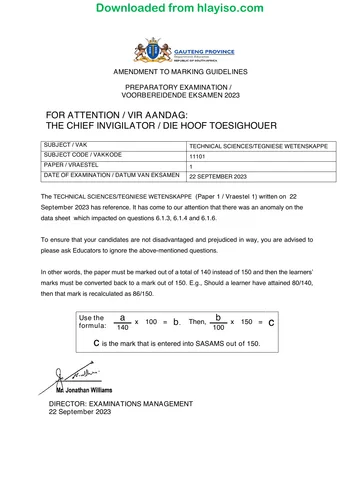
Technical Sciences Grade 12 P1 GP Prelim 2023 Memo (English)
Memorandum
Technical Sciences Grade 12 P1 Gauteng Mock 2021 Memo (Eng)
Question paper
Technical Sciences Grade 12 P1 Gauteng June 2025 QP (Eng)
Question paper
Technical Sciences Grade 12 P1 Gauteng Mock 2025 QP (Eng)
More from Grade 12 Technical Sciences
Annual teaching plan
Gr 12 Tech Sci ATP 2023 24
Question paper
Technical Sciences Grade 12 P1 Eastern Cape Mock 2025 QP
Question paper
Technical Sciences Grade 12 P2 Eastern Cape Mock 2025 QP
Question paper
Technical Sciences Grade 12 P1 NSC June 2025 Question Paper
Question paper
Technical Sciences Grade 12 P2 NW June 2025 QP (Eng)
Errata