Blouberg Ridge Primary School
Social Sciences: History Teachers: ……………………...
Marking Guideline Grade 4
Date: 28 June 2021 Time: 1 hour
Examiner: L. Arbuckle Moderator: …………………….……
Task 3: Controlled Test Total: 35
Section A: (16)
Question 1: Match Column A with Column B by filling in the correct letter in Column C.
Column A Column B Column C
1.1 Evidence a. A statue or structure that has been
established to remind people of a 1.1 C
person or event.
1.2 Memorial b. An object made by a human being,
usually of historical interest. 1.2 A
1.3 Artifacts c. Something that provides you with
proof. 1.3 B
LO (3)
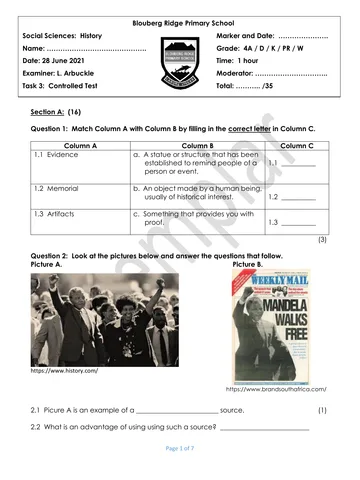
Question 2: Look at the pictures below and answer the questions that follow.
Picture A. Picture B.
https://www.history.com/
https://www.brandsouthafrica.com/
2.1 Picure A is an example of a visual source. LO (1)
2.2 What is an advantage of using using such a source? A photograph shows reality OR
Page 1 of 8
You're offline
Skip to contentMemorandum
Grade 4 History Mid Year Examination 2021 Marking Guidelines
History · Grade 4 · June Exam · 2021. Memorandum, 8 pages. Read online or download the PDF.
- Subject
- History
- Grade
- Grade 4
- Document type
- Memorandum
- Year
- 2021
- Exam period
- June Exam
- Pages
- 8
- File size
- 527.8 KB
Loading document…
Loading document…
1 of 8
Document textSearch extracted text and jump to a page.
It shows what was really there when the photo was taken. MO (1)
2.3 Identify the source of information in picture B. Written source LO (1)
2.4. Explain why you think the event in picture A was written down. The information
was recorded long ago and we can still read about it today OR This information
can be kept and used for many years. MO (1)
2.5 In your opinion, why do you think it is important to have different types of sources
of information about the same event? Any relevant answer. Different sources
show different information. OR It gives us more information about the event. HO (1)
2.6 Complete the table below by filling in the missing information.
Sources Examples
Oral sources a. stories, songs, interviews
b. Material sources Objects
LO (2)
Question 3: Read the diary entry below and answer the questions that follow:
My Week Monday Tuesday
June 2018 I caught the early bus I did my homework
to school because I and studied hard for
Maria Plaatjies had tennis practice. A my test.
traffic jam made me
late.
Page 2 of 8
Wednesday
Thursday Friday
I played with my
brother. We rode our It was Mom’s birthday I wrote my spelling test
bikes. today. Granny made today. I got full marks!
a yummy cake!
3.1 Using the information above, how do we know that Maria takes her studies seriously?
It says that Maria did her homework and studied for her test She got full marks for
for her spelling test. MO (2)
3.2 Is Maria a sporty person? Explain your answer. Yes. She plays tennis OR she likes
riding her bike with her brother. MO (2)
3.3 What other source of information could we use to find out about her day?
An oral source of information. MO (1)
3.4 Give one disadvantage of the source mentioned in question 3.3. Any relevant
answer. She could get confused / forget details / not tell the truth / be misheard
or misunderstood. MO (1)
Page 3 of 8
Section B: (19)
Question 4: Complete the mind map below by filling in the missing information.
Any three answers. Qualities of a
democratic leader
are …
a. Supports his followers
Can handle criticism.
Has consideration for everyone. b. Listens to others
Is helpful
Takes part in everything
c. Encourages people
Does not criticise https://www.kindpng.com/
LO (3)
Question 5: Answer the questions below.
5.1 Explain why Nelson Mandela was arrested and sent to prison. Nelson Mandela led
protest marches through the streets / He broke many laws / The government didn’t
like what he was doing. MO (1)
5.2 Nelson Mandela believed in a (democratic / autocratic) society. LO (1)
Page 4 of 8
5.3 Look at the pictures below and complete the timeline.
Nelson Mandela was
born on 18 July 1918.
Nelson Mandela was
elected as South Africa’s
first democratic president in
1994. https://www.theguardian.com/
http://attigs.blogspot.com
/
https://www.brandsouthafrica.com/
https://www.independent.co.uk/
Nelson Mandela and his friends
wrote the Freedom Charter in 1955. Nelson Mandela was convicted
and sent to prison in 1964.
Year Information
a. 1918 Nelson Mandela was born.
1955 b. Nelson Mandela and his friends wrote the Freedom Charter.
1964 Nelson Mandela was arrested and sent to jail.
c. 1994 d. Nelson Mandela became president of South Africa.
MO (4)
Question 6: Rewrite the following sentences so that they are true.
6.1 A protest is an action that shows happiness about something.
Page 5 of 8
A protest is an action that shows unhappiness about something. MO (1)
6.2 A form of government where all people of the legal age choose their leader
by voting is called an autocracy.
A form of government where all people of the legal age choose their leader
by voting is called a democracy. MO (1)
Question 7: Write a paragraph about the person shown below in the picture. Use the
writing frame to help you write your paragraph. Remember, this is NOT for marks.
In a gentle way, you can
change the world. Anger is the enemy
of non-violence.
https://www.ndtv.com/
You must be the change
you want to see in the
world.
Who is the man in the picture? Mohandas (Mahatma) Gandhi
What type of protest did he believe in? He believed in non-violent protest action
called Satyagraha.
Write one quote from above to show this. In a gentle way, you can change the world. /
Anger is the enemy of non-violence.
How did he fight for the rights of South Africans? He fought against the unfair laws.
Now write your paragraph neatly below. THIS PART IS FOR MARKS
Mohandas (Mahatma) Gandhi believed in non-violent protest action called
Page 6 of 8
“Satyagraha” which means the force that comes from truth and love or non-violence.
He said “In a gentle way, you can change the world.” OR “Anger is the enemy of non-
violence.” He fought against the unfair laws in South Africa. HO (4)
Question 8: Answer the questions below.
8.1 What does Mahatma mean in English? Great Soul LO (1)
https://www.travelground.com/
8.2 Discuss why a statue was erected of him in Pietermaritzburg. Any two relevant
answers.
To honour and remember him for what he did in South Africa.
To remember how he fought peacefully against the unfair laws.
He was thrown off the train in Pietermaritzburg as he was sitting in a white’s only
compartment.
To remember the “Great March” that helped change many unfair laws. HO (2)
8.3 What was “The Great March”? A protest organized by Gandhi. Thousands of
men, woman and children walked from Natal to Transvaal (KwaZulu Natal to
Gauteng) to protest against unfair laws. MO (1)
Page 7 of 8
Page 8 of 8
Recommended for this subject
Published documents with matching subject and grade metadata.
Related documents
Matched using subject, grade, language, document type and exam metadata.