
DEPARTMENT OF EDUCATION
LIFE ORIENTATION
GRADE 12
CURRICULUM RECOVERY
BOOKLET
TEACHER GUIDE
TABLE OF CONTENTS
1 | LIFE ORIENTATION TEACHER GUIDE GRADE 12
Skip to content
View all
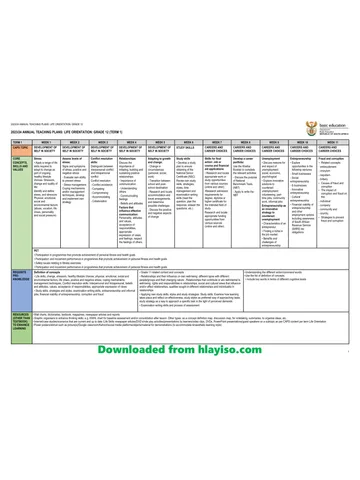
Life Orientation Grade 12 Life Orientation 2020 QP
Grade 12 Life Orientation question paper from the Life Orientation 2020, 172 pages. Read online or get the free PDF download, memo linked when available.
Life Orientation · Grade 12 · Life Orientation · 2020. Question paper, 172 pages. Read online or download the PDF.
- Subject
- Life Orientation
- Grade
- Grade 12
- Document type
- Question paper
- Year
- 2020
- Exam period
- Life Orientation
- Curriculum
- CAPS
- Pages
- 172
- File size
- 9.2 MB
Free to read online, no sign-up needed
Loading document…
Loading document…
1 of 172
Document textSearch extracted text and jump to a page.
1. 2020 National Revised Teaching Plan 3
2. 2020 National Phased Plan 8
3. Programme of Assessment (Revised) 10
4. Term 1:
Class Notes 11
Informal assessment 43
Marking Guideline 57
5. Term 2:
Class Notes 71
Informal assessment 83
Marking Guideline 93
6. Term 3:
Class Notes 104
Informal assessment 134
Marking Guideline 141
7. Corona Virus Information 151
8. Common Assessment Task (CAT) 167
Previous Question Papers
2 | LIFE ORIENTATION TEACHER GUIDE GRADE 12
2020
N ATIONAL R EVISED T EACHING
P LANS
G RADE 12
3 | LIFE ORIENTATION TEACHER GUIDE GRADE 12
Life Orientation
Revised National Teaching Plan
Life Orientation Grade 12 National Revised Annual Teaching Plan 2020 Term 2
TERM 2:
39 Days/ Week 1 Week 2 Week 3 Week 4 Week 5 Week 6 Week 7 Week 8
5=8 (5 days) (5 days) (5 days) (5 days) (5 days) (5 days) (5 days) (4 days)
weeks
Democracy Democracy Democracy Democracy Social and Social and Social and Social and
CAPS and Human and and Human and Human environmental environmental environmental environmental
Topics rights Human rights rights responsibility responsibility responsibility responsibility
rights
Evaluation Extent to Community Responsibilities Formulating a Formulating a
citizenship: regarding which media - Critical responsibility to of various personal personal mission
- Evaluating outcomes reporting analysis of provide levels of mission statement for life
own position of reflects a media and environments and government: statement for based on:
when dealing campaigns democratic campaigns services that laws, life based on: - Personal views,
with and events society: - Coverage promote safe and regulations, - Personal values, belief
discrimination topics of sport, healthy living: rules, and views, values, system, religion,
and human the media covered, sports - community belief system, ideologies,
rights in a positions personalities, services religion, lifestyle (physical
violations, democratic taken by and personal mission - Educational ideologies, and emotional
taking into society: editors, recreation statement for life and lifestyle well-being),
account the electronic space activities based on: intervention (physical and environmental
Bill of and print allocated - Personal views, programmes; emotional well- responsibility,
Rights: media to topics and beliefs and values, belief impact studies being), goals for studies
participation - Freedom geographical worldviews system, religion, environmental and career
in of distribution on recreation ideologies, responsibility, choices
discussions, expression (accessibility and physical lifestyle (physical goals for
projects, and of activity and emotional studies and on:
Topic,
campaigns, limitations information across well-being), career choices -
Concepts,
and events - to different cultures and environmental Actions/behaviour
Skills and
which groups in genders responsibility, vision on: in life
Values
address society) - Critical goals for studies - Actions/ - Immediate
discrimination analysis of and career behaviour in community and
and human media and choices life society at large
rights campaigns - Immediate
violations - Coverage on: community and
of sport, - society at large
sports Actions/behaviour
personalities, in life
and - Immediate
recreation community and
activities society at large
beliefs and
worldviews
on recreation
and physical
activity
across
cultures and
genders
4 | LIFE ORIENTATION TEACHER GUIDE GRADE 12
Definition of concepts: Citizenship, Grade 11 related content and concepts Understanding the different action/
discrimination and human rights South Africa’s diverse religions and belief command words
violation, Bill of rights, campaigns, and systems, own values and beliefs, various Use the list of definition of concepts.
events, electronic and print media, moral and spiritual issues and dilemmas, Include key words in terms of
freedom of expression and limitations, respect for differing opinions different cognitive levels
Requisite media campaigns, ideologies, beliefs, Environmental issues causing ill-health,
pre- worldviews, inhumane farming methods, depletion of
knowledge Safe and healthy living, levels of natural resources (flora and fauna),
government and their environmental climate change, mitigation, and
responsibilities, personal mission adaptation.?????
statement, personal views, values,
belief systems, religion, ideologies,
lifestyle, vision,
Bill of rights hand out on human rights, factsheet on human rights, academic but relevant documents of the role of
the media in a democratic country, list of definition of concepts.
Resources
Dictionaries, magazines, newspaper articles, DVDs, video clips, internet, past examination papers, relevant past
tests items, information from NGOs, government websites etc.
Complete Class/ homework activities consisting of different questions based on the above content.
The homework must blend the questions (low-mid and higher order), worksheets are used for the completion of both
the home / classwork. Marks will vary in terms of the nature of the questions.
The length will be determined by the stretch of content treated.
Informal Various nature of questions is used: short, discursive, columns, true or false with motivation, definition of concepts,
assessment attachment of concepts to expressions, scenario based, case studies, simulations, panel discussion, practical
demonstrations, etc. Both written and practical demonstrations are considered.
For practical demonstration, observation sheets must be used
After a reasonable amount of content has been treated, informal assessment must be given.
At least one informal assessment must be administered in each period.
Formal An exemplar of a short task is on the DBE website
assessment www.education.gov.za
5 | LIFE ORIENTATION TEACHER GUIDE GRADE 12
Life Orientation Grade 12 National Revised Annual Teaching Plan 2020 Term 3
TERM 3 Week 1 Week 2 Week 3 Week 4 Week 5
21 days/5 = 4 (5 days) (5 days) (5 days) (5 days) (1 day)
weeks
Development of the Development of Careers and career Careers and Careers and career
self in society the self in society choices career choices choices
CAPS Topics
Human factors that - Lifestyle diseases
cause ill-health, as a result of job contract: worker job contract: worker contract: worker rights and
accidents, crises, and poverty and gender rights and obligations; rights and obligations; conditions of
disasters: imbalances: cancer, conditions of service obligations; service
psychological, social, hypertension, - Labour laws: Labour conditions of - Labour laws: Labour
religious, cultural diseases of the Relations Act, service Relations Act, Employment
practices and heart and Employment Equity - Labour laws: Equity Act and Basic
different knowledge circulatory system, Act and Basic Labour Relations Conditions of Employment
perspectives tuberculosis, Conditions of Act, Employment Act
- Contributing factors: sexually transmitted Employment Act Equity Act and - Principles of equity and
eating habits, lack of infections including - Principles of equity Basic Conditions of redress
exercise, smoking, HIV and AIDS and redress Employment Act - Recruitment process:
Topic, Concepts,
substance abuse and - Recruitment process: - Principles of equity general trends and
Skills and Values
unsafe sexual participate in general trends and and redress practices
behaviour physical activities practices - Recruitment - Trade unions and
- Intervention for long-term - Trade unions and process: general organised labour
strategies: prevention engagement: organised labour trends and practices - Work ethics and societal
and control, early develop an action - Work ethics and - Trade unions and expectations
detection, treatment, plan societal expectations organised labour
care, and support - Long-term effects - Work ethics and work gives meaning to life
of participation: how work gives societal
physical, mental, meaning to life expectations
social, and
emotional how work gives
- Value-added meaning to life
benefits and
diseases of lifestyle
Definition of concepts: Grade 11 related content and Understanding the different
Ill health, Lifestyle diseases, action plan, human concepts action/ command words
factors causing ill-health, diseases of lifestyle, eating Balanced lifestyle, factors impacting Use the list of definition of
habits, negatively on lifestyle choices, risky concepts.
Job contract, workers’ rights, workers’ obligations, behaviour, socio-economic factors, Include key words in terms of
conditions of service, labour laws: Labour Relations lifestyle choices, role models, different cognitive levels
Requisite pre- Act (LRA), Employment Equity Act (EEA), Basic nutrition, and wellbeing,
knowledge Conditions of Employment Act (BCEA), equity and
redress, trends of recruitment, labour unions Competencies, abilities, and ethics;
(employer and employee organisations), ethics and advertisement, CV, work ethics,
societal expectations and value of work. meetings and their management,
interviews, job/ career interests,
expectancy and reality,
perseverance.
Dictionaries, magazines, newspaper articles, DVDs, video clips, internet, past examination papers and marking guidelines, relevant
Resources past tests items and marking guidelines, information from NGOs, government websites and other related websites.
other than the
textbook
. Complete Class/ homework activities consisting of different questions based on the above content.
The homework must blend the questions (low-mid and higher order), worksheets are used for the completion of both the
home / classwork. Marks will vary in terms of the nature of the questions.
The length will be determined by the stretch of content treated.
Informal Various nature of questions is used: short, discursive, columns, true or false with motivation, definition of concepts,
assessment attachment of concepts to expressions, scenario based, case studies, simulations, panel discussion, practical
demonstrations, etc. Both written and practical demonstrations are considered.
For practical demonstration, observation sheets must be used
After a reasonable amount of content has been treated, informal assessment must be given.
At least one informal assessment must be administered in each period.
Formal
Project or Written Task
assessment
6 | LIFE ORIENTATION TEACHER GUIDE GRADE 12
Life Orientation Grade 12 National Revised Annual Teaching Plan 2020 Term 4
TERM 20 Week 1 Week 2 Week 3 Week 4 Weeks 5-10
days/ 5 = 4 (5 days) (5 days) (5 days) (5 dais)
weeks
CAPS Study Study skills Careers and career Careers and career choices
Topics skills choices
for success: success: plans for life after school: life after school: record of plans and Final NSC
strategies strategies to record of plans and progress towards achievement of examination
to follow in follow in order progress towards those plans
order to to succeed in achievement of those - Admission requirements for
succeed in the Grade 12 plans degree/diploma or higher certificate for
the Grade examination - Admission requirements the intended field of study
12 - Revision of for degree/diploma or - Details of identified institutions that
examination own study skills higher certificate for the offer finance for the intended
Topic,
- Revision - Revision of intended field of study course(s): option 1 and 2
Concepts,
of own examination - Details of identified - Identified possible employment
Skills and
study skills writing skills institutions that offer opportunities
Values
- Revision finance for the intended - Letters of application and responses
of course(s): option 1 and 2 for employment/study/bursary
examination - Identified possible - A short CV, for application for part-
writing skills employment opportunities time or full-time employment or for a
- Letters of application and bursary
responses for
employment/study/bursary
- A short CV, for
application for part-time or
full-time employment or
for a bursary
Definition of concepts: Grade 11 related content and concepts
How to succeed in grade 12, revision of own study skills, Study skills, study styles, study strategy, examination writing
styles, methods, and strategies, skills, time management,
Personal career portfolio, post school plans, requirement for Diversity of jobs, work settings, Competencies, abilities, and
Requisite
admission to different educational fields and qualifications, ethics; advertisement, CV, work ethics, meetings and their
pre-
application tertiary fees, application for jobs management, interviews, job/ career interests, expectancy and
knowledge
reality, perseverance.
Understanding the different action/ command words
Use the list of definition of concepts.
Include key words in terms of different cognitive levels
Resources Dictionaries, magazines, newspaper articles, DVDs, video clips, internet, past examination papers and marking guidelines,
textbook relevant past tests items and marking guidelines, information from NGOs, government websites, etc.
Complete Class/ homework activities consisting of different questions based on the above content.
The homework must blend the questions (low-mid and higher order), worksheets are used for the completion of both
the home / classwork.
Marks will vary in terms of the nature of the questions. The length will be determined by the stretch of content
treated.
Informal Various nature of questions is used: short, discursive, columns, true or false with motivation, definition of concepts,
assessment attachment of concepts to expressions, scenario based, case studies, simulations, panel discussion, practical
demonstrations, etc. Both written and practical demonstrations are considered.
For practical demonstration, observation sheets must be used. After a reasonable amount of content has been
treated, informal assessment must be given.
At least one informal assessment must be administered on each period.
Revision exercises including previous QPs, etc.
Formal End year examination
assessment
7 | LIFE ORIENTATION TEACHER GUIDE GRADE 12
2020
N ATIONAL PHASED
CONTENT P LANS
GRADE 12
8 | LIFE ORIENTATION TEACHER GUIDE GRADE 12
GRADE: 12 LIFE ORIENTATION PHASE:
FET
REVISED CONTENT MAP
KEY TOPIC
Responsible Citizenship
Term 2:
The role of the media in a democratic society
Study Skill
Ideologies, beliefs and worldviews on construction of recreation
and physical activity across cultures and genders
Social and Environment and services which promote a healthy
environmental Responsibilities of various levels of
responsibility
Human factors that causes ill-health, accidents, crises, and
Term 3 disaster
Development of
Action plan for life long participation in physical activities.
the self in society
Career and career Core elements of a job contract
choices Refinement of portfolio of plans for life after school
Strategies to follow in order to succeed in Grade 12
Term 4
Study skills
Career and career Refinement of portfolio of plans for life after school
choices
9 | LIFE ORIENTATION TEACHER GUIDE GRADE 12
PROGRAMME OF ASSESSMENT
(REVISED)
GRADE 12
MARKS PER TERM
ASSESSMEN
TERM
T TASK RECORDING REPORTING
Written task 80 100
1
PET 20
(60 ÷ 60 x 100)
Short Task
2 60
100
(80 ÷ 80 x 100)
80
Project
3 100
(80 ÷ 80 x 100)
Final 80
Examinations
4
100
320 400
FINAL TOTAL
10 | LIFE ORIENTATION TEACHER GUIDE GRADE 12
TERM 1
CLASS NOTES
11 | LIFE ORIENTATION TEACHER GUIDE GRADE 12
Development of the self in society
Life skills required to adapt to change as part of healthy life style choices:
Identify, assess and manage stress.
What is stress?
o Stress is what we feel in situations we find difficult, challenging or even
frightening when we feel we can’t cope with the situation.
o It is a physical, mental or emotional strain that is caused by demands that
are place on a person.
o It is a physical, mental, or emotional factor that causes bodily or mental
tension which can be external (from the environment, psychological, or
social situations) or internal (illness, or from a medical procedure).
o It can initiate the "fight or flight" response, a complex reaction of nervous
and endocrine (hormones) systems.
Signs and symptoms of stress
Emotional
Low self-esteem
Loneliness
Irritability
Frequent crying
Frustration
Feeling ‘uptight’
Depression
Helplessness
Physical Mental
Frequent head ache or Confusion
migraine Can’t concentrate
Dizziness Reduce creativity and
Increase blood pressure productivity
Back pain Cannot make decision
Sore neck muscles Carelessness
Nausea, vomiting and High risk behaviour including
diarrhoea drug and alcohol abuse
Insomnia (sleep disturbances)
and night mares
What is good stress (Eustress)?
o Eustress is a positive form of stress having a beneficial effect on health,
motivation, performance, and emotional well-being.
12 | LIFE ORIENTATION TEACHER GUIDE GRADE 12
o Stress that makes you ready for action as it gives you adrenalin and
energy.
o For example: when you have to stand in
front of the class and speak. It is for a
short term and you can have sweaty
palms and a dry mouthy or butterflies in
your tummy.
What is bad stress/negative (Distress)?
o Distress is perceived as outside of our coping abilities, feels
unpleasant, decreases performance and can lead to mental and
physical problems.
o If the stress is more than you can cope with, it is unhealthy; may become
ill, unhappy and depressed, unable to do your task as well as you could
and a will have headaches or will not be able to sleep.
What is a stressor?
o A chemical or biological agent, environmental condition, external stimulus
seen as causing stress to individuals.
o An event that individuals might consider demanding, challenging, and/or
threatening individual safety
Types of stressors:
o Physical - stressors caused by health issues, trauma to the body, self-harm,
lifestyle choices and abuse.
Health issue Trauma Self-harm Lifestyle choices
Acute and Experience Alcohol and Lack of sleep
chronic illness violent attacks drug abuse Poor diet
Pregnancy Being a crime Cutting one- Lack of exercise
Menstruation victim self Too much
drinking and
smoking
o Environmental - stressors that are found in our surroundings causing
irritations. Some examples of common environmental stressors include:
- Poverty
- Noise
- Over crowding
- Pollution
- Natural disasters
- Poor ventilation
13 | LIFE ORIENTATION TEACHER GUIDE GRADE 12
- Insects
o Social – stressors caused by the people around you that stems from one’s
relationships with others and from the social environment in general. Some
examples of common environmental stressors include:
- Poor communication
- Conflict
- Bullying
- Negative peer pressure
- Changes in family structure e.g. divorce, new siblings
o Emotional – stressors brought be people’s reactions to difficult situations
with negative emotions. Some examples of common environmental
stressors include:
- Death
- Moving house
- Not coping well with uncertainty about life port-matric
- Negative thoughts about life
- Unrealistic expectations
- Frustration, anger, conflict and anxiety
What is stress management
o A wide spectrum of techniques and treatments aimed at controlling a person's
level of stress, especially chronic stress, usually for the purpose of and for
the motive of improving everyday functioning.
o It consists of making changes to one’s life in a constant stressful situation,
preventing stress by practicing self-care and relaxation and managing
response to stressful situations when they do occur.
Why is it important to manage stress?
o Your body produce cortisol and adrenalin. These are 2 stress hormones.
Cortisol is the hormone produced by fear, results in anxiety. Adrenalin- is
the hormone that prepares the body to react physically to a threat. If you
fail to manage your stress your body can produce too much of the hormones
for too long. The stress will damage your body and change to chronic
diseases like high blood pressure.
How to manage stress: Behaviours, techniques, strategies and examples of
ways in which stress can be managed
14 | LIFE ORIENTATION TEACHER GUIDE GRADE 12
o Decrease negative self-talk. Challenge negative thoughts about yourself
with alternative neutral or positive thoughts. "My life will never get better"
can be transformed into "I may feel hopeless now, but my life will probably
get better if I work at it and get some help."
o Learn to feel good about doing a competent job rather than demanding
perfection from yourself and others.
o Meditation and relaxation exercises (abdominal breathing and muscle
relaxation techniques); simple deep breathing exercises can assist greatly
in relieving stress because it helps to calm the mind.
o Exercise and eat healthy foods regularly at least 3 times a week.
o Avoid excess caffeine intake which can increase feelings of anxiety and
agitation.
o Don't use illegal drugs, alcohol and tobacco.
o Apply assertiveness skills. For example, state feelings in polite, firm, and
not overly aggressive or passive ways ("I feel angry when you yell at me"
"Please stop yelling"). Rehearse and practice situations which cause
stress. One example is taking a speech class, if talking in front of a class
makes you anxious.
o Apply practical and effective coping skills; break a large task into smaller,
more attainable tasks.
o Take a break from stressful situations; activities like listening to music,
talking to a friend, drawing, writing, or spending time with a pet can reduce
stress.
o Build a network of friends who help you cope in a positive way.
o Keep a stress journal; can help to identify the regular stressors in life and
the way one deals with them. Each time you feel stressed; keep track of it
in your journal. As you keep a daily log, you will begin to see patterns and
common themes. Write down:
o Analyse your stress; what caused your stress (make a guess if you’re
unsure),How you felt, both physically and emotionally, How you acted in
response, what you did to make yourself feel better.
o Not all stress can be avoided, and it’s not healthy to avoid a situation that
needs to be addressed. You may be surprised, however, by the number of
stressors in your life that you can eliminate.
15 | LIFE ORIENTATION TEACHER GUIDE GRADE 12
o Learn how to say “no” – Know your limits and stick to them. Whether in your
personal or professional life, refuse to accept added responsibilities when
you’re close to reaching them. Taking on more than you can handle is a
sure recipe for stress and can lead to burn out.
o Avoid people who stress you out – If someone consistently causes stress in
your life and you can’t turn the relationship around, limit the amount of time
you spend with that person or end the relationship entirely.
o Plan: Take control of your environment e.g. If the evening news makes you
anxious, turn the TV off.
o Cut down your to-do list – Analyse your schedule, responsibilities, and daily
tasks. If you’ve got too much on your plate, distinguish
between the “should” and the “must.” Drop tasks that
aren’t truly necessary to the bottom of the list or eliminate them.
16 | LIFE ORIENTATION TEACHER GUIDE GRADE 12
Source: https://angelobenuzzi.files.wordpress.com/2013/02/stress-management-poster-web-apr121.jpg
17 | LIFE ORIENTATION TEACHER GUIDE GRADE 12
Conflict Resolution skills
Conflict - When there are disagreements, opposing viewpoints, or struggles for
power between people.
Types of conflict
Conflict resolution skills (solve both intra and interpersonal conflict)
Source: https://www.bing.com/images/search?q=Resolving+Conflict+Techniques&FORM=IRIBIP
o Be assertive: do not become aggressive, but state your problem
clearly and explain which of your rights are being ignored or violated.
18 | LIFE ORIENTATION TEACHER GUIDE GRADE 12
o Use I- statements: let the other person know how you feel and respond
to the problem using -I statements: e.g. I feel that you do not understand
me when…
o Keep your feelings under control: Keep your feelings under control so
that you do not hurt the person physically or emotionally, e.g. talk and
do not shout.
o Do not accuse: Try not to blame the other person. Accept the conflict
and deal with it.
o Accept compromise: agree on a middle situation which is not
completely in favour of one side, but not unacceptable for either of you.
o Move on: when the conflict is over, move on. Do not refer to previous
conflict
o Cool down before your express your feelings: be in control of your
feelings.
o Recognize the other person’s point of view even if you do not
agree: agree that it is fine to have different opinions but do not fight.
o Respect the other person: if you show that your respect the other
person, it will help to solve the conflict.
o Be willing to make peace or seek solution: Maintaining conflict is not
a positive way of dealing with it.
Initiate, build and sustain positive relationships and importance of
communication
Stages in a relationship
o Initiating
o building
o sustaining relationships
How do I initiate, (begin), keep friends and build the relationships?
Positive communication leads to positive relationships. Our ability to communicate
with others will determine the success of our relationships with them
Communication is about understanding others and communicating our feelings,
beliefs and attitudes to them.
o Initiating positive relationships
- Establish trust; be open, talk about what is important to you, let the other
person get to know who you are.
- Be honest; express yourself, discuss your thoughts and feelings
sincerely.
- Be attentive; listen attentively (pay attention), be genuinely interested in
what other person has to say, find out what interest the other person has
and speak your interest as well.
- Take time to get to know each other
o Building positive relationship
- Treat each other with respect; appreciate each other’s uniqueness;
respect the rights of everyone, understand each other’s emotions, allow
each other the freedom to be themselves.
- Behave appropriately; be kind and generous, accept responsibility for
your action, support each other, commitment.
- Communicate with honesty; develop empathy, control your emotions.
19 | LIFE ORIENTATION TEACHER GUIDE GRADE 12
o Sustaining positive relationships
- Sharing; what is important to you and that you trust and appreciate the
other person, your feelings, your ideas, and your opinions.
- Being compassionate; allows one to understand and support each
other.
- Trust and honesty; trusting each other means you can rely on each
other’s support and being honest means, you can always believe the
other person.
- Tolerance; accepting the views, beliefs or behaviours of others different
from you in which you will both feel accepted and appreciated in the
relationship.
Build and sustain positive relationships with good communication and
listening skills.
o Effective communication
- A two-way information sharing process which involves one party
sending a message that is easily understood by the receiving party.
- It’s about understanding the emotion and intentions behind the
information. As well as being able to clearly convey a message, one
needs to also listen in a way that gains the full meaning of what’s being
said and makes the other person feel heard and understood.
o Factors that influence effective communication
- Personality: The way you act, behave, and react and your attitudes all
form part of your personality. Remember that we all act in a certain way
in a certain situation.
Sometimes a shy person is seen as boring and uninteresting until you
get to know him or her. Other people are extraverts and they might
intimidate you with their way of communication. Other people hide
behind their “weaknesses” by seeking attention all the time and they
need to be the centre of attention. Your own personality will determine
20 | LIFE ORIENTATION TEACHER GUIDE GRADE 12
whether you are attracted of put off by the other person’s way of
communicating.
- Attitudes and values: If you have an attitude (you think and act) that you
are better than others, if will affect communication. If you think that only
your ideas, beliefs and values are right and you do not show respect, you
will not be a good listener and you will not allow others to freely express
their views. This will block communication between you and other people
and can lead to conflict.
- Acceptance of responsibilities: Responsibility means you are
accountable, do your duty and take responsibility for your actions. You can
be trusted to do a job, because you take responsibility. If you make a
mistake, you don’t try to shift responsibility to somebody or something else.
Effective communication can only t happen where there is trust, reliability
and responsibility. Friendship comes with responsibilities.
- Appropriate expression of views and feelings: Appropriate expression
of views and feelings mean that you say what you think and feel, but in a
way that does not hurt or offend others.
- Respect the feelings of others: When you show respect for the feeling of
others, they will show respect for you and your feelings.
21 | LIFE ORIENTATION TEACHER GUIDE GRADE 12
Transition between school and post-school destination
22 | LIFE ORIENTATION TEACHER GUIDE GRADE 12
Change in circumstances
Speak to
somebody
you trust
•Make a plan to deal
Know with each aspect
what the
changes •The more information
will be you have the easier it
will be to cope.
•Learn from
previous situations
Think of and knowledge and
previous apply it.
changes •Learn from
mistakes others
have made
Look for •See it as a
the good challenge and
aspects opportunity to
of the develop and grow.
change •Take charge
Give yourself
time to adapt
Guidelines for Managing Change:
o Take care of yourself. Managing change can be stressful if you are not
prepared, so be sure to take care of yourself. Eat a balanced diet, exercise
regularly and get enough sleep. Take time to relax. When you are healthy,
you are better equipped and in a better frame of mind to handle anything. If,
on the other hand, you are already stretched to your limits and having trouble
coping, change will only add to your difficulties.
o Be open and flexible. Knowing that change can occur at any time helps you
accept and adjust to it when does happen. Be able to let go of expectations
that no longer fit what is currently going on in the world. Certainly, at no other
time in history has there ever been so much change or happening as rapidly
as it is today. Even though most of us prefer to settle into comfortable
predictable routines, realize that your current routine is probably temporary.
o Stay positive and put it in perspective. We all have the ability to control our
inner and emotional responses to whatever happens. Our attitudes towards
it and how we choose to deal with it is totally up to us. With that in mind, look
for the positive outcomes of change - there are always some. In fact, how you
react to it can often determine the outcome.
23 | LIFE ORIENTATION TEACHER GUIDE GRADE 12
o Take control of your life. You can manage change by taking control of your
life. Use your critical thinking skills. We all know that some change is
forthcoming. Therefore, ask yourself what can you do in advance to help
prepare for the transition. Make a list of options. Determine the best
approaches. Take charge of your thoughts and actions. If you are mentally
and psychologically prepared for change, it will not rock your world when it
happens.
o Make changes. Become the change agent. Sometimes we are forced into
making changes because we allow ourselves to get stuck in a routine or
lifestyle that is no longer working for us. If, however, we anticipate it and
become active rather than reactive, we can take control of a situation. We can
look at where we need to make adjustments and then take action. Doing so
can prevent the stress and anxiety that accompany unexpected change.
Change in life is inevitable (unavoidable). Rather than fear or try avoid it, our best
course of action is to accept it, meet it head on and allow it to be a positive,
constructive force in our lives.
Positive and negative aspects of change
We are often resistant to change, and we don’t realize that change itself is constant
(continous) even if you resist or avoid it, it will enter your life just the same. When
you initiate the change yourself, it’s pretty easy to adapt to it, since it’s a wanted
one.
POSITIVE
- Exciting
- Challenging
- Motivating
- Can lead to better things
- Demands that you keep flexible
- Keep your brain alert
- Allows you to discover hidden
potential
- Keeps your life interesting
- Opportunities
- Can lead to personal growth
NEGATIVE
- Can cause stress
- Not always for the better
- May make you feel unsure and
insecure
- Can be irritating
- Loss
- Fear of the unknown
- Threatening
- Painful, for example, illness
- Sorrowful, for example, death
24 | LIFE ORIENTATION TEACHER GUIDE GRADE 12
Benefits of change
o Personal growth
You grow and learn new things every time something changes. You discover new
insights about different aspects of your life. You learn lessons even from changes
that did not lead you to where you wanted to be.
o Flexibility
Frequent changes make you easily adapt to new situations, new environments,
and new people. As a result, you do not freak out when something unexpectedly
shifts.
o Improvements
We all have things in our lives we’d like to improve—finances, job, partner, house,
etc. All of us know that nothing will improve by itself. We need to do things
differently to make that happen. Without change, there’d be no improvements.
o Life values
From time to time changes make you re-evaluate your life and look at certain
things from a different perspective. Depending on what the change is, it may also
reinforce your life values.
o The Swell effect
Often, we give up because we cannot accomplish the difficult task of making a
huge and immediate change. That is when small changes become extremely
valuable. One shift at a time, small changes will eventually lead you to the desired
big one.
o Strength
Not all changes lead you to pleasant periods of life. Unfortunately, we do not live
in fairy tale and sad things happen, too. Overcoming the tough period will make
you stronger.
o Progress
Changes trigger (cause) progress. Things move forward and develop.
o Opportunities
One never knows what each change may bring. When you turn from your usual
path there will be plenty of different opportunities waiting for you. Changes will
bring new choices for happiness and fulfillment.
o New beginnings
Each change is a turning page. It is about closing one chapter and opening
another one. Changes bring new beginnings and excitement to life.
o Lead you to where you want be
Doing the same things in exactly day in and day out leads a completely dull,
extremely predictable, and uninteresting life. That is how your life would be
without changes.
So next time you get the temptation to avoid or resist the change, aim instead to
initiate the ones that will.
And remember—if there were no change, there would be no butterflies!
Adapted from: https://tinybuddha.com/blog/10-powerful-benefits-of-change-why-embrace-it/
25 | LIFE ORIENTATION TEACHER GUIDE GRADE 12
“If you do not create change, change will create you.” ~Unknown
Life cycle
Baby
Young child
/ teenager
Grand parent, old age
Parent / adult
Young adult
o Stages of development may be marked by rituals; rituals will depend on which
traditional practice your culture follows.
o The rituals are also called rites of passage that helps to make it easier to
move from one phase to the next Rituals are ceremonies used by people to
mark the transition or change from one stage in the life cycle to another.
o They are a way for cultures to teach values and ways of living.
26 | LIFE ORIENTATION TEACHER GUIDE GRADE 12
o Different stages will allow different rights, but it will also mean different
responsibilities.
Personal life style plan to promote quality of life
Healthy life style
o It refers to healthy living, leaving one fit, energetic and at reduced risk for
disease, based on the choices one makes about their daily habits.
o It is characterized as a “balanced life” in which one makes “wise choices”.
o It outlines the positive and voluntary measures that a person can implement
to maintain good mental and physical health that includes healthy habits in
terms of diet, treatment of the body, sex, and the environment.
Personal lifestyle plan
o A plan or strategy to live in a specific way which is to live a healthy and
balanced life.
o The aim is to: improve or maintain a good quality of life, promote one’s well-
being and live a fulfilling and happy life.
Different aspects of lifestyle plan that promote quality of life.
- Physical exercise
- Nutrition and weight management
- Outdoor recreation and relaxation
- Sleep
- Promote healthy habits
- Abstention / safe sex
- Avoid harmful substances
- Cope with change
- Emotional health
- Stress management
- Time management
- Conflict resolution
- Relationships and communication
- Volunteer / help others
27 | LIFE ORIENTATION TEACHER GUIDE GRADE 12
Study skills
Process of assessment and examination writing skills:
o What is assessment?
It is the continuous planned process of gathering information on achievement.
o Assessment is important because:
- It identifies how one cope with new knowledge, content and skills.
- It is an opportunity to enhance (improve) individual growth and
development
- It allows one to monitor progress
- It gives feedback on one’s growth and development
o Types of assessment?
Study skills, strategies and styles
Study skills Skills that help to make the best of the learning
experience; essential to select information when
overwhelmed with various information.
Skills that can be learnt to enhance one’s potential.
28 | LIFE ORIENTATION TEACHER GUIDE GRADE 12
Study Different approaches or ways of learning
strategies The way one prepares to take in, understand, organise
and recall information
Use the one that help you to remember best
Study styles Ways one used to get information in and out of the
brain
Based on one’s study style choose strategies that
works for the person.
Study habits
29 | LIFE ORIENTATION TEACHER GUIDE GRADE 12
Examination writing skills
o Multiple Choice
- This question test factual knowledge
o Essay questions:
- The key to writing a good essay is to understand the instructions
properly. What does the examiner want?
30 | LIFE ORIENTATION TEACHER GUIDE GRADE 12
Preparing for exams
Presenting a question paper:
The following are some points to keep in mind to present the paper well:
1. Hand Writing – Keep the hand writing legible. If the examiner cannot read your
writing you will lose marks. Do not do too much scratching around on the paper.
This really makes the paper look dirty.
2. Margins - Draw margins on both side of the paper. This is generally very
important that your answers are in the centre of the answer paper and visible
properly. The best time to do it is the time when you get the answer sheets and
before you get the question paper, so this does not waste any time of attempting
the paper.
3. Figures – Generally you can draw figures with pen. But preferably draw them
with pencil. Generally, a free hand diagram would do in an engineering paper
but when done with a pencil is much easier to correct and change than a one
drawn with pen. And it looks much neater.
4. Rough Work – Do not do rough work of any kind just next to the sum. Do the
rough work in the margin. Or you could just mark the last page as rough work
and do all the rough work there.
5. Sub Question – All the sub question of a question should be attempted in a
sequential order. If you do not know a sub question leave appropriate place for
it. Do not attempt the sub question anywhere else. This would be highly irritating
for the examiner. He might not even check that answer.
NB. All these small things do not take up a lot of time during the paper but if not done
they make the paper untidy. Due to this the examiner might not be able to read exactly
what you have written and it might affect your marks drastically. So do keep these tips in
mind.
31 | LIFE ORIENTATION TEACHER GUIDE GRADE 12
Key examination question words and their meanings
Key word Meaning
Analyse Break up into separate parts and discuss, examine, interpret, explore and
investigate each part. Say how each part is important. Explain how the
parts are linked or related.
Apply Use in practical way. When you apply you show in a practical way what
your understanding is. Use your knowledge and understanding of the topic
to make it relevant to a situation, issue or problem.
assess Judge or estimate the nature, quality or value of something. Make a value
judgement that you justify by giving reasons.
calculate You need to get to an answer by using numbers. You will add, subtract,
multiply or divide numbers to reach an answer.
comment Give your opinion on, explain or criticise. Make a judgement based upon
the evidence.
compare Look at two or more things. Identify similarities and differences. See how
they are the same, and how they are different. Focus more on similarities
than differences.
Complete Add the missing information.
consider Think about and give your opinion.
Contrast Focus on the differences between two or more things. Show them in
opposition to each other.
create Put together ideas or parts to develop an original idea; engage in creative
thinking; offer a novel or new suggestion or item.
Criticise You need to make judgements to show your own ideas and evaluation.
critically Show approval or disapproval, or find mistakes or faults, and merits or good
analyse aspects; give reasons.
Define You need to give the exact meaning of the term or words. Definitions are
short and exact. This is not a discussion.
Describe Give an account of something where you recall what you have learned or
state what you observed.
Determine Find out the facts. For example, determine how many learners in Grade 11
do physical exercise more than four times a week.
Discuss Write about something; compare a number of possible views about an
issue or problem. Debate, consider, and argue the issues. Include
comparisons and contrasts, look at pros and cons. Say what you think
about the topic. Give a full answer in sentences, not just a list in point form.
Always give a conclusion.
do you Give your OWN opinions about an issue or problem. Pay attention to the
think reason you give and arguments you offer; you will not be given marks just
for an opinion. Provide well-reasoned or logical reasons for your opinions,
based on facts.
Enumerate This is the same as list. Give a number of points.
evaluate Give your own opinion and /or the opinions of others. Give evidence to
support your evaluation. Give an indication of the amount, quality or value
32 | LIFE ORIENTATION TEACHER GUIDE GRADE 12
of something. Compare a number of possible views about an issue or
problem. Make judgements based on facts.
examine Carefully look at something and in detail so you can comment on it. Break
down an issue or problem into smaller parts to understand it. Then explain
what you have learned.
Explain Give details, describe, make clear, make it understandable. Make
something plain or simplify. Describe in detail so that it can be understood.
Always give examples when you are asked to explain.
Give You supply, provide, present, or offer information.
Identify Recognise and name someone or something; to say who or what they are.
Illustrate Give realistic examples. Explain very clearly. You can use examples and
comparisons.
Interpret Show your understanding of the topic, comment on it, give examples.
Describe relationships, explain the meaning.
in your This asks you what you think about something or feel about something. For
opinion example, in your opinion do the youth do enough to celebrate Youth Day on
the 16th of June?
List Give a short list of the points. State in the shortest way. Be brief. Do not
discuss or write an essay. Usually you write items one below the other in a
list.
Match Find things that go together; find things that are similar or connected to
each other.
Measure Find the size, quantity, etc. of something. Judge the importance, value or
effect of something
mention Write about something without explaining. There should be no detail; keep
it brief.
name Similar to mention; give a brief answer without long explanations.
Outline Summarise, describe main ideas and core points, concepts or events. Give
an overview.
Prove Give the facts to support the issue.
State Explain exactly and clearly as it is.
suggest Give possible reasons or ideas. These must be believable; they do not
necessarily have to be proven to work.
Summarise Give a very short and brief account. Include a short conclusion. Do not give
unnecessary details.
33 | LIFE ORIENTATION TEACHER GUIDE GRADE 12
Top 10 Mistakes
The top 10 mistakes that most students make when attempting a test or
examination paper, and how to overcome them.
MISTAKE HOW TO CORRECT
1. Spotting only some questions or Start revising long before the exams in order
cramming too much information into your to be able to cover all the work. Plan your
memory study time; develop personal time table.
2. Arriving late to the exam Give yourself enough time to travel to venue.
venue/failing to bring necessary Make a note on the exam time table.
stationary e.g. pen, calculator, etc.
3. Panic before or during paper Prepare well, sleep enough before a paper.
Tell yourself it is not the end of the world and
only aa exam paper. Take a deep breath to
calm you down.
4. Failing to read instructions and scan Read the instructions and make sure of the
through questions number of questions you need to answer.
Scan through a paper before you begin to
write. Answer the easy questions first.
5. Failing to allocate time for each Allocate time to each question. Plan your
question/failing to plan your time exam time before you go to the exam room.
Know how long you should take for the short
and long questions. Allocate your time
accordingly. If you fail to plan, you plan to
fail!
6. Misinterpreting question/producing Underline the key words in the question.
and incoherent answer/writing too much Make sure you just answer what the question
or too little requires.
7. Not sure how to start or end question Don’t waste time by starting over and over
again. The emphasis should be on the flow of
your ideas. Make sure paragraphs are
coherent
8. Failing to write legibly (clear enough If you’re a looks like a u and your v looks like
to read) a u you will lose marks as the marker give up
because he cannot read your answer.
Practice your handwriting
9. Reading and writing too slowly Practice your reading will increase your
reading speed. Practice you writing skills or
you can try different types of pens and
pencils.
10. Forgetting to write your personal Always start your exam by writing your
particulars e.g. exam number, ID personal detail on your exam book
number etc. Write your name and particulars on the loose
pages, as a whole stack of papers may fall
apart during transit
34 | LIFE ORIENTATION TEACHER GUIDE GRADE 12
Importance of obtaining the NSC
o It allows you to study at a Higher Education Institute.
o It is a basic requirement if you want to apply for a bursary.
o Most employees require NSC, it’s a basic requirement for many jobs.
o It shows employees that you have some skills and knowledge and that you
know how to learn.
3. Develop a study plan for grade 12
For example:
Careers and career choices
Commitment to a decision taken
o Commit to a decision
- You should make a decision based on your interests, strengths,
weaknesses, skills abilities and personality and commit to it.
- You may have decided to further your future career path, but a decision
alone does not lead to much.
- You have to act on your decision.
- Make an effort to apply, get all the necessary forms and organise all
the requirements for next year’s choice.
- You have to apply this year, as early as June. Most institutions look at your
grade 11 results and give you provisional acceptance. Final acceptance depend on
grade 12 results.
Course Application for higher Education
o You will complete a student application/registration form
o Make sure the institution you apply form offers the course you want to study.
o Check that you meet the requirements for the particular educational
institution.
o Fill in application forms
- Use plain block (capital) letters
35 | LIFE ORIENTATION TEACHER GUIDE GRADE 12
-Be careful not to crease or dirty the form
-Send the original application form with certified copies of the document
the institution required e.g. ID
- Always keep a copy of your form.
o Apply in good time. Late application is costly.
o You can get application forms from: online on the institution website, via mail
from the institution you applied to and Student Support Centre.
o Availability of funds (options)
- Working and studying at the same time
- Applying for bank loan
- Applying for bursary or scholarship
- Funding assistance from NSFAS
Job application
- Most employers require applicants to complete a job application, even if
they submit a resume and cover letter. Employers use job applications to
ensure that they have consistent information for all candidates.
- In addition, by signing a job application or acknowledging online that the
information in the application is accurate, the candidate is attesting to their
job and educational history. This means that you can be denied
employment or fired in the future if you aren't truthful about your
employment record.
- Before you complete a job application, either online or in-person, it's
important to have all the information you need to complete the application
on hand. Review these job application tips to be sure you're prepared to
submit an application for employment.
o Job Application Tips
- Review Your Employment History. You'll need your resume or a list of your
employment and education history to make sure that you're listing the correct
dates of employment, job titles, and education. Your resume should match
the job application perfectly - discrepancies will be noticed.
- Download a Sample Job Application. Download a job application
sample and practice filling it out. That way you can be sure you have all the
information you need, in advance.
- Ask for an Application. If you are applying for a position in-person, ask for
an job application, then take it home with you to complete.
- When You Apply In-Person. When you stop in to pick up or drop off a job
application, be sure you are dressed appropriately. You may end up
speaking to the manager and it's important to look professional, just in case
you get an on-the-spot interview.
- In-Person Job Application Checklist. Review this list of information you'll
need to apply to complete an in-person job application.
- Online Job Applications. Job applications for many companies are
available online. Large employers offer such a r service. In fact, some
employers no longer accept paper applications and require applications to
apply via their company web site or the site where they have posted job
openings.
36 | LIFE ORIENTATION TEACHER GUIDE GRADE 12
- Follow the Instructions. Follow the instructions when completing both
online and paper job applications. Check the company web site or the fine
print on the job application form for instructions, because the most important
rule to remember when completing a job application is to follow the
directions.
- Review Before You Submit. Thoroughly read the instructions for applying
for employment - before you click the Submit button or turn in your
application. The company will regard applications that are submitted
correctly and accurately in a much better light than those from candidates
who don't follow the instructions. In fact, some companies won't accept
incomplete applications, so you'll be rejected before you even apply if you
don't submit your job application correctly.
- Be Prepared to Take a Test. Some companies test applicants for
employment to determine if the candidate is a good match for the jobs they
are hiring for. Companies who conduct pre-employment tests (talent
assessments) are seeking applicants that match their hiring criteria. Review
advice on taking employment tests, so you're prepared to respond to the
employment-related questions you may be asked. Companies also may
require drug tests for applicants for employment.
- Know How to Complete a Job Application. These step-by-step
instructions how to complete a job application include all the information you
need to complete an application for employment and tips and suggestions
for writing applications that make a great impression.
Reasons for and impact of unemployment
What is unemployment?
What causes unemployment?
o Poor education
- Lack of skills and education makes it hard for the people to find
employment
o Labour laws
- Overly protective labour laws (for employees) make it less attractive to
hire new staff; make it very difficult to dismiss or retrench workers,
employers are therefore less keen to employ people.
o Imbalance in skills set available
37 | LIFE ORIENTATION TEACHER GUIDE GRADE 12
- There are too many unskilled and semi-skilled workers available and not
enough jobs; a number of children who start school have not completed
their matric.
- There are also shortages of skilled and highly skilled workers among
graduates and therefore too many unskilled labourers and insufficient
skilled workers.
o Technology and automation
- Machinery and other technology have replaced employees.
o Poverty
- Poverty and the resultant social issued incapacitates and discourages
the job search and access to labour markets.
- Unemployment causes poverty, and poverty in turn contributes to high
and sustained unemployment
o Infrastructure
- People who live in rural areas experience barriers.e.g. high transport
cost, a lack of social networking to pass on information about jobs and
support job searches logistically in the city.
- General lack of formal labour market information and often do not have
access to technology to help people searching for job; makes job
searches expensive, difficult and high risk for those with no resources
and little cash.
The effect or impact of unemployment:
o A job provides satisfaction, support and hope and fulfilment. Unemployment
affects the unemployed not only financially, but also personally and socially.
38 | LIFE ORIENTATION TEACHER GUIDE GRADE 12
Innovative solutions to counteract unemployment
o Register on the Department of Labour database as an unemployed work
seeker. The Department of Labour’s work seeker database is a register of all
unemployed people seeking work opportunities. To register your details on this
database, you will need to visit your local Labour Centre and complete a work
seeker application. The Department of Labour will provide you with a reference
number and inform you of learnerships and other opportunities that arise.
o Start working part time during school holidays and weekends and gain
experience that will add value to your CV.
o Volunteering
- Volunteering means you help others by giving your time and skills without
expecting payment.
- Volunteering makes you feel good about yourself because you are doing
something for somebody else; builds confidence.
- It also allows you to explore your interests, abilities and skills that might
make it easier for you to choose a career.
- Volunteering is not only about helping people. You can also volunteer to
clean up rivers or beaches, or work in an animal shelter.
When you volunteer, you usually get a letter or a certificate to state what
kind of work you did and for how many hours which can be added this to
your CV because now you have work experience, and have shown that
you are willing to help make South Africa a better place.
o Part-time jobs
- Working for a short while or for part of a day or week.
- You can gain a lot of experience through part-time jobs, because you can
have more than one job at a time.
- For example, you may get a job to help with directing spectators to their
seats at soccer matches. This job is only on certain days, so it is part time.
- You will build up good experience, and become skilled in different aspects
of work. In addition, you will earn an income, while you build your CV.
o Community work:
- Community work means you do something to benefit your community or a
community in need.
39 | LIFE ORIENTATION TEACHER GUIDE GRADE 12
- It is also a form of volunteering, but you concentrate on the needs of your
community.
- The work is usually paid for by government or an NGO, or a religious-based
organisation e.g. you may help to feed orphans or help to make a
community peace garden.
o Entrepreneurship;
- To be an entrepreneur you have to see a need and provide a service or
goods that people need.
- This is a great way to earn money while you look for other work
opportunities.
- If your entrepreneurship leads to success, you may turn this into your day-
to-day job and also employ others.
o Informal jobs
- are usually short term jobs.
- For example, you may wash cars, do gardening, sell newspapers, make
clothes, or sell fruit or sweets at the taxi rank or next to the school.
- Some people prefer informal employment due to its flexible hours; allows
them to balance family responsibilities.
- Others find this is the only work they can do to survive.
o Sign up as a temporary employee
- Some managers assume you’re happy as a temp, and you need to let them
know that you would be happier as a full-time employee.
o Contact a job agency
- (a Google search will reveal several in your area), and set up a profile with
them.
- Don't e-mail them - call them.
o Get an employment, no matter where it is, even if it's just a part time job.
- Whether you want to be a cashier at the local supermarket or a helper at
Home Depot, you'll need to start getting some kind of income while looking
for your next full-time job!
- Don’t think that you are too smart to any job. You must start somewhere.
Financial and social viability of entrepreneurship and other employment
options
o Entrepreneurship and other employment options may be the best way to earn
money. The more jobs that are created the better for everyone.
o We also cannot expect the government to provide job; each citizen has to try to
create jobs and work opportunities for others.
SARS tax obligations (South African Revenue Services)
o When you earn a salary, part of your income is taxed. This means that when
you look at job application adverts, the amount you see is not the full amount
you will earn, as tax will be deducted. When you receive any income, tax is
deducted. You must register at SARS.
o Income tax is the government's main source of income that is levied on all
income and profits received by a taxpayer. This includes individuals,
companies and trusts.
o It is every citizen’s duty to pay tax. Without income tax, there will be no
services, such as roads, hospitals and schools, and the government could
not function.
40 | LIFE ORIENTATION TEACHER GUIDE GRADE 12
o Even if you are an entrepreneur or an informal worker, you have a duty to
pay income tax if you earn more than R63 556 a year. If you earn less than
this or are unemployed, you are said to be below the tax threshold.
o Our government is making it easier for small business and entrepreneurs;
you don’t have to pay the same amount of tax as big corporations. But do
your citizen’s duty and pay tax! If you don’t pay tax, you contribute to
unemployment because the government can’t create employment
opportunities as there is not enough money to do so.
Concepts
o Corruption
o Fraud
41 | LIFE ORIENTATION TEACHER GUIDE GRADE 12
o Bribery
Corrupt behaviours
Forms of corruption
42 | LIFE ORIENTATION TEACHER GUIDE GRADE 12
The impact of corruption and fraud on the individual, company, community
and country
References:
Focus on Life Orientation, Maskew, Miller and Longman, 2013.
Yebo Life Orientation, Heinemann, 201
https://en.wikipedia.org/wiki/Stressor
https://study.com/academy/lesson/environmental-stressors-exmples-definition-
types.html
https://www.helpguide.org/articles/relationships-communication/effective-
communication.htm
https://www.healthylifestylesliving.com/health/healthy-lifestyle/what-is-a-healthy-
lifestyle/
https://image.slidesharecdn.com/corruptionglobal-160318185008/95/corruption-
global-9-638.jpg?cb=1458327034
https://image.slidesharecdn.com/corruption11111-150426023946-conversion-
gate02/95/removal-of-extortionary-corruption-22-638.jpg?cb=1430016131
https://www.informal-vs-formal-
table.jpg&exph=348&expw=725&q=formal+assessment&selectedindex=0&ajaxhi
st=0&vt=0&eim=0,1,6
43 | LIFE ORIENTATION TEACHER GUIDE GRADE 12
TERM 1
INFORMAL ASSESSMENT
44 | LIFE ORIENTATION TEACHER GUIDE GRADE 12
INFORMAL ASSESSMENT 1: SHORT QUESTION
Question 1: Answer the following questions by writing the answer next to the
question number (1.1 – 1.6) in your informal assessment book.
1.1 State TWO reasons why School Based Assessment is important for a
grade 12 learner. (2)
1.2 Briefly explain the following concepts in relation to physical activity:
(a) endurance (2)
(b) flexibility (2)
1.3 State TWO personal safety measures to be applied during Physical
Education. (2)
1.4 The reading technique that is most suitable to find the following in
a newspaper:
(a) Main ideas, for example identifying stereotyping. (1)
(b) Specific information, for example sports scores. (1)
1.5 When people in positions of power unfairly give the best jobs to
their family and friends. (1)
1.6 The type of conflict you experience when a part of you wants to
study the whole weekend and the other part wants to visit a friend. (1)
[9]
INFORMAL ASSESSMENT 2: SOURCE-BASED
Question 2: Read the extract below and answer the questions that follow.
Write your answers in full sentences.
THE POTENTIAL OF YOUNG ENTREPRENEURS IN SOUTH AFRICA
South Africa, along with the rest of the world, is facing a youth employment crisis of
unprecedented proportions. The country’s National Youth Policy (NYP) of 2009-2014
made mention of the mid-year population estimates for 2008 where the young people
(aged 14 - 35) are said to comprise 37.4%.
It confirms that the vast majority of the South African population constitute youth,
while the population analysis statistics indicate that the youth also constitute a
significant proportion of the adult population.
According to the International Labour Organisation (ILO), "... compared to adults,
young people today are more than three times as likely to be unemployed ... (and)
being without work means being without a chance to work themselves out of
poverty".
A matriculation certificate also, does not guarantee employment for those wishing to
enter the labour market after school. Self-employment and entrepreneurship in South
Africa are what is needed at this point for the youth of the country.
(https://www.skillsportal.co.za/accessed on 18 April 2019 )
45 | LIFE ORIENTATION TEACHER GUIDE GRADE 12
2.1 Identify THREE reasons why ‘young people today are more than three
time likely to be unemployed’. (3x1) (3)
2.2 Briefly explain the term entrepreneurship. (1x2) (2)
2.3 Discuss why entrepreneurship could be a good option for an unemployed
person. (1x2) (2)
2.4 Evaluate TWO reasons why people should support entrepreneurs
in their communities. (2x2) (4)
2.5 Suggest TWO strategies that entrepreneurs can use to succeed in their
businesses. (2x2) (4)
[15]
INFORMAL ASSESSMENT 3: SOURCE-BASED
QUESTION 3: Read the following extract and answer the questions that
follow. Write your answers in full sentences.
Unemployment: is there a way forward?
Reducing unemployment should be the top priority of the government.
Unemployment is South Africa’s biggest problem. And it’s not just a matter of
statistics: every one of the 6.1 million people who are unemployed at present has
a story to tell.
More than one in four people who want to work cannot find any. Officially,
unemployment has increased over the past decade from 21.5% to 27.1% of the
working-age population, one of the highest rates in the world. If you take into
account people who have given up looking for work, the unemployment rate is even
higher; 37%.
One thing economist agree on is that poor education policies are a big part of the
problem. There are in fact jobs available in South Africa — if you’re qualified. Only
1.7% of the country’s unemployed are graduates. Many of these graduates have
been absorbed by the financial sector, which has created over 620,000 jobs since
2008.
What does seem to be clear is that major interventions are necessary. The status
quo is not creating jobs. Even in periods when South Africa’s economy was growing
much faster than the 1.5% predicted for 2019, job creation was not fast enough to
mop up unemployment.
Unemployment destroys people’s health and self-worth. Finding ways to fix our
biggest problem should be the top priority of the government.
28 February 2019 by Ground Up Editors
46 | LIFE ORIENTATION TEACHER GUIDE GRADE 12
3.1 Define the term unemployment. (1x2) (2)
3.2 Discuss TWO specific reasons for youth unemployment. (2x2) (2)
3.3 Asses how the following skills-based training can assist you with
future employment or acceptance to a university or college:
3.1.1 Volunteering (1x3) (3)
3.1.2 Work experience (1x3) (3)
3.1.3 Community Service (1x3) (3)
[15]
INFORMAL ASSESSMENT 4: SHORT ESSAY
QUESTION 4: Write an essay in which you evaluate the benefits of participating in
programmes that promote achievement of personal fitness and health goals based on
the following:
● Physical (2)
● Mental (2)
● Social (2)
● Emotional (2)
● Academic performance (2)
[10]
INFORMAL ASSESSMENT 5: SHORT ESSAY
QUESTION 5: Read the extract below and answer the questions that follow.
As we get older we seem to lose energy and we tend to be less active. There
always seems to be more important things to do. Because we are no longer fit, the
idea of regaining our fitness seems to be unattainable and out of our reach.
Anon.
Write paragraphs on physical education activities in which you…
Explain THREE differences between sports and recreational activities.
(3x2) (6)
Critically discuss THREE ways in which physical activities could improve
your quality of life. (3x3) (9)
[15]
47 | LIFE ORIENTATION TEACHER GUIDE GRADE 12
INFORMAL ASSESSMENT 6: PARAGRAPH
QUESTION 6: Read the extract below and answer the questions that follow.
Upon completing your grade 12 year, you will join either the world of work or
institutions of higher learning where you will meet people from all “walks of life” for
the first time. To start and maintain good relationships with people from different
cultural groups and backgrounds you should be able to apply communication skills
and conflict management skills.
Source: Unknown
Write paragraphs on conflict resolution skills in which you include the following:
● Explain THREE ways in which your positive attitude can lead to resolving
conflict between your peers and family. (3x2) (6)
● Critically evaluate TWO conflict management skills and ONE communication
skill that can help you sustain positive relationships with other people. (3x3) (9)
[15]
INFORMAL ASSESSMENT 7: CARTOON
QUESTION 7: Study the cartoon below and answer the questions that follow.
Write your answers in full sentences.
7.1 Why do you think Jackson is holding the world on his shoulder. (1x2) (2)
7.2 Explain why it would be important for Jackson to communicate his
feelings to someone he trusts. (1x2) (2)
7.3 Describe how the stress could affect Jackson’s ability to communicate.
(3x1) (3)
7.4 Explain TWO impacts the stress can have on Jackson’s performance
at work. (2x2) (4)
48 | LIFE ORIENTATION TEACHER GUIDE GRADE 12
7.5 Advise Jackson on how to manage his stress. (2x2) (4)
[15]
INFORMAL ASSESSMENT 8: CARTOON
QUESTION 8: Study the cartoon below and answer the questions that
follow. Write your answers in full sentences.
Adapted from Google Images, accessed on 18 March 2019]
8.1 Identify THREE physical symptoms of stress. (3x1) (3)
8.2 Discuss how stress negatively affects your academic performance. (1x2) (2)
8.3 By using an example explain positive stress. (1x2) (2)
8.4 Evaluate how the following may reduce examination stress:
Revision (1x2) (2)
Relaxation (1x2) (2)
8.5 Propose TWO practical solutions that a learner can use to resolve
conflict with their friends. (2x2) (4)
[15]
49 | LIFE ORIENTATION TEACHER GUIDE GRADE 12
HOMEWORK 1: QUESTIONAIRE 1
What's Your Learning Style?
Purpose:
To learn about learning styles.
To understand the differences between auditory, visual and kinaesthetic
learners
To identify your own learning style
There are three basic types of learning styles. The three most common are visual,
auditory, and kinaesthetic. To learn, we depend on our senses to process the
information around us. Most people tend to use one of their senses more than the
others. The questionnaire will help you determine which of these learning styles you
rely on the most.
There is a series of 16 questions that are related to the three main learning styles.
Read the question and select the answer that closest fits your answer. Don't think
about the questions too much. Go with your first choice. After you answer each of
these questions, tabulate your total number of a’s, b’s and c’s.
Sometimes people have two or three that all have about the same number of
choices. Some people depend on two or more types of learning styles. It is not
unusual to use different learning styles for different tasks. That's why people can
respond so differently to the same thing.
Questions to ask yourself
1. How could knowing your learning style be of benefit to you, personally?
2. How can it be helpful in your interactions with others?
3. How do you think this could help you in your studies?
4. How do you think this could help you in lectures, notes, summaries, etc.?
5. How do you think this could help you in note taking?
What's Your Learning Style
For the questions below, choose the first answer that comes to mind and click on
a, b, or c.
Question 1
When you study for a test, would you rather
a) read notes, read headings in a book, and look at diagrams and illustrations.
b) have someone ask you questions, or repeat facts silently to yourself.
c) write things out on index cards and make models or diagrams.
Question 2
Which of these do you do when you listen to music?
a) daydream (see things that go with the music)
b) hum along
c) move with the music, tap your foot, etc.
50 | LIFE ORIENTATION TEACHER GUIDE GRADE 12
Question 3
When you work at solving a problem do you
a) make a list, organize the steps, and check them off as they are done
b) make a few phone calls and talk to friends or experts
c) make a model of the problem or walk through all the steps in your mind
Question 4
When you read for fun, do you prefer
a) a travel book with a lot of pictures in it
b) a mystery book with a lot of conversation in it
c) a book where you answer questions and solve problems
Question 5
To learn how a computer works, would you rather
a) watch a movie about it
b) listen to someone explain it
c) take the computer apart and try to figure it out for yourself
Question 6
You have just entered a science museum, what will you do first?
a) look around and find a map showing the locations of the various exhibits
b) talk to a museum guide and ask about exhibits
c) go into the first exhibit that looks interesting, and read directions later
Question 7
What kind of restaurant would you rather not go to?
a) one with the lights too bright
b) one with the music too loud
c) one with uncomfortable chairs
Question 8
Would you rather go to
a) an art class
b) a music class
c) an exercise class
Question 9
Which are you most likely to do when you are happy?
a) grin
b) shout with joy
c) jump for joy
Question 10
If you were at a party, what would you be most likely to remember the next day?
a) the faces of the people there, but not the names
b) the names but not the faces
c) the things you did and said while you were there
Question 11
When you see the word "d - o - g", what do you do first?
a) think of a picture of a particular dog
b) say the word "dog" to yourself silently
c) sense the feeling of being with a dog (stroking it, running with it, etc.)
51 | LIFE ORIENTATION TEACHER GUIDE GRADE 12
Question 12
When you tell a story, would you rather
a) write it
b) tell it out loud
c) act it out
Question 13
What is most distracting for you when you are trying to concentrate?
a) visual distractions
b) noises
c) other sensations like, hunger, tight shoes, or worry
Question 14
What are you most likely to do when you are angry?
a) scowl
b) shout or "blow up"
c) stomp off and slam doors
Question 15
When you aren't sure how to spell a word, which of these are you most likely to do?
a) write it out to see if it looks right
b) sound it out
c) write it out to see if it feels right
Question 16
Which are you most likely to do when standing in a long line at the movies?
a) look at posters advertising other movies
b) talk to the person next to you
c) tap your foot or move around in some other way
Total your a’s, b’s and c’s.
Three Different Learning Styles
If you scored mostly a's you may have a visual learning style. You learn by seeing
and looking. Visual Learners
o take numerous detailed notes
o tend to sit in the front
o are usually neat and clean
o often close their eyes to visualize or remember something
o find something to watch if they are bored
o like to see what they are learning
o benefit from illustrations and presentations that use colour
o are attracted to written or spoken language rich in imagery
o prefer stimuli to be isolated from auditory and kinaesthetic distraction
o find passive surroundings ideal
If you scored mostly b's, you may have an auditory learning style. You learn by
hearing and listening. Auditory Learners
o sit where they can hear but needn't pay attention to what is happening in front
o may not coordinate colours or clothes, but can explain why they are wearing what
they are wearing and why
52 | LIFE ORIENTATION TEACHER GUIDE GRADE 12
o hum or talk to themselves or others when bored acquire knowledge by reading
aloud
o remember by verbalizing lessons to themselves (if they don't they have difficulty
reading maps or diagrams or handling conceptual assignments like mathematics).
If you had mostly c's, you may have a kinaesthetic learning style. You learn by
touching and doing. Kinaesthetic Learners
o need to be active and take frequent breaks
o speak with their hands and with gestures
o remember what was done, but have difficulty recalling what was said or seen
o find reasons to tinker or move when bored
o rely on what they can directly experience or perform
o activities such as cooking, construction, engineering and art help them perceive
and learn
o enjoy field trips and tasks that involve manipulating materials
o sit near the door or someplace else where they can easily get up and move around
o are uncomfortable in classrooms where they lack opportunities for hands-on
experience
o communicate by touching and appreciate physically expressed encouragement, such as
a pat on the back
Adapted from: What’s Your Learning Style (2009). Retrieved Nov 4, 2010, from http://people.usd.edu/~bwjames/tut/learning-
style/
Know your learning style and study in a way that
best matches it.
53 | LIFE ORIENTATION TEACHER GUIDE GRADE 12
RESOURCE: STUDY SKILLS (LEARNING STYLES)
54 | LIFE ORIENTATION TEACHER GUIDE GRADE 12
55 | LIFE ORIENTATION TEACHER GUIDE GRADE 12
Source:
https://www.bing.com/images/search?q=learning%20style%20dominant%20auditory&qs=n&form=QBIRMH&sp=-
1&pq=learning%20style%20dominant%20auditory&sc=0-32&sk=&cvid=4F33786AFCC84F4599CED9A6F6DE8228
56 | LIFE ORIENTATION TEACHER GUIDE GRADE 12
HOMEWORK 2: QUESTIONNAIRE 2
57 | LIFE ORIENTATION TEACHER GUIDE GRADE 12
MARKING GUIDELINE
INFORMAL ASSESSMENT 1: SHORT QUESTIONS
QUESTION 1:
1.1 State TWO reasons why School Based Assessment is important for a
grade 12 learner.
Possible responses could be:
● SBA assists learners to improve on the final examination mark as it forms
25% of the final mark in all subjects beside LO. ( )
● It determines whether the learning objectives of the content have been
met. ( )
● When learners are able to see how they are doing in a class, they are able
to determine whether they understand the content. ( )
● Assessment can also help motivate learners; if learners know they are
doing poorly, they may begin to work harder. ( )
● It is a way for the learner to communicate their learning to the teacher and
for the teacher to give feedback to the learner. ( )
● It helps the learner to know how much more effort is required to achieve
their goals. ( )
● It helps learners to set goals to improve further on their results. ( )
(2x1) (2)
1.2 Briefly explain the following concepts in relation to physical activity:
(a) Endurance is the ability of the muscles to exert ( ) itself and remain active
for a long period of time, as well as its ability to resist, withstand, and
recover ( ) from any strain on the muscles or exertion (2x1) (2)
(b) Flexibility is defined as the range of motion ( ) of your muscle and the
mobility ( ) of the muscles, which allows for more movement around
the joints. (2x1) (2)
1.3 State TWO personal safety measures to be applied during Physical
Education.
Possible responses could be:
● Follow exercise rules and procedures. ( )
● Do not exercise when unwell or injured. ( )
● Begin your exercise programme slowly with low-intensity exercises. ( )
● Wear appropriate attire (clothes/ shoes/ no jewellery) for your activity. ( )
● Warm up before exercising/ cool down afterwards. ( )
● Pay attention to your surroundings for possible safety hazards when
exercising outdoors. ( )
● Drink water before, during, and after your workout session to keep
hydrated, even if you don't feel thirsty. ( )
● Dress appropriately for the temperature outdoors, or opt for an indoor
activity if it's very hot or cold. ( )
58 | LIFE ORIENTATION TEACHER GUIDE GRADE 12
● Choose to do types of physical activity that are appropriate for your
current fitness level and health goals. ( )
(2x1) (2)
1.4 The reading technique that is most suitable to find the following in
a newspaper:
(a) Skimming ( ) (1)
(b) Scanning ( ) (1)
1.5 When people in positions of power unfairly give the best jobs to
their family and friends.
Nepotism / Cronyism ( ) (1)
1.6 The type of conflict you experience when a part of you wants to study the
whole weekend and the other part wants to visit a friend.
Intrapersonal conflict. ( ) (1)
[9]
INFORMAL ASSESSMENT 2: SOURCE-BASED
QUESTION 2: Write your answers in full sentences.
2.1 Identify THREE reasons why ‘young people today are more than three
time likely to be unemployed’
Possible responses could be:
● They are likely to have less work experience than adults. ( )
● Fewer jobs may be available in the job market. ( )
● The increase in technology may result in fewer human skills needed. ( )
● Competition may be greater as more and younger people graduate. ( )
● A young person often lacks both labour market information and job search
experience. ( )
● They take longer to “shop around” for the right job, meaning they might wait
longer to find work that suits their requirements. ( )
● Young people just starting out in the labour force are unlikely to have the
financial resources to relocate, nationally or internationally, in pursuit
of work. ( )
. (3x1) (3)
2.2 Briefly explain the term entrepreneurship.
Possible responses could be:
It is the process of designing/ launching/ running a new business offering a
product/ process/ service ( ) for which there's a need in the community ( ).
It is a business venture that is committed ( ) to turning an idea into a profitable
business ( ).
The capacity and willingness to develop/organize/manage a business venture
along with any of its risks ( ) in order to make a profit ( ).
59 | LIFE ORIENTATION TEACHER GUIDE GRADE 12
(1x2) (2)
2.3 Discuss why entrepreneurship could be a good option for an unemployed
person.
Possible responses could be:
● Entrepreneurship results in a job and regular income ( ) for those wishing
to work ( ).
● It empowers a person ( ) to move forward and participate in the local and
global economy ( ).
● It creates a direct relationship between the effort you put in and your
income. ( ) In other words, if you work hard your reward should be higher
too. ( )
(1x2) (2)
2.4 Evaluate TWO reasons why people should support entrepreneurs in their
communities.
Possible responses could be:
● Entrepreneurs improve the local economy ( ), therefore when a consumer
buys from local entrepreneurs, more money stays in the community ( ).
● Entrepreneurs keep the community unique: they give a community its flavour.
( ) By supporting these businesses instead of chain stores, you ensure that
uniqueness is preserved as a part of your community. ( )
● Entrepreneurs provide better customer service. ( ) When you shop local, the
business owner is usually directly connected to every employee in the store
and this leads to a personal approach that often means any problem you have
is taken seriously. ( )
● More personalized service is provided as the owner personally knows his
customers. ( ) He knows the products you buy or the services you request
on a regular basis and can tailor services to make your experience even
better ( ).
● Buying from local entrepreneurs has benefits beyond mere convenience.
( ) When you support local business owners, you get a better level of
service thereby helping to make your community a better place to live in.
( )
● It may stimulate other businesses or sectors to support the new venture ( )
thus increasing economic development in communities ( ).
● New and improved offerings, products or technologies from entrepreneurs (
) enable new markets to be developed and new wealth created. ( )
● Through their unique offerings of new goods and services ( ), entrepreneurs
offer alternative options for the community ( ).
● Entrepreneurs also invest in community projects and provide financial support
to local charities ( ) and this enables further development in communities
( ).
● Many entrepreneurs support eco-friendly environments ( ) by making use of
recycled items for bags which they resell to communities ( ).
(2x2) (4)
2.5 Suggest TWO strategies that entrepreneurs can use to succeed in their
businesses.
Possible responses could be:
60 | LIFE ORIENTATION TEACHER GUIDE GRADE 12
● Create a product or deliver a service that is distinctly different ( ) so that it
is better than what is available ( ).
● Conduct thorough research ( ) to identify a niche in the market ( ).
● Cater for a specific group of the target audience ( ) to ensure a constant
customer base ( ).
● Devise a loyalty programme ( ) to reward existing customers and to recruit
new ones ( ).
● Keep abreast of changes and adapt your product accordingly ( ) to ensure
customer satisfaction and retention ( ).
● Define and popularise what makes you different ( ) to attract the attention
of potential customers.
● Advertise products on different places such as social networks ( ) if they
want to succeed above other competitors ( ).
(2x2) (4)
[15]
INFORMAL ASSESSMENT 3: SOURCE-BASED
QUESTION 3: The answers of the learners should be in full sentences.
3.1 Define the term unemployment.
Unemployment refers to someone who is willing to work, ready for work and
desperately wanting a job ( ), but cannot get work because there are just not
enough jobs around for everyone ( ). (1x2) (2)
3.2 Discuss TWO specific reasons for youth unemployment.
Possible responses could be:
Businesses preference; ( ) prefer employees who already have skills and
experience to inexperienced and unskilled youth ( ).
Employers do not regard schooling as an accurate measure of abilities. ( )
Low pass marks for NSC are not acceptable in a competitive workplace. ( )
Expectations of youth may not match reality. ( ) Some youth would rather
not work than do a job thought to be below their hopes. ( )
Lack of businesses that are willing to do on-the-job training ( ) hence few
opportunities for learners to gain skills ( ).
Lack of entrepreneurial skills ( ) therefore learners are unable to take
advantage of opportunities or funding available for entrepreneurship ( ).
Lack of knowledge on how to apply for a job or study, study loans and
learnerships ( ) hence many learners remain unemployed ( ).
Lack of networking skills/not knowing whom to contact ( ) therefore many
learners sit at home idle and unemployed ( ).
The youth do not have enough information about the role of FET colleges
and their courses that lead to jobs ( ) hence they are unable to choose
other routes that would make them employable ( ).
61 | LIFE ORIENTATION TEACHER GUIDE GRADE 12
Poverty, ( ) which leads to lack of funds for further qualifications, and lack
of money to pay for transport to job interviews, CV printing, airtime and
online application access ( ).
Some young people make high wage demands at entry level, ( ) which
workplaces are not willing to agree to ( ).
Some youth give up, become demotivated because of the lack of
opportunities ( ) and stop looking for jobs ( ).
There are too many recent university graduates with qualifications that do
match market needs ( ) and this makes them unemployable ( ).
There are too few universities to accommodate all the applicants ( ) so
many learners give up on their dreams and remain at home ( ).
(2x2) (2)
3.3 Asses how the following skills-based training can assist you with future
employment or acceptance to a university or college:
3.3.1 Volunteering
Possible responses could be:
Volunteering can be a positive way to get training in areas your current or past
jobs didn't provide. ( ) If you need some additional experience for a particular
job or promotion, there are many options. For example: Project management:
organizing events or fundraising efforts, Sales skills: contacting people for
donations or recruiting volunteers, managing a team: many projects require a
group effort, and a leader to coordinate it. ( ) If you choose a volunteer role
related to your target job, you might run into people with similar interests or that
have jobs similar to the one you want. ( )
Many companies have a strong social responsibility core, and showing your
charitable side displays a good cultural fit. ( ) Candidates who volunteer stand
out in a positive way because their passion and involvement with the community
is evident. ( ) Volunteering can add depth to your resume and help get you
noticed. Volunteer experience is also professional experience. ( )
Once you volunteer, you can on your resume, list the organization and dates of
your service, and instead of using the title "volunteer," use your responsibilities
as a title—"project coordinator" or "instructor" ( ) and in this way of mentioning
your accomplishments, results, or awards like any other job, without being
misleading ( ) highlights your willingness to jump in, learn new things, and do
more ( ).
(1x3) (3)
3.3.2 Work experience
Possible responses could be:
Employers prefer graduates with work experience. ( ) A work placement
provides the opportunity for you to develop key employability skills such as
problem-solving, teamwork, communication and time management that
graduate recruiters look for. ( ) The importance of work experience in securing
a permanent job after graduation has become highly important over time. ( )
Work experience has become an important criterion for employers in recruiting
prospective candidates. ( ) In a highly competitive job market, having a degree
62 | LIFE ORIENTATION TEACHER GUIDE GRADE 12
is just not sufficient ( ) since graduates are often expected to prove their ability
to work in an active, stimulating and vigorous work environment ( ).
Work experience is not just limited to helping students enhance their
employability as there are several other personal benefits that students are most
likely to receive from it. ( ) University is the best time for students to take on
work experience and internships as this gives them a much-needed head start
to their careers ( ) as it plays a vital role in improving the marketability of
students amongst employers ( ).
(1x3) (3)
3.3.3 Community Service
Possible responses could be:
● Universities/Colleges like seeing that students have done community service
( ) as they want to admit students who are actively involved in activities that
better themselves, and eventually, will better the world ( ). Students who have
been actively involved in community service in high school show colleges that
they will be the type of student who will be actively involved in making the
college community a better place to be. ( )
● The people you work with on community service projects will be good people
to turn to when the time comes for letters of recommendation ( ) as they'll be
able to speak to your leadership abilities, passion, and character ( ) and doing
this kind of work will show prospective schools that you can balance activities
with your schoolwork and that you have good time management skills ( ).
● Community service is a great way to explore different interests. ( ) Learners
who do community service can try different kinds of work and work
environments that they otherwise would likely not be exposed to at such a
young age ( ) and the experiences that they gain will also look great the CV
as future employers will likely be much more interested in hearing about a
fundraiser that they ran and that they are able to work in a team ( ).
(3x3) (9)
[15]
INFORMAL ASSESSMENT 4: SHORT ESSAY
QUESTION 4: Write an essay in which you briefly explain the benefits of participating
in programmes that promote achievement of personal fitness and health goals based
on the following:
Physical
Possible responses could be:
Engaging in regular physical activity can increase energy levels ( ) thus
controls fatigue and improve your health of and keep your body ( ).
Exercise is essential to supporting metabolism and burning more calories ( )
that helps in maintaining your muscle mass and weight loss ( ).
Regular exercise has shown to improve cardiovascular fitness and body
composition( ) thus lower the blood pressure and blood fat levels that reduces
your belly fat ( ).
Physical activity helps you build muscles and strong bones ( ) that helps
prevent the weakening and fragility of your bones ( ) .
63 | LIFE ORIENTATION TEACHER GUIDE GRADE 12
Regular exercise can help you relax and sleep better ( ) and makes you feel
more energised during the day ( ).
Physical activity build muscle mass and burns excess fat. ( ) It tones body
muscles helping you to look fit, fresh and less fatigue. ( ).
(1x2) (2)
Mental
Possible responses could be:
Regular exercise improves blood flow to the brain ( ) that helps the brain to
be health and improve the memory ( ).
Physical activities allow increase blood flow to the brain ( ) that releases
endorphin hormones and lifts our mood ( ).
Exercise enhances the mind’s ability to endure daily hassles and stressors ( )
and to regulate itself ( ).
Physical activities provide you the chance to find balance in your life ( ) and
puts you in control of how you're spending your time to prevent you to feel
overwhelmed by many obligations ( ).
Physical activities are associated with deeper relaxation ( ) that can help you
better manage stress and reduce depression ( ).
Regular activities enable you to sleep better ( ) that protects your brain and
increases your energy level ( ).
Regular exercise is always associated with higher self- esteem ( ); it improves
our appearance, our skin looks refreshed, our body tones up, and all of that
together makes us look more attractive ( ).
Exercise is an excellent way to reduce muscular tension, which significantly
impacts stress ( )since it releases a lot of emotional tension( ).
Exercise caused the release of cortisol hormones in our bodies ( ) that lowers
our stress level ( ).
Exercise causes your body to release endorphins ( ) which has a “feel good
factor” that makes you feel happier ( ).
(1x2) (2)
Social
Possible responses could be:
● Group exercise helps you make friends ( ) as you socially interact with others
( ).
● You learn cooperation through group activities ( ) and form a positive sense
of identity as part of a team ( ).
● Physical activities such as sports increase social skills ( ) including the ability
to cooperate with others and work as a team ( ).
● Group or partner physical activities increase social activity ( ) that decreases
feelings of loneliness and isolation ( ).
● Physical activities have the power to increase your social skills ( ) that fosters
good communication skills and allows you to develop confidence in your ability
to interact with others ( ). (1x2) (2)
Emotional
Possible responses could be:
● Regular exercise is always associated with higher self- esteem ( ) since
it improves our appearance ( ).
64 | LIFE ORIENTATION TEACHER GUIDE GRADE 12
● Exercise increases assertiveness and enthusiasm ( ) that can help you tap into
your sensitivity and creativity and makes you to feel motivated ( ).
● Physical activities allow you to be more aware of your mental state ( ) hence
enable you to practice distraction from your feeling of fears and anxieties ( ).
● Physical activity can be a powerful prevention to sadness and depression ( )
as it decreases stress hormones and releases endorphins, the body’s natural feel-
good chemicals ( ).
(1x2) (2)
Academic performance
Possible responses could be:
● Physical activity contributes to improved your academic performance ( ) as it
improves your academic focus ( ).
● Physical activity is strongly associated with higher concentration levels ( ) and
more directed, composed behavior ( ).
● Regular exercise is associated with better thinking, learning, and judgment ( )
since it is an excellent way to clear the mind, enabling you to make smarter
decisions, and feel better ( ).
● Physical activities such as sports teaches you to be disciplined ( ) be in the
classroom and your study that can improve your academic performance ( ).
● The skills you learned during physical activities participation e.g. team work,
leadership, problem-solving, communication, etc. can be applied at school in
your association ( ) to improve relationship with your teachers and classmates
( ).
(1x2) (2)
[15]
INFORMAL ASSESSMENT 5: PARAGRAPH WRITING
QUESTION 5: Write paragraphs on physical education activities in which you…
Explain THREE differences between sports and recreational activities.
Possible responses could be:
Sporting Activities always have set rules ( ) while relaxation/ recreational
activities some have set rules like bowl, others do not like swimming or hiking
( ).
In sporting activities every match has a winner and loser ( ) while in relaxation/
recreational often no winner or loser for example an aerobics class ( ).
Physical ability is important in sporting activities ( ) while in relaxation/
recreational activities physical ability is not important as much ( ).
In sporting activities, you compete against others ( ) while in relaxation/
recreational activities you can do it on your own like yoga ( ).
Sporting activities always have referees or umpires ( ) while relaxation/
recreational activities this are not necessary or needed ( ).
Sporting activities always require special skills ( ) while in relaxation/
recreational activities these are not always required ( ).
Sporting activities usually require special equipment ( ) while in relaxation/
recreational activities the special equipment is only required sometimes ( ).
65 | LIFE ORIENTATION TEACHER GUIDE GRADE 12
Participants usually take the sporting activities seriously ( ) while this is not the
case in in relaxation/ recreational activities ( ).
(3x2) (6)
Critically discuss THREE ways in which physical activities could improve your quality
of life.
Possible responses could be: (It will improve my quality of life in the following ways)
It will ensure that I stay fit ( ) and improve my chances of a longer life ( ) as it
will prevent many lifestyle diseases ( ).
Physical activity reduces body fat ( )which is associated with high blood
pressure ( ) and by reducing body fat, physical activity can help to prevent and
control diabetes ( ).
Physical activity helps to reduce body fat ( ) by building or preserving muscle
mass and improving the body's ability to use calories ( ) and when physical
activity is combined with proper nutrition, it can help control weight and prevent
obesity, a major risk factor for many diseases ( ).
By increasing muscle strength and endurance and improving flexibility and
posture, ( ) regular exercise helps to prevent back pain ( ) and will keep me fit
and healthy ( ).
regular physical activity can improve my mood and the way I feel about myself
( )and in this way it may reduce depression and anxiety ( ) and may help me to
better manage stress ( )
(3x3) (9)
[15]
INFORMAL ASSESSMENT 6: SHORT ESSAY
QUESTION 6: Write paragraphs on conflict resolution skills in which you include the
following:
Explain THREE ways in which your positive attitude can lead to resolving conflict
between your peers and family.
Possible responses could be:
Be prepared to listen to the other person’s side of the story until you understand
fully the other side. ( ) This requires you to empathise with other people and see
things from their perspective. ( )
Clarify what the disagreement is about. ( ) Find out what the root cause of the
problem is. ( )
Be open and non-judgemental. ( ) This will allow the other person to talk freely
and explain his/her side of the story. ( )
If somebody has done something that made you angry, if you don’t understand
somebody’s viewpoint, if you don’t understand their actions – ask. ( ) Sometimes
there’s a perfectly good reason why that person does what he does, and a
potential conflict evaporates right there. ( )
Adopt a positive attitude towards work and life on the whole. ( ) Be a little more
flexible and adjust. ( )
66 | LIFE ORIENTATION TEACHER GUIDE GRADE 12
Don’t always be negative. ( ) If you adopt a positive attitude, good things happen
to you, whereas a negative attitude always attracts negative things ( ).
Always look at the brighter side of life. ( ) There are much better things in life
rather than quarrelling with everyone. ( )
A positive attitude can avoid disagreements, conflicts ( ) and lead to a happy and
a peaceful life ( )
(3x2) (6)
Critically evaluate TWO conflict management skills and ONE communication skill that
can help you sustain positive relationships with other people.
ONE mark (✓) for mentioning an example of conflict management skills.
AND
TWO marks (✓✓) for discussing how it can sustain a positive relationship.
Possible response could be:
Do not shout or show your anger ( ) because it might threaten the other person
( ) and prevent you from getting a solution. ( )
Do not avoid the conflict ( )but face the difference you have and try to sort it
out, ( ) because long term unsolved conflict will harm your relationship ( )
You should be willing to be convinced and accept that the other person can
have a different point of view ( ) and that you can agree to disagree ( )
because this will give a feeling of mutual respect. ( )
Do not be emotional, ( )keep your emotions under control when seeking a
solution, ( ) if you fail you will not be able to solve the conflict ( )
Do not try to solve your conflict while angry, ( ) because you will not be able to
think clearly and think of a solution, ( ) rather cool down and seek a solution
for the problem ( )
Seek a peaceful solution ( ) because ill feelings will harm your relationship in
the long run ( ) and conflict will not be resolved or might recur. ( )
Take responsibility for your actions ( ) and do apologize or acknowledge when
you are wrong ( ) to build and maintain mutually respectful relationships. ( )
(3x3) (9)
[15]
INFORMAL ASSESSMENT 7: CARTOONS
QUESTION 7: Write in full sentences.
7.1 Why do you think Jackson is holding the world on his shoulder.
His problems are weighing him down () because he feels like he has the
weight of the world on his shoulders (). (1x2) (2)
7.2 Explain why it would be important for Jackson to communicate his feelings to
someone he trusts.
Talking about the problem can offer different perspectives and possible
solutions () because sometimes what we perceive is not the same as
what is actually happening ().
67 | LIFE ORIENTATION TEACHER GUIDE GRADE 12
Talking helps reduce the burden () and makes you feel lighter and in this
way the stress is reduced () . (1x2) (2)
7.3 Describe how the stress could affect Jackson’s ability to communicate.
When stressed Jackson could become irritable and could snap easily ()
because he will talk without thinking about what he is saying () and that
could be hurtful to others () (1x3) (3)
7.4 Explain TWO impacts the stress can have on Jackson’s performance at work.
Possible responses could be:
It could lead to absenteeism () as his stress could lead to a sharp rise in sick
days and this may reduce productivity in the workplace. ()
Lack of punctuality () as the stress and anxiety he is experiencing may make
it harder for him to get up in the morning or to keep track of time. ()
There could be a lack of relationship building and communication with
colleagues () and he may become less likely to put forward ideas, make
suggestions or take part in proactive discussions ().
He may experience pressure and added stress ()which can lead to members
of a team crumbling, meaning the quality of their work is decreased ().
(2X2) (4)
7.5 Advise Jackson on how to manage his stress.
Possible responses could be:
Turn to co-workers for support ()as having a solid support system at work can
help safeguard you from the negative effects of job stress. ()
Lean on your friends and family members () as having a strong network of
supportive friends and family members is extremely important to managing
stress in all areas of your life. ()
Build new satisfying friendships () as having friends and can help significantly
reduce stress. ()
Support your health with good nutrition and exercise, () as the stronger you
are you become more resilient to stress. ()
Make time for regular exercise ()as this helps you gain balance in your life. ()
Improve the quality of your sleep () by making healthy changes to your daytime
and nightly routines. ()
Try to find a balance between work and family life, social activities and solitary
pursuits, daily responsibilities and downtime () as this will help to cope with
stress. ()
(2x2) (4)
[15]
INFORMAL ASSESSMENT 8: CARTOONS
QUESTION 8: Write in full sentences.
8.1 Identify THREE physical symptoms of stress.
Possible responses could be:
68 | LIFE ORIENTATION TEACHER GUIDE GRADE 12
suffering from headaches. ()
having stomach aches/pains/diarrhoea. ()
inability to sleep. ()
rapid heartbeats/bleeding ulcers/over-sweating ()
tremors, trembling of lips()
neck and back pains ()
nervous habits, e.g., fidgeting ()
rapid or mumbled speech ()
upset stomach ()
elevated blood pressure ()
(3x1) (3)
8.2 Discuss how stress negatively affects your academic performance.
Possible responses could be:
Learners who are suffering from high levels of stress could become disorganized
and uncertain of their goals and priorities. () This could lead to an inability to
effectively budget and manage their time. ()
A high level of stress reduces learners' ability to concentrate on their studies.
() Consequently, it makes it difficult for them to memorize facts for tests. ()
Poor concentration could limit learners' ability to think critically or at optimal
levels when they write their papers or during tests. () So poor judgment could
lead to weak responses on exams and classwork. ()
Memory is vital to learners' academic success, and forgetfulness is one of the
symptoms of being stressed. () It is clear then that this could adversely affect
learners' quality of work. ()
Because of excessive worry about different problems, learners might find it
difficult to fall asleep. () Consequently, the work they complete could be
mediocre or they could miss assignment deadlines. They could end up failing
tests. ()
They may lack confidence in their abilities () which hinders them from
performing to their highest potential and succeed in school ()
(1x2) (2)
8.3 By using an example explain positive stress.
ONE mark () for the meaning of positive stress and ONE mark () using an
example to explain it.
Possible responses could be:
Positive stress or eustress (also called good stress) is when you perceive a
stressful situation as an opportunity that will lead to a good outcome. ()
OR
A eustress or positive response to a stressor motivates you to deal with a
challenge or accomplish a task. ()
OR
69 | LIFE ORIENTATION TEACHER GUIDE GRADE 12
It helps you face what you have to face or fix what you have to fix. In the end,
eustress can lead you to feelings of satisfaction and accomplishment, well-
being and wholeness. ()
Possible examples:
● A desired physical activity such as weight training ()
● Winning in sports competition ()
● Taking an examination ()
● The excitement of falling in love ()
● Planning for a wedding ()
● Planning a vacation ()
● Labour and delivery ()
● Meeting a work deadline ()
● Managing the daily, repetitive stress of a job ()
(1x2) (2)
8.4 Evaluate how the following may reduce examination stress:
Possible responses could be:
Revision
● By revising one's work, one can identify possible problem areas in advance
and get the help one needs to pass () thereby eliminating a lack of
understanding of the work which may cause stress. ()
● One may be able to recall better what one has studied () thereby reducing
stress that could be caused by a lack of recall. () (1x2) (2)
Relaxation
● Short, regular and responsible relaxation periods may calm your mind ()
thereby reducing examination stress caused by over-studying ().
● Relaxation gives one an opportunity to rest and refresh one's mind () thereby
reducing examination stress caused by crowded thinking/overthinking/over-
working (). (1x2) (2)
8.5 Propose TWO practical solutions that a learner can use to resolve conflict with their
friends.
Possible responses could be: A learner could …
take full responsibility for his actions during a conflict () instead of blame
shifting/accusing his friends for his/her attitude ()
express his feelings/ needs to his friends () thereby making them aware of it
so that they will be able to support him more effectively ().
use listening and paraphrasing skills in conversations with his friends () to
make sure that he understands them correctly and to avoid misunderstandings
().
apply self-control/remain calm () to avoid being overly emotional and reacting
in such a way to his friends that it worsens the conflict ( ).
70 | LIFE ORIENTATION TEACHER GUIDE GRADE 12
apply negotiation skills when talking to his friends () in order to keep the
peace/sustain a good relationship ().
work together with friends on a support strategy () so that both parties fully
understand their role in fulfilling their obligations to one another ().
(2x2) (4)
[15]
71 | LIFE ORIENTATION TEACHER GUIDE GRADE 12
CLASS NOTES
TERM 2
72 | LIFE ORIENTATION TEACHER GUIDE GRADE 12
TERM 2
Responsible Citizenship
1. Responsible citizenship
Responsible citizenship means that you do your duty as a citizen, you fulfil your
responsibilities, and do what is right or expected of you as a citizen.
A responsible citizen is a person who:
- follows the rules and laws of the country without obligation.
- is aware of, respect, and promote human rights.
- is concerned about the welfare of others.
- take part in campaigns, projects and events that fight against the violation of
the human rights.
- obey the law.
- pays tax.
1.1 Evaluate your position on discrimination and human rights violations
It means you evaluate your position regarding discrimination and human rights
violations by critically analysing your opinions, attitudes and behaviour taking the
Bill of Rights into account.
1.2. Bill of Rights
The Bill of Rights is a cornerstone of democracy in South Africa. It is the rights of
all people in our country. The Bill of Rights is basic human rights that all people,
not only South African citizens, should enjoy and respect. Examples of some of
these rights are:
to be treated equally;
to have dignity and self-respect;
to have your own opinion and views and to follow any religion
you chose;
to express your ideas,
views and opinions freely, as long as they don’t violate the rights of
others;
to live and work in a healthy environment;
to be treated fairly at work;
to speak any language, you chose
to have access to basic health care.
73 | LIFE ORIENTATION TEACHER GUIDE GRADE 12
74 | LIFE ORIENTATION TEACHER GUIDE GRADE 12
1.3. Discrimination
It is the unjust, unfair, and unequal treatment to others on the grounds of age,
race, sex, religion or creed.
1.4. Human rights violation
It refers to violation of the basic rights of people by treating them wrongly;
hurting, disrespecting or acting against someone’s rights.
The role of the media in a democratic society: electronic and print media
2. The role of the media in a democratic society
2.1. Electronic and print media
Electronic media are any media that need electricity or batteries, such as
the Internet and emails, websites, blogs, Facebook, Twitter, radio, TV, film
and DVDs.
Print media include books, newspapers, magazines, pamphlets, brochures,
posters and billboards
2.2 Role of the media in a democracy
To inform the public on what is going on: inform democratic choices through
the clarification of complex issues, particularly in an age when information is
the driving force of economic advancement and international events impact
on people's daily lives as never before;
To provoke public debates leading to greater public participation in important
decisions;
To uncover abuses and expose violations of human rights
To inform citizens about their government, their rights and freedom and their
health and safety.
To alert and mobilize public opinion to humanitarian causes/injustices;
To allow political diversity to express itself by advertising different views/
ideological approaches to certain issues;
To keep politicians attuned to public opinion while offering politicians a
medium to explain policies/decisions to public opinion and build the
necessary support.
To report on unlawful activities, the courts and court cases
To expose corruption and mismanagement
To give political information that can inform voters
To promote nation-building, by giving access to diverse viewpoints and world
views, as well as sports cover
75 | LIFE ORIENTATION TEACHER GUIDE GRADE 12
Examples of when the media do not fulfil their roles responsibly include:
Most media make money from advertisements and sponsors. The media
therefore aim to satisfy the interests of their advertisers. These may not be the
same as the interests of the public. They may withhold information or give biased
reports, to satisfy their sponsors.
News entertains rather than informs. Some media are filled with gossip,
scandals, sex and violence rather than facts.
Political news is often more about personalities, than about politicians’ work and
contributions. Media publicise the scandalous private lives of politicians and
their families, which have nothing to do with their work.
The lives of famous stars are made difficult by the paparazzi who invade their
privacy. The media are like vultures when celebrities are in trouble; they
persecute rather than protect them.
The media sometimes exaggerate (overemphasised) dangers and make people
afraid for no reason.
News and interpretations of events may be biased, incomplete or incorrect.
The information in the printed press, radio and TV has been selected from a
large pool of information. Somebody, somewhere, made a decision on what was
necessary to tell the public and what not. What is not told may be just as
important as what is told.
2.3 Freedom of expression and limitations:
“Everyone has the right to freedom of expression, which includes freedom of the press
and other media; freedom to receive or impart information or ideas; freedom of artistic
creativity; and academic freedom and freedom of scientific research.”
Freedom of expression means that you can express your ideas and opinions freely
through speech, writing, and other forms of communication. Freedom of expression is
a basic right in a democratic society, and it applies to everyone, including individuals
and the media. People may not express viewpoints that violate the rights of others.
Constitutional limitations to freedom of expression
Freedom of expression is a basic human right since this is part of the foundation
of any democracy and essential for the health of a democracy. However, it must
be remembered that freedom of expression is not a superior right in South Africa
and must be seen in the context of the rights to dignity and privacy.
This means that social media users do not have carte blanche to post what they
please. Online conduct is governed by the same laws as offline conduct and hate
speech, incitement to commit violence and defamation are examples of speech
that is not protected.
The right to freedom of expression does not include:
- Propaganda for war e.g. you may not publish something that will provoke
war or anything that will compromise peace and stability of the country.
- Incitement of imminent violence e.g. you may not encourage people to
take part in any form of violent acts
- Advocacy of hatred that is based on race, ethnicity, gender or religion e.g.
you may not use racist language or hate speech
- incitement to cause harm e.g. you may not publish or distribute anything
that is criminal in nature that may be hurtful or harmful to others.
76 | LIFE ORIENTATION TEACHER GUIDE GRADE 12
2.4 Extent to which media reporting reflects a democratic society
The following information is an indication of how much the media mirror or
reflects a democratic South Africa:
topics covered - areas of wide range of interest and relevance catering
equally for all citizens of a country
positions taken by editors – reflects the position of the editor and how the
editor feels about an issue or event.
space allocated- how big the item is, which page it appears on in newspaper
or magazine, or much time is allocated to it in TV or radio broadcast, or
whether it appears in the beginning or at end of a news report
Geographical distribution – refers to accessibility (availability) of information
to different groups of society.
2.5 Critical analysis of media and campaigns
Media - the main means of mass communication (broadcasting, publishing, and
the Internet) regarded collectively.
It is important to critically analyse the media to evaluate their balance and fairness
in reporting. One needs to ask questions and gather information from a number of
different sources before accepting or forming an opinion. One way of evaluating
the media is through checking if the media follow the South African Press code:
Reporting of news – report the truth and only according to facts.
Gathering of news– obtained legally, honestly and fairly unless public
interest dictates otherwise
Independence and conflict of interest – conflict of interest must be avoided
and commercial, political personal or non-professional consideration are not
allowed to influence reporting.
Privacy – exercise exceptional care and consideration in matter involving
private life unless overruled by valid public interest.
Dignity and reputation -exercise exceptional care and consideration in
matter involving dignity and reputation unless overruled by valid public
interest
Discrimination and hate speech – media is obliged not to publish material
that amounts tohate speech or discrimination with reference to race, colour,
illness, age, ethnicity, sexual orientation or other status except when strictly
relevant to the matter reported.
Advocacy – although a publication is considered justified in strongly
advocating its own views on controversial topics, readers should be
treated fairly by highlighting fact and opinion.
77 | LIFE ORIENTATION TEACHER GUIDE GRADE 12
Comment– any criticism must be fair and honest.
Children – the press should not identify children who
have been victims of abuse or exploitation, or have been
charged with or convicted of a crime.
Violence – care in presentation of violence.
Headlines, posters, pictures and captions – provides
reasonable reflection of the contents of the report or
picture and not misrepresentation.
Confidential and anonymous sources – oblige to protect confidential
sources and information.
Payment for articles – avoid paying informant (informer).
Campaigns – are movements, drives or crusades that push, fight or advocate for an
issue. Some campaigns are useful necessary and contribute positively to a
democratic society e.g. Mandela day campaign, Right2Know campaign while others
are not helpful e.g. where some media start a campaign to humiliate a politician or
celebrity for personal reason.
2.6 Coverage of sport, sports personalities and recreation activities
The coverage differs; the media tend to focus on the big five sports in South Africa
e.g. man’s soccer, golf, motor racing, cricket and rugby that have a wide range of
coverage. Indigenous games and orienteering, netball, women’s soccer, hockey
table tennis, are often less covered.
Often sportsmen also dominate the sports media over sportswomen, who struggle
to get media coverage. Media do not report equally on famous sportsmen and
sportswomen. Women referred to in sexist term as ‘girls’, whereas men are
referred to as ‘men’; women are portrayed in terms on how attractive they look and
not in their performance.
3. Ideologies, beliefs and world views on recreation and physical activity
across cultures and genders
3.1 Culture
Eastern and Western cultures
- In some Eastern countries forms of martial art or self-defence are practised
by many people because these activities are part of their ideologies, belief
systems and religions.
- In the Western culture, sport is a way to make money. Lots of money is spent
on sporting activities, events and sponsorships. Sport is a huge industry, with
many job opportunities. The focus of sport is developing champions with very
specific skills.
- In South African culture all people are allowed and encouraged to pla any
sports they preferred to.
Traditional culture and indigenous games
- Culture plays an important part in the choice of recreation. In many
traditional cultures, if you are good in sport, it boosts your social status.
- Sport also teaches young people the values of their culture e.g. team
work and self-discipline and comradeship as it brings the community
together.
78 | LIFE ORIENTATION TEACHER GUIDE GRADE 12
3.2 Gender
Participation in sport and many recreational activities is men dominated since
many still believe that men are more competitive and aggressive thinking that
these qualities are necessary to play sport and be a winner.
Men who have no interest in sport are often laugh at while women who are good
at sport are often accused of being manly.
In some culture women are restricted in terms of what they can wear to play
sport and being marginalised or treated insignificant.
For example, in some countries women in sport must obey certain dress code
in their country whilst in African countries; women’s participation in sport is
limited due to gender discrimination.
Although the media is still biased against women in sports since most of sports
commentator are men, male sports are given front page headlines and
advertisement for sports-related goods shown during a sports programme, use
more male personalities than females one, our South African government is
trying to promote equality in sports and recreation.
SOCIAL AND ENVIRONMENTAL RESPONSIBILITY
4. Community responsibility to provide environments and services that
promote safe and healthy living
4.1 Responsibilities of various levels of government
The Constitution says that everyone has the right to a safe and healthy environment.
It is the responsibility of every person in every community to look after the environment
and to use resources responsibly. It is also the responsibility of various levels of
government to ensure that environments and services are safe and healthy.
- Parliament makes laws for the whole country.
- Provincial governments make laws for their own provinces.
- Municipalities make by-laws for their municipal areas.
Concepts
CONCEPT EXPLANATION
Laws Acts of/set of rules which a country or community
has in place to control the behaviour of its citizens.
Regulations The details necessary to implement laws that are
put in place and maintained by different
authorities/levels of government.
Rules Procedures to be followed / ways of doing things
specific to an area of activity.
79 | LIFE ORIENTATION TEACHER GUIDE GRADE 12
Laws, regulations and rules
A law is also called an Act and is general in nature. Acts provide the opportunity
for ministers, provinces and municipalities to make regulations. These also
promote safe and healthy living.
Government departments keep the environment safe and healthy by inspecting
workplaces, facilitating health programmes and providing safe sanitation
Municipal by-laws and community services deal with fire prevention and
protection, disposal of bodies, sewage, keeping parks clean and safe, street
trading cleanliness, water services, health programmes, animal welfare, public
toilets and clinics.
4.2 Educational and intervention programmes: Impact studies
Educational programmes deal with creating awareness on health and safety
issues; teach communities what they can do to improve health and safety
and provide information where to get help if there is health or safety issue in
your community.
Intervention programmes deals with solving or improving urgent problems
such as health programmes to fight obesity and diabetes, sport programme
to discourage crime and substance abuse, and programme such as gender-
based violence.
Some examples of educational and intervention programmes are:
- Youth Substance Abuse Prevention and Awareness Programmes is run
by South African National Council on Alcoholism (SANCA) that promote
healthy lifestyle by providing drug education and developing leadership
and life skills in schools.
- Recycling Day is usually held in September during Cleanup SA week
that aims to educate community about social environmental and
economic benefits of recycling and contribution to a cleaner, greener
and healthier South Africa.
- NICRO: Safety Ambassador is an intervention programme for school
going youth (15-18 years) aims to promote gender-based violence
awareness and community engagement.
Impact Studies – measure and monitor programmes to assess their
effectiveness.
80 | LIFE ORIENTATION TEACHER GUIDE GRADE 12
4.3 Formulating a personal mission statement for life
Personal mission statement is an expression of your personal views, values,
belief system or religion, ideology, lifestyle and goals for your studies and
career choices. It states what you want to achieve and the kind of person you
want to be. It briefly states how you will achieve these goals.
Concepts
CONCEPT EXPLANATION
Mission Statement A short statement of why an organization exists, what its
overall goal is, identifying the goal of its operations. i.e.
popular mission statements:
Personal Mission A personal mission statement is a brief description of
Statement what you want to focus on, what you want to accomplish
and who you want to become in a particular area of your
life over the next one to five years. It is a way to focus
your energy, actions, behaviors and decisions towards
the things that are most important to you.
Personal Values Things that you choose and are important to you,
influenced by everything that you have had contact with
in your life: your parents, your friends, your life
experiences, your access to media and your
conscience.
Personal views Your opinions and what you consider to be important
and maybe be influenced by your future goals, your
religion, culture, and values.
Belief Trust, faith or confidence, an acceptance that something
exists or is true, especially one without proof, and based
on religion, i.e. Allah, Jesus Christ
Belief system The way you try to understand the world and your place
in it; set of beliefs about what is right and wrong, true
and false that may be based on the teachings of a
formal religion or may be part of your cultural belief
system.
81 | LIFE ORIENTATION TEACHER GUIDE GRADE 12
CONCEPT EXPLANATION
Religion What you believe and who or what you worship based
on faith and belief in God or a god that has a moral
codes, rituals and ways of behaving towards others. It
can guide your values, attitudes and behaviour.
Ideologies These are organised set of beliefs, values and ideas; the
way you believe you should live in the world and the way
society should operate.
Vision It is your dream for the future that gives you direction
and inspiration.
Environmental Responsibility towards your environment; treating the
responsibility nature with respect and not doing anything harmful to
your environment, get involved with environmental
clean-up campaigns.
Lifestyle (physical Your lifestyle is how you live your life on a daily basis;
and emotional well- regular exercise, eat healthy food, practise safe sex, and
being) not drink alcohol so that you care for you physical well-
being and health.
4.3 Personal mission statement
Purpose:
o Encourages you to explore and identify your own values, dreams and goals.
o Helps to identify your skills, your values and your dreams.
o Shows what is important to you, and how you plan to achieve your aims and
goals.
o Gives control and structure or purpose to your life and guides you into the
future.
While there is no unique format or formula for creating your personal mission
statement, the following guidelines may be helpful:
o Keep it simple, clear and brief. The best mission statements tend to be 3 to
5 sentences long.
o Your mission statement should touch upon what you want to focus on and
who you want to become as a person (character) in this part of your life.
Think about specific actions, behaviors, habits and qualities that would have
a significant positive impact in this part of your life over the next one to three
years.
o Make sure your mission statement is positive. Instead of saying what you
don't want to do or don't want to be, say what you do want to do or become.
Find the positive alternatives to any negative statements.
o Include positive behaviors, character traits and values that you consider
particularly important and want to develop further.
o Think about how your actions, habits, behavior and character traits in this
area affect the important relationships in your life.
o Create a mission statement that will guide you in your day-to-day actions
and decisions. Make it a part of your everyday life.
o Think about how your mission affects the other areas of your life. Is it
consistent with your other personal mission statements? Will it conflict with or
contradict something else? Is it balanced?
82 | LIFE ORIENTATION TEACHER GUIDE GRADE 12
o Make it emotional. Including an emotional payoff in your mission statement
infuses it with passion and will make it even more compelling, inspiring and
energizing.
Remember that your mission statement is not cast in
stone. It will continue to change and evolve as you gain
insights about yourself and what you want out of each
part of your life.
4.5 Impact of vision
It impacts on your action and behaviour in life; drives you
to achieved, guides you, helps you to set goals, and keep
you on your path to success. It also affects you community
and society because if you achieve your vision and fulfil
your dreams others will benefit and you will be positive role
model.
References
1. Focus on Life Orientation, Maskew, Miller and Longman, 2013.
2. Yebo Life Orientation, Heinemann, 2013
3. https://ace.nsula.edu/assets/Writing-a-Personal-Mission-Statement.pdf
83 | LIFE ORIENTATION TEACHER GUIDE GRADE 12
TERM 2
INFORMAL ASSESSEMENT
84 | LIFE ORIENTATION TEACHER GUIDE GRADE 12
INFORMAL ASSESSMENT 1: SHORT QUESTIONS
QUESTION 1: Answer the following questions by writing the answer next to the
question number (1.1–1.4) in your answer sheet.
1.1 Provide ONE advantage of electronic media. (1)
1.2 State TWO different meanings of censorship with regards to the media. (2)
1.3 Name the RIGHT that protects you from anyone searching your body
and belongings, opening your mail and listening to your phone calls. (1)
1.4 Provide THREE reasons why sport and recreation are important for South
Africans. (3)
[7]
INFORMAL ASSESSMENT 2: SHORT QUESTIONS (ONE WORD)
QUESTION 2: Give the correct word/term for the following statements by
writing only the correct answer next to the question number (2.1-2.3).
2.1 The illegal movement of people, typically for the purposes of forced labour
or commercial sexual exploitation. (1)
2.2 A system of government in which people choose their rulers by voting
them during elections. (1)
2.3 Journalists who try to find information that is normally hidden from the
public. (1)
[3]
85 | LIFE ORIENTATION TEACHER GUIDE GRADE 12
INFORMAL ASSESSMENT 3: SOURCED/BASED
QUESTION 3: Study the extract below and answer the questions that follow.
Write in full sentences.
Campaign Against Crime
The local police, together with members of the community policing forum (CPF)
recently conducted a door-to-door campaign aimed at sensitising the community
(making them aware), especially the youth, about the effects of using nyaope
(heroine) and other drugs. This Blitz Awareness campaign was held on Thursday
and Friday in Soshanguve. “We chose to start with Mabopane Station, then went to
other sections like Block T, W and Batho Plaza, where we distributed pamphlets and
spoke to people, because these areas are associated with drug use.” explained CPF
chairman Paul Makgoba.
It is alleged that most crimes in the community are committed by young boys who
smoke nyaope and other drugs. The community also pleaded with the police to
increase their visibility in the community, especially at night.
Homes of victims were also visited, “We will refer them for professional help, and
next time we will invite other stakeholders to come with us,” said Makgoba.
During the visits, members of the public complained about the growing rate of house
robberies as well as cable theft, which often left the community without electricity.
Author: David Matsena Adapted: REKORD: 13 MARCH 2015, PAGE 15
3.1 Mention THREE aims of this campaign. (3)
3.2 Provide TWO reasons why you think boys are more likely to use drugs. (2)
3.3 Suggest THREE ways in which the community can support the
campaign so that it becomes more effective. (3x2) (6)
3.4 Critically discuss TWO ways through which the impact of this campaign
can be evaluated. (2x2) (4)
[15]
86 | LIFE ORIENTATION TEACHER GUIDE GRADE 12
INFORMAL ASSESSMENT 4: SHORT TEXT
QUESTION 4: Study the short text below and answer the questions that follow.
Write your answers in full sentences.
https://za.pinterest.com/lindashepherd/mission-statementtime-management/ Accessed on
20th of March 2019
4.1 What do you understand by the term Personal Mission statement and why do you
think that every person should have a personal mission statement. (1+1) (2)
4.2 What does Stephen Covey mean by saying that a personal mission statement is
the DNA of all other decisions? (2)
4.3 Distinguish between a Mission and a Vision. (2+2) (4)
4.4 List THREE essential components of a personal mission statement. (3x1) (3)
4.5 Suggest TWO ways in which a personal mission statement may assist you to
choose a job/career (2x2) (4)
[15]
INFORMAL ASSESSMENT 5: PARAGRAPH WRITING
QUESTION 5: Read the extract below and answer the questions that follow.
Residents no longer report water leaks
Many streets in the locations have a river of water running from either a burst pipe or
a valve that needs replacing.
Two weeks ago, a team from the municipality came to attend to one of the major
leaks, but they left without fixing it after they dug up a huge hole on the side of the
road.
Instead of fixing the leaks the municipality is cutting off the water leading to blocked
toilets.
Adapted from the witness. Accessed on 24 October 2018.
87 | LIFE ORIENTATION TEACHER GUIDE GRADE 12
Write paragraphs on the responsibility of communities in providing safe and healthy
living. Use the following guidelines to answer the questions:
Name THREE diseases that can affect the community because of the unhealthy
environment. (3)
Discuss THREE human rights violations in the extract. (3x2) (6)
Suggest THREE legal actions that the community can take to make the municipality
aware of their dissatisfaction concerning service delivery.
(3x2) (6)
[15]
INFORMAL ASSESSMENT 6: PARAGRAPHS WRITING
QUESTION 6: Read the statement below and answer the questions that follow.
For Our Protection
The following is a way in which the national government has promoted safe and
healthy living.
The Consumer Protection Act, (CPA), which came into effect on 1 April 2011,
regulates goods and services that impact the environment and/or health. The
obligation to provide information in respect of potential or actual environmental or
health impacts of goods or services is covered by CPA regulation.
Anon
Write paragraphs on safe and healthy living in which you...
● Discuss THREE activities through which local governments can ensure
the provision of services that promote safe and healthy living. (3x2) (6)
● Critically evaluate THREE contributions of your own towards
environmental health and safety in your community. Use examples
to illustrate your answer. (3x3) (9)
[15]
INFORMAL ASSESSMENT 7: PARAGRAPH WRITING
Read the text below and answer the question that follows.
Physical activity in various forms has always been part of human history. Different
cultures have different views on physical activity. Most societies in the past were
patriarchal, where men were dominant.
Anon
Write paragraphs on worldviews on physical activity across genders and include the
following:
● Assess how this inequality has been redressed in South Africa. (3x2) (6)
88 | LIFE ORIENTATION TEACHER GUIDE GRADE 12
● Evaluate the past patriarchal society’s influence on women’s participation
in sport across South Africa. (3x3) (9)
[15]
INFORMAL ASSESSMENT 8: PARAGRAPH WRITING
QUESTION 8: Study the extract below and answer the questions that follow:
What is 'Fake News'?
Fake news is the deliberate spread of misinformation, be it via the traditional news
media or via social media, with the intent to mislead in order to gain financially or
politically. It often employs eye-catching headlines or entirely fabricated news-stories
in order to increase readership and, in the case of internet-based stories, online
sharing. Profit relies on advertising regardless of the truth of the published stories.
Anonymously-hosted fake news websites lacking known publishers have also been
implicated, because they make it difficult to prosecute sources of fake news.
Anon
Write paragraphs on the media in South Africa in which you:
Explain THREE ways in which truthful investigative journalism contributes to our
democratic society. (3x2) (6)
“The limitation to freedom of expression is applied when it threatens national
security, justice or the personal safety of an individual.” Critically discuss THREE
ways in which this limitation protects the citizens in a democratic South Africa.
(3x3) (9)
[15]
89 | LIFE ORIENTATION TEACHER GUIDE GRADE 12
INFORMAL ASSESSMENT 9: CARTOON
QUESTION 6: Study the cartoon below and answer the questions that follow.
Write in full sentences.
HUMAN RIGHTS CAMPAIGN
[Adapted from www.sabc.co.za Retrieved on 07 March 2017 ]
9.1 Define the term “human rights abuse” and give ONE example of such an abuse.
(2+1) (3)
9.2 Explain the following TWO concepts:
A. Racism
B. Religious intolerance (2x2) (4)
9.3 Discuss TWO strategies that can be applied to ensure the success of anti-
xenophobia campaigns (2x2) (4)
9.4 Assess how an anti-Xenophobia campaign can equip the youth with regard to
engaging in societal issues. Give TWO answers. (2x2) (4)
[15]
90 | LIFE ORIENTATION TEACHER GUIDE GRADE 12
INFORMAL ASSESSMENT 10: CARTOON
QUESTION 10: Study the cartoon and answer the questions that follow.
Cecil John Rhodes Statue pelted with Excrement at UCT
Source: http://www.zapiro.com/cartoon/2594102-150320mg
Write an essay on the extent to which media reporting reflects a democratic South
Africa in which you include the following:
Analyse THREE ways in which the cartoon reflects freedom of the press.
(3x2) (6)
Critically evaluate THREE roles of the media in a democratic society. (3x3) (9)
[15]
91 | LIFE ORIENTATION TEACHER GUIDE GRADE 12
INFORMAL ASSESSMENT 10: HOMEWORK 1
SCENARIO TYPE IMPACT/ CORRECTIVE
EVALUATION e.g. MEASURE e.g.
individual, how to address
community, the individual
company issue
A contractor hands money to Bribery
municipal manager in order to be
favoured in a contract bid / A voter
accepts an offer to sell his vote to a
candidate for R50.00.
Some businesses collaborated in Collusion
inflating the price of masks and hand
sanitizers during the corona virus
outbreak.
A lodging company gets lodging access Undue
to customary land by flying the leaders influence
and their wives to Australia and giving
them gifts, without consultation with
other members of the community.
A man is employed as driver for a Nepotism
government department by his relative
without going through the recruitment
process; stating that he is an
experienced, safe and reliable driver.
A teacher takes pens and note pads Embezzlement
from her school stores cupboard to use
for her church meetings.
Electoral workers are provided with food Undue
and drinks by a candidate. influence
A minister for defence owns a company Conflict of
with which the defence department has interest
a million-dollar contract.
The manager appointed friends and Cronyism
associates to positions of authority,
without proper regard to their
qualifications.
STUDY SKILLS: Learners can An acronym like CECBUNC may be used for
develop a pneumonic on the memorising the different forms of corruption
different types of Fraud and
Corruption:
C = Conflict of interest
E = Embezzlement
C = Cronyism
B = Bribery
U = Undue influence
N = Nepotism
C = Collusion
92 | LIFE ORIENTATION TEACHER GUIDE GRADE 12
INFORMAL ASSESSMENT 11: HOMEWORK 2
Write TWO positive quotes which mean something to you and helps you identify
your dream. Acknowledge the authors.
INFORMAL ASSESSMENT 12: HOMEWORK 3
Write your personal mission statement (7-10 lines) using the template below.
Personal Mission Statement Sentence Templates
"To ... [what you want to achieve, do or become] ... so that ... [reasons why
it is important]. I will do this by ... [specific behaviors or actions you can
use to get there]."
"I value ...[choose one to three personal values]... because ...[reasons why
these values are important to you]. Accordingly, I will ...[what you can do to
live by these values]."
"To develop and cultivate the qualities of ...[two to three values/character
traits]... that I admire in ...[an influential person in your life]... so that ...[why
you want to develop these qualities]."
"To live each day with ...[choose one to three values or principles]... so that
...[what living by these values will give you]. I will do this by ...[specific
behaviors you will use to live by these values]."
"To appreciate and enjoy ...[things you want to appreciate and enjoy more]
by ...[what you can do to appreciate/enjoy these things]."
"To treasure above all else ...[most important things to you] by ...[what you can
do to live your priorities]."
"To be known by ...[an important person/group]... as someone who is
...[qualities you want to have]...; by ...[some other person/group]... as
someone who is ...[other qualities]...;
93 | LIFE ORIENTATION TEACHER GUIDE GRADE 12
MARKING GUIDELINE
TERM 2
INFORMAL ASSESSMENT 1: SHORT QUESTIONS
QUESTION 1:
1.1 Provide ONE advantage of electronic media.
Possible responses could be:
More up to date ( )
more interactive ( )
faster / cost-effective ( )
less time consuming ( ) (1)
1.2 State TWO different meanings of censorship with regards to the media.
Possible responses include: Censorship means …
preventing certain information from being published. ( )
not providing journalists access to information. ( )
covering up information such as crime statistics. ( )
censoring (removing) hate speech, libel or defamation. ( ) (2)
1.3 Name the RIGHT that protects you from anyone searching your body and
belongings, opening your mail and listening to your phone calls.
The Right to personal privacy. (✓) (1)
1.4 Provide THREE reasons why sport and recreation are important for South
Africans.
Possible responses could be:
Promotes national pride in the country. ( )
Promotes team spirit in South Africa. ( )
Produces healthy South Africans. ( )
Develops leadership skills. ( )
Boosts the South African economy. ( )
Promotes nation-building. ( )
Creates a global platform for interaction. ( )
Boosts the tourism industry. ( )
Contributes to job creation. ( )
Provides financial benefits for South Africa. ( )
Develops national sporting heroes and role models. ( )
Reduces the prevalence of lifestyle diseases in the country. ( )
Creates interest in participation in physical activities. ( )
(3x1) (3)
[7]
94 | LIFE ORIENTATION TEACHER GUIDE GRADE 12
INFORMAL ASSESSMENT 2: SHORT QUESTIONS (ONE WORD)
QUESTION 2: Give the correct word/term for the following statements by
writing only the correct answer next to the question number (2.1-2.3).
2.1 The illegal movement of people, typically for the purposes of forced labour
or commercial sexual exploitation.
Human trafficking ( ) (1)
2.2 A system of government in which people choose their rulers by voting them
during elections.
Democracy ( ) (1)
2.3 Journalists who try to find information that is normally hidden from the
public.
Investigative journalists ( ) (1)
[3]
INFORMAL ASSESSMENT 3: SOURCED/BASED
QUESTION 3: Answers should be in full sentences
3.1 Mention THREE aims of this campaign.
Possible responses could be:
Sensitising / making the youth aware of the effects of usage of drugs ( )
Increase visibility of the police especially at night ( )
To help the youth see the link between crime and drug usage ( )
To stop crime and substance abuse ( )
To refer victims for professional help ( )
(3x1) (3)
3.2 Provide TWO reasons why you think boys are more likely to use drugs.
Possible responses could be: Boys may be more likely to use drugs because …
They are more likely to indulge in risky behavior. ( )
Socially it is more unacceptable for girls to use drugs. ( )
Boys may be more prone to peer pressure.
Boys may more likely belong to gangs. ( )
They could have dropped out of school. ( )
There is more shame associated with girls taking drugs. ( )
Social expectations from boys – they can’t show emotion so
they need to suppress it. ( )
Boys may be more concerned about wanting acceptance. ( )
Boys are more likely to be seen as “masculine” if they take drugs,
it is not viewed as “feminine” for girls. ( ) (2x1) (2)
95 | LIFE ORIENTATION TEACHER GUIDE GRADE 12
3.3 Suggest THREE ways in which the community can support the campaign so
that it becomes more effective.
Possible responses could be:
Parents can join forces with the campaign ( ) by becoming involved with their
children and thereby change attitudes and behavior( ).
Volunteer and be trained as a campaign worker ( ) so that the community can
continue with it ( ).
Have a plan for when the campaign is over ( ) people/community must know
what to do and they do not feel abandoned ( ).
Community members should be involved by being taught about crime, drug
abuse and their effects ( ) and spread the message in less formal settings for
example churches ( )
Voluntarism should be encouraged amongst community members ( ) to
monitor and assist stakeholders for example the police ( ).
Community can apply for rehabilitation centres / support groups for the youth
who are at school ( ) so they don’t have to leave school to go to rehabilitation
( ).
Youth development centres (e.g. sport and recreation centres) should focus on
keeping the youth engaged in physical (productive) activities ( ) so that there
is less chance of them becoming part of a gang or the wrong crowd ( ).
Schools in the community ( ) could create awareness campaigns ( ) around
the existing community campaign to bring about a change in attitudes and
behaviours ( )
Teachers, coaches, youth workers, faith-based community workers as well as
extended family members could provide youth with education and positive role
modeling ( ) to prevent learners from becoming involved with drugs ( )
Raise funds ( ) so that those who are involved get incentives and / or there
are more resources ( ).
(3x2) (6)
3.4 Critically discuss TWO ways through which the impact of this campaign can be
evaluated.
Possible responses could be:
Interview the community ( ) to find out if crime has decreased ( ) .
Visit schools ( ) to see if the students are more aware / knowledgeable as
compared to before the campaign ( )
Questionnaires can be used ( ) to measure a change in attitudes, knowledge
and behavior in community ( ).
Service providers like social workers, courts, health, shelters, etc. ( ) could
be asked about statistics of crime / drug abuse ( ).
The media could be involved in investigating and assessing ( ) the media
involvement in the community and if it has made a difference ( ).
Social media could be used ( ) to find out if people were aware of the
campaign and if it made any difference ( ).
(2x2) (4)
[15]
96 | LIFE ORIENTATION TEACHER GUIDE GRADE 12
INFORMAL ASSESSMENT 4: SHORT TEXT
QUESTION 4: Answers should be in full sentences.
4.1What do you understand by the term Personal Mission statement and why do you
think that every person should have a personal mission statement.
ONE mark for the term Personal Mission statement and ONE mark for the
reason.
● A personal mission statement is a declaration of your purpose/goal/what you
want to achieve in life. ( ) AND
● A personal mission statement is important in order to guide them, give them
purpose and to help them know themselves, their values and beliefs/ A
personal mission statement helps us reach our goals and stay focused. ( )
(1+1) (2)
4.2 What does Stephen Covey mean by saying that a personal mission statement is
the DNA of all other decisions?
Possible responses could be:
● He is explaining that we build on our personal mission statement ( ) and that
all other choices we make relies on our goals and develops from our vision and
mission in life ( ).
● Just like your DNA is a blueprint for who you are, ( ) similarly all your decisions
/ actions/goals that you set for yourself in life stems from your mission statement
( ).
(2)
4.3 Distinguish between a Mission and a Vision.
A mission describes a group or individual’s intentions or what they strive to
accomplish, ( ) while a vision describes larger goals that are anticipated to
come into fruition from their efforts ( ).
Mission- what you want to achieve/ something one is willing to accomplish
( ) whilst a vision is where you are going to be in the future with your goals/
Way you view yourself in the future and what you have achieved ( ).
(2+2) (4)
8.4 List THREE essential components of a personal mission statement.
Personal views ( )
Values ( )
Beliefs ( )
Religion and ideologies ( )
Lifestyle ( )
Environmental and community responsibility ( )
Goals and career choices ( )
(3x1) (3)
8.5 Suggest TWO ways in which a personal mission statement may assist you to
choose a job/career.
Possible responses could be: A mission statement will help you to…
Consider the things you value the most in a job () so that you apply for a job
that does not conflict with your values. ()
97 | LIFE ORIENTATION TEACHER GUIDE GRADE 12
Identify your own talents and interests () that would help you consider the job
that you would be most suited to. ()
Give you focus on the right course of action to take ( ) when seeking
employment suitable to your lifestyle. ()
Consider what is really important in life () so that you are able to weigh your
options in deciding where to apply for a job. ()
(2x2) (4)
[15]
INFORMAL ASSESSMENT 5: PARAGRAPH WRITING
QUESTION 5: Write paragraphs on the responsibility of communities in providing
safe and healthy living. Use the following guidelines to answer the questions:
Name THREE diseases that can affect the community because of the unhealthy
environment.
Possible responses could be:
Tuberculosis (TB) ()
Asthma ()
Sinuses ()
Diarrhoea () (3x1) (3)
Discuss THREE human rights violations in the extract.
The right to a healthy environment () because stinking sewerages and blocked
toilets are unhygienic ().
The right to water () due to water cut off by the municipality ().
The right to life () as stinking sewerages and blocked toilets can cause
health problems which might lead to death ()
(3x2) (6)
Suggest THREE legal actions that the community can take to make the municipality
aware of their dissatisfaction concerning service delivery.
Possible responses could be:
The community members can arrange a meeting with the mayor () where they
express their dissatisfaction to the municipality ().
They can draw up a petition signed by community members to be presented to
the municipal manager () where they list their grievances ().
Putting up posters with their grievances around the municipality’s building () so
as to express their dissatisfaction about service delivery ()
Organise peaceful protests () so as to make their voice heard ()
(3x2) (6)
[15]
98 | LIFE ORIENTATION TEACHER GUIDE GRADE 12
INFORMAL ASSESSMENT 5: PARAGRAPH WRITING
QUESTION 5: Write paragraphs on safe and healthy living in which you...
Discuss THREE activities through which local governments can ensure the provision
of services that promote safe and healthy living.
Possible responses could be:
Provision of clean environment () the council has the legal responsibility to
ensure refuse is removed so the there is no spreading of disease ().
Garbage removal () so the there is no change of disease spreading and the
environment is clean ().
Protecting workers () against environmental hazards associated with their
work ()
Service delivery with regards to sustainability of resources for example solar
energy () or providing parks ()
Recycling () this would belong under the local government responsibility this
would ensure sustainability and a safer environment ().
Waste dumps () ensuring that these are controlled in a hygienic manner so
that it does not affect the environment or citizens ().
Cleaning of rivers () local government would have to ensure that citizens in the
community are breathing and drinking water and air which is safe ().
Repair of broken sewerage / water pipes () so the citizens have a clean and
safe environment because sewerage can cause disease ().
Availability of Health Care at a local level () clinics in communities should
provide family planning, ARVs etc ().
Provision of basic needs like water () clean and safe drinking water should be
available in every household ()
Provision of social and physical environment that promotes physical activities ()
for example parks and community centers that include activities that encourages
healthy lifestyles ().
(3x2) (6)
Critically evaluate THREE contributions of your own towards environmental health and
safety in your community. Use examples to illustrate your answer.
Possible responses could be:
Save electricity () for example: I switch off lights when not in the room / boil only
the amount of water I need / we use solar heating instead of a geyser () this will
decrease the pressure on the electricity usage with affects load shedding ().
Lessen pollution () for example I pick up rubbish and recycle / reuse plastic bags
while shopping / I report places that pollute / I do not burn tyres or burn illegally
() this lessens the pollution in my immediate environment and acts as an
example to others ().
Read the label on household chemicals. () I ensure that for example gloves are
worn if need be, chemicals do not end up in water that runs into the garden or
can harm any birds / animals () this ensures that the vegetation and wildlife
around me is not harmed ().
Grow plants () I increase the amount of greenery in our garden / community ()
not only because of its beauty but because it increases oxygen in the air and
combats erosion ()
99 | LIFE ORIENTATION TEACHER GUIDE GRADE 12
Plant only indigenous flowers, trees and shrubs () because it is better for my
environment () exotic plants can use more water, may affect indigenous plants
and be bad for the soil ()
Do not burn tyres to get rid of them as the smoke is toxic but I use them as
planting containers for seeds and vegetables or for insulation, or to make sandals
Do not start fires or do something that may accidently start a fire () for example
leave candles unattended or gas stoves () in this way I am sure that my
environment is safer for me and others
Close all taps tightly so they do not drip () I report leaking taps and toilets
immediately and follow up that they been fixed () this contributes to water
conservation ().
(3x2) (6)
[15]
INFORMAL ASSESSMENT 6: PARAGRAPH WRITING
QUESTION 6: Write paragraphs on worldviews on physical activity across genders
and include the following:
Analyse the past patriarchal society’s influence on women’s participation in sport
across South Africa.
Possible responses include:
● In patriarchal societies men were seen as the stronger sex and were identified
with speed and power, women were regarded as delicate and weak, () as a
result, women were only allowed to participate in activities such as skating and
swimming and men participated in sports such as rugby and boxing ()
● Historically in South Africa women were only allowed to watch sports and not
to take part in sports such as boxing, cricket and rugby () thus men thought
the acceptable activities for women were tennis, netball or golf ()
● Endurance exercise was thought to be harmful to women and so activities such
as weightlifting were not socially acceptable by a patriarchal society () as this
became exclusive for men only and women are not supposed to take part at all
().
● Historically in South Africa women were perceived to be home-makers () and
had to tend to family chores hence they were not permitted to be outdoors
engaging in physical activities ()
(3x2) (6)
Evaluate how this inequality has been redressed in South Africa.
Possible responses could be:
International pressure () had in some cases led to these bans been lifted and
it created equal opportunities for South African women to participate in sport ()
and in this way women who had the passion and potential started parting in
sporting activities ().
Gender equality on all levels was guaranteed by the Constitution and the Bill of
Human Rights () and activists and women started campaigning for these rights
for women () and in this way women gained more confidence to participate in
sport as they had the law on their side ().
100 | LIFE ORIENTATION TEACHER GUIDE GRADE 12
The South African government encourages all South Africans to participate in
sport and recreational activities () and it is making an effort to provide facilities,
equipment, education, training and opportunities () to encourage women to
participate in all sporting codes ().
The government regards sport as a nation- building tool () and therefore
encourages all citizens to take part () and in this way more women are
encouraged to participate in sporting activities ().
The government and sporting bodies have introduced many policies aimed at
getting the nation to play () to encourage participation among everyone,
including previously disadvantaged groups, like women () and in this way
more and more women are supported by these policies and are encouraged to
participate ().
(3x3) (9)
[15]
INFORMAL ASSESSMENT 7: PARAGRAPH WRITING
QUESTION 7: Write paragraphs on the media in South Africa in which you:
Explain THREE ways in which truthful investigative journalism contributes to our
democratic society.
Possible responses could be:
They create awareness in society about real situations and issues (). They help
to keep the public informed about current affairs and current issues that are not
always investigated by other types of reporting. ()
They become a voice for the people so that issues can openly be discussed ()
and thereby ensure transparency ()
They act as a watchdog () and address people directly about their actions and
thereby ensure accountability ().
They influence relevant authorities to expose unfair acts or corruption () so that
they can be dealt with ().
They create a platform for people / parties () so that information is accessible
to all and issues can be debated openly ()
They make people aware of their rights and responsibilities () so people are
able to exercise those rights according to the Bill of Rights ().
(3x2) (3)
“The limitation to freedom of expression is applied when it threatens national security,
justice or the personal safety of an individual.” Critically discuss THREE ways in which
this limitation protects the citizens in a democratic South Africa.
Possible responses could be:
The media may not reflect hate (media may not promote hate speech) (). This
limitation is needed to protect the people in a democracy and to avoid conflict
among the different groups of society () in order to promote diversity and
tolerance as it is important in democracy ().
The media may not use propaganda to promote war (). This limitation will not
encourage war () but rather foster peace in our democracy ().
The media may not encourage violence (). This limitation encourages respect
for diversity () and promote tolerance amongst citizens ().
101 | LIFE ORIENTATION TEACHER GUIDE GRADE 12
The media may not advocate hatred that is based on race, ethnicity, gender or
religion (). This limitation protects South African citizens from false or
unjustifiable attacks on their attacks on their reputation and dignity. () It will also
prevent violations of one’s religious convictions for feelings. ()
The media may not incite harm (). This limitation will discourage citizens from
taking part in violent acts, riots or illegal strikes () which could lead to people
being injured or property being destroyed ().
The media may not report untruthfully () this ensures that people and
organisations reputations are protected () and they are not slandered (lied about)
().
The media may not expose children to inappropriate, indecent or offensive material
(). This limitation protects minors () from material that may be harmful to them
().
The media may not jeopardise national security () this limitation ensures that
citizens are protected () and do no come to harm and are kept safe which is in
the Bill of Rights (). (3x3) (9)
[15]
INFORMAL ASSESSMENT 8: CARTOON
QUESTION 8: Write in full sentences
8.1 Define the term “human rights abuse” and give ONE example of such an abuse.
It refers to violation of the basic rights of people () by treating them wrongly;
hurting, disrespecting or acting against someone’s rights() .
Examples
Killing or ill- treating foreigners ()
No access to housing. ()
No access to education ()
Not treated with dignity ()
(2+1) (3)
8.2 Explain the following TWO concepts:
(a) Racism - Prejudice or discrimination () directed against someone of a
different race. ()
(b) Religious intolerance - unwillingness to recognise a person’s religious
beliefs, opinions and practices, () viewing your religion is the only correct
one ().
(2x2) (4)
8.3 Discuss TWO strategies that can be applied to ensure the success of anti-
xenophobia campaigns
Possible responses could be:
Local people, victims and perpetrators should share their experiences ( ) and
come up with strategies to overcome the challenges facing the society ().
102 | LIFE ORIENTATION TEACHER GUIDE GRADE 12
The police, churches and other stakeholders should be involved in developing
strategies () and prioritise them to ensure active participation of all in the
implementation of such strategies ().
(2x2) (4)
8.4 Assess how an anti-Xenophobia campaign can equip the youth with regard to
engaging in societal issues. Give TWO answers.
Possible responses could be: The campaign.......
● Allows them to come face to face with their real-life experiences (), thus
building confidence and developing coping skills ().
● Creates awareness by exposing human rights violations (), thus equipped
with knowledge and skills on how to protect themselves from such violations.
()
(2x2) (4)
[15]
INFORMAL ASSESSMENT 7: CARTOON
QUESTION 7: Study the cartoon and answer the questions that follow.
Write an essay on the extent to which media reporting reflects a democratic South
Africa in which you include the following:
Analyse THREE ways in which the cartoon reflects freedom of the press.
Possible responses could be:
It does reflect freedom of the press () because the cartoonist was allowed to
express a critical view () .
The cartoon illustrates freedom of the media () to debate and educate on
issues arising in the community/ country ().
It allows the media freedom to criticise and make people aware through humour
() of what is happening in the community/country ().
It allows the media to publish newspapers, magazines, and other printed matter
() without government restriction and subject only to the laws of libel ().
(3x2) (6)
Critically evaluate THREE roles of the media in a democratic society.
Possible responses could be:
● The primary role of media is to inform and educate the general public about
domestic and international political developments () but the state of media
currently in our country is far from ideal, () which is reflected in the TV news
programme or newspaper as well as the processes involved in making the
product including editorial policy, government censorship, advertiser pressure,
etc. () .
● The mass media is expected to serve as a nonconforming voice against
excesses of power, () but instead of the media framework being set by
democratic mechanisms from the bottom-up, () we actually have a system
that is directed by corporate and political interests ().
103 | LIFE ORIENTATION TEACHER GUIDE GRADE 12
● The role of the media is to inform democratic choices through the clarification
of complex issues, particularly in an age when information is the driving force
of economic advancement and international events impact on people's daily
lives as never before() but the media sometimes misinform and publish
inaccurate versions of events() and failed to put the events in the true context
or situation ().
● The role of the media is to provide political information that can inform voters,
() however political news is often more focused on the scandalous private
lives of politicians () instead about politicians’ work and their positive
contribution ().
(3x3) (9)
[15]
104 | LIFE ORIENTATION TEACHER GUIDE GRADE 12
TERM 3
105 | LIFE ORIENTATION TEACHER GUIDE GRADE 12
Development of the self in society
Human factors that cause ill-health, accidents, crises and disasters
Bad life style choices such as smoking, drinking, use and abuse of drugs can
cause ill-health. Driving under the influence of drug or alcohol can lead to accident.
People can cause crises by stealing copper cables that trains cannot run whilst
sports fans that push into stadiums can cause disaster.
Psychological, social, religious, cultural practices and different knowledge
practices can also cause ill-health.
Concepts
KEY CONCEPTS EXPLANATION
Human factors Human and individual characteristics, that influence
behaviour affecting health and safety e.g. low self-
esteem resulting to risky behaviour,
Environmental factors Issues in our surroundings, the natural world that
contribute to ill health, accidents, disasters and crises
such as floods, extreme temperatures
Lifestyle diseases Illnesses linked to the way we live that can be
prevented by change in nutrition, environment and
your general lifestyle.
Natural disasters A sudden accident or natural catastrophe that causes
great damage or loss of life such as fires, floods,
tsunamis and earth quakes.
Hazard Danger, risks or a threat that is usually caused by
man, such as pollution, toxic waste, deforestation etc.
Ill-health Illness, sickness or a medical condition that makes
you unwell that can be prevented or avoided.
Accidents Mishaps / misfortunes which happen when
unexpected or unplanned.
Crises Emergency situations that cause great distress and
upheaval, sudden change or disruption.
Disasters Tragedies, events that cause adversity, devastation,
damage or destruction.
o Psychological factors
- Issues which involve the mental and emotional aspects of being human; as
the body and mind interact closely, some psychological factors can cause
illness and sometimes illness has psychological effect.
106 | LIFE ORIENTATION TEACHER GUIDE GRADE 12
- Psychosomatic illness is a sickness that involves both body and mind. It
may start with emotional stress, but can become physical e.g. stress can
lead to stroke. This illness is real and needs to be treated.
- Some examples of psychological factors that cause ill-health are negative
self-image or low self-esteem which may result to risky behaviour and
unsafe sexual behaviour could lead to sexually transmitted diseases (STIs)
such as HIV and AIDS.
o Social factors
- Issues which involve people, the community and the public; how people
behave towards each other and the social conditions they live in, can affect
their health and make them ill.
- For example, peer pressure may result in poor decision-making,
overcrowding and poverty increase the risk of ill-health and accident and
limited or no access to clean water and good sanitation can lead to disease and
insufficient or poor-quality food leads to nutritional deficiencies.
o Religious factors
- Issues on religion and belief-system which may help to heal people but
possibly cause ill-health.
- For example, some religion may prevent people from taking medicine or
having a blood transfusion which may lead to serious illness / death while
others believe only their god can cure them, refusing medical treatment of
any form.
- In other religions various potions and medicines are mixed and given to sick
people that are not scientifically tested or may have negative interaction
with the other medicine that the person is already taking and may not be
good for their health e.g. taking herbal medicine together with the
prescribed antibiotics can revoke its effect thus causing serious illness.
- Religions and belief that promote sharing of a communal cup, passed from
one to another can also cause illness e.g. flu, mouth sore to spread.
- Belief in bogus (not genuine) faith healers who do not have the power to
heal may result to become more ill or death since they do not get the
treatment needed.
- Wars fought over religion have led to disaster; terrorist attacks by religious
extremist have caused great distress and tragedy for many innocent
victims.
o Cultural practices
- Issues regarding cultural influences or practices that are damaging and
cause ill-health although there are many cultures which are beneficial,
helpful and healing.
- Harmful cultural practices which are often aimed at benefiting males and
cause harm to female; female genital mutilation and cutting, practice of
early marriage, wife inheritance / unkungena, arranged marriage and
polygamous marriages place women at higher risk of abuse, HIV and other
STIs.
- Other examples of harmful cultural practices include male child preference
where female foetuses are being aborted or female babies being killed at
birth or neglect of female children, circumcision performed by untrained or
careless people who do not take enough care to prevent infection,
107 | LIFE ORIENTATION TEACHER GUIDE GRADE 12
- Culture of silence where it is taboo to speak about sex, relationships and
matter of reproductive health leads to misinformation, myths and lack of
knowledge, and stop people from visiting the clinic for treatment that can
save their lives.
- In some culture there are nutritional taboos; some food may not be eaten
by pregnant mothers and their babies that has harmful effect because they
are not getting all the nutrients.
o Different knowledge perspective
- This is the viewpoint or outlook one has e.g. facts and information can be
seen from a particular viewpoint, outlook or angle; different people have
different ways of understanding and knowing about things.
- For example, people may say it is healthy to fast or not eat for three days
while another will say it is harmful to our body or a person may say eating
meat is healthy others will say they do not like meat. Similarly, somebody
thinks that bottled water is healthier than tap water, but another may say
tap water is healthier than bottled water.
Lifestyle diseases
o Lifestyle diseases are diseases linked with the way people live their life and
the result of an unhealthy lifestyle; lack of physical activity, unhealthy eating,
alcohol, drugs, smoking and as a result of poverty and gender imbalances that
are preventable.
- Diseases that mostly have an effect on our lifestyle are cancer,
hypertension, diseases of the heart and circulatory system, tuberculosis,
sexually transmitted infections including HIV and AIDS.
- The lifestyles of people who live in poverty includes increase deprivation,
lack of access in medical care and ability to get help needed, loss of hope
and increased stress.
- Some examples of lifestyle diseases include: cancer, hepatitis B,
hypertension, diseases of the heart and circulatory system, tuberculosis,
and STIs (Sexually transmitted infections, including HIV/AIDS)
108 | LIFE ORIENTATION TEACHER GUIDE GRADE 12
o Concepts
KEY CONCEPTS EXPLANATION
Cancer These are range of diseases in which abnormal cells
increase and spread out of control.
Hepatitis B A kind of liver infection which can lead to liver disease
and liver cancer
Hypertension An illness where the blood pressure in the arteries is
constantly high.
Circulatory system Abnormalities of the heart and vessel system
diseases
Cardiovascular diseases Group of diseases that involved the heart, blood
vessels, arteries and veins.
Tuberculosis An infectious disease caused by bacterium which
spread through airborne and infectious droplets.
Sexually Transmitted Diseases which are spread from person to person
Diseases during sexual contact.
Poverty Lack of money to provide for one’s basic needs.
Gender roles The different roles and responsibilities assigned to
men and women by society.
Cancers
- South Africa has the highest risk of cancer in the world.
- Cervical cancer in women affects as many as 1 In 34 South African
women and appears while they are still young with weak immune
system. It is a slow growing cancer that may not have symptoms but can
be found in screening.
- Lung cancer is a tumor in the lungs caused primarily by smoking tobacco
and exposure to asbestos, environmental tobacco smoke, and exposures to other
- Prostate cancer starts in the male prostate gland (small gland which is part
of the male reproductive organ).
Hepatitis B
- The most common serious liver infection in the world.
- Having chronic hepatitis B increases one’s risk of developing liver failure,
liver cancer or cirrhosis — a condition that permanently scars of the liver.
- Spread when people come in contact with the blood, open sores, or body
fluids of someone who has the hepatitis B virus.
Hypertension
- Refers to ‘silent killer’ because people are not aware that they are
sufferer.
- Some contributory lifestyle factors include: poor diet, poverty, stressful
lifestyle, lack education and difficult yin accessing medical care.
Tuberculosis
- Leading cause of death in South Africa and most common in conditions of
poverty and over-crowding.
- Pulmonary or lung TB is the most widespread and contagious form of
active TB although TB can occur in almost any part of the body e.g.
bones
109 | LIFE ORIENTATION TEACHER GUIDE GRADE 12
- People living with HIV are higher risk of developing TB because their
immune systems cannot resist the TB bacteria.
Sexually Transmitted Infections
- More than 1 million sexually transmitted infections (STIs) are acquired
every day worldwide.
- Some high level sexually transmitted infections like syphilis, gonorrhea
and HIV in South Africa partly are the results of poverty e.g. women have
fewer choices, low status of women e.g. no say in the relationship and
violence and abuse against women e.g. women in abusive relationships
cannot negotiate safer sex.
Disease of the heart and circulatory system
- The leading contributory condition to circulatory system disease is
hypertension.
- Some other examples include heart diseases and stroke.
- The number one cause of death globally
- Seriously affect low-and middle-income groups and occur equally in men
and women.
Lifestyle diseases as a result of poverty and gender imbalances
o Poverty
- The main diseases of poverty are TB, HIV and AIDS and malnutrition.
People who live in poverty are also at a greater risk of lifestyle diseases,
because of fewer choices and lack money to access health care e.g. may
not have money for transport to get to a clinic, buy medicines, or cannot
afford to take time off from work to get medical care and rest.
- Poverty also results in:
poor sanitation and lack of water in the community can lead to
diseases.
food insecurity; people have no access to enough food or healthy
food. The less balanced and nutritious meals weaken the immune
system thus results to people put at risk of infections and diseases.
overcrowding due to lack of adequate housing results to poor
ventilation cause TB to spread easily.
people suffering from hypertension due to stress cannot get
medication thus worsen the condition.
lack of access to safe source of energy; women walk long distances
to gather firewood. This collection of wood increases the risk of
being attack and sexual assault, often leading to STIs including
HIV.
women being forced to engage in sex for money to survive are also
higher risk of getting STIs and pass it on.
o Gender imbalances
- Gender imbalance is a result of the continuous discrimination of one group
of people based upon gender and manifests itself differently according to
race, culture, politics, country, and economic situation.
- It is a causal factor of violence against women. While gender
discrimination happens to both men and women in individual situations,
110 | LIFE ORIENTATION TEACHER GUIDE GRADE 12
discrimination against women is prevalent (wide spread) in South Africa
and the whole world.
- Gender imbalances or inequalities affect the health of both men and
women but discrimination against women e.g. unequal power
relationships, can prevent women from getting health care they need and
from living a healthy life.
- Men and women have different patterns of ill-health because of:
difference in biological make up
women reproductive function
different gender roles
Lifestyle diseases: contributing factors and intervention strategies
o Contributing factors to life style diseases
- Eating habits; bad eating habits and unbalanced diet cause ill-health e.g.
overweight or obese.
- Lack of exercise is associated with various illnesses such as obesity, heart
disease and general lack of well-being.
- Smoking/5obacco use is responsible to 80% of a lung cancer death.
Linked to reduce fertility in women, risk of
miscarriage, early birth and still birth.
Pneumonia and asthma are aggravated by
smoking
Causes poor blood flow to the arm and legs.
- Substance abuse
Studies show smoking of marijuana is linked
to mental illness including depression and
anxiety.
Lowers immune system making one more
vulnerable to illness and disease.
- Unsafe sexual behaviours
Early sexual intercourse among women (before the age of 18) and
with many sexual partners have a higher risk if developing cervical
cancer.
STIs like HIV and AIDS are a result of unsafe sexual behaviour.
Intervention strategies
o Prevention
The best way to prevent or lower the risk of lifestyle disease is to:
- Avoid
Avoid the bad habits and behaviours that contribute to lifestyle
diseases e.g. avoid lot of sugar and salt, avoid all tobacco
products, etc.
AbstainThe best way to prevent STIs is to abstain (restrain
oneself from doing or enjoying something) from sexual
intercourse or use condom properly every time you have sex.
To prevent lung cancer abstain from smoking.
111 | LIFE ORIENTATION TEACHER GUIDE GRADE 12
- Adapt
One may lower the risk of cancer by adapting (getting use to)
your diet e.g. low meat intake or becoming a vegetarian, high in
omega-3 fatty acids; fish is a rich source of omega-3, etc.
o Intervention
- Protect people from tobacco smoke, banning smoking in public area,
raising taxes on tobacco and warnings about the danger of tobacco
use.
- Educating people about healthy lifestyle, STIs including HIV, early
detection, regular screening and visits to the clinic,
- Promoting testing for HIV
- Community awareness about nutrition and promoting
backyard garden.
- Limiting access to alcohol, banning alcohol
advertisement and raising taxes on alcohol
- Reducing salt intake and salt content food
- Replacing trans-fat in food with polyunsaturated fat.
Control and Management
- If you control something, it means you manage it so that it does not
become a crisis or
disaster. For example:
- To avoid getting or to control the spread of TB you can -
open the windows and let fresh air comes into your home
help and encourage people to follow the treatment instructions
and take their medication.
- To prevent heart attack or stroke if you have hypertension you can-
eat healthy e.g. less salt, less fats, et.
do regular physical exercise
lose weight
stop smoking
deal with your stress applying relaxation techniques.
o Early Detection
The earlier disease is detected, the more likely it can be cured or managed
properly. Early management can save life; prevent or delay serious
complications.
- Screening test can be done to detect health problems even before
symptoms happen; medical examinations and self-examination.
- For example, although hypertension is a chronic disease for which there
is no cure, the earlier it is detected, the better the management will be.
- Another example is cancer, where there is good success rate of survival,
with early detection.
- HIV testing can lead to early treatment of those who are infected and
may prevent them from spreading the disease to others.
112 | LIFE ORIENTATION TEACHER GUIDE GRADE 12
o Treatment
Treatment is medical care e.g. surgery, medication and chemotherapy that
deals with disease so that someone can feel better or become healthy again.
The aim of treatment is to cure the disease, reduce or ease the symptoms.
- Lifestyle changes; changing diet, exercise, and taking part activities to
reduce stress are recommended in combination with medication
treatment
- It is important that people have access to treatment and continue taking
their treatment because if the course of medication is interrupted e.g.
medication for TB and HIV, they can develop resistance to drugs
(decrease in effectiveness of medication) and cannot be treated with the
said medication.
o Care and Support
People who get the correct care and support continue their treatment
programme.
- Clinic sister, social workers, psychologists and community support groups
form part of care and support programme. Patients needs are assessed
and a care plan is created; education about the disease and referral to
the right services and support group.
- Family
- Organisations are also involved in care and support e.g. South African
National AIDS Council – testing and treatment.
Commitment to participate in physical activities for long-term engagement
o Long-term effects of participation
Committing to long-term participation in physical exercise helps prevent lifestyle
diseases and has mental, emotional and social benefits.
113 | LIFE ORIENTATION TEACHER GUIDE GRADE 12
The physical, mental, social and emotional effects of long-term participation
Physical benefits Mental benefits Social benefits Emotional benefits
(keeps your body (helps to keep your (helps you to make (helps you feel good
healthy and strong) mind alert) friends and feel part about yourself and to
of a group; cope with your stress
contributes to nation- and negative feelings)
building
o Prevention of o Improved thinking, o Meeting people o Increased
chronic diseases learning and and making chemicals in the
o Weight judgement skills friends brain that make you
management o Clears the mind o Helps to integrate feel happy and
o Stronger bones, o Helps to prevent in a new situation relaxed
joints and mental diseases o Prevents o Feelings of self-
muscles o Prevents negative loneliness worth improve
o Protection from thinking o Promotes social o Improved the
osteoporosis o Reduce stress support mood; laughing and
(bone disease) o Growth of new o Decreases keep you happy
Better sleep brain cells in the absenteeism at o Feel good about
habits and areas of the brain school/work yourself
patterns responsible for o Improves o Prevents
o Reduced risk of memory and teamwork and depression
heart attack and learning leadership skills o Prevents stress
stroke o A sense of well- o Promotes a spirit o Improves physical
o Increased being and of co-operation appearance which
protection from achievement o A sense of enhances self-
viral diseases belonging esteem and
o Prevention of increases
diabetes confidence
o Prevention of
cancers
o Improved general
health and fitness
o Strong immune
system
o Improve ability to
function in daily
activities
HOW EXERCISE CAN BOOST BRAIN FUNCTION.
Studies show that making time for exercise can benefit mental health, relationships
and lead to a healthier and happier life overall.
o Reduce Stress
One of the most common mental benefits of exercise is stress relief. Working up
a sweat can help manage physical and mental stress. Exercise also increases
concentrations of norepinephrine, a chemical that can moderate the brain's
response to stress. So, go ahead and get sweaty -- working out can reduce stress
and boost the body's ability to deal with existing mental tension. Win-win!
114 | LIFE ORIENTATION TEACHER GUIDE GRADE 12
o Boost Happy Chemicals
Exercise releases endorphins, which create feelings of happiness and euphoria.
Studies have shown that exercise can even alleviate symptoms of depression.
For this reason, doctors recommend that people suffering from depression or
anxiety (or those who are just feeling blue) to exercise frequently. From working
out for just 30 minutes a few times a week can instantly boost overall mood.
o Improve Self-Confidence
On a very basic level, physical fitness can boost self-esteem and improve positive
self-image. Regardless of weight, size, gender or age, exercise can quickly
elevate a person's perception of his or her attractiveness, that is, self-worth.
Exercising in the great outdoors can increase self-esteem even more plus, all
that Vitamin D acquired from soaking up the sun (while wearing sunscreen, of
course!) can lessen the likelihood of experiencing depressive symptoms.
o Alleviate Anxiety
The warm and fuzzy chemicals that are released during and after exercise can
help people with anxiety to calm down.
o Boost Brainpower
Various studies have shown that cardiovascular exercise can create new brain
cells and improve overall brain performance. Studies also suggest that a tough
workout increases levels of a brain-derived protein in the body, believed to help
with decision making, higher thinking and learning.
o Sharpen Memory
Regular physical activity boosts memory and ability to learn new things. Getting
sweaty increases production of cells responsible for memory and learning. For
this reason, research has linked children's brain development with level of
physical fitness. A study showed that running sprints improved vocabulary
retention also.
o Help Control Addiction
Exercise can help in addiction recovery. Short exercise sessions effectively
distract drug or alcohol addicts, making them de-prioritize cravings (at least in the
short term). Working out when on the wagon has other benefits, too. Alcohol
abuse disrupts many body processes, including daily tempos. As a result,
alcoholics find they can't fall asleep (or stay asleep) without drinking. Exercise
can help reboot the body clock, helping people hit the hay at the right time.
o Increase Relaxation
For some, a moderate workout can be the equivalent of a sleeping pill, even for
people with insomnia. Moving around five to six hours before bedtime raises the
body's core temperature. When the body temp drops back to normal a few hours
later, it signals the body that it's time to sleep.
o Get More Done
Feeling uninspired? The solution might be just a short walk or jog away. Research
shows that those who take time for exercise on a regular basis are more
productive and have more energy than their more sedentary peers.
115 | LIFE ORIENTATION TEACHER GUIDE GRADE 12
o Tap into Creativity
A heart-pumping activity can boost creativity for up to two hours afterwards.
Supercharge post-workout inspiration by exercising outdoors and interacting with
nature. Next time you need a burst of creative thinking, hit the trails for a long
walk or run to refresh the body and the brain at the same time.
o Inspire Others
Whether it's a pick-up game of soccer or just a run with a friend, exercise rarely
happens in a bubble. And that's good news for all of us.
Even fitness beginners can inspire each other to push harder during a sweat
session, so find a workout buddy and get moving!
Working out can have positive effects gaining self-confidence, getting out of a funk,
and even thinking smarter are some of the motivations to take time for exercise on a
regular basis.
Source: Adopted from https://www.huffpost.com/entry/mental-health-benefits-
exercise_n_2956099
116 | LIFE ORIENTATION TEACHER GUIDE GRADE 12
Careers and career choices
Core elements of a job contract: worker rights and obligations; conditions
of service
o Concepts
KEY CONCEPTS EXPLANATION
Employment A voluntary agreement between two parties in terms of
contract which one party (the employee) places his or her personal
services or labour potential at the disposal and under the
control of the other party (the employer) in exchange for
some form of remuneration which may include money
and/or payments in kind.
Also refer to contract of employment is a kind of contract
used in labour law to attribute rights and responsibilities
between parties
Act Law or piece of legislation
Obligations Refers to duties and responsibilities; things you must do
because these are the law, you have promised to them, or
they are morally right.
Condition of Sets out the duties, responsibilities, hours of work, salary,
service leave and other privileges to be enjoyed by person
employed.
Affirmative Action Action taken to favour people who were discriminated in
the work environment in the past.
Equity Refers to fairness; equal opportunity and fair treatment in
the workplace by eliminating unfair discrimination in any
employment policy or practice.
Redress A way to correct or fix something that is wrong or unfair.;
correct or fix injustice experience by groups who have
been disadvantaged in the past by developing skills of
those who did not have the opportunities or making right
what is wrong.
Principle A basic idea or rule that explains or controls how
something happens or works.
Designated groups People from a certain groups; black people, women and
people with disabilities
Recruitment Finding suitable people for a particular job.
e-recruitment Recruitment on line.
Collective People negotiating as a group.
bargaining
Dismissal Being fires from the job.
o Labour Laws
Over the past few years, the labour laws have changed;
replaced with new versions. Here’s all you need to know
about this Act.
117 | LIFE ORIENTATION TEACHER GUIDE GRADE 12
LEGISLATION EXPLANATION
The Labour o Address trade union matters, collective bargaining,
Relation Act (LRA) dismissal law and labour disputes resolution.
o Address unfair labour practices and provide key
requirements for a fair dismissal
o Gives code of good practice; guidelines to deal with
issues such as HIV and AIDS, sexual harassment
cases and trade union and employer organisation
registration
The Employment o Focuses on the removal of unfair workplace
Equity Act (EEA) discrimination
o Applies affirmative action
- According to the Act, it is not unfair
discrimination to promote affirmative action
consistent with the Act or to prefer or exclude
any person on the basis of inherent job
requirement.
Basic Conditions of o Controls and standardise the basic conditions of
Employment Act employment
o Covers the basic terms of employment
SUMMARY: LABOUR RELATIONS ACT (LLRC)
Objects of the Act:
The Labour Relations Act aims to promote economic development, social justice,
labour peace and democracy in the workplace.
It sets out to achieve this by fulfilling the primary objectives of the Act, which are:
To give effect to and regulate the fundamental rights conferred by section 27
of the Constitution, including the right to fair labour practices, to form and join
trade unions and employer’s organisations, to organise and bargain
collectively, and to strike and lock out.
To provide a framework for regulating the relationship between employees
and their unions on the one hand, and employers and their organisations on
the other hand. At the same time it also encourages employers and
employees to regulate relations between themselves.
To promote orderly collective bargaining, collective bargaining at sectoral
level, employee participation in decision-making in the workplace and the
effective resolution of labour disputes.
Key Provisions:
Joining Organisations. [Chapter 2]
Strong trade unions and employer’s organizations are necessary for effective
collective bargaining. Collective bargaining is an important way of regulating industrial
relations and of determining employees’ wages and benefits.
In the past trade unions struggled to secure organizational rights (such as permission
to enter a workplace or conduct union meetings there). This was a major hamstring
for trade unions as this right is essential for building the capacity of trade unions to
enable them to bargain more effectively.
The Act therefore sets out to strengthen trade union organisation by supporting
118 | LIFE ORIENTATION TEACHER GUIDE GRADE 12
freedom of association rights, which enable employees and job seekers to participate
freely in union activities, and by supporting organisational rights, which makes it easier
for unions to organise employees.
The Act also makes sure that no obstacles exist that will prevent employers to join
employers’ organisations.
Even though employers’ organizations do not have to register with the Department of
Labour, they are advised to do so. If they do not register, there is no guarantee for
members that thee will be a proper constitution or control over finances. Registration
provides some check on abuse, corruption and unconstitutional practices such as
racism. It also affords certain rights to unions such as the right to participate in forming
a federation of trade unions or a federation of employers’ organizations and the right
to conclude collective agreements.
If there is a dispute about the interpretation or application of any of the provisions in
this chapter, then the party who alleges that a right has been infringed must prove the
facts of the conduct. The burden then shifts to the party who engaged in that conduct to
prove that the conduct did not infringe any provision of the chapter.
Organizing and Collective Bargaining [Chapter 3]
The Act provides for the following organizational rights:
* Trade union access to a workplace.
This includes the right of unions to enter an employer’s premises to recruit or meet
members, hold meetings with employees outside their working hours and conduct
elections or ballots among its members on union matters.
* Deductions from employees’ wages of trade union subscriptions by the employer
for the trade union.
* Election of trade union representatives at a workplace.
The more members the trade union has, the more representatives it can elect. These
representatives can assist and represent employees in grievance and disciplinary
proceedings, monitor the employer’s compliance with labour laws, etc.
* Leave for trade union activities during working hours.
Union representatives are entitled to reasonable time off with pay during working hours
to perform their functions as union representatives, or receive training in the functions
of union representatives.
Strikes and lock-outs. [Chapter 4]
The Act grants employees the right to strike. It also grants employers recourse to lock
out employees. Some of the issues over which a strike or lock-out might be held are
wage increases, a demand to establish or join a bargaining council, a demand for
organizational rights, etc.
Strikes can be either protected or unprotected. If a trade union wants to embark on a
protected strike, then certain requirements have to be met. One of the most important
requirements is that the trade union must give the employer at least 48 hours notice
of its intention to embark on a strike action. If the employer is the State, then 7 days
notice is required.
Once a strike is protected employees may not be dismissed for going on strike, they
may not get a court interdict to stop the strike, employees do not commit breach of
contract by going on strike and employers may not institute civil proceedings against
119 | LIFE ORIENTATION TEACHER GUIDE GRADE 12
employees on strike.
Participation in workplace decision-making. [Chapter 3]
The Act provides three options for promoting centralised collective bargaining, i.e.:
* Collective agreements
Employers and a trade union can negotiate a collective agreement, providing for joint
negotiations. The terms and conditions of the collective agreement will then apply only
to the parties to the agreement and its members.
* Bargaining Councils
May negotiate agreements on a range of issues, including wages and conditions of
work, benefits, training schemes, and disciplinary and grievance procedures. Council
agreements may be extended to all employers and employees in the council’s
registered scope of representivity, as long as certain requirements are met.
* Statutory Councils
Is a weaker version of a bargaining council. While the parties to a statutory council can
draw up agreements on wages and working conditions, these agreements cannot be
extended to employers and employees outside the council. However, agreements on
training schemes, provident or pension funds, medical schemes and similar benefit
schemes can be extended by the minister to cover all employers and employees in
that sector.
Registering and managing organizations. [Chapter 6]
Provision of workplace forums is a major innovation in the Act. These forums are
committees of employees elected by employees in a workplace. They will meet
employers on a regular basis for consultation on workplace issues.
The general functions of workplace forums are to promote the interests of all
employees (not just those of trade union members), to enhance efficiency in the
workplace, to be consulted by the employer on certain matters and to participate in
joint decision-making on other matters.
Settling disputes. [Chapter 7]
The Act fundamentally changes dispute resolution institutions and procedures.
Procedures are planned to be simple and efficient. The Act promotes private
procedures negotiated between parties for the resolution of disputes.
It establishes an independent body, the Commission for Conciliation, Mediation and
Arbitration (CCMA), which will actively seek to resolve disputes through conciliation
and arbitration. It also establishes new courts, namely the Labour and Labour Appeal
court, which are the only courts which can hear and decide labour disputes arising
from 11 November 1996, and which have more authority and power than the previous
courts.
Unfair treatment in the workplace. [Chapter 8]
The Act provides for the regulation of unfair treatment in the workplace via a provision
on unfair labour practices. In terms of the Act the following treatments amount to unfair
labour practice, i.e.:
* Discrimination against employees or applicants for employment.
* Discrimination based on any arbitrary reason, e.g. race, gender, sex, etc.
Discrimination can be either direct (e.g. employer refuses to pay a woman doing the
same job as a man the same wage just because she is a woman. It can also occur in
120 | LIFE ORIENTATION TEACHER GUIDE GRADE 12
an indirect manner, (e.g. employer rules that employees who are absent from work for
longer than 30 days in a year will not get a bonus).
Treatment will however not amount to an unfair labour practice where the employer
applies an affirmative action policy or where he discriminated on the ground of the
inherent requirements of a particular job.
Discipline and Dismissals. [Chapter 9]
The Act provides three grounds on which an employer may dismiss an employee, i.e.
where the employee is guilty of misconduct, for incapacity and for operational reasons
(retrenchment).
Dismissal must however be the last resort for an employer. In order for a dismissal to
be valid, it has to be fair both in terms of substance and procedure. In other words, the
dismissal must be for a substantive reason such as breaking a rule of conduct in the
workplace where the rule was valid and reasonable, the employee knew about the
rule, the employer applied the rule consistently and dismissal
is the appropriate step to take against the employee.
Even if there are very good substantive reasons for a dismissal, an employer must
follow a fair procedure before dismissing the employee. This requires the employer to
conduct an investigation into the alleged misconduct. The employer must inform the
employee of the investigation, the union should be consulted before the inquiry
commences, the employee should be given adequate time to prepare his or her
response to allegations levelled against him or her and the employee has the right to
be assisted by a shop steward or other employee.
An employee, who feels that he or she has been unfairly dismissed, can lodge a
complaint with the Commission on Conciliation, Mediation and Arbitration (CCMA). If
a dispute remains unresolved, the employee may refer it to arbitration where it
concerns misconduct or incapacity or to the Labour Court where it concerns
retrenchment. The employee only has to prove the dismissal and then the onus shifts
to the employer to prove that the dismissal was for a fair reason.
The Commission or Labour court can either order reinstatement of the employee, pay
from the date of dismissal until the last day of the court or arbitration proceedings if
the dismissal is only procedurally unfair, up to two years’ wages for automatically unfair
dismissals and a maximum of one years’ wages if the unfair dismissal is for
misconduct, incapacity and retrenchments.
Obligations imposed by the Act
1. Employer
In terms of the organizational rights of registered trade unions, the employer is
obliged to grant to trade union representatives access to its premises in order
to recruit members or communicate with members or otherwise serve
members’ interests. The Act also obliges the employer to grant leave of
absence to trade union representatives to carry out the work of the union.
Where an employee joins a trade union and authorizes the employer to deduct
membership fees, the employer is obliged to make such deductions as soon as
possible and must then remit the membership fees to the relevant trade union.
The employer is also obliged to disclose to a trade union representative any
relevant information that will enable the representative to
perform his or her functions effectively. [Chapter 3]
121 | LIFE ORIENTATION TEACHER GUIDE GRADE 12
2. In terms of dismissal of employees, the Act obliges the employer to follow a fair
procedure. This includes the requirements that the employer should conduct
investigations into alleged cases of misconduct, inform the employee of the
investigation, consult the union before the inquiry commences, give the employee
adequate time to prepare his or her response to allegations levelled against him
or her and the informing the employee of his or her to be assisted by a shop
steward or other employee [Chapter 9]
Employers are also obliged to keep records of any collective agreements,
arbitration awards or wage determinations.
3. Employee
In terms of the registration of trade unions, the Act obliges trade unions to keep
proper records of its income, expenditure and liabilities. To this end, financial
statements have to be prepared
within six months after the end of each financial year.
4. Registered trade unions are also obliged to keep a list of its members, the minutes
of any
meetings held and the ballot papers for a period of three years.
They must also provide the Registrar of Labour Relations with financial reports,
lists of members, changes of addresses, information on the election of its office
bearers etc. [Chapter 6: Part A]
5. Registrar of Labour Relations
The Act makes provision for the appointment of a Registrar of Labour Relations.
It obliges the registrar to keep a register of registered trade unions, registered
employers’ organizations, federations of trade unions, federations of
employers’ organizations and councils. If a new entry is made or removed from
the register, the Registrar must give notice thereof in the Government Gazette
within 30 days of the entry or deletion [Chapter 6: Part C].
Source:http://pmg-assets.s3-website-eu-west-1.amazonaws.com/docs/2000/appendices/000229LRASummary.htm
Summary: Employment Equity Act
South Africa is one of the most culturally, racially and economically diverse countries
in the world. To ensure that everyone enjoys equal opportunity and fair treatment in
the workplace, the Employment Equity Act, No 55 of 1998 was enacted into law.
The Employment Equity Act protects you, and your rights, from any form of
discrimination by your employer. Here’s all you need to know about this Act.
What is the Employment Equity Act?
The Employment Equity Act is the law that promotes equity in the workplace, ensures
that all employees receive equal opportunities and that employees are treated fairly
by their employers. The law protects you from unfair treatment and any form of
discrimination. The law states that your employer can't discriminate against you
directly or indirectly through employment policy or practice on the grounds of:
122 | LIFE ORIENTATION TEACHER GUIDE GRADE 12
race,
gender,
pregnancy,
marital status,
family responsibility,
ethnic or social origin,
colour,
sexual orientation,
age,
disability,
religion,
HIV status,
conscience,
belief,
political opinion,
culture,
language, and
birth.
The law aims to redress injustices of the past by implementing affirmative action
measures. According to the legislation, it isn't unfair discrimination to promote
affirmative action consistent with the Act or to prefer or exclude any person on the
basis of an inherent job requirement.
The purpose of the Employment Equity Act
The purpose of the Act is to achieve equity in the workplace, by:
Promoting equal opportunity and fair treatment in employment through the
elimination of unfair discrimination.
Implementing affirmative action measures to redress the disadvantages in
employment experienced by designated groups (A designated group means
black people, women, or people with disabilities) to ensure their equitable
representation in all occupational categories and levels in the workforce.
The act applies to all employees and employers, except to the South African
National Defence Force, National Intelligence Agency, and South African
Secret Services.
The act also protects employees from unfair medical testing and evaluation, it
states:
Medical testing of an employee is permissible only when legislation requires testing or
when this is justifiable for various reasons.
HIV testing is prohibited unless such testing is determined to be justifiable by the
Labour Court.
Psychological testing and similar assessments are prohibited, unless the test is
scientifically valid and reliable, can be applied fairly to all employees, and isn't biased
against any employee or group.
Application of the Act
According to the legislation the act applies to:
a. Chapter II (sections 5 – 11) all employers and employees.
123 | LIFE ORIENTATION TEACHER GUIDE GRADE 12
b. Chapter III (sections 12 – 27) applies to designated employers.
c. A designated employer means an employer who employs 50 or more
employees or has a total annual turnover as reflected in Schedule 4 of the
Act, municipalities and organs of state. Employers can also volunteer to
become designated employers.
d. A designated group means black people, women, or people with disabilities.
e. The South African National Defence Force, National Intelligence Agency, and
South African Secret Services are excluded from this Act.
What's the responsibility of the employer to ensure that the EEA is being
implemented?
A designated employer must prepare and implement a plan to achieve employment
equity, which must:
have objectives for each year of the plan,
include affirmative action measures,
have numerical goals for achieving equitable representation,
have a timetable for each year,
have internal monitoring and evaluation procedures, including internal
dispute resolution mechanisms, and
identify persons, including senior managers, to monitor and implement the
plan.
What can you do if you were unfairly dismissed or discriminated against?
An employee, or applicant for employment, may refer a dispute concerning
alleged unfair discrimination (or medical or psychological testing) to the
CCMA for conciliation. This must be done within 6 months of the alleged
discrimination (or testing).
If a dispute isn't resolved at conciliation, a party may refer it to the Labour
Court for adjudication. The parties to a dispute may also agree to refer the
dispute to arbitration.
Unfair dismissal disputes in which unfair discrimination is alleged must be
dealt with in terms of the Labour Relations Act. The dismissal must be
referred to the CCMA within 30 days.
Source: https://www.westerncape.gov.za/general-publication/employment-equity-act-summary
Summary: The Basic Conditions of Employment Act (BCEA)
2020
Department of Labour (National)
(The Government of South Africa)
South African workers and employers enjoy many rights, thanks to the
Basic Conditions of Employment Act. From leave days to the
termination of your employment and more, here’s all you need to know about this Act.
Who does the Act apply to?
The Act applies to all workers and employers except members of the National Defence
Force, National Intelligence Agency, South African Secret Service and unpaid
volunteers working for charities.
Working hours
This section doesn’t apply to:
124 | LIFE ORIENTATION TEACHER GUIDE GRADE 12
senior managers (those who can hire, discipline and dismiss workers)
sales staff who travel
workers who work less than 24 hours a month
those doing emergency work are excluded from certain provisions.
Ordinary hours of work
You must not work more than:
45 hours in any week.
9 hours a day if a worker works 5 days or less a week.
8 hours a day if a worker works more than 5 days a week.
Compressed work week
You may agree to work up to 12 hours a day without paid overtime. This agreement
must be in writing. When working a compressed working week, workers can’t work
more than 45 hours a week, 10 hours overtime or 5 days a week.
Averaging
A collective agreement may allow your working hours to be averaged over a period
of up to 4 months. Agreeing to this, a worker can’t work more than an average of 45
ordinary hours a week and 5 hours of overtime a week. A collective agreement for
averaging must be re-negotiated each year.
Overtime
Overtime hours
If overtime is needed, you must agree to it and may not work for more than 12
hours a day or more than 10 hours overtime a week.
Please note that a collective agreement can be made to increase this to 15
hours a week, but only for up to 2 months a year.
Pay for overtime
Overtime must be paid at one-and-a-half (1.5) times of your normal hourly pay
rate.
You and your employer may also agree to paid time off instead of extra pay or
a combination of time off and paid overtime.
Meal breaks and rest periods
You must have a meal break of 60 minutes after 5 hours' work. A written
agreement may lower this to 30 minutes and do away with the meal break if
you work less than 6 hours a day.
You must have a daily rest period of 12 continuous hours and a weekly rest
period of 36 continuous hours. Unless otherwise agreed, this must include
Sundays.
Sunday work
If you sometimes work on a Sunday, you must get double pay. If you normally
work on a Sunday, you must be paid one-and-a-half (1.5) times the normal
wage. There may be an agreement for paid time off instead of overtime pay.
125 | LIFE ORIENTATION TEACHER GUIDE GRADE 12
Night work
Night work is unhealthy and can lead to accidents. If you work between 18:00
and 06:00 you must get extra pay (allowance) or be able to work fewer hours
for the same amount of money.
Transport must be available to the workers.
If you usually work between 11pm and 6am, you must be told of the health and
safety risks. You’re entitled to regular medical check-ups, paid for by your
employer. You must be moved to a day shift if night work develops into a health
problem. All medical examinations must be kept confidential.
Public holidays
You must be paid if you work on a public holiday and you’re only allowed to
work if you’ve agreed to. You can either get paid double your normal wage or
negotiate time off work.
Leave
Annual Leave
You can take up to 21 continuous days' annual leave or, by agreement, 1 day
for every 17 days worked or 1 hour for every 17 hours worked.
Leave must be taken by no later than 6 months after the end of the annual leave
cycle. You can only get paid for any leave outstanding when you leave the job.
Sick Leave
You can take up to 6 weeks' paid sick leave during a 36-month cycle.
During the first 6 months of starting at a company, you can take 1 day's paid
sick leave for every 26 days you’ve worked.
An employer may want a medical certificate before paying you when you’re
sick for more than 2 days at a time or more than twice in 8 weeks.
Maternity leave
If you’re pregnant, you can take up to 4 continuous months of maternity leave.
You can start your maternity leave any time from 4 weeks before the expected
date of birth or on a date a doctor/midwife says is necessary for your health
or that of your unborn child.
You may work for 6 weeks after the birth of your child unless a doctor or
midwife has advised you to.
A pregnant or breastfeeding female worker isn’t allowed to perform work that’s
dangerous to her or her child.
Your rights as a working breastfeeding mom
When you return to work from maternity leave, you can ask your manager or
supervisor for space where you can breastfeed or express milk.
According to the Code of Good Practice on the protection of employees during
pregnancy and after the birth of a child, arrangements should be made for you
to have 2 breaks of 30 minutes per day for breastfeeding or expressing milk.
This should be arranged for every working day for the first 6 months of your
child's life.
A toilet isn't a safe or hygienic space to express milk. Try to get a clean and
private space for you to express milk or breastfeed.
126 | LIFE ORIENTATION TEACHER GUIDE GRADE 12
Paternity leave
Fathers are entitled to 10 consecutive days unpaid paternity leave. You will
have to claim from the Unemployment Insurance Fund (UIF) for those unpaid
days.
This is applicable to fathers who adopt a child under 2 years old. This leave
can be taken from the date that the adoption order is given or when the child
is placed in the care of the adoptive parents.
The employer should be notified in writing when the leave will be taken unless
you’re unable to do so.
NOTE: Please confirm with your Human Resources department if your company has
adopted the 10-day paternity leave and the conditions attached to it.
Family responsibility leave
If you’re employed full-time for longer than 4 months, you can take 3 days' paid
family responsibility leave per year when your
child is born
child is sick
or for the death of your spouse or life partner, parent, adoptive parent,
grandparent, child, adopted child, grandchild or sibling.
NOTE: An employer may want reasonable proof of the birth, illness or death for
which the leave was taken.
Job information and payment
Employers must give new workers information about their job and working conditions
in writing. This includes all the terms of conditions of employment and a list of any
other related documents.
Minimum wage
Minimum wage is the lowest wage that an employer should pay to a worker. As
from the 1st of January 2019, no worker may be paid below the national
minimum wage which is currently set at R20 an hour.
Your minimum wage is determined by the sector you work in.
Keeping records
Employers must keep a record of at least:
Your name and job.
Time worked
Money paid
Date of birth for if you’re under 18 years old.
Payment
An employer must pay you:
In South African money.
Daily, weekly, every two weeks or monthly.
In cash, cheque or direct deposit.
With a payslip.
Each payslip must include:
The employer's name and address.
Your name and job.
The period of payment.
127 | LIFE ORIENTATION TEACHER GUIDE GRADE 12
Your pay.
The amount and purpose of any deduction made from the pay.
The actual amount paid to you.
The pay slip must also include:
Ordinary pay rate and overtime pay rate.
The number of ordinary and overtime hours worked during that period of
payment.
The number of hours worked on a Sunday or public holiday during that period.
The total number of ordinary and overtime hours worked in the period of
averaging if there’s an averaging agreement.
Approved deductions
An employer may not deduct any money from your pay, unless:
You’ve agreed in writing.
The deduction is required by law or permitted in terms of a law, collective
agreement, court order or arbitration award.
Termination of employment
Notice
You or your employer must give notice to end an employment contract of not less
than:
1 week, if employed for 6 months or less.
2 weeks, if employed for more than 6 months but not more than one year.
4 weeks, if employed for 1 year or more.
The notice must be in writing, except for a worker who can’t write. If you can’t
write, you can give verbal notice.
If you live in premises owned by your employer, you must be given 1 months’ notice
to leave or be given another place to live until the contract is lawfully ended.
Even if you’re given notice to leave the premises where you’re living, you can still
challenge the dismissal using the Labour Relations Act or any other law.
Severance pay
An employer must pay you if you’re dismissed due to retrenchment or restructuring, at
least 1 week's severance pay for every year of continuous service.
You’re not entitled to severance pay if you unreasonably refuse other employment with
the same employer or with another employer.
Certificate of service
You must be given a certificate of service when you leave a job.
Child labour and forced labour
It is against the law to employ a child under 15 years old.
Children under 18 may not do dangerous work or work meant for an adult.
It is against the law to force someone to work.
128 | LIFE ORIENTATION TEACHER GUIDE GRADE 12
Variations of Basic Conditions of Employment
Bargaining Council
A collective agreement concluded by a bargaining council can be different from this
law. It however must not:
Negatively affect workers’ health and safety, and family responsibilities.
Lower annual leave to less than 2 weeks.
Lower maternity leave in any way.
Lower sick leave in any way.
Lower the protection of night workers.
Allow for any child labour or forced labour.
Other agreements
Collective agreements and individual agreements must
follow the Act.
The Minister
The Minister of Labour may decide to vary or exclude a basic condition of employment.
Employers or employer organisations can also apply to do this.
Sectoral determinations
Special rules that still abide by this Act can be made for specific sectors to establish
basic conditions for workers in a sector and area.
Employment Conditions Commission
This Act allows the Employment Conditions Commission to advise the Minister of
Labour, Monitoring, Enforcement and Legal Proceedings.
Inspectors play an important role in implementing this law. They need to do the
following:
Advise workers and employers about their labour rights and obligations.
Inspect, investigate complaints.
Question people.
Inspect, copy and remove records.
Serve a compliance order by writing to the Director-General of the
Department of Labour, who will then look at the facts and agree, change or
cancel the order.
This Act overrides any agreement or contract you may have signed with your employer
or worker and it is important that you take note of the following key points. It is a crime
to:
Try to prevent, block or influence a labour inspector or any other person
obeying this Act.
Get or try to get a document by stealing, lying or showing a false or forged
document.
Pretend to be a labour inspector or any other person obeying this Act.
Refuse or fail to answer questions from a labour inspector or any other
person obeying this Act.
Refuse or fail to obey a labour inspector or any other person obeying this
Act.
Note: If a worker works more than 24 hours a month, a worker is a full time worker and
protected by the Basic Conditions of Employment Act.
129 | LIFE ORIENTATION TEACHER GUIDE GRADE 12
Where to get help
If you need to make a complaint or have a question, contact the provincial Department
of Labour office.
Source https://www.westerncape.gov.za/general-publication/basic-conditions-employment-act
Core Elements of job contract
The core elements of job contract are workers rights, workers obligations and
conditions of service which are all determined and protected by legislation.
The Basic Condition of Employment Act (BCEA), 75 of1997 sets out the core
elements (refers to conditions of service). The basis of employment contracts
can be found in Section 13 of the South African Constitution.
Employment contract contain numerous vital elements on which the employment
is based and are useful for employers to know before they decide to draw up the
document. An employer needs an employment contract that protects him and his
business, while ensuring a suitable work environment for his employee. When both
interests are served in fair manner, both the company and the employee reap
benefits. Providing an employment contract essentially replaces the standard
hiring understanding between employer and employee.
Conditions of service
- Companies and jobs are not the same and they will have different conditions
of service. Conditions of service includes things like the number of hours
you will be expected to work (normally 40 hours per week) as well as the
amount of leave you will be able to take every year. All of the conditions of
service should be covered in your employment contract.
- Depending on your job and responsibility within a company your conditions
of service will also indicate items like disciplinary procedures for e.g.
constant late coming for work, absent without valid reason or any other form
of non-compliance with company policy.
- All the conditions of service are covered in the Basic Conditions of
Employment Act and each company should set their conditions of service in
line with this law.
- This act or law will protect you and your employer from taking advantage of
each other or of practising unfairness in the workplace.
- In order to protect you, your conditions of service should also indicate the
policies and procedures in case of grievances in your company.
- Labour laws:
- As a result of South Africa’s apartheid past, job reservation and the
segregation and exploitation of workers, South African labour is ruled by four
major acts or laws. They are the Labour Relations Act, the Basic Conditions
of Employment Act, the Employment Equity act and the Skills development
Act. These laws were designed to protect the rights of workers and
employers and all of them will affect you directly when you start working or
looking for a job. (These laws do not apply to members of the South African
Secret Service, the National Intelligence Agency or the National Defence
force members). All these laws can be found on the website of the
Department of Labour. (www.labour.gov.za)
- All laws have an introduction. This refers to the reason for making and
implementing the law and to whom it applies or who is excluded from it. The
130 | LIFE ORIENTATION TEACHER GUIDE GRADE 12
next part will refer to the “rules” made by the law. It will end by saying how
to solve problems.
- Labour Relations Act (LRA) (as amended in 2002)
- The Labour Relations Act covers all the inter action between employers and
employees. The act applies to all employers, workers, trade unions and
employers’ organisations.
- Labour relations are controlled by the government and the regulations it lays
down working conditions for employers. The purpose of the act is to make
sure that Section 27 of the Constitution of South Africa is implemented in
the work place. The act makes sure that the Constitutional Rights or all
employers and employees are adhering to.
Source https://smallbusiness.chron.com/basic-elements-employment-contract-15518.html
Labour issues: Workers rights, Laws and Acts
o Workers’ Rights
Workers and Employers rights are protected in the
Labour Relations Act (LRA). Workers’ rights in South
Africa are outline in the Bill of Rights or Section 27 of
the Constitution of the Republic of South Africa.
Workers’ rights in South Africa Employers rights in South Africa
o The right to choose your own trade, o The right to join an employer’s
profession or occupation. organisation
o The right to fair labour practise o The right to be part of the program and
o The right to join a union activities arrange by the employers
o The right to be part of the program organisation.
and activities arranged by the o To keep to the agreement in the job
Union. contract. He cannot change the
o The right to strike conditions of employment without
o To keep to the agreement in the job consulting the employee.
contract. o Not to engage in unfair labour practice
o Give the employer value for his o To arrange his business practices
money by being productive during according to the labour law of the
working hours and not stay away country.
without a valid reason. o To apply Affirmative action
o To apply the Equity act in the work place
Principles of equity and redress
- The history of South Africa’s labour practices has been known by inequality
and exploitation; division between black and white, male and female. Skills
development and employment equity did not exist e.g. most black women
worked on farms or as domestic works with few rights.
- The employment Equity Act contains the principles of equity and redress.
This is achieved when everybody has the same opportunities and
everybody is treated fairly.
o Principle of Equity
131 | LIFE ORIENTATION TEACHER GUIDE GRADE 12
The principle of giving extra job opportunities or advantages to people who have
traditionally been treated unfairly because of their race, gender, sexual
orientation physical differences, marital status, disability, religion, HIV status,
belief, political opinion, culture, language and birth.
o Principle of Redress
The principle which deals with rectifying the wrongs or injustices of the past,
making right the current wrong and restoring fairness in South African work
place.
- There is an effort to redress the disadvantages of the past and to promote
previously disadvantage people like women and disable people.
o What is the difference between employment equity and affirmative action?
- Affirmative action deals with equal employment opportunities and
equal representation in all occupation groups and levels in the
workplace.
- Employment equity has to do with the numbers of workers from
different groups in the workplace. Equity is achieved through affirmative
action.
What does the law say about Affirmative Action?
- Affirmative action are measures intended to ensure that suitably qualified
employees from designated groups have equal employment opportunity
and are equitably represented in all occupational categories and levels of
the workforce.
- Measures for affirmative Action includes: identifying and elimination of
barriers that affect designated groups, measures to promote diversity,
training of designated group and preferential treatment to ensure equal
representation in the work place.
Recruitment process: general trends and practices.
- Recruitment refers to the process of getting the right person to apply for
the job in a company. The aim of recruitment is to get a number of qualified
or skilled people to apply for a particular job or vacancy.
-
- The recruitment process should be fair, confidential, promote diversity
and achieve equity in the workplace.
o See the exemplar diagram below for detail about the process.
132 | LIFE ORIENTATION TEACHER GUIDE GRADE 12
Work ethics and societal expectations
Work ethics
- Deals with a worker’s attitude
towards his or her job and
employer. You can compare it
with your attitude towards your
school and your responsibility
towards your schoolwork. It
involves attitudes, behaviour,
respect, honesty, accountability,
communication and interaction
with other people. It can be compared with the effort you take to study, how
you respect your teachers and fellow students and make your school a better
place.
- Good work ethics will refer to your positive attitude and commitment to your
work or in your case your school.
- Work ethics demonstrate the decisions you make about what is right and
acceptable against what is wrong and unacceptable.
- Work ethics come from within a person and give others a picture of your values,
culture and upbringing.
- People with good work ethics are likely to keep their jobs and make a success
at work. They will also benefit from their good ethics by coming in line for
promotion.
- The skills of having good work ethics are referred to as soft skills e.g. the
willingness to learn and to be taught by a senior or supervisor, the ability to get
along with other workers well, the behaviour and attitude of the worker towards the
company, being on time and being at work without taking leave or sick leave unnecessary or
without proper reason.
- Good work ethic is the most important skill in keeping a good job. Good work
will start the moment you apply for a job. You will show this by putting in a neat,
complete and well organised application without any mistakes.
- When you start a new job, the first thing your supervisor will notice is the time
you arrive and leave your work. It will also show in the way you dress for work,
volunteer for new tasks, cooperate with other workers and contribute with new
ideas to the company you work for. You will have an attitude of what can I offer
the company instead of what can the company offer me.
133 | LIFE ORIENTATION TEACHER GUIDE GRADE 12
o Work Ethics and Societal expectation
- Societal expectation refers to what the
society and people in your community
expect of other people sharing the
community with them. It is about how
people expect other people to behave and
how to treat each other.
- It can almost be compared with our basic human rights in our constitution.
Rights like the right to be treated with respect, to be safe, to be treated with
dignity and not judged unfairly. It also refers to our environment and the
way we expect others to treat the environment we share and protect for
the future.
- When you enter the world of work people in the workplace will have certain
expectations of you and the way you behave. Each society and community
will have its own expectations based on the culture, values and religion of
the society. When you apply for a job, you should make sure your personal
values and beliefs fit in with the expectations of the society.
The value of work
o Work is not only earning money.
o It gives us purpose and meaning and help us to
live a fulfilled life (satisfied, contented and
happy).
o It gives meaning to life because: it allows you to
grow and develop, gives you a purpose and
goals, use your talents and abilities and as you
grow and develop you reach self-actualisation
(achieve potential), which is where you come to
find a meaning to life.
o We find values of work only if we have passion; a
love for the work and enjoy doing it because we have chosen our right or
correct career.
References
Focus on Life Orientation, Maskew, Millerand Longman, 2013.
Yebo Life Orientation, Heinemann, 2012
https://smallbusiness.chron.com/basic-elements-employment-contract-
15518.html
https://www.westerncape.gov.za/general-publication/employment-equity-act-summary
https://www.westerncape.gov.za/general-publication/employment-equity-act-summary
www.jobsearch.about.com
www.gtegypt.org
134 | LIFE ORIENTATION TEACHER GUIDE GRADE 12
TERM 3
INFORMAL ASSESSMENT
135 | LIFE ORIENTATION TEACHER GUIDE GRADE 12
INFORMAL ASSESSMENT 1: MATCHING COLUMN
QUESTION 1: Choose a description from COLUMN B that matches an item in
COLUMN A. Write only the letter (A–H) next to the question number (1.3.1–1.3.5),
for example 1.3.6 J.
COLUMN A: ITEMS COLUMN B: DESCRIPTIONS
1.1 Recruitment A a set of principles that protects employers and
employees by giving guidance on conditions of
1.2 Work ethics work, health and safety in the working
environment
1.3 Employment contract
B responsible for the workforce, determines
1.5 Interview labour demand, labour availability, selection
and training of employees
Human resource
department C represents its members and aims to improve
working conditions and payment
D a set of principles and norms which guides an
employee's behaviour
E the process of attracting applicants who have
the knowledge, skills and ethics to help an
organisation to achieve its mission
F the process of observing the work that a person
does at the workplace for a limited period with
the purpose of getting to know what the job is
about
G a mutual agreement on workplace expectations
for the employer and employee
H a meeting during which a potential employee is
evaluated by an employer for possible
employment in the company
(5x1) (5)
136 | LIFE ORIENTATION TEACHER GUIDE GRADE 12
INFORMAL ASSESSMENT 2: TRUE/FALSE
QUESTION 2: Indicate whether the following statements are TRUE or FALSE. Write
only 'true' or 'false' next to the question number (1.2.1–1.2.4). Give a reason if the
statement is FALSE.
2.1 A job contract can be open to negotiation and renegotiation if both parties are
willing, but the contract should include certain core elements.
2.2 The purpose of the Basic Conditions of Employment Act, 1997 Act 75 of
1997) is to achieve equality in the workplace by implementing affirmative
action measures to redress disadvantages in employment.
2.3 You may encounter certain tax obligations as an entrepreneur, for example
you must have a payroll system if you employ people.
2.4 Creative thinking involves judging the causes of a problem.
[6]
INFORMAL ASSESSMENT 3: SHORT QUESTIONS
QUESTION 3: Answer the following questions by writing the answer next to
the question number (3.1–3.3) in your answer sheet.
3.1 State the chronic disease that affects glucose levels in the blood. (1)
3.2 The process of observing the work that a person does at a workplace
for a limited period with the purpose of getting to know what the job
is about. (1)
3.3 A meeting during which a potential employee is evaluated by an
employer for possible employment in the company. (1)
[3]
INFORMAL ASSESSMENT 4: MULTIPLE CHOICE QUESTIONS
Question 4: Various options are provided as possible answers to the
Following questions. Choose the answer and write only the letter (A–D) next
to the question number (4.1–4.5), for example, 4.6 D.
4.1 One physical benefit of long physical participation includes:
A. Increase chemicals in the brain that make you happy and relaxed.
B. Growth of new brain cells in the areas of the brain responsible for
memory and learning.
C. Improves physical appearance which enhances self-esteem and
increases confidence
D. Improve ability to function in your daily activities.
4.2 Sets out the duties, responsibilities, hours of work, salary, leave and other
privileges to be enjoyed by person employed.
137 | LIFE ORIENTATION TEACHER GUIDE GRADE 12
A. Employment Contract
B. Collective bargaining
C. Condition of service
D. Affirmative action
4.3 The aim of the Employment Equity Act, 55 of 1998 is to promote…
A. control and standardise collective bargaining, good codes of practice and
fair discrimination.
B. skills development, fair treatment, labour peace and fair discrimination in
the workplace.
C. the rights of the employer, ensure health and safety and promote fair
discrimination in the workplace.
D. equal opportunity and fair treatment in the workplace and protect workers
and job seekers from unfair discrimination.
4.4 Treatment for hypertension as a lifestyle disease includes taking prescription
medication and…
A. following a low-salt diet.
B. drinking lots of energy drinks.
C. following a high-salt diet.
D. following a high-protein diet.
4.5 People who practise unsafe sexual behaviour are at risk of HIV and …
A. prostate cancer, hypertension, diseases of the heart.
B. hypertension, diseases of the heart, cancer of the liver.
C. cervical cancer, syphilis, gonorrhea.
D. hypertension, cancer of the lungs, heart disease. (5x1) (5)
/5/
INFORMAL ASSESSMENT 5: SOURCE-BASED
QUESTION 5: Read the extract below and answer the questions that follow.
Reasons for Lack of Exercise in Teens
Approximately 50 percent of young South Africans aged 12 to 21 lack a regular,
vigorous activity routine, according to the Centres for Disease Control and Prevention.
Children and teens need regular exercise for strong muscles and bones, fewer health
problems and a reduced risk for obesity. Identifying the exercise barriers than keep
your teen from being active allows you to help her become more physically fit.
A decrease in the amount of physical education time in schools contributes to less
teen exercise. According to the Centres for Disease Control and Prevention, about 19
percent of teens in high school participate in a daily physical education class lasting at
least 20 minutes. If PE class is the primary source of exercise for a teen, he/she does
not get enough regular daily exercise. In some cases, teens are able to opt out of PE
or are only required to take it during certain school terms, meaning he/she could go
for long stretches of time without any exercise during the school year.
138 | LIFE ORIENTATION TEACHER GUIDE GRADE 12
Like adults, teens often lack the motivation or desire to exercise. If physical fitness
hasn't been a valued activity in the family, a teen is less likely to put forth the effort or
find the motivation to exercise.
By Shelly Frost Sept. 11, 2017
3.1 Name any THREE lifestyle diseases that can occur as a result of minimal
or lack of physical exercise. (3)
3.2 Apart from schools, explain how local government (municipalities)
can involve teens in physical activities? (1x2) (2)
3.3 Discuss THREE factors that may prevent teens from taking part in
regular physical activity. (3x2) (6)
3.4 Suggest TWO ways in which schools can motivate learners to
attend Physical Education classes. (2x2) (4)
[15]
INFORMAL ASSESSMENT 6: ESSAY WRITING
QUESTION 4: Read the extract below and answer the question that follows.
Recruitment processes
The recruitment, selection and development of suitable candidates are crucial
strategic functions to ensure the competitiveness of corporate and public sector
organisations
Anon
Write a short essay on the recruitment process using the following as a guideline:
Define the term recruitment process and explain the importance of such
a process. (1+2) (3)
Describe THREE actions which will ensure that your job application
is accepted. (3x2) (6)
Explain ONE way in which EACH of the following labour acts creates a fair
working environment:
- The Labour Relations Act (LRA), 1995 (Act 66 of 1995)
- The Employment Equity Act (EEA), 1998 (Act 55 of 1998)
- The Basic Conditions of Employment Act (BCEA), 1997 (Act 75 of
1997)
(3x2) (6)
[15]
139 | LIFE ORIENTATION TEACHER GUIDE GRADE 12
INFORMAL ASSESSMENT 5: PARAGRAPH WRITING
QUESTION 6: Read the extract below and answer the questions that follow.
Lifestyle Diseases in South Africa
A survey conducted by the Human Science Research Council (HSRC) warns that
"South Africa is heading for a disaster" if the number of people living with "chronic
diseases of lifestyle" does not change.
Globally 2.1 billion people are overweight or obese, or just over 30% of the world’s
population – however, the situation is much worse in South Africa, according to new
statistics published by Discovery Vitality.
“The big picture is worse in South Africa. Nearly 70% of South African women and 31%
of South African men are overweight or obese,” said Dr Craig Nossel, head of Wellness
at Vitality.
Adapted from https://businesstech.co.za/news/lifestyle/331389/heres-how-many-south-africans-are-
overweight-according-to-discovery/ Retrieved on 12 May 2020
Write paragraphs on lifestyle diseases in which you include the following...
Mention THREE possible causes for the increase of chronic diseases
in South Africa. (3x1) (3)
According to the passage: “There was a higher prevalence of obesity in
women than in men.” Briefly discuss THREE reasons why you think
women in today’s society could be more obese than men. (3x2) (6)
Identify TWO intervention strategies that have been put in place by the
government to address lifestyle diseases. Explain one positive and one
negative impact that each strategy has on society. (2x3) (6)
[15]
INFORMAL ASSESSMENT 7 PARAGRAPH WRITING
QUESTION 7: Read the extract below and answer the questions that follow.
Work ethics
Many job seekers struggle though to understand that work ethic is more than
just an innate mix of a good family upbringing and personal qualities, but rather
a trait you can actually nurture.
Adapted fromhttps://www.paymoapp.com/blog/work-ethic/.Accessed on 12 May 2020
140 | LIFE ORIENTATION TEACHER GUIDE GRADE 12
Write paragraphs on work ethics in which you include the following:
State THREE societal expectations with regard to work ethics of
companies/organisations. (3x1) (3)
Explain THREE ways in which a strong work ethic helps you in
your career paths. (3x2) (6)
Propose THREE ways in which you can develop strong work ethics
when you enter the job market. (3x2) (6)
[15]
141 | LIFE ORIENTATION TEACHER GUIDE GRADE 12
MARKING GUIDELINE
TERM 3
INFORMAL ASSESSMENT 1: MATCHING COLUMN
QUESTION 1:
1.1 E ()
1.2 D ()
1.3 G ()
1.4 H ()
1.5 B ()
(5x1) (5)
[5]
INFORMAL ASSESSMENT 2: TRUE/FALSE
QUESTION 2: ONE mark () for stating TRUE or FALSE and ONE mark () for
providing a relevant reason if FALSE.
2.1 True ()
2.2 False ()
The purpose of the Basic Conditions of Employment Act is to give insight to fair
labour practices. ()
OR
The purpose of the Employment Equity Act is to achieve equality in the workplace
by implementing affirmative action measures to redress the disadvantages in
employment. ()
OR
This is the purpose of the Employment Equity Act and not that of the Basic
Conditions of Employment Act. () (2)
2.3 True ()
2.4 False ()
Creative thinking is to generate new ideas to solve a problem. ()
OR
Critical thinking/ evaluating/ analysis involve making judgement of the causes
of a problem. ()
(2)
142 | LIFE ORIENTATION TEACHER GUIDE GRADE 12
[6]
INFORMAL ASSESSMENT 3: SHORT QUESTIONS
QUESTION 3:
3.1 Diabetes / Sugar Diabetes / Type 1 or Type 2 Diabetes () (1)
3.2 Job Shadowing/Work shadowing ( ) (1)
3.3 Interview ( ) (1)
[3]
INFORMAL ASSESSMENT 4: MULTIPLE CHOICE QUESTIONS
QUESTION 4:
4.1 D ( )
4.2 C ( )
4.3 D ( )
4.4 A ( )
4.5 C ( )
(5x1) (5)
/5/
INFORMAL ASSESSMENT 5: SOURCE-BASED
QUESTION 5: Write in full sentences.
5.1 Name any THREE lifestyle diseases that can occur as a result of minimal or lack
of physical exercise.
Possible responses could be:
Diabetes (Type 2), heart disease, stroke, cancer ( ).
Physical Effects of Poor Nutrition: Causes of poor nutrition include eating
disorders/ alcoholism/starvation and poor diet. ( )
Short-term effects of poor nutrition include lethargy and feeling unwell in
general. ( )
These include obesity/ high cholesterol/ diabetes/ heart disease/ cancer/
gallstones/ gout and many other health problems. ( )
Mental Effects of Poor Nutrition: Vitamin and mineral deficiencies resulting from
a bad diet link with disorders of the nervous system. ( )
Malnutrition in infants can lead to mental retardation and other developmental
delays, and malnutrition in pregnancy may even increase the risk of Alzheimer’s
disease when the child reaches old age. ( )
Poor diet may also contribute to depression. ( )
(3x1) (3)
143 | LIFE ORIENTATION TEACHER GUIDE GRADE 12
5.2 Apart from schools, explain how local government (municipalities can involve
teens in physical activities?
Possible responses could be:
They can set requirements for developers ( ) to provide sidewalks, walking and
biking trails, and greenspace in new developments, as well as invest public
money in enhancing existing areas ( ).
Local governments can support physical activity in other ways as well ( ). Parks
and recreation departments, for example, often run sports leagues or offer
dance, gymnastics, or other active classes. ( )
Promote walking and bicycling to school ( ) through Safe Routes to School
programs and related initiatives ( ).
Improve traffic safety and enforce traffic laws ( ) to make streets safer for
children to walk, bicycle, and play ( )
Local governments can provide support and resources to local organizations
( ) that want to create healthy environments ( ).
Develop media campaigns, utilizing multiple channels (print, radio, Internet,
television, other promotional materials) ( ) to promote physical activity using
consistent messages ( ).
Design a media campaign ( ) that establishes physical activity as a health equity
issue and reframes obesity as a consequence of environmental inequities and
not just the result of poor personal choices ( ).
(1x2) (2)
5.3 Discuss THREE factors that may prevent teens from taking part in regular physical
activity.
Possible responses could be:
Lack of time to exercise. ( ) If a teen has lots of homework, works a part-time
job or carries much of the household responsibilities, he may find it difficult to
make time for exercise. ( )
Lack of self-motivation. ( ) If physical fitness hasn't been a valued activity in the
family, a teen is less likely to put forth the effort or find the motivation to exercise
( ).
Lack of access to exercise equipment, sports teams or space to perform fitness
routines ( ) that could make it more difficult for the teen to exercise regularly ( ).
Lack of interest ( ) may cause teenagers not to enjoy doing physical activities
and feel bored as well ( ).
Lack of confidence in their ability to be physically active ( ) lead to self-
efficacy to some teenagers ( ).
Fear of being injured or having been injured recently, ( )an experience which
may discourage amongst some of them ( ).
Lack of self-management skills ( ) to set personal goals, monitor and fit in
their daily routine to exercise.
Lack of encouragement, support, or companionship from family and friends
( ) can easily makes teenagers lazy to do physical activities ( ).
144 | LIFE ORIENTATION TEACHER GUIDE GRADE 12
Lack of facilities such as parks, sidewalks, bicycle trails, or safe and pleasant
walking places to do outdoors exercise ( ) may result to teenagers not very
keen to do physical activities ( ).
Technology such as computers, TVs, video games, and smartphones promote a
sedentary lifestyle. ( )Teenagers who spend long periods of time online or on the
sofa watching TV usually miss out on valuable exercise and fitness activities. ( )
(3x2) (6)
5.4 Suggest TWO ways in which schools can motivate learners to attend Physical
Education classes.
Possible responses could be:
● Schools can develop activities that build on learner’s interests ( ) by including
activities that learners like doing and are trendy and happening in that phase
( ).
● Increase opportunities for self-directed learning ( ) by allowing learners to take
ownership of their learning, choose their personal goals and offer options of
different activities from which they can develop skills ( ).
● Physical education activities can start with simple forms of activities, ( ) so that
learners can build confidence and gain self-esteem in a non-judgmental way
( ).
● Activities should include attainable goals ( ) and in this way when learners
succeed, they will be proud of their performance, which can lead to more interest
and a willingness to take on more challenging work ( ).
● Allow learners to design their own games and activities ( ) as this will generate
an interest in them to attend the Physical Education classes and participate with
enthusiasm ( ).
(2x2) (4)
[15]
INFORMAL ASSESSMENT 6: ESSAY WRITING
QUESTION 6: Write a short essay on the recruitment process using the following as
a guideline.
Define the term recruitment process and explain the importance of such a process.
ONE mark ( )for a definition of recruitment process and TWO marks ( ) for a well-
explained response.
Possible response could be: Recruitment process is a …
process/method of finding suitable candidates for a job. ( )
OR
way of attracting/selecting/appointing suitable candidates for a job in an
organisation. ( )
AND
145 | LIFE ORIENTATION TEACHER GUIDE GRADE 12
Possible responses could be: The importance of the process of recruitment is to …
attract the right kind of employees by ( ) availing a high number of candidates
( ).
provide the organisation with sufficient skills so ( ) as to choose the best one for
present or future use ( ).
enable companies to target potential candidates and recruit them for future
employment ( ) rather than striving to find the right one at the last minute ( ).
ensure diversity in selection in ( ) order to meet all legal and social types of
obligations such as affirmative action/employment equity ( ).
ensure fairness/transparency ( ) in order to give equal opportunity to all job-
seekers ( )
direct the employer on the correct processes and procedures to be followed ( )
so as to combat unfair discrimination/minimize possible disputes ( ).
create a platform which applicants can use to base their grievances on in ( )
case they were disadvantaged by the process/the process was flawed ( )
(1+2) (3)
Describe THREE actions which will ensure that your job application is accepted.
Possible responses could be:
Write a cover letter to give an overview of your abilities/qualifications relevant to
the job requirements ( ) so that it is clear why you are the suitable candidate for
the position ( ).
Include all required documents and information e.g. certified copies of your ID
and certificates ( ) to ensure that you have met all requirements ( ).
Submission should be on time ( ) to avoid your application being rejected ( ).
Complete the application form correctly and neatly ( ) so that your application is
accepted ( ).
Provide your correct contact details so ( ) that you can be contacted/reached for
an interview ( ).
Carefully check your spelling and grammar/use appropriate language ( ) in order
to leave a good impression/prove your professionalism/display good academic
skills ( ).
Send your application to the relevant person or as indicated in the advertisement
( ) to avoid your application being lost ( ).
Write a concise and accurate CV according to the job description ( ) so that your
prospective employer gets a quick overview of your competency/experience. ( )
Use correct and credible references ( ) so that the employer gets a professional
impression of your work experience ( )
(3x2) (6)
Explain ONE way in which EACH of the following labour acts creates a fair working
environment:
The Labour Relations Act (LRA), 1995 (Act 66 of 1995)
Possible responses could be: The Labour Relations Act creates a fair working
environment because it …
146 | LIFE ORIENTATION TEACHER GUIDE GRADE 12
Regulates rules for the relationship between the employer and worker thereby
( ) ensuring fair practice between the two parties ( ).
Gives the worker the right to belong to a trade union ( ) whereby the worker can
be protected by his trade union in the workplace ( ).
Established the Commission for Conciliation, Mediation and Arbitration (CCMA)
( ) whereby disputes and arguments are settled between workers and employers
in a fair manner ( ).
Regulates the organisational rights of trade unions ( ) to ensure that they do not
overstep their boundaries ( ).
Promotes and facilitates collective bargaining at the workplace ( )to meet the
rights of its members ( ).
Regulates the right to strike and the option to lock out ( ) in conformity with the
Constitution ( ).
Promotes employee participation in decision-making ( ) through the
establishment of workplace forums ( ).
Provides simple procedures for dispute resolution ( ) in order to achieve a win-
win situation between employer and employee ( ).
Provides for dispute resolution ( ) through independent alternative dispute
resolution services ( ).
(1 x 2)
The Employment Equity Act (EEA), 1998 (Act 55 of 1998)
Possible responses could be: The Employment Equity Act creates a fair working
environment because it …
Promotes equal opportunities in the workplace ( ) thereby unfair discrimination
or practices in any employment policy or practice are eliminated ( ).
Regulates affirmative action ( ) therefore people from the designated groups are
given employment opportunities which ensure fair treatment of all people ( ).
Implements affirmative action measures ( ) to redress the disadvantages of the
past ( ).
Ensures equitable representation in all occupational categories and levels in the
work force ( ) to address imbalances of the designated groups ( ).
(1 x 2)
The Basic Conditions of Employment Act (BCEA), 1997 (Act 75 of 1997)
Possible responses could be: The Basic Conditions of Employment Act creates a fair
working environment because it...
Ensures that all workers have employment contracts ( ) so that the worker and
employer are both protected from unfair working practices ( ).
Sets out the duties and responsibilities workers have towards their employers
( ) therefore, making sure that workers do what is expected of them so that
employers do not make unreasonable requests ( ).
Regulates the right to fair labour practices by ( ) establishing and enforcing basic
conditions of employment/monitoring the variation of basic conditions of
employment ( ).
Prescribes the minimum conditions of employment ( ) that employers must
legally comply with ( ).
147 | LIFE ORIENTATION TEACHER GUIDE GRADE 12
Protects workers from exploitation ( ) thereby promoting respect for human rights
and social justice ( ).
Regulates labour practices by ( ) setting out the rights and duties of employers
and employees ( ).
Ensures social justice by ( ) establishing the basic standards of employment with
regard to working hours, leave, payment, dismissal and dispute resolutions ( ).
(1 x 2)
[15]
INFORMAL ASSESSMENT 6: PARAGRAPH WRITING
QUESTION 6: Write paragraphs on lifestyle diseases in which you include the
following…
Mention THREE possible causes for the increase of chronic disease in South Africa.
Possible responses could be:
More people have access to technological devices e.g. computers, television, etc.
and therefore their lifestyles are becoming even more inactive. ()
Poor diet - junk or fast food outlets are spreading and making unhealthy choices
easier, faster or cheaper than healthy options. ()
Laws and policies that are designed to protect people are not being implemented
e.g. selling tobacco and alcohol products to persons under 18. ()
Lack of education on good nutrition and healthy lifestyle choices. ()
Poverty and food security are important social and environmental issues in South
Africa that cause people to not eat regularly or to follow a poor diet. ()
Genetically modified food may also contribute to the development of chronic
diseases. ()
(3x1) (3)
According to the passage: “There was a higher prevalence of obesity in women than
in men.” Briefly discuss THREE reasons why you think women in today’s society could
be more obese than men.
Possible responses could be:
Traditional and cultural practices. () Women are more likely to do household
chores and men are more likely to work outside for example in the garden ().
Stereotypical career choices. () Men are more likely to do jobs that require
physical activity and women are more likely to do administrative or office type of
jobs ().
Women’s hormones are different from men. () For example, menopause/ birth
control pills etc. ().
Pregnancy, () where women struggle to lose weight after giving birth ().
Women’s genes and metabolism () could predispose them to weight gain. ()
Working women often have to eat on the run when they need to multitask e.g.
look after children, household chores etc. () This could result in poor diet and
lack of time for exercise. ()
(3x2) (6)
148 | LIFE ORIENTATION TEACHER GUIDE GRADE 12
Identify TWO intervention strategies that have been put in place by the government to
address lifestyle diseases. Explain one positive and one negative impact that each
strategy has on society.
● ONE mark () for the intervention strategy.
● ONE mark ()for a positive impact.
● ONE mark () for a negative impact.
Possible responses could be:
● Warning labels on tobacco products. ()
⮚ This has educated people who were ignorant of the dangers of tobacco and
they now no longer smoke. ()
AND
⮚ people continue to smoke or they ignore the warnings. ()
● Provision of condoms in health clinics. ()
⮚ This is effective because they are readily available and the rate of HIV
infection has dropped. ()
AND
⮚ this may not be effective because there are still many people who are
infected with STI’s/STD’s. ()
● Inclusion of Physical Education as part of the Life Orientation curriculum.
()
⮚ Life Orientation is a compulsory subject and policy states all learners must
do Physical Education for 1 hour a week. ()
AND
⮚ Many of the schools are not implementing the policy and learners are not
doing 1 hour of Physical Education once a week. ()
● Banning the advertising of tobacco products on television. ()
⮚ children are no longer exposed to the negative image of glamour and
sophistication that the adverts on television portrayed on smoking. ()
AND
⮚ children are still bombarded by advertising in other forms of media that
glamorizes smoking. ()
● Introducing the process of restricting the amount of salt that is used in
manufactured foods. ()
⮚ manufacturers are accountable for what they put into the food being sold to
the public. ()
AND
⮚ people may still just add salt to whatever they eat because they are used to
it and prefer saltier foods. ()
● Restricting the access to alcohol and tobacco products from being sold to
children under the age of 18. ()
149 | LIFE ORIENTATION TEACHER GUIDE GRADE 12
⮚ shop owners are now more aware that could be prosecuted if they are
found to be selling tobacco products and alcohol to minors. ()
AND
⮚ These laws are not being implemented because some shop owners are still
selling these products to minors and are not being prosecuted for it. ()
● Passing a law to provide consumers with food labels on products. ()
⮚ consumers are able to make more informed choices about the products that
they are buying. ()
AND
⮚ Many consumers don’t bother to read the labels or the nutritional contents
of the products they buy. ()
(2x3) (6)
[15]
INFORMAL ASSESSMENT 7 PARAGRAPH WRITING
QUESTION 7: Write paragraphs on work ethics in which you include the following:
State THREE societal expectations with regard to work ethics of companies/
organisations.
Possible responses could be:
Meet demands for honest treatment of customers/clients ()
Provide for fair working conditions for employees ()
Be an environmentally friendly business ()
Stay within legal parameters ()
Always maintain its integrity in the community ()
Honour company policies and agreements ()
Accountability by performing their duties and taking responsibility for their
actions ()
Pursue excellence in service delivery ()
(3x1) (3)
Explain THREE ways in which a strong work ethic helps you in your career paths.
Possible responses could be:
A strong work ethic will not only expose you to greater opportunities, () but it will
earn you a reputation of excellence in your profession ().
If you are an individual with a strong work ethic, you embody the qualities () that
will keep you in demand by top companies throughout your career ().
Individuals with a strong work ethic derive greater satisfaction from their work ()
because they are fully engaged in what they are doing every day ().
If you desire to advance in your profession, a strong work ethic will keep your
career moving upward. () Every employer wants an employee with this kind of
mentality. ()
150 | LIFE ORIENTATION TEACHER GUIDE GRADE 12
By demonstrating a strong work ethic in your job, you’ll discover you are more
marketable, in demand, satisfied and promotable () than those content to watch
the clock and collect a pay check ().
(3x2) (6)
Propose THREE ways in which you can develop strong work ethics when you enter
the job market.
Possible responses could be:
Develop integrity () by performing consistently at the same level of quality at all
times ()
Take responsibility () for your actions at all times, which includes being punctual
().
Develop positive communication skills () by knowing how to communicate in a
way that is positive and constructive – and shows respect for the feelings of others
()
Avoid negative talk and gossip () by providing feedback that improves situations
and builds people up ().
Be an active listener () and be considerate of others and respectful of their roles
in the organization ().
Develop a can-do attitude () and be willing to assist in efforts outside your realm
of responsibility ().
Accomplishing all things () as if they were great and noble ().
Identify someone you believe personifies a good work ethic, () observe their
behaviour, and then emulate it ()
(3x2) (6)
[15]
151 | LIFE ORIENTATION TEACHER GUIDE GRADE 12
THE CORONA VIRUS
INFORMATION
152 | LIFE ORIENTATION TEACHER GUIDE GRADE 12
What is the Corona Virus Disease?
153 | LIFE ORIENTATION TEACHER GUIDE GRADE 12
HOW COVID 19 IS SPREAD?
154 | LIFE ORIENTATION TEACHER GUIDE GRADE 12
155 | LIFE ORIENTATION TEACHER GUIDE GRADE 12
156 | LIFE ORIENTATION TEACHER GUIDE GRADE 12
Symptoms may vary per individual as some may have no symptoms (but be a carrier)
while others mild to severe symptoms that can even cause death. Symptoms may arise
between 2 to 14 days after one is exposed to the virus having the following:
157 | LIFE ORIENTATION TEACHER GUIDE GRADE 12
WHO IS AT RISK?
158 | LIFE ORIENTATION TEACHER GUIDE GRADE 12
HOW TO PROTECT ONESELF AND OTHERS
FROM CORONA VIRUS 19 INFECTION
159 | LIFE ORIENTATION TEACHER GUIDE GRADE 12
160 | LIFE ORIENTATION TEACHER GUIDE GRADE 12
161 | LIFE ORIENTATION TEACHER GUIDE GRADE 12
162 | LIFE ORIENTATION TEACHER GUIDE GRADE 12
163 | LIFE ORIENTATION TEACHER GUIDE GRADE 12
IS THERE ANY SPECIFIC TREATMENT FOR
COVID19?
There is
no vaccine or set cure
for COVID 19,
only medication to relieve symptoms.
Severe cases of COVID 19 will
be admitted to hospital.
164 | LIFE ORIENTATION TEACHER GUIDE GRADE 12
HOW TO COPE WITH STRESS RELATED TO COVID 9
165 | LIFE ORIENTATION TEACHER GUIDE GRADE 12
166 | LIFE ORIENTATION TEACHER GUIDE GRADE 12
167 | LIFE ORIENTATION TEACHER GUIDE GRADE 12
168 | LIFE ORIENTATION TEACHER GUIDE GRADE 12
169 | LIFE ORIENTATION TEACHER GUIDE GRADE 12
COMMON ASSESSMENT TASK
(CAT) PREVIOUS QUESTION
PAPERS
170 | LIFE ORIENTATION TEACHER GUIDE GRADE 12
Beat Exam Stress
Avoid panic at all cost
If you feel like you’re losing your nerve, remember to do regular deep
breathing exercises. Try one or more of the following techniques:
o Close your eyes, relax and breathe deeply. Imagine your ideal, safe and
relaxing place. In your mind, go there for approximately 30 seconds.
Breathe easily and enjoy the relaxation. Go to this relaxation sanctuary
every time you feel stressed.
o Breath in deeply and hold your breath for three seconds. Exhale out loud,
letting your head, jaw and shoulders drop. Breathe in again bringing your
neck, jaw and shoulders back to its original position. Repeat this once or
twice.
o Try some desk exercises? roll your shoulders to release tension in your
back and neck.
o When you are on your study breaks, rest your eyes by looking into the
distance.
Get Active
Stress builds up cortisol, which clogs you up. Exercise physically
neutralizes stress hormones. Make sure to set aside some time to do some
physical activity and to keep your heart rate up for at least 30 minutes at a
time, and aim to do this 5 times a week.
Good exercises for combating stress are running and boxing.
Sleep
171 | LIFE ORIENTATION TEACHER GUIDE GRADE 12
Studies show that a lack of sleep affects your concentration and mental
agility. You should make sure you sleep for at least 7 to 8 hours a night
and avoid all-nighters!
Learn to say no
Don’t over-commit yourself to things not related to your studies. The less
you have on your plate, the less you have to stress about.
Think positively
When you are thinking positively, you will automatically feel happier and it
dispels the anxiety you may experience during study time.
Have a routine
Getting into good habits during exam time can minimise stress. For
instance, why not have your regular mealtimes away from your books,
have your study breaks outside, or have a relaxing bath every evening after
a long period of studying?
172 | LIFE ORIENTATION TEACHER GUIDE GRADE 12
Study this subject
Recommended for this subject
Question paper
Life Orientation Grade 12 Life Orientation 2024 QP
Question paper
Life Orientation Grade 12 Life Orientation 2024 QP
Question paper
Life Orientation Grade 12 Life Orientation 2021 QP (Eng)
Question paper
Life Orientation Grade 12 Life Orientation 2021 QP (Afr)
Question paper
Life Orientation Grade 12 NSC November 2025 QP (Afr)
Question paper
Life Orientation Grade 12 Eastern Cape Mock 2024 QP (Eng)
More from Grade 12 Life Orientation
Study guide
Gr 12 Teacher s Guide (moderated)
Annual teaching plan
Gr 12 LO ATP 2023 24
Study guide
Life Orientation Survival Kit
Memorandum
Life Orientation Grade 12 NSC November 2025 Memo (Afrikaans)
Memorandum
Life Orientation Grade 12 NSC November 2025 Memo (English)
Memorandum