
Downloaded from hlayiso.com
NATIONAL SENIOR CERTIFICATE EXAMINATION
NOVEMBER 2016
HISTORY: PAPER I
SOURCE MATERIAL BOOKLET
FOR SECTION B AND SECTION C
IEB Copyright © 2016 PLEASE TURN OVER
Skip to contentQuestion paper 
View all
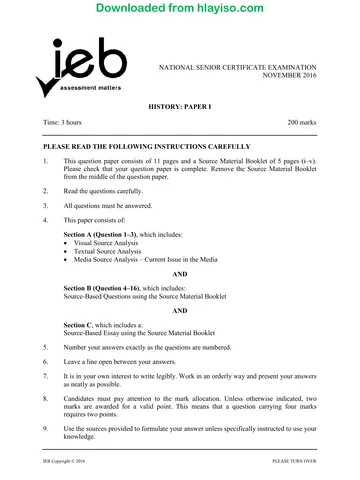
History Grade 12 IEB Paper 1 2016 Question Paper
IEB Grade 12 History Paper 1 question paper from the 2016, 5 pages. Read online or get the free PDF download, memo linked when available.
Publisher: IEB
History · Grade 12 · 2016. Question paper, 5 pages. Read online or download the PDF.
- Subject
- History
- Grade
- Grade 12
- Document type
- Question paper
- Year
- 2016
- Paper
- 1
- Publisher
- IEB
- Curriculum
- IEB
- Pages
- 5
- File size
- 211.5 KB
Loading document…
Loading document…
1 of 5
Document textSearch extracted text and jump to a page.
Downloaded from hlayiso.com
NATIONAL SENIOR CERTIFICATE: HISTORY: PAPER I – SOURCE MATERIAL BOOKLET Page ii of v
SOURCE A This is an extract describing some of the aims and functions of the Truth
and Reconciliation Commission (TRC).
The … Commission was given the task of establishing as complete a picture as possible of the
causes, nature and extent of the gross human rights violations* committed in the period between
1 March 1960 and the cut-off date of 10 May 1994, by conducting investigations and holding
hearings. It also had to grant amnesty to people who made full disclosures* of all the facts
relating to those violations committed with a political objective*. In addition, the commission was
required to restore the human and civil dignity of victims by recommending reparation measures.
The commission had to compile a report of its findings and activities and recommend measures
to prevent future violations* of human rights.
[Adapted from: Krog, A, Mpolweni, N, Ratele, K 2009. There was this Goat: Investigating the Truth Commission
Testimony of Notrose Nobomvu Konile. 1st ed. South Africa: University of KwaZulu-Natal Press. pp. 41–42]
* violations – abuses
* disclosures – confessions
* objective – aim
SOURCE B This is an extract of Andy Ribeiro's personal experience of the Truth
and Reconciliation Commission (TRC). He was a victim of human rights
violations during Apartheid.
With the advent* in 1996 of the TRC process my family was faced with a dilemma*. We initially
strongly opposed the TRC chiefly because of the truth for amnesty clause … The South African
government then stated that if victims did not participate in the TRC process they would not be
eligible to receive any aid, counselling or reparation from the government … This was a form of
blackmail and it had the effect of dividing us children. (Paragraph 1)
My brother Chris led the family delegation to the TRC hearings. We had to relive the whole
painful memory of the death of our parents … The TRC gave amnesty to the people who
murdered my parents. We only learnt of the amnesty verdict from the newspapers – nobody
bothered informing us personally. It was an immoral* decision as the perpetrators did not show
any remorse and neither did they divulge* the whole truth … (Paragraph 2)
At the TRC hearings the murderers were well represented by … lawyers whose fees were paid
by the government. We victims were not even afforded a counsellor to guide us through this
traumatic TRC process. In actual fact, we as a family are very bitter about the TRC process.
(Paragraph 3)
After the TRC hearings the criminals returned to their families and continued normally with their
lives … The perpetrators remain free today and have gone unpunished … We victims, on the
other hand, have returned to our shattered lives faced with a deep sense of loss and despair,
confronted with a life of poverty. There has been no reconciliation – just more pain and suffering
whilst we are desperately crying out for JUSTICE. (Paragraph 4)
[Adapted from: Presentation by Mr Andy Ribeiro. 2002. Stockholm International Forum. [ONLINE] Available at:
<http://www.d.dccam.org > (Accessed 6 January 2016)]
* advent – start
* dilemma – problem
* immoral – sinful
* divulge – reveal/tell
IEB Copyright © 2016
Downloaded from hlayiso.com
NATIONAL SENIOR CERTIFICATE: HISTORY: PAPER I – SOURCE MATERIAL BOOKLET Page iii of v
SOURCE C This is an extract from a book by South African journalist Allister
Sparks explaining how the Truth and Reconciliation Commission (TRC)
was experienced by black and white South Africans.
It is difficult to judge how this outpouring* has affected the South African public. For some black
people it seems to have been cathartic* to be able to tell their stories and to hear the
confessions … Boraine quotes Lucas Sikwepere who had been shot in the face by police and
blinded, then badly tortured, as saying at the end of his testimony: "I feel what has been making
me sick all the time is the fact that I couldn't tell my story. But now it feels like I got my sight back
by coming here and telling you the story." … Many whites accused the TRC of being a witch-
hunt and of stirring up hatreds that would make reconciliation impossible.
[Adapted from: Sparks, A, 2003. Beyond the Miracle: Inside the New South Africa. 1st ed. Jeppestown: Jonathan Ball
Publishers (PTY) LTD. p. 167]
* outpouring – a passionate display or expression of feeling
* cathartic – providing a sense of healing/providing psychological relief through the open expression of strong
emotions
SOURCE D This is an extract from a South African website commenting on the
achievements of the Truth and Reconciliation Commission (TRC).
The TRC achieved some notable successes … Testimonies revealed many cases of rape,
torture, deaths in detention, political assassinations, and even human burnings. The TRC
granted amnesty to qualified perpetrators as a gesture of peace and reconciliation. In some
cases, relatives of victims forgave individuals who admitted killing their loved ones … While the
TRC may not have united the nation, its public engagement with South Africa's painful past
helped to prevent a return to the political violence of a few years earlier and laid the foundation
for a brighter future for all South Africans.
[Adapted from: Unit 7. Exploring the Truth and Reconciliation Commission: South Africa Overcoming Apartheid
Building Democracy. 2016. [ONLINE] Available at: <http://www.overcomingapartheid.msu.edu>
(Accessed 16 January 2016)]
SOURCE E This is an extract from the Truth and Reconciliation Commission's
(TRC's) 1998 final report on the role of the state in political violence in
the 1990s.
While the Truth and Reconciliation Commission found no evidence of a centrally-directed "third
force", it says a network of serving and former security force members fomented* violence during
the 1990s. The final TRC report … said the network collaborated* with right wing elements and
Inkatha Freedom Party members to initiate and facilitate violence. The report said the network
often operated with the active collusion* or knowledge of senior security force personnel – and
the former government either deliberately, or by omission*, failed to act against them.
[Adapted from: South African Press Association. 1998. THIRD FORCE FOMENTED VIOLENCE: TRC. [ONLINE]
Available at: <http://www.justice.gov.za> (Accessed 6 January 2016)]
* fomented – increased/encouraged
* collaborated – worked together
* collusion – agreement
* omission – to exclude/exclusion
IEB Copyright © 2016 PLEASE TURN OVER
Downloaded from hlayiso.com
NATIONAL SENIOR CERTIFICATE: HISTORY: PAPER I – SOURCE MATERIAL BOOKLET Page iv of v
SOURCE F This is an extract from the findings of the Truth and Reconciliation
Commission's Amnesty Committee in 2000, on the role of the police in
the June 1992 Boipatong Massacre.
The credibility of South Africa's Truth and Reconciliation Commission (TRC) has been dealt
another blow – this time by its own amnesty committee. In a recent ruling, the amnesty
committee contradicted* the TRC's October 1998 report on a vital issue – police culpability* for
the massacre of 45 people at Boipatong in the Vaal Triangle in June 1992. The committee found
that Inkatha Freedom Party (IFP) supporters from the KwaMadala Hostel perpetrated* the
killings on their own, without police help, and in revenge for repeated attacks by African National
Congress (ANC) supporters.
[Adapted from: Nelson Mandela Centre of Memory: O'Malley Heart of Hope. 2000. O'Malley Heart of Hope.
[ONLINE] Available at: <https://www.nelsonmandela.org> (Accessed 6 January 2016)]
* contradicted – challenged/disproved
* culpability – guilt/blame
* perpetrated – committed/did
SOURCE G This is a cartoon commenting on the achievements of the Truth and
Reconciliation Commission (TRC) in July 1998.
Desmond
Tutu points
up the stairs
[Shapiro, J, Zapiro, 1998: End of Part One, 1st ed., Cape Town, David Phillip Publishers, p. 139]
IEB Copyright © 2016
Downloaded from hlayiso.com
NATIONAL SENIOR CERTIFICATE: HISTORY: PAPER I – SOURCE MATERIAL BOOKLET Page v of v
SOURCE H This is an extract from an article written by Archbishop Emeritus
Desmond Tutu in 2014, in which he reflects on the successes and failures
of the Truth and Reconciliation Commission (TRC).
The commission played a magnificent role in facilitating the telling of the story of the true horrors
of Apartheid. I believe truth is central to any healing process because in order to forgive, one
needs to know whom one is forgiving, and why … (Paragraph 1)
But healing is a process. How we deal with the truth after its telling defines the success of the
process. And this is where we have fallen tragically short. Why? … Literally on the eve of the
handover of the commission's report to President Mandela, the ANC took the commission to
court in an attempt to force it to excise* from the report findings in respect of human rights
violations committed by ANC members and supporters. (Paragraph 2)
The commission was a beginning, not an end. It united South Africans around a common fire for
the first time in history to hear the stories of our past, so that we could begin to understand each
other … The tardy* and limited payments of reparations to victims of human rights violations
eroded* the very dignity that the commission sought to build. The fact that the government did
not prosecute those who failed to apply for amnesty undermined* those who did. (Paragraph 3)
[Adapted from: Mail & Guardian. 2014. "Tutu: 'Unfinished business' of the TRC's healing" [ONLINE] Available at:
<http://mg.co.za> (Accessed 7 January 2016)]
* excise – remove
* tardy – delayed/late
* eroded – worn down/decreased
* undermined – demoralised/damaged
IEB Copyright © 2016
Study this subject
Revise the topics in this paper, then practise them question by question.
- Grade 12 History notes
CAPS revision notes with worked examples.
- History questions by topic
Past exam questions sorted by CAPS topic, with memos where available.
- Grade 12 History quizzes
Short topic quizzes with instant feedback.
- All Grade 12 History past papers
Past papers by year, with memos where available.
- Grade 12 IEB past papers
More History and other subjects in this collection.
Recommended for this subject
More papers and memos for this grade and subject.
Question paperIEB
History Grade 12 IEB Paper 1 2019 Question Paper
Question paperIEB
History Grade 12 IEB Paper 1 2019 Question Paper (Afrikaans)
Question paperIEB
History Grade 12 IEB Paper 1 2019 Question Paper (Afrikaans)
Question paperIEB
History Grade 12 IEB Paper 2 2019 Question Paper
Question paperIEB
History Grade 12 IEB Paper 2 2019 Question Paper (Afrikaans)
Question paperIEB
History Grade 12 IEB Paper 2 2019 Question Paper (Afrikaans)
Related documents
Question paperIEB
History Grade 12 IEB Paper 1 2016 Question Paper
MemorandumIEB
History Grade 12 IEB Paper 1 2016 Memo
Question paperIEB
History Grade 12 IEB Paper 2 2016 Question Paper
Question paperIEB
History Grade 12 IEB Paper 1 2018 Question Paper
Question paperIEB
History Grade 12 IEB Paper 1 2017 Question Paper
MemorandumIEB
History Grade 12 IEB Paper 2 2016 Memo
More from Grade 12 History
MemorandumIEB
History Grade 12 IEB Paper 1 2019 Memo
MemorandumIEB
History Grade 12 IEB Paper 2 2019 Memo
AddendumIEB
History Grade 12 IEB Paper 2 2019 Addendum
AddendumIEB
History Grade 12 IEB Paper 2 2019 Addendum (Afrikaans)
MemorandumIEB
History Grade 12 IEB Paper 1 2018 Memo
Question paperIEB