
Downloaded from hlayiso.com
SENIOR CERTIFICATE EXAMINATIONS
SENIORSERTIFIKAAT-EKSAMEN
PHYSICAL SCIENCES: CHEMISTRY (P2)
FISIESE WETENSKAPPE: CHEMIE (V2)
2017
MARKING GUIDELINES/NASIENRIGLYNE
MARKS/PUNTE: 150
These marking guidelines consist of 14 pages.
Hierdie nasienriglyne bestaan uit 14 bladsye.
Copyright reserved/Kopiereg voorbehou Please turn over/Blaai om asseblief
Skip to contentAll 2017 papers 
View all





Physical Sciences Grade 12 Paper 2 NSC June 2017 Memo
Grade 12 Physical Sciences Paper 2 memorandum from the NSC June Exam 2017, 14 pages. Read online or download the free PDF.
Physical Sciences · Grade 12 · NSC June Exam · 2017. Memorandum, 14 pages. Read online or download the PDF.
- Subject
- Physical Sciences
- Grade
- Grade 12
- Document type
- Memorandum
- Year
- 2017
- Exam period
- NSC June Exam
- Paper
- 2
- Curriculum
- CAPS
- Pages
- 14
- File size
- 518.0 KB
Free to read online, no sign-up needed
Loading document…
Loading document…
1 of 14
This exam
NSC June Exam 2017
Questions in this paper
- Question 1Organic Compounds and Macromolecules20 marks
- Question 2Organic Compounds and Macromolecules13 marks
- Question 3Organic Compounds and Macromolecules15 marks
- Question 4Organic Compounds and Macromolecules13 marks
- Question 5Rate and Extent of Reactions16 marks
- Question 6Chemical Equilibrium16 marks
Document textSearch extracted text and jump to a page.
Downloaded from hlayiso.com
Physical Sciences P2/Fisiese Wetenskappe V2 2 DBE/2017
SCE/SSE – Marking Guidelines/Nasienriglyne
QUESTION/VRAAG 1
1.1 D (2)
1.2 D (2)
1.3 B (2)
1.4 A (2)
1.5 C (2)
1.6 A (2)
1.7 B (2)
1.8 D (2)
1.9 C (2)
1.10 C (2)
[20]
QUESTION/VRAAG 2
2.1 A bond / an atom / a group of atoms that determine(s) the (physical and
chemical) properties of a group of organic compounds.
'n Binding / 'n atoom / 'n groep atome wat die (fisiese en chemiese)
eienskappe van 'n groep organiese verbindings bepaal. (2)
2.2
2.2.1 O
C H (1)
2.2.2 Carboxyl (group) / karboksiel(groep) (1)
2.3
2.3.1 Ketones / Ketone (1)
H H H H H Marking criteria/Nasienriglyne:
2.3.2 O
• Functional group/
H C C C C C C H Funksionele groep korrek
• Two methyl substituents/
H H H Twee metielsubstituente
H C H H C H • Whole structure correct/
Hele struktuur korrek: 3
H H 3
(3)
Copyright reserved/Kopiereg voorbehou Please turn over/Blaai om asseblief
Downloaded from hlayiso.com
Physical Sciences P2/Fisiese Wetenskappe V2 3 DBE/2017
SCE/SSE – Marking Guidelines/Nasienriglyne
2.4
2.4.1 5-bromo-4-ethyl-2,2-dimethylhexane
5-bromo-4-etiel-2,2-dimetielheksaan
Marking criteria/Nasienriglyne:
• Correct stem i.e. hexane./Korrekte stam d.i. heksaan.
• All substituents (bromo, ethyl and dimethyl) correctly identified./Alle substituente
(bromo, etiel en dimetiel) korrek geïdentifiseer.
• IUPAC name completely correct including numbering, sequence, hyphens and
commas./IUPAC-naam heeltemal korrek insluitende volgorde, koppeltekens en
kommas . (3)
2.4.2 4-methylpent-2-yne
4-metielpent-2-yn
OR/OF
4-methyl-2-pentyne / 4-metiel-2-pentyn
NOTE/LET WEL
4-methyl / 4-metiel
pent-2-yne / pent-2-yn
IUPAC name correct but hyphens omitted / IUPAC naam korrek maar
koppeltekens uitgelaat: 1
2
(2)
[13]
QUESTION/VRAAG 3
3.1
3.1.1 H Marking criteria/Nasienriglyne:
• Functional group
H C H Funksionele groep korrek
• Methyl substituent on C-2
H H Metielsubstituent op C-2
• Whole structure correct
H C C C O H
Hele struktuur korrek: 3
3
H H H Accept/Aanvaar:
-OH as condensed
-OH as gekondenseerd (3)
3.1.2 D
Accept/Aanvaar:
butan-1-ol (1)
3.1.3 G
Accept/Aanvaar
2-methylpropan-2-ol / 2-metielpropan-2-ol (1)
Copyright reserved/Kopiereg voorbehou Please turn over/Blaai om asseblief
Downloaded from hlayiso.com
Physical Sciences P2/Fisiese Wetenskappe V2 4 DBE/2017
SCE/SSE – Marking Guidelines/Nasienriglyne
3.2
3.2.1 (Increase in) chain length / molecular size / molecular mass/ number of C-
atoms/ surface area / contact area / number of electrons
(Toename in) kettinglengte / molekulêre grootte / molekulêremassa / aantal C-
atome (reaksie)oppervlakte / kontakopperlakte /aantal elektrone (1)
3.2.2 London forces / dispersion forces / induced dipole forces
Londonkragte / dispersiekragte / geïnduseerde dipoolkragte (1)
3.3
3.3.1 108 (°C) (1)
3.3.2 Compare compound F with compounds C and D:
Vergelyk verbinding F met verbindings C en D:
• Compound F has a larger molecular mass / molecular size / surface
area/contact area / number of C-atoms / number of electrons / than
compound C.
Verbinding F het 'n groter molekulêre massa/molekulêre grootte /
(reaksie)oppervlakte /kontak area / aantal C-atome / aantal elektrone as
verbinding C.
• Compound F is more branched than compound D.
Verbinding F is meer vertak as verbinding D.
• Intermolecular forces in compound F are stronger than in compound C
and weaker than in compound D.
Intermolekulêre kragte in verbinding F is sterker as in verbinding C en
swakker as in verbinding D.
• More energy needed to overcome intermolecular forces in compound F
than in compound C and less energy needed to overcome (break)
intermolecular forces in compound F than in compound D.
Meer energie word benodig om intermolekulêre kragte in verbinding F te
oorkom as in verbinding C, en minder energie word benodig om
intermolekulêre kragte in verbinding F te oorkom / breek as in verbinding
D. (4)
3.4 H H
H
O C H
H C O
H H
H
Marking criteria/Nasienriglyne:
At least one structural formula of methanol as shown.
Ten minste een struktuurformule van metanol soos aangetoon.
Dotted line drawn from O atom on one molecule to H atom bonded to
an O atom in the second molecule. (H atom should be between two O
atoms.)
Stippellyn getrek van O-atoom op een molekuul na die H-atoom gebind
aan 'n O-atoom in die tweede molekuul. (H-atoom moet tussen twee
O-atome wees.)
Accept/Aanvaar:
-OH as condensed / -OH as gekondenseerd
(2)
Copyright reserved/Kopiereg voorbehou Please turn over/Blaai om asseblief
Downloaded from hlayiso.com
Physical Sciences P2/Fisiese Wetenskappe V2 5 DBE/2017
SCE/SSE – Marking Guidelines/Nasienriglyne
3.5
3.5.1 Esterification / Condensation
Verestering / Esterifikasie / Kondensasie (1)
3.5.2 Marking criteria/Nasienriglyne:
H H H H • Functional group/
O Funksionele groep korrek
• Whole structure correct/
H C C O C C C H
Hele struktuur korrek: 2
2 (2)
H H H H [17]
QUESTION/VRAAG 4
4.1
4.1.1 Addition / hydrogenation
Addisie / hidrogenering / hidrogenasie (1)
4.1.2 Substitution / halogenation / chlorination
Substitusie / halogenering / halogenasie / chlorinering / chlorinasie (1)
4.1.3 Elimination / dehydration (1)
Eliminasie / dehidrasie / dehidrering
4.2 2-bromopropane Note/Aantekening:
2-bromopropaan IF/INDIEN:
Bromopropane/bromopropaan 1
2
2-bromo
propane (2)
4.3
4.3.1 Dehydrohalogenation / Dehydrobromination
Dehidrohalogenering / dehidrohalogenasie / dehidrobrominering /
dehidrobrominasie (1)
4.3.2 Hot ethanolic strong base
• Concentrated strong base / NaOH / KOH
Gekonsentreerde sterk basis / NaOH / KOH
OR/OF
Strong base with no water / Sterk basis met geen water nie.
OR/OF
Strong base in (pure) ethanol as solvent. / Sterk basis in (suiwer) etanol
as oplosmiddel.
• Strongly heated or hot base / Sterk verhitte of warm basis
OR/OF
High temperature/heat strongly / Hoë temperatuur/sterk verhit (2)
Copyright reserved/Kopiereg voorbehou Please turn over/Blaai om asseblief
Downloaded from hlayiso.com
Physical Sciences P2/Fisiese Wetenskappe V2 6 DBE/2017
SCE/SSE – Marking Guidelines/Nasienriglyne
4.4
4.4.1 H 2 O / NaOH / KOH (1)
4.4.2 H H H H H H
H C C C H + H−Cℓ H C C C H +H O
H O H H Cℓ H H
H
Notes/Aantekeninge:
• Ignore/Ignoreer ⇌
• Accept HCℓ and H 2 O as condensed./Aanvaar HCℓ en H 2 O as gekondenseerd.
• Any additional reactants and/or products
Enige addisionele reaktanse en/of produkte: Max./Maks. 3
4
• Accept coefficients that are multiples.
Aanvaar koëffisiënte wat veelvoude is.
• Incorrect balancing/Verkeerde balansering: Max./Maks. 3
4
• Molecular/condensed formulae
Molekulêre/gekondenseerde formule: Max./Maks. 2
4
Accept/Aanvaar: -OH as condensed / -OH as gekondenseerd (4)
[13]
QUESTION/VRAAG 5
5.1
5.1.1 To measure volume / amount of gas/oxygen produced.
Om die volume van die gas / suurstof berei te meet. (1)
5.1.2 Catalyst / Speeds up the reaction. / Increases reaction rate.
Katalisator / Versnel die reaksie. / Verhoog die reaksietempo. (1)
5.2 No gas / bubbles produced. / Geen gas / borrels word gevorm nie.
OR/OF
Volume of gas in syringe remains constant. / The plunger stops moving.
Volume van gas in spuit bly konstant. / Die suier hou op beweeg. (1)
5.3 CuO / Copper(II) oxide / catalyst
CuO / koper(II)oksied / katalisator (1)
5.4 • A catalyst provides an alternative pathway of lower activation energy.
'n Katalisator verskaf 'n pad van laer aktiveringsenergie.
• More molecules have sufficient / enough kinetic energy. / Meer molekule
het voldoende/genoeg kinetiese energie.
OR/OF
More molecules have kinetic energy equal to or greater than the activation
energy./ Meer molekule het kinetiese energie gelyk aan of groter as die
aktiveringsenergie.
• More effective collisions per unit time. / Frequency of effective collisions
increases.
Meer effektiewe botsings per eenheidtyd. / Frekwensie van effektiewe
botsings neem toe. (3)
Copyright reserved/Kopiereg voorbehou Please turn over/Blaai om asseblief
Downloaded from hlayiso.com
Physical Sciences P2/Fisiese Wetenskappe V2 7 DBE/2017
SCE/SSE – Marking Guidelines/Nasienriglyne
5.5
5.5.1 Released / Vrygestel
- Products at lower (potential) energy than reactant. / Reaction is exothermic /
∆H < 0
Produkte by laer (potensiële) energie as reaktans. / Reaksie is eksotermies. /
∆H < 0 (2)
5.5.2 B (1)
5.6 V Marking criteria/Nasienriglyne:
n(O 2 ) produced = • Use 0,4 dm3 and 25 dm3 to calculate n(O 2 ).
Vm
0,4 Gebruik 0,4 dm3 en 25 dm3 om n(O 2 ) te
=
25 bereken.
• Use/Gebruik n(H 2 O 2 ) = 2n(O 2 ).
= 0,016 mol
• Substitute/Vervang 0,05 dm3 in a/’n
relevant formula /relevante formula
• Substitute ∆c/∆n in rate formula.
Vervang ∆c/∆n in tempoformule.
• Substitute ∆t in rate formula
Vervang ∆t in tempoformule.
• Final answer/Finale antwoord:
0,11 mol∙dm-3∙min-1
Range/Gebied: 0,11 to 0,14 mol∙dm-3∙min-1
OPTION/OPSIE 1 OPTION/OPSIE 2
Rate at which O 2 is formed:
n(H 2 O 2 ) used/gebruik = 2(0,016) Tempo waarteen O 2 vorm:
= 0,032 mol ∆n
n rate =
[H 2 O 2 ] = ∆t
V 0,016 − 0
0,032 =
= 5,8 − 0
0,05 = 2,76 x 10⁻³ mol∙min-1
= 0,64 mol∙dm-3 Rate/tempo H 2 O 2 used = 2(rate O 2formed )
∆c = 2(2,76 x 10⁻³)
Rate/tempo = − = 5,52 x 10⁻³ mol∙min-1
∆t
0 − 0,64
= − 5,52 × 10 −3
5,8 − 0 Rate/tempo =
0,05
= 0,11 (mol∙dm-3∙min-
1
) = 0,11 (mol∙dm-3∙min-1)
0,64
Accept /Aanvaar: and
5,8
− 0,64
5,8 (6)
[16]
Copyright reserved/Kopiereg voorbehou Please turn over/Blaai om asseblief
Downloaded from hlayiso.com
Physical Sciences P2/Fisiese Wetenskappe V2 8 DBE/2017
SCE/SSE – Marking Guidelines/Nasienriglyne
QUESTION/VRAAG 6
6.1
6.1.1 Products can be converted back to reactants.
Produkte kan omgeskakel word na reaktanse.
OR/OF
Both forward and reverse reactions can take place.
Beide voor-en terugwaartse reaksies kan plaasvind. (1)
6.1.2 Endothermic/Endotermies (1)
-
6.1.3 • K c increases with increase in temperature.
K c neem toe met toename in temperatuur.
• Forward reaction is favoured. / Concentration of products increases. /
Concentration of reactants decreases.
Voorwaartse reaksie word bevoordeel. / Konsentrasie van produkte neem
toe. / Konsentrasie van reaktanse neem af.
• Increase in temperature favours an endothermic reaction.
Toename in temperatuur bevoordeel 'n endotermiese reaksie. (3)
6.1.4 Increases / Vermeerder (1)
6.1.5 Remains the same / Bly dieselfde (1)
6.2
6.2.1 Marking criteria/Nasienriglyne:
(a) Use 48 g·mol-1 to calculate n(Ti).
Gebruik 48 g·mol-1 om n(Ti) te bereken.
(b) Use 71 g·mol-1 to calculate n(Cℓ 2 ).
Gebruik 71 g·mol-1 om n(Cℓ 2 ) te bereken.
(c) Use mole ratio/Gebruik molverhouding: n(Cℓ 2 ) = 2n(Ti).
(d) n(Cℓ 2 ) equilibrium/ewewig = n(Cℓ 2 ) initial/aanvanklik – n(Cℓ 2 ) reacted/reageer .
(e) Divide by volume/Deel deur volume.
(f) K c expression/K c uitdrukking.
(g) Substitution of c(Cℓ 2 ) in K c /Vervanging van c(Cℓ 2 ) in K c .
(h) Final answer/Finale antwoord: 0,25
Copyright reserved/Kopiereg voorbehou Please turn over/Blaai om asseblief
Downloaded from hlayiso.com
Physical Sciences P2/Fisiese Wetenskappe V2 9 DBE/2017
SCE/SSE – Marking Guidelines/Nasienriglyne
OPTION/OPSIE 1
Cℓ 2 Ti
Initial quantity (mol)
6 (b) 7 (a)
Aanvangshoeveelheid (mol)
Use mole ratio(c)
Change (mol)/Verandering (mol) 2 1
Gebruik
Quantity at equilibrium (mol) molverhouding
4 (d) 6 (a)
Hoeveelheid by ewewig (mol)
Equilibrium concentration (mol∙dm-3) Divide by 2(e)
2
Ewewigskonsentrasie (mol∙dm-3) Deel deur 2
No KC expression/Verkeerde Kc-uitdrukking:
1
Kc = (f) Max./Maks. 7
[Cl2 ] 2 8
1 Wrong KC expression/Verkeerde Kc-uitdrukking:
= (g)
(2)2 Max./Maks. 5
= 0,25 (h) 8
OPTION/OPSIE 2
m 336 − 288
n(Ti) reacted/reageer = = = 1 mol
M 48
n(Cℓ 2 ) reacted/reageer = 2n(Ti) = 2(1) = 2 mol
m 426
n(Cℓ 2 ) initial/aanvanklik = = = 6 mol
M 71
n(Cℓ 2 ) equilibrium/ewewig = 6 – 2 = 4 mol
n 4
c= =
V 2
No KC expression/Verkeerde Kc-uitdrukking:
= 2 mol·dm-3
1 Max./Maks. 7
Kc = 8
[Cl2 ] 2
Wrong KC expression/Verkeerde Kc-uitdrukking:
1
= Max./Maks. 5
(2)2 8
= 0,25 (8)
6.2.2 Remains the same / Bly dieselfde (1)
[16]
Copyright reserved/Kopiereg voorbehou Please turn over/Blaai om asseblief
Downloaded from hlayiso.com
Physical Sciences P2/Fisiese Wetenskappe V2 10 DBE/2017
SCE/SSE – Marking Guidelines/Nasienriglyne
QUESTION/VRAAG 7
7.1
7.1.1 Weak (acid) / Swak (suur) (1)
7.1.2 pH = -log[H 3 O+]
4 = -log[H 3 O+]
[H 3 O+] = 1 x 10⁻⁴ mol∙dm-3 (3)
7.2
7.2.1 A substance that produces hydroxide ions / OH- in water.
'n Stof wat hidroksiedione / OH- in water vorm.
NOTE/LET WEL:
If water is omitted/Indien water weggelaat is: 1
2 (2)
7.2.2 Marking guidelines/Nasienriglyne:
n c × Va na
• Formula/Formule: c = /n = cV/ a =
V c b × Vb nb
• Use mol ratio/Gebruik molverhouding: 1:1
• Substitution of/Vervanging van: 0,16 x 25 /0,16 x 0,025
• Use/Gebruik V b = 12,5 cm3/0,0125 dm3
• Use/Gebruik 56 g·mol-1
• Substitute/Vervang V = 0,25 dm3
• Final answer/Finale antwoord: 4,48 g
OPTION/OPSIE 1 OPTION/OPSIE 2 OPTION/OPSIE 3
c a × Va na c a × Va na n(acid) used = cV
= = = (0,16)(0,025)
c b × Vb nb c b × Vb nb
= 4 x 10⁻³ mol
0,16 × 25 1 0,16 × 25 1
= =
c b × 12,5 1 c b × 12,5 1 n(KOH) = 4 x 10⁻³ mol
c b = 0,32 mol·dm-3 c b = 0,32 mol·dm-3
In 12,5 cm3:
m n n(KOH) = 4 x 10⁻³ mol
c= c=
MV V
m n In 250 cm3
0,32 = 0,32 = 250
56× 0,25 0,25 n(KOH) = × 4 × 10 −3
n = 0,08 mol 12,5
m = 4,48 g
m = 0,08 mol
n=
M
m(KOH) = nM
m
0,08 = = 0,08 x 56
56 = 4,48 g
m = 4,48 g
Copyright reserved/Kopiereg voorbehou Please turn over/Blaai om asseblief
Downloaded from hlayiso.com
Physical Sciences P2/Fisiese Wetenskappe V2 11 DBE/2017
SCE/SSE – Marking Guidelines/Nasienriglyne
OPTION/OPSIE 4 OPTION/OPSIE 5
n(CH 3 COOH) used = cV n(CH 3 COOH) used = cV
= (0,16)(0,025) = (0,16)(0,025)
= 4 x 10⁻³ mol = 4 x 10⁻³ mol
n(KOH) = 4 x 10⁻³ mol n(KOH) = 4 x 10⁻³ mol
n n
c= c=
V V
4 × 10 −3 4 × 10 −3
= =
0,0125 0,0125
c b = 0,32 mol·dm-3 c b = 0,32 mol·dm-3
m n
c= c=
MV V
m n
0,32 = 0,32 =
56× 0,25 0,25
m = 4,48 g n = 0,08 mol
m
n=
M
m
0,08 =
56
m = 4,48 g (7)
7.2.3 Greater than 7 / Groter as 7 (1)
7.2.4 CH 3 COO-(aq) + H 2 O(ℓ) ⇌ CH 3 COOH(aq) + OH-(aq)
Due to formation of (OH-), the solution is basic / alkaline
As gevolg van die vorming van (OH-) is die oplossing basies / alkalies
Notes/Aantekeninge
• Reactants Products Ignore balancing
Reaktanse Produkte Ignoreer balansering
• Ignore/Ignoreer and phases/en fases.
• Marking rule 6.3.10/Nasienreël 6.3.10 (3)
[17]
Copyright reserved/Kopiereg voorbehou Please turn over/Blaai om asseblief
Downloaded from hlayiso.com
Physical Sciences P2/Fisiese Wetenskappe V2 12 DBE/2017
SCE/SSE – Marking Guidelines/Nasienriglyne
QUESTION/VRAAG 8
8.1
8.1.1 Emf / Emk (1)
8.1.2 Voltmeter / Multimeter (1)
8.1.3 Salt bridge / Soutbrug (1)
8.1.4 Temperature / Temperatuur: 25 °C / 298 K
Concentration / Konsentrasie: 1 mol·dm-3 (2)
8.2 Marking criteria/Nasienriglyne:
Dependent and independent variables correctly identified.
- Afhanklike en onafhanklike veranderlikes korrek geïdentifiseer.
Relationship between the independent and dependent variables correctly
stated./Verwantskap tussen die afhanklike en onafhanklike veranderlikes korrek
genoem.
Examples/Voorbeelde:
Emf increases as concentration (of oxidising agent) increases.
Emk neem toe soos wat konsentrasie (van die oksideermiddel) toeneem.
NOTE/LET WEL:
IF/INDIEN: Emf is directly proportional to concentration.
Emk is direk eweredig aan konsentrasie. .1
2 (2)
8.3 OPTION/OPSIE 1 Notes/Aantekeninge
θ
E cell θ
= E reduction θ
− E oxidation • Accept any other correct formula from the
data sheet./Aanvaar enige ander korrekte
1,11 = EθX / X2+ - (- 0,76) formule vanaf gegewensblad.
EθX / X2+ = 0,35 (V) • Any other formula using unconventional
abbreviations, e.g. E° cell = E° OA - E° RA
followed by correct substitutions:/Enige
X = Copper / Cu / koper ander formule wat onkonvensionele
afkortings gebruik bv.
Accept/Aanvaar: E° sel = E° OM - E° RM gevolg deur korrekte
Cu/Cu2+ half reaction / half-reaksie
vervangings: Max/Maks: 3
4
OPTION/OPSIE 2
X2+(aq) + 2e- X(s) 0,35 (V)
Zn(s) Zn2+(aq) + 2e- 0,76 (V)
X2+(aq) + Zn(s) X(s) +Zn2+(aq) 1,11 (V)
X = Copper/Cu/koper
Accept/Aanvaar:
Cu/Cu2+ half reaction / half-reaksie (5)
Copyright reserved/Kopiereg voorbehou Please turn over/Blaai om asseblief
Downloaded from hlayiso.com
Physical Sciences P2/Fisiese Wetenskappe V2 13 DBE/2017
SCE/SSE – Marking Guidelines/Nasienriglyne
8.4 Cu2+(aq) + Zn(s) → Zn2+(aq) + Cu(s) Bal.
Accept/Aanvaar:
• X2+(aq) + Zn(s) → Zn2+(aq) + X(s)
• Any metal identified in QUESTION 8.3 of which the ion has a +2 charge.
Enige metaal geïdentifiseer in VRAAG 8.3 waarvan die ioon 'n +2-lading
het.
Notes/Aantekeninge
• Reactants Products Balancing
Reaktanse Produkte Balansering
• Ignore phases./Ignoreer fases.
• Ignore double arrows./Ignoreer dubbelpyle.
• Marking rule 6.3.10/Nasienreël 6.3.10. (3)
[15]
QUESTION/VRAAG 9
9.1 Electrolytic (cell) / Elektrolitiese (sel) (1)
9.2 P (1)
9.3
9.3.1 Au(s) → Au3+(aq) + 3e-
Ignore phases / Ignoreer fases
Notes/Aantekeninge
Au3+ + 3e- ← Au (2 ) Au3+ + 3e- ⇌ Au (0 )
2 2
Au ⇌ Au + 3e
3+ -
( 1 ) Au3+ + 3e → Au ( 0 )
2 2 (2)
9.3.2 (+)3 (1)
9.3.3 Electrical energy (is converted) to chemical energy.
Elektriese energie (omgeskakel) na chemiese energie. (1)
9.3.4 Becomes smaller / thinner / eroded / decrease in mass.
(1)
Word kleiner / dunner / weggevreet / afname in massa.
9.4 ANY ONE/ENIGE EEN:
• Increase in value. / Neem toe in waarde.
• Protection against rust. / Beskerming teen roes. (1)
9.5 ANY ONE/ENIGE EEN:
• Replace Au3+(aq) / electrolyte with Ag+(aq) / silver(I) solution / use a silver
solution
Vervang Au3+(aq) / elektroliet met Ag+(aq) / silwer(I)-oplossing / gebruik 'n
silwer oplossing
• Replace P / anode / gold with Ag(s) / silver
Vervang P / anode / goud met Ag(s) / silwer. (1)
[9]
Copyright reserved/Kopiereg voorbehou Please turn over/Blaai om asseblief
Downloaded from hlayiso.com
Physical Sciences P2/Fisiese Wetenskappe V2 14 DBE/2017
SCE/SSE – Marking Guidelines/Nasienriglyne
QUESTION/VRAAG 10
10.1
10.1.1 B/air/lug & C/methane/metaan (2)
10.1.2 Nitric acid / HNO 3 / salpetersuur (1)
10.1.3 A / Sulphur / Swael / S (1)
10.1.4 2NH 3 (g) + H 2 SO 4 → (NH 4 ) 2 SO 4 Bal.
Notes/Aantekeninge
• Reactants Products Balancing
Reaktanse Produkte Balansering
• Ignore/Ignoreer ⇌ and phases/en fases.
• Marking rule 6.3.10/Nasienreël 6.3.10 (3)
10.1.5 D / potassium chloride / kalium chloried (1)
10.2
10.2.1 OPTION/OPSIE 1: OPTION/OPSIE 2:
3 3 22
%P = x 22% ∴ m(P) = (0,44) ( x 2 = 0,44)
7 7 100
= 9,43% = 0,19 kg
9,43
∴m(P) = × 2 kg
100
= 0,19 kg (3)
10.2.2 OPTION/OPSIE 1 OPTION/OPSIE 2
22 %filler/bindstof = 100 – 22
m(fertiliser/kunsmis) = x2 = 78%
100
= 0,44 kg
78
m(filler/bindstof) = x2
m(filler/bindstof) = 2 – 0,44 100
= 1,56 kg = 1,56 kg (3)
[14]
TOTAL/TOTAAL: 150
Copyright reserved/Kopiereg voorbehou
Study this subject
Recommended for this subject
Memorandum
Physical Sciences Grade 12 Paper 1 NSC June 2017 Memo
Memorandum
Physical Sciences Grade 12 Paper 2 EC June 2017 Memo
Errata
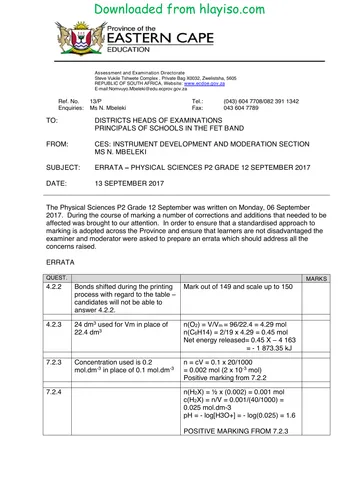
Physical Sciences Grade 12 P2 Eastern Cape Mock 2017 Errata
Question paper
Physical Sciences Grade 12 P2 KwaZulu Natal November 2017 QP
Question paper
Physical Sciences Grade 12 P2 NSC Supplementary 2017 QP
Question paper
Physical Sciences Grade 12 P2 NSC June 2025 QP (Eng)
More from Grade 12 Physical Sciences
Question paper
Physical Sciences Grade 12 P1 Eastern Cape June 2025 QP
Question paper
Physical Sciences Grade 12 P2 Eastern Cape Mock 2025 QP
Question paper
Physical Sciences Grade 12 P2 Gauteng Mock 2025 QP
Question paper
Physical Sciences Grade 12 P1 KZN Mock 2025 Question Paper
Question paper
Physical Sciences Grade 12 Limpopo March Test 2025 QP
Question paper