
KNOWLEDGE AREA: Diversity,
change and continuity
TOPIC 1: Biodiversity and
Classification of Micro-organisms
Role of Micro-
organisms
Skip to contentStudy guide 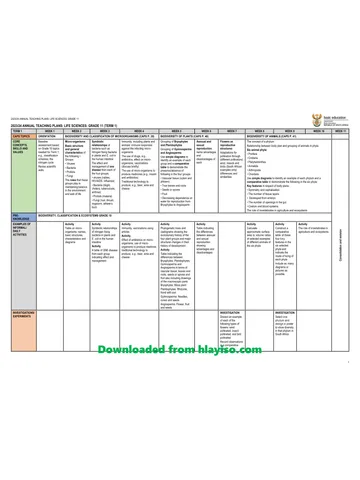



View all



PP2 Role of micro organisms
Grade 11 Life Sciences study guide, 25 pages. Read online or get the free PDF download.
Publisher: Other Study Guides
Life Sciences · Grade 11. Study guide, 25 pages. Read online or download the PDF.
- Subject
- Life Sciences
- Grade
- Grade 11
- Document type
- Study guide
- Publisher
- Other Study Guides
- Curriculum
- CAPS
- Pages
- 25
- File size
- 1.0 MB
Loading document…
Loading document…
1 of 25
Document textSearch extracted text and jump to a page.
Role of Micro-organisms in Maintaining
Balance in the Environment and Web
of Life.
Symbiotic
Relationships
Some micro-organisms are autotrophic.
They are therefore known as producers.
As producers they use light energy or chemical energy
to make their own food.
When the consumers feed on the producer the energy
is then transferred to the consumer.
This process is known as energy flow.
Look at the example of the
aquatic food chain.
The phytoplankton use
the sunlight to make food.
This energy is then
transferred to the
zooplankton when it feeds
on the phytoplankton.
The energy is the
transferred to the small
fish when it feed on the
zooplankton and so on.
Therefore the energy from the sun is transferred from
the producer to all the consumers.
The autotrophic micro-organisms that are produces also
photosynthesis.
They therefore use up carbon dioxide and release
oxygen.
Therefore they too maintain the carbon dioxide/oxygen
balance.
Some micro-organisms act as decomposers, they break
down dead and decaying matter.
For example : the decomposition bacteria and saprophytic
fungi and protists.
As these organisms break down dead and decaying
matter, they release important nutrients such as water,
carbon dioxide and energy in the form of heat back into
the environment.
These nutrients can then be reused by other organisms.
These nutrients are recycled.
Some micro-organisms have close relationships with
other organisms.
These relationships are called symbiotic relationships.
Symbiosis is a close relationship between two organisms
of different species that live together in direct contact.
There are 3 types of symbiotic relationships.
Mutualism
Commensalism
Parasitism
MUTUALISM: is a relationship between 2 organisms in
which both these organisms benefit.
COMMENSALISM: is a relationship where 1 organism
benefits and the other does not
benefit and is not harmed.
PARASITISM: is a relationship between 2 organisms
where 1 benefits and the other is harmed.
Examples of micro-organisms in these types of
relationships:
the nitrogen fixing bacteria
and in humans Escherichia coli.
Plants and animals use nitrogen to make proteins.
However plants cannot absorb the nitrogen as it occurs
in the atmosphere (as N2).
Plants can only absorb nitrogen in a soluble form, as a
nitrate.
Animals then obtain their nitrogen from the plants they
eat.
The nitrogen can be converted into a nitrate by a type of
bacteria.
This bacteria is called Nitrogen-fixing bacteria.
The Nitrogen-fixing bacteria can live freely in the soil.
Some of them are found in the root nodules of plants.
The nodule bacteria provides the plant with nitrates and
the plant provides the bacteria with manufactured food.
Explain why the relationship between the
nodule bacteria and the plant is an example
of mutualism.
The plant provides the bacteria with food in the form of
carbohydrates, while the bacteria converts nitrogen into
nitrates, which the plant can absorb.
This is an example of mutualism because the bacteria
benefits by obtaining food and the plant benefits by
getting nitrates.
Since they both benefit this is a mutualistic relationship.
E. coli is one of the many bacteria found in the human
intestine.
They obtain digested food from the human intestine
while the human benefits because they help in the decay
of indigestible food and they help to make vitamins B, E
and K.
This is an example of a mutualism because both the
E.coli and the human benefits from this relationship.
Energy flow: is the transfer of energy from one
organism to the next.
Symbiosis: is a close relationship between two
organisms of different species that live
together in direct contact.
Mutualism: is a relationship between 2 organisms in
which both these organisms benefit.
Commensalism: is a relationship where 1 organism
benefits and the other does not benefit
and is not harmed.
Parasitism: is a relationship between 2 organisms
where 1 benefits and the other is harmed.
The transfer of energy form one organism to the next
is known as…
A. Energy flow
B. Parasitism
C. Mutualism
D. Commensalism
The relationship between the root nodule bacteria
and the plant is an example of…
A. Energy flow
B. Parasitism
C. Mutualism
D. Commensalism
The saprophytic fungi…
A. Breaks down dead and decaying matter.
B. Provides all other organisms in the food chain
with oxygen.
C. Provides all other organisms in the food chain
with nutrients.
D. Both A and C.
Saprophytic bacteria play an important role in …
A. Nutrient recycling
B. Converting nitrogen into nitrate
C. Converting nitrate into nitrogen.
D. None of the above
Bacteria are important to humans because…
A. In the intestine they make certain vitamins.
B. They are involved in the decay of indigestible
material.
C. Both A and B
D. None of the above
Plants can only absorb nitrogen in a soluble form
as…
A. Nitrogen gas
B. nitrate
C. Both A and B
D. None of the above
Autotrophic micro-organisms maintain the ________
balance
A. Carbon dioxide/nitrogen
B. Oxygen/nitrogen
C. Carbon dioxide/oxygen
D. None of the above
Autotrophic micro-organisms are also known as …
A. producers
B. consumers
C. decomposers
D. None of the above
Heterotrophic organisms obtain their food from…
A. photosynthesis
B. decomposers
C. producers
D. None of the above
Prokaryotic organisms lack …
A. proteins
B. a true nucleus
C. mitochondria
D. None of the above
1. A
2. C
3. A
4. A
5. C
6. B
7. C
8. A
9. C
10. B
Study this subject
Notes, quizzes and topic questions for Grade 11 Life Sciences.
- Grade 11 Life Sciences notes
CAPS revision notes with worked examples.
- Life Sciences questions by topic
Past exam questions sorted by CAPS topic, with memos where available.
- Grade 11 Life Sciences quizzes
Short topic quizzes with instant feedback.
- All Grade 11 Life Sciences past papers
Past papers by year, with memos where available.
- Grade 11 Study guides
More Life Sciences and other subjects in this collection.
Recommended for this subject
More papers and memos for this grade and subject.
Annual teaching plan
Gr 11 Life Sci ATP 2023 24
Memorandum
Life Sciences Grade 11 Eastern Cape November 2025 Memo (Afr)
Memorandum
Life Sciences Grade 11 P1 Eastern Cape November 2025 Memo (Eng)
Question paper
Life Sciences Grade 11 Eastern Cape November 2025 QP (Afr)
Question paper
Life Sciences Grade 11 P2 Eastern Cape November 2025 QP
Question paper and memo
Life Sciences Grade 11 KZN June 2025 Paper & Memo
Related documents
Question paper and memo
Life Sciences Grade 11 Eastern Cape June 2024 Paper & Memo
Memorandum
Life Sciences Grade 11 P2 Eastern Cape November 2024 Memo (Afr)
Memorandum
Life Sciences Grade 11 P2 Eastern Cape November 2024 Memo (Eng)
Question paper
Life Sciences Grade 11 P2 Eastern Cape November 2024 QP (Eng)
Question paper and memo
Life Sciences Grade 11 KZN June 2024 Paper & Memo
Question paper
Life Sciences Grade 11 NW June 2024 Question Paper (Afrikaans)
More from Grade 11 Life Sciences
Question paper
Life Sciences Grade 11 NW June 2024 Question Paper (English)
Memorandum
Life Sciences Grade 11 P1 Eastern Cape November 2023 Memo (Afr)
Memorandum
Life Sciences Grade 11 P1 Eastern Cape November 2023 Memo (Eng)
Memorandum
Life Sciences Grade 11 P2 Eastern Cape November 2023 Memo (Afr)
Question paper
Life Sciences Grade 11 P1 Eastern Cape November 2023 QP (Eng)
Question paper