
KNOWLEDGE AREA: Diversity,
change and continuity
TOPIC 1: Biodiversity and
Classification of Micro-
organisms
Immunity
Skip to contentStudy guide 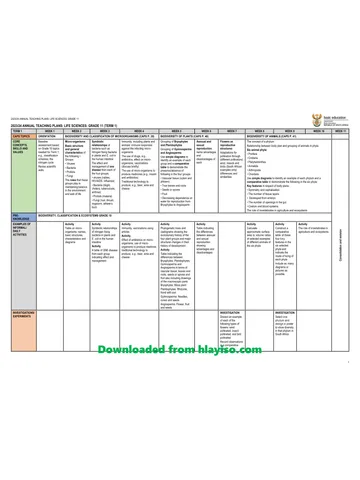
View all
PP7 Immunity
Grade 11 Life Sciences study guide, 41 pages. Read online or get the free PDF download.
Publisher: Other Study Guides
Life Sciences · Grade 11. Study guide, 41 pages. Read online or download the PDF.
- Subject
- Life Sciences
- Grade
- Grade 11
- Document type
- Study guide
- Publisher
- Other Study Guides
- Curriculum
- CAPS
- Pages
- 41
- File size
- 1.3 MB
Loading document…
Loading document…
1 of 41
Document textSearch extracted text and jump to a page.
Introduction
Passive Immunity
Active Immunity
Vaccinations
Response of Pathogenic Micro-organism on
Entering the host
Effects of the use of Drugs on Micro-
organisms
How to Avoid Drug Resistance
Immunity refers to the ability to produce
antibodies to fight diseases.
There are 2 types of immunity.
They are:
a. Passive immunity
b. Active immunity
Passive immunity are the mechanisms that
are used by both plants and animals to prevent
pathogens form entering the body.
These pathogens are prevented from entering the
human body in the following ways:
1. The mucus found in the nose and throat
prevents the pathogen from entering the body
through the nasal passages and trachea.
2. The cilia lining the nasal passages and trachea
drive out any pathogens that may have been
carried in with the air.
3. Tears wash away any pathogen that tries to
enter the eyes.
4. The conjunctiva acts as a barrier preventing
pathogens from entering the eye.
5. The hydrochloric acid(HCl) in the
stomach kills any pathogen that may have
entered the body with the food.
6. The unbroken skin provides a very
effective barrier against the pathogens.
The following are the ways in which the plants
prevent pathogens from causing infections
within the plant body:
1. The inner tissues of the plant are protected by a
thick bark.
2. The cuticle not only reduces water loss, it also
acts as a barrier preventing the pathogens from
entering the plant.
3. Some plants give secretions. These
secretions are sticky, this makes it difficult for
animals and insects to feed on the plants.
4. Plants have chemical secretions. These
secretions maybe poisonous to many organisms.
Fruits usually contain large amounts of vitamin
C and bioflavonoid. These are anti-bacterial
and antiviral.
Can you explain the terms anti-bacterial and
antiviral?
Anti-bacterial is anything that prevents bacteria
from developing.
Antiviral is anything that prevents a virus from
developing.
Active immunity is the way in which plants and
animals fight of an infection once a pathogen has
entered the body.
This is also called the immune response.
If the pathogenic microbes do enter our bodies
then the white blood cells produce antibodies.
Each antibody can only fight off a particular
microbe.
Therefore antibodies are very specific to the
microbe they attack.
However some antibodies are able to fight off
closely related microbes. For example the
antibody used to kill the microbe causing cow pox
can also be used to kill the microbe causing small
pox.
Immunity is the bodies ability to produce
antibodies.
There are two types of immunity.
They are acquired immunity and natural
immunity.
NATURAL IMMUNITY:
This refers to our natural or inborn ability to
produce antibodies.
ACQUIRED IMMUNITY:
This is the immunity we acquire throughout our
life.
We can acquire this immunity in the following
way:
1. When a person gets ill, the body produces
antibodies to fight against the disease.
2. Then the person recovers.
3. The antibodies remain in the person’s body so
that if the person gets sick with the same
disease again the antibodies are present to
fight of the disease immediately.
4. Therefore this person has acquired the
immunity because of the initial infection.
Acquired immunity can be obtained through
artificial means.
One example of this artificial means is the
vaccination.
The vaccination works in the following way:
1. The person receives a weakened form of the
germ, in the form of a pill, syrup or an injection.
2. The body then produces antibodies to fight of
the infection caused by the weakened germ.
3. The person does not get sick because he/she is
healthy and they received only a weakened
form of the disease.
4. These antibodies remain in the body.
5. Should this person be attacked by this germ
then the antibodies are already there and the
will be able to fight off the germ.
6. Therefore the person has acquired this
immunity through the vaccination.
The active immunity of plants work in the
following way:
1. If a plant is infected with a pathogen or bacteria,
then the infected cells die off quickly to prevent
the infection from spreading.
2. This is called a localized hypersentive
response (HR)
3. The plant then uses the Systematic Acquired
Resistance (SAR).
4. SAR is used to make the entire plant resistant to
the disease.
SARS works in the following way:
1. The plant produces salicylic acid (SA) at the site
of the infection.
2. The SA activates the plant defenses.
3. Some of the SA is converted into an inactive
form called methyl salicylate.
4. The methyl salicylate can be converted back
into SA if needed.
5. The value of the methyl salicylate is that
because it is inactive it is not used and can
collect to large amounts.
6. The methyl salicylate is carried by the phloem
to the uninfected tissues.
7. In the tissue it is converted back into SA.
8. The SA activates the plants defenses in the
uninfected tissue.
Methyl salicylate is the main ingredient in aspirin.
Remember that aspirin is used to relieve fever,
pain and inflammation.
When a pathogen enters the host, it begins to
reproduce rapidly.
The reason it does this is to make many copies of
itself so that at least a few of the parasites
survives the hosts natural immunity.
Not all the copies are identical to the original
micro-organism that entered the hosts body.
These that are slightly different are called
mutations.
Some drugs can kill the pathogen.
Other drugs can only slow down the disease and
stop it from getting worst like the ART and
HIV/AIDS.
Sometimes the drugs work and then become
ineffective.
This happens because the pathogen mutates and
the drug is only able to kill the original strain of
the pathogen and not the mutated form.
This organism has developed immunity or is
drug resistant.
Scientist are not sure about what causes the
mutations in some micro-organisms
The following facts are known about resistance of
micro-organisms to drugs:
1. The mutations are sometimes caused by the
drugs themselves.
2. Resistance can also occur when the patient
stops his/her antibiotics even for a few days.
3. However drug resistance can be prevented by
using a cocktail of drugs.
Here are some recommendation to avoid drug
resistance:
1. Always take the combination of recommended
drugs.
2. Take the drugs regularly as recommended
3. Take the drugs as per doctors instruction.
4. Patients must understand what drugs are to be
taken, how and when to take them.
Immunity: refers to the ability to produce
antibodies to fight diseases.
Passive immunity: refers to the mechanisms that
are used by both plants and animals to prevent
pathogens form entering the body.
Anti-bacterial: is anything that prevents bacteria
from developing.
Antiviral: is anything that prevents a virus from
developing.
Natural immunity: this refers to our natural
or inborn ability to produce antibodies.
SA: activates the plant defenses.
Mutations: changes that may occur in a
micro-organism that makes it immune to the
drugs.
Cocktail of drugs: using a combination of
drugs.
Mechanisms to prevent pathogens from entering
the body.
A. Passive immunity
B. Active immunity
C. Natural immunity
D. Acquired immunity
Response mechanism to fight off infections once the
pathogens have entered the body.
A. Passive immunity
B. Active immunity
C. Natural immunity
D. Acquired immunity
The inborn ability to produce antibodies is called…
A. Passive immunity
B. Active immunity
C. Natural immunity
D. Acquired immunity
The antibodies that are in the person’s body after an
initial infection are a result of…
A. Passive immunity
B. Active immunity
C. Natural immunity
D. Acquired immunity
Vaccinations are examples of…
A. Active immunity
B. Acquired immunity
C. Natural immunity
D. Both A and B
In a plant when cells die off to prevent the disease
from spreading is called…
A. SA
B. SAR
C. HR
D. None of the above
The plant’s attempt to make the entire plant
resistant is called…
A. SA
B. SAR
C. HR
D. None of the above
The chemical that activates the plant’s defense
mechanism at the site of infection is called…
A. SA
B. SAR
C. HR
D. None of the above
The inactive form of SA
A. Methyl salicylate
B. SAR
C. HR
D. None of the above
The mechanism that prevent drug resistance is…
A. Taking a cocktail of drugs.
B. A dose may be missed.
C. Not to follow the doctors
recommendations.
D. None of the above
The plant chemical that can be used to make aspirin.
A. HR
B. SA
C. Methyl salicylate
D. SAR
The value of methyl salicylate is that…
A. It is inactive so that it can build up
B. It is active so that it can build up
C. It cannot build up
D. None of the above
Passive immunity in a plant is…
A. SAR
B. HR
C. Thick bark of woody plants the protect the
inner tissue
D. A and B only
Passive immunity in humans are…
A. Taking a vaccination
B. Taking an antibiotic
C. Antibodies produced by the body
D. Mucus in the throat and nose
Two types of immunity found in plants and animals
are…
A. HR and SAR
B. Active and Passive
C. Natural and acquired
D. A only
1. A 11. C
2. B 12. A
3. C 13. C
4. D 14. D
5. D 15. B
6. C
7. B
8. A
9. A
10. A
Study this subject
Notes, quizzes and topic questions for Grade 11 Life Sciences.
- Grade 11 Life Sciences notes
CAPS revision notes with worked examples.
- Life Sciences questions by topic
Past exam questions sorted by CAPS topic, with memos where available.
- Grade 11 Life Sciences quizzes
Short topic quizzes with instant feedback.
- All Grade 11 Life Sciences past papers
Past papers by year, with memos where available.
- Grade 11 Study guides
More Life Sciences and other subjects in this collection.
Recommended for this subject
More papers and memos for this grade and subject.
Annual teaching plan
Gr 11 Life Sci ATP 2023 24
Memorandum
Life Sciences Grade 11 Eastern Cape November 2025 Memo (Afr)
Memorandum
Life Sciences Grade 11 P1 Eastern Cape November 2025 Memo (Eng)
Question paper
Life Sciences Grade 11 Eastern Cape November 2025 QP (Afr)
Question paper
Life Sciences Grade 11 P2 Eastern Cape November 2025 QP
Question paper and memo
Life Sciences Grade 11 KZN June 2025 Paper & Memo
Related documents
Question paper and memo
Life Sciences Grade 11 Eastern Cape June 2024 Paper & Memo
Memorandum
Life Sciences Grade 11 P2 Eastern Cape November 2024 Memo (Afr)
Memorandum
Life Sciences Grade 11 P2 Eastern Cape November 2024 Memo (Eng)
Question paper
Life Sciences Grade 11 P2 Eastern Cape November 2024 QP (Eng)
Question paper and memo
Life Sciences Grade 11 KZN June 2024 Paper & Memo
Question paper
Life Sciences Grade 11 NW June 2024 Question Paper (Afrikaans)
More from Grade 11 Life Sciences
Question paper
Life Sciences Grade 11 NW June 2024 Question Paper (English)
Memorandum
Life Sciences Grade 11 P1 Eastern Cape November 2023 Memo (Afr)
Memorandum
Life Sciences Grade 11 P1 Eastern Cape November 2023 Memo (Eng)
Memorandum
Life Sciences Grade 11 P2 Eastern Cape November 2023 Memo (Afr)
Question paper
Life Sciences Grade 11 P1 Eastern Cape November 2023 QP (Eng)
Question paper