
Downloaded from hlayiso.com
SENIOR CERTIFICATE/SENIOR SERTIFIKAAT
NATIONAL SENIOR CERTIFICATE/
NASIONALE SENIOR SERTIFIKAAT
GRADE/GRAAD 12
TECHNICAL SCIENCES P2/
TEGNIESE WETENSKAPPE V2
NOVEMBER 2020
MARKING GUIDELINES/NASIENRIGLYNE
MARKS/PUNTE: 150
These marking guidelines consist of 17 pages.
Hierdie nasienriglyne bestaan uit 17 bladsye.
Copyright reserved/Kopiereg voorbehou Please turn over/Blaai om asseblief
Skip to contentAll 2020 papers 
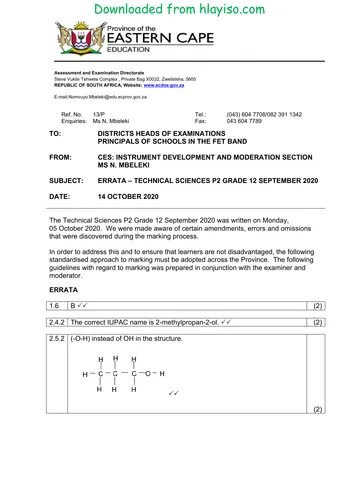
View all
Technical Sciences Grade 12 Paper 2 NSC November 2020 Memo
Grade 12 Technical Sciences Paper 2 memorandum from the NSC November Exam 2020, 17 pages. Read online or download the free PDF.
Technical Sciences · Grade 12 · NSC November Exam · 2020. Memorandum, 17 pages. Read online or download the PDF.
- Subject
- Technical Sciences
- Grade
- Grade 12
- Document type
- Memorandum
- Year
- 2020
- Exam period
- NSC November Exam
- Paper
- 2
- Curriculum
- CAPS
- Pages
- 17
- File size
- 576.0 KB
Free to read online, no sign-up needed
Loading document…
Loading document…
1 of 17
This exam
NSC November Exam 2020
Questions in this paper
Document textSearch extracted text and jump to a page.
Downloaded from hlayiso.com
Technical Sciences/P2/Tegniese Wetenskappe/V2 2 DBE/November 2020
SC/NSC/SS/NSS – Marking Guidelines/Nasienriglyne
QUESTION/VRAAG 1
1.1 B (2)
1.2 C (2)
1.3 D (2)
1.4 A (2)
1.5 A (2)
1.6 D (2)
1.7 B (2)
1.8 C (2)
1.9 C (2)
1.10 D (2)
[20]
Copyright reserved/Kopiereg voorbehou Please turn over/Blaai om asseblief
Downloaded from hlayiso.com
Technical Sciences/P2/Tegniese Wetenskappe/V2 3 DBE/November 2020
SC/NSC/SS/NSS – Marking Guidelines/Nasienriglyne
QUESTION/VRAAG 2
2.1 An atom or a group of atoms (bond) that determine the chemistry of a
molecule.
OR
An atom or a group of atoms (bond) that determine(s) the physical
and chemical properties of a group of organic compounds.
'n Atoom of groep atome (binding) wat die chemie van 'n molekule
bepaal.
OF
'n Atoom of groep atome (binding) wat die fisiese en chemiese
eienskappe van 'n groep organiese verbindings bepaal. (2)
2.2.1 Alkenes /Alkene (1)
2.2.2 Aldehydes /Aldehiede (1)
2.2.3 Carboxylic acids /Karboksielsure (1)
2.3.1 Hexanal/Heksanal (2)
2.3.2 Propanoic acid/Propanoësuur (2)
Marking criteria/Nasienriglyne:
2.4.1 H H H Double bond
Whole structure correct.
H C C C C H Note: Any hydrogen atom or bond
missing or added Max: 1/2
H H H
Dubbelbinding (2)
Hele struktuur korrek.
Let wel: Enige waterstofatoom of
binding uitgelaat of
bygevoeg Maks: 1/2
2.4.2 H O H H H Marking criteria/ Nasienriglyne:
Functional group
H C C C C C H Whole structure correct.
Note: Any hydrogen atom or bond
H H H H missing or added Max 1/2
(2)
Funksionele groep.
Hele struktuur korrek.
Let wel: Enige waterstofatoom of
binding uitgelaat of
bygevoeg Maks: 1/2
Copyright reserved/Kopiereg voorbehou Please turn over/Blaai om asseblief
Downloaded from hlayiso.com
Technical Sciences/P2/Tegniese Wetenskappe/V2 4 DBE/November 2020
SC/NSC/SS/NSS – Marking Guidelines/Nasienriglyne
2.5.1 H H H Marking criteria/Nasienriglyne:
Double bond
C C C C H Whole structure correct.
Note: Any hydrogen atom or bond
H H H H missing or too many bonds Max ½
(2)
If compound A is drawn 0/2
OR/OF
Dubbelbinding.
H H Hele struktuur korrek.
Let wel: Enige waterstofatoom of binding
C C C H uitgelaat of teveel binding
Maks: ½
H H Indien verbinding A geteken 0/2
H C H
H
2.5.2 H O H O H H
H C O C C H OR/OF H C O C C H
H H H H
Marking criteria/ Nasienriglyne:
Correct functional group
Whole structure correct.
Note: Any hydrogen atom or bond missing or added Max ½
Korrekte funksionele groep. (2)
Hele struktuur korrek.
Let wel: Enige waterstofatoom of binding uitgelaat of bygevoeg Maks: ½
2.6.1 Negative marking from 2.5.1/Negatiewe nasien van 2.5.1.
Positional (if but-1-ene is given in 2.5.1).
Posisioneel (indien but – 1-een gegee is in 2.5.1)
OR/OF
Chain/positional isomer (if 2-methyl prop-1-ene is given in 2.5.1)
Ketting/posisionele isomeer (indien 2-metielprop-1-een gegee is) (1)
2.6.2 Functional /Funksioneel (1)
2.7.1 Unsaturated /Onversadig (1)
2.7.2 Negative marking from 2.7.1/Negatiewe nasien van 2.7.1.
It contains carbon - carbon double/multiple bond
Bevat koolstof-koolstof dubbelbindinge/meervoudige bindinge (1)
[21]
Copyright reserved/Kopiereg voorbehou Please turn over/Blaai om asseblief
Downloaded from hlayiso.com
Technical Sciences/P2/Tegniese Wetenskappe/V2 5 DBE/November 2020
SC/NSC/SS/NSS – Marking Guidelines/Nasienriglyne
QUESTION/VRAAG 3
3.1 The pressure exerted by a gas in equilibrium with a (solid or) liquid
in a closed container/closed system (at a given temperature).
Die druk wat deur 'n gas in ewewig met 'n (vaste stof) of vloeistof in 'n
geslote houer/geslote stelsel (by 'n bepaalde temperatuur), uitgeoefen
word. (2)
3.2.1 Vapour pressure decreases with an increase in molar mass/molecular
mass/number of C-atoms/chain length.
OR
Vapour pressure increases with a decrease in molar mass/molecular
mass/number of C-atoms/chain length.
OR
Vapour pressure decreases from 1-propanol to 1-pentanol.
OR
Vapour pressure increases from 1-pentanol to 1-propanol.
Dampdruk verlaag met 'n toename in mol massa/molekulêre
massa/aantal C-atome/kettinglengte.
OF
Dampdruk verhoog met 'n afname in mol massa/molekulêre
massa/aantal C-atome/kettinglengte.
OF
Dampdruk verlaag van 1-propanol na 1-pentanol.
OF
Dampdruk verhoog van 1-pentanol na 1-propanol (1)
Copyright reserved/Kopiereg voorbehou Please turn over/Blaai om asseblief
Downloaded from hlayiso.com
Technical Sciences/P2/Tegniese Wetenskappe/V2 6 DBE/November 2020
SC/NSC/SS/NSS – Marking Guidelines/Nasienriglyne
3.2.2 Chain length/molar mass increases from 1-propanol to
1-pentanol.
The strength of intermolecular forces increases from 1-propanol to
1-pentanol/with increase in chain length/molar mass
More energy is needed to overcome strong intermolecular forces
from 1-pentanol to 1-propanol.
OR
Chain length/molar mass decreases from 1-pentanol to
1-propanol.
The strength of intermolecular forces decreases from 1-pentanol
to 1-propanol/with decrease in chain length/molar mass area.
Less energy is needed to overcome weak intermolecular forces
from 1-propanol to 1-pentanol.
Kettinglengte/molekulêre massa verhoog van 1-propanol na
1-pentanol.
Die sterkte van die intermolekulêre kragte verhoog van 1-propanol
na 1-pentanol/met toename in kettinglengte/molekulêre massa
Meer energie is nodig om die sterk intermolekulêre kragte in
1-pentanol te oorkom as in 1-propanol.
OF
Kettinglengte/mol massa verlaag van 1-pentanol na1-propanol.
Die sterkte van die intermolekulêre kragte verlaag van 1-pentanol
na 1-propanol/ met afname in kettinglengte/molekulêre massa.
Minder energie is nodig om die swak intermolekulêre kragte in
1-propanol te oorkom as in 1-pentanol. (3)
3.3.1 A : Aldehydes /A: Aldehiede
B : Alkanes /B: Alkane (2)
Copyright reserved/Kopiereg voorbehou Please turn over/Blaai om asseblief
Downloaded from hlayiso.com
Technical Sciences/P2/Tegniese Wetenskappe/V2 7 DBE/November 2020
SC/NSC/SS/NSS – Marking Guidelines/Nasienriglyne
3.3.2 A/Aldehydes have (London forces) and dipole-dipole forces.
B/Alkanes contain London forces only.
Dipole-dipole forces/forces in A/aldehydes are stronger than
London forces/forces in B/ alkanes.
OR
London forces/Forces in B/alkanes are weaker than dipole-
dipole forces /forces in A/aldehydes.
OR
The intermolecular forces in A are stronger than the
intermolecular forces in B.
OF
The intermolecular forces in B are weaker than the
intermolecular forces in A.
Aldehydes need more energy to overcome the intermolecular
forces and therefore have higher boiling points.
OR
Aldehydes have higher boiling points than alkanes.
OR
Alkanes have lower boiling points than aldehydes.
Marking criteria/Nasienriglyne:
A/B or forces is only accepted if 3.3.1 is correctly identified.
A/B of kragte word slegs aanvaar indien 3.3.1 korrek is.
geidentifiseer is.
A/Aldehiede het (London-kragte) en dipool-dipool-kragte.
B/Alkane het slegs London-kragte.
Dipool-dipool-kragte/Kragte in A/aldehiede is sterker as
London-kragte/Kragte in B.
OF
London-kragte/Kragte in B/alkane is swakker as dipool-dipool-
kragte/Kragte in A.
OF
Die intermolekulêre kragte in A is sterker as die intermolekulêre
kragte in B.
OF
Die intermolekulêre kragte in B is sterker as die intermolekulêre
kragte in A.
Aldehiede benodig meer energie om die intermolekulere kragte
te oorkom en het dus hoër kookpunte.
OF
Aldehiede het hoër kookpunte as alkane.
OF
Alkane het laer kookpunte as aldehiede. (3)
[11]
Copyright reserved/Kopiereg voorbehou Please turn over/Blaai om asseblief
Downloaded from hlayiso.com
Technical Sciences/P2/Tegniese Wetenskappe/V2 8 DBE/November 2020
SC/NSC/SS/NSS – Marking Guidelines/Nasienriglyne
QUESTION/VRAAG 4
4.1.1 Addition/hydration
Addisie/hidrasie (1)
4.1.2 Addition/hydrohalogenation/hydrobromination
Addisie/hidrohalogenering/hidrobrominering (1)
4.1.3 Substitution/Halogenation
Substitusie/Halogenasie (1)
4.2.1 Water/H2O (1)
4.2.2 (Dilute) sulphuric acid/H2SO4 OR (Dilute) phosphoric acid/H3PO4
(Verdunde) swaelsuur/H2SO4 OF (Verdunde) fosforsuur/H3PO4 (1)
4.3 H H H H
C C + H-Br → Br C C H
H H H H (3)
Note: Do not penalise HBr
Let wel: Moenie HBr penaliseer nie.
No arrow max 2/3
Geen pyl maks 2/3
4.4 Moderate/warm temperature /Mild heat. (Accept: UV light).
No water (Accept: concentrated H2SO4 + NaBr/HBr).
Warm/Matige temperatuur/Matige warmte/hitte (Aanvaar: UV lig).
Geen water (Aanvaar: gekonsentreerde H2SO4 + NaBr/HBr). (2)
4.5 C2H4 +3O2 → 2CO2 + 2H2O (+ energy) (balancing/balansering)
Marking criteria/Nasienriglyne:
Reactants/reagense
Products/produkte
Balancing/balansering
Note: Do not penalise if energy is omitted.
Let wel: Moenie penaliseer indien energie uitgelaat is
(3)
4.6 Ethene/Eteen (1)
[14]
Note: Penalise if molecular formula is written
Let wel: Penaliseer indien molekulêre formule geskryf is
Copyright reserved/Kopiereg voorbehou Please turn over/Blaai om asseblief
Downloaded from hlayiso.com
Technical Sciences/P2/Tegniese Wetenskappe/V2 9 DBE/November 2020
SC/NSC/SS/NSS – Marking Guidelines/Nasienriglyne
QUESTION/VRAAG 5
5.1 (A process) in which electrical energy is converted into chemical
energy
OR
The decomposition of a (ionic) substance when an electric current is
passed through it.
('n Proses) waar elektriese energie omgeskakel word in chemiese
energie.
OF
Die ontbinding van 'n (ioniese) stof/verbinding wanneer elektriese
stroom daardeur gestuur word. (2)
5.2 Non spontaneous /Nie-spontane (1)
5.3 Apply negative marking from 5.2./Negatiewe nasien van 5.2. (1)
It requires electrical energy
OR
It is an endothermic reaction
Dit vereis elektriese energie
OF
Dit is 'n endotermiese reaksie.
5.4 CuCℓ2 (1)
Note: Penalise if name is written.
Let wel: Penaliseer indien naam geskryf is.
5.5.1 Anode (1)
5.5.2 Cathode /Katode (1)
5.6 Reducing agent – a substance that is oxidised/loses electrons.
OR
Reducing agent – A substance that undergoes oxidation.
Reduseermiddel – 'n Stof wat geoksideer word/verlies van elektrone.
OF
Reduseermiddel – 'n Stof wat oksidasie ondergaan. (2)
5.7.1 2Cℓ- → Cℓ2 + 2e- (2)
Note: Marking criteria:/Nasienriglyne:
Penalise once if charge if left out 2Cℓ- → Cℓ2 + 2e- 2/2
- -
on chloride ion 2Cℓ ⇌ Cℓ2 + 2e 1/2
Penaliseer eenmalig indien 2Cℓ- ← Cℓ2 + 2e- 0/2
- --
lading op chloorioon uitgelaat is Cℓ2 + 2e ⇌ 2Cℓ 0/2
Copyright reserved/Kopiereg voorbehou Please turn over/Blaai om asseblief
Downloaded from hlayiso.com
Technical Sciences/P2/Tegniese Wetenskappe/V2 10 DBE/November 2020
SC/NSC/SS/NSS – Marking Guidelines/Nasienriglyne
5.7.2 Cu2+ + 2e- → Cu (2)
Note: Marking criteria:/Nasienriglyne:
Penalise once if charge if left Cu2+ + 2e- → Cu 2/2
2+ -⇌
out on copper ion Cu + 2e Cu 1/2
Penaliseer eenmalig indien Cu ⇌ Cu2+ + 2e- 0/2
lading op koperioon uitgelaat is Cu + 2e ← Cu
2+
0/2
5.7.3 Cu2+ + 2Cℓ- → Cℓ2 + Cu (2)
Accept/Aanvaar: CuCℓ2(aq) → Cℓ2 + Cu
[15]
Copyright reserved/Kopiereg voorbehou Please turn over/Blaai om asseblief
Downloaded from hlayiso.com
Technical Sciences/P2/Tegniese Wetenskappe/V2 11 DBE/November 2020
SC/NSC/SS/NSS – Marking Guidelines/Nasienriglyne
QUESTION/VRAAG 6
6.1.1 An (electrochemical cell) that converts chemical energy to electrical
energy.
'n (Elektrochemiese sel) waar chemiese energie na elektriese energie
omgeskakel word. (2)
6.1.2 (Direction of e-
flow/rigting van (Voltmeter)
elektron vloei)
Anode/Zn v
Cathode/Katode/Cu
Saltbridge/
Soutbrug
2+
SO42- SO42-
Zn
Cu2+
CRITERIA FOR MARKING/NASIENRIGLYNE
Anode in correct half cell, labelled (Zn electrode in Zn2+ /zinc
sulphate or zinc nitrate solution)
Anode in korrekte halfsel, benoem (Zn elektrode in Zn2+
/sinksulfaat of sinknitraatoplossing)
Cathode in correct half cell, labelled (Cu electrode in Cu2+
/copper sulphate or copper nitrate solution)
Katode in korrekte halfsel, benoem (Cu elektrode in Cu2+
/kopersulfaat of kopernitraatoplossing)
Voltmeter included and labelled/Voltmeter ingesluit en benoem
Accept: galvanometer/multimeter/lightbulb/gloeilamp
Salt bridge included and labeled
Correct direction of the flow electrons in the external circuit
Korrekte rigting van elektron vloei in eksterne stroombaan.
Note: if not labelled, do not penalise/indien geen byskrif gegee
nie, moenie penaliseer nie
(5)
Note: Credit the saltbridge and voltmeter only if separate containers.
Krediteer soutbrug en voltmeter slegs indien verskillende
houers.
6.1.3 Temperature/Temperatuur: 25°C/298 K
Concentration of electrolytes / Konsentrasie van elektroliete:
1 mol∙dm-3 (2)
Copyright reserved/Kopiereg voorbehou Please turn over/Blaai om asseblief
Downloaded from hlayiso.com
Technical Sciences/P2/Tegniese Wetenskappe/V2 12 DBE/November 2020
SC/NSC/SS/NSS – Marking Guidelines/Nasienriglyne
6.1.4 Towards the zinc (half cell)/anode. /Na sink(halfsel)/anode
Accept/Aanvaar: Zn/Zn2+(aq) (1)
6.1.5 To maintain electrical neutrality, because the Zinc half-cell becomes
more positive as zinc is oxidised to form zinc ions/Zn2+..
Handhaaf elektriese neutraliteit, omdat die sinkhalfsel meer positief
word soos wat die sink na sinkione/Zn2+ geoksideer word. (2)
6.2.1 OPTION/OPSIE 1 OPTION/OPSIE 2
Eθcell = Eθcathode - Eθanode X → Xn+ + ne- (y)
Cu2+ + 2e- → Cu -(0,34)
2,00= 0,34 - EθX
X + Cu2+ → Xn+ + Cu 2,00V
EθX = - 1,66 V
EθX = - 1,66 V
Electrode X is aluminium/Aℓ Electrode X is aluminium/Aℓ
Elektrode X is aluminium/Aℓ Elektrode X is aluminium/Aℓ
(5)
Note:
Positive marking of answer obtained in 6.2.1 for 6.2.2, 6.2.3. and 6.2.4.
Positiewe nasien van antwoord in 6.2.1 in 6.2.2, 6.2.3 en 6.2.4
6.2.2 Aℓ → Aℓ3+ + 3e- (2)
Marking criteria:/Nasienriglyne:
Aℓ → Aℓ3+ + 3e- 2/2
Aℓ ⇌ Aℓ + 3e
3+ -
1/2
Aℓ3+ + 3e- ⇌ Aℓ 0/2
3+ -
Aℓ ← Aℓ + 3e 0/2
6.2.3 X/Aluminium/ Aℓ/ anode/negative electrode / negatiewe elektrode (1)
6.2.4 X/Aluminium/Aℓ will be oxidised.
OR
X/Aluminium/Aℓ will lose electrons.
X/Aluminium/Aℓ word geoksideer.
OF
X/Aluminium/Aℓ verloor elektrone. (2)
[22]
Copyright reserved/Kopiereg voorbehou Please turn over/Blaai om asseblief
Downloaded from hlayiso.com
Technical Sciences/P2/Tegniese Wetenskappe/V2 13 DBE/November 2020
SC/NSC/SS/NSS – Marking Guidelines/Nasienriglyne
QUESTION/VRAAG 7
7.1.1 The change in direction of a wave upon striking the interface
between two materials.
OR
The change in direction of a wave front at the interface (boundary)
between two media, bouncing back into the original medium.
Die verandering in bewegingsrigting van 'n golf wanneer dit die grens
tussen die twee media tref.
OF
Die verandering in bewegingsrigting van 'n golffront by die grens
tussen twee media, en dit terugweerkaats word in die oorspronklike
medium. (2)
7.1.2 Incident (ray) /Invallende (straal) (1)
7.1.3 Reflected (ray) /Weerkaatste (straal) (1)
7.1.4 Normal /Normaal (1)
7.1.5 (Angle) of incidence /invals(hoek) (1)
7.1.6 (Angle) of reflection /weerkaatsings(hoek) (1)
7.2 30° (1)
7.3 The speed will decrease. /Die spoed sal afneem. (1)
7.4.1 Water (1)
7.4.2 It will bent towards the normal/It will be refracted towards the normal
Dit sal na die normaal gebuig word./Dit sal na die normaal gebreek
word.
Accept/Aanvaar: change direction/verander rigting (1)
7.4.3 Refraction /Refraksie (1)
7.5.1 (Critical angle) is the angle of incidence in the denser medium such
that the refracted ray just passes through the surface of separation of
the two media.
OR
An angle of incidence in the denser medium whose angle of refraction
is 90º (a right angle).
Die (grenshoek) is die invalshoek in die digter medium sodanig dat die
gebreekte straal al langs die skeidingsoppervlak van die twee media
beweeg.
OF
Die invalshoek in die digter medium waar die refraksiehoek 90º
(regtehoek) is. (2)
Copyright reserved/Kopiereg voorbehou Please turn over/Blaai om asseblief
Downloaded from hlayiso.com
Technical Sciences/P2/Tegniese Wetenskappe/V2 14 DBE/November 2020
SC/NSC/SS/NSS – Marking Guidelines/Nasienriglyne
7.5.2 Light ray will travel from water and pass into the air. It will be
refracted away/move away from the normal/Ligstraal sal vanaf water
na die lug beweeg. Dit sal weg van die normaal breek. (2)
7.5.3 When the angle of incidence is greater than the critical angle the ray
of light reflects (back) into the original medium
Wanneer die invalshoek groter is as die grenshoek, sal die ligstraal
(terug) weerkaats word in die oorspronklike medium. (2)
7.5.4 Greater than /Groter as (1)
[19]
QUESTION/VRAAG 8
8.1 (The phenomenon) whereby white light breaks up (spreads out) into
its component colours.
(Die verskynsel) wanneer witlig in sy saamgestelde kleure opbreek. (2)
8.2 The different colours of visible light include:/Die verskillende kleure van
sigbare lig is:
Red Rooi
Orange Oranje
Yellow Geel
Green Groen
Blue Blou
Indigo Indigo
Violet Violet
(Any FOUR)/(Enige VIER) (4)
8.3. It is always virtual.
Erect/upright.
Its size is equal to that of the object.
It is formed at the same distance behind the mirror as the object is
in front of the mirror.
It is laterally inverted.
(Any THREE)
Dit is 'n skynbeeld.
Regop.
Dieselfde grootte as die voorwerp.
Dit is dieselfde afstand agter die spieël as die voorwerp voor die
spieël is.
Dit is sywaarts omgekeerd.
(Enige DRIE) (3)
Copyright reserved/Kopiereg voorbehou Please turn over/Blaai om asseblief
Downloaded from hlayiso.com
Technical Sciences/P2/Tegniese Wetenskappe/V2 15 DBE/November 2020
SC/NSC/SS/NSS – Marking Guidelines/Nasienriglyne
8.4.1 Note:
Penalise once if arrow is
missing in answer 8.4.1,
8.4.2 and/or 8.4.3.
Penaliseer slegs eenmalig
indien pyl uitgelaat is in
8.4.1, 8.4.2 en/of 8.4.3
Marking criteria/Nasienriglyne:
Ray through the optical centre of the lens continues (1)
straight through the lens without deviation.
Straal beweeg regdeur die optiese middelpunt van die lens
sonder afwyking
8.4.2
Marking criteria/Nasienriglyne: (2)
Ray parallel to the principal axis on the opposite side of the
lens without any refraction
Correct direction of ray
Straal beweeg parallel aan die hoofas, aan die
teenoorgestelde kant van die lens sonder enige breeking.
Korrekte rigting van die straal
Copyright reserved/Kopiereg voorbehou Please turn over/Blaai om asseblief
Downloaded from hlayiso.com
Technical Sciences/P2/Tegniese Wetenskappe/V2 16 DBE/November 2020
SC/NSC/SS/NSS – Marking Guidelines/Nasienriglyne
8.4.3
Marking criteria/Nasienriglyne: (2)
Ray refracted and diverges on the opposite side of the lens [14]
Correct direction of ray
Note: Don’t penalise if dotted extrapolated line is omitted or is incorrectly
drawn, but angle of refracted ray must be correct
Straal gebreek, divergeer aan die teenoorgestelde kant van die lens
Korrekte rigting van die straal
Let wel: Moenie penaliseer indien gestippelde ge-ekstrapoleerde straal
uitgelaat is of verkeerd geteken is nie, maar hoek van die gerefrakteerde
straal moet korrek wees
Copyright reserved/Kopiereg voorbehou Please turn over/Blaai om asseblief
Downloaded from hlayiso.com
Technical Sciences/P2/Tegniese Wetenskappe/V2 17 DBE/November 2020
SC/NSC/SS/NSS – Marking Guidelines/Nasienriglyne
QUESTION/VRAAG 9
9.1 (Electromagnetic wave) is the changing of the magnetic and electric
fields mutually perpendicular to each other and to the direction of
propagation of the wave.
(Elektromagnetiese golf) is die verandering in die magneet- en
elektriese velde wat onderling loodreg op mekaar is en op die
voortplantingsrigting van die golf. (2)
9.2 They have longer wavelengths /Hulle het langer golflengtes (1)
9.3 Quantum (packets) of energy/Kwantumenergie (pakkies) (1)
9.4.1 Ultraviolet (1)
9.4.2 Infrared /Infrarooi (1)
Accept/Aanvaar: radio waves/radiogolwe
9.4.3 Radio waves /Radiogolwe
(1)
Accept/Aanvaar: micro waves/mikrogolwe
9.5 Wavelength and frequency are inversely proportional.
OR
When wavelength becomes longer, frequency decreases.
OR
When wavelength becomes shorter, frequency increases
Golflengte en frekwensie is omgekeerd eweredig.
OF
Wanneer golflengte langer word, word frekwensie korter.
OF
Wanneer golflengte korter word, word frekwensie langer. (2)
9.6 OPTION/OPSIE 1 OPTION/OPSIE 2
c = ƒλ
c
3,0 x 108 = ƒ (4,06 x 10⁻¹¹) Eh
λ
ƒ = 7,39 x 10¹⁸ Hz
E
6,63 x 10 34 3,0 x 10 8
E = hƒ 4,06 x 10 11
E 4,90 10 -15 J
= (6,63 x 10⁻³⁴)(7,39 x 10¹⁸ )
= 4,90 × 10⁻¹⁵ J
Accept/Aanvaar : 4,8990 × 10⁻¹⁵ J
(5)
[14]
TOTAL/TOTAAL: 150
Copyright reserved/Kopiereg voorbehou
Study this subject
Recommended for this subject
Question paper
Technical Sciences Grade 12 P2 NSC November 2020 QP (Afr)
Question paper
Technical Sciences Grade 12 P2 NSC November 2020 QP (Eng)
Question paper
Technical Sciences Grade 12 P1 NSC November 2020 QP (Eng)
Errata
Technical Sciences Grade 12 P2 Eastern Cape Mock 2020 Errata
Question paper
Technical Sciences Grade 12 P2 Eastern Cape Mock 2020 QP
Question paper
Technical Sciences Grade 12 P2 Eastern Cape Mock 2020 QP
More from Grade 12 Technical Sciences
Annual teaching plan
Gr 12 Tech Sci ATP 2023 24
Question paper
Technical Sciences Grade 12 P1 Eastern Cape Mock 2025 QP
Question paper
Technical Sciences Grade 12 P2 Eastern Cape Mock 2025 QP
Question paper
Technical Sciences Grade 12 P1 Gauteng June 2025 QP (Eng)
Question paper
Technical Sciences Grade 12 P2 Gauteng June 2025 QP (Afr)
Question paper