
Downloaded from hlayiso.com
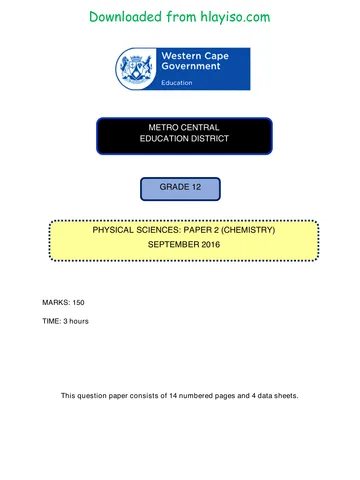
METRO NORTH
EDUCATION DISTRICT
NATIONAL
SENIOR CERTIFICATE
GRADE 12
PHYSICAL SCIENCES: Chemistry (P2)
SEPTEMBER 2016
MARKS: 150
TIME: 3 hours
This paper consists of 14 pages and 4 data sheets.
Skip to contentQuestion paper 
View all





Physical Sciences Grade 12 Western Cape November 2016 QP
Grade 12 Physical Sciences question paper from the Western Cape November 2016, 19 pages. Read online or get the free PDF download, memo linked when available.
Physical Sciences · Grade 12 · Western Cape November · 2016. Question paper, 19 pages. Read online or download the PDF.
- Subject
- Physical Sciences
- Grade
- Grade 12
- Document type
- Question paper
- Year
- 2016
- Exam period
- Western Cape November
- Curriculum
- CAPS
- Pages
- 19
- File size
- 313.7 KB
Loading document…
Loading document…
1 of 19
Document textSearch extracted text and jump to a page.
Downloaded from hlayiso.com
INSTRUCTIONS AND INFORMATION
1. This question paper consists of TEN questions. Answer ALL the questions.
2. Start EACH question on a NEW page.
3. Number the answers correctly according to the numbering system used in this
question paper.
4. Leave ONE line between two sub questions, for example
between QUESTION 2.1 and QUESTION 2.2.
5. You may use a non-programmable calculator.
6. You may use appropriate mathematical instruments.
7. You are advised to use the attached DATA SHEETS.
8. Show ALL formulae and substitutions in ALL calculations.
9. Round off your final numerical answers to a minimum of TWO decimal places.
10. Give brief motivations, discussions, et cetera where required.
11. Write neatly and legibly.
Downloaded from hlayiso.com
QUESTION 1: MULTIPLE-CHOICE QUESTIONS
Four options are provided as possible answers to the following questions. Each question has
only ONE correct answer. Choose the answer and write only the letter (A–D) next to the
question number (1.1–1.10), for example 1.11 E.
1.1 An example of an unsaturated hydrocarbon is:
A C2HCℓ3
B C4H8
C C3H8
D C3H7OH (2)
1.2 The condensed structural formula of an organic compound is indicated
below.
CH3
CH3 CH2 CH2 CH CH CH CH3
CH2CH3 CH3
Choose the correct IUPAC name for the above compound.
A 3,4-dimethylhexane
B 4-ethyl-2,3-dimethylheptane
C 4-ethyl-5,6-dimethylheptane
D 2,3-dimethyl-4-ethylheptane (2)
Downloaded from hlayiso.com
1.3 Which ONE of the following reaction types can be used to prepare ethene
from octane?
A Cracking
B Addition
C Substitution
D Hydrogenation (2)
1.4 A state of dynamic equilibrium is established in a reaction when the..
A concentration of the reactants is equal to the concentration of the
products.
B concentration of the reactants and products remain constant.
C reaction has reached its completion.
D value of the equilibrium constant is equal to zero. (2)
1.5 Consider the following equilibrium reaction:
2CrO4 (aq) + 2H+ (aq) ⇌ Cr2O7 –2 (aq) + H2O(aq) ∆H< 0
(yellow) (orange)
Which one of the following changes to the state of equilibrium will cause
the colour of the equilibrium solution to turn orange?
A Adding concentrated HCℓ – solution.
B Adding concentrated NaOH – solution.
C Increasing the pressure of the system.
D Increasing the temperature of the system.
(2)
Downloaded from hlayiso.com
1.6 If the [HCℓ] solution is 0,001 mol.dm-3, then the pH-value and the [OH– ] of
the HCℓ solution will be ...
pH – value of HCℓ solution [OH-] mol.dm–3
A 11 10–3
B 11 10–11
C 3 10–11
D 3 (2)
10–3
1.7 In the reaction X + H2O H3O+ + HSO4 – , X represents the following:
A acid SO42–
B base SO42–
C acid H2SO4
D base H2SO4 (2)
1.8 Which ONE of the following statements regarding the anode of an operating
standard galvanic cell is correct?
A The anode gains electrons.
B The mass of the anode decreases.
C The concentration of the electrolyte in the half cell that contains the
anode decreases initially.
D The anode is the positive terminal of the cell. (2)
Downloaded from hlayiso.com
1.9 The Maxwell-Boltzmann-energy distribution curve underneath indicates the
number of particles as a function of their kinetic energy for a reaction, at four
different temperatures. The minimum kinetic energy needed for effective
collisions is indicated by E.
Which one of the following curves represent the reaction that take place at
the highest temperature?
A I
B II
C III
D IV (2)
1.10 A farmer had the soil tested and is informed that the soil has a shortage of
potassium. He is given the choice of four inorganic fertilisers. The four
choices are marked as follows:
i) 2: 4 : 1 (30)
ii) 1: 2 : 4 (30)
iii) 4:2:1 (30)
iv) 2:4:2 (30)
The fertiliser that best suits the soils nutrient requirements is...
A (i)
B (ii)
C (iii)
D (iv) (2)
[20]
Downloaded from hlayiso.com
QUESTION 2 (Start on a new page.)
The letters A to F in the table below represent six organic compounds. Use the information in
the table to answer the questions that follow.
H H
A B C C C
But-1-ene 1-bromopentan-2-one
H H n
CH3 H O H CH3
I I II I l
D E F
CH3 CHCH2CH3 H–C–C–O–C–H CH3 – C – CH3
I I l
H H OH
2.1 Write down the LETTER that represents the following:
2.1.1 A ketone. (1)
2.1.2 A tertiary alcohol (1)
2.1.3 A unsaturated compound (1)
2.2 Write down the IUPAC name of:
2.2.1 compound D. (2)
2.2.2 compound F. (2)
2.3 Write down the STRUCTURAL FORMULA for the following:
2.3.1 Compound B (2)
2.3.2 The functional group for compound E. (2)
2.3.3 The monomer used to form compound C. (2)
2.3.4 A FUNCTIONAL isomer for compound B. (2)
[15]
Downloaded from hlayiso.com
QUESTION 3 (Start on a new page.)
An experiment is conducted to determine the boiling point of organic compounds with
three different homologous series, indicated with letters A to C, determined under the
same conditions. The results are given in the table below:
ORGANIC
MOLECULAR FORMULA BOILING POINT (ºC)
COMPOUND
A CH3CH2CH2OH + 97
B CH3CH2CH3 ‒ 42
C CH3CH2CHO + 48
3.1 Define the term homologous series. (2)
3.2 Write the name of the homologous series to which A, B and C belong to. (3)
3.3 Formulate an investigative question for this practical investigation. (2)
3.4 Write down the IUPAC name for compound C. (1)
3.5 Fully explain the difference between the boiling point of compound A and B. (4)
3.6 Which one of the above mentioned compounds will have the highest
VAPOUR PRESSURE? Explain your answer. (2)
[14]
Downloaded from hlayiso.com
QUESTION 4 (Start on a new page.)
The flow diagram illustrates some of the reactions that pent-2-ene undergoes.
pentane
E
2-bromopentane pent-2-ene compound X
C
+ H2O
Use the information in the flow diagram to answer the questions that follow.
4.1 Name the TYPE of addition reaction that takes place at:
4.1.1 A (1)
4.1.2 C (1)
4.1.3 D (1)
4.2 Name the TYPE of reaction that takes place at E. (1)
4.3 Which reaction conditions are needed so that reaction B can take place? (2)
4.4 Write down a balanced chemical equation for reaction D using structural (4)
formula.
4.5 Write the NAME or SYMBOL for the catalyst used during reaction A. (1)
4.6 Write down the CONDENSED STRUCTURAL FORMULA and the IUPAC
NAME for compound X. (3)
[14]
Downloaded from hlayiso.com
QUESTION 5 (Start on a new page.)
5.1 Define the term reaction rate in words. (2)
Learners use the reaction between IMPURE POWDERED zinc and excess
hydrochloric acid to investigate reaction rate. The balanced equation for the reaction is:
Zn(s) + 2HCℓ(aq) → ZnCℓ2(aq) + H2(g)
They perform four experiments under different conditions of concentration, mass
and temperature as shown in the table below. They use identical apparatus in the
four experiments and measure the volume of gas released in each experiment.
EXPERIMENT
1 2 3 4
-3
Concentration of acid (mol·dm ) 1 0,5 1 1
Mass of impure zinc powder (g) 15 15 15 25
Initial temperature of acid (°C) 30 30 40 40
5.2 The results of experiments 1 and 3 are compared in one of these
investigation.
Write down the:
5.2.1 Independent variable (1)
5.2.2 dependent variable for this investigation. (1)
5.3 Use the collision theory to explain why the reaction rate in experiment 1 will
be higher than that in experiment 2. (3)
5.4 Experiment 3 and experiment 4 are now compared with each other.
5.4.1 How will the reaction rate of experiment 3 compare to that of
experiment 4? Write down only HIGHER THAN, LOWER THAN or
(1)
EQUAL TO.
5.4.2 Draw a sketch graph to show the difference between experiment 3
and 4. Place the volume H2 gas on the y axis and time on the x axis.
No values have to be indicated on the graph. Clearly mark the line
graphs as experiment 3 and experiment 4. (4)
5.5 When the reaction in experiment 4 reaches completion, the volume of the
gas formed is 8,6 dm3. Determine the percentage purity of the zinc powder.
PLEASE NOTE: The molar gas volume at 40º C is equal to 25,7 dm3.
(NOT 22,4 dm3) (5)
[17]
Downloaded from hlayiso.com
QUESTION 6 (Start on a new page.)
Nitrosyl bromide decomposes to form nitrogen(II) oxide and bromide gas according to the
balanced equation below:
2NOBr (g) ⇄ 2NO (g) + Br2 (g)
55g NOBr is sealed in a 2 dm3 container and allowed to decompose. At equilibrium 78% of
the NOBr has decomposed.
6.1 Calculate the Kc – value for this reaction. (8)
6.2 The same reaction takes place at the same temperature, but in a
1 dm3 container. How will the following be influenced?
(Write only INCREASE, DECREASE or STAY THE SAME.)
6.2.1 Kc value. (2)
6.2.2 Time it takes to reach equilibrium. (2)
6.2.3 The number of moles of Br2 (2)
6.3 Use Le Chatelier’s principle to fully explain your answer in 6.2.3. (3)
[17]
Downloaded from hlayiso.com
QUESTION 7 (Start on a new page.)
7.1 Ethanoic acid is a weak monoprotic acid.
Give the definition for:
7.1.1 an acid in terms of th Lowry-Brønsted theory. (1)
7.1.2 a weak acid. (2)
7.2 During titration,15 cm3 of a 0,25 mol·dm-3 acetic acid solution is neutralised by
20 cm3 sodium hydroxide solution, according to the following balanced
equation below:
CH3COOH(aq) + Na+ (aq) + OH‒ (aq) → CH3COO‒ (aq)+ Na+(aq) + H2O(ℓ)
7.2.1 Write down two conjugate acid base pairs that occurs in this
equation. (4)
7.2.2 Which indicator (bromothymol blue or phenolphthalein) is suitable to
use in this titration reaction? (1)
7.2.3 Will the pH at the endpoint of the titration be LARGER THAN,
SMALLER THAN or EQUAL TO 7? Give a reason for your (2)
answer
7.2.4 Calculate the concentration of the NaOH solution. (4)
7.2.5 Calculate the pH of the original acetic acid solution. (3)
[17]
Downloaded from hlayiso.com
QUESTION 8 (Start on a new page.)
A galvanic cell is set up under standard conditions in order to identify an unknown metal X as
indicated in the diagram below.
It was found that the mass of metal X decreases as the reaction takes place.
V
+
I2(g) X
Pt
I‒ (aq) X2+ (aq)
Half-cell B
8.1 Which energy conversion takes place in this cell? (2)
8.2 Give TWO functions of the salt bridge. (2)
8.3 Identify metal X if the initial EMF of the cell is 0,82 V. Show how you arrived
at the answer. (4)
8.4 Write down the net cell reaction that takes place in this cell. (2)
8.5 Write down the correct cell notation for this cell. (3)
[13]
Downloaded from hlayiso.com
QUESTION 9 (Start on a new page.)
Aluminium oxide is an ionic compound. It is found in the earth’s crust as ore and is known as
bauxite. The ore contains aluminium oxide. To obtain aluminium the bauxite must be melted
and electricity must be passed through it.
anode
cathode
Mixture of bauxite and
cryolite
Molten aluminium
9.1 Define the term electrolytic cell. (2)
9.2 Why is cryolite added to the bauxite before it is melted? (1)
9.3 Give the symbol of the ions present in the molten aluminium oxide. (2)
9.4 Write down the half reaction that takes place at the cathode. (2)
9.5 Explain why the carbon anode should be replaced regularly. Make use of a
chemical reaction to support your answer. (4)
[11]
Downloaded from hlayiso.com
QUESTION 10 (Start on a new page.)
10.1 In the table below five possible reactions for the fertiliser industry are given.
Reaction I Methane reacts with steam to form hydrogen.
Reaction II Hydrogen and nitrogen react in the presence of a catalyst
to form ammonia.
Reaction III Ammonia reacts with oxygen in the presence of a catalyst
and form nitrogen oxide and water.
Reaction IV Sulphur trioxide reacts with sulphuric acid to form oleum.
The oleum is diluted to Sulphuric acid.
Reaction V Ammonia reacts with nitric acid to form a fertiliser.
10.1.1 Write down a balanced chemical equation for Reaction III. Also
Give the formula of the catalyst that is used. (4)
10.1.2 What is the name of the industrial process which Reaction II
occurs in? (1)
10.1.3 Write down the formula for oleum. (2)
10.1.4 Write down the NAME and FORMULA for the fertiliser that is
formed in Reaction V. (2)
10.2 A farmer buys a bag of fertiliser with the following information on it.
20 kg
3:5:2
(30)
Calculate the mass of phosphorous the bag contains. (3)
[12]
TOTAL: 150
Downloaded from hlayiso.com
DATA FOR PHYSICAL SCIENCES GRADE 12
PAPER 2 (CHEMISTRY)
GEGEWENS VIR FISIESE WETENSKAPPE GRAAD 12
VRAESTEL 2 (CHEMIE)
TABLE 1: PHYSICAL CONSTANTS/TABEL 1: FISIESE KONSTANTES
NAME/NAAM SYMBOL/SIMBOOL VALUE/WAARDE
Standard pressure pθ 1,013 x 105 Pa
Standaarddruk
Molar gas volume at STP
Vm 22,4 dm3∙mol-1
Molêre gasvolume by STD
Standard temperature
Tθ 273 K
Standaardtemperatuur
Charge on electron
e -1,6 x 10⁻¹⁹ C
Lading op elektron
Avogadro's constant
NA 6,02 x 10²³ mol-1
Avogadro-konstante
TABLE 2: FORMULAE/TABEL 2: FORMULES
m N
n= n=
M NA
n m V
c= or/of c= n=
V MV Vm
ca va na
= pH = -log[H3O+]
cb vb nb
Kw = [H3O+][OH-] = 1 x 10-14 at/by 298 K
Eθ = Eθ − Eθ /E θ = Eθ − Eθ
cell cathode anode sel katode anode
or/of
Eθ = Eθ − Eθ /E θ = Eθ − Eθ
cell reduction oxidation sel reduksie oksidasie
or/of
Eθ = Eθ − Eθ /E θ = Eθ − Eθ
cell oxidisingagent reducingagent sel oksideermiddel reduseermiddel
Physical Sciences/P2
Downloaded from hlayiso.com 2 DBE/Feb.–Mar. 2015
NSC
TABLE 3: THE PERIODIC TABLE OF ELEMENTS
TABEL 3: DIE PERIODIEKE TABEL VAN ELEMENTE
1 2 3 4 5 6 7 8 9 10 11 12 13 14 15 16 17 18
(I) (II) (III) (IV) (V) (VI) (VII) (VIII)
Atomic number
1 KEY/SLEUTEL Atoomgetal 2
2,1 H He
1 29 4
3 4 Electronegativity Symbol 5 6 7 8 9 10
1,0 Li 1,5 Be Elektronegatiwiteit 1,9 Cu Simbool 2,0 B 2,5 C 3,0 N 3,5 O 4,0 F Ne
63,5
7 9 11 12 14 16 19 20
11 12 13 14 15 16 17 18
0,9 Na 1,2 Mg Approximate relative atomic mass 1,5 Aℓ 1,8 Si 2,1 P 2,5 S 3,0 Cℓ Ar
23 24 Benaderde relatiewe atoommassa 27 28 31 32 35,5 40
19 20 21 22 23 24 25 26 27 28 29 30 31 32 33 34 35 36
0,8 K 1,0 Ca 1,3 Sc 1,5 Ti 1,6 V 1,6 Cr 1,5 Mn 1,8 Fe 1,8 Co 1,8 Ni 1,9 Cu 1,6 Zn 1,6 Ga 1,8 Ge 2,0 As 2,4 Se 2,8 Br Kr
39 40 45 48 51 52 55 56 59 59 63,5 65 70 73 75 79 80 84
37 38 39 40 41 42 43 44 45 46 47 48 49 50 51 52 53 54
0,8 Rb 1,0 Sr 1,2 Y 1,4 Zr Nb 1,8 Mo 1,9 Tc 2,2 Ru 2,2 Rh 2,2 Pd 1,9 Ag 1,7 Cd 1,7 In 1,8 Sn 1,9 Sb 2,1 Te 2,5 I Xe
86 88 89 91 92 96 101 103 106 108 112 115 119 122 128 127 131
55 56 57 72 73 74 75 76 77 78 79 80 81 82 83 84 85 86
0,7 Cs 0,9 Ba La 1,6 Hf Ta W Re Os Ir Pt Au Hg 1,8 Tℓ 1,8 Pb 1,9 Bi 2,0 Po 2,5 At Rn
133 137 139 179 181 184 186 190 192 195 197 201 204 207 209
87 88 89
0,7 Fr 0,9 Ra Ac 58 59 60 61 62 63 64 65 66 67 68 69 70 71
226 Ce Pr Nd Pm Sm Eu Gd Tb Dy Ho Er Tm Yb Lu
140 141 144 150 152 157 159 163 165 167 169 173 175
90 91 92 93 94 95 96 97 98 99 100 101 102 103
Th Pa U Np Pu Am Cm Bk Cf Es Fm Md No Lr
232 238
Copyright reserved Please turn over
Downloaded from hlayiso.com
TABLE 4A: STANDARD REDUCTION POTENTIALS
TABEL 4A: STANDAARD-REDUKSIEPOTENSIALE
Half-reactions/Halfreaksies Eθ (V)
F2(g) + 2e− 2F− + 2,87
3+ −
⇌
Co + e + 1,81
⇌ Co2+
H2O2 + 2H +2e−
+
2H2O +1,77
− ⇌
+ 8H + 5e−
+
MnO 2+
Mn + 4H2O + 1,51
4 ⇌
Cℓ2(g) + 2e− 2Cℓ− + 1,36
2− + −
⇌
Cr O + 14H + 6e 3+
2Cr + 7H2O + 1,33
2 7 + −
⇌
O2(g) + 4H + 4e 2H2O + 1,23
+ −
⇌ 2+
MnO2 + 4H + 2e Mn + 2H2O
⇌ + 1,23
Pt + 2e−
2+
⇌ Pt + 1,20
Br2(ℓ) + 2e− 2Br− + 1,07
− + −
⇌
NO + 4H + 3e NO(g) + 2H2O + 0,96
3 ⇌
−
Hg(ℓ)
2+
Hg + 2e ⇌ + 0,85
Increasing reducing ability/Toenemende reduserende vermoë
Ag + e−
+
Ag + 0,80
− + −
⇌
NO + 2H + e
Increasing oxidising ability/Toenemende oksiderende vermoë
NO2(g) + H2O + 0,80
3 ⇌
Fe + e−
3+
2+ + 0,77
+ −
⇌ Fe
O2(g) + 2H + 2e H2O2 + 0,68
⇌
I2 + 2e− 2I− + 0,54
⇌
Cu + e−
+
Cu + 0,52
⇌
SO2 + 4H + 4e−
+
S + 2H2O + 0,45
⇌
2H2O + O2 + 4e− 4OH− + 0,40
⇌
Cu + 2e−
2+
Cu + 0,34
⇌
2− + − SO2(g) + 2H2O + 0,17
SO
4 + 4H + 2e ⇌
Cu + e−
2+ +
Cu + 0,16
⇌
4+ −
Sn + 2e ⇌ Sn2+ + 0,15
S + 2H + 2e−
+
⇌ H2S(g) + 0,14
2H + 2e−
+
H2(g) 0,00
⇌
Fe + 3e−
3+
⇌ Fe − 0,06
Pb + 2e−
2+
⇌ Pb − 0,13
Sn + 2e−
2+
⇌ Sn − 0,14
Ni + 2e−
2+
⇌ Ni − 0,27
2+ −
Co + 2e ⇌ Co − 0,28
Cd + 2e−
2+
⇌
Cd − 0,40
3+ −
Cr + e
⇌ Cr2+ − 0,41
Fe + 2e−
2+
⇌ Fe − 0,44
3+ −
Cr + 3e ⇌ Cr − 0,74
Zn + 2e−
2+
⇌ Zn − 0,76
−
2H2O + 2e− H2(g) + 2OH − 0,83
⇌
Cr + 2e−
2+
⇌ Cr − 0,91
Mn + 2e−
2+
⇌ Mn − 1,18
Aℓ + 3e− Aℓ
3+
⇌ − 1,66
Mg + 2e−
2+
⇌
Mg − 2,36
+ −
Na + e
⇌ Na − 2,71
Ca + 2e−
2+
⇌ Ca − 2,87
2+ −
Sr + 2e ⇌ Sr − 2,89
Ba + 2e−
2+
⇌ Ba − 2,90
+ -
Cs + e Cs - 2,92
⇌
K + e−
+
⇌ K − 2,93
Li + e−
+
⇌ Li − 3,05
Copyright reserved Please turn over
Downloaded from hlayiso.com
Physical Sciences/P2 4
NSC
TABLE 4B: STANDARD REDUCTION POTENTIALS
TABEL 4B: STANDAARD-REDUKSIEPOTENSIALE
Half-reactions/Halfreaksies Eθ (V)
Li + e−
+
Li − 3,05
⇌
K + e−
+
⇌ K − 2,93
Cs + e−
+
⇌ Cs − 2,92
Ba + 2e−
2+
⇌ Ba − 2,90
Sr + 2e−
2+
⇌ Sr − 2,89
2+ −
Ca + 2e ⇌ Ca − 2,87
Na + e−
+
⇌ Na − 2,71
Mg + 2e−
2+
⇌ Mg − 2,36
Aℓ + 3e− Aℓ
3+
⇌ − 1,66
Mn + 2e−
2+
⇌ Mn − 1,18
2+ −
Cr + 2e ⇌ Cr − 0,91
−
Increasing oxidising ability/Toenemende oksiderende vermoë
2H2O + 2e− H2(g) + 2OH − 0,83
⇌
2+ −
Zn + 2e ⇌ Zn − 0,76
Increasing reducing ability/Toenemende reduserende vermoë
Cr + 3e−
3+
⇌ Cr − 0,74
2+ −
Fe + 2e
⇌
Fe − 0,44
Cr + e−
3+
⇌ Cr 2+ − 0,41
2+ −
Cd + 2e
⇌ Cd − 0,40
Co + 2e−
2+
⇌ Co − 0,28
2+ −
Ni + 2e ⇌ Ni − 0,27
Sn + 2e−
2+
⇌ Sn − 0,14
Pb + 2e−
2+
⇌
Pb − 0,13
Fe + 3e−
3+
⇌ Fe − 0,06
2H + 2e−
+
H2(g) 0,00
⇌
S + 2H + 2e−
+
⇌ H2S(g) + 0,14
Sn + 2e−
4+
⇌ Sn 2+ + 0,15
2+ − +
Cu + e Cu + 0,16
⇌
2− + − SO2(g) + 2H2O + 0,17
SO
+ 4H + 2e
4 ⇌
Cu + 2e−
2+
⇌ Cu + 0,34
2H2O + O2 + 4e− 4OH− + 0,40
+ −
⇌
SO2 + 4H + 4e S + 2H2O + 0,45
⇌
Cu + e−
+
⇌ Cu + 0,52
I2 + 2e− 2I− + 0,54
+ −
⇌
O2(g) + 2H + 2e H2O2 + 0,68
⇌
Fe + e−
3+
+ 0,77
− ⇌ Fe2+
+ 2H + e−
+
NO NO2(g) + H2O + 0,80
3 ⇌
+ −
Ag + e ⇌ Ag + 0,80
Hg + 2e−
2+
Hg(ℓ) + 0,85
− + −
⇌
NO + 4H + 3e NO(g) + 2H2O + 0,96
3
−
⇌
Br2(ℓ) + 2e
⇌ 2Br− + 1,07
2+ −
Pt + 2 e Pt + 1,20
⇌
MnO2 + 4H + 2e−
+ 2+
Mn + 2H2O + 1,23
⇌
O2(g) + 4H + 4e−
+
2H2O + 1,23
2− ⇌
+ 14H + 6e−
+ 3+
Cr O 2Cr + 7H2O + 1,33
2 7 −
⇌
−
Cℓ2(g) + 2e 2Cℓ + 1,36
− ⇌
+ 8H + 5e−
+
MnO 2+
Mn + 4H2O + 1,51
4 ⇌
H2O2 + 2H +2 e−
+
⇌ 2H2O +1,77
Co + e−
3+
⇌ Co 2+ + 1,81
F2(g) + 2e− 2F− + 2,87
⇌
Copyright reserved
Study this subject
Revise the topics in this paper, then practise them question by question.
- Grade 12 Physical Sciences notes
CAPS revision notes with worked examples.
- Physical Sciences questions by topic
Past exam questions sorted by CAPS topic, with memos where available.
- Grade 12 Physical Sciences quizzes
Short topic quizzes with instant feedback.
- All Grade 12 Physical Sciences past papers
Past papers by year, with memos where available.
- Grade 12 past papers
More Physical Sciences and other subjects in this collection.
Recommended for this subject
More papers and memos for this grade and subject.
Question paper
Physical Sciences Grade 12 P1 Eastern Cape June 2025 QP (Afr)
Question paper
Physical Sciences Grade 12 P2 Eastern Cape Mock 2025 QP
Question paper
Physical Sciences Grade 12 P2 Gauteng Mock 2025 Question Paper
Question paper
Physical Sciences Grade 12 Paper 1 KZN Mock 2025 Question Paper
Question paper
Physical Sciences Grade 12 Limpopo March Test 2025 Question Paper
Question paper
Physical Sciences Grade 12 P1 Limpopo Mock 2025 Question Paper
Related documents
Question paper
Physical Sciences Grade 12 Western Cape November 2016 QP
Question paper
Physical Sciences Grade 12 Western Cape November 2016 QP
Question paper
Physical Sciences Grade 12 P2 Eastern Cape Mock 2016 QP
Question paper
Physical Sciences Grade 12 Paper 1 EC June 2016 Question Paper
Question paper
Physical Sciences Grade 12 P2 NSC November 2016 Question Paper
Question paper
Physical Sciences Grade 12 P2 NSC November 2016 Question Paper
More from Grade 12 Physical Sciences
Memorandum
Physical Sciences Grade 12 Paper 2 Eastern Cape June 2025 Memo
Memorandum
Physical Sciences Grade 12 Paper 1 Eastern Cape Mock 2025 Memo
Memorandum
Physical Sciences Grade 12 Paper 1 Limpopo June 2025 Memo
Memorandum
Physical Sciences Grade 12 Paper 2 Limpopo June 2025 Memo
Memorandum
Physical Sciences Grade 12 Paper 1 Limpopo Mock 2025 Memo
Question paper