
Education
Business Studies 2
Downloaded from hlayiso.com
September 2017 Preparatory Examinaton
NSC
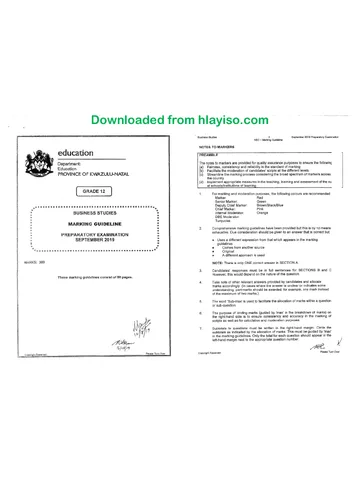
NOTES TO MARKERS.
KwaZulu-Natal Department of Education
REPUBLIC OF SOUTH AFRICA
BUSINESS STUDIES
i MEMORANDUM
: PREPARATORY EXAMINATION
‘ SEPTEMBER 2017 Fa
NATIONAL
SENIOR CERTIFICATE
GRADE 12
Marks: 300
Time: 3 hours
This memorandum consists of 43 pages.
Please tum over Copyright Reserved
PREAMBLE
‘The notes to markers are provided for quality assurance purposes to ensure the following:
(a) Fairness, consistency and reliability in the standard of marking
(o) Facilitate the moderation of candidates’ scripts at the different levels
(c) Streamline the marking process considering the broad spectrum of markers across
the country
(3) Implement appropriate measures in the teaching, learning and assessment of the
subject at schools/institutions of learning
41. For marking and moderation purposes, the following colours are recommended:
Marker Red
Senior Marker Green
Deputy Chief Marker Brown
Chief Marker Pink
Internal Moderator Orange
DBE Moderator Turquoise
2: Candidates’ responses must be in full sentences for SECTIONS B and C. However,
this would depend on the nature of the question.
3. A comprehensive memorandum has been provided but this is by no means exhaustive.
Due consideration should be given to an answer that is correct but:
* Uses a different expression from that which appears in the memorandum
* Comes from another source
© Original
* Adifferent approach is used.
NOTE: There is only one correct answer in SECTION A.
4. Take note of other relevant answers provided by candidates and allocate marks
accordingly. (In cases where the answer is unclear or indicates some understanding.
part-marks should be awarded, for example, one mark instead of the maximum of two
marks.)
5. The word 'Sub max' is used to facilitate the allocation of marks within a question or sub
question
6.
The purpose of circling marks (guided by ‘max’ in the breakdown of marks) on the right-
hand _ side is to ensure consistency and accuracy in the marking of scripts as well as for
calculation purposes.
Please tum over Copyright Reserved
Skip to contentAll 2017 papers 



View all


Business Studies Grade 12 KZN Prelim 2017 Memo
Grade 12 Business Studies memorandum from the KZN Prelim 2017, 22 pages. Read online or get the free PDF download, question paper linked when available.
Business Studies · Grade 12 · KZN Prelim · 2017. Memorandum, 22 pages. Read online or download the PDF.
- Subject
- Business Studies
- Grade
- Grade 12
- Document type
- Memorandum
- Year
- 2017
- Exam period
- KZN Prelim
- Curriculum
- CAPS
- Pages
- 22
- File size
- 7.6 MB
Free to read online, no sign-up needed
Loading document…
Loading document…
1 of 22
This exam
KZN Prelim 2017
- Other filesQuestion paperMemo
Document textSearch extracted text and jump to a page.
Business Studies
Downloaded from hlayiso.com
3 September 2017 Preparatory Examination
NSC
Subtotals to questions must be written in the right-hand margin. Circle the subtotals as
indicated by the allocation of marks. This must be guided by 'max' in memo. Only the
total for each answer should appear in the left-hand margin next to the appropriate
question number.
In an indirect question, the theory as well as the response must be relevant and related
to the question.
Incorrect numbering of answers to questions or sub questions in Sections A and B will
be severely penalised. Therefore, correct numbering is strongly recommended in all
sections.
No additional credit must be given for repetition of facts. Indicate with an ‘R’
Note that no marks will be awarded for indicating Yes/No in evaluation type questions
requiring substantiation or motivation. (Applicable to SECTIONS B and C.)
The differentiation between ‘evaluate’ and ‘critically evaluate’ can be explained as
follows:
12.1 When 'evaluate' is used, candidates are expected to respond in either a
positive/negative manner or take a neutral (positive and negative) stance,
e.g. Positive: 'COIDA eliminates time and costs spent” on lengthy
civil court proceedings.’
412.2 When critically evaluate’ is used, candidates are expected to respond in either a
positive/negative manner or take a neutral (positive and negative) stance. In this
instance candidates are also expected to support their responses with more
depth, e.g. ‘COIDA eliminates time and costs spent ¥ on lengthy civil court
proceedings, ~ because the employer will not be liable for compensation to the
employee for injuries sustained during working hours as ong as it can be proved
that the business was not negligent.’
NOTE: The above could apply to ‘analyse’ as well.
The allocation of marks must be informed by the nature of the question, cognitive verb
used, mark allocation in the memorandum and the context of each question.
Cognitive verbs, such as:
13.1 Advise, devise, name, state, mention, recommend, suggest, (list not
exhaustive) do not usually require much depth in candidates’ responses.
Therefore, the mark allocation for each statement/answer appears at the end.
13.2 Describe, explain, discuss, elaborate, justify, analyse, evaluate, critically evaluate
(list not exhaustive) require a greater depth of understanding, application and
reasoning. Therefore, the marks must be allocated more objectively to ensure that
assessing is conducted according to established norms so that uniformity,
consistency and fairness are achieved.
Please tum over Copyright Reserved
Business Studies 4
14.
14.5
September 2017 Preparatory Examination
Nsc
SECTION B
14.1 If, for example, FIVE facts are required, mark the candidate's FIRST FIVE
responses and ignore the rest of the responses. Indicate by drawing a line across
the unmarked portion or use the word MAX’.
NOTE: This applies only to questions where the number of facts is specified.
14.2 If two facts are written in one sentence, award the candidate FULL credit. Point
14.1 above still applies.
14.3 If candidates are required to provide their own examples/views, brainstorm
this at the marking centre to finalise alternative answers.
14.4 Use of cognitive verbs and allocation of marks:
14.4.1 If the number of facts is specified, questions that require candidates to
‘describe/discuss/explain' may be marked as follows:
« Fact 2 marks (or as indicated in the memorandum)
« Explanation 1 mark
The ‘fact’ and ‘explanation’ are given separately to facilitate mark
allocation.
14.4.2 If the number of facts required is not specified, the allocation of marks must
be informed by the nature of the question and the maximum mark allocated
in the memorandum
ONE mark may be awarded for answers that are easy to recall, requires one-word
answers or is quoted directly from a scenario/case study. This applies to SECTION
B and C in particular (where applicable).
SECTION C
15.1 The breakdown of the mark allocation for the essays is as follows:
Introduction
Content Maximum:
Conclusion |
Insight 8
TOTAL 40
Please tum over Copyright Reserved
Business Studies
15.2
Downloaded from hlayiso.com
5 September 2017 Preparatory Examination
NSC
Insight consists of the following components:
| Layout/Structure
Is there an introduction, body, proper paragraphs and zg
a conclusion?
| Analysis and
interpretation
Learners' ability to break down the question/interpret 2
it correctly to show understanding of what is being
asked.
Synthesis
Are there relevant decisions/facts/responses made 2
based on the questions?
Marks to be allocated using this guide:
No relevant facts: 0 (Two '-S')
| Some relevant facts: 1 (One -S')
Only relevant facts: 2 (Zero '-S’)
NB: If there are no -S' award the maximum of TWO
(2) marks.
| Originality
Examples, recency of information, current trends 2
and developments.
TOTAL FOR INSIGHT: TOTAL| 8
MARKS FOR FACTS: TOTAL| 32
MARKS FOR ESSAY (8 + 32)|_ 40
NOTE:
15.3
15.4
Please tum over
No marks will be awarded for contents repeated from the introduction and
conclusion.
The candidate forfeits marks for layout if the words INTRODUCTION and
CONCLUSION are not stated
No marks will be allocated for layout, if the headings INTRODUCTION
and CONCLUSION are not supported by an explanation.
Indicate insight in the left-hand margin with a symbol, e g. (L, A, S and/or 0’)
The breakdown of marks is indicated at the end of the suggested answer!
marking guidelines to each question.
Mark all relevant facts until the SUB MAX/MAX mark in a subsection has
been attained. Write ‘SUB MAX'/'MAX' after maximum marks have been
obtained.
Copyright Reserved
Business Studies
15.6
15.7
15.8
15.10
Please turn over
6 September 2017 Preparatory Examination
NSC
At the end of each essay indicate the allocation of marks for facts and marks
for insight as follows:
L —Layout, A — Analysis, S — Synthesis, O — Originality as in the table below.
CONTENT MARKS
Facts 32 (max.)
L 2
L A 2
s - 2
fe} 2
TOTAL 40
When awarding marks for facts, take note of the sub-maxima indicated, especially
if candidates do not use the same subheadings.
Remember, headings and subheadings are encouraged and contribute to insight
(structuring/logical flow/sequencing) and indicate clarity of thought.
(See MARK BREAKDOWN at the end of each question.)
If the candidate identifies/interprets the question INCORRECTLY, then he/she
may still obtain marks for layout.
If a different approach is used by candidates, ensure that the answers are
assessed according to the mark allocation/subheadings as indicated in the
memorandum.
15.10.1 Award TWO marks for complete sentences. Award ONE mark for
phrases, incomplete sentences and vague answers.
15.10.2 With effect from November 2015, the TWO marks will not
necessarily appear at the end of each completed sentence. The
ticks (v) will be separated and indicated next to each fact, e g.
‘Product development is a growth strategy, ¥ where businesses aim
to introduce new products into existing markets.'V
This will be informed by the nature and context of the question, as
well as the cognitive verb used.
Copyright Reserved
Businoss Studies
SECTION A (COMPULSORY)
QUESTION 1
14
144 CvY
142 Dvv
113 BYY
144 AVY
115 BYY
14.6 CvY
147 BYY
118 BYY
149 AYY
11.40 AvY
1.2
1.2.4 strategy vv
4.2.2 control “vw
1.2.3. partners ¥v
1.2.4 professionalism vv
1.2.5 tertiary vv
1.3
1.3.1 Cv
1.3.2 AVY
1.3.3 D¥vv
13.4 EvY
13.5 Ivy
Please turn over
Downloaded from hlayiso.com
T September 2017 Preparatory Examination
NSC
(10 x 2) (20)
( x 2) (40)
(6 x 2) (10)
BREAKDOWN OF MARKS
QUESTION 1 | MARKS
14 20
1.2 10
1.3 10
TOTAL [40]
Copyright Reserved
Business Studies
8 ‘September 2017 Preparatory Examination
NSC
SECTION B
QUESTION 2
24
2.2
221
2.2.2
2.2.3
2.2.4
212.5
2.3
Components of PESTLE
Political, ~ Economical, v Social, ¥ Technological, “ Legalv and Environmental”
(6)
Consumer rights
Right to choose v ¥
Right to privacy and confidentially vv
Right to information about products and agreements/
Right to disclosure and information v ~
Right to accountability from suppliers VV
Right to fair and honest dealings v ”
(10)
Strategic management process
OPTION 1
- Have a clear vision, a mission statement and measurable/realistic objectives in place.
vy
- Identify opportunities\weaknesses/strengths/threats by conducting environmental
scanning/situational analysis. ¥
- Tools available for environmental scanning may include a SWOT/PESTLE/Porters Five
Forces-analysis. ¥~
- Formulate alternative strategies to respond to the challenges/scanning results.“ ~
- Develop (an) action plan(s), including the tasks to be done/deadlines to be
met/resources to be procured, etc. Vv“
- Implement selected strategies by communicating it to all stakeholders/organising the
business's resources/motivating staff. vv
- Continuously evaluate, monitor, measure strategies in order to take corrective
action. v~
- Any other relevant answer related to how the strategic management process can be
applied.
OR
OPTION 2
- Review vision statement. v ¥
- Analyse/Re-examine mission statement. v ~
- Conduct an analysis using models such as PESTLE/PORTERS. ¥ ¥
- Formulate strategy, referring to strategies such as defensive/retrenchment. v ~
- Implement strategy using templates such as action plans. v ~
- Control of strategy to identify gaps in planning. v¥
- Evaluate strategy to identify deviations in implementation. ~
- Take corrective action to ensure goals/objectives are met. v~
- Any other relevant answer related to how the strategic management process can be
applied.
NOTE: The steps may be in any order.
Max (10)
Please tum over Copyright Reserved
Business Studies 9
2.44
2.4.2
25
Downloaded from hlayiso.com
‘September 2017 Preparatory Examination
Nsc
SECTOR MOTIVATION
(a) Primary sector”
Supplies mealies to the local markets”
(b) Secondary sector” v
Manufacture super maize meal! samp/
maize flour/ instant maize porridge.~”
@)
Backward integration. ~~ 2)
(8)
Types of diversification strategies
NOTE:
Please tum over
Concentric diversificationvV
* The business adds a new product or service that is related to existing products
and which will appeal to new customers.
* Occurs when a business wants to increase its product range and markets.V.
* Any other relevant answer related to concentric diversification.
Sub max (3)
Horizontal diversificationvV
* The business adds new products or services that are unrelated to existing
products, but which may appeal to existing customers.¥
* Occurs when a business acquires or merges with a business that is at the same
production stage, but it may offer a different product.
* Any other relevant answer related to horizontal diversification.
Sub max (3)
Conglomerate diversificationvV
* The business adds new products or services that are unrelated to existing
products which may appeal to new groups of customers.V
* Conglomerate diversification means that a business grows into new products,
services and markets.
* Any other relevant answer related to conglomerate diversification.
Sub max (3)
Mark the first TWO (2) only.
(3 x 2) (6)
Copyright Reserved
Business Studies 10
2.6.1
vv
2.6.2
26.3
27
September 2017 Preparatory Examination
NSC
The Compensation for Occupational Injuries and Diseases Act (Act 61 of 1997)/ (COIDA)
(2)
Purpose of COIDA
COIDA protects all casual and full-time workers who become ilfinjured/disabled/killed
due to a workplace accident/disease. vv
It excludes workers who are guilty of wilful misconducthworkers working
outside South Africa for at least twelve months/members of the SA Defence
Force/ Police services. vv
It provides for the establishment of a Compensation Board whose function
is to advise the Minister of Labour on the application/provisions of
COIDAY~
Medical expenses/Other types of compensation are paid to employees
and/or their families depending on the type/severity of the injuries. “~~”
Employers have to pay a monthly amount to the Compensation Fund
depending on the number of employees/the level of risk they are exposed
tovy
Any other relevant answer related to the purpose/nature of COIDA
Max (8)
YES
NO
Njabulo got injured when a recycling machine chopped off his fingers. vv
He was not given protective clothing. vv
NOTE: Do not allocate marks for Yes or No.
Max (4)
National Skills Development Strategy
Please tum over
Provides for the participationy of government, organised business and labour.
Encourages good quality training in the workplace to ensure on-going development
of skills.
Indicates how Sector Education and Training Authorities (SETAs) should use the
money allocated vfrom the Skills Development Levy (SDL).
Improves social developmenty through economic development.V
Increases access to programmes’ that train eople.V
Encourages and supports small businessesV, community-training groups, NGOs and
worker-initiated training initiatives.v
Increases the skills of the public sectory to improve service delivery.v
Builds/provides~’ career vocational guidance/ training centres.
Establishes and promotes closer links between employersv, training institutions
and the SETAs.V
Any other relevant answer related to the National Skills Development Strategy.
Max (6)
Copyright Reserved
Business Studies 4
Downloaded from hlayiso.com
September 2017 Preparatory Examination
NSC
QUESTION 2 | MARKS
24 6
22 {| 10
10
6
2
6
2
; 8
4
6
60
QUESTION 3: BUSINESS VENTURES.
3.1 Types of shares
3.1.1 Ordinary shareholders v ¥
3.1.2 Preference shareholders Vv
3.1.3 Bonus shares ¥~
3.1.4 Founders shares “~
3.1.5 Redeemable preference shares v (5x2) (10)
3.2. Factors to be considered when making an investment decision
- Return of investment (ROI) ”
- Risk”
- Investment term / period”
- Influence of inflation on the pay-out value / growth of investments“
(Any other relevant factors related to making an investment decision)
(4x1) (4)
3.3 Functions of JSE
- Serves as a link ¥ between investors and entrepreneurs. ¥
- Keeps investors informed ~ through newspapers and other media by publishing
share prices daily. ¥
- Regulates market v for dealing with shares. “
- Serves as a barometer/indicator “ of economic conditions.
- Mobilises the funds ~ of insurance companies and other institutions. ”
- Raisesv primary capital. ~
- Venture capital market v is made possible. ~
- Provides protection “ for investors.
- Has strict listing requirements ¥ which increase liquidity for investors. “
- Creates a safe environment ~’ for exchanging securities.
- Forces listed companies to improve their reporting, ¥ and provide better
information for decision-making by investors. “
- Encourages ~ short term investments. ¥
- Allows small investors to buy shares in large companies.
Please tum over Copyright Reserved
Business Studies
3.4.4
3.4.2
3.5
12 September 2017 Preparatory Examination
NSC
- Enables financial institutions to invest v their surplus funds in shares. ¥
- Enables companies to offer share option incentives, v which increases their
ability to attract and retain high-quality investment talent. ”
- Monitors change ~ in listed companies. ~
- Monitors the activities ~ of the stockbrokers. ”
- Uses STRATE ¥ to facilitate share transactions. v
- Promotes the JSE to the general public “ and educates the public about the
stock exchange. ¥
- Plans, researches and advises Y on investment possibilities. ~
- Allows shareholders to realise the value of their investments” through a public
trading platform. v
- Any relevant answer related to the functions of the JSE.
Max (8)
Transformational leadership theory. ¥~ (2)
Motivation
- has the ability to inspire his employees ¥
- to develop new leaders and build the group”
- appeals to the ethical values of managers”
- inspire people with his innovative style”
Note: Mark the first TWO examples only (2)
(4)
Application of Transformational Theory
- May be applied when followers/employees have a low morale ~/are demotivated/
are underperforming. ¥
- Applied during the strategic planning process~’, where vision/mission/objectives
have to be developed/changed. ”
- When a business is restructuring” and exploring new ways of doing things. ~
- Any other relevant answer related to the application of the transformational leadership
theory in the workplace.
Max (4)
Role of personal attitude in successful leadership
- Positive attitude releases leadership potential vv
- Aleader's good/bad attitude can influence the success/failure of the business. v ¥
- Leaders must know their strengths and weaknesses to apply their leadership style
effectively. vv
- Great leaders understand that the right attitude will set the right atmosphere. v ~
- Leaders’ attitude can influence employees'/teams' thoughts and behaviour. v “
- Leaders should model their behaviour that they want to see in team members. v ~
- Leaders must know/understand their teams to be able to allocate tasks/roles
effectively” ¥
- Enthusiasm produces confidence in a leader. v “
- A positive attitude is critical for good leadership because good leaders will stay with
the task regardless of difficulties/challenges. vv
- Successful employees and leaders have a constant desire to work and achieve
personal and professional success. Vv“
Please tum over Copyright Reserved
Business Studies 13
3.6.1
3.6.2
3.7.1
3.7.2
Downloaded from hlayiso.com
September 2017 Preparatory Examination
NSC
- Leaders with a positive attitude know that there is always more to learn and
space to grow. vw
- Any other relevant answer related to the role of personal attitude in successful
leadership.
Max (8)
Unit trusts” ¥ (2)
Advantages / benefits of unit trusts
- Managed by a fund manager ~ to buy shares on the stock exchange. “
- The investor has a variety to choose from/a wider range of shares v and a
lower degree of risk. ¥
- Safe investments, ~ as it is managed according to rules and regulations. v
- Asmall amount ¥ can be invested per month. ~
- Easy to invest in, v as investors simply fill in several forms or invest online. “
- Easy to cash in ~ when an investor needs money. ¥
- Fluctuations in unit trust rates of return are often not so severe “ because of
diversity of the investment fund. ~
- Generally beats inflation “ on the medium/long term. “
- Offer competitive returns v in the form of capital growth and dividend distribution. ~
- Fund managers are knowledgeable/experts/reliable/trustworthy “ as they are
required to be accredited to sell unit trusts.
- Any other relevant answer related to the advantages of unit trusts.
Max (6)
Success factors of a private company
Capital
- Can raise large amounts of capital “ /New shareholders can be attracted. v
- Share capital clause in the Memorandum of Incorporation (MO!) may be changed ~
to issue more shares, “
- May attract financially strong investors v if share value increases /remain stable. ”
- Any other relevant answer related to the contribution of capital to the success of a
public company.
Max (4)
Legislation
- Procedures to form a private company Y have been simplified by the new
Companies Act 71 of 2008. ¥
- Limited liability allows for greater risk taking, V which may lead to growth of the
business. ”
- Auditing of financial statements (if required), “ gives shareholders the assurance
that the business is being properly managed and supports raising additional
finance. ~
- There is no longer a limit v on the number of shareholders in a private company.”
- Aprivate company can benefit from government programmes ~’if they comply with
the relevant legislation. ”
- Personal liability of share- holders” does not affect the company's assets. “
- Any other relevant answer related to the contribution of legislation to the success
of a private company.
Max (4)
Please tum over Copyright Reserved
Business Studios 14
3.8
September 2017 Preparatory Examination
NSC
Effectiveness of using graphs
Positives
- Used when information ¥ needs to be shown in parts. ~
- Graphs are invaluable visual summaries, v as it enhances a better understanding
of the presentation. ¥
- People can easily identify trends with graphs, “ because it clearly show which parts
are bigger/relative to others. “
- More visually appealing, v therefore important facts could be remembered better. ~
- Easier to read Y and keeps the audience attentive. v
- Useful visual ways to represent data v to easily see patterns/make comparisons. v
- Communicates figures much clearer v than just being a set of numbers. “
- Any other relevant positives for effectiveness of using graphs.
AND/OR
Negatives
- Can be confusing v if they are not simple and clear. “
- Time consuming ~ because it involves cumbersome calculations. ”
- Too many variables “ may make it difficult to read. “
- Audience can be distracted by graphs v and not concentrate on the presentation
itself. ~
- Some graphs may only show the percentage, ~ but they do not indicate the major
trends. ¥
- _ Any other relevant negatives for effectiveness of using graphs.
Max (6)
[60]
BREAKDOWN OF MARKS
QUESTION 3 | MARKS
3.1 10
@
5
|] | ]0|r] 00] a].n) co].
Please tum over Copyright Reserved
Business Studies 15
Downloaded from hlayiso.com
September 2017 Preparatory Examination
NSC
QUESTION 4: BUSINESS ROLES
44
4.44
41.2
4.1.3
AAA
4.1.5
42
Unethical / unprofessional business practice
Unprofessional Vv”
Unprofessional v~
Unethical vv
Unethical “~
Unethical. v~
(10)
Characteristics of successful teams
- Interpersonal attitudes and behaviour “
- Have a positive attitude of support and motivation towards co-team
members. v~
- Have a positive attitude and passion to achieve team objectives. v~
- There must be clear objectives and agreed upon goals, v~
- Team members must be committedy to achieve the team objectives. ¥
- Team leader should acknowledge/give credit “to members for positive
contributions. vv
- Shared values”’/Mutual trust and support. “~~
- Shows loyalty/respect” towards team members despite differences. “VW
- Shows respect to the knowledge and skills of other members. v “
- Perform team tasks with integrity, pursuing responsibility and meeting team
deadlines with necessary commitment to team goals. v~
- Team members trust one another. ¥~
- Effective” communication v ~
- Speaks clearly and listens attentively “
- Communicates with team members and allows for feedback. ¥
- Encourages discussion about the problem so that solutions can be found. v”
- Co-operation/Collaboration amongst team members ¥ ¥
- Willingness to co-operate in the team to achieve team objectives. v~
- Willingness to co-operate with management to achieve team and business
objectives. v~
- Agree on methods/ways to get the job done effectively without wasting time on
conflict resolution. ““
- Allmembers take part in decision making. Vv ¥
- Any other relevant answer related to characteristics of teams.
Note: Mark the first FIVE characteristics
Max (10)
Please tum over Copyright Reserved
Business Studies 16 September 2017 Preparatory Examination
NSC
4.3 Procedure for dealing with grievances in the workplace
444
- An aggrieved employee must verbally report the incident/grievance to his/her
supervisor/manager, Y who needs to resolve the issue within 3 to 5 working days. ~
- Should the employee and supervisor not be able to resolve the grievance, “ the
employee may take it to the next level of management. “
- The employee may move to a more formal process” where the grievance must be
lodged in writing/completes a business grievance form. ~
- He/She must receive a written reply “ in response to the written grievance. ~
- Agrievance hearing/meeting v must be held with all relevant parties present. ”
- Minutes of the meeting must be recorded ¥ and any resolution passed must be
recorded on the formal grievance form. ~
- Should the employee not be satisfied, v then he/she could refer the matter to the
highest level of management. ¥
- Top management should arrange a meeting v with all relevant parties concerned. v
- Minutes of this meeting should be filed/recorded” and the outcome/decision must be
recorded on the formal grievance form. ¥
- Should the employee still not be satisfied, he/she may refer the matter to the CCMA”
who will make a final decision on the matter. ~
- Any other relevant answer related to the correct procedure to deal with grievances in
the workplace.
NOTE: The procedure may be in any order.
Max (8)
- Increase in salesv
- Increase in productivity”
- Increased morale~
- _ Increased motivation’
NOTE: Mark the first TWO only. (2)
Benefits of a diverse workforce
- Workforce diversity improves the ability of a business ~ to solve problems/
innovate/cultivate diverse markets. “
- Employees value each other's diversity“ and learn to connect and communicate
across lines of difference.
- Diversity in the workforce improves morale and motivation. ~
- Employees demonstrate greater loyalty to the business ~ because they feel
respected/accepted/understood. ”
- Adiversified workforce can give businesses a competitive advantage v as they can
render better services. Vv
- Being respectful of differences/demonstrating diversity “ makes good business
sense/improves profitability. ~
- Diverse businesses ensure that its policies/practices empower every employee to
perform at his/her full potential.
- Customers increasingly evaluate businesses Y on how they manage diversity in the
workplace. ”
- Employees from different backgrounds ¥’ can bring different perspectives to the
business.
Please tum over Copyright Reserved
Business Studies 7 September 2017 Proparatory Examination Business Studies 18
Downloaded from hlayiso.com
NSC
- Adiversified workforce stimulates debate v on new and improved ways of getting
things done. ¥
- Employees represent various groups ~ and are therefore better able to recognise
customer needs/satisfy consumers. ~
- Businesses with a diverse workforce are more likely to have a good public image “
and attract more customers. ~
- Any other relevant answer related to benefits of diversity in the workplace.
(Do not award marks if responses to 4.4.1 are repeated)
Max (8)
Address issues of diversity in the workplace
(a) Language
- Abusiness may specify that all communications must be in one specific language
only and would expect employees to have a certain level of fluency in that AS
language.vW
- It may sometimes be necessary to employ an interpreter so that
everyone can fully understand what is being said in a meeting. VW
- All business contracts should be in easy-to-understand language and
should be available in the language of choice for the parties signing.Vv
- Any other relevant answer related to how businesses should address
language as a diversity issue in the workplace.
Sub max (4)
(b) Age
- Eromaiens should not be linked to age, but rather to specific skills
set
- Abusiness must not employ children aged 15 or younger.vv
- The ages of permanent workers should vary from 18 to 65 to include
all age groups.VV
- A business may employ a person who is older than the normal
retirement age provided that person is the most suitable candidate.vV
- Businesses must encourage older employees to help young
employees to develop their potential.VV
- Young employees must be advised to respect and learn from older
employees. vV¥
- The business should encourage employees to be sensitive to different
perspectives of various age groups.vV
- Any other relevant answer related to how businesses should address
age as a diversity issue in the workplace.
Sub max (4)
(c) Disability
= Provide employment opportunities for people with disabilities. VV
- Accommodate people with disabilities by providing facilities/ramps
for wheel chairsw\, etc.
- Ensure that workers with special needs are not marginalised/feel
excluded from workplace activities.\V
- Business should be well informed with how to deal with disabled
employees.vv)
- Policies and programs should accommodate the needs of people with
disabilities. WW
Please tum over Copyright Reserved
September 2017 Preparatory Exeminetion
NSC
- Create an organisational culture and climate that is conducive for
people with disabilities. VV
- Employees should be trained to deal with colleagues with disability.Vv
- _ Bringing in external experts to help with disability and accommodation
issues.W
- Ensure that employees with disabilities are treated fairly VV
- Focus on job skills/work performance of the disabled, rather than their
disability/ possible problems they may pose in the future. VV
- Any other relevant answer related to how businesses should address
disability as a diversity issue in the workplace.
Sub max (4)
Max (12)
Creative thinking
- _ Emphasise the importance of creative thinking to ensure that all staff know that you
want to hear their ideas. vv
- Encourage staff to come up with new ideas/opinions/solutions. v”
- Make time for brainstorming sessions to generate new ideas, e. g. regular
workshops/generate more ideas/build on one another's ideas. “”
- Place suggestion boxes around the workplace and keep communication channels
open for new ideas. vv
- Train staff in innovative techniques/creative problem solving skills/mind-
mapping/lateral thinking. v ~
- Encourage job swops within the organisation/studying how other businesses are
doing things. v ~
- Encourage alternative ways of working/doing things. vv
- Respond enthusiastically to all ideas and never let anyone feel less important. vv
- Reward creativity by introducing reward schemes for teams/individuals who come up
with creative ideas. vv
- Provide a conducive working environment free from distractions. vv
- Any other relevant answer related to ways in which businesses can promote creative
thinking in the workplace.
NOTE: The emphasis is on ‘ways’, not necessarily advantages.
Max (10)
BREAKDOWN OF MARKS
QUESTION 4 | MARKS
44. 10 |
42 10
43 8
444 2
4.4.2 8
4430 12
45 - 40
TOTAL 60
Please tum over Copyright Reserved
Business Studies 19
Downloaded from hlayiso.com
September 2017 Preparatory Examination
NSC
QUESTION 5: BUSINESS OPERATIONS.
5.1
a
in
5.3
Business functions
5.1.1. General Management v ~
5.1.2. Production Function vv
5.1.3. Human Resource Function’ “
5.1.4 Financial Function v¥
5.1.5 Public Relations Function vv
(10)
Contents / details of an employer contract
- Name/Address/Contact details of Employer. “
- Personal details/Address of Employee. ”
- Job title.
- Job description.
- Working hours. ~
- Overtime. ¥
- Salary/Remuneration package. ¥
- Normal place of work. “”
- Leave. ¥
- Date of commencement of employment/Starting date. v
- Probation period. v
- Code of conduct and/or Code of ethics. ~
- Termination of the contract”
- Disciplinary policy. ~
- Any other relevant answer related to the contents of the employment contract.
NOTE: Mark the first FIVE details.
Any (5x 1) (5)
Selection Procedure
- Determine fair assessment criteriay on which selection will be based.
- Use the assessment criteria to assess all CVs/application forms v received during
recruitment “Preliminary screening” is done by sorting the applications received
according to the criteria for the job. ”
- Check that applicants are not submitting false documents” such as forged
certificates/degrees. “
- Make a list of all applicants” who qualify for the post. ~
- Screen and check reference, Y e.g. check applicants’ criminal records/credit
history/social media, ¥ etc.
- Conduct preliminary interviews ~ to sift out applicants who qualify for the job. ”
- Inform all applicants v about the outcome of the application. ~
- Compile a shortlist “ of approximately five people. ~
- Invite the shortlisted applicants/candidates v for an interview. ~
- Shortlisted candidates may be subjected to various types of selection tests, ¥ e.g.
skills test. ¥
- Awvritten offer is made” to the chosen candidate.
- Any other relevant answer related to the selection procedure of a receptionist.
NOTE: Procedure can be in any order.
Max (10)
Please tum over Copynght Reserved
Business Studies 20
5.4.2
September 2017 Preparatory Examination
NSC
Identification
Intemal recruitment (2)
Motivation
Bollywood Boutique has advertised the vacancies on the staff notice board/bulletins~
(t)
Identification (2)
Motivation (1)
Max (3)
Evaluation of internal recruitment.
Positives
Cheaper/Quicker~ to fill the post. ~
Placement is easy, Y as management knows the employees’ skills/personality/
experience/strengths.
Provides opportunities V for career paths within the business. Vv
The employee already has an understanding” of how the business operates. “/
Induction/Training” is not always necessary. ”
Reduces the chances of losing employees, “ as future career prospects are
available. ¥
Detailed, reliable information” can be obtained from the supervisors/employee
records. ~
Any other relevant answer related to the positives of internal recruitment.
AND/OR
Negatives
Please tum over
The promotion of an employee could cause resentment” among other employees. ¥
The number of applicants from which to choose is limited to existing staff only. ¥
Itis possible to promote certain employees who do not really have the required
skills for the new job. v
It may close the door” to new ideas from outsiders. “
The business has to spend more money on training/developing “ existing employees
on the new position. ~
Employees who are not promoted v may feel demotivated. v
Any other relevant answer related to the negatives of internal recruitment.
Max (8)
Copyright Reserved
Downloaded from hlayiso.com
Business Studies 24
NSC
September 2017 Preparatory Examination
5.5 Difference between quality control and quality assurance
QUALITY CONTROL
QUALITY ASSURANCE
Inspection of the final product¥ to
ensure that it meets the required
standards.
- Carried out during and after the
production process¥ to ensure
required standards have been met at
every stage of the process.V
Includes setting targets/measuring
performancev and taking corrective
measures.¥
- Ensure that every process is aimed at
getting the product right first timev
and prevent mistakes from happening
again.v
Any other relevant answer related to |
quality control
- Any other relevant answer related to
quality assurance.
Sub max (4) Sub max (4)
NOTE: 1. The answer does not have to be in tabular format.
2. The distinction must be clear.
Max (8)
5.6 Benefits / Advantages of a good quality management system
Effective customer services will be rendered, resulting in increased customer
satisfaction. Vv
Time and resources are used efficiently.
vv
Productivity increase through proper time management and using high quality
resources. v¥
Products and services are constantly improved. vv
Vision and mission/Business goals” may be achieved, Vv”
The business may achieve a competitive advantage over its competitors. Vv“
Continuous training will continuously improve the quality of employees’ skills and
knowledge. vv
Employers and employees will have a healthy working relationship which generally
results in happy workers. v~
Increased market share/profitability may result in business growth/expansion. ¥v ~
Any other relevant answer related to the advantages of a good quality control
system.
Max (8)
5.7 Quality indicators for the purchasing function
Buy raw materials in bulk at lower prices. vv
Select reliable suppliers that render the best quality raw materials/capital goods at
reasonable prices. v
Place orders timeously and regular follow-ups to ensure that goods are delivered
on time. ¥~
Effective co-ordination between purchasing and production departments so that
purchasing staff understand the requirements of the production process. VW”
Required quantities are delivered at the
Implement and maintain stock control systems to ensure the security of stock. “”
right time and place. vv
Maintain optimum stock levels to avoid overstocking/reduce outdated stock. vv
Monitor and report on minimum stock levels to avoid stock-outs. Vv”
Effective use of storage space and maintain product quality while in storage. vv
Please tum over
Copyright Reserved
Business Studies 22
September 2017 Preparatory Examination
NSC
Involve suppliers in strategic planning/product design/material selection/quality
control process. vv
Ensure that there is no break in production due to stock shortages. vv”
Establish relationships with suppliers so that they are in alignment with the business's
vision/mission/values. v
Have a thorough understanding of supply chain management. vv
Any other relevant answer related to quality indicators for the purchasing function.
Max (8)
[60]
BREAKDOWN OF MARKS
QUESTION 5__| MARKS
5.1 10
5.2 [5
5.3 to |
5.4.4 3
5.4.2 8
5.5 8
5.6 8
5.7 8
TOTAL 60
QUESTION 6: MISCELLANEOUS TOPICS
BUSINESS ENVIRONMENTS
6.1
Provisions of the BCEA
Family responsibility/maternity/annual leave.V
Fringe benefits/Employee benefits/Perks.V
Remuneration/Salary/Severance packages or pay.
Sunday/Public holiday.v
Prohibition of child labour.
Termination of employment.V
Any other relevant answer related to the provision of the BCEA.
NOTE: Mark the first FIVE only. (5)
Please tum over
Copyright Reserved
Business Studies 23
6.2
Downloaded from hlayiso.com
September 2017 Preparatory Examination
NSC
Business Strategies
Intensive strategies
Market penetrationy v
- Business may use aggressive marketing campaigns, e.g. low prices, to attract
competitors’ clients/attempt to persuade consumers that are already buying their
products to continue supporting them.
- Increase the market share of existing products/Promote new products that have
become well established. v
- Business should do market research on existing clients to decide how to improve his
marketing mix. ”
- Reduce prices to increase sales. ¥
- Embark on an intensive advertising campaign to increase awareness and customer
loyalty. ¥
- Employ more sales staff to improve sales services. ¥
- Any other relevant answer related to a discussion of market penetration.
Strategy: 2
Discussion: 1
Sub max (3)
Market development v “
- tis a growth strategy where businesses aim to sell its existing products in new
markets. ~
- Businesses can target consumers in a potential market that is outside of its normal
target market. “
- Find new ways of selling cars to other customers/in other areas. ¥
- Restructure pricing policies to cater for customers of all income levels. ¥
- Any other relevant answer related to a discussion of market development
Strategy: 2
Discussion: 1
Sub max (3)
Product development vv
- It is a growth strategy where businesses aim to introduce new products into existing
markets.
- Businesses generate new ideas/develop a new products/services. ¥
- Businesses may conduct test marketing/market research to establish whether new
products will be accepted by existing customers. ¥
- New products may be different/of a higher quality than those of competitors. “
- Any other relevant answer related to a discussion of product development.
Strategy: 2
Discussion: 1
Sub max (3)
Max (9)
Please tum over Copyright Reserved
Business Studies 24 September 2017 Preparatory Examination
NSC
BUSINESS VENTURE
63
6.3.1 Insurance
6.3.2
6.4
Amountinsured x damages (formula)
Market value
400000 y x 300000”
500 000
= R240 000 ¥Y (4)
NOTE: 1. Allocate full marks (4) if the answer is correct and no working are
shown.
2. If working were shown correctly, but the final answer is wrong, award
a maximum of TWO (2) marks
3. If the answer is incorrect, award a maximum of ONE (1) mark for the
understanding of concept and method.
4. If there are no workings shown and the answer is incorrect, allocate a
ZERO mark.
Average clausev “
Applies when goods/ property are/is under insured”, then the insurance company will not
pay out the full amount of the loss. ” (4)
Responding to questions
- Understand each question/comment before responding. v¥
- Listen carefully to each question and then respond. v ¥
- Address questions and not the person. v ~
Acknowledge good questions. v
Remain professional, polite, calm and open. Vv
Ability to answer the questions and follow up on it. ¥Y
- Rephrase questions if uncertain/ensure that you understand what is being asked. v
- Do not get involved in a debate/argument. Vv”
- Do not allow one member of the audience to dominate the discussion/session and
ask all the questions. vv
- Avoid answering difficult questions when the answer is not known.v”
- Apologise for the error and promise to provide everyone with the correct details. vv
- Address the whole audience and not only the person asking the question. v ”
- Any other relevant answer related to aspects to keep in mind when responding to
questions in a non-aggressive and professional manner after the presentation
NOTE: Mark the first THREE only.
(3 x 2) (6)
Please tum over Copyright Reserved
Business Studies 25
Downloaded from hlayiso.com
September 2017 Preparatory Examination
NSC
BUSINESS ROLES
65
6.6.1
66.2
67
King code principles
Transparency ~
Accountability ~
Responsibility “ (3 x 1) (3)
Delphi technique “~ (2)
Positives / Advantages of the Delphi technique in solving business problems
A group of experts will be used~’ without bringing them together. ”
Experts will give clear ideas/solutions” on how to improve on low
productivity/profitability. “
Panel members/Experts can give new information” on problems. “
Information received from experts” can be kept confidential. ”
It reduces noise levels in an office environment” since there is no group discussion.”
Panel members/Experts need to reach consensus, v so that the best solution is
found. ¥
All experts are given an equal opportunity to give their opinions, “ so no-one
dominates the process. “
Any other relevant positive evaluation related to the use of the Delphi technique in
solving business problems.
Max (6)
Ways of promoting social rights in the workplace
Please tum over
Businesses should ensure that employees have access to health care/social
security. “Vv
Encourage employees/Provide opportunities for skills training/basic education. vv
Register workers at UIF to provide adequate protection in the event of unemployment/
illness. vv
Encourage employees to participate in special events, e.g. World Aids day. ¥“
Establish site clinics to give employees access to basic medical examinations. ¥”
Any other relevant answer related to the promotion of social rights
in the workplace.
NOTE: Do not accept ways that promote human and/or economic rights.
Max (6)
Copyright Reserved
Business Studies 26 September 2017 Preparatory Examination
NSC
BUSINESS OPERATIONS
6.8.1 Car allowance ~ (1)
6.8.2 Advantages of fringe benefits to SE
6.9
Altractive fringe benefit packages“ may result in higher employee retention/reduces
employee turnover. ~
It increases employee satisfactionoyalty, “ as they may be willing to work under
pressure/improve personal performance. “
Leads to higher productivity, ~ as workers work for longer hours/more days. ¥
Attracts good/qualified employees~ who do not always need extra training. ~
Any other relevant positive aspect related to fringe benefits.
Max (6)
Benefits of a good management system
Please tum over
Effective customer services will be renderedy, resulting in increased customer
satisfaction.v
Time and resources\ are used efficiently.v
Productivity increase through proper time managementv and using high quality
resources.
Products and servicesv are constantly improved.¥
Vision and mission/Business goals may be achieved.
The business may achieve a competitive advantage over its competitors.V
Continuous trainingy will continuously improve the quality of employees’ skills and
knowledge.¥
Employers and employees will have a healthy working relationshipy which generally
results in happy workers.
Increased market share/profitability) may result in business growth/expansion.v
Any other relevant answer related to the benefits / advantages of a good quality
control system.
Max (8)
[60]
BREAKDOWN OF MARKS
QUESTION 6 | MARKS
6.1 5
6.2
6.3.1
6.3.2
6.4
6.5
6.6.1
66.2
6.7,
6.8.1
68.2
8) 0\0|-]o]a|nJos/o]a| aloo
Copyright Reserved
Business Studies 27
Downloaded from hlayiso.com
September 2017 Preparatory Examination
NSC
QUESTION 7 7.3
BUSINESS ENVIROMENTS
7
7.2
BUSINESS ENVIRONMENTS (LEGISLATIONS)
Introduction
- The Skills Development Act, 1998 (Act 97 of 1998) (SDA) was developed in response
to the demand for redress and equity. ~
- The SDA is the integral part of the National Skills Development Strategy that aims to
link learning to the demands of the world of work and enables employers/employees
to become more productive and competitive. ~
- Learnerships are theoretical and practical training opportunities that can lead to a
recognised occupational qualification.
- Broad-Based Black Economic Empowerment (BBBEE) creates opportunities for
people who were previously excluded from participating in the South African
economy. ~
- BBBEE empowers black people including women, youth, and people with disabilities
and people living in rural areas. ~
- BBBEE is a mechanism to transform all business in South Africa. ~
- The aim of BBBEE is to address the shortcomings of the Employment Equity Act,
BEE and affirmative action as a whole. “
- The BBBEE Act deals with codes of good practice and industry charters. ~
- Any other relevant introduction related to the implementation offcompliance to the
SDA/SETAs and BBBEE (1 x 2) (2)
7.4
Role of SETAs
- Develops skills plans in line with the National Skills Development Strategy. v~
- Approves workplace skills plans and annual training reports. v~
- Pays out grants to companies complying with the requirements of the Skills
Development Act. “~
- Promotes and establishes learnerships. v ”
- Registers learnerships and learning programmes. ¥ ~
- Provides training material/programmes for skills development facilitators. v ~
- Provides accreditation for skills development facilitators. “~
- Oversees training in different sectors of the South African economy. ¥¥
- Draws up skills development plans for their specific economic sectors. v ¥
- Allocates grants to employers, education and training providers and employees. v ”
- Promotes learnerships and learning programmes by identifying suitable workplaces
for practical work experience. “~
- Collects levies and pays out grants as required. v ”
- Any other relevant answer related to the roles of SETAs.
Max (10)
Please tum over Copyright Reserved
Business Studies 26
September 2017 Preparatory Examination
NSC
Purposes of the SDA
- Develops the skills of people in South Africa ‘in order to improve productivity. ~
- Invests in education” and training of workers. ”
- Encourages businesses” to improve the skills of their workers. “
- Improves the chances of getting a job” for previously disadvantaged people. ¥
- Redresses imbalances of the pastv through education and training. ~
- Provides for the implementation of strategies“ on a national, sector and workplace
basis. v
- Provides funds for skills development through the levy-grant scheme” anda
- National Skills Fund. ”
- Encourages workers “to participate in learning programmes. ¥
- Any other relevant answer related to the purpose of the SDA.
Max (12)
Impact of the Skill Development Act on businesses
Businesses:
Positives / Advantages
- Increases the number of skilled employees in areas where these skills are
scarce.¥
- Improves productivity” in the workplace. ~
- Increases global“ competitiveness.
- Increases investment in education” and training in the labour market. ~~
- Improves the return on investment” in education and training. ¥
- Any other relevant answer related to the positive impact of the SDA on businesses.
AND/OR
Negatives / Disadvantages
- The SDA process is prescriptive and requires a large amount of paperwork and
administration. v This can cost time and money. v
- Skill Development Levy could be an extra burden to financially struggling
businesses. v
- Itmay be monitored and controlled by government departments ~ that do not have
education and training as their key priorities. v
- The SETAs may not be well organised and many courses offered by companies”
may not have unit standards that relate to the course content. ~
- Many service providers that offer training services” are not SAQA accredited. v
- Many businesses” may not support this government initiative.
- Implementation of the SDAY can be difficult to monitor and control. “
- Employees are expected to attend learnerships during work hours“ which could
affect the production process/productivity. “
- Costly for businesses to employ a personv to implement, manage and control
learnerships. ¥
- The time and money spent on improving employee skills is wasted v if they leave the
business. ¥ ”
Any other relevant answer related to the negative impact of the SDA on businesses.
Max (12)
Please tum over Copyright Reserved
Downloaded from hlayiso.com
Business Studies i September 2017 Preparatory Examination Business Studies 30 September 2017 Preparatory Examination
NSC
7.5 Recommendations of BBBEE pillars on Isilumko Staffing BREAKDOWN OF MARK ALLOCATION FOR QUESTION 7
7.5.1 Ownership Details Maximum | Total
- Businesses should include black people in shareholding/partnerships/ franchises. v ” Introduction 2
- Exempted microenterprises (EMEs) with a black ownership of 50% or more have a Role of SETAs. 10
better BEE rating/score. vw Purpose of SDA 12
- More opportunities are created for black people to become owners/ Impact of SDA on businesses 12 Max
entrepreneurs. v~” Recommendations of 32
- Businesses sometimes find it difficult to attract suitable black business Ownership and Management as 12
partners/shareholders. v ~ pillars of BBBEEE
- Many black people cannot afford shares/contributions to partnerships. v~ Conclusion 2
- Any other relevant answer related to the implication of ownership as a BBBEE pillar INSIGHT _
on businesses. Layout 2
Sub max (6) Analysis, interpretation 2 8
‘Synthesis 2
7.5.2 Management Originality, examples 2
- Appointing black people in senior executive positions/management. v~ TOTAL MARKS 40
- Ensuring black female representation in management. vv LASO - For each component:
- When businesses sell 25% of their shares to black investors to become directors, the Allocate 2 marks if all requirements are met.
business will score points in both management and ownership. v~ Allocate 1 mark if some requirements are met.
- Due to a shortage of skilled black managers/directors, some businesses may find it Allocate 0 marks where requirement are not met at all.
difficult to make appointments, “~~
- Any other relevant answer related to the implication of management as a BBBEE
pillar on businesses.
Sub max (6)
Max (12)
7.6 Conclusion
- The SDA plays an important role in ensuring that the workforce is skilled and
contributes to productivity and the economic growth of the country. v~
- The SDA enables businesses to improve the skills of their employees and this
increases employee morale/reduces staff turnover. vv
- Itis a practical growth strategy that aims to stimulate economic growth. vv
- Itis a good strategy of government to address the imbalances of the past. vv
- To promote access to finance for Black Economic Empowerment. “~~
- Any other relevant conclusion related to the implementation offcompliance to the SDA
and BBBEE.
(2 x 1) (2)
[40]
Please tum over Copyright Reserved Please tum over Copyright Reserved
Business Studies 34
Downloaded from hlayiso.com
September 2017 Preparatory Examination
NSC
QUESTION 8: BUSINESS VENTURE (Insurance)
8.4
8.2
Introduction
Insurance is extremely beneficial to businesses as it provides financial relief in times
of unforeseen financial losses. ¥
Business owners should have a clear understanding of the financial impact of
accidents and disasters on their business operations, so that they can make provision
for that in advance. v
Business owners should be aware of the benefits of contributing towards compulsory
insurance, e.g. UIF and RAF. “
Itis important for business owners to understand the difference between insurable
and non-insurable risks. ~
Any other relevant introduction related to insurance.
(2x1) (2)
Advantages insurance to businesses
Please tum over
Transfers the risk from the business/insured v‘to an insurance company/insurer.
The transfer of the risk is subject to the terms and conditions” of the insurance
contract. 7
Protects the business against theft and loss of stock and/or damages~ caused by
natural disasters such as floods, storm damage, etc. “
The business will be compensated” for insurable losses, e.g. destruction of property
through fire. ”
Business assets”, e.g. vehicles/equipment/buildings need to be insured against
damage and/or theft. “
Business is protected against the loss of earnings e.g. strikes by employees result
in losses worth millions of rands.
Protects the business against deeds of dishonesty” by employees.
Insurance can be taken against the life of partnersv in a partnership. v
Should the services of key personnel be lost due to accidents or death, “the
proceeds of an insurance policy can be paid out to the business/ beneficiaries. “
Replacement costs for damaged machinery and equipment are very high, “
therefore, insurance can reduce/cover these costs. ~
Any other relevant answer related to the advantages of insurance to businesses.
Max (12)
Copyright Reserved
Business Studies
8.3
a2 September 2017 Preparatory Examination
NSC
Principles of Insurance
Indemnification/IndemnityvV
Applicable to short term insurance.VV
Insured is restored to almost the same financial position as before the loss
occurred.vV
Neither the insurer nor the insured may profit from insurance. VY
Principle of re-instatement may be applied if the item was over-insured.vV
In the case of under-insurance only a portion of the loss will be refunded. VV
Any other relevant answer related to the principle of indemnification/indemnity.
Principle (2)
Description (4)
Sub max (6)
SecurityvV
- Applicable to long/short term insurance/life assurance.v
- Insurer undertakes to pay out a pre-determined amount in the event of the
death/reaching a certain age/personal injury of the insured.vY
- Aim is to provide financial security to the insured at retirement/the
dependants of the deceased.
- Any other relevant answer related to the principle of security.
Principle (2)
Description (4)
Sub max (6)
Utmost good faithvY
Insured has to be honest in supplying details when entering into the insurance
contract.vv
Details/Information supplied when claiming should be accurate/true.vV
Any other relevant answer related to the principle of utmost good faith
Principle (2)
Description (4)
Sub max (6)
Insurable interestv¥
Please tum over
Insured will suffer a financial loss/liability as a result of an insurable risk.vVv
Insured must have a legal relationship with the object insured in the contract, e.g. a
man is legally married to his wife and he can insure her life.vv
Any other relevant answer related to the principle of insurable interest.
Principle (2)
Description (4)
Sub max (6)
Max (12)
Copyright Reserved
Downloaded from hlayiso.com
Business Studies
84
8.5.
33
NSC
Insurable risks vs. Non-Insurable risks
‘September 2017 Preparatory Examination
INSURABLE RISKS.
L NON-INSURABLE RISKS
Businesses are compensated ~for losses
arising from specified risks. ~
| These risks are not insured by insurance
companies ~/It remains the responsibility
of the business. ”
Business Studies 34
‘September 2017 Preparatory Examination
NSC
8.5.2 Benefits of RAF (RABS) to business
- The RAF (RABS) provides compulsory cover for all road users in South Africa, “ which
include South African businesses. ~
- As drivers of business vehicles are indemnified against claims by persons injured in
vehicle accidents/claims of dependants of people killed in vehicle accidents, ~ the
2) (2) responsibility for these claims may be reduced. v
= =H - The next of kin of workers who are injured or killed in road accidents, may claim directh
TW les: Any TWO examples: ly
Any TWO examples: nya - from RAF (RABS), “so businesses cannot be held totally responsible in this regard. “
* Fire, v + Losses caused by war. ” - me answer related to the relevance to businesses of contributions to the
° Theft and burglary. ~ + Most risks occurring in the period . ‘Sub max (6)
* Storm/Damage during natural between placing orders and receiving Max (14)
disasters. ~ goods. ~
© Life insurance. ~
* Vehicle insurance (includes theft,
hijacking, accidents, etc.).
* Public liability insurance. ~
° Fidelity insurance. “
* Money-in-transit. ”
* Unemployment insurance. “
Any other relevant answer related to
examples of insurable risks.
* Changes in fashion.
* Shoplifting (recurrent expenditure /
tisk too high). ~
+ Losses caused by marketing
malpractices on the part of the
business. “
¢ Advancement in technology/new
machinery invention. ~
Any other relevant answer related to
examples of non-insurable risks.
8.7 Conclusion
- Insurance plays an important role in securing the future of businesses as it provides a
guarantee of compensation for specified loss, damage, illness or death. vv”
Taking out comprehensive insurance on assets and other specified losses is regarded
as sound business practice. vv
Any other relevant conclusion related to insurance
(Any 2 x 4) (2)
(40)
(2x 1) (2) (2x1) (2) BREAKDOWN OF MARK ALLOCATION FOR QUESTION 8
Sub max (4) Sub max (4) Details, Maximum | Total
NOTE: 1. Although bad debts are generally not insurable risks, they can be Introduction 2
insured If certain conditions are met. Advantages _ | 12
2. Mark first TWO examples for each one. Principles 12 Max
Max (8) Insurable vs Non-insurable 8 | 32
Benefits of UIF and RAF 14
Benefits of UIF to business Conclusion 2
- The UIF provides benefits (such as unemployment, maternity, etc.) to workers who INSIGHT
have been working and become unemployed for various reasons, ~ so the business is Layout 2
not solely responsible to make provision in this regard. v 7
_ Businesses only contribute 1% (of a total of 2%) towards UIF, v therefore reducing the aretysis interpretation 3 8
expenses of providing UIF benefits themselves. ” a4 ‘nalit 7 2
- Affordable contributions v may make it possible for businesses to appoint substitute riginality, examples
workers in some instances. ” TOTAL MARKS 40
- As the UIF also pays out to dependants of deceased contributors, the business [40]
cannot be held responsible in this regard. ~
- Any other relevant answer related to the benefits to businesses of contributing to the
UIF.
Sub max (8)
Please tum over Copyright Reserved Please tum over
LASO - For each component:
Allocate 2 marks if all requirements are met.
Allocate 1 mark if some requirements are met.
Allocate 0 marks where requirement are not met at all.
Copyright Reserved
Downloaded from hlayiso.com
Business Studies 35 September 2017 Preparatory Examination
NSC
QUESTION 9
9.1. INTRODUCTION
9.2
- Corporate social responsibility (CSR) is the way a business conducts itself, ethically
and morally, regarding their use of human resources, physical \resources and their
funds. ¥
- CSR improves the lifestyle and quality of life of their human resources and caring for
the environment by ensuring that they have the most efficient and sustainable
resources. ¥
- Corporate social responsibility is about making profit in a responsible way, e.g. taking
into account the impact of the business's operations on the environment. ~
Businesses are corporate citizens and therefore have a responsibility towards
society.”
CSI is a component of CSR, where social responsibility is the intention and social
investment is the action. ~
- Businesses should consider the importance of the wellbeing of the community in
relation to profitability and productivity, ~
- Any other relevant introduction related to CSR and CSI.
(2x 1) (2)
Differentiate between CSR and CSI
CSR CSI
« Refers to strategies used by business Refers to any project undertaken by
¥ to take responsibility for their impact business ¥ which is not directly aimed
‘on society/the environment. v” — at increasing profitability. ~”
* Aims at improving the quality of life Regarded as direct investments in
for the employees/their families and projects ” that will benefit the
the community in which the business community.
operates.
* It is the way in which companies © CSI projects are developmental of
manage their business operations nature “ and business resources are
so that it impacts positively on all used to benefit/uplift communities. ¥
_ stakeholders. v7
* Focus is on the commitment from
business to act ethically v by
contributing to social/economic
development.
« Any other relevant answer related to Any other relevant answer related to
CSR. Csi.
Sub max (4) Sub max (4)
NOTE: 1. The answer does not have to be tabular format, but differences
must be clear.
2. Award a maximum of FOUR (4) marks if differences are not clear!
Mark either CSR or CSI only/
CSI focuses on how businesses
manage ¥ their expenditure on CSI
projects.
Max (8)
Please tum over Copyright Reserved
Business Studies 36 September 2017 Preparatory Exemination
NSC
9.3. Evaluation of the impact of CSR on the Nedbank Group
Positives / Advantages for the business
- Can serve as a marketing strategy “and promote the image of the business. ~
- Acompany may have a competitive advantage, v as it leads to good publicity and an
improved reputation. ~
- May attract experienced employees/increase the pool of skilled labour” which could
increase productivity. “
- Ithelps to attract and retain staff/“Lower staff tumover as employees’ health and safety
are considered/Improve the health of its employees. ~
- The business enjoys the goodwillV and support of communities.
- CSR helps to attract investors” because of increased profits “
- If CSR is aligned with company policies/vision/mission statement, it shows
accountability towards all stakeholders. ~
- Businesses that support CSR through various programmes, v encourages and
rewards employees if they get involved in CSI programmes.”
- CSI programmes have a better success rate if it is fully supported by top
management. ~
Sustained environmental conservation programmes may lead to reducing costs, ¥
which can make funds available for other business operations. “
- Ifthe corporate sector gets involved voluntarily in CSRY, it is less likely that
government will enforce the issue through legislation. ~
- Businesses may enjoy tax rebates” from SARS. ¥
- Any other relevant answer related to a positive evaluation/assessment of the role of
CSR in the business.
ANDIOR
Negatives / Disadvantages for the business
The community may not support the enterprise”, ie. may not buy the products of the
enterprise. “
- Difficulty in adherence” to legislation governing CSR. ~
- Small and medium enterprises~ find it difficult to implement CSI programmes.
- CSI activities can distract businesses from their core business functions. “
Social involvement is paid from a company's profit” that could have been used to lower
prices to the benefit of customers. ~
Detailed reports must be drawn up”, which can be time consuming. ”
Social spending reduces a company's economic efficiency “and makes it less
competitive. ”
It can increase financial risk, “ as programmes cost money and may impact negatively
on profits.
Company directors are accountable to shareholders, ~ not to the communities.
- Itis difficult to accurately measure the effectiveness” of social investment. ~
Itis difficult to determine the exact needs~ of the communities. v
Most managers are not trained” and lack experience to handle social programmes. ¥
Some shareholders/stakeholders might withdraw their support from the company” as
they feel that social issues should be the government's responsibility. v7
Providing goods and services that meet the needs of consumers~ is, according to
some stakeholders, already socially responsible. ~
- Some CSI programmes will be regarded as a public relations stunt’, as these
programmes improve the business's image without having 4 sustainable/long term
effect.
Please tum over Copyright Reserved
Business Studies 37
9.4
9.5
96
Downloaded from hlayiso.com
September 2017 Preparatory Examination Business Studies
NSC
- Shareholders, as the only real stakeholders, may suffer as their profits are spent on
CSR. v
- Employees may spend more time working on CSI programmes~ instead of focusing on
their core duties.
- Any other relevant answer related to a negative evaluation/assessment of the role of
CSR in the business.
Max (16)
Corporate social investment initiatives
- Businesses can donate computers to underprivileged schools. “”
- Teaching entrepreneurship skills and offering support to individuals starting new
ventures. YY
- Providing adult basic education and training in local communities. ~~”
- Sponsoring art and cultural programmes. V~
- Establishing programmes to promote early childhood development. v ~
- Conduct job creation programmes. Vv“
- Support sport development programmes/sport bursaries/-sponsorships. ~ ”
- Any relevant answer related to corporate social Investment initiatives.
Max (10)
How Nedbank group can contribute time and effort to advance the wellbeing of
their employees.
- The Nedbank Group should improve the general quality of life of employees, e.g pay
fair wages/skills development, “etc.
- Start a nutritional programme so that employees can enjoy one meal per day to keep
them in a healthy condition. v~
- Provide subsidised housing/accommodation for their employees. v”
- Give time to staff to get involved in projects they choosev “/Allow staff to use some of
the working hours to participate in the projects of their choice. “~~
- Encourage employees to stay fit and healthy by getting them involved in health
activities to minimise stress/substance abuse/obesity. vv
- Provide transport for employees who work unusually long hours. vv”
- Establish coaching and mentoring programmes for junior employees. “~
- Conduct team-building sessions to improve employees’ morale. vv
~ Encourage employees to attend capacity-building workshops/training programmes/
staff-development programmes/team-development programmes. Vv ~
- Offer counselling sessions to employees with personal/emotional challenges. ““
- Any other relevant recommendations related to ways in which the Nedbank Group can
contribute time and effort to advance the wellbeing of their employees.
Max (42)
Conclusion
- Corporate social responsibility is an obligation required by law and benefits both
business and society. v~
- CSR programmes and CSI projects allow businesses to influence people's lives in
many ways. v “
- Businesses use CSR programmes and CSI projects to comply with laws and ethics. v ”
- Any other relevant conclusion on CSR and the wellbeing of the community.
(1 x 2) (2)
[40]
Please tum over Copyright Reserved Please tum over
38 September 2017 Preparatory Examination
NSC
BREAKDOWN OF MARK ALLOCATION OF QUESTION 9
Details Maximum Total
Introduction 2
Differences 8
Evaluation of CSR 16 Max
Recommendations 410 32
Advise — well being 12
Conclusion 2
INSIGHT a
Layout 2
Analysis, interpretation 2
Synthesis 2
Originality, examples 2
TOTAL MARKS l 40
LASO - For each component:
Allocate 2 marks if all requirements are met.
Allocate 1 mark if some requirements are met.
Allocate 0 marks where requirement are not met at all.
Copyright Reserved
Business Studies 39
Downloaded
September 2017 Preparatory Exemination
NSC
BUSINESS OPERATIONS
10.1 Introduction
Total quality relates to products that totally satisfy customers’ needs and expectations
in every respect on a continuous basis. ~
Quality is to satisfy customers’ needs. ”
Business functions and employees’ activities must be properly managed to ensure
quality goods and services. “
Quality management should not just be an inspection process, but become part of the
culture of the business.
TQM is an integrated system and methodology applied throughout the organisation
which helps to design, produce and provide quality products and quality service to
customers.
Any other relevant introduction related to total quality management. (TQM)
(2x1) (2)
10.1 Benefits of induction
Please tum over
Increases quality of performance/productivityy ~
Allows new employees to settle in quickly and work effectively. “~~
Ensures that new employees understands rules and restrictions in the business. v “
The results obtained during the induction process provide a base for focussed
training.“
Minimises the need for on-going training and development. v~
New employees may establish relationships with fellow employees at different
levels.“ ¥
Employees will be familiar with organisational structures, e.g. who are their
supervisors/low level managers. “~
Opportunities are created for new employees to experience/explore different
departments. vv
New employees will understand their role/responsibilities concerning safety regulations
and rules. vv
New employees will know the layout of the building/factory/offices/where everything is,
which saves production time. vv
Learn more about the business so that new employees understand their roles/
responsibilities in order to be more efficient. vv
Make new employees feel at ease in the workplace, which reduces anxiety!
insecurity/fear. vv
Company policies are communicated, regarding conduct and procedures/safety and
security/employment contract/conditions of employment/working hours/ leave. v ~
Realistic expectations for new employees as well as the business are created. vv
New employees may feel part of the team resulting in positive morale and
motivation.“ “
Employees may have a better understanding of business policies regarding
ethical/professional conduct/procedures/CSR-Y , etc.
Any other relevant answer related to the benefits of induction.
Max (6)
Copyright Reserved
from hlayiso.com
Business Studies 40
September 2017 Preparatory Examination
NSC
Impact of the elements of TQM on large businesses
10.3.1 Total client/customer satisfaction
Positives/Advantages
- Large businesses use market research/customer surveys” to measure/ monitor
customer satisfaction/analyse customers' needs.”
- Continuously promote” a positive company image. ”
- May achieve a state of total customer satisfaction, if businesses follow sound business
practices” that incorporate all stakeholders. ~
- Strive to understand and fulfil customer expectations“ by aligning cross-functional
teams across critical processes. v
- Ensures that cross-functional teams understand its core competencies” and
develop/strengthen it. ”
May lead to higher customer retention/loyalty” and businesses may be able to charge
higher prices. ”
Businesses may be able to gain access~ to the global market. ””
May lead to increased” competitiveness/profitability. ~
Any other relevant answer related to the positives/advantages of total client/customer
satisfaction,
AND/OR
Negatives/Disadvantages
Employees who seldom come into contact with customers” often do not have a clear
idea of what will satisfy their needs. ~
- Monopolistic companies have an increased bargaining power so they do not
necessarily have to please customers. “
- Notall employeesv may be involved/committed to total client satisfaction. v
- Any other relevant answer related to the negatives/disadvantages of total
client/customer satisfaction.
Sub max (10)
10.3.2 Continuous improvements to systems and processes
Positives/Advantages
- Large businesses have more resources” to check on quality performance in each
unit. ~
- Enough capital resources are availablew for new equipment required for systems and
processes. “
- Large businesses have a person dedicated” to the improvement of systems and
processes ¥
- Willing to take risk on/try new processes and systems” because they are able to
absorb the impact of losing money.”
- They can afford to use the services of the quality circles“ to stay ahead of their
competitors.
Any other relevant answer related to the positives/advantages of continuous
improvement to systems and processes.
ANDIOR
Please tum over Copyright Reserved
Business Studies at
Downloaded from hlayiso.com
September 2017 Preparatory Examination
NSC.
Negatives/Disadvantages
Large scale manufacturing” can complicate quality control. ”
Systems and processes take time and effort to implement in a large business” as
communication/buy-in may delay the process. “
Risk of changing parts of the businessv that are actually working well. ”
Not all negative feedback from employees and customers is going to be accurate’
which may result in incorrect/unnecessary changes to systems and processes.
Any other relevant answer related to the negatives/disadvantages of continuous
improvement to systems and processes
Sub max (10)
10.3.3 Continuous skills development/Education and Training
Positives/Advantages.
Large businesses have a human resources department~ dedicated to skills training
and development. ~
Human resources experts” ensure that training programmes are relevant to increased
customer satisfaction. “
Ability to afford specialised/skilled employees ”
May be able to conduct skills audits“ to establish the competency/education levels of
staff performing work which could affect the quality of products/processes. “
May be able to hire qualified trainers~ to train employees on a regular basis. ~
Any other relevant answer related to the positives/advantages of continuous skills
development.
AND/OR
Negatives/Disadvantages
Please tum over
Poor communication system” may prevent effective training from taking place. ¥
Trained employees may leave for better jobs after they gained more skills.
De-motivates employees, if they do not receive recognition for training. “
Employees who specialise in narrowly defined jobs” may become frustrated/
demotivated. ~
Employees may not be aware of the level of competency they should meet’ in order to
achieve their targets. ”
It may be difficult to monitor/evaluatev the effectiveness of training. ”
Any other relevant answer related to the negatives/disadvantages of continuous skills
development.
Sub max (10)
Max (24)
Copyright Reserved
Business Studies 42 ‘September 2017 Preparatory Examination
NSC
10.4 Negative impact of poorly implemented TQM
10.5
10.6
Setting unrealistic deadlines~ that may not be achieved, v
Employees may not be adequately trained resulting in poor quality products. ”
Decline in productivity, ~ because of stoppages.
Businesses may not be able to make necessary changesv to satisfy the needs of
customers, ~
The reputation of the business“ may suffer because of faulty goods. ~
Customers will have many alternatives to choose fromy’ and the impact could be
devastating to businesses. v
Investors might withdraw investment, v if there is a decline in profits. v
Bad publicity” due to poor quality products supplied. v
Decline in sales, v as returns from unhappy customers’ increase. ”
High staff turnover, v because of poor skills development.
Undocumented quality control systems/processes’ could result in error or deviations
from pre-set quality standards.
Any other relevant answer related to the negative impact resulting from poor TQM
Max (8)
Recommendations for reducing the cost of quality
Introduce quality circles/small teams of five to ten employees, who meet regularly to
discuss ways of improving the quality of their work, “”
Schedule activities to eliminate duplication of tasks/activities. vv
Share responsibility for quality output amongst management and workers. VY
Train employees at all levels, so that everyone understands their role in quality
management. vv
Develop work systems that empower employees to find new ways of improving
quality.“
Work closely with suppliers to improve the quality of raw materials/inputs. v ~
Improve communication about quality challenges/deviations, so that everyone can
learn from experiences. v~”
Reduce investment on expensive, but ineffective inspection procedures in the
production process. “¥“
Implement pro-active maintenance programmes for equipment/machinery to
reduce/eliminate breakdowns. v
Any other relevant answer related to ways in which business can reduce the cost of
quality.
Max (8)
Conclusion
Please tum over
Induction clearly informs employs about policies, rules and procedures. v~
Businesses should always focus on customers’ needs to establish total satisfaction.v “”
TQM is a thought revolution in management, where the entire business is operated
with customer orientation in all activities all the time by everyone in the
organisation.” ¥
Any other relevant conclusion related to TQM.
(Any 1 x 2) (2)
[40]
Copyright Reserved
Downloaded from hlayiso.com
Business Studies 43 September 2017 Preparatory Examination
NSC
BREAKDOWN OF MARK ALLOCATION FOR QUESTION 10
Details Maximum. Total
Introduction 2
Induction 6
Elements 24 Max
Impact 8 32
Recommendations 8
Conclusion 2
INSIGHT
Layout
Analysis, interpretation
Synthesis
Originality, examples
TOTAL MARKS
LASO - For each component:
Allocate 2 marks if all requirements are met.
Allocate 1 mark if some requirements are met.
Allocate 0 marks where requirements are not met at all
FS
B]vln|ry|y
Study this subject
Recommended for this subject
Memorandum
Business Studies Grade 12 Eastern Cape Mock 2017 Memo (Afr)
Memorandum
Business Studies Grade 12 Paper 2 KZN Prelim 2022 Memo
Memorandum
Business Studies Grade 12 Paper 1 KZN Prelim 2020 Memo
Memorandum
Business Studies Grade 12 Paper 2 KZN Prelim 2020 Memo
Memorandum
Business Studies Grade 12 KZN Prelim 2019 Memo
Question paper
Business Studies Grade 12 Eastern Cape Mock 2017 QP (Eng)
More from Grade 12 Business Studies
Question paper
Business Studies Grade 12 P1 Eastern Cape June 2025 QP (Eng)
Question paper
Business Studies Grade 12 P1 Free State Mock 2025 QP
Question paper
Business Studies Grade 12 P2 Gauteng June 2025 QP (Afr)
Memorandum
Business Studies Grade 12 Paper 2 North West Mock 2025 Memo
Question paper
Business Studies Grade 12 P1 NSC June 2025 QP (Eng)
Question paper