
Downloaded from hlayiso.com
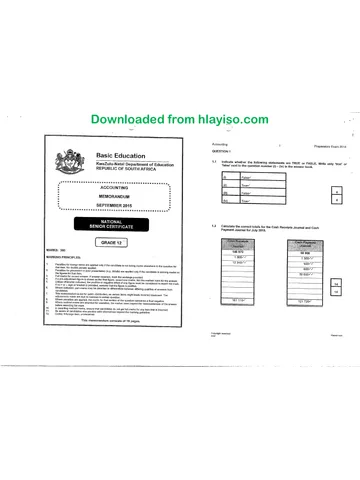
NATIONAL
SENIOR CERTIFICATE
GRADE 12
SEPTEMBER 2015
ACCOUNTING
MEMORANDUM
GENERAL RULES:
1. Award full marks for the correct final answers. If the answer is incorrect, mark the workings provided.
If a workings figure/amount is shown as a final answer, allocate the working mark.
2. “Method” marks are denoted by
In calculations and final totals, at least one part of the workings must be correct to earn the mark.
In cases where answers of previous questions must be used, check the transfer.
Ignore brackets on statements, but check the operation before awarding marks.
3. Where penalties are applied, the marks for that section cannot be a negative. (foreign items)
4. For questions requiring explanations and comments, award part-marks. A good explanation will
normally mention and explain a point. Beware of alternative wording reflecting the same points. This
marking guideline provides some explanations – they are not conclusive. Read the candidates’
responses and give credit for their interpretations.
5. Where appropriate/acceptable, accept recognisable abbreviations.
6. Educators are expected to work through the entire paper and make reasonable adjustments within the
framework of the mark allocation.
This memorandum consists of 17 pages.
Skip to contentAll 2015 papers 
View all
Accounting Grade 12 Eastern Cape Mock 2015 Memo (English)
Grade 12 Accounting memorandum from the Eastern Cape Mock Exam 2015 (English), 17 pages. Read online or download the free PDF.
Accounting · Grade 12 · Eastern Cape Mock Exam · 2015. Memorandum, 17 pages. Read online or download the PDF.
- Subject
- Accounting
- Grade
- Grade 12
- Document type
- Memorandum
- Year
- 2015
- Exam period
- Eastern Cape Mock Exam
- Curriculum
- CAPS
- Pages
- 17
- File size
- 452.5 KB
Free to read online, no sign-up needed
Loading document…
Loading document…
1 of 17
This exam
Eastern Cape Mock Exam 2015
Document textSearch extracted text and jump to a page.
Downloaded from hlayiso.com
2 ACCOUNTING (EC/SEPTEMBER 2015)
QUESTION 1: COST ACCOUNTING
1.1 1.1.1 Direct labour cost
1.1.2 Factory overhead cost
1.1.3 Administration cost
1.1.4 Direct material cost
1.1.5 Selling and distribution cost 5
1.2 1.2.1 FACTORY OVERHEAD COST
Consumable stores (31 080 – 3 180 ) 27 900
Water and electricity (37 220 + 3 280) x 75% 30 375
Insurance (14 820 – 1 480 ) x 3/4 10 005
Factory salary 113 040
Sundry expenses 21 840
Operation (one part correct) 203 160
-1 foreign items (maximum – 2) 11
1.2.2 PRODUCTION COST STATEMENT – 28 FEBRUARY 2015
Direct material cost 748 000
Direct labour cost One part correct
(532 000 + 58 520 + 12 000 + 1 320 ) 603 840
Prime cost Operation 1 351 840
Factory overhead cost Refer 1.2.1 203 160
Total manufacturing cost Operation 1 555 000
Work-in-process (1 March 2014) 142 400
1 697 400
Work-in-process (28 February 2015) (101 400)
Operation (subtracted)
Cost of production of finished goods 1 596 000 16
Copyright reserved Please turn over
Downloaded from hlayiso.com
(EC/SEPTEMBER 2015) ACCOUNTING 3
1.3 Naidoo’s Toy Shop
1.3.1 Confirm that the break-even point for 2015 is correct by doing a
calculation.
R54 x 2 640 (2 marks)
142 560 = 2 741,5 or 2 742 units
R172 – R120
R52 (2 marks)
4
1.3.2 Explain whether Naidoo should be concerned about the break-
even point for 2015. Quote relevant figures in your explanation.
Good explanation (with figures) satisfactory weak wrong “0”
She should be concerned because she failed to break even (made a loss)
BEP was 2 742 ; she only produced 2 640 units. 3
1.3.3 Provide ONE reason each for the change in the direct material
cost per unit and the direct labour cost per unit.
Any valid explanation (2 marks for each)
Award part marks for incomplete correct answers.
Figures are not required.
Increase is greater than an inflationary increase.
Direct Could be wastage, poor workmanship (mistakes).
material cost Increased transport costs (carriage on purchased)
Not able to get bulk discounts due to reduced production
Disruptions in production due to strikes/load shedding.
Direct labour
Less overtime worked.
cost
More efficient machinery used in the production process. 4
Provide a suitable reason for the decrease in the break-even point
1.3.4
from 2014 to 2015.
Valid reason
Increase in variable costs. (raw materials specifically)
Maintaining the selling price at R172. 2
Q1:
TOTAL 45
MARKS
Copyright reserved Please turn over
Downloaded from hlayiso.com
4 ACCOUNTING (EC/SEPTEMBER 2015)
QUESTION 2: BUDGETING
2.1 List TWO items on the Projected Income Statement provided, that
would not appear on a cash budget.
Any TWO
Cost of sales
Discount received
Depreciation
Trading stock deficit 2
2.2
120 000 – 75 000 = 45 000
A Gross profit (Two marks or nothing)
2
132 000 x 100/160 = 82 500 (one part correct)
B Cost of sales
Or: 132 000 x 62,5% or 132 000 – (132 000 x 37,5%)
4
2 400
/120 000 = 2%
C Advertising
132 000 x 2% = 2 640 (one part correct)
4
17 100 x 108% = 18 468 (one part correct)
D Salaries
Or 17 100 + 1 368 = 18 468
2
17 040
Net Profit (17 625 – 585) x 30% = 5 112
E after tax
17 040 – 5 112 = 11 928 (one part correct) 4
Copyright reserved Please turn over
Downloaded from hlayiso.com
(EC/SEPTEMBER 2015) ACCOUNTING 5
2.3 2.3.1 The percentage increase in wages that the cleaners will receive
in December 2015.
176
(3 376 – 3 200) x 100 = 5,5% (one part correct)
3 200 4
2.3.2 The monthly salary due to the sales manager in December 2015.
(17 100 – 300) = 8 400 (8 400 + 300 ) x 108% = 9 396
2 (one part correct) 4
2.3.3 The total credit sales expected in December 2015.
(99 000 x 160% ) x 75% = 118 800 (one part correct) OR
132 000 x 120% = 158 400 x 75% = 118 800 3
2.3.4 The loan balance on 1 November 2015.
585 x 1200/9 = 78 000 (one part correct) 3
2.4 Refer to the actual figures for Depreciation and Trading stock deficit for
October 2015. In each case, provide a reason for the difference with the
budgeted figures.
Any reasonable answer
Depreciation Purchase of a new asset.
Calculation error (omission).
Any reasonable explanation
Trading stock
deficit Unanticipated stock loss.
Random stock take revealed stock shortage.
Damaged goods noted and taken into account.
2
Copyright reserved Please turn over
Downloaded from hlayiso.com
6 ACCOUNTING (EC/SEPTEMBER 2015)
2.5 Refer to the actual figures for October 2015.
Comment on any two expenses that were not well controlled by the
business. In each case, quote the relevant figures and give ONE
suggestion on how this expense can be more effectively managed.
EXPENSE COMMENT (with figures) SUGGESTION
Any TWO of : Comment and figure each Suggestion each
Maintenance Over budgeted / underspent. Adjust budget or use the money
(4 000 – 1 650) wisely to maintain the assets.
This could extend the lifespan
and productivity of the assets.
Telephone Overspent / under budgeted. Control usage or check for
(2 000 – 4 280) over 50% misuse. Budget correctly if
found to be necessary.
Advertising Underspent / over budgeted. Spend money allocated. Look at
2 400 – 1 900 different forms of advertising.
May result in better sales/profit.
6
Q2:
TOTAL 40
MARKS
Copyright reserved Please turn over
Downloaded from hlayiso.com
(EC/SEPTEMBER 2015) ACCOUNTING 7
QUESTION 3: COMPANIES – FINANCIAL STATEMENTS
3.1 MATCHING-ITEMS
3.1.1 C
3.1.2 E
3.1.3 D
3.1.4 A
3.1.5 B
5
3.2 FINANCIAL STATEMENTS: NOTES
(a) FIXED ASSETS
BUILDING VEHICLES EQUIPMENT
750 000
Cost (1/3/2014) 0
375 500
Accumulated Depreciation (1/3/2014) (0) (450 000) (141 500)
300 000 234 000
CARRYING VALUE (1/3/2014) 0
MOVEMENTS:
2 500 000 24 800
Additions
-
(56 250)
Disposals -
-
(48 040)
Depreciation - (103 125)
140 625 210 760
CARRYING VALUE (28/2/2015) 2 500 000
Cost (28/2/2015) 2 500 000 562 500 400 300
(421 875)
Accumulated depreciation (28/2/2015) (0)
(189 540) 15
(b) ORDINARY SHARE CAPITAL
560 000 Issued shares on 1 March 2014 2 924 000
120 000 Additional shares issued during the financial year 816 000
(50 000) Shares re-purchased (50 000 x 5,50) (275 000)
630 000 Issued shares on 28 February 2015 3 465 000 10
Copyright reserved Please turn over
Downloaded from hlayiso.com
8 ACCOUNTING (EC/SEPTEMBER 2015)
(c) RETAINED INCOME
Balance (1 March 2014) 89 000
Net profit after income tax (1 005 000 – 281 400 ) 723 600
Shares re-purchased (50 000 x 1,50 ) (75 000)
Ordinary share dividends (469 600)
Interim dividends (paid) 252 000
680 000 x 0,32 cents
Final dividends (recommended)
(one part correct)
217 600
Balance (28 February 2015) Operation 268 000 12
(d) TRADE AND OTHER PAYABLES
Creditors control 203 900
Accrued expenses 19 220
Shareholders for dividends Refer note above (final dividends) 217 600
SARS: Income tax 25 500
Short term portion of loan 159 500 x 12/11 174 000
Operation (one part correct above) 640 220
8
3.2.2 Calculate the net asset value per share (NAV) after the re-
purchase of shares.
See 3.2(b) see 3.2(c)
000 000
00
0 000
= 593 cents (one part correct) accept R5,93 5
Copyright reserved Please turn over
Downloaded from hlayiso.com
(EC/SEPTEMBER 2015) ACCOUNTING 9
3.2.3 (a) As an existing shareholder, what factors/indicators would you
assess in determining whether R7,20 per share is an
acceptable issue price? Explain.
NAV: 593 cents in 2015
Market price of shares will also give an indication of investor confidence. 4
(b) V. Slink owns 52% of the issued share capital. Calculate the
minimum number of shares she must purchase in order to
retain her position as the major shareholder.
(check 3.2 (b))
52% of 630 000 = 327 600 shares.
50% of 700 000 = 350 000 shares.
She needs (350 000 – 327 600) = 22 401 shares
Or 51% of 700 000 : 357 000 – 327 600 = 29 400 shares 4
(c) V. Slink has suggested that, as a major shareholder, she
should be given the first option to purchase the additional
shares before they are advertised to the public. What should
the directors do?
Good explanation satisfactory weak wrong “0”
Must mention that this is unethical. Not allowed by law. Insider trading.
The directors must apply the law to safeguard the integrity of the business. 3
3.2.4 Do buying back shares have any benefit for the company?
Explain. Provide TWO points.
Any TWO separate and valid explanations
It improves the NAV of shares which could impact positively on the market price of
shares.
If profits remain constant, then a higher EPS would be recorded which means better
dividends for existing shareholders.
Depending on the price offered to buy back the shares, the remaining shareholders
may be disadvantaged if a very generous price is offered.
The solvency and liquidity tests will be essential before shares are bought back.
This will also have to be assessed. 4
Q3:
TOTAL 70
MARKS
Copyright reserved Please turn over
Downloaded from hlayiso.com
10 ACCOUNTING (EC/SEPTEMBER 2015)
QUESTION 4: CASH FLOW AND INTERPRETATION
4.1 4.1.1 Dividends paid:
300 000 x 56 cents = 168 000 (total dividends)
(42 000 + 168 000 – 66 000 ) = 144 000 (one part correct)
Accept different presentations of information such as T accounts, signs reversed etc. 5
4.1.2 Income tax paid:
- 8 800 + 75 600 – 12 500 = 54 300 (one part correct)
Accept different presentations of information such as T accounts, signs reversed etc. 4
4.1.3 Fixed assets purchased:
(1 505 400 – 1 201 500 + 64 000 + 23 500 )
= 391 400 (one part correct)
Accept different presentations of information such as T accounts, signs reversed etc. 5
4.1.4 Total investing activities:
See 4.1.3
(391 400) + 23 500 + (40 000) = (407 900) (one part correct)
4
4.1.5 Net change in cash and cash equivalents:
(17 500 – 2 000) + 23 900 = 39 400 (one part correct)
(15 500)
4
4.2 4.2.1 Stock holding period
148 100
0 00 000
000
= 37,2 days (one part correct) 4
4.2.2 Debtors average collection period
67 850
00 0 00
= 31,2 days (one part correct)
000 0
793 600 6
4.2.3 Debt/equity ratio
740 000 : 1 006 800 0,74 : 1 (one part correct)
3
Copyright reserved Please turn over
Downloaded from hlayiso.com
(EC/SEPTEMBER 2015) ACCOUNTING 11
4.3 Comment on the management of stock (trading inventory). Quote TWO
relevant financial indicators (with figures) in your answer.
Any TWO valid financial Indicators (with figures) Valid comment
Stock turnover rate: was 11 times – dropped to 9,8 times.
Stock holding period was 33 days – increased to 37,2 days. (refer 4.2.1)
The current ratio also increased from 1,27 : 1 to 1,43 : 1
Stock is being held for a longer period / stock is being bought/sold less often than previously.
There is some degree of stock piling or could be reduced sales.
It could be argued that the business took advantage of bulk discounts or that the goods may
have a reasonable shelf life period. 6
4.4 Is the management of debtors and creditors effective? Explain. Quote
relevant financial indicators and/or figures in your answer.
Quoting financial indicators with figures : explanation for each indicator
Debtors average collection period: was 38 days now 31,2 days.
Creditors’ average payment period: was 62 days now 65 days.
A good improvement on the collection policy of the business (close to the desired 30 days).
Depending on credit terms granted, it is wise to take the maximum permissible time to pay
back creditors (taking advantage of “short term financing” . As long as the business does not
incur any interest charges. It is also important to pay accounts on time to maintain credit-
worthiness. 6
4.5 4.5.1 Comment on the earnings per share (EPS), the dividends per
share (DPS) and the return on shareholders’ equity (ROSHE) for
both companies.
Quoting figures (for both companies) valid comments
Comments may be a general overall comment showing the relationship between the
different financial indicators.
Pixie LTD: EPS decreased from 72 cents to 63 cents. ROSHE decreased from 24%
to 19,7% but DPS increased from 52 cents to 56 cents.
The business did not do so well this financial year. (7% decrease in EPS). Although
the ROSHE decreased, it is still above the rate of alternative investments. The trend
however may be discouraging. Shareholders were kept satisfied by getting a higher
DPS. This simply means that the business did not retain as much of the profits as
was done last year.
Comparatively – Vivi Traders: EPS is 92 cents (63 cents) and DPS is 46 cents (56
cents) performed better but are retaining a larger % of the profits. Their ROSHE is
only 9,6% (19,7%). Shareholders at Pixie LTD are receiving a better return on their
investment. 6
Copyright reserved Please turn over
Downloaded from hlayiso.com
12 ACCOUNTING (EC/SEPTEMBER 2015)
4.5.2 Comment on the financial gearing of both companies. Explain
which company is making more use of loans and state whether it
is a good idea or not, for that company to do so.
Quoting relevant financial indicators (with figures) Valid comment
Debt/Equity ratio – Pixie Ltd (0,7 : 1), Vivi Traders Ltd (0,52 : 1)
Pixie Ltd is making greater use of loans than Vivi Traders Ltd.
ROTCE – Pixie Ltd 21,2%, Vivi Traders Ltd 10,8%
Pixie Ltd is making good use of the loan by obtaining a return that is greater than
the current interest rate (positive gearing). So it is a good idea to continue using the
loan.
Vivi Traders is only achieving a return of 10,8% on capital employed. Clearly not
making effective use of the loan. It would be in their interest to start repaying that
debt.
Note: Refer to answer in QUESTION 4.2.3 – learners responses may be based on
their incorrect calculations. 4
4.5.3 Refer to the market value of the shares and the net asset value
per share. What advice would you offer John Cann about
investing in either company?
Quoting the relevant figures valid comment with advice.
Although Vivi Traders Ltd has a better NAV than Pixie Ltd (342 cents to 336 cents),
its share price is much lower than that of Pixie Ltd. It is also lower than its NAV.
This is an indication that the company’s shares are not popular with investors.
Their shareholders also received a smaller dividend per share which could
contribute to investor confidence.
I would advise John Cann to invest in Pixie Ltd as the above figures as well as other
financial indicators show that the company is making steady progress. 3
Q4:
TOTAL 60
MARKS
Copyright reserved Please turn over
Downloaded from hlayiso.com
(EC/SEPTEMBER 2015) ACCOUNTING 13
QUESTION 5: VAT AND RECONCILIATIONS
VAT
5.1
5.1.1 Value added tax
5.1.2 (a) False
(b) False
5.1.3 Input VAT
4
5.2 5.2. Calculate the total credit sales for the period (excluding VAT).
1
12 320 x 100/14 = 88 000 (one part correct)
2
5.2. Taking into account the errors and omissions, calculate the
2 amount that is either payable to or receivable to SARS for VAT.
17 430 + 12 320 – 1 260 – 672 – 63 (27 755)
13 356 – 91 + 119 (13 384)
= 14 371 + 9 889 = 24 260 due to SARS
Accept different presentations of information such as T accounts, signs reversed
etc. 11
5.2. The internal auditor, through a random check, discovered that
3 the owner, Joe, does not pay the full amount due to SARS on
due dates. On enquiry, Joe stated that he spends the money on
the business. What advice would you offer Joe concerning this
practice?
Good explanation satisfactory weak wrong “0”
The business is an agent of SARS (VAT is collected on behalf of SARS).
Therefore it does not belong to the business and should not be viewed as
cash reserves for the business.
Unethical business practice.
SARS obligations must be kept separate and dealt with immediately.
3
Could incur penalties if discovered by a SARS audit.
Copyright reserved Please turn over
Downloaded from hlayiso.com
14 ACCOUNTING (EC/SEPTEMBER 2015)
5.3 CREDITORS RECONCILIATION:
CREDITORS
NO. STATEMENT
LEDGER ACCOUNT
BALANCE 5 350 12 540
i 540
ii (4 200 x 2) 8 400
iii 4 000
iv (250)
v (2 500)
TOTAL 14 040 14 040
9
5.4 DEBTORS RECONCILIATION
5.4.1 Give TWO steps that the bookkeeper must follow when he/she
discovers a difference between the Debtors Control Account
and the Debtors List.
Any TWO valid steps
Reconciling debtors’ list with debtors’ control account.
Identify if the error affects the control account or the DL or both.
Identify if ONE, TWO or MORE accounts are affected.
Make GJ entries to correct posting errors (wrong debtors / amounts over or under
cast / wrong general ledger accounts)
For single entry errors (amounts) make the necessary corrections and adjust the
balances. 2
5.4.2 Calculate the correct balance of the Debtors Control Account
and the Debtors List by completing the table provided.
DEBTORS CONTROL ACCOUNT: Insert amounts only on the appropriate side
DEBIT CREDIT
i 120
ii 90
iii 75
iv 530
v
If amount are placed in both columns -1 mark for the incorrect one
provided a mark was scored on that line. 5
Copyright reserved Please turn over
Downloaded from hlayiso.com
(EC/SEPTEMBER 2015) ACCOUNTING 15
DEBTORS LIST: Show the adjustment amount next to each debtor. Final balance is
not necessary.
M. Mouse 4 510 + 90 – 1 320 – 50
D. Duck 3 270 + 75
K. Chicken 940 + 530
F. Fox 2 260 + 1 320
Amounts must have the correct signs (+/-) to score the mark. 6
5.4.3 (a) Explain why you would be concerned about the
management of debtors in this business. Quote relevant
figures in your answer.
Any TWO valid comments with figures.
11590/23 180 = 50% of debtors are more than 60 days overdue.
Only 20% of debtors are current (within the 30 days credit terms).
10% of debtors are likely to be written off as irrecoverable.
Debtors are not taking advantage of the 5% discount for early payments.
Collection policy needs to be more vigilant.
4
(b) Provide TWO internal control measures that the business
can use to improve the collection of money from debtors.
Any TWO valid explanations.
Division of duties – explained.
Shared responsibilities in preparing documents (statements, receipts,
invoices) and depositing of money.
If the organisation is big, could assign a set number of debtors per
employee. Could result in personalised service and constant monitoring.
A separate screening department (follow-up and approval of credit).
Computerised messages to inform debtors not up to date with payments.
For 1 mark each:
Send SMS and reminders.
Charge interest on late payments (overdue accounts)
Give discounts for early payments. 4
Q5:
TOTAL 50
MARKS
Copyright reserved Please turn over
Downloaded from hlayiso.com
16 ACCOUNTING (EC/SEPTEMBER 2015)
QUESTION 6: STOCK VALUATION AND PROBLEM SOLVING
6.1 Calculate the value of the closing stock using the first-in-first-out (FIFO)
method of stock valuation.
12 94 880 – 22 600 = 72 280
(4 x 5 650)
5 x 5 520 + 260 = 28 900
(17–12) 5 780
101 180
One part correct for all method marks
10
6.2 Calculate the cost of sales of the laptops sold.
51 000 + 329 360 – (3 x 4 740) – (4 x 5 650) – 101 180 = 242 360
14 220 22 600 (one part correct)
(6.1)
or
51 000 + 53 760 + (99 800 – 14 220) + (9 x 5 780) = 242 360
85 580 52 020 6
6.3 How would a change in policy impact on the financial reporting of
the business? Give ONE point.
Any reasonable answer
May result in a different closing stock figure for the balance sheet.
Will result in a different gross profit figure for the income statement.
May impact on the amount of income tax payable/ may influence the EPS. 2
6.4 Taking into account the technology market, what advice can you offer
Max regarding his marketing strategy and his pricing policy? Provide
TWO points.
TWO valid points
Need to be aware of rapid changes in technology (goods may become obsolete).
May need constant upgrading of software.
Need to keep the different ranges (price levels) to cater for the different needs of
individuals.
Broaden the target market.
Stock and supply software and other computer accessories (complementary goods).
Provide an after-sales service such as repairs/maintenance. 4
Copyright reserved Please turn over
Downloaded from hlayiso.com
(EC/SEPTEMBER 2015) ACCOUNTING 17
6.5 PROBLEM SOLVING
6.5.1 Identify a different problem (with relevant figures) in each of the
branches.
BRANCH PROBLEM (WITH FIGURES )
24 cash sets = R100 800 Only R79 800 deposited
MENLYN (shortfall of R21 000)
High credit sales (54 600 is 31% of total sales)
Too high returns (12 sets)
MOORTON Only worked 73% of the normal and choose to cash in on the
overtime (52 hours)
Less than 50% of sets sold (after returns)
Very low sales volume (21/50) sets
VINCENT Low normal hours worked (102/160 hrs) and also do not like
overtime (maybe due to age) 6
6.5.2 Identify ONE branch that Siddie should consider closing down.
Provide a valid reason for your choice.
Branch Appropriate reason (Award mark for Branch name only if reason is relevant)
Moorton: High rent / average sales (turnover) / young, poor disciplined salesperson
with too many returns.
Vincent John is near retirement / working few hours / no effort to increase sales 3
6.5.3 Give Siddie with ONE suggestion to address the problem
identified in 6.5.1 for each of the other branches.
Any reasonable internal control measure for each branch
BRANCH INTERNAL CONTROL MEASURE
Sally is energetic but need to be audited regularly
Menlyn (checking sales and deposits).
Possibly change to another branch or division of
duties.
Moorton Time sheet for normal time / set targets / minimise
or overtime hours / calculate commission on net sales
Vincent Provide John with an assistant / set sales targets /
make a set number of hours for overtime. 4
Q6:
TOTAL 35
MARKS
TOTAL: 300
Copyright reserved Please turn over
Study this subject
Recommended for this subject
Memorandum
Accounting Grade 12 Eastern Cape Mock 2015 Memo (Afrikaans)
Question paper
Accounting Grade 12 Eastern Cape Mock 2015 QP (Afr)
Question paper
Accounting Grade 12 Eastern Cape Mock 2015 QP (Eng)
Memorandum
Accounting Grade 12 Gauteng Mock 2015 Memo (English)
Memorandum
Accounting Grade 12 KZN Prelim 2015 Memo
Memorandum
Accounting Grade 12 P2 Eastern Cape Mock 2022 Memo (Afr)
More from Grade 12 Accounting
Study guide
Accounting
Addendum
Accounting Grade 12 P1 Eastern Cape June 2025 Addendum (Eng)
Question paper
Accounting Grade 12 P1 Eastern Cape June 2025 QP (Afr)
Question paper
Accounting Grade 12 P1 Eastern Cape June 2025 QP (Eng)
Question paper
Accounting Grade 12 P2 Eastern Cape June 2025 QP (Eng)
Addendum