
Downloaded from hlayiso.com
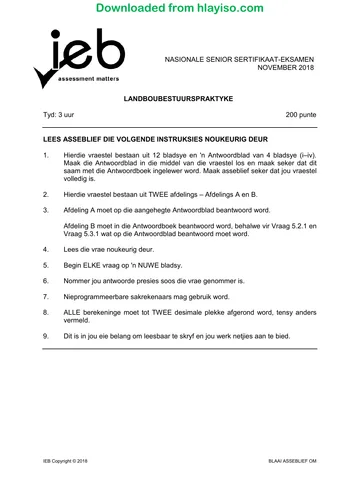
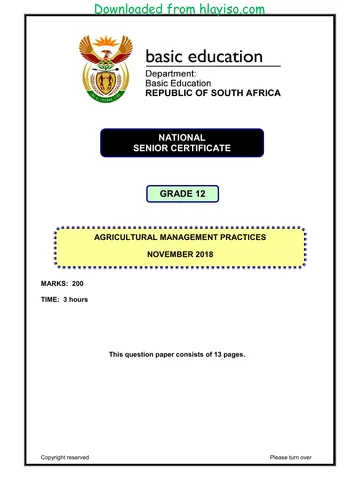
NATIONAL SENIOR CERTIFICATE EXAMINATION
NOVEMBER 2018
AGRICULTURAL MANAGEMENT PRACTICES
Time: 3 hours 200 marks
PLEASE READ THE FOLLOWING INSTRUCTIONS CAREFULLY
1. This question paper consists of 12 pages and an Answer Sheet of 4 pages (i–iv).
Detach the Answer Sheet from the centre of the question paper and ensure that it
is handed in together with the Answer Book. Please check that your question paper
is complete.
2. This question paper consists of TWO sections – Sections A and B.
3. Section A must be answered on the attached Answer Sheet.
Section B must be answered in the Answer Book, except for Question 5.2.1 and
Question 5.3.1 which must be answered on the Answer Sheet.
4. Read the questions carefully.
5. Start EACH question on a NEW page.
6. Number your answers exactly as the questions are numbered.
7. Non-programmable calculators may be used.
8. ALL calculations must be rounded off to TWO decimal places unless stated
otherwise.
9. It is in your own interest to write legibly and to present your work neatly.
IEB Copyright © 2018 PLEASE TURN OVER
You're offline
Skip to contentQuestion paper 
View all
Agri Management 2018 hlayiso.com
Agricultural Management Practices · Grade 12 · 2018. Question paper, 12 pages. Read online or download the PDF.
- Subject
- Agricultural Management Practices
- Grade
- Grade 12
- Document type
- Question paper
- Year
- 2018
- Publisher
- IEB
- Pages
- 12
- File size
- 255.0 KB
Loading document…
Loading document…
1 of 12
Document textSearch extracted text and jump to a page.
Downloaded from hlayiso.com
NATIONAL SENIOR CERTIFICATE: AGRICULTURAL MANAGEMENT PRACTICES Page 2 of 12
SECTION A
Answer this section on the ANSWER SHEET.
QUESTION 1
Various options are provided as possible answers to the following questions.
Choose the most correct answer and make a cross (X) in the block (A–D) next to
the question number (1.1–1.10) on the attached ANSWER SHEET.
1.1 A labourer who is hired for the purpose of picking fruit at a particular time
each year is referred to as a …
A permanent labourer.
B casual labourer.
C seasonal labourer.
D temporary labourer.
1.2 To determine the liquidity of a farm one calculates the difference between
the …
A income and expenditure.
B assets and liabilities.
C profit and loss.
D loan and monthly payments.
1.3 The amount of moisture that soil can retain after rainfall or irrigation is the …
A water-holding capacity.
B drainage.
C aeration.
D waterlogging.
1.4 Animal carcasses are inspected by a health inspector for the following
reason:
A To determine the fat content of the carcass.
B To determine the grade of the carcass.
C To determine if the carcass is free of pests and diseases.
D To determine the age of the animal.
1.5 A physical characteristic of soil that cannot be changed through soil
improvement measures …
A soil drainage.
B soil texture.
C soil nutrient content.
D soil structure.
IEB Copyright © 2018
Downloaded from hlayiso.com
NATIONAL SENIOR CERTIFICATE: AGRICULTURAL MANAGEMENT PRACTICES Page 3 of 12
1.6 The farming system in which the farmer only produces enough produce for
the household and has no extra produce to sell.
A Commercial farming
B Small-scale farming
C Specialised farming
D Subsistence farming
1.7 The main factor used to determine the veld type is the …
A composition of grass species.
B annual rainfall.
C density of the grass.
D amount of bush.
1.8 One of the following records is NOT an example of raw data for a beef herd.
A Number of calves born.
B Calving percentage.
C Birth mass.
D Weaning mass.
1.9 A farming system that produces high output on a small piece of land is
referred to as …
A precision farming.
B small-scale farming.
C intensive farming.
D extensive farming.
1.10 Which of the following factors are NOT included in the harvesting costs for
a crop?
A Fertilizer used during growing season.
B Fuel for harvester.
C Casual labour for hand harvesting.
D Transport to storage silo.
[20]
IEB Copyright © 2018 PLEASE TURN OVER
Downloaded from hlayiso.com
NATIONAL SENIOR CERTIFICATE: AGRICULTURAL MANAGEMENT PRACTICES Page 4 of 12
QUESTION 2
Choose a description from COLUMN B that matches a term from COLUMN A.
Write only the letter (A–M) next to the question number (2.1–2.10) on the attached
ANSWER SHEET, for example 2.11 P. Each description in COLUMN B may only
be used ONCE.
COLUMN A COLUMN B
2.1 Cash-flow statement A Marketing that is done by an agent where
buyers bid and the highest bid is accepted.
2.2 Mechanisation
B The reduction in value of a tractor over a
2.3 Sourveld period of time due to wear and tear.
2.4 Supply C The loss of exposed topsoil due to heavy
rain or wind.
2.5 Calibration
D Capital used to purchase fuel for the tractor.
2.6 Moveable capital
E A natural pasture with high nutrient value
2.7 Auction during summer and low nutrient value in
winter.
2.8 Depreciation
F The partial replacement of labour by capital
2.9 Weathering investment.
2.10 Receipt G Refers to the sources, amounts and dates of
cash inflow and outflow during a specific
period.
H The breakdown of rocks to form soils.
I The quantity of an agricultural product which
a producer delivers on the market at a
specific price.
J A natural pasture found in low rainfall areas.
K A source document that is issued to
acknowledge that money has been received
by the business.
L Measurement, calculation and setting of
implements to apply substances used in the
production process.
M Capital used to purchase animals for a
livestock enterprise.
[20]
IEB Copyright © 2018
Downloaded from hlayiso.com
NATIONAL SENIOR CERTIFICATE: AGRICULTURAL MANAGEMENT PRACTICES Page 5 of 12
QUESTION 3
Give the correct agricultural term for each of the following descriptions. Write only
the term next to the question number (3.1–3.10) on the attached ANSWER
SHEET, for example 3.11 Marketing.
3.1 The process of gathering information about consumers' needs and
preferences.
3.2 The application of natural or chemical substance to the soil to improve the
productivity of the soil.
3.3 The number of animals that can be kept per hectare without degrading the
environment.
3.4 An approach to agriculture that uses information technology to ensure that
crops and soil receive exactly what they need for optimum health and
productivity.
3.5 An agricultural operation that brings visitors to the farm to enjoy or
participate in agricultural activities.
3.6 A list of the closing balances of all ledger accounts of a business that is
usually prepared at the end of an accounting period.
3.7 The method of protecting the soil by covering it with dead plant material.
3.8 Knowledge, skills and practices gathered by our ancestors in a specific
geographical area, which are still usable and valuable.
3.9 The classification of harvested products according to quality criteria.
3.10 Cash used for small, unexpected payments such as postage or fixing a flat
tyre.
[10]
50 marks
IEB Copyright © 2018 PLEASE TURN OVER
Downloaded from hlayiso.com
NATIONAL SENIOR CERTIFICATE: AGRICULTURAL MANAGEMENT PRACTICES Page 6 of 12
SECTION B
This section consists of THREE questions. Start each question on a NEW page.
QUESTION 4 FARM PLANNING
4.1 Refer to the tables below to answer the questions that follow. Table 1 gives
the resource data for Bergvlei Farm and Table 2 gives the growing
requirements for various field crops.
Table 1: Resource data for Bergvlei Farm
Farm size 900 ha
300 ha arable; 600 ha non-arable
Average 18–30 °C (summer)
temperatures 5–20 °C (winter)
Frost Light to medium frost April–August
Annual rainfall 600 mm
Rainfall distribution Summer rainfall (Oct.–Feb.)
Soil texture 20% clay, mostly well-drained
Soil acidity Mostly 5,5–6
Irrigation None – all dryland production
Table 2: Requirements for optimal growth of crops
Water Day Growing
Frost
requirements temperature Soil type Soil pH season –
tolerance
mm °C days
Deep
Cotton 700–1 300 20–30 None 6,5–8 150–220
Medium–heavy
Deep
Dry beans 300–500 15–20 None 5,5–6 90–120
Well-drained
Deep
Maize 500–900 24–30 None 5–7 100–140+
Well-drained
Not sandy
Soyabeans 450–700 20–25 None 6–6,5 80–130
Well-drained
Deep
22–30
Sugarcane 1 300–1 600 None Light–heavy 5,5–8 250–540
min 15 °C
Well-drained
15–20
Wheat 180–250 Fair Medium–heavy 6–8 120–210
min 5 °C
[Adapted from: Department of Water Affairs, 2010]
4.1.1 Does Bergvlei Farm have a temperate or a tropical climate? Explain
your answer. (2)
4.1.2 Identify TWO crops from the table that would be suitable for this
production area and that could be planted in a crop rotation. Give
reasons for your choice. (4)
IEB Copyright © 2018
Downloaded from hlayiso.com
NATIONAL SENIOR CERTIFICATE: AGRICULTURAL MANAGEMENT PRACTICES Page 7 of 12
4.1.3 Suggest TWO livestock enterprises that could be kept on this farm.
Explain your choice. (4)
4.1.4 The farmer can either use manual labour or mechanisation to
perform the various tasks required by the cropping enterprise.
Compare the use of manual labour and mechanisation in terms of
the following:
(a) Costs
(b) Efficiency
(c) Product quality
(d) Time taken
(e) Area that can be completed
(f) More suitable option for this farm (own opinion) (6)
4.1.5 Give FOUR factors which are used to determine whether soil is
arable. (4)
4.1.6 Give THREE ways in which a farmer can improve the drainage of a
soil. Explain your answer. (3)
4.1.7 Explain the effect of soil pH on crop production. (2)
4.1.8 Explain how a farmer can change the pH of a soil and how this
process works. (3)
4.1.9 Give FOUR benefits of using crop rotation in a cropping system. (4)
4.1.10 Describe FOUR factors which would influence one's choice of crops
for a crop rotation system. (4)
4.2 A crop farmer is considering the use of precision farming techniques.
4.2.1 Give FOUR examples of how precision farming can be used in a
cropping enterprise. (4)
4.2.2 Give THREE benefits of using precision farming methods in a
cropping enterprise. (3)
4.2.3 List THREE types of equipment that would be required for the use
of precision farming methods. (3)
4.3 A farm has an area of crop land with a slope of 1:8.
4.3.1 Describe the slope of the land AND explain its usefulness for crop
production. (2)
4.3.2 Explain what the farmer could do to improve the usefulness of this
land for crop production. (2)
[50]
IEB Copyright © 2018 PLEASE TURN OVER
Downloaded from hlayiso.com
NATIONAL SENIOR CERTIFICATE: AGRICULTURAL MANAGEMENT PRACTICES Page 8 of 12
QUESTION 5 HARVESTING AND MARKETING
5.1 Read the article below and answer the questions that follow.
SA egg shortage sends prices scrambling
Ray Mahlaka and Aarti Bhana, Moneyweb,
15 December 2017
1 SA is in the throes of an egg
shortage and breakfast has become
more expensive lately.
[Picture: Matthew Lloyd/Bloomberg]
2 Egg costs are surging and showing no signs of declining as SA's farmers
battle with an avian flu outbreak resulting in the culling of millions of
egg-laying hens. About 4,7 million egg-laying hens have been culled since
the outbreak in June this year, affecting 13 egg farms, mostly in the
Western Cape.
3 The flu outbreak has led to more than 1 000 direct job losses and reduced
SA's egg production by 3,9 million eggs a day, according to the South
African Poultry Association.
4 The average price of a tray of 18 eggs cost 16,9% more in November 2017
compared with the same time last year, Statistics SA data indicated. In
rand terms, SA's average egg prices (carton of 18 eggs) rose from R36,49
to R42,65 over the same period. Inflation for eggs in October was 4,8%
year-on-year.
5 The Western Cape has emerged as the most expensive province to
purchase eggs, with the average price for a carton of 18 eggs being R46,85.
6 The Western Cape has been hit the hardest by the avian flu virus as
about three million egg-laying hens have been culled. Industry estimates
showed the Western Cape has the largest distribution of chickens and
eggs in SA with an estimated market share of 21,9%.
7 The on-going severe drought in the Western Cape has seen smaller egg
farmers exit the industry over the last two years as higher feed costs
knocked their profitability.
8 SA's average egg production for 2017 is expected to be the lowest in five
years at 379 000 cases per week, data from the South African Poultry
Association showed.
5.1.1 Explain the effect of the Avian Influenza outbreaks on the supply of
eggs in South Africa. (2)
5.1.2 Explain, using a supply and demand curve to support your answer,
how the reduced supply of eggs has affected the price of eggs in
South Africa. (4)
IEB Copyright © 2018
Downloaded from hlayiso.com
NATIONAL SENIOR CERTIFICATE: AGRICULTURAL MANAGEMENT PRACTICES Page 9 of 12
5.1.3 The article mentions the South African Poultry Association. Give
THREE functions of industry associations or organisations in the
agricultural industry. (3)
5.1.4 The article mentions that a number of small producers have gone
out of business as a result of the disease outbreak.
(a) Give TWO reasons why small producers are more vulnerable
in this situation. (2)
(b) Suggest what these small producers could do to protect their
businesses and make them more sustainable. (3)
5.1.5 As a poultry farmer, explain how you would use the five
management roles (Control, Planning, Coordination, Motivation and
Organisation) to control and prevent the Avian Influenza disease
from affecting your farm. (5)
5.2 Farmer Mokoena has a farm on which he produces potatoes. He has the
following items on the farm on 28 February 2018.
Farm land R1 200 000
Land Bank loan R800 000
Tractor R80 000
Potato packing shed R80 000
Account at co-operative R90 000
Bank overdraft R40 000
Fuel on hand R10 000
Fertilizer on hand R12 000
Harvested potatoes R60 000
5.2.1 Compile a balance sheet for this farm using the table provided on
the ANSWER SHEET. (12)
5.2.2 Using the balance sheet from Question 5.2.1, evaluate the liquidity
of this farm at this time. Provide clear explanations for your
response. (3)
5.2.3 The table below provides three marketing channels that Farmer
Mokoena could use to market his potatoes. Copy the table into your
Answer Book and complete it by giving one advantage and one
disadvantage of each marketing channel.
Marketing channel Advantage Disadvantage
Farm gate
Contract
Free market (6)
IEB Copyright © 2018 PLEASE TURN OVER
Downloaded from hlayiso.com
NATIONAL SENIOR CERTIFICATE: AGRICULTURAL MANAGEMENT PRACTICES Page 10 of 12
5.3 Lerato is planning to produce a batch of broiler chickens to sell at the local
taxi rank at a price of R60 per bird. The local extension officer has advised
her to expect a 4% mortality rate during the rearing period and has given
her the following list of inputs:
500 day old chicks at R6,50 per chick
50 bags of feed at R180 per bag
40 kg of gas for brooders at R22 per kg
1 load of wood shavings at R200 per load
100 km transport of marketable broilers at R5 per km
5.3.1 Using the table in your ANSWER SHEET, compile a partial budget
for a single batch of broilers to determine the gross margin of a
single batch. (8)
5.3.2 In reality, the actual gross margin may be different to the expected
figures calculated in Question 5.3.1. Give TWO reasons why this
might occur. (2)
[50]
IEB Copyright © 2018
Downloaded from hlayiso.com
NATIONAL SENIOR CERTIFICATE: AGRICULTURAL MANAGEMENT PRACTICES Page 11 of 12
QUESTION 6 BUSINESS PLANNING AND MANAGEMENT
6.1 Read the article below to answer the questions that follow.
Agritourism helps ostrich farm fly high
Unfavourable market and production conditions are forcing farmers to look for
ways to diversify risks and enhance farm cash flow. Johan Keller, who farms at
De Denne outside Oudtshoorn in the Little Karoo, had to seriously re-evaluate
farm sustainability following the avian flu outbreak a few years ago. The
outbreak led to a ban on ostrich exports – their primary source of income at the
time – even though this disease did not affect any birds in the region.
In response to the outbreak, Johan diversified farm production from ostriches,
lucerne and lucerne seed to include dairy and Bonsmara cattle. Two years ago
he added further value to the business by boldly entering the agritourism
market.
Jam-packed tourist destination
Starting an agritourism enterprise is capital-intensive. De Denne had a few old
buildings dating back more than hundred years which had to be renovated. At
the moment, four buildings that accommodate 16 people are available, either
on a bed-and-breakfast or self-catering basis. A camping site near the farm dam
for tourists who are interested in an outdoor experience is also being
developed. The self-catering units are equipped with modern amenities, such as
air conditioning, a bar fridge, TV, hairdryer, tea- and coffee-making facilities,
microwave and a hotplate. Each unit has a private entrance and braai facility.
De Denne's tourist activities include bird watching, mountain biking and scenic
walks. Daily environmental and farm tours to watch ostrich chicks hatching have
also become very popular. Guests enjoy being on a working farm where they
see workers going about their tasks – milking cows, feeding the ostriches and
harvesting lucerne. Surrounding attractions include ostrich show farms and wine
farms, 4×4 trails, the Cango Caves, Cango Wildlife Range and mountain biking up
the Swartberg.
New-age marketing
As part of De Denne's marketing strategy, Johan had the website
www.dedenne.com designed. This real-time website allows people to check the
availability of rooms and make bookings on the website or via e-mail.
The guest house's income is quite significant compared with that generated
from primary farming activities. Johan says tourism has increased cash flow
during difficult months and it has created new jobs on the farm.
[Adapted from: Farmers Weekly, March 19, 2007]
6.1.1 The owner of this farm, Johan Keller, is a successful entrepreneur.
Identify FIVE characteristics of Mr Keller that make him an
entrepreneur. (5)
IEB Copyright © 2018 PLEASE TURN OVER
Downloaded from hlayiso.com
NATIONAL SENIOR CERTIFICATE: AGRICULTURAL MANAGEMENT PRACTICES Page 12 of 12
6.1.2 In order to obtain capital from the bank for the agritourism business,
Mr Keller would have been required to compile a business plan.
Describe the FIVE main sections of a business plan AND briefly
explain what would be included in each section. (10)
6.1.3 The reading mentions that Mr Keller diversified his farming
operations to include dairy cattle, beef cattle and agritourism.
Evaluate this decision in terms of the physical and financial
compatibility of these new enterprises with the existing farm. (4)
6.1.4 Explain how the agritourism business will contribute to the overall
value of the farm. (3)
6.1.5 Could you foresee any negative impact of having large numbers of
tourists visiting the farm? Suggest THREE possible problems. (3)
6.1.6 This farmer is using a website to market the business. Evaluate the
suitability of this advertising method for this business. (3)
6.1.7 Suggest TWO other relevant ways in which Mr Keller could market
his agritourism business. (2)
6.2 South Africa traces deadly listeria to sausage meat, issues recall
South Africans were told not to consume "ready to eat" processed meat as the
government linked a listeria outbreak which has killed 180 people to a sausage
meat made by the country's biggest consumer foods group.
[Adapted from: Reuters, March 4, 2018]
6.2.1 Give THREE reasons for processing meat into various products. (3)
6.2.2 The listeria bacteria was introduced by a processed meat additive
brought in from South America. Discuss THREE ways in which the
contamination of meat products in South Africa could have been
prevented. (3)
6.2.3 List FOUR pieces of information that should be displayed on the
label of processed agricultural products. (4)
6.2.4 Design a poster which could be displayed in a meat processing
facility which will inform staff of food safety procedures. Include at
least FOUR procedures on your poster. Use a clean page in your
Answer Book to present your poster. (5)
6.2.5 The recent listeriosis outbreaks have significantly reduced
consumer confidence in pork products.
(a) What impact has this outbreak had on South African pork
producers. (3)
(b) Suggest TWO ways in which pork producers could regain
their status in the meat industry. (2)
[50]
150 marks
Total: 200 marks
IEB Copyright © 2018
Recommended for this subject
Published documents with matching subject and grade metadata.
Question paper
Agricultural Management Practices Nov 2025 Afr
Question paper
Agricultural Management Practices Nov 2025 Eng
Question paper
AGRIC SCIENCES P1 QP GR12 SEPT 2024 Xhosa
Question paper
AGR SCIENCES P2 GR12 QP SEPT2024 IsiXhosa
Question paper
Agricultural Management Practices Nov 2024 Afr
Question paper
Agricultural Management Practices Nov 2024 Eng
Related documents
Matched using subject, grade, language, document type and exam metadata.
Question paper
Agri Management Afr hlayiso.com
Question paper
Agricultural Management Practices Nov 2018 Eng hlayiso.com
Question paper
Agricultural Management Practices Nov 2018 Afr hlayiso.com
Question paper
Agricultural Management Practices Feb March 2018 Eng hlayiso.com
Memorandum
Agri Management Afr memo hlayiso.com
Memorandum
Agri Management Memo 2018 hlayiso.com
More from Grade 12 Agricultural Management Practices
Explore more published documents in this catalogue.
Annual teaching plan
Gr 12 Agric Man Prac ATP 2023 24
Memorandum
Agricultural Management Practices Nov 2025 MG Eng
Memorandum
Agricultural Management Practices Nov 2025 MG Afr
Memorandum
AGRIC SCIENCES P1 QP GR12 SEPT 2024 Xhosa Memo
Memorandum
AGR SCIENCES P2 GR12 MEMO SEPT2024 English
Question paper