
Downloaded from hlayiso.com
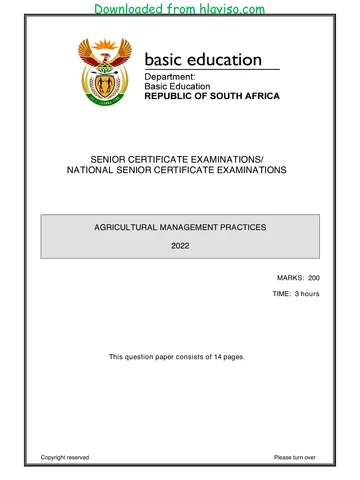
SENIOR CERTIFICATE EXAMINATIONS/
NATIONAL SENIOR CERTIFICATE EXAMINATIONS
AGRICULTURAL MANAGEMENT PRACTICES
2022
MARKING GUIDELINES
MARKS: 200
These marking guidelines consist of 12 pages.
Copyright reserved Please turn over
You're offline
Skip to contentQuestion paper 



View all


Agricultural Management Practices May June 2022 MG Eng hlayiso.com
Agricultural Management Practices · Grade 12 · NSC June Exam · 2022. Question paper, 12 pages. Read online or download the PDF.
- Subject
- Agricultural Management Practices
- Grade
- Grade 12
- Document type
- Question paper
- Year
- 2022
- Exam period
- NSC June Exam
- Pages
- 12
- File size
- 395.4 KB
Loading document…
Loading document…
1 of 12
Document textSearch extracted text and jump to a page.
Downloaded from hlayiso.com
Agricultural Management Practices 2 DBE/2022
SC/NSC – Marking guideline
SECTION A
QUESTION 1
1.1 Multiple-choice questions
1.1.1 C
1.1.2 D
1.1.3 B
1.1.4 D
1.1.5 A
1.1.6 A
1.1.7 B
1.1.8 C
1.1.9 B
1.1.10 A
(10 x 2) (20)
1.2 Matching items
1.2.1 F
1.2.2 H
1.2.3 K
1.2.4 E
1.2.5 C
1.2.6 D
1.2.7 A
1.2.8 G
1.2.9 L
1.2.10 J
(10 x 2) (20)
1.3 Agricultural terms
1.3.1 Productivity
1.3.2 Radiation/Ultraviolet rays or light
1.3.3 Diversification/Diversity
1.3.4 Light or sunlight
1.3.5 Entrepreneurship
(5 x 1) (5)
1.4 Underlined words
1.4.1 Perishability/Perishing
1.4.2 Organising/Organisation
1.4.3 Climate of weather
1.4.4 Break-even point
1.4.5 Domestic or local
(5 x 1) (5)
TOTAL SECTION A: 50
Copyright reserved Please turn over
Downloaded from hlayiso.com
Agricultural Management Practices 3 DBE/2022
SC/NSC – Marking guideline
QUESTION 2: PHYSICAL FARM PLANNING
2.1 Veld management
2.1.1 Importance of knowing optimal plant growth
To know the time of optimal growth will establish the best plant
potential
Knowledge on the different type of grasses will help to determine the
carrying capacity of the farm (Any 1) (2)
2.1.2 TWO ways of how division of camps can assist the farmer
Maximise the continuous production of high-quality feed
Have feeds available in times of slow growth and dormant periods
Provide the nutritional requirements of livestock and game (eg, winter
pastures)
Plan and respond to unexpected events (droughts, floods, fire, etc.)
Increase efficiency of daily management
Prevent degradation of veld by preventing overgrazing
Minimise animal stress by avoiding unnecessary movement (Any 2) (4)
2.1.3 TWO advantages of good pasture management
No need to buy additional feed
Need for planted pastures would be less
The farmer would save money or have a higher income (Any 2) (2)
2.2 Factors influence grazing
2.2.1 Palatability – influence on grazing
Sweet veld – more palatable higher intake
Mixed veld – moderate palatable eaten first, moderate intake
Sour veld – less palatable grasses thus lower intake (Any 1 x 2) (2)
2.2.2 Topography – influence on grazing
Topography like e.g. low-lying fields and plains can be more accessible to
animals This can lead to being grazed more often
Topography like e.g. mountain areas and slopes can be less accessible
to animals These areas will be grazed less often (Any 1 x 2) (2)
2.2.3 Erosion – influence on grazing
No erosion more areas for grazing
Moderate erosion areas for grazing decreases
Severe erosion little grazing available (Any 1 x 2) (2)
Copyright reserved Please turn over
Downloaded from hlayiso.com
Agricultural Management Practices 4 DBE/2022
SC/NSC – Marking guideline
2.3 Capital
2.3.1 Fixed capital item
C or fences (Any 1) (1)
2.3.2 Movable capital item
A or B or crop produce or cattle (Any 1) (1)
2.3.3 Reasons reducing risk with B and A or E
There will be more than one income for the farmer
Farmer can sell animals as well as the product (milk) as an income
More sustainable farming enterprise from more sources of income
Diversification or have more than one enterprise on the farm reduce
price, disease and marketing risk
Value adding of the product can create an extra income (Any 2) (2)
2.4 Soil structure
2.4.1 Definition soil structure
Is the grouping of soil particles into structural unit (aggregates)
Is the natural cohesion of soil particles to form larger parts
(aggregates) (Any 1 x 2) (2)
2.4.2 Soil structure and cultivation
Structured soil
o Has high clay content – difficult to cultivate
Non-structured soil
o Is loose and sandy – easy to cultivate (2)
2.5 TWO advantages of organic farming
Lower input costs
Prohibits chemical input thus:
o healthier for human consumption
o less harmful effects on the environment
Improves the soil health (Any 2) (2)
2.6 Precision farming
Correct main element
MAIN ELEMENTS
ACTION PLAN APPLY RESULT ANALYSE
Irrigation/Spraying
Data processing
Precision maps
Harvesting
Fertilisation (5)
Copyright reserved Please turn over
Downloaded from hlayiso.com
Agricultural Management Practices 5 DBE/2022
SC/NSC – Marking guideline
2.7 Physical inputs obtained in determining farming system
Soil
Precipitation
Sun
Location
Drainage (5)
2.8 Mechanisation
2.8.1 Influence on the costs of labour
More skilled labours needed
Less labourers employed or labourers will reduce (2)
2.8.2 Negative social impact of mechanisation
It results in unemployment/job losses (1)
2.9 Effect of reduced wastage of pesticides in precision farming
Only a small area is sprayed that will reduce the cost of spaying
Less pesticide (less wastage) used reduce the risk of pollution
therefore less environmental damages (more environmentally friendly)
Better control on the pest because of focused spraying (Any 2) (4)
2.10 Agritourism
2.10.1 Educational tourists
People visiting places to do research
on the veld, soil, topography (2)
2.10.2 Product route tourists
People follow routs to see how agricultural products are produced
or how agricultural products are processed (2)
2.11 FIVE disadvantages of agritourism
Brings more responsibilities
Not enough people available with the knowledge on agritourism
Many laws that regulate agriculture and tourism
Aspects like transport, nature conservation, social welfare can be a
problem
Costly to start
The effect of loss of privacy
Negative impact on environment
Public liability
Difficulty to stay interconnected to all people involved
Highly affected by global health conditions (Any 5) (5)
[50]
Copyright reserved Please turn over
Downloaded from hlayiso.com
Agricultural Management Practices 6 DBE/2022
SC/NSC – Marking guideline
QUESTION 3: BUSINESS PLANNING, ENTREPRENEURSHIP, MARKETING,
PRICE DETERMINATION AND THE MANAGEMENT PROCESS
3.1 Business plan
3.1.1 FIVE reasons for developing a business plan
Test the feasibility of the enterprise
To assist in determining the financial needs
To determine daily activities
Indicates the current position of the business
Outline the future prospects of the business
To gain knowledge of relevant marketing issues
To obtain credit from a financial institution (Any 5) (5)
3.1.2 FIVE marketing strategies
Potential profit projections based on realistic figures
Indicate to what extend profit will be reinvested
Focus on weakness of competition and provide better product
Justify price by thinking like the consumer
Price or service must reflect business's overall strategy
Indicate cost that improve quality of the product
Indicate expected sales
Indicate possible market share
Indicate break-even point
Indicate weakness in financing
Make suggestions on how shortcomings can be reduced (Any 5) (5)
3.2 Entrepreneurship
3.2.1 THREE entrepreneurial characteristics A, B, C and D
A – organisational/coordination abilities
B – technical/operational knowledge
C – innovative/creativeness/vision insight
D – perseverance (4)
3.2.2 THREE resources that an entrepreneur requires when starting a farming
enterprise
Financial resources (appropriate examples)
Human resources (appropriate examples)
Physical resources (appropriate examples) (3)
3.3 Distinguishing primary agricultural sector from secondary and tertiary
agricultural sectors
The primary sector uses natural resources to produce raw products in
farming, fishing and forestry sectors
Secondary sector transforms raw materials obtained from the primary
sector to produce semi-finished or finished goods
The tertiary sector includes goods and services that the primary and
secondary agricultural sectors need to produce their products (3)
Copyright reserved Please turn over
Downloaded from hlayiso.com
Agricultural Management Practices 7 DBE/2022
SC/NSC – Marking guideline
3.4 Marketing laws applicable to the marketing of agricultural products
3.4.1 C (1)
3.4.2 A (1)
3.4.3 B (1)
3.4.4 E (1)
3.5 Marketing channels
3.5.1 THREE advantages of farm gate marketing
No marketing costs
No transport costs
Better suited for small scale farmers
Products can be sold by the farmer/no middle man or agent (Any 3) (3)
3.5.2 THREE disadvantages of farm gate marketing
The farmer will have to accept the local price for the product on sale
The farmer will not necessarily be well located to reach consumers
Risk of robbery is high
Volumes that are sold are sometimes small (Any 3) (3)
3.6 Difference between internet marketing and contract marketing
INTERNET MARKETING CONTRACT MARKETING
No contract – done on several A signed contract between the
online platforms producer and the consumer
Fluctuating prices Price is fixed
No guaranteed income Guaranteed income
Sell to anyone – can reach a Obligated to deliver to contract
global audience (6)
3.7 THREE functions of producer organisations in the agriculture industry
Assist in the marketing of agricultural products
Research possible local markets for farmer's produce
Involved in export possibilities of farmer's products
Advice farmers on production methods of the product
Involved in research of the product to the benefit of all role players
Analyse markets and determine market tendencies
Promotion of the product (Any 3) (3)
Copyright reserved Please turn over
Downloaded from hlayiso.com
Agricultural Management Practices 8 DBE/2022
SC/NSC – Marking guideline
3.8 THREE advantages of fresh produce market
Farmers can benefit from higher prices in time of shortages
Assuring the integrity of each party in the transaction
Guaranteeing that the negotiated price will be paid
Market is able to sell large quantities
Farmer can use an agent to do the marketing
Money is available immediately after sales (Any 3) (3)
3.9 FOUR advantages of evaluation
Increase the efficiency of the operation
Resources are utilised optimally
Increased productivity in the workplace
Constant improvement of the operation or enterprise
Indicate areas of wastage and how to correct it (Any 4) (4)
3.10 FOUR advantages of proper management regarding labour
Time saving
It increases efficiency and work is done faster
Each worker gains more skills in their part of specialisation and becomes
an expect
Devising simple machinery for each operation becomes possible
The supervisor will know the responsibility of each worker (Any 4) (4)
[50]
Copyright reserved Please turn over
Downloaded from hlayiso.com
Agricultural Management Practices 9 DBE/2022
SC/NSC – Marking guideline
QUESTION 4: FINANCIAL PLANNING, RECORDING, HARVESTING, VALUE
ADDING, AND PACKAGING
4.1 A budget has both a planning function and a control function
Planning function - link expected income and expected expenses of the
farm to the goals of the farm
Control function – make sure that the real activities adhere to the
planned activities (4)
4.2 Budgets
4.2.1 Inputs and outputs in budget
(a) Input
Seed
Fertilizer
Poisons /chemicals/herbicide/pesticide
Fuel (Any 2) (2)
(b) Output
Harvested product
Wastage from harvested product sold (Any 1) (1)
4.2.2 Budget for in terms of resources
Identification of the available resources
Determine the utilization of resources
Determine the cost for the use of resources (3)
4.3 Income statement
4.3.1 Calculate Gross Profit
Gross profit = sales – cost of sales
= R942 700,00 – R780 900,00
= R161 800,00 (3)
4.3.2 Calculate Net Profit
Net profit = Gross profit – indirect expenses (overheads/non-production
costs)
= R161 800,00 – (R21 700,00 + R72 300,00 + R52 300,00)
= R161 800,00 – R146 300,00
= R15 500,00 (3)
4.4 Distinguish between seasonal workers and occasional workers
Seasonal workers
o Do repetitive tasks
o Tasks are season bound (e.g. of worker can be used)
Occasional workers
o Do project based, not repetitive tasks
o Tasks are not seasonal (e.g. of worker can be used)
(Any 1 comparison) (2)
Copyright reserved Please turn over
Downloaded from hlayiso.com
Agricultural Management Practices 10 DBE/2022
SC/NSC – Marking guideline
4.5 THREE requirements of good record keeping
Clear and simple
Practical and easy to use
Specific
Realistic
Relevant
Complete
Useful and address specific needs on the farm
Up to date (Any 3) (3)
4.6 Acceptable condition of fresh raw products
Product must be firm and not wilted
No damage , marks, bruises on the product
Smell and colour must be specific to the fresh product
No signs of diseases and pests visible on the product
The product must be clean from soil and residue (Any 2 x 2) (4)
4.7 Mechanical harvesting and harvesting by hand
MECHANICAL HAND
HARVESTING HARVESTING
Influence of whether conditions small / little great
Theft of the produce less more (4)
4.8 THREE correct personal health and hygiene practices for labourers
Must be well trained (know the dangers of fresh produce)
Bath regularly
Good toilet practises
Regular hand washing
Wear clean clothes
Wear required protective clothing (gloves, masks, shoes, hair cover)
Keep nails short (Any 3) (3)
4.9 TWO main factors that determine the method of storage
Type of product
The relative humidity of the environment during the storage period
The moister content of the product from the field (Any 2) (2)
Copyright reserved Please turn over
Downloaded from hlayiso.com
Agricultural Management Practices 11 DBE/2022
SC/NSC – Marking guideline
4.10 Conversion through various actions and processes
4.10.1 Pasteurisation (1)
4.10.2 Extraction (1)
4.10.3 Fermentation (1)
4.10.4 Sterilisation (1)
4.10.5 Extrusion (1)
4.11 Methods of packaging agricultural products
4.11.1 Vacuum packaging
Removing the air will delay spoilage or rotting of the product
Removing of the air reduces the size of the product that make storage
and handling easier
Delayed rotting increased the shelf-life the product (Any 1) (2)
4.11.2 Non-vacuum packaging
Do not need specialized equipment thus less costs
Protect the product shape or crushing of the product
More products can be packed because it saves time on packaging
(Any 1) (2)
4.12 Transport of products
4.12.1 Requirements of the truck and trailer
Floor must be slip-free – to prevent animals from falling and injuring
themselves
Sufficient side panels – to prevent animals from falling-off and separating
small and large stock
Height in multi-level vehicles must be sufficient – to allow larger animals
to stand up and allow air to flow freely
Must be spacious – to ensure animal safety during transport
Safety of the animals – animals are not injured when moving
Ensure biosecurity – power-wash and sanitize vehicle before loading
animals (Any 3) (3)
4.12.2 TWO requirements of animals during the journey
Water
Food – hay, concentrate (2)
Copyright reserved Please turn over
Downloaded from hlayiso.com
Agricultural Management Practices 12 DBE/2022
SC/NSC – Marking guideline
4.12.3 Stress levels of the animals
Stress has negative effects on the performance of farm animals
Weaken immune system
Reduce reproduction
Weight loss
Digestive upsets
Inflammatory reactions
Reduced feed consumption (Any 2) (2)
[50]
TOTAL SECTION B: 150
GRAND TOTAL: 200
Copyright reserved
Recommended for this subject
Published documents with matching subject and grade metadata.
Question paper
Agricultural Management Practices Nov 2025 Afr
Question paper
Agricultural Management Practices Nov 2025 Eng
Question paper
AGRIC SCIENCES P1 QP GR12 SEPT 2024 Xhosa
Question paper
AGR SCIENCES P2 GR12 QP SEPT2024 IsiXhosa
Question paper
Agricultural Management Practices Nov 2024 Afr
Question paper
Agricultural Management Practices Nov 2024 Eng
Related documents
Matched using subject, grade, language, document type and exam metadata.
Question paper
Agricultural Management Practices May June 2022 Afr hlayiso.com
Question paper
Agricultural Management Practices May June 2022 MG Afr hlayiso.com
Question paper
Agricultural Management Practices May June 2022 Eng hlayiso.com
Question paper
Agricultural Management Practices Nov 2022 Eng hlayiso.com
Question paper
Agricultural Management Practices Nov 2022 Afr hlayiso.com
Question paper
Agricultural Management Practices Nov 2022 MG Eng hlayiso.com
More from Grade 12 Agricultural Management Practices
Explore more published documents in this catalogue.
Annual teaching plan
Gr 12 Agric Man Prac ATP 2023 24
Memorandum
Agricultural Management Practices Nov 2025 MG Eng
Memorandum
Agricultural Management Practices Nov 2025 MG Afr
Memorandum
AGRIC SCIENCES P1 QP GR12 SEPT 2024 Xhosa Memo
Memorandum
AGR SCIENCES P2 GR12 MEMO SEPT2024 English
Question paper