
Downloaded from hlayiso.com
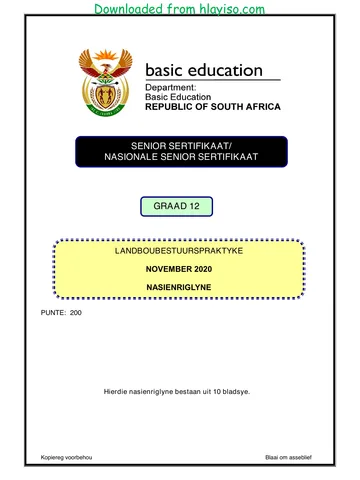
SENIOR CERTIFICATE/
NATIONAL SENIOR CERTIFICATE
GRADE 12
AGRICULTURAL MANAGEMENT PRACTICES
NOVEMBER 2020
MARKING GUIDELINES
MARKS: 200
These marking guidelines consist of 10 pages.
Copyright reserved Please turn over
You're offline
Skip to contentMemorandum 




View all
Agricultural Management Practices Nov 2020 Memo Eng hlayiso.com
Agricultural Management Practices · Grade 12 · NSC November Exam · 2020. Memorandum, 10 pages. Read online or download the PDF.
- Subject
- Agricultural Management Practices
- Grade
- Grade 12
- Document type
- Memorandum
- Year
- 2020
- Exam period
- NSC November Exam
- Pages
- 10
- File size
- 377.1 KB
Loading document…
Loading document…
1 of 10
Document textSearch extracted text and jump to a page.
Downloaded from hlayiso.com
Agricultural Management Practices 2 DBE/November 2020
SC/NSC – Marking Guidelines
SECTION A
QUESTION 1
1.1 MULTIPLE CHOICE
1.1.1 B
1.1.2 A
1.1.3 B
1.1.4 A, B, C
1.1.5 B
1.1.6 D
1.1.7 C
1.1.8 A, D
1.1.9 B
1.1.10 C
(10 x 2) (20)
1.2 MATCH COLUMN A AND COLUMN B
1.2.1 G
1.2.2 E
1.2.3 K
1.2.4 J
1.2.5 C
1.2.6 D
1.2.7 H
1.2.8 B
1.2.9 A
1.2.10 F
(10 x 2) (20)
1.3 AGRICULTURAL TERMS
1.3.1 Budget
1.3.2 Sorting
1.3.3 Basic Conditions of Employment Act
1.3.4 Surplus / Glut
1.3.5 Current / short term liabilities
(5 x 1) (5)
1.3 UNDERLINED WORDS
1.4.1 Management / Crop rotation/ Sustainability
1.4.2 Capital
1.4.3 Stability
1.4.4 Topography
1.4.5 Contract marketing
(5 x 1) (5)
TOTAL SECTION A: 50
Copyright reserved Please turn over
Downloaded from hlayiso.com
Agricultural Management Practices 3 DBE/November 2020
SC/NSC – Marking Guidelines
SECTION B
QUESTION 2: PHYSICAL AND FINANCIAL PLANNING
2.1 Negative influence of strong winds on crop production
The wind can damage the leaves, flowers, and fruit setting this will lead
to a reduction in photosynthesis and thus lower production.
More transpiration and evaporation plants to stress more production
will be lower.
Plants can also be uprooted or be blown over this will result in no
production
Plants are smaller, grow abnormally and low production
Pollination negatively affected less fruit form thus lower production
(Any 3) (3)
2.2 Agricultural Acts
2.2.1 Farm workers have the right to work in a safe environment
Occupational Health and Safety Act, 1993 (Act 85 of 1993) (1)
2.2.2 FOUR protective measures
Wash their hands after using the chemicals
Wear protective clothing like overalls with long sleeves, masks
Never pour chemicals from hand to hand but on a stable surface
Mix chemicals according to instructions of manufacturer
Be properly trained to work with chemicals
Don't bring chemicals close to water, food, fish and animals (Any 4) (4)
2.3 Needed capital
Medium-term
Long-term Short-term
capital
capital capital
(movable
(fixed capital) (working capital)
capital)
Livestock
Implements
Fences
Wages (4)
2.4 Types of labour
2.4.1 Seasonal worker (1)
2.4.2 Permanent/ full-time employee (1)
2.4.3 Casual / occasional labour/ contracted worker (1)
Copyright reserved Please turn over
Downloaded from hlayiso.com
Agricultural Management Practices 4 DBE/November 2020
SC/NSC – Marking Guidelines
2.5 Protecting soil fertility and erosion
Additional organic material reduce erosion
Better groundcover reduce erosion
Use zero/minimum tillage for better soil cover
Correct cultivation-/ irrigation- /grazing practices
Reduce length of slope to reduce speed of water that contributes to
erosion
Mulching reduce erosion (Any 5) (5)
2.6 Commercial farming Subsistence farming
system system
2.6.1 Technology Mechanised/ Use animal traction/hands /
More Less
2.6.2 Outputs Large amounts Small amounts (4)
2.7 Resource utilization and grazing management
2.7.1 Evaluate the sizes of the camps
The farmer must fence veld types with the same potential and palatability
of grazing together
If the natural veld is more palatable the farmer needs a smaller area
to get the same nutrition for the livestock.
If the natural veld is less palatable the farmer needs a bigger area
to get the same nutrition for the livestock (Any 2) (2)
2.7.2 THREE advantages of a wagon wheel layout
The water trough is in the middle of all the camps
Only one trough to maintain
Reduces labour costs
Reduces time, energy and money spend on maintenance (Any 3) (3)
2.7.3 Problem of rotational grazing between camps of different size and
nutrition
The time that the animals spend in a small camp should be shorter and
vice versa (2)
2.7.4 Reasons for resting camps
The maximum production of grazing material can then take place
Mature climax grasses can form seeds
Young plants can get the opportunity to establish themselves
Further root development can take place
Plants can recover after grazing
Prevent overgrazing (Any 3) (3)
Copyright reserved Please turn over
Downloaded from hlayiso.com
Agricultural Management Practices 5 DBE/November 2020
SC/NSC – Marking Guidelines
2.8 Soil properties
2.8.1 Soil colour
Red / yellow soils have good drainage and crops will grow well if
sufficient water is available
Dark / brown soils are rich in organic matter and have a natural 'fertility'
making them good for crop production
Grey soils are waterlogged soils and not good for crop production
(Any 2 x 2) (4)
2.8.2 Soil texture
Sandy soils have a fast infiltration rate but does not hold water – soil
will produce well if enough rainfall present
Sandy soils are less fertile than clay soils and more fertilisers need to be
added to sandy soils than to clay soils to obtain good production
Clay soils have a slow infiltration and hold water better – good for
production
Clay soils are also more fertile because of nutrients retained – good for
production (Any 2 x 3) (6)
2.9 Soil pollution
2.9.1 Soil degradation
A too high concentration of pesticides will kill soil organisms (bacteria/
earthworms)
Infertility of soil leads to bare areas and no vegetation
Contribute to loss of ecosystems (Any 2) (2)
2.9.2 Water pollution
A too high concentration of pesticides from the polluted soil drain into
the ground water and cause pollution of the ground water
Pesticides drift can pollute water sources (Any 2) (2)
2.10 Use of animal traction on the farm
Ploughing
Pulling a cart to deliver lick/transport material etc.
Gathering and counting livestock/checking fences
Transporting people (Any 2) (2)
[50]
Copyright reserved Please turn over
Downloaded from hlayiso.com
Agricultural Management Practices 6 DBE/November 2020
SC/NSC – Marking Guidelines
QUESTION 3: ENTREPRENEURSHIP, RECORDING, MARKETING, BUSINESS
PLANNING AND ORGANISED AGRICULTURE
3.1 FOUR aspects a farmer should consider in conducting a market survey
Location of the market /demographic of the market
The products that consumers need
The price consumers are willing to pay for the product
Expectations of the consumers on the product you are producing
Competitors producing the same product (Any 4) (4)
3.2 Agricultural businesses
3.2.1 Primary agricultural sector
Vegetables
Dairy (2)
3.2.2 Secondary agricultural sector
Agritourism
Abattoirs (2)
3.2.3 Tertiary agricultural sector
Feed companies
Irrigation supplier (2)
3.3 Comparison of free and cooperative marketing
3.3.1 Less bargaining power (1)
3.3.2 High marketing costs (1)
3.3.3 Less protection (1)
3.3.4 High bargaining power (1)
3.3.5 Low marketing costs per unit (1)
3.3.6 More protection (1)
3.4. Need for finance in the process of selling produce
For transport costs
For storage costs
For labour costs (Any 2) (2)
3.5 Price determination
Cost – it determines the minimum price that one can sell produce to
make a profit.
Demand – the higher the demand for a specific product, the higher the
price will be and vice versa.
Competition – competitive products will have an influence on the price. (6)
Copyright reserved Please turn over
Downloaded from hlayiso.com
Agricultural Management Practices 7 DBE/November 2020
SC/NSC – Marking Guidelines
3.6 Supply and demand
It is best to supply the market with your product when demand for the
product is high and the supply from other producers is low in order to
collect the highest possible market price. (4)
3.7 Crop production budget
3.7.1 Definition of a budget plan
It is a plan of the future income and expenses of a business (2)
3.7.2 Crop production budget: Missing values
(a) R80,00
(b) R85,00
(c) R1 600,00
(d) R10 012,00
(e) R22 500,00 (5)
3.7.3 Calculate the profit or loss
Profit/ loss= total income minus total expenses (Formula)
Profit/ loss=R22 500–R10 012 (CA-marking)
Profit/loss = R12 488 (profit) because the expenses are less than the
income. (Unit must be indicated) (4)
3.7.4 Basic elements of a budget
Estimated income for a certain period
Estimated cost/expenditure to obtain it (2)
3.8 List of farming enterprise records
Production record Physical record Financial record
Crop yield per ton of Workshop tool Cash flow
fertilizer. inventory
Number and Stock of seeds for the Workshop tool
condition of young next planting season inventory
animals born
(5)
3.9 Balance sheet
3.9.1 Increase in asset
Land and building: Fixed assets will grow in value over time with normal
maintenance
Livestock: There could be in increase in livestock numbers
Cash Selling more products/obtain higher prices for products
(Any 1 x 2) (2)
3.9.2 Increase in liability
Accounts payable (1)
3.9.3 Reason for lower value
Depreciation (wear and tear/old) (1)
[50]
Copyright reserved Please turn over
Downloaded from hlayiso.com
Agricultural Management Practices 8 DBE/November 2020
SC/NSC – Marking Guidelines
QUESTION 4: HARVESTING, PROCESSING, MANAGEMENT AND
AGRITOURISM
4.1 Farm Management
4.1.1 Reasons for planning
Change in resource patterns – how resources are available and the
balance between these resources requires new planning
Change in technological and biological relations – new technology used
required new planning
Change in prices – higher input costs require new planning regarding
products produced.
Risks and uncertainties – Review is a continual process, some aspects
are beyond the farmers control and requires review. (Any 3 x 2) (6)
4.1.2 Steps in the planning process
Formulate objectives and goals.
Collect information.
Analyse information.
Develop alternatives
Choose between alternatives.
Implementation and evaluation. (6)
4.2 Reasons for employer/employee contract
It is a legal requirement
Establish legal agreement
Protects the right of both parties
Formally defines terms of employment
It can be referred to if a dispute arises
Defines what is expected (job description)
Contains the basic conditions of employment (Any 5) (5)
4.3 Storage of agricultural products
4.3.1 Temperature
Must be cool /suitable temperature (1)
4.3.2 Ventilation
Must be sufficient air circulation/enough oxygen/low carbon dioxide
levels (1)
4.4 Food processing
4.4.1 Aim of processing food
To bring high quality food / Prevent spoiling or decay/longer shelf-life
Value adding / Higher prices (2)
4.4.2 Discuss THREE disadvantages of processing
Difficult to acquire capital to start new venture
New products compete with established products
Lack of expertise by the farmer in a competitive market
Change in physical appearances and taste (Any 3) (3)
Copyright reserved Please turn over
Downloaded from hlayiso.com
Agricultural Management Practices 9 DBE/November 2020
SC/NSC – Marking Guidelines
4.4.3 THREE requirements of Ideal packaging material
Light weight
Transparent
Easily opened and closed
Non-toxic
Hygienic
Adjustable with food
Protection of the product
Tamperproof
Easy to print or labelling
Resistant to mechanical and thermal damage
Environmentally friendly
Cost effective
Easily disposable (Any 3) (3)
4.4.4 Types of packaging material
Rigid
Semi-rigid
Flexible (Any 2) (2)
4.5 Food safety
4.5.1 Food handling strategies
Regular monitoring and surveillance by health authority
Management of food handling process (Any 1) (1)
4.5.2 Principles of health in food handling
Education and training
Reporting of illness/health interviews
Management commitment (Any 2) (2)
4.6 Value adding methods
4.6.1 Meat – graded, cuts, dried and packed (4)
4.6.2 Wool – sheared, graded, packed (3)
4.6.3 Grains – graded, milled, packed, baked (4)
Copyright reserved Please turn over
Downloaded from hlayiso.com
Agricultural Management Practices 10 DBE/November 2020
SC/NSC – Marking Guidelines
4.7 Agritourism
4.7.1 Reasons behind the positive increase in the agritourism
People are looking for new experiences/adventure/recreation/
uncomplicated life/less technology.
It is local therefore people can spend more money because travelling costs
are reduced.
Parents want children to experience the country life/get educated in farm
life.
Farmers diversify- reducing risks
- increase income
- optimize use of resources
Farmers can enjoy sharing farm lifestyle with other people/meet
interesting people/socialize more. (Any 4) (4)
4.7.2 Agritourism contributes to the economic objectives of the country
Jobs are created /increase employment
Training is provided and people are empowered.
Communities benefit from the development/living conditions are improved/
transport services/vegetable gardens/ entrepreneurial possibilities
Conservation of resources takes place
Increasing revenue of the area and/or country (Any 3) (3)
[50]
TOTAL SECTION B: 150
GRAND TOTAL: 200
Copyright reserved
Recommended for this subject
Published documents with matching subject and grade metadata.
Memorandum
Agricultural Management Practices Nov 2025 MG Eng
Memorandum
Agricultural Management Practices Nov 2025 MG Afr
Memorandum
AGRIC SCIENCES P1 QP GR12 SEPT 2024 Xhosa Memo
Memorandum
AGR SCIENCES P2 GR12 MEMO SEPT2024 English
Memorandum
Agricultural Management Practices May June 2024 MG Afr
Memorandum
Agricultural Management Practices Nov 2020 Memo Afr hlayiso.com
Related documents
Matched using subject, grade, language, document type and exam metadata.
Question paper
Agricultural Management Practices Nov 2020 Eng hlayiso.com
Question paper
Agricultural Management Practices Nov 2020 Afr hlayiso.com
Memorandum
Agricultural Management Practices Nov 2019 Memo Afr hlayiso.com
Memorandum
Agricultural Management Practices Nov 2019 Memo Eng hlayiso.com
Memorandum
Agricultural Management Practices Nov 2018 FINAL Memo Eng hlayiso.com
Memorandum
Agricultural Management Practices Nov 2018 FINAL Memo Afr hlayiso.com
More from Grade 12 Agricultural Management Practices
Explore more published documents in this catalogue.
Annual teaching plan
Gr 12 Agric Man Prac ATP 2023 24
Question paper
Agricultural Management Practices Nov 2025 Afr
Question paper
Agricultural Management Practices Nov 2025 Eng
Question paper
AGRIC SCIENCES P1 QP GR12 SEPT 2024 Xhosa
Question paper
AGR SCIENCES P2 GR12 QP SEPT2024 IsiXhosa
Question paper