Downloaded from hlayiso.com
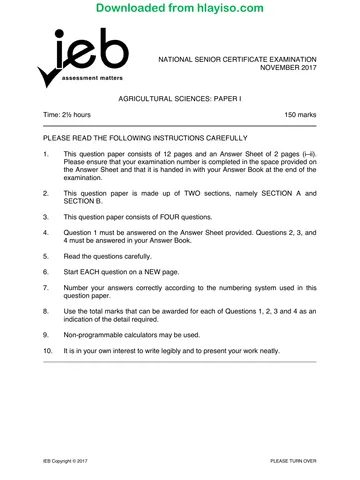
NATIONAL SENIOR CERTIFICATE EXAMINATION
NOVEMBER 2017
AGRICULTURAL SCIENCES: PAPER II
Time: 2½ hours 150 marks
PLEASE READ THE FOLLOWING INSTRUCTIONS CAREFULLY
1. This question paper consists of 12 pages and an Answer Sheet of 2 pages (i–ii).
Please ensure that your question paper is complete. Please ensure that your
examination number is completed in the space provided on the Answer Sheet and
that it is handed in with your Answer Book at the end of the exam session.
2. This question paper consists of TWO sections, namely SECTION A and
SECTION B.
3. This question paper consists of FOUR questions.
4. Question 1 must be answered on the Answer Sheet provided. Questions 2, 3, and
4 must be answered in your Answer Book.
5. Read the questions carefully.
6. Start EACH question on a NEW page.
7. Number your answers exactly as the questions are numbered in the question
paper.
8. Use the total marks that can be awarded for each of Questions 2, 3 and 4 as an
indication of the detail required.
9. Non-programmable calculators may be used.
10. It is in your own interest to write legibly and to present your work neatly.
IEB Copyright © 2017 PLEASE TURN OVER
Skip to contentQuestion paper 
View all
Agricultural Sciences Grade 12 IEB Paper 2 2017 Question Paper
IEB Grade 12 Agricultural Sciences Paper 2 question paper from the 2017, 12 pages. Read online or get the free PDF download, memo linked when available.
Publisher: IEB
Agricultural Sciences · Grade 12 · 2017. Question paper, 12 pages. Read online or download the PDF.
- Subject
- Agricultural Sciences
- Grade
- Grade 12
- Document type
- Question paper
- Year
- 2017
- Paper
- 2
- Publisher
- IEB
- Curriculum
- IEB
- Pages
- 12
- File size
- 685.0 KB
Loading document…
Loading document…
1 of 12
Document textSearch extracted text and jump to a page.
Downloaded from hlayiso.com
NATIONAL SENIOR CERTIFICATE: AGRICULTURAL SCIENCES: PAPER II Page 2 of 12
SECTION A
QUESTION 1
Answer the following questions on the Answer Sheet provided.
1.1 Various options are provided as possible answers to the following
questions. Choose the answer and make a cross (X) in the block (A–D)
next to the question number (1.1.1–1.1.10) on the attached Answer Sheet.
NO marks will be awarded if more than one cross (X) appears for the
answer.
EXAMPLE 1.1.11 A B C D
1.1.1 Using cultural values would be the most effective way for a maize
producer to increase the market for their produce. This can be done
by encouraging …
A a pig producer to use more maize meal for feed mixtures.
B rural and urban communities to eat more porridge made from
maize meal.
C vegetarians to eat more products made from maize.
D a dairy farmer to utilise more maize meal in their dairy rations.
1.1.2 One of the following is the first step in the development of the
strategic management plan.
A Setting goals and objectives
B Developing the vision
C Evaluation
D Developing the mission
1.1.3 When a red flower is crossed with a white flower and pink flowers are
produced, the genetic interaction seen is …
A co-dominance.
B complete dominance.
C incomplete dominance.
D None of the above.
1.1.4 A farm owner observing and counting cattle and recording the data
reflects the following management principle:
A Motivation
B Coordination
C Leadership
D Control
IEB Copyright © 2017
Downloaded from hlayiso.com
NATIONAL SENIOR CERTIFICATE: AGRICULTURAL SCIENCES: PAPER II Page 3 of 12
1.1.5 A farmer wants to grow a crop of chickpeas in a camp that has clay
soil and a problem with oats as a weed.
Rate (l/ha)
Crop Weeds Light Medium Heavy
soil soil soil
Amaranthus
Kikuyu
Chickpeas 1,5 1,7 2,0
Millet
Oats
What rate of herbicide should the farmer use?
A 1,5
B 1,7
C 2,0
D 1,2
1.1.6 A Black Angus farmer had, for the first time in the history of the stud,
a red calf born. Indicate the statement most relevant to the scenario.
A The farm can expect to have more red calves born in the
future.
B The neighbour's bull jumped the fence.
C This red calf is probably infertile.
D It is a genetic mutation and shouldn't happen again.
1.1.7 This is one way in which a farmer can decrease the risk factors that
will influence income.
A Pawning capital items
B Repairing capital items
C Insuring capital items
D Selling capital items
1.1.8 …. cause an individual to die or be badly deformed at birth.
A Polygenes
B Lethal genes
C Recessive genes
D Dominant genes
IEB Copyright © 2017 PLEASE TURN OVER
Downloaded from hlayiso.com
NATIONAL SENIOR CERTIFICATE: AGRICULTURAL SCIENCES: PAPER II Page 4 of 12
1.1.9 ONE of the following is NOT a form of capital:
A Product capital
B Working capital
C Fixed capital
D Movable capital
1.1.10 When crossing two double heterozygous individuals, the following is
the expected phenotypic ratio of the offspring:
A 1:2:1
B 9:3:3:1
C 1 : 2 : 1 : 2 : 4 : 2 : 1: 2 : 1
D 3:1
(20)
1.2 Choose a term/phrase from COLUMN B that matches a description in
COLUMN A. Write only the letter (A–J) next to the question number (1.2.1–
1.2.5) on the Answer Sheet provided, e.g. 1.2.6 K.
COLUMN A COLUMN B
1.2.1 A cross between two homozygous A. Land
individuals, which in a particular
characteristic, produce heterozygous B. Co-dominance
offspring similar to one of the parents.
C. Elasticity of supply
1.2.2 The place where consumers and
producers meet. D. Machinery
1.2.3 Medium term capital item. E. Over supply
1.2.4 A phenomenon that shows how the F. Market
quantity of produced goods responds to
a change in price at a market. G. Market equilibrium
1.2.5 A level in marketing where the amount H. Complete dominance
demanded and the amount produced
are equal. I. Surplus
J. Farmers' association (10)
IEB Copyright © 2017
Downloaded from hlayiso.com
NATIONAL SENIOR CERTIFICATE: AGRICULTURAL SCIENCES: PAPER II Page 5 of 12
1.3 Give ONE word/term/phrase for each of the following descriptions. Write
only the word/term/phrase next to the question number (1.3.1–1.3.5) on the
attached Answer Sheet.
1.3.1 A sterile hybrid produced by crossing two individuals from different
species.
1.3.2 A source of farm capital created by borrowing money from a financial
institution.
1.3.3 The process of attracting public attention to a specific agricultural
product or business through various forms of communication.
1.3.4 The management function that encourages farm workers to do their
best at all times.
1.3.5 The modification of the DNA resulting in a change in the sequence of
the genes.
(10)
1.4 Change the UNDERLINED WORD in each of the following statements to
make the statements TRUE. Write only the correct word(s) next to the
question number (1.4.1–1.4.5) on the attached Answer Sheet.
1.4.1 The business contract is an agreement to buy/sell a certain quantity
of a product at a given price at a predetermined date in the future.
1.4.2 Prepotency is the appearance in a population of a characteristic
determined by homozygous recessive gene.
1.4.3 In the stages of the marketing chain, accidents, theft and spoilage
could be regarded as processing.
1.4.4 Homozygous is the improved performance of offspring created when
breeding two individuals of different breeds.
1.4.5 Moveable capital refers to capital goods that are used for one
production season only, for example fuel, fertiliser and feeds.
(5)
45 marks
IEB Copyright © 2017 PLEASE TURN OVER
Downloaded from hlayiso.com
NATIONAL SENIOR CERTIFICATE: AGRICULTURAL SCIENCES: PAPER II Page 6 of 12
SECTION B
QUESTION 2 AGRICULTURAL MANAGEMENT AND MARKETING
Answer this question in your Answer Book.
2.1 The tables below represent the financial statements of two farmers involved
in egg production.
Farmer A:
Expenditure items/expenses (Rand) Income (Rand)
Cost price of layers 13 500 Eggs 25 200
Feed 11 500 Sale of layers 6 700
Electricity, water and wages 7 000 Sale of manure 5 400
Gas for heating 400
Egg trays 2 100
Veterinary care 1 200
Maintenance 800
(A) (B)
Farmer B:
Expenditure items/expenses (Rand) Income (Rand)
Cost price of layers 14 500 Eggs 28 200
Feed 10 500 Sale of layers 7 800
Electricity, water and wages 6 000
Gas for heating 400
Egg trays 2 500
Veterinary care 1 200
Maintenance 800
(C) (D)
2.1.1 Calculate the values of A, B, C and D. (4)
2.1.2 Identify the most profitable farmer and show all your calculations. (3)
2.1.3 Make THREE recommendations on how Farmer A could reduce his/
her costs. (3)
2.1.4 Describe TWO components of a cash-flow budget as it is presented
in the data of Farmer A and B above. (2)
IEB Copyright © 2017
Downloaded from hlayiso.com
NATIONAL SENIOR CERTIFICATE: AGRICULTURAL SCIENCES: PAPER II Page 7 of 12
2.2 The table below shows data of the average number of layers that are laying
eggs (%) in a farming district and data from actual averages of a number of
layers (%) that are laying eggs at a specific farm.
Layer age
21 22 23 25 26 28 31 32 40 48 60 65 70
(weeks)
Average % of
layers that are 5 10 18 52 65 84 94 88 83 77 73 70 70
laying eggs (%)
Actual farm
average % of
0 5 10 40 55 75 80 82 78 72 68 65 60
layers that are
laying eggs (%)
2.2.1 Using a line graph, plot the data in the table above. Put the age of
the birds on the X-axis. (6)
2.2.2 Indicate whether the farmer in this example is performing better or
worse than the district average. Give a reason from the data above
to support your answer. (2)
2.2.3 Let us assume the farmer in this example has 10 000 laying hens.
Calculate the number of eggs that will be produced during Week 32
of production. (3)
2.2.4 Assuming the farmer has 10 000 hens, calculate how much more
money the farmer could have produced each day of Week 31, had
the farm been producing at the same rate as the district average.
Work on an average egg price of R7,50 per dozen. (7)
2.3 List FIVE main items that should be included in a good business plan. (5)
[35]
QUESTION 3 PRODUCTION FACTORS
Start this question on a NEW page.
3.1 Agricultural management can be defined as a comprehensive activity, involving
the combination and coordination of human, physical and financial resources.
These factors are combined in a way which produces a commodity or a service,
which is both wanted and can be offered at a price which will be paid. This
process also includes making the working environment agreeable and
acceptable for those involved.
3.1.1 Identify FOUR main factors that need to be combined in the
management of a farm. (4)
3.1.2 State FOUR external influences that may affect the farm as a
business. (4)
3.1.3 Briefly describe FIVE economical characteristics of land. (5)
IEB Copyright © 2017 PLEASE TURN OVER
Downloaded from hlayiso.com
NATIONAL SENIOR CERTIFICATE: AGRICULTURAL SCIENCES: PAPER II Page 8 of 12
3.2 The advert below appeared in a newspaper under the heading: Vacancies/
Employment offered.
Farm manager and farm worker required for a progressive beef breeding farm
and feedlot (two posts vacant). Apply by sending your CV to the owner at
JoeBloggs@bloggsbeef.co.za. Competitive salaries and other benefits are
offered.
The owner compiled the following brief summaries of the CVs from
applicants:
Candidate A Candidate B
Computer literate, experience in 10 years' experience working with
export marketing, financial sheep, cattle, horses, poultry and
experience and has been a farm maize on different farms. Tractor
manager. Hard-working, self- operator and completed a basic
motivated with good organisational course on maintenance of farm
skills. Agricultural degree in equipment.
financial and business planning.
3.2.1 A panel was appointed to interview the candidates for each position.
The following grid was provided to evaluate all the candidates that
were selected for the interview. Evaluate EACH of the candidates
mentioned above using the following grid.
Adopt the following rating: 3 = good; 2 = fair; 1 = weak
Qualification Management Technical
Candidates
level skills skills
Candidate A
Candidate B (6)
3.2.2 Identify a candidate based on the evaluation in Question 3.2.1 that
would be most suitable for each of the following positions on the farm
and motivate for your choice in each case.
(a) Farm manager (2)
(b) Farm worker (2)
IEB Copyright © 2017
Downloaded from hlayiso.com
NATIONAL SENIOR CERTIFICATE: AGRICULTURAL SCIENCES: PAPER II Page 9 of 12
3.3 Refer to the income statement below to answer the questions that follow.
Farm income Rand Farm expenditure Rand
Beef sales 85 000 Electricity and water 10 200
Dry beans 15 000 Bank charges 1 440
Maize sales 34 050 Marketing costs 19 283
Feed 26 420
Seed and seedlings 1 980
Telephone 2 520
Rent paid 4 000
Contractor costs 1 500
Livestock purchased 7 500
Fertiliser and lime 12 370
Weedicides and pesticides 15 000
Hired transport 2 000
Labour costs (wages) 55 400
Fuel, oil and grease 29 376
Insurance and licenses 10 560
Repairs and fixed improvements 1 900
Other crop costs 297
Total income 134 050 Total expenditure 201 746
3.3.1 Overheads are general expenses and not related to one enterprise in
particular. Fixed costs do not vary with the level of production, but
variable costs are affected by the level of production.
Choose ONE example of each of the following cost items from the
table above and explain your choice:
(a) Overheads (2)
(b) Variable costs (2)
(c) Fixed costs (2)
3.3.2 The income statement shows that labour is the largest expense of
this farming enterprise. Suggest TWO ways to reduce this expense. (2)
3.4 State FOUR ways by which the farm manager can improve the living
conditions of the workers. (4)
[35]
IEB Copyright © 2017 PLEASE TURN OVER
Downloaded from hlayiso.com
NATIONAL SENIOR CERTIFICATE: AGRICULTURAL SCIENCES: PAPER II Page 10 of 12
QUESTION 4 BASIC AGRICULTURAL GENETICS
Start this question on a NEW page.
4.1 The plant breeder conducted research work with two Bt maize cultivars to
determine the lysine content of the seeds in the F1 generation. The gene (A) for
high lysine is dominant over the recessive gene (a) for low lysine content. The Bt
maize cultivar with heterozygous high lysine content (Aa) was cross-pollinated
with the Bt maize cultivar that had a low lysine content (aa) and the
F1 generation has 50% maize seeds with low lysine content.
4.1.1 Use the Punnett square to show the crossing of the two cultivars. (4)
4.1.2 Define the following genetic terms:
(a) Genotype (2)
(b) Phenotype (3)
(c) Recessive gene (2)
4.1.3 Apart from the lysine content mentioned above, name FOUR other
characteristics of genetically modified maize that would make the
plant hardier and better able to survive in harsh production
environments. (4)
IEB Copyright © 2017
Downloaded from hlayiso.com
NATIONAL SENIOR CERTIFICATE: AGRICULTURAL SCIENCES: PAPER II Page 11 of 12
4.2 The blue lily (Agapanthus africanus) is an annual and ornamental plant that
has two species that bear either blue (B) or white (b) flowers. The following
schematic representation shows the crossing from P1 to F2:
4.2.1 Identify the genotypes represented by labels (i) to (ix). (9)
4.2.2 Identify the genotypic ratio as a percentage of each genotype in the
F1 generation above. (2)
4.2.3 Determine the genotypic ratio as percentages of each genotype in
the F2 generation above. (3)
4.2.4 Indicate the percentage of white flowers in the F2 generation. (1)
IEB Copyright © 2017 PLEASE TURN OVER
Downloaded from hlayiso.com
NATIONAL SENIOR CERTIFICATE: AGRICULTURAL SCIENCES: PAPER II Page 12 of 12
4.3 Indigenous cattle breed of South Africa
The Nguni Innovation Project launched in 2004 in the different provinces will
reintroduce the Nguni cattle to emerging livestock farmers. These animals can
survive in our country because they are resistant to a number of diseases,
parasites and extreme heat conditions.
4.3.1 Deduce a reason from the passage above suggesting that Nguni
cattle are indigenous. (1)
4.3.2 Name FOUR qualities of Nguni cattle that make it possible for them
to survive in the climatic conditions of South Africa. (4)
[35]
105 marks
Total: 150 marks
IEB Copyright © 2017
Study this subject
Revise the topics in this paper, then practise them question by question.
- Grade 12 Agricultural Sciences notes
CAPS revision notes with worked examples.
- Agricultural Sciences questions by topic
Past exam questions sorted by CAPS topic, with memos where available.
- Grade 12 Agricultural Sciences quizzes
Short topic quizzes with instant feedback.
- All Grade 12 Agricultural Sciences past papers
Past papers by year, with memos where available.
- Grade 12 IEB past papers
More Agricultural Sciences and other subjects in this collection.
Recommended for this subject
More papers and memos for this grade and subject.
Question paperIEB
Agricultural Sciences Grade 12 IEB 2019 Question Paper
Question paperIEB
Agricultural Sciences Grade 12 IEB 2019 Question Paper (Afr)
Question paperIEB
Agricultural Sciences Grade 12 IEB 2018 Question Paper
Question paperIEB
Agricultural Sciences Grade 12 IEB 2018 Question Paper (Afr)
Question paperIEB
Agricultural Sciences Grade 12 IEB Paper 1 2017 Question Paper
Question paperIEB
Agricultural Sciences Grade 12 IEB P1 2017 Question Paper (Afr)
Related documents
Question paperIEB
Agricultural Sciences Grade 12 IEB P2 2017 Question Paper (Afr)
MemorandumIEB
Agricultural Sciences Grade 12 IEB Paper 2 2017 Memo
MemorandumIEB
Agricultural Sciences Grade 12 IEB Paper 2 2017 Memo (Afrikaans)
MemorandumIEB
Agricultural Sciences Grade 12 IEB Paper 1 2017 Memo
MemorandumIEB
Agricultural Sciences Grade 12 IEB Paper 1 2017 Memo (Afrikaans)
MemorandumIEB