
Downloaded from hlayiso.com
KZN — DEPT. OF EDUCATION
GREENBURY SECONDARY SCHOOL
FIRST CONTROL TEST - 2015
BUSINESS STUDIES — GRADE 11
EXAMINER : R NAIDOO MARKS : 100
MODERATOR : R GOVENDER DURATION : ihr
INSTRUCTIONS AND INFORMATION
1. This paper consists of _3_ printed pages.
2. There are 3 sections :
SECTION A : Compulsory
SECTION B : Consists of 3 questions. CHOOSE ANY TWO QUESTIONS.
SECTION C : ESSAY question. Consists of 2 questions. CHOOSE ANY ONE
QUESTION.
3. Use the SPECIAL ANSWER SHEET for Section A.
» SECTION A
QUESTION ONE : (20 marks)
1.1 State whether the following statements are TRUE or FALSE. If False,
correct the underlined word/s to make it true.
BRR eR
BPR PE
UO BRWNhNH
Trace Unions form part of the market environment.
The marketing function promotes a favourable image for the business.
The ANC and its Youth League can be referred to as an alliance.
A retailer of preserved foods falls under the secondary sector.
The annual increase in the general price level of goods and services is called
hedging.
1.2 Choose the correct word/s from those given in brackets. Write only
the correct word/s.
1.2.1
1.2.2
1.2.3
1.2.4
1.2.5
The (macro/market) environment consists of variables such as political,
economic, social,etc.
(Nhlanhla Nene/Lesetja Nkanyago) is the Minister of Finance.
People owning Grimm Brothers are called (partners/shareholders).
(Networking/Power relationships) involves groups and individuals who
exchange information and make contacts.
The commercial banks lending rates is called the (prime/repo) rate.
P.T.O/SECTION B....
Page 1 of3
Skip to content
View all

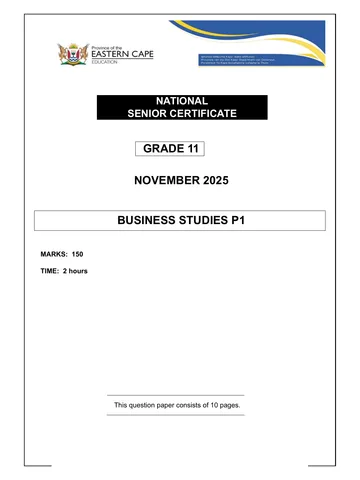
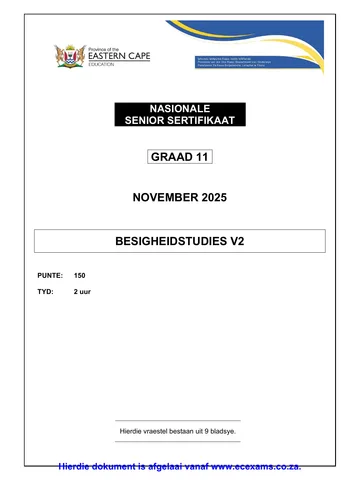

Business Studies Grade 11 March Test 2015 Paper & Memo
Grade 11 Business Studies question paper and memo from the March Test 2015, 6 pages. Read online or get the free PDF download.
Business Studies · Grade 11 · March Test · 2015. Question paper and memorandum, 6 pages. Read online or download the PDF.
- Subject
- Business Studies
- Grade
- Grade 11
- Document type
- Question paper and memo
- Year
- 2015
- Exam period
- March Test
- Curriculum
- CAPS
- Pages
- 6
- File size
- 300.3 KB
Free to read online, no sign-up needed
Loading document…
Loading document…
1 of 6
Document textSearch extracted text and jump to a page.
Downloaded from hlayiso.com
SECTION B
CHOOSE ANY TWO QUESTIONS FROM THIS SECTION
QUESTION TWO : (20 marks)
2.1 READ THE FOLLOWING STATEMENTS AND PLACE THEM IN THE CORRECT
ENVIRONMENT (MICRO; MARKET; MACRO)
2.1.1 Vodacom, MTN report to Competition Board
2.1.2 Government announces increase in petrol price.
2.1.3 New machinery improves quality.
2.1.4 HIV/Aids policies threaten labour force.
2.1.5 Cheap imports affect local factories. (5)
2.2 List the PORTERS Five Forces that business need to overcome in order to
succeed (10)
2.3 Identify the FIVE(5) challenges in the Micro Environment (5)
QUESTION THREE : (20 marks)
3.1 What is Intellectual Property? (2)
3.2 List and explain the THREE(3) Solutions to Piracy (6)
3.3 What is Dumping? (2)
3.4 What threat does Dumping pose to a business? (3)
3.5 Explain the basic procedure to be followed before a strike can take place? (4)
3.6 List any THREE(3) Role Players in labour relations (3)
QUESTION FOUR : (20 marks)
4.1 IDENTIFY THE SECTORS TO WHICH THE FOLLOWING ACTIVITES BELONG TO
(PRIMARY; SECONDARY; TERTIARY)
4.1.1 A doctor taking care of his patient
4.1.2 Diamond mining in Kimberley
4.1.3 Deep sea fishing
4.1.4 Yoghurt factory
4.1.5 A person selling DVD (5)
4.2 REDRAW AND COMPLETE THE TABLE
PARTNERSHIP CLOSE CORPORATION
NO, OF OWNERS
NAME ENDING
LIABILITY
CONTINUITY
SOEs core)
TAXATION
(10)
4.3 List FIVE(5) Disadvantages of a Sole Trader (5)
Page 2 of 3
Downloaded from hlayiso.com
SECTION C : ESSAY
CHOOSE ANY ONE QUESTION FROM THIS SECTION
QUESTION FIVE : (40 marks)
“Industrial disputes may lead to industrial action in the form of strikes, lockouts and
go-slows. Trade unions balance the power between employees and employers by
using collective bargaining.”
Discuss TRADE UNIONS under the following headings :
Definition of Trade Unions
History of Trade Unions
Role of Trade Unions
Functions of the Trade Unions (40)
QUESTION SIX : (40 marks)
“There are many socio-economic issues that impact on operations and productivity.”
Discuss the following socio-economic issues that affect business :
Inflation
Piracy
Sexual Harassment
Corruption
Mismanagement of funds
Illiteracy
Lack of Skills (40)
TOTAL = 100
GREENBURY SECONDARY SCHOO!
DEPARTMENT OF COMMERCE
H.0.0,-MR8 6 MAHARAJ
Page 3 of 3
Downloaded from hlayiso.com
- + Bus: OT. — Genii QUESTION THREE
SECTION A 3.1 INTELLce TUAL PROPERTY
QUESTION ONE ; . vee .
* Assets that are creations of the mine and recognised by law as having
La value and benefit to the creator, “/ 2
111 TRUE W/ 3.2 SOLUTIONS TO PIRACY
112 FALSE“PUBLIC RELATIONS
1i3 TRUE 7 1. Copyright /
* Protects the IP so that artistic creations and written, recorded or filmed
11.4 FALSET
4. LSE.YTERTIARY / ideas cannot be copied or pirated by others,
1.1.5 FALSE.“INFLATION /
£ 2. Patent vA
(eo) 1.2 i « Isacertificate that verifies that an invention is new or novel and is
(©) 121 MACRO WY protected from piracy. /
°
1.2.2 NHLANHLA NENE
{o) ; $y PARTNER Wd 3. Trademark J
n an ERS Ww * Isa sign, logo or graphic representation that is used to distinguish one
> 1.2.4 NETWORKING V/ . brand from another. — / 6
| 1.2.5 PRIME W/ ==
my) 3.3 DUMPING
<x * The act of flooding the market illegally with cheap goods, v/ z
20 GREENBURY SECONDARY SCHOGi
= | 20 HOD MRSC moet 3.4 Dumping is unethical because goods are sold at extremely low prices making
eeu it difficult for local manufacturers to compete. They will lose market
[o) a , share, The business may become redundant. My 3
Co. soe ay ee a
— SECTION B 3.5 PROCEDURE FOR STRIKE
xo} * CCMA will issue a certificate confirming that a dispute remains
0) 3 PESTION Two unresolved,
: A strike b i 30 days after th ‘tificate has been
re} Zit Marker V . A strl 2 may be organised only lays after the certific
¥; .
(4) 2412 Macro J e Union must provide 48 hours notice to the employer that they: intend to
ro) 213 Micro/Aacro strike, J
— 2.1.4 Macro a « Anemployer must also give 48 hours notice if they intend to lockout.
ng 215 Macro Vv
s 3.6 ROLE PLAYERS IN LABOUR RELATIONS
ro) 2.2 J « The state
* Power of suppliers ~/ © The employer /
QO * Powerof buyers WwW ® The employee 3
* Newentrants v/ * Trade Union
¢ Competitive rivalry V/
° Substitut vf io
ute products — QUESTION FOUR
4a
2.3
Difficult employees Vv
* Lack of vision and mission /
«Lack of management skilis “
* Unions J a 20
* Strikes and go-slows / —
441 Tertiary /
412 Primary /
4.1.3 Primary /
4.14 Secondary / 2
4.15 Tertiary /
F° 32
L- 2
evesrion ave: k- 2
S og A
z
Oo £0 VS
INTRODUCTION
e otrade unions are employee organisations thet balance the power between workers
2 bargaining.
ers rights, regoticre for worker's using collective
| disputes.
ion and represent workers: in industpi
is LY
and employers by using collectiv
+ Traditionally, unions protect wor
bargaining , organise industrial a¢
Boby
DEFINITION oF TRAE INIQNS
T rhe trade unions will cepresent the best interests of
negotiate working conditions, wage increases and esp
lective b: aay
GEES Gnd polact te rants of te wembers
1
members workers and will
ment contracts through
2. HES TORY OF TRADE UNEONS
> When many people started migrating to cities to Find work, and women and children
rst Trade unions were created, LP
also entered the workforce, the
The reason for this was shat these workers had very few s ‘1 ong yere abused and
exploited. . ta
= “Their working conditions were poor, with unsafe work ervieanmens, disease, long
4
hours and very little poy.
+ To protect themselves and
the very first union.
= They started to negotiate
yo gain mare power, workers joined cagyst employers in
for workers’ rights end minimum safety regulations.
ROLES OF TRADE UNIONS
juence labour relations. a.
® The main role of trede unions is teint
| the traditional role of trade unions ig to use collective barggiging Yo ensure fair
labour practices. y,
2 Unions also have an important po
+ They protect workers agains inflation by bergaining for annual increases.
aS
4, FUNCTZONS OF TRADE UNIONS
cease carer info collective bargaining agreements on behalf of employe
« Toadvise employers on their human resource po cies and practices. Z
«To formulate and represent workers rights a7 ‘statutory level Le
+ To promote greater participation of workers in management decisions. 4 _
© To organise strikes and offer industrial action Fo, strengthen the demangs of
: Za
utes and grievances with their employers.
their members and their children .
es."
workers.
eo” Te represent workers in disp
© To ensure the welfare and education of
CONCLUSION
mers own mespons]- af ;
o a earn
TNS OF SURES a5 ae
2. NAME ENDING No specific name endir i
io specific nama ending Must end with
3. LABILITY Unlimited Ligiited « ,
4. CONTINUITY Lacks continut v Has continuity
5. TAXATION Personal capacity Companys tx ie
4.3 DISDVANTAGES OF A SOLE TRADER
+ Lacks continuity 7
+ Lack of capital v
+ One person makes all de
° Cash flow is problem
\w
20
WESTION. SIX
ENTRODUCTION
+ The world + i i
oe wor today is more challenging as a business environment than ever bef:
@ reasons for ongoing change is social transformation. LL, “
BODY
1, INFLATION
* Inflation poses a chailenge to productivity because ni # ts of
lenge to productivity b.
“al ser | ' y because pease he costs of raw
= This puts pre
puis pressure on business to be more productive ih order to save costs. //
2. PIRACY
* Piracy occurs when the IP of g business is copied by someone else without
permission. if
2 This i igi
is causes a huge joss to the original owner and may cause damage to the vaiu
e
of the IP. “/
3. SEXUAL HARASSMENT
cer take the form of sexual comments, touching, ete ° 4 gender, &
Tr reduces employee motivation and causes strained relationships. 7”
4, CORRUPTION
* Occurs when two parties enter into an illegal but mutually beneficial agreement.”
+ Undermines the business practice and prevents fair competition, Z
. OS
5. MISMANAGEMENT OF FUNDS:
* Tris criminal offence which usually involves fraud. a
+ Causes a business to lose « large amount of money. JS
6. ILLITERACY
+ Means the inability to read and write G
* They find themselves in a pover f
hed employee poveriy trap because fey lack skill that will make
7. LACK OF SKILLS
TI .
: [ns probien in SA is not the lack of jobs, but rather the lack of ski 2
ack of skills slows down the development of new products, processes and
employees.
4
CONCLUSION
caapr te then. Dusngss needs to learn to
Study this subject
Recommended for this subject
Question paper and memo
Business Studies Grade 11 KZN June 2015 Paper & Memo
Question paper and memo
Business Studies Grade 11 KZN November 2015 Paper & Memo
Question paper and memo
Business Studies Grade 11 National June 2015 Paper & Memo
Question paper and memo
Business Studies Grade 11 National November 2015 QP & Memo
Question paper and memo
Business Studies Grade 11 September Test 2015 Paper & Memo
Question paper and memo
Business Studies Grade 11 March Test 2019 Paper & Memo
More from Grade 11 Business Studies
Question paper
Business Studies Grade 11 P1 November Mock Exam 2 2026 QP
Annual teaching plan
Gr 11 Bus Stu ATP 2023 24
Memorandum
Business Studies Grade 11 Eastern Cape November 2025 Memo
Question paper
Business Studies Grade 11 P1 Eastern Cape November 2025 QP
Question paper
Business Studies Grade 11 P2 Eastern Cape November 2025 QP
Memorandum