
Downloaded from hlayiso.com
NATIONAL
SENIOR CERTIFICATE
GRADE 12
DESIGN P1
(THEORY)
NOVEMBER 2015 (R)
MARKS: 100
TIME: 3 hours
This question paper consists of 13 pages.
This question paper must be printed in full colour.
Copyright reserved Please turn over
Skip to contentAll 2015 papers 
View all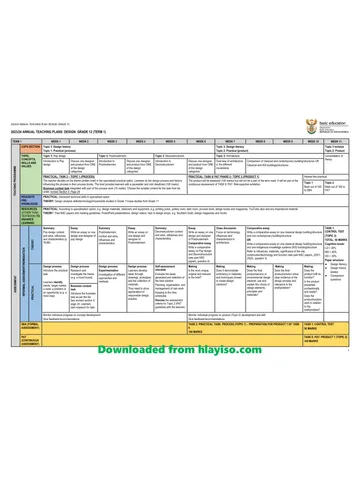
Design Grade 12 P1 NSC November 2015 Question Paper (Eng)
Grade 12 Design Paper 1 question paper from the NSC November Exam 2015 (English), 13 pages. Read online or download the free PDF.
Design · Grade 12 · NSC November Exam · 2015. Question paper, 13 pages. Read online or download the PDF.
- Subject
- Design
- Grade
- Grade 12
- Document type
- Question paper
- Year
- 2015
- Exam period
- NSC November Exam
- Paper
- 1
- Curriculum
- CAPS
- Pages
- 13
- File size
- 1.0 MB
Free to read online, no sign-up needed
Loading document…
Loading document…
1 of 13
This exam
NSC November Exam 2015
Questions in this paper
Document textSearch extracted text and jump to a page.
Downloaded from hlayiso.com
Design/P1 2 DBE/November 2015 (R)
NSC
INSTRUCTIONS AND INFORMATION
1. This question paper consists of SIX questions.
2. There are three choice questions in this question paper. Read the options
carefully.
3. This question paper consists of THREE sections:
SECTION A: Design literacy (30 marks)
QUESTIONS 1 to 3
SECTION B: Design history (30 marks)
QUESTION 4
SECTION C: Design in a sociocultural/environmental and sustainable context
(40 marks)
QUESTIONS 5 and 6
4. Read the requirements of each question carefully.
5. Answer in full sentences and avoid the listing of facts.
6. Use the mark allocation to determine the time to be spent on each question.
7. Do NOT repeat the same facts and examples in different questions.
8. Write neatly and legibly.
Copyright reserved Please turn over
Downloaded from hlayiso.com
Design/P1 3 DBE/November 2015 (R)
NSC
KEEP THIS PAGE BLANK.
Copyright reserved Please turn over
Downloaded from hlayiso.com
Design/P1 4 DBE/November 2015 (R)
NSC
SECTION A: DESIGN LITERACY
QUESTION 1: 'UNSEEN' EXAMPLES
ANSWER EITHER QUESTION 1.1 OR QUESTION 1.2.
1.1
FIGURE A: Shweshwe-inspired fabric,
designer unknown (Eastern Cape), 2012.
1.1.1 Discuss the use of the following elements and principles of design
in relation to the product in FIGURE A above:
• Movement
• Tone
• Two-dimensional form
• Contrast (8)
1.1.2 How does the design in FIGURE A highlight African aesthetics? (2)
[10]
OR
Copyright reserved Please turn over
Downloaded from hlayiso.com
Design/P1 5 DBE/November 2015 (R)
NSC
1.2
FIGURE B: Bench by John Vogel (Woodstock, South Africa), 2012.
1.2.1 Discuss the use of the following elements of design in relation to
FIGURE B above:
• Colour
• Texture (4)
1.2.2 Define the following terms with regard to FIGURE B:
• Biomimicry
• Ethnic eclectic
• Ergonomics (6)
[10]
Copyright reserved Please turn over
Downloaded from hlayiso.com
Design/P1 6 DBE/November 2015 (R)
NSC
QUESTION 2: COMMUNICATION THROUGH DESIGN
2.1
FIGURE A: Nelson Mandela by Carlos Andrade (Venezuela), 2013.
2.1.1 Identify TWO symbols seen in FIGURE A above and explain how
they communicate the message of the poster. (4)
2.1.2 Discuss whether the concept of stereotypes applies to the poster in
FIGURE A. Substantiate your answer. (2)
Copyright reserved Please turn over
Downloaded from hlayiso.com
Design/P1 7 DBE/November 2015 (R)
NSC
2.2
FIGURE B: Against the Ideas of Racism by LM Design (Slovenia), 2011.
Discuss how the designer has manipulated the typography and imagery of the
poster in FIGURE B to communicate its message effectively. (4)
[10]
Copyright reserved Please turn over
Downloaded from hlayiso.com
Design/P1 8 DBE/November 2015 (R)
NSC
QUESTION 3
ANSWER EITHER QUESTION 3.1 OR QUESTION 3.2.
3.1 Refer to FIGURE A and FIGURE B below and answer the question that
follows.
FIGURE A: Zulu Hat (Isicholo) by FIGURE B: Top Hat by Modeste
Earth Africa Curio (South Africa), 2012. Clothing (USA), 2012.
Hats are designed for different purposes in different parts of the world.
Compare the two designs above, using the following as guidelines:
• Proportion
• Colour
• Two-dimensional form
• Context/Purpose
• Materials [10]
OR
Copyright reserved Please turn over
Downloaded from hlayiso.com
Design/P1 9 DBE/November 2015 (R)
NSC
3.2
FIGURE C: Mapungubwe Interpretation Centre by
Peter Rich Architects (South Africa), 2009.
The contemporary building in FIGURE C celebrates the lost Mapungubwe
civilisation that flourished in Limpopo between 1200 and 1300 CE. This
building provides information on Mapungubwe and preserves artefacts from
its ancient history. A 600-year-old vault system was used to build this complex
arrangement of domes. This system was used before the development of the
steel frame structure and reinforced concrete.
Write an essay (at least 200–250 words or ONE full page) in which you
compare the contemporary Mapungubwe Interpretation Centre in FIGURE C
above with ANY Classical building you have studied.
Use the following as guidelines for your essay:
• Use of materials and building techniques
• Function
• Use of two-dimensional form and space
• Relation to the site [10]
TOTAL SECTION A: 30
Copyright reserved Please turn over
Downloaded from hlayiso.com
Design/P1 10 DBE/November 2015 (R)
NSC
SECTION B: DESIGN HISTORY
QUESTION 4
4.1 JJ Winkleman, in commenting on one design style, said: 'Unity and
simplicity are the two sources of beauty …'
Write an essay in which you discuss how ONE design style/movement/period
represents the above quote AND how ONE other design style/movement/
period opposes the quote. Refer to the characteristics and influences of both
to support your statements. Refer to at least ONE work and ONE designer of
each.
Choose from the design styles/movements/periods below:
Ancient Greece; Ancient Rome; Gothic; Renaissance; Baroque; Rococo;
Neo-Classical design; Victorian design; Arts and Crafts Movement;
Art Nouveau; De Stijl; Bauhaus; Art Deco; Scandinavian design;
Postmodernism; digital design (20)
4.2
FIGURE A: Paper Dress Show by Sandi FIGURE B: i-D magazine cover by
Vincent (USA), 1967. (Modernism) Terry Jones (USA), 1980.
(Deconstructivism)
Write an essay (at least 200–250 words or ONE full page) in which you
compare the characteristics and influences of Deconstructivism and
Modernism by referring to the designs in FIGURE A and FIGURE B above. (10)
TOTAL SECTION B: 30
Copyright reserved Please turn over
Downloaded from hlayiso.com
Design/P1 11 DBE/November 2015 (R)
NSC
SECTION C: DESIGN IN A SOCIOCULTURAL/ENVIRONMENTAL AND SUSTAINABLE
CONTEXT
QUESTION 5
ANSWER EITHER QUESTION 5.1 OR QUESTION 5.2.
5.1
FIGURE A: LittleSun by Olafur Eliasson (Germany), 2011.
This small, solar-powered lamp is designed to replace kerosene-burning
lanterns. These solar-powered lamps are cheaper, brighter and safer than
kerosene-burning lanterns.
5.1.1 Write a paragraph in which you discuss the differences between
socially responsible and socially irresponsible design. Refer to the
above design (FIGURE A) to motivate your statements. (6)
5.1.2 Write an essay (at least 200–250 words or ONE full page) in which
you discuss and briefly compare the work of ONE contemporary
socially responsible South African designer/design group with ONE
contemporary socially responsible international designer/design
group you have studied. Your discussion must also include a brief
description of ONE design by each designer/design group.
You may NOT refer to any designer(s)/design group(s) that you
have discussed previously or designer(s)/design group(s) referred
(14)
to in this question paper.
[20]
OR
Copyright reserved Please turn over
Downloaded from hlayiso.com
Design/P1 12 DBE/November 2015 (R)
NSC
5.2
FIGURE B: Beaded stools by Riaan Hanekom
(South Africa), 2012.
5.2.1 Do you think the design product in FIGURE B above is craft or
design, or both? Give reasons for your answer. (2)
5.2.2 Discuss any ONE traditional craft you have studied this year.
In your discussion, refer to the following:
• Materials, methods and processes
• Functions
• A description of ONE example, as well as the name of the
indigenous cultural community that produced it (8)
5.2.3 Discuss ONE contemporary South African or African
designer/design group whose work reflects the influence of
traditional techniques and/or materials.
Consider the following in your discussion (at least 200–250 words
or ONE full page):
• The name of the designer/design group and one or more of
his/her/their works.
• A discussion of his/her/their aims and works, explaining how the
use of traditional materials and techniques is reflected in the
work.
• The relevance of the application of traditional materials and
techniques to contemporary design.
You may NOT refer to any designer(s)/design group(s) that you
have discussed previously or designer(s)/design group(s) referred
to in this question paper. (10)
[20]
Copyright reserved Please turn over
Downloaded from hlayiso.com
Design/P1 13 DBE/November 2015 (R)
NSC
QUESTION 6
FIGURE A: Rhino horn campaign, courtesy of WWF,
designer unknown, 2012.
6.1 Describe and discuss how the imagery and colour in FIGURE A are used to
convey its message effectively. (4)
6.2 Discuss the work of ONE contemporary South African designer/design group
and ONE contemporary international designer/design group whose work
upholds the ideals of environmental/sustainable design.
Refer to the following in your discussion:
• Name of designer/design group
• Name and describe ONE example of work by each designer/design group.
• Discuss which environmental issue is addressed through the work and
how this is conveyed.
You may NOT refer to any designer(s)/design group(s) that you have
discussed previously or designer(s)/design group(s) referred to in this
question paper. (16)
[20]
TOTAL SECTION C: 40
GRAND TOTAL: 100
Copyright reserved
Study this subject
Recommended for this subject
Question paper
Design Grade 12 P1 NSC November 2015 Question Paper (Afr)
Memorandum
Design Grade 12 Paper 1 NSC November 2015 Memo (English)
Memorandum
Design Grade 12 Paper 1 NSC November 2015 Memo (Afrikaans)
Question paper
Design Grade 12 P1 Eastern Cape Mock 2015 QP (Eng)
Question paper
Design Grade 12 P1 Eastern Cape Mock 2015 QP (Afr)
Question paper
Design Grade 12 P1 NSC Supplementary 2015 QP (Afr)
More from Grade 12 Design
Annual teaching plan
Gr 12 Des ATP 2023 24
Memorandum
Design Grade 12 Paper 1 NSC June 2025 Memo (Afrikaans)
Memorandum
Design Grade 12 Paper 1 NSC November 2025 Memo (English)
Memorandum
Design Grade 12 Paper 1 NSC November 2025 Memo (Afrikaans)
Memorandum
Design Grade 12 Paper 1 NSC November 2025 Memo (Afrikaans)
Question paper