
Downloaded from hlayiso.com
DESIGN
GUIDELINES FOR
PRACTICAL ASSESSMENT TASKS
2016
These guidelines consist of 20 pages and a 1-page annexure.
Copyright reserved Please turn over
Skip to contentPractical assessment task 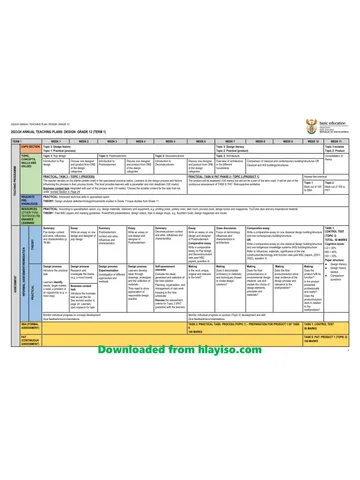
View all
Design PAT GR 12 2016 Eng
Grade 12 Design practical assessment task from the 2016 (English), 21 pages. Read online or get the free PDF download.
Design · Grade 12 · 2016 · English. Practical assessment task, 21 pages. Read online or download the PDF.
- Subject
- Design
- Grade
- Grade 12
- Language
- English
- Document type
- Practical assessment task
- Year
- 2016
- Curriculum
- CAPS
- Pages
- 21
- File size
- 1.8 MB
Loading document…
Loading document…
1 of 21
Document textSearch extracted text and jump to a page.
Downloaded from hlayiso.com
Design 2 DBE/PAT 2016
NSC
TABLE OF CONTENTS
1. INTRODUCTION 3
2. TEACHER GUIDELINES 3
2.1 How to administer PATs 3
2.2 Assessing the PATs 11
2.3 Moderation of PATs 13
2.4 Declaration of authenticity 15
3. LEARNER GUIDELINES 15
3.1 Instructions to the learner 15
3.2 Tasks 15
3.3 Assessment/Moderation rubrics/tools 19
3.4 Requirements for presentation 19
3.5 Timeframes 19
3.6 Absence/Non-submission of tasks 19
3.7 Declaration of authenticity 19
4. LIST OF RESOURCES 20
5. CONCLUSION 20
ANNEXURE A: Declaration of authenticity
ACRONYMS
CAPS Curriculum and Assessment Policy Statement
FET Further Education and Training
NCS National Curriculum Statement
NSC National Senior Certificate
PAT Practical Assessment Task
POA Programme of Assessment
SBA School-based Assessment
Copyright reserved Please turn over
Downloaded from hlayiso.com
Design 3 DBE/PAT 2016
NSC
1. INTRODUCTION
The 16 Curriculum and Assessment Policy Statement subjects which contain
a practical component all include a practical assessment task (PAT). These
subjects are:
• AGRICULTURE: Agricultural Management Practices, Agricultural
Technology
• ARTS: Dance Studies, Design, Dramatic Arts, Music,
Visual Arts
• SCIENCES: Computer Applications Technology, Information
Technology
• SERVICES: Consumer Studies, Hospitality Studies, Tourism
• TECHNOLOGY: Civil Technology, Electrical Technology,
Mechanical Technology and Engineering Graphics
and Design
A practical assessment task (PAT) mark is a compulsory component of the
final promotion mark for all candidates offering subjects that have a practical
component and counts 25% (100 marks) of the end-of-year examination
mark. The PAT is implemented across the first three terms of the school year.
This is broken down into different phases or a series of smaller activities that
make up the PAT. The PAT allows for learners to be assessed on a regular
basis during the school year and it also allows for the assessment of skills
that cannot be assessed in a written format, e.g. test or examination. It is
therefore important that schools ensure that all learners complete the practical
assessment tasks within the stipulated period to ensure that learners are
resulted at the end of the school year. The planning and execution of the PAT
differs from subject to subject. The PATs for Design will be showcased into a
cohesive body of work that is seen in the context of an exhibition
environment. This Retrospective Exhibition therefore reflects the final PAT
assessment for each learner in the country.
2. TEACHER GUIDELINES
2.1 How to administer PATs
• Design teachers will set their own practical assessment tasks. The
creative nature of Design encourages teachers to develop themes
relevant to their specific contexts. These themes will then determine
specific briefs to be completed by the learners for each PAT.
• Teachers must design THREE separate practical assessment tasks
that are undertaken during the academic year (terms 1 to 3). The trial
examination practical will be the task for term 3.
• Each task should include both Topic 1 (process) and Topic 2 (the
making of the product).
• Marks for each PAT should be allocated as follows:
Topic 1: The process (50 marks)
Topic 2: The product (50 marks)
Copyright reserved Please turn over
Downloaded from hlayiso.com
Design 4 DBE/PAT 2016
NSC
• Choosing themes for the PATs:
Teachers should choose themes to guide their briefs (e.g. if the
theme is 'Improved Living' a brief could focus on finding a variety
of solutions to improve living).
You may develop your own themes and/or choose them from the
approved textbooks.
You may decide on a broad theme for the annual practical work
and then sub-divide them into specific briefs, one per term. This
will result in a more coherent body of work in the retrospective
exhibition.
• You should ensure that at least 60% of each PAT is done in class
under your supervision as you have to authenticate the work as the
learner's own. If you cannot authenticate the work it should NOT be
marked.
• The PATs should be set in accordance with the context of the school.
Teachers should give specific instructions in the brief to set the
requirements for the PAT.
All PATs should run concurrently with the term's prescribed 'Design in a
Business Context' research modules (terms 1 and 2).
Summary of the year's practical tasks:
TERM 1 TERM 2 TERM 3 TERM 4
PAT 1 PAT 2 TRIAL PRACTICAL RETROSPECTIVE EXHIBITION:
EXAMINATION • PATs 1 and 2
• Trial examination practical
• ONE best Grade 11 work
• TWO Business Context research
modules*
AND
PAPER 2 (FINAL PRACTICAL EXAM)
*TERM 1: Design in a business context as part of Topic 1
The focus in the first term is on a basic understanding of the marketing of design
products aimed at a specific target market through the use of packaging and
advertising as marketing tools.
*TERM 2: Design in a business context as part of Topic 1
The focus in the second term is on career opportunities within the design discipline:
Range, scope, training needed and training available and how to apply for a job.
Research or study any ONE award-winning South African designer/design
agency/creative director. It would be beneficial if this relates to the career discipline
that has been researched.
Both of the research tasks above should be presented in the form of a comprehensive
and formally structured assignment or activity that shows evidence of thorough and
coherent planning and referencing skills.
Copyright reserved Please turn over
Downloaded from hlayiso.com
Design 5 DBE/PAT 2016
NSC
RETROSPECTIVE EXHIBITION
This exhibition shows substantial evidence of the learner's design skills and knowledge
developed over a period of time. It showcases the learner's practical design
development in presenting a cohesive body of work as seen in a retrospective
exhibition.
The exhibition is very similar to a designer's pitch when presenting his/her work to
prospective clients. This exhibition should therefore be well planned in terms of its
concept and presentation. The Retrospective Exhibition showcases further
development of the PATs into a cohesive body of work that is seen in the context of an
exhibition environment.
An example of a retrospective exhibition assessment rubric is provided on page 14.
The table below is a checklist for the contents of PAT 1 and PAT 2.
TOPIC 1:
MARKS
DESIGN PROCESS DESCRIPTION
(50)
(sourcebook)
Expression of intention and Brainstorm or do a mind map of ideas to
rationale/concept explore the theme and the intention of
the brief. Develop a concept. A rationale 10
should be provided to validate the
design solution found.
Evidence of research, Research the brief and find relevant
experimentation and reflection source materials (visual references).
Show evidence of research by
completing a few thumbnail sketches of
ideas. Design a few different solutions
10
that explore the brief. Evidence of
experimentation, e.g. a mood board
should be visible. Exploration of different
materials and techniques should be
encouraged.
Evidence of detailed planning, Generative drawings should explore a
drawing skills and presentation variety of solutions to the brief (different
techniques and materials). Drawing
10
skills development should be evident.
This process should be creatively
presented.
Evidence of final drawing/ Show evidence of the final design
collage/maquette related to the solution in the form of a detailed,
10
final concept annotated drawing/collage/maquette/
prototype, etc.
Research: Design in a business PAT 1: Basic understanding of
context marketing design products aimed at a
specific target market through the use of
packaging and advertising as marketing
10
tools.
PAT 2: Career opportunities within the
design discipline: Range, scope, training
needed and training available.
Copyright reserved Please turn over
Downloaded from hlayiso.com
Design 6 DBE/PAT 2016
NSC
TOPIC 2: DESCRIPTION MARKS
DESIGN PRODUCT (50)
Creativity/Originality/Interpretation Is the work unique, original and
10
relevant to the brief?
Evidence of design involvement Overall impression. How have the
elements and principles been used to 10
create a unique design solution?
Technique/Craftsmanship/Method How technically competent is the final
product? Is the craftsmanship 10
adequate and professional?
Time management Evidence of and utilisation of available
time to complete the product.
Does the design product show 10
legitimate involvement in the making
of the design product?
Professional presentation and Does the product fulfill its function?
functionality Is the product presented
professionally and neatly? Does the 10
product solution work in relation to
the brief?
Due date(s) should be advised by the teacher.
Copyright reserved Please turn over
Downloaded from hlayiso.com
Design 7 DBE/PAT 2016
NSC
A few ideas and approaches to guide the development of the PATs
Successful designs are created when learners
play with ideas and generate different approaches
responding to purposeful tasks, in imaginative,
unique and personal ways.
The Design teacher should guide the creative process from start to finish.
How to choose a theme:
Teachers are advised to choose themes relevant to the context of the learners and the
time in which we live. The theme should be carefully considered in order to ensure that
the learners are not disadvantaged in any way. The theme will then determine the
requirements of the brief.
How to set a brief:
A brief should outline the following:
• Identify a problem/need/opportunity that offers the learner an opportunity to create
an aesthetical pleasing functional design solution
• Stipulate the format, medium/material, technique specifications
• Request or specify possible target market(s)
• Specify deadline(s) clearly
TIP
Although learners should receive a written brief, it is sometimes a good idea to give the
brief just before making the final product.
Topic 1 would then consist of a series of 'building blocks' given at consecutive times to
ensure experimentation and the development of the process. With careful planning the
teacher will know where these 'building blocks' will lead the learners. Learners might
not know where it is leading to, creating constant aspects of surprise. It also combats
the tendency that learners get stuck on a first idea, without really experimenting and
researching other possibilities. Furthermore the process or workbook will be almost
completed before the making of the final product.
Copyright reserved Please turn over
Downloaded from hlayiso.com
Design 8 DBE/PAT 2016
NSC
TOPIC 1 – Sourcebook guidelines for the teacher
Brainstorming, selection and evaluation of ideas:
• Help the learner to find his/her own creative voice during the design process.
• Learners should start by noting or illustrating all possible ideas, activities, issues,
etc. relating to the theme, i.e. in a mind map, photo journal, collage, etc.
• It is important to emphasise that the purpose of almost any design is to add value
to life and the world we find ourselves in.
• While learners are gathering ideas, try to lead their thought processes to those that
are personal, unusual, innovative and challenging and fills them with passion. Try
to lead them to individual and innovative approaches.
• When evaluating ideas with the learner, eliminate ideas that are 'kitsch' (e.g. the
obviously borrowed ideas like a 'flower lamp'), insincere (e.g. world peace poster)
or overtly pretty and lacking in substance or function (e.g. a glitter book cover).
• Encourage learners to source quality imagery. Discourage the use of already
existing photographs and designs. It is preferable to explore a topic first-hand (use
own photographs or direct observational drawings) as many images taken from the
Internet are generic and of poor quality.
• Help them to develop as effective, independent learners and as critical, reflective
thinkers with enquiring minds.
• Ensure the extensive use of drawing to express perception and innovation, to
communicate ideas in a skilled way.
How to generate ideas:
Drawing mind maps
A mind map is a good tool for coming up with ideas that are connected to a central
theme. The end result of mapping should be a web-like structure of words and ideas or
even images.
A few quick guidelines
• Start by placing the theme in
the middle of the page (write
the word and/or draw an
image of it)
• Draw at least four thick
organic looking branches
radiating outwards from the
central keyword/image, etc.
Different colours can be used
to represent each branch.
• Draw additional branches that extend from the main branches. The words on these
branches are sub-topics of the words you wrote on the main branches.
• Keep expanding the mind map outwards with additional sub-topics/keywords and
branches.
Useful website: http://blog.iqmatrix.com/how-to-mind-map
Copyright reserved Please turn over
Downloaded from hlayiso.com
Design 9 DBE/PAT 2016
NSC
Example of a mind map:
Theme: Movement
• Moving versus stagnancy
• Moving from A to B
• Walking, running, crawling, driving
• Slow versus fast
• Symbols depicting movement
• Movement in culture/tradition
• Movement in time
• Movement as optical illusion
• Real versus optical
• Process as movement
• Textures in movement
• Line in movement
• Shapes and forms
• Colour
• Metaphors
Below are examples of a few activities that will help learners to generate ideas
and develop 'building blocks' using the theme of movement before handing out
the brief.
• Experiment with movable objects/designs.
• These experiments can be placed in the sourcebook and might trigger ideas for the
final work.
• Give learners 10 minutes to collect 10 images from magazines that depict
movement. Hand out photocopies of additional examples. Using all the images
learners should make a collage in approximately 20 minutes. This exercise should
be done before handing out the brief, as they will then work more freely. After they
have received the brief, they can go back to these collages to see if they can use
some of it. This is a way to create interesting juxtapositions.
• Play word games using a thesaurus to take them on a journey of synonyms that
open up new possibilities for inspiration, e.g. action, advance, evolution, flow,
progression, transit, etc.
• Ask learners to do drawings of different forms of movement based on some of the
examples above. These could address issues such as the carbon footprint or they
could just be interesting surrealistic juxtapositions.
Copyright reserved Please turn over
Downloaded from hlayiso.com
Design 10 DBE/PAT 2016
NSC
Experimentation:
• Guide learners to experiment with media and processes, to produce trial examples,
prototypes, and mood boards or colour charts.
• Exploring should be purposeful and relevant to the design solution.
Drawing skills
The development of drawing skills should be
evident. A variety of solutions to the brief
should be explored through the use of
drawings (thumbnails, idea/conceptual,
technical/construction and observation).
During the course of the year this exploratory
process should reflect the use of different
drawing materials (e.g. erasers, pens, ink,
bleach, string, wire, etc.) and a wide range of
drawing techniques (e.g. stippling, hatching,
doodling, scribbling, tonal drawing) and styles
(naturalistic, expressive, gestural) should be
explored. This process should be creatively
presented and annotated.
Copyright reserved Please turn over
Downloaded from hlayiso.com
Design 11 DBE/PAT 2016
NSC
2.2 Assessing the PATs
Assessment criteria for PAT 1 (term 1) and PAT 2 (term 2)
TOPIC 1: SOURCEBOOK/WORKBOOK
CRITERIA
Expression of intention and rationale/concept 10
Evidence of research, experimentation and reflection 10
Evidence of detailed planning, drawing skills and presentation 10
Evidence of final drawing/collage/maquette related to the final concept 10
Research: Design in a business context 10
TOTAL 50
TOPIC 2: THE PRODUCT/PRACTICAL
CRITERIA
Creativity/Originality/Interpretation in terms of the concept and solutions 10
relevant to the brief
Evidence of design involvement: The appropriate use of design elements 10
and principles
Technique/Craftsmanship/Method 10
Completion of work/time management/evidence of full utilisation of 10
available time
Professional presentation and functionality of the design solution 10
TOTAL 50
COMBINED TOTAL OF TOPIC 1 AND TOPIC 2 100
ASSESSMENT CRITERIA FOR TRIAL EXAMINATION PRACTICAL: (To be completed
during term 3)
TOPIC 1: SOURCEBOOK/WORKBOOK
CRITERIA
Expression of intention and rationale 10
Evidence of research, experimentation and reflection 10
Evidence of detailed planning and presentation related to the final concept 30
TOTAL 50
TOPIC 2: THE PRODUCT/PRACTICAL
CRITERIA
Creativity/Originality/Interpretation in terms of the concept and solutions 10
that are relevant to the brief
Evidence of design involvement: the appropriate use of design elements 10
and principles
Technique/Craftsmanship/Method 10
The design solution must show evidence of at least 12 hours of work under 10
controlled circumstances
Professional presentation and functionality of the design solution 10
TOTAL 50
COMBINED TOTAL OF TOPIC 1 AND TOPIC 2 100
Copyright reserved Please turn over
Downloaded from hlayiso.com
Design 12 DBE/PAT 2016
NSC
This taxonomy should be used in conjunction with the assessment criteria for
PAT 1 (term 1) and PAT 2 (term 2) shown on page 10.
COGNITIVE LEVEL DESCRIPTORS FOR PRACTICAL PROJECTS
An example:
WILLIAMS' TAXONOMY: WILLIAMS' TAXONOMY:
COGNITIVE (THINKING) AFFECTIVE (FEELING)
Fluency Flexibility Originality Elaboration Risk-taking Complexity Curiosity Imagination
(the generation (the generation (the generation (the expansion, (experiment- (the ability to (the ability to (the ability to
of ideas, of alternatives of new, unique enlargement, ing, trying new create wonder, build mental
answers, and variations, and novel enrichment or challenges) structure out of ponder, pictures,
responses, adaptations, responses/ embellishment chaos, to bring contemplate or visualise
possibilities to different ideas/ solutions) of ideas to logical order to puzzle) possibilities
a given solutions/ make it easier a given and new things
situation/ options) for others to situation and/or or reach
problem) understand or to see the beyond
make it more missing parts) practical limits)
interesting)
The learner The learner The learner The learner The learner The learner The learner The learner
generated was able to generated took the idea(s) tried new ideas was able to fill looked at was able to
many ideas adapt and creative much further, through risky in the missing various options visualise
and many consider solutions adding enough experiment- parts to make and put in a lot possible
possible alternative detail for other ation up a complete of thought solutions, even
solutions to the solutions or people to solution if not
problem/brief options understand it practically
implementable
Descriptors for the assessment criteria for TOPICS 1 and 2
Outstanding 90–100 Exceptional ability; richness; insightful; fluent; high skill; observation and knowledge
powerfully expressed; supported by an original or unusual process and design solution.
Outstanding and original presentation of the process and the product.
Excellent 80–89 Striking impact; most of the above; detailed; well organised and coherent; polished;
skill evident; supported by an original/unusual/relevant design process and solution;
presentation original and considered. Some minor flaws evident.
Very good 70–79 Well-organised, as above, but lacks the impact; good level of competence and selection
of content; supported by a relevant design process and solution; obvious care and effort
taken with original presentation. Some obvious inconsistencies/ flaws evident.
Good 60–69 Interesting presentation; clear intent; convincing; simple direct use of chosen medium;
displays understanding but tends towards the pedestrian and stereotyped response at
times; adequate design process and solution; reasonable effort taken with presentation.
Distracting/Obvious inconsistencies.
Average 50–59 Adequate; feels mechanical; derivative or copied; little insight; unimaginative; design
process and solution not always clearly identified; fair presentation. Many distracting
inconsistencies.
Below average 40–49 Enough work to pass; not logically constructed: some flashes of insight; limited selection
of information; poor technical skills might be a contributing factor; no real design
process and solution; clumsy or careless presentation. In need of support/motivation
to pass.
Weak 30–39 Visually uninteresting; uncreative; limited/poor technical skill used; little attempt to
present information in an acceptable manner; little or no design process and solution;
general lack of commitment. In need of support/motivation to pass.
Very weak 20–29 Very little information or irrelevant work/design process and solution. No effort
Fail made to present work in an acceptable manner. General lack of commitment and
technical skill.
Unacceptable 0–19 Incoherent; irrelevant, very little or no work; lack of even limited skills being applied.
Fail No commitment and technical skill.
Copyright reserved Please turn over
Downloaded from hlayiso.com
Design 13 DBE/PAT 2016
NSC
2.3 Moderation of PATs
This moderation tool is strictly for the purpose of moderation. The PATs
should be both internally and externally moderated. Schools will be notified
by the provinces concerning date, time and venue for the external
moderation of PATs and examination work.
A possible moderation tool for Design PATs
Subject: DESIGN Date: ____________
1. THE PAT BRIEF √ OR x
Clear instructions of what is expected, relevant to the specific grade
Visual inspiration
The brief provides for the development of/gives the opportunity for the following:
• Fluency (the generation of ideas, answers, responses, possibilities for a given
situation/problem)
• Flexibility (the generation of alternatives, variations, adaptations, different
ideas/solutions/options)
• Originality (the generation of new, unique and novel responses/solutions)
• Elaboration (the expansion, enlargement, enrichment or embellishment of
ideas to make it easier for others to understand or to make it more interesting)
• Risk-taking (experimenting, trying new challenges)
• Complexity (the ability to create structure out of chaos, to bring logical order to
a given situation and/or to see the missing parts)
• Curiosity (the ability to wonder, ponder, contemplate or puzzle)
• Imagination (the ability to build mental pictures, visualise possibilities and new
things or to reach beyond practical limits)
Clear assessment criteria
Due date(s) and time management
2. ASSESSMENT OF PATS
Relevant to the specific grade, in line with standard of province, i.e. realistic marking
Use of assessment criteria
50 marks for sourcebook including assessment of the following:
• Intention and rationale of the brief (for example in the form of a mind map,
visual presentation, etc.)
• Evidence of research, experimentation and reflection (for example thumb-nail
sketches, mood boards, etc.)
• Evidence of detailed planning, drawing skills and presentation relevant to the
design brief
• Evidence of final drawing/collage/maquette related to the final concept
• The Design in a Business Context research modules
50 marks for product(s) including assessment of the following:
• Creativity/Originality/Interpretation in terms of the concept and solutions
relevant to the brief
• Evidence of design involvement: The appropriate use of design elements and
principles
• Technique/Craftsmanship/Method
• Completion of work/time management/evidence of full utilisation of available
time
• Professional presentation and functionality of the design solution
Copyright reserved Please turn over
Downloaded from hlayiso.com
Design 14 DBE/PAT 2016
NSC
A possible moderation tool for the Retrospective Exhibition
Subject: DESIGN Date: ____________
1. THE RETROSPECTIVE EXHIBITION √ OR x
Clear instructions of what is expected, relevant to the specific grade
Visual inspiration
The brief provides for the development of/gives the opportunity for the following:
• Fluency (the generation of ideas, answers, responses, possibilities for a given
situation/problem)
• Flexibility (the generation of alternatives, variations, adaptations, different
ideas/solutions/options)
• Originality (the generation of new, unique and novel responses/solutions)
• Elaboration (the expansion, enlargement, enrichment or embellishment of
ideas to make it easier for others to understand or to make it more interesting)
• Risk-taking (experimenting, trying new challenges)
• Complexity (the ability to create structure out of chaos, to bring logical order to
a given situation and/or to see the missing parts)
• Curiosity (the ability to wonder, ponder, contemplate or puzzle)
• Imagination (the ability to build mental pictures, visualise possibilities and new
things or to reach beyond practical limits)
Clear assessment criteria
Due date(s) and time management
2. ASSESSMENT OF EXHIBITION
Relevant to the specific grade, in line with standard of province, i.e. realistic marking
Use of assessment criteria
80 marks for exhibition including assessment of the following:
• Creativity/Originality/Interpretation in terms of the concept and solutions
relevant to the brief
• Evidence of design involvement: Evidence of detailed planning and appropriate
use of design elements, principles and materials in presenting the exhibition as
a cohesive body of work. Technique/Craftsmanship/Method/Competence
utilised in presenting the exhibition.
• Completion of ALL PATs/time management/evidence of progressive design
development in presenting a substantial, cohesive body of work.
• Professional presentation and functionality of the exhibition to the viewer.
Copyright reserved Please turn over
Downloaded from hlayiso.com
Design 15 DBE/PAT 2016
NSC
2.4 Declaration of authenticity
Refer to ANNEXURE A.
3. LEARNER GUIDELINES
3.1 Instructions to the learner
• The completion of all PATs is compulsory. Non-compliance in this
regard will compromise your final Design result.
• PLAGIARISM should be avoided at all costs. Direct copying of an image
or design that is not your own will be severely penalised. This will result in
a school-based assessment irregularity. Utmost importance is placed on
the process of transformation and manipulation of the source material.
You are encouraged to provide solutions in relation to your design brief
that are unique and original.
• Adhere to the deadline(s) as stipulated in the brief.
• Ensure that your brief for each PAT is pasted in your sourcebook.
• Ensure that all work is professionally presented.
3.2 Tasks
TASK 1 (Term 1): TASK 3 (Term 2): TASK 5 (Term 3):
Practical Assessment Practical Assessment Trial Examination
Task (100) Task (100) Practical Task (100)
Topic 1: Prep/Sourcebook/ Topic 1: Prep/Sourcebook/ Topic 1: Prep/
Business Module 1 Business Module 2 Sourcebook
(50) (50) (50)
Topic 2: Finished practical Topic 2: Finished practical Topic 2: Finished practical
work/product work/product work/product
(50) (50) (50)
These practical tasks allow learners to demonstrate their technical and
problem-solving skills and show evidence of innovative thinking and insight.
Copyright reserved Please turn over
Downloaded from hlayiso.com
Design 16 DBE/PAT 2016
NSC
These practical tasks will allow you to demonstrate your technical and problem-solving
skills and show evidence of innovative thinking and insight. Listed below is a guideline
of some approaches you may adopt.
What designers do?
Remember Create Imagine
Feel Observe Distort
Experiment Invent Play
Repeat Transform Investigate
Plan Analyse Symbolise
You should do the same!
• It is important to develop your particular strengths. Some of you will be careful
planners, while others work more intuitively.
• You should be a confident risk-taker. Try out new ideas and processes without fear
of failure.
• Creative activity may take place at a number of different levels, from producing a
collage or product inspired by an existing idea or design, to developing an entirely
fresh and individualised process and outcome. An idea is only as good as its
execution. Technically inferior work will ruin a good idea.
• A design is first and foremost an expression of its medium. In all great designs, the
subject and the means by which it is rendered are inseparable. You should master
technique to protect its content.
• Consider the purposeful use of the elements and principles in your design process.
• Discuss your body of work continuously with the teacher. It will help you to identify
your strengths and weaknesses.
Copyright reserved Please turn over
Downloaded from hlayiso.com
Design 17 DBE/PAT 2016
NSC
Tips for TOPIC 1 (Sourcebook):
The source book could include the following:
• Sketches and preparatory drawings
• Images, articles, excerpts, samples, photographs, etc. collected by you
• Objects (pieces of paper, packaging, tickets, etc.) which you find interesting,
stimulating, of personal significance or which may prove useful for a practical
project at some stage
• Doodles, words, sketches, notations, related to your experiences and context
• Research a wide variety of designers and examples that will inform your
practical work
• Investigation of different techniques and materials
• Mind maps to generate ideas
• Documentation of any process work
Examples of TOPIC 1 (Sourcebook) approaches:
Copyright reserved Please turn over
Downloaded from hlayiso.com
Design 18 DBE/PAT 2016
NSC
Copyright reserved Please turn over
Downloaded from hlayiso.com
Design 19 DBE/PAT 2016
NSC
3.3 Assessment/Moderation rubrics/tools
Refer to pages 4 and 5 of the Teacher Guideline.
3.4 Requirements for presentation
TOPIC 1 (Sourcebook)
• Clearly write your name and surname on the front cover of your sourcebook.
• Label each PAT clearly.
• Paste in your brief for each PAT.
• Your sourcebook should reflect activities chronologically.
• Paste all work in your sourcebook securely.
• Present your work in your sourcebook neatly and creatively.
• Ensure that this document/sourcebook opens easily.
TOPIC 2 (Product)
• Clearly label your product for each PAT.
• Your product must be professionally presented.
3.5 Timeframes
All PATs are to be completed according to the specified date(s) of the brief.
Failure to complete the PATs and the TRIAL PRACTICAL EXAMINATION could
result in an incomplete SBA mark. This will severely compromise your final
matric result.
3.6 Absence/Non-submission of tasks (consequences)
The absence of ANY PAT without submitting a doctor's certificate will result in an
incomplete mark. At least 60% of ALL tasks MUST be done in class, under
supervision of your teacher. Your teacher has to authenticate the work as your
own. When your work is done at home your teacher cannot declare authenticity
and the work will NOT be marked.
3.7 Declaration of authenticity
Refer to ANNEXURE A.
Copyright reserved Please turn over
Downloaded from hlayiso.com
Design 20 DBE/PAT 2016
NSC
4. LIST OF RESOURCES
The teacher should have the following resource materials in the
classroom:
• LTSM subject to availability
• Any of the textbooks approved by the national Department of Basic
Education
• Any design magazines, e.g. House and Leisure, World of Interiors, Visi,
Elle Decor, etc.
Useful websites:
• www.behance.com
• www.pinterest.com
• www.yatzer.com
• www.dezeen.com
• www.itsnicethat.com
• www.underconsideration.com/fpo
• www.ineedaguide.blogspot.com
• www.lostateminor.com
• www.coutequecoute.blogspot.com
• www.antwerp-fashion.be
• www.logopond.com
• www.thedieline.com
5. CONCLUSION
On completion of the practical assessment task learners should be able to
demonstrate their understanding of the industry, enhance their knowledge,
skills, values and reasoning abilities as well as establish connections to life
outside the classroom and address real-world challenges. The PAT
furthermore develops learners' life skills and provides opportunities for
learners to engage in their own learning.
Copyright reserved
Downloaded from hlayiso.com
Design DBE/PAT 2016
NSC
ANNEXURE A
DECLARATION OF AUTHENTICITY
This is to declare that at least 60% of this PAT was done under the supervision of the
Design teacher. This declaration certifies that all work submitted is original and the work of
the learner.
Learner
School
District
PAT 1 / 2 / Trial Examination: (Select and encircle ONE only)
Signature Date
Learner
Teacher
Principal
School stamp
Copyright reserved
Study this subject
Notes, quizzes and topic questions for Grade 12 Design.
- Grade 12 Design notes
CAPS revision notes with worked examples.
- Design questions by topic
Past exam questions sorted by CAPS topic, with memos where available.
- All Grade 12 Design past papers
Past papers by year, with memos where available.
- Grade 12 Practical assessment tasks
More Design and other subjects in this collection.
Recommended for this subject
More papers and memos for this grade and subject.
Annual teaching plan
Gr 12 Des ATP 2023 24
Memorandum
Design Grade 12 Paper 1 NSC November 2025 Memo
Memorandum
Design Grade 12 Paper 1 NSC November 2025 Memo
Question paper
Design Grade 12 Paper 1 NSC November 2025 Question Paper
Question paper
Design Grade 12 Paper 1 NSC November 2025 Question Paper
Question paper
Design Grade 12 Paper 1 November 2024 NSC Question Paper
Related documents
Memorandum
Design Grade 12 Paper 1 NSC June 2024 Memo (English)
Memorandum
Design Grade 12 Paper 1 Eastern Cape Mock 2018 Memo (English)
Question paper
Design Grade 12 P1 Eastern Cape Mock 2018 Question Paper (Eng)
Memorandum
Design Grade 12 Paper 1 Eastern Cape Mock 2016 Memo
Memorandum
Design Grade 12 Paper 1 Eastern Cape Mock 2016 Memo
Question paper
Design Grade 12 Paper 1 Eastern Cape Mock 2016 Question Paper
More from Grade 12 Design
Question paper
Design Grade 12 Paper 1 November 2024 NSC Question Paper
Question paper
Design Grade 12 Paper 2 November 2024 NSC Question Paper
Question paper
Design Grade 12 Paper 2 November 2024 NSC Question Paper
Question paper
Design Grade 12 Paper 1 November 2024 NSC MG Question Paper
Question paper
Design Grade 12 Paper 1 November 2024 NSC MG Question Paper
Question paper