Confidential
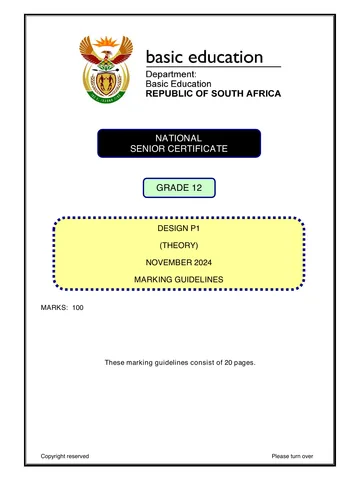
NATIONAL
SENIOR CERTIFICATE
GRADE 12
DESIGN P1
(THEORY)
NOVEMBER 2025
MARKS: 100
TIME: 3 hours
This question paper consists of 15 pages.
This question paper must be printed in full colour.
Copyright reserved Please turn over
You're offline
Skip to contentQuestion paper View all
Design P1 Nov 2025 Eng
Design · Grade 12 · NSC November Exam · 2025. Question paper, 15 pages. Read online or download the PDF.
- Subject
- Design
- Grade
- Grade 12
- Document type
- Question paper
- Year
- 2025
- Exam period
- NSC November Exam
- Paper
- 1
- Pages
- 15
- File size
- 1.8 MB
Loading document…
Loading document…
1 of 15
Document textSearch extracted text and jump to a page.
Design/P1 2 DBE/November 2025
NSC Confidential
INSTRUCTIONS AND INFORMATION
1. This question paper consists of SIX questions.
2. There are THREE choice questions in this question paper. Read the options
carefully.
3. This question paper consists of THREE sections:
SECTION A: Design literacy (30 marks)
QUESTIONS 1 to 3
SECTION B: Design history (30 marks)
QUESTION 4
SECTION C: Design in a sociocultural/environmental and sustainable
context (40 marks)
QUESTIONS 5 and 6
4. Read the requirements of each question carefully.
5. Answer in full sentences and avoid the listing of facts. Do NOT answer in
tabular form.
6. Number the answers correctly according to the numbering system used in this
question paper. Incorrect numbering will NOT be credited.
7. Answer all bullet points required in each question.
8. Do NOT repeat the same facts and examples in different questions.
9. Use the mark allocation to determine the time to be spent on each question.
10. Write neatly and legibly.
Copyright reserved Please turn over
Design/P1 3 DBE/November 2025
NSC Confidential
GLOSSARY 2025
Ubuntu: A value system that includes the essential human virtues such
as compassion, humanity and empathy
Containment bed: A bed frequently used during pandemics or disease outbreaks
that are highly contagious; to isolate infected individuals from
others and curb further spreading of infection
Ebola: An infectious and frequently fatal disease characterised by
fever and severe internal bleeding. Ebola is spread through
contact with the body fluids of an infected individual.
Observation tower: A tall narrow building from which one can observe the
environment
Body shaming: Expressing inappropriate and negative comments about
another person's body, their weight, shape or appearance
Nguni: A collective term for black people historically originating in the
eastern regions of Southern Africa, such as Swaziland,
KwaZulu-Natal and the Eastern Cape
Aluminium: A strong metal alloy used for window frames and functional
objects
Mahogany: A type of wood that is very hard and expensive
Copyright reserved Please turn over
Design/P1 4 DBE/November 2025
NSC Confidential
SECTION A: DESIGN LITERACY
QUESTION 1: 'UNSEEN' EXAMPLES
Answer EITHER QUESTION 1.1 OR QUESTION 1.2.
1.1
FIGURE A: Textile design advert by Thandiwe Muriu (Kenya), 2023.
1.1.1 Analyse the use of the following elements and principles in
FIGURE A above:
• Colour
• Texture
• Unity
• Movement (4 x 2) (8)
1.1.2 Identify the focal point of the textile design advert in FIGURE A and
discuss how it was achieved. (2)
[10]
OR
Copyright reserved Please turn over
Design/P1 5 DBE/November 2025
NSC Confidential
1.2
FIGURE B: Handbag by Erkek Johnature (UK), 2023.
1.2.1 Analyse the use of the following elements and principles in relation
to the handbag design shown in FIGURE B above:
• Line
• Shape
• Variety
• Balance (4 x 2) (8)
1.2.2 Discuss the possible influences for FIGURE B above. (2)
[10]
Copyright reserved Please turn over
Design/P1 6 DBE/November 2025
NSC Confidential
QUESTION 2: COMMUNICATION THROUGH DESIGN
2.1
FIGURE C: Embrace Every Body, End the Shame – Beauty Knows No
Size, designer unknown (USA), 2024.
2.1.1 Identify and discuss the message conveyed by the poster in
FIGURE C above. (2)
2.1.2 Identify and explain ONE possible stereotype or bias evident in the
poster. (2)
Copyright reserved Please turn over
Design/P1 7 DBE/November 2025
NSC Confidential
2.2
FIGURE D: Undercut handmade FIGURE E: Nguni folding chair by
aluminium chair by Groundcover Leather Company
Uriel Schwartz (USA), 2024. (South Africa), 2022.
Write a paragraph in which you compare the chair in FIGURE D with the chair
in FIGURE E.
Refer to the use of the following in your comparison:
• Form
• Aesthetics OR Inspiration
• Ergonomics (3 x 2) (6)
[10]
Copyright reserved Please turn over
Design/P1 8 DBE/November 2025
NSC Confidential
QUESTION 3: ARCHITECTURE
Answer QUESTION 3.1 OR QUESTION 3.2 OR QUESTION 3.3.
3.1 Acropolis
FIGURE F: Classical Tower of the Winds by the Greek astronomer Andronikos
of Cyrrhus (Roman Agora, Athens, Greece), 50 BCE. The tower was used to
indicate wind direction. This tower was also used as a clock. On the outside of the
tower, time was indicated by sundials, but inside the tower a water clock
measured time with water pressure.
FIGURE G: Contemporary Observation Tower Kärven designed by
White Arkitekter (Sweden), 2024.
Copyright reserved Please turn over
Design/P1 9 DBE/November 2025
NSC Confidential
3.1 Write an essay (at least ONE page) in which you compare the Classical Tower
of the Winds in FIGURE F with the contemporary Observation Tower Kärven in
FIGURE G.
Refer to the following in your essay:
• Function
• Materials
• Decoration OR Influence
• Technology
• Significance of location/site (5 x 2) [10]
OR
3.2 Write an essay (at least ONE page) in which you compare any Classical
building/structure with any contemporary building/structure that you have
studied.
Refer to the following in your essay:
• Function
• Materials
• Decoration OR Influence
• Technology
• Significance of location/site (5 x 2) [10]
OR
3.3 Write an essay (at least ONE page) in which you compare any Classical
building/structure with any Indigenous Knowledge Systems building/structure
that you have studied.
Refer to the following in your essay:
• Function
• Materials
• Decoration OR Influence
• Technology
• Significance of location/site (5 x 2) [10]
TOTAL SECTION A: 30
Copyright reserved Please turn over
Design/P1 10 DBE/November 2025
NSC Confidential
SECTION B: DESIGN HISTORY
QUESTION 4
4.1 Study the images below and answer the question on the next page.
Art Nouveau Art Deco
De Stijl Pop
Modernism Scandinavian
Bauhaus Decontructivism
Copyright reserved Please turn over
Design/P1 11 DBE/November 2025
NSC Confidential
'If you don't like the way the world is, you change it … one step at a
time.'
– Marian Wright Edelman
Choose any TWO of the movements/styles from the list below, represented by
the images on the previous page, and explain how the design movements/
styles changed the world.
• Art Nouveau
• De Stijl
• Bauhaus
• Art Deco
• Modernism
• Pop design
• Scandinavian
• Deconstructivism
Write TWO separate essays (at least ONE page each) in which you refer to the
following:
• Discuss the statement above with reference to the movement/style you
have chosen. (2 marks)
• Explain the aims, influences and characteristics of the design movement.
(5 marks)
• Name a design and the designer/design group. (1 mark)
• Include a discussion of the chosen design. (2 marks)
(2 x 10) [20]
Copyright reserved Please turn over
Design/P1 12 DBE/November 2025
NSC Confidential
4.2
FIGURE H: Arts and Craft mahogany bookcase by
Wylie and Lockhead (UK), 1900s.
FIGURE I: Postmodernism Carlton bookcase by
Ettore Sottsass Memphis Group (USA), 1981.
Write an essay (at least ONE page) in which you compare the bookcases in
FIGURE H and FIGURE I above and explain how they are typical of the design
movements they represent.
Refer to the following to support your answer:
• Inspiration
• Colour
• Balance
• Aims of the movement reflected in the bookcases
• Fitness for purpose/function (5 x 2) [10]
TOTAL SECTION B: 30
Copyright reserved Please turn over
Design/P1 13 DBE/November 2025
NSC Confidential
SECTION C: DESIGN IN A SOCIOCULTURAL/ENVIRONMENTAL AND SUSTAINABLE
CONTEXT
QUESTION 5
Answer EITHER QUESTION 5.1 OR QUESTION 5.2.
5.1
FIGURE J: Ubuntu containment bed by Ilteris Ilbasan (Türkiye), 2022.
The Ubuntu containment bed is affordable, easy to assemble and used during
an Ebola (deadly virus) outbreak. Ebola requires emergency medical care.
5.1.1 Discuss the sociocultural benefits of the design in FIGURE J above. (2)
5.1.2 Name ONE other example of a sociocultural design solution besides
FIGURE J. Explain how this design solution improves the lives of
human beings. (2)
5.1.3 Write TWO separate essays (at least ONE page each) in which you
discuss the work of ONE South African contemporary designer/
design group AND ONE international contemporary designer/design
group who address sociocultural issues in their work.
Refer to the following in your essay:
• Name of the designer/design group and ONE design product
(1 mark)
• Discussion of the aims, design materials and techniques used
by the designer/design group (5 marks)
• An explanation of how this design addresses sociocultural
issues (2 marks)
You may NOT refer to any designer(s)/design group(s) that you
discussed previously or design examples used in this question
paper. (8 x 2) (16)
[20]
OR
Copyright reserved Please turn over
Design/P1 14 DBE/November 2025
NSC Confidential
5.2
FIGURE K: Armchairs by Andile Dyalvane (South Africa), 2021.
5.2.1 Identify and discuss the influence of traditional community craft
techniques evident in FIGURE K above. (2)
5.2.2 Write an essay (at least ONE page) on ONE indigenous traditional
craft that you have studied this year.
Refer to the following in your essay:
• Name of the indigenous cultural community that produced the
traditional craft (1 mark)
• The materials, methods and processes used to create the
traditional craft (5 marks)
• The social value and function of the craft (2 marks) (8)
5.2.3 Write an essay (at least ONE page) in which you discuss the work
of ONE South African/African contemporary designer/design group
whose designs are inspired by or make use of any indigenous
South African/African craft techniques and/or materials.
Refer to the following in your essay:
• Name of the design/design group and ONE contemporary
design product (1 mark)
• Discussion of the aims, influences and materials of the designer/
design group (6 marks)
• Explanation of how the contemporary design product is an
adaptation and continuation of the indigenous craft technique
(3 marks) (10)
[20]
Copyright reserved Please turn over
Design/P1 15 DBE/November 2025
NSC Confidential
QUESTION 6
6.1
FIGURE L: From Africa with Love pendant light by Heath Nash
(South Africa), 2013.
6.1.1 Define the term eco-friendly by referring to FIGURE L above. (2)
6.1.2 Discuss TWO other methods of making products that are
eco-friendly besides FIGURE L. (Do NOT refer to design examples
in this question paper.) (2)
6.2 Write TWO separate essays (at least ONE page each) in which you discuss
the work of ONE South African contemporary designer/design group AND ONE
international contemporary designer/design group whose work addresses
sustainable/environmental issues.
Refer to the following in your essays:
• Name of the designer/design group and ONE of their designs (1 mark)
• Aims, materials and processes (5 marks)
• A discussion of the design product and an explanation of how it addresses
sustainable/environmental concerns (2 marks)
You may NOT refer to any designer(s)/design group(s) that you have discussed
previously or design examples used in this question paper. (8 x 2) (16)
[20]
TOTAL SECTION C: 40
GRAND TOTAL: 100
Copyright reserved
Recommended for this subject
Published documents with matching subject and grade metadata.
Related documents
Matched using subject, grade, language, document type and exam metadata.
--5cf24f22-37cf-4c83-99d1-522c23cb4496/v1-d115bc5f6aec2e1521e3/card.webp)
More from Grade 12 Design
Explore more published documents in this catalogue.