
Downloaded from hlayiso.com
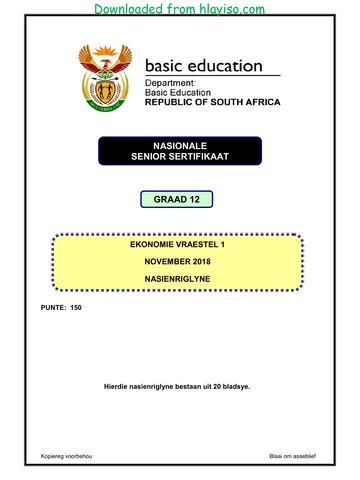
NATIONAL
SENIOR CERTIFICATE
GRADE 12
ECONOMICS
ECONOMICS
PAPER
P1 1
MACROECONOMICS & ECONOMIC PURSUITS
NOVEMBER 2018
MARCH 2016
MARKS: 150
TIME: 2 hours
This question paper consists of 12 pages.
Copyright reserved Please turn over
You're offline
Skip to contentQuestion paper 
View all%20June%202025%20Possible%20Answers--3df8bb66-2d0a-4b1b-89bf-509b303bfa3e/v1-45abc04fbe038cfc315d/card.webp)
Economics P1 Nov 2018 Eng_hlayiso.com_.pdf
Economics · Grade 12 · NSC November Exam · 2018. Question paper, 12 pages. Read online or download the PDF.
- Subject
- Economics
- Grade
- Grade 12
- Document type
- Question paper
- Year
- 2018
- Exam period
- NSC November Exam
- Paper
- 1
- Pages
- 12
- File size
- 567.3 KB
Loading document…
Loading document…
1 of 12
Document textSearch extracted text and jump to a page.
Downloaded from hlayiso.com
Economics/P1 2 DBE/November 2018
NSC
INSTRUCTIONS AND INFORMATION
1. Answer FOUR questions as follows in the ANSWER BOOK:
SECTION A: COMPULSORY
SECTION B: Answer TWO of the three questions.
SECTION C: Answer ONE of the two questions.
2. Answer only the required number of questions. Answers in excess of the
required number will NOT be marked.
3. Number the answers correctly according to the numbering system used in this
question paper.
4. Write the question number above each answer.
5. Read the questions carefully.
6. Start EACH question on a NEW page.
7. Leave 2–3 lines between subsections of questions.
8. Answer the questions in full sentences and ensure that the format, content
and context of your responses comply with the cognitive requirements of the
questions.
9. Use only black or blue ink.
10. You may use a non-programmable pocket calculator.
11. Write neatly and legibly.
Copyright reserved Please turn over
Downloaded from hlayiso.com
Economics/P1 3 DBE/November 2018
NSC
SECTION A (COMPULSORY)
QUESTION 1 30 MARKS – 20 MINUTES
1.1 Various options are provided as possible answers to the following questions.
Choose the answer and write only the letter (A–D) next to the question
numbers (1.1.1 to 1.1.8) in the ANSWER BOOK, e.g. 1.1.9 D.
1.1.1 An open economy is best described as a … sector economy.
A one
B two
C three
D four
1.1.2 Investment is an example of a/an ... in the circular flow model.
A leakage
B injection
C withdrawal
D loss
1.1.3 Fiscal policy is an action taken by government in respect of
taxation and ... to influence economic activity.
A exchange control
B money supply
C expenditure
D credit control
1.1.4 Economies of scale are associated with …
A mass production.
B limited output.
C long-term average cost increases.
D increased wastage.
1.1.5 Production by the citizens of a country, locally and abroad, is called
the … product.
A gross national
B gross domestic
C net national
D net domestic
1.1.6 A physically enclosed area next to a harbour or airport where
production for exports is encouraged through incentives, is known
as the …
A spatial development initiatives.
B industrial development zone.
C special economic zone.
D foreign investment grant.
Copyright reserved Please turn over
Downloaded from hlayiso.com
Economics/P1 4 DBE/November 2018
NSC
1.1.7 The comparison of a country's export prices with import prices by
means of indexes is referred to as the …
A exchange rate.
B conditions of trade.
C terms of trade.
D inflation rate.
1.1.8 Economic development is measured in terms of the …
A per capita gross domestic product.
B increase in the productive capacity.
C nominal gross domestic product.
D money supply. (8 x 2) (16)
1.2 Choose a description from COLUMN B that matches the item in COLUMN A.
Write only the letter (A–I) next to the question numbers (1.2.1 to 1.2.8) in the
ANSWER BOOK.
COLUMN A COLUMN B
1.2.1 Nationalisation A number of years a person will live after birth
1.2.2 Medium-term B persuasion of banks by the South African
expenditure Reserve Bank (SARB)
framework
C indicator used to measure the change in the
1.2.3 System of national price of goods produced locally when it
accounts leaves the factory floor
1.2.4 Money flows D measures income inequality and wealth
1.2.5 Protectionism E movement of income and expenditure
between participants in the economy
1.2.6 Gini coefficient
F shows income and expenditure estimates
1.2.7 Life expectancy for a three-year period
1.2.8 Production price G prescribed by the United Nations to compile
index gross domestic product figures
H trade policy that tries to keep the domestic
economy safe by restricting the import of
goods and services
I transfer of functions and ownership of
entities from the private to the public sector
(8 x 1) (8)
Copyright reserved Please turn over
Downloaded from hlayiso.com
Economics/P1 5 DBE/November 2018
NSC
1.3 Give ONE term for EACH of the following descriptions. Write only the term
next to the question numbers (1.3.1 to 1.3.6) in the ANSWER BOOK.
Abbreviations, acronyms and examples will NOT be accepted.
1.3.1 A systematic record of all trade and financial transactions between
one country and other countries for a particular period of time
1.3.2 Money paid by the government to a person/institution without any
counterperformance
1.3.3 When a product is sold on a foreign market at a price that is lower
than the cost of production in the country of origin
1.3.4 Increase in the productive capacity of a country
1.3.5 The rate at which commercial banks borrow money from the South
African Reserve Bank
1.3.6 The policy that aims to stabilise prices by combating
inflation (6 x 1) (6)
TOTAL SECTION A: 30
Copyright reserved Please turn over
Downloaded from hlayiso.com
Economics/P1 6 DBE/November 2018
NSC
SECTION B
Answer any TWO of the three questions in this section in the ANSWER BOOK.
QUESTION 2: MACROECONOMICS 40 MARKS – 30 MINUTES
2.1 Answer the following questions.
2.1.1 Name the TWO financial markets in the circular-flow model. (2 x 1) (2)
2.1.2 What effect will a decrease in income levels have on international
trade? (1 x 2) (2)
2.2 Study the graph below and answer the questions that follow.
EXCHANGE RATES – THE RAND IS AT THE MERCY OF THE MARKET
D1 S
D
Price of US dollar in rand
R14
R13
D1
S D
Q1 Q2
Quantity of US dollars
2.2.1 Identify the exchange rate system in the graph above. (1)
2.2.2 What was the original rand/dollar exchange rate before the
demand for US dollars increased? (1)
2.2.3 Briefly describe the term exchange rate. (2)
2.2.4 How has the increased demand for US dollars affected the value of
the rand? (2)
2.2.5 What could the South African Reserve bank do to strengthen the
value of the rand against the dollar? (2 x 2) (4)
Copyright reserved Please turn over
Downloaded from hlayiso.com
Economics/P1 7 DBE/November 2018
NSC
2.3 Study the table below and answer the questions that follow.
NATIONAL ACCOUNT AGGREGATES – SOUTH AFRICA
SUMMARY OF GROSS DOMESTIC PRODUCT R million
(AT CURRENT PRICES) 2016
Compensation of employees 2 051 326
Net operating surplus 1 130 210
Consumption of fixed capital 613 605
Gross value added at factor cost 3 795 141
Other taxes on production 86 008
Other subsidies on production 9 935
Gross value added at basic prices 3 871 214
Taxes on products 484 059
Subsidies on products 16 415
Gross domestic product at market prices (A)?
[Source: Quarterly Bulletin SARB, June 2017]
2.3.1 Identify the factor of production in the table above that receives the
biggest portion of the national income. (1)
2.3.2 Which method was used to calculate the figures above? (1)
2.3.3 Briefly describe the term basic prices. (2)
2.3.4 Briefly explain how subsidies can influence production. (2)
2.3.5 Calculate the gross domestic product at market prices (A).
Show ALL calculations. (4)
2.4 Briefly discuss pricing policy and parastatals as problems of public sector
provisioning. (2 x 4) (8)
2.5 Calculate the change in aggregate income if there is an injection of R20 billion
into the economy with a marginal propensity to save of 0,3. Show how the
multiplier effect could influence the government to create more jobs.
Show ALL calculations. (8)
[40]
Copyright reserved Please turn over
Downloaded from hlayiso.com
Economics/P1 8 DBE/November 2018
NSC
QUESTION 3: ECONOMIC PURSUITS 40 MARKS – 30 MINUTES
3.1 Answer the following questions.
3.1.1 Name any TWO redress policies that South Africa has used since
1994. (2 x 1) (2)
3.1.2 What effect will increased urbanisation have on the economy?
(1 x 2) (2)
3.2 Study the cartoon below and answer the questions that follow.
NORTH-SOUTH DIVIDE
I wish I could
process everything
before I export …
NORTH
SOUTH
Exporting most of the agricultural
produce in their natural form is
not beneficial to a country.
[Adapted from www.wikipedia, 2016]
3.2.1 Name any ONE agricultural product exported to countries in the
north. (1)
3.2.2 Give any reason for the poor economic conditions of the countries
in the south. (1)
3.2.3 Briefly describe the term North-South divide. (2)
3.2.4 Explain standards of living of countries in the Northern
Hemisphere. (2)
3.2.5 What positive impact will globalisation have on the North-South
divide? (2 x 2) (4)
Copyright reserved Please turn over
Downloaded from hlayiso.com
Economics/P1 9 DBE/November 2018
NSC
3.3 Study the extract below and answer the questions that follow.
SMALL BUSINESS DEVELOPMENT IN SOUTH AFRICA
Small, medium and microenterprises are the engines of growth in
South Africa, and contribute between 52% and 57% of the GDP. It provides
60% of all jobs, compared to the corporate and public sectors combined. The
government provides training, employment subsidies and financing to
SMMEs.
[Adapted from Stats SA Quarterly Labour Force Survey, 2016]
3.3.1 What positive effect could small business development have on
markets? (1)
3.3.2 Why is it important that the government provides financial aid to
SMMEs? (1)
3.3.3 Briefly describe the term economically active population. (2)
3.3.4 Briefly explain how the Department of Trade and Industry (DTI)
supports small business development in South Africa. (2)
3.3.5 How can the establishment of more SMMEs be promoted in
South Africa? (2 x 2) (4)
3.4 How can the Critical Infrastructure Programme (CIP) and the
Foreign Investment Grant (FIG) improve industrial development in South
Africa? (2 x 4) (8)
3.5 Evaluate the potential success of special economic zones in South Africa. (8)
[40]
Copyright reserved Please turn over
Downloaded from hlayiso.com
Economics/P1 10 DBE/November 2018
NSC
QUESTION 4: MACROECONOMICS AND ECONOMIC PURSUITS
40 MARKS – 30 MINUTES
4.1 Answer the following questions.
4.1.1 Give any TWO examples of production indicators. (2 x 1) (2)
4.1.2 Why do developed countries favour the idea of free trade?
(1 x 2) (2)
4.2 Study the graph below and answer the questions that follow.
(bn)
R200
R175
R150
Tax revenue R100
0 10 20 45 65 100
Tax rate %
4.2.1 Identify the curve in the graph above. (1)
4.2.2 At what tax rate will government revenue be maximised? (1)
4.2.3 How much revenue will the government receive if the tax rate
is 100%? (2)
4.2.4 What effect will a decrease in the tax rate from 65% to 45% have
on tax revenue? (2)
4.2.5 What consequences could a 1% VAT increase have on the
different role players in the South African economy? (2 x 2) (4)
Copyright reserved Please turn over
Downloaded from hlayiso.com
Economics/P1 11 DBE/November 2018
NSC
4.3 Study the bar graph below and answer the questions that follow.
GROSS DOMESTIC PRODUCT – AN ECONOMIC INDICATOR
HOW DID SOUTH AFRICAN INDUSTRIES PERFORM IN THE
FIRST QUARTER OF 2017?
Industry growth in the first quarter of 2017, compared to the
first quarter of 2016*
Agriculture
Mining
Personal services
Government
Finance
Construction
Transport
Manufacturing
Electricity
Trade
*Seasonally adjusted and annualised
[Adapted from Stats SA GDP, 2017]
4.3.1 Which figure indicates that the GDP growth rate was not
satisfactory? (1)
4.3.2 Identify the sector that contributed least to the GDP above. (1)
4.3.3 Give a reason why trade performed so poorly in respect of the
total GDP. (2)
4.3.4 Why are only real GDP figures used to compare economic
production that occurred in different years? (2)
4.3.5 What can the South African government do to ensure a better
economic growth performance? (2 x 2) (4)
4.4 Briefly discuss health as a social indicator. (4 x 2) (8)
4.5 How can developing countries ensure the survival of labour-intensive
industries in a global economy? (8)
[40]
TOTAL SECTION B: 80
Copyright reserved Please turn over
Downloaded from hlayiso.com
Economics/P1 12 DBE/November 2018
NSC
SECTION C
Answer any ONE of the two questions in this section in the ANSWER BOOK.
Ensure that your answer follows the structure indicated below in order to obtain
maximum marks:
MARK
STRUCTURE OF ESSAY
ALLOCATION
Introduction
The introduction is a lower-order response. Max. 2
• A good starting point would be to define the main concept related to the
question topic.
• Do not include any part of the question in your introduction.
• Do not repeat any part of the introduction in the body.
• Avoid mentioning in the introduction what you are going to discuss in the
body.
Body
Main part: Discuss in detail/In-depth discussion/Examine/Critically discuss/ Max. 26
Analyse/Compare/Evaluate/Distinguish/Differentiate/Explain
Additional part: Give own opinion/Critically discuss/Evaluate/Critically evaluate/
Draw a graph and explain/Use the graph given and explain/Complete the given Max. 10
graph/Calculate/Deduce/Compare/Explain/Distinguish/Interpret/Briefly debate/
How/Suggest
Conclusion
Any higher-order conclusion should include: Max. 2
• A brief summary of what has been discussed without repeating facts already
mentioned
• Any opinion or value judgement on the facts discussed
• Additional support information to strengthen the discussion/analysis
• A contradictory viewpoint with motivation, if required
• Recommendations
TOTAL 40
QUESTION 5: MACROECONOMICS 40 MARKS – 40 MINUTES
• Discuss ALL the features underpinning the forecasting of business cycles,
excluding the economic indicators. (26 marks)
• Why is price stability important to prevent extreme fluctuations in business cycles?
(10 marks) [40]
QUESTION 6: ECONOMIC PURSUITS 40 MARKS – 40 MINUTES
• Discuss the demand-side approach in promoting economic growth. (26 marks)
• Evaluate the success of the expanded public works programme to reduce poverty
and unemployment. (10 marks) [40]
TOTAL SECTION C: 40
GRAND TOTAL: 150
Copyright reserved
Recommended for this subject
Published documents with matching subject and grade metadata.
Question paper
ECONOMICS P2 GR12 QP JCT 2025 AFR D_watermark.pdf
Question paper
Economics-Grade-12-NSC-P1-QP-September-2025-Free-State.pdf
Question paper
Economics P1 May-June 2025 Afr.pdf
Question paper
Economics P2 May-June 2025 Afr.pdf
Question paper
ECONOMICS QP.P1 GR 12 JUNE 2024 (Backup papers)_hlayiso.com_.pdf
Question paper
ECONOMICS P1 GR12 QP JUNE 2024_Afrikaans_hlayiso.com_.pdf
Related documents
Matched using subject, grade, language, document type and exam metadata.
Memorandum
Economics P1 Nov 2018 FINAL Memo Afr_hlayiso.com_._hlayiso.com_.pdf
Question paper
Economics P2 Nov 2018 Eng_hlayiso.com_.pdf
Question paper
ECON P1 GR12 QP SEPT 2018 Eng D2_hlayiso.com_.pdf
Question paper
ECON P1 GR12 QP SEPT 2018 Eng D_hlayiso.com_.pdf
Question paper
ECON P1 GR12 QP SEPT 2018 English_hlayiso.com_.pdf
Question paper
Economics P1 Nov 2023 Eng_hlayiso.com_.pdf
More from Grade 12 Economics
Explore more published documents in this catalogue.
Memorandum
Economics P2 Memo Afr_watermark.pdf
Memorandum
Economics P2 (English) June 2025 Possible Answers.pdf
Memorandum
Economics-Grade-12-NSC-P2-MEMO-September-2025-KZN.pdf
Memorandum
Economics-Grade-12-NSC-P1-MEMO-Pre-June-2025-Limpopo.pdf
Memorandum
Economics P2 May-June 2025 MG Afr.pdf
Memorandum