
Mock
hlayiso mock exams
Practice Series:
Grade 10 Exam Preparation
WWW.HLAYISO.COM
NATIONAL
SENIOR CERTIFICATE
GRADE 10
PHYSICAL SCIENCES: CHEMISTRY (P2)
NOVEMBER EXAMINATION 2026 (MOCK)
MARKING GUIDELINES
MARKS: 100
These marking guidelines consist of 9 pages.
Copyright reserved Please turn over
Skip to contentAll 2026 papers 
View all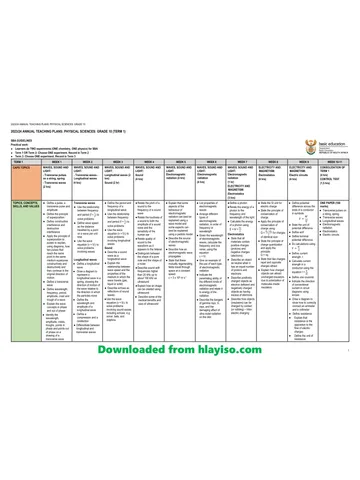
Physical Sciences Grade 10 P2 November Mock Exam 2 2026 Memo
Grade 10 Physical Sciences Paper 2 memorandum from the November Mock Exam 2 2026 (English), 9 pages. Read online or download the free PDF.
Physical Sciences · Grade 10 · November Mock Exam 2 · 2026 · English. Memorandum, 9 pages. Read online or download the PDF.
- Subject
- Physical Sciences
- Grade
- Grade 10
- Language
- English
- Document type
- Memorandum
- Year
- 2026
- Exam period
- November Mock Exam 2
- Paper
- 2
- Publisher
- Hlayiso
- Curriculum
- CAPS
- Pages
- 9
- File size
- 150.7 KB
Free to read online, no sign-up needed
Loading document…
Loading document…
1 of 9
This exam
November Mock Exam 2 2026
- Paper 1Question paperMemo
- Paper 2Question paperMemo
Document textSearch extracted text and jump to a page.
Physical Sciences/P2 2 Hlayiso/Mock 2026
NSC – Marking Guidelines
GENERAL MARKING GUIDELINES
1. Calculations: Marks are awarded for the correct formula, correct substitution and the
correct final answer WITH the correct unit, as indicated by the ticks (✓). If an incorrect
formula is used, no further marks are awarded for that calculation.
2. Units: Penalise an omitted or incorrect unit in a final answer only ONCE per question.
3. Rounding: Accept final answers rounded to a minimum of TWO decimal places.
4. Positive marking: Where an incorrect answer to a previous question is used correctly
in a later calculation, the later calculation is marked positively.
5. Equations: Reactants ✓, products ✓, balancing ✓ (the balancing mark requires correct
phases where phases are asked for), unless otherwise indicated.
6. Definitions: Where key words are underlined, deduct 1 mark for EACH key word or
phrase omitted or used in an incorrect context.
7. Names and formulae: If a FORMULA is asked for, a name is not accepted, and
vice versa. If a LETTER is asked for, accept the correct name/formula only if it is
unambiguous.
Copyright reserved Please turn over
Physical Sciences/P2 3 Hlayiso/Mock 2026
NSC – Marking Guidelines
QUESTION 1
1.1 C ✓✓ (2)
1.2 A ✓✓ (2)
1.3 B ✓✓ (2)
1.4 D ✓✓ (2)
1.5 C ✓✓ (2)
1.6 C ✓✓ (2)
1.7 A ✓✓ (2)
1.8 B ✓✓ (2)
[16]
Notes for teachers: 1.2 – P has the lowest boiling point (hydrogen), so the least energy is needed to
overcome the forces between its particles. 1.6 – total moles of atoms: A 1; B 0,5 × 4 = 2; C 0,4 × 8 = 3,2;
D 1,5 × 2 = 3. 1.7 – V(NH3 ) = 23 × 30 = 20 cm3 (volume ratio = mole ratio). 1.8 – n = cV = 0,25 × 0,2 = 0,05
mol; m = nM = 0,05 × 40 = 2 g.
QUESTION 2
2.1 A pure substance consisting of one type of atom (that cannot be broken down
into simpler substances by chemical means). ✓✓ (2)
2.2.1 C✓ (1)
2.2.2 D✓ (1)
2.2.3 B✓ (1)
2.3 Steel (metal) is a GOOD conductor of heat, so heat is transferred quickly to
the food. ✓
Plastic/wood is a POOR conductor of heat (thermal insulator), so the handle
stays cool enough to hold. ✓
Accept for steel: high melting point / strong / does not rust / malleable (does not melt on
the stove). Accept for plastic/wood: poor conductor of heat (thermal insulator) ONLY,
since that is the reason the handle is safe to hold. (2)
2.4.1 Cu(OH)2 ✓✓ (Cu2+ and OH– ✓; correct ratio with brackets ✓) (2)
2.4.2 Potassium permanganate ✓ (1)
[10]
Copyright reserved Please turn over
Physical Sciences/P2 4 Hlayiso/Mock 2026
NSC – Marking Guidelines
QUESTION 3
3.1 The temperature at which a liquid changes to a solid (at a given pressure). ✓✓
Accept: the temperature at which the solid and liquid phases of a substance are in
equilibrium. (2)
3.2 69 ◦ C ✓ (1)
3.3 Energy is released as the particles move closer together and forces of
attraction between the particles form / become stronger (potential energy
decreases). ✓
The average KINETIC energy of the particles remains constant. ✓
Temperature is a measure of the average kinetic energy of the particles, so the
temperature remains constant. ✓ (3)
3.4 Solid ✓ (1)
3.5 Beaker 2 ✓
At the higher temperature the water particles (and permanganate particles)
have a HIGHER average kinetic energy. ✓
The particles move faster, so the permanganate particles spread out (diffuse)
through the water faster. ✓ (3)
[10]
Copyright reserved Please turn over
Physical Sciences/P2 5 Hlayiso/Mock 2026
NSC – Marking Guidelines
QUESTION 4
4.1.1 The mass of a particle on a scale where an atom of carbon-12 has a mass of
12. ✓✓ (2)
4.1.2 36 ✓ (65 – 29) (1)
4.1.3 Let the percentage of copper-63 be x; then copper-65 is (100 – x). ✓
63x + 65(100 – x)
Ar = ✓
100
63x + 65(100 – x)
63,5 = ✓
100
6 350 = 6 500 – 2x x = 75% ✓
Accept any correct method, e.g. using fractions x and (1 – x): 63x + 65(1 – x) = 63,5,
x = 0,75. (4)
4.2
2p
2s
1s
Marking criteria
1s and 2s orbitals each with a pair of electrons with opposite spins ✓
THREE 2p orbitals, each with ONE electron (Hund’s rule), arrows in the same
direction ✓ (2)
4.3.1 18 ✓ (1)
4.3.2 16 ✓ (1)
[11]
Copyright reserved Please turn over
Physical Sciences/P2 6 Hlayiso/Mock 2026
NSC – Marking Guidelines
QUESTION 5
5.1 The first ionisation energy INCREASES (generally) from sodium to argon /
across the period. ✓ (1)
5.2 From Na to Ar the number of protons / nuclear charge INCREASES. ✓
The valence electrons are in the SAME energy level (3), so the atomic radius
DECREASES. ✓
The attraction between the nucleus and the valence electrons INCREASES,
so MORE energy is needed to remove an electron. ✓ (3)
5.3 Mg: 1s2 2s2 2p6 3s2 ; Aℓ: 1s2 2s2 2p6 3s2 3p1 ✓
The electron removed from aluminium is in the 3p sub-level, which has a
HIGHER energy than the 3s sub-level (it is further from the nucleus). ✓
The 3p electron is therefore LESS strongly attracted by the nucleus, so LESS
energy is needed to remove it. ✓
Accept for the 2nd mark: the 3p electron is in a higher-energy sub-level / is further
from the nucleus. Reference to shielding by the 3s electrons may be credited but is
NOT required.
Both configurations must be correct for the first mark. Accept [Ne] 3s2 and [Ne] 3s2 3p1 . (3)
5.4 Sodium ✓ (1)
[8]
Copyright reserved Please turn over
Physical Sciences/P2 7 Hlayiso/Mock 2026
NSC – Marking Guidelines
QUESTION 6
6.1 The transfer of electrons (from a metal to a non-metal) to form oppositely
charged ions that attract each other (electrostatically). ✓✓ (2)
6.2.1
H× N ×H
×
H
Marking criteria
Three N–H bonding pairs ✓
ONE lone pair on N ✓
(2)
6.2.2
2–
Na +
× O + × Na [Na]+ × O× [Na]+
OR: 2[Na]+ [O]2– with 8 electrons shown around O.
Marking criteria
Lewis diagrams of TWO Na atoms (1 valence electron each) and O (6 valence
electrons) ✓
Transfer of electrons shown: TWO Na+ ions with charges ✓
O2– ion with 8 electrons, brackets and charge ✓
(3)
6.3 (a) Metallic ✓ (b) Covalent ✓ (c) Ionic ✓ (3)
6.4 Mg3 N2 ✓ Ionic ✓ (2)
[12]
Copyright reserved Please turn over
Physical Sciences/P2 8 Hlayiso/Mock 2026
NSC – Marking Guidelines
QUESTION 7
7.1.1 Decomposition ✓ (1)
7.1.2 Chemical ✓
NEW substances (CuO and CO2 ) with different properties are formed / bonds
are broken and new bonds are formed. ✓
Accept: a new black substance and a gas are formed. A colour change ALONE is not
accepted. (2)
7.2.1 C3 H8 (g) + 5O2 (g) → 3CO2 (g) + 4H2 O(g)
Marking criteria
Reactants ✓ Products ✓ Balancing and phases ✓
Accept H2 O(ℓ). Phases are required for the third mark.
(3)
7.2.2 Mass of reactants = 1(44) + 5(32) = 44 + 160 = 204 g ✓
Mass of products = 3(44) + 4(18) = 132 + 72 = 204 g ✓
Mass of reactants = mass of products, therefore mass is conserved. ✓
POSITIVE MARKING FROM 7.2.1 if the equation used is balanced. (3)
7.3
C H O
Mass in 100 g 62,1 g 10,3 g 27,6 g
m 62,1 10,3 27,6
n= = 5,18 = 10,3 = 1,73
M 12 1 16
Ratio 3 6 1
Dividing by the moles in 100 g (any one correct) ✓ all three n correct ✓
simplest ratio 3 : 6 : 1 ✓
Empirical formula: C3 H6 O (M = 58 g·mol–1 )
116
=2✓
58
Molecular formula: C6 H12 O2 ✓
Accept the ratio method directly from masses. POSITIVE MARKING from an incorrect
empirical formula. (5)
[14]
Copyright reserved Please turn over
Physical Sciences/P2 9 Hlayiso/Mock 2026
NSC – Marking Guidelines
QUESTION 8
8.1.1 M(NaHCO3 ) = 23 + 1 + 12 + 3(16) = 84 g·mol–1
m 8,4
n= ✓ = ✓
M 84
n = 0,1 mol ✓ (3)
8.1.2 n(Na2 CO3 ) = 12 n(NaHCO3 ) = 0,05 mol (mol ratio 2 : 1) ✓
m = nM = 0,05 × 10⁶ ✓
m = 5,3 g ✓
POSITIVE MARKING FROM 8.1.1. (3)
8.1.3 n(CO2 ) = 21 n(NaHCO3 ) = 0,05 mol ✓
V V
n= 0,05 = ✓
Vm 22,4
V = 1,12 dm3 ✓
POSITIVE MARKING FROM 8.1.1. (3)
8.1.4 n(H2 O) = 21 n(NaHCO3 ) = 12 (0,1) = 0,05 mol ✓
m = nM = 0,05 × 18 ✓
m = 0,9 g ✓
POSITIVE MARKING FROM 8.1.1. (3)
n n
8.2.1 c= 0,1 = ✓ n = 0,025 mol ✓
V 0,25
m 7,15
M= = = 286 g·mol–1 ✓
n 0,025
106 + 18x = 286 ✓
x = 10 ✓
m 7,15
OR: c = : 0,1 = ✓✓; M = 286 g·mol–1 ✓; 106 + 18x = 286 ✓; x = 10 ✓
MV M(0,25) (5)
10(18)
8.2.2 % H2 O = × 100 ✓
286
= 62,94% ✓
POSITIVE MARKING FROM 8.2.1. (2)
[19]
TOTAL: 100
Copyright reserved
Study this subject
Recommended for this subject
Question paper
Physical Sciences Grade 10 P2 Gauteng June 2024 QP (Eng)
Question paper
Physical Sciences Grade 10 P2 North West November 2024 QP
Question paper
Physical Sciences Grade 10 P2 Gauteng November 2020 QP (Eng)
Question paper
Physical Sciences Grade 10 P2 2020 QP (Eng)
Question paper
Physical Sciences Grade 10 P2 2019 QP (Eng)
Question paper
Physical Sciences Grade 10 P2 Gauteng June 2018 QP (Eng)
More from Grade 10 Physical Sciences
Annual teaching plan
Gr 10 Phys Sci ATP 2023 24
Question paper and memo
Physical Sciences Grade 10 Eastern Cape June 2025 QP & Memo
Question paper
Physical Sciences Grade 10 Eastern Cape March Test 2025 QP
Question paper and memo
Physical Sciences Grade 10 Free State June 2025 Paper & Memo
Question paper and memo
Physical Sciences Grade 10 P1 KZN November 2025 Paper & Memo
Question paper and memo